Invest KC and Korund-Cian: a real plant, heavy debt and 29.7% in dollars
Invest KC owns Korund-Cian JSC of Dzerzhinsk, the largest producer of sodium cyanide in Russia and the CIS. Sodium cyanide is the reagent gold miners use to extract gold from ore; there is no commercial alternative to it in the industry. The group has one exchange-traded issue, 001R-01 (RU000A10BQV8): par value USD 100, a 12% annual coupon paid monthly, maturity on 19 June 2028, no put options and no amortisation. The issue is available to non-qualified investors after passing a test, on the second listing level.
The issuer's card with metrics and charts – frontier.eninvs.com/issuer/9703017043. This review was prepared following a [request from the channel's chat](https://t.me/eninvscomments/30783) of 9 September 2026. We calculate from the group's consolidated IFRS statements for 2025 and for 6 months of 2026, the issuer's own statements and disclosure data.
In short: there is nothing to pay with, and everything rests on the lending bank
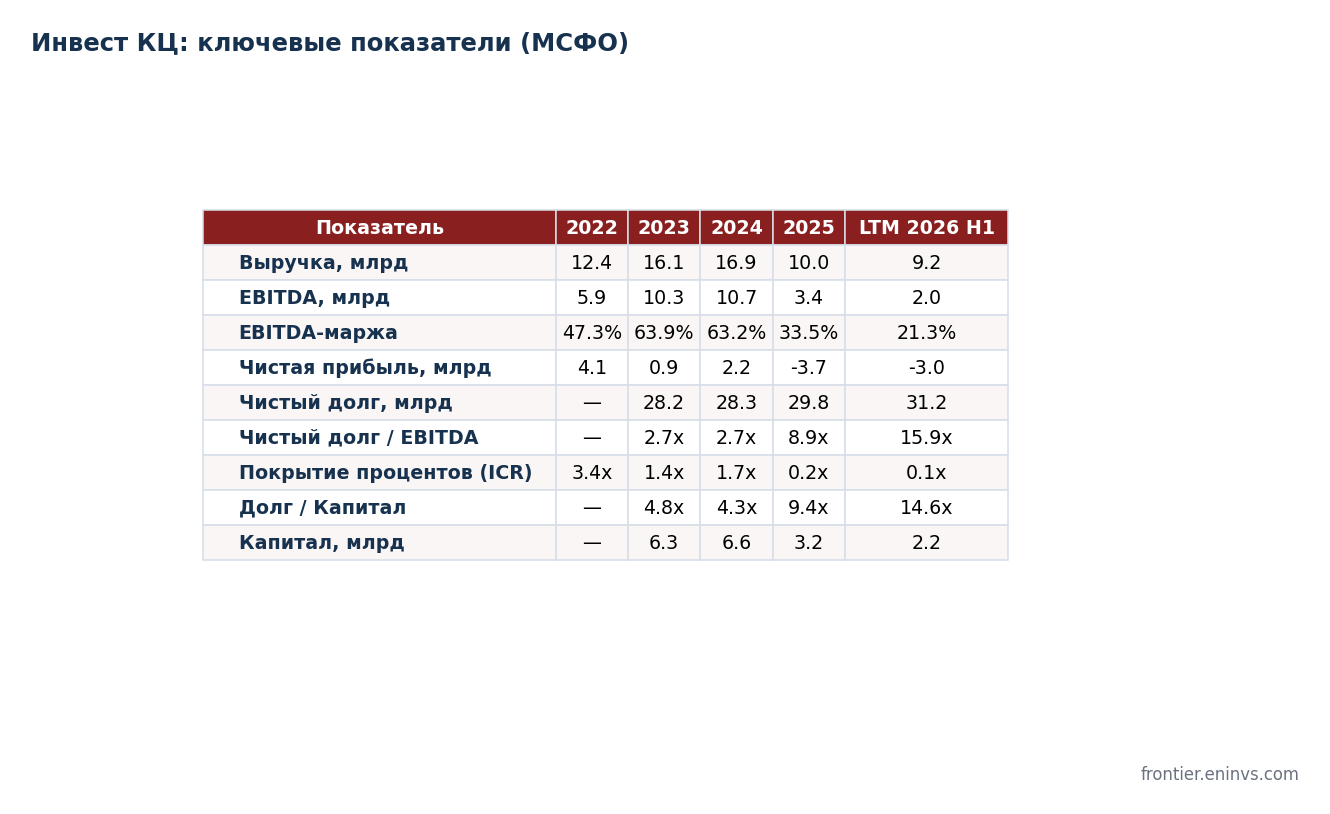
Authors' estimate. Over the last 12 months (July 2025 – June 2026) the group earned RUB 3.7bn of EBITDA and accrued RUB 5.6bn of interest. Operating cash flow after interest has been negative for the second reporting period in a row. Cash in accounts is RUB 176mn, and free limits across all five credit lines total RUB 116mn. Net debt is RUB 31.2bn against equity of RUB 2.2bn, of which RUB 5.1bn comes from revaluation of fixed assets, while the accumulated loss is already minus RUB 4.5bn.
Fact. The leverage covenant (net debt to EBITDA no higher than 3.5) was breached both at the end of 2025 and in the first half of 2026. The bank gave a written waiver of its right to demand early repayment for 12 months ahead. Debt under agreements with breached covenants is RUB 20.2bn. Management writes directly that it expects new breaches in 2026 and counts on new letters from the bank.
Authors' estimate. At the same time, the plant has recovered operationally. In dollars, revenue for the first half of 2026 (USD 72.5mn) is practically equal to last year's (USD 73.4mn), and the collapse of the second half of 2025 (USD 45.5mn) is behind. The problem is not demand for cyanide, but that with a strong ruble and ruble costs even normal utilisation has stopped covering interest.
What makes the bond attractive. A 29.7% annual yield in dollars with maturity in June 2028 and a monthly coupon is the best yield among liquid foreign-currency issues on the exchange after Slavyansk ECO. The issuer is not in default, pays its coupons, and has behind it the only plant of this scale in the country. We generally like foreign-currency bonds: they protect against ruble weakening, and there are few such bonds on the exchange.
The conclusion we reach: the asset is real, but the risks are high, and we are not taking this bond into our own portfolio now. This is not a temporary dip at a strong monopolist, but a company bought with debt whose debt service has stopped fitting into operating profit. The bondholder stands last in line: there is no collateral, while the bank has everything, including 100% of the plant's shares. The 29.7% yield reflects not volatility but a real probability of restructuring.
The asset is first-class, but bought with debt, and the debt stayed at the holding
Fact. Invest KC LLC was created on 4 September 2020 specifically to buy Korund-Cian JSC, and the deal closed on 25 December 2020. The holding itself produces nothing: its balance sheet has only a financial investment in the subsidiary and received loans. All of the group's revenue and profit comes from the plant in Dzerzhinsk. The group's third company, Korund-Cian 2 LLC, was created in 2021 for a production expansion project.
Fact. The plant's capacity is 65 thousand tonnes of sodium cyanide a year, more than 65% of the country's production capacity. Its share of shipments on the Russian market in 2023 was 64%, and on the CIS market 53%. The only Russian competitor, Saratovorgsintez LLC, is noticeably smaller. Cyanide is bought by gold-mining companies, and three customers account for 71% of 2025 revenue (67% in 2024). The company does not disclose their names.
Fact. The holding's participants at the end of 2025: the closed-end mutual fund Reward Capital managed by SOLID Management JSC with a 49.2% stake, Tosol-Sintez LLC with 27.5%, Iosif Khaitsin and Yakov Vasilevsky with 9.9% each, Dmitry Utkin 2.5%, Sberbank Investments LLC 1%. By its own disclosure, the group has no ultimate controlling party. The group's CEO is Stepan Kolyukaev.
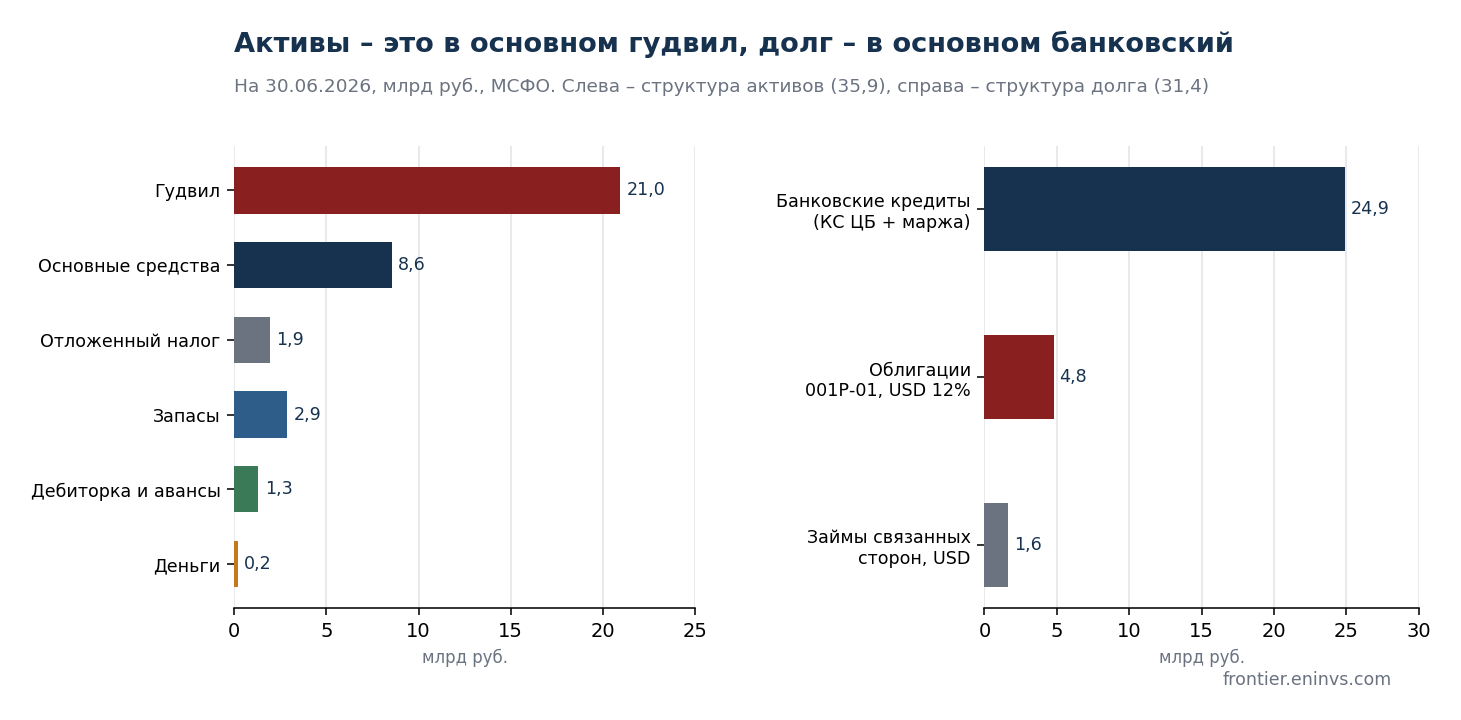
Authors' estimate. The price paid for the plant is visible in the balance sheet: goodwill of RUB 20.96bn, or 58% of all group assets. Real production assets, that is, fixed assets, are only RUB 8.6bn. If goodwill is removed from the balance sheet, the group's equity would be minus RUB 18.8bn.
What the plant sells and at what price: a tonne of cyanide costs about USD 3,300
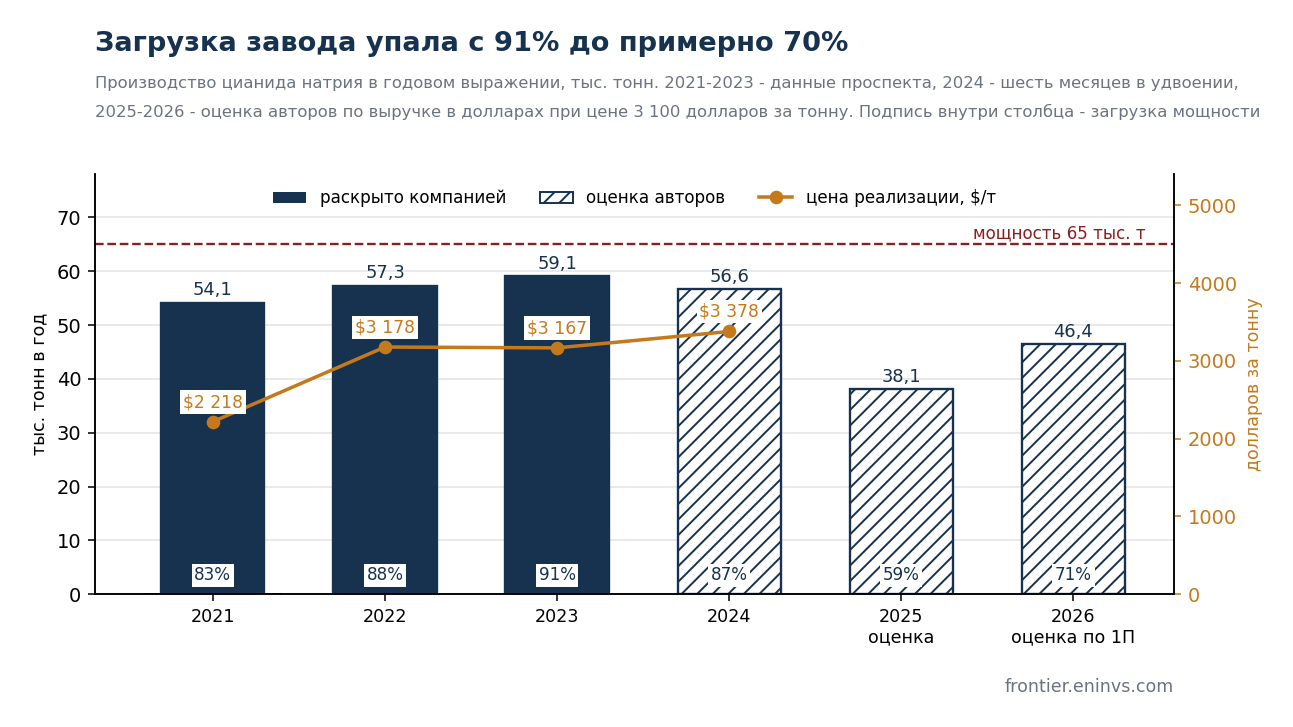
Fact. The site's capacity is 65 thousand tonnes a year. Output was 54.1 thousand tonnes in 2021, 57.3 in 2022, 59.1 in 2023 and 28.3 in the first six months of 2024. Capacity utilisation rose from 83% to 91%, and was 87% in the first six months of 2024. After the prospectus the company does not publish physical indicators, and they are not in the statements.
Authors' estimate. Dividing cyanide revenue by volume gives the realised price: USD 2,218 per tonne in 2021, 3,178 in 2022, 3,167 in 2023 and 3,378 in the first half of 2024. In rubles the price rose from RUB 163 thousand to RUB 306 thousand per tonne, and EBITDA per tonne rose from USD 1,070 to USD 2,167. The profitable years of 2022-2024 were made by price, not volume: tonnage added 9% over three years, while EBITDA tripled.
Fact. External benchmarks for the second quarter of 2026 (IMARC): USD 3,295 per tonne in the US, 2,092 in Australia, 1,748 in Indonesia, and the average Chinese export price about USD 1,770. A year earlier the US was at USD 3,066 – world prices have not fallen.
Authors' estimate. The Russian price is comparable to the American and almost twice the Chinese export price. The gap explains both the high margin of past years and the arrival of the Chinese: the premium rests on the status of guaranteed supplier and costly logistics for a hazardous cargo, but it is also the main prize for a competitor.
Authors' estimate. There are no physical data for 2025-2026. If the price held around USD 3,100 per tonne, dollar revenue corresponds to about 38 thousand tonnes in 2025 (59% utilisation) and an annualised pace of about 46 thousand tonnes based on the first half of 2026 (71%). Indirectly this is confirmed by material costs: in 2025 they fell by 16% while revenue fell by 41%.
2025 broke the model: revenue fell by 41%, EBITDA by 57%
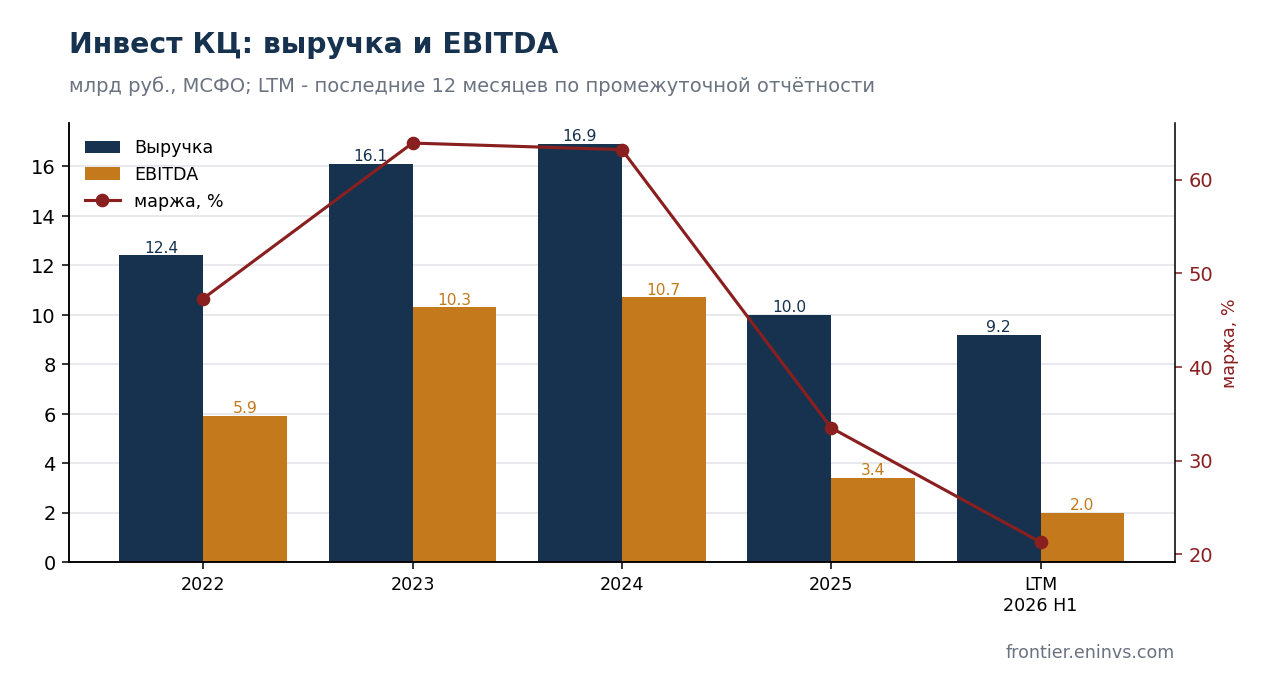
Fact. Group revenue was RUB 16.86bn in 2024 and RUB 10.01bn in 2025. EBITDA by the company's calculation was RUB 10.68bn and RUB 4.57bn. Operating profit was RUB 9.05bn and RUB 1.43bn. Net result: a profit of RUB 2.22bn in 2024 and a loss of RUB 3.72bn in 2025. In the first half of 2026 revenue was RUB 5.53bn against RUB 6.35bn a year earlier, with a loss of RUB 1.25bn.
Management view. Three reasons are named. In summer 2025 an emergency occurred at the production site, which forced a change in the production programme and the write-off of part of the inventory. The company does not disclose the nature of the incident. Direct costs were RUB 991mn in 2025 and another RUB 607mn in the first half of 2026. The second reason is the strengthening of the ruble. Most sales are denominated in dollars, and the average rate fell from 92.6 in 2024 to 83.4 in 2025. The third reason is the arrival of Chinese suppliers on the Russian market and falling prices.
Authors' estimate. Breaking EBITDA down by half-years shows that the bottom has been passed. RUB 3.05bn in the first half of 2025, RUB 1.52bn in the second, RUB 2.18bn in the first half of 2026. Production is recovering, but does not reach last year's level, and the EBITDA margin has slid from 63% in 2024 to 39% in the first half of 2026.
The 2025 decline was made by volume, the 2026 decline is made by the exchange rate
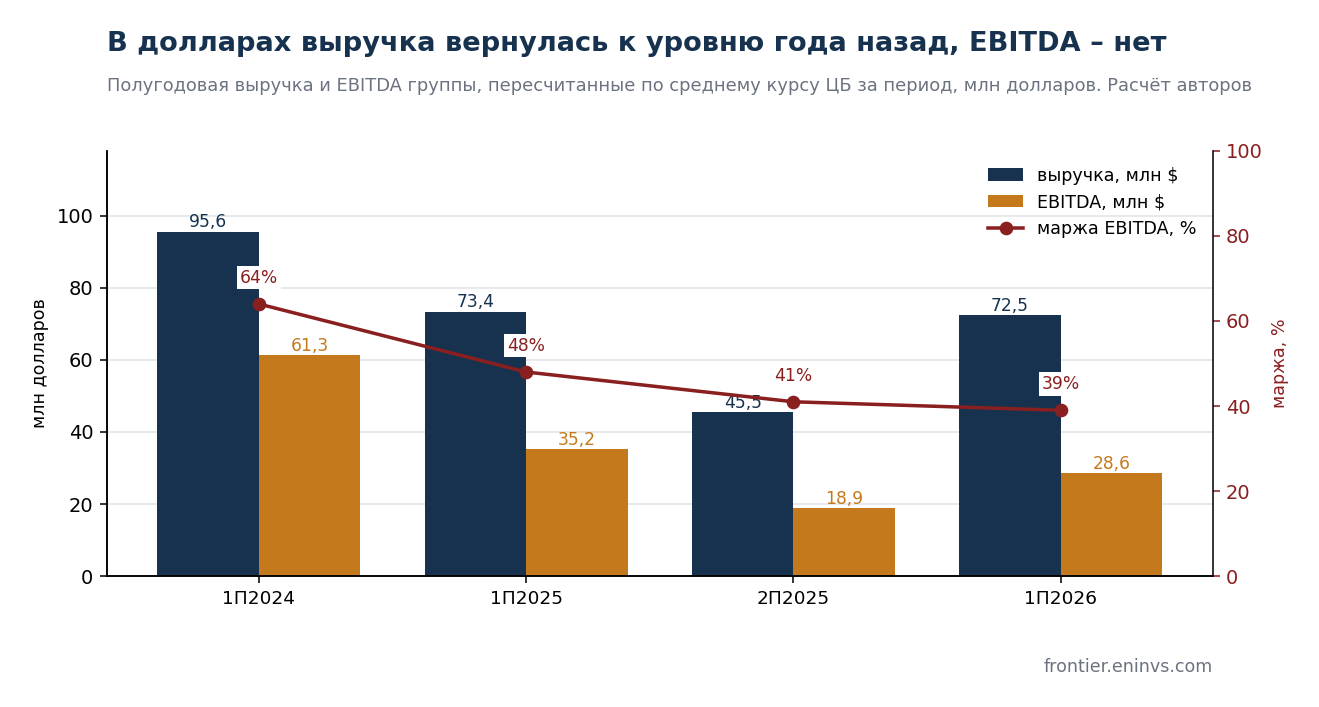
Authors' estimate. Recalculating at the average central bank rate separates two different stories. Revenue in dollars: USD 95.6mn for the first half of 2024, USD 73.4mn for the first half of 2025, USD 45.5mn for the second half of 2025 (the accident) and USD 72.5mn for the first half of 2026. In dollars, sales returned to last year's level, while ruble revenue dropped by 13%, because the average rate fell from 86.6 to 76.3 rubles per dollar.
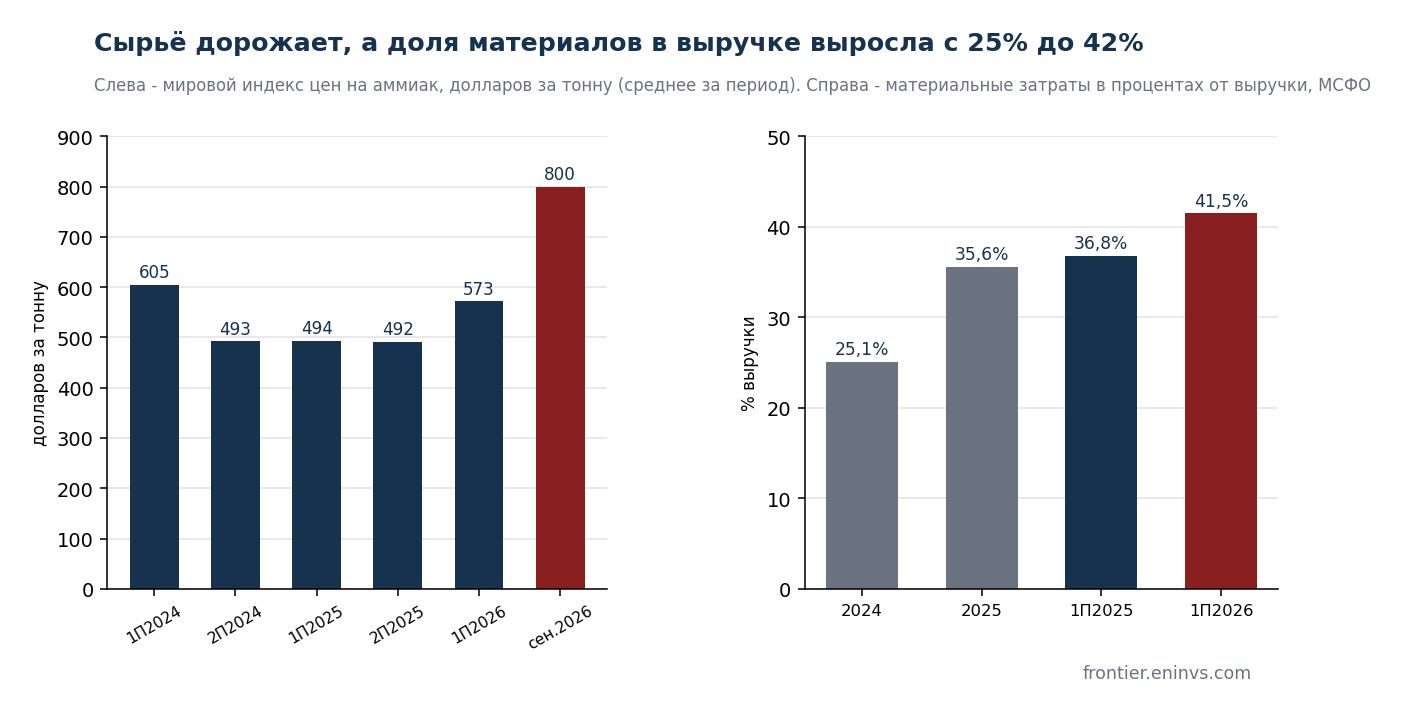
Authors' estimate. With EBITDA it did not work out that way: USD 61.3mn for the first half of 2024, USD 35.2mn for 2025 and USD 28.6mn for 2026, with the margin from 64% to 39%. Revenue is tied to the dollar, while costs are in rubles. Materials in the first half of 2026 cost RUB 2.29bn against RUB 2.34bn a year earlier, almost unchanged in rubles, but their share of revenue rose from 37% to 41%. Auxiliary materials and services became 58% more expensive, and personnel costs added 1%.
Fact. The raw materials for sodium cyanide are natural gas, ammonia and caustic soda. The world ammonia price index rose from an average of USD 494 per tonne in the first half of 2025 to 573 in the first half of 2026, and by September 2026 reached 800. The raw-material basket is getting more expensive, while the product's dollar price stands still.
Interest exceeds EBITDA: coverage of 0.8 and negative cash flow
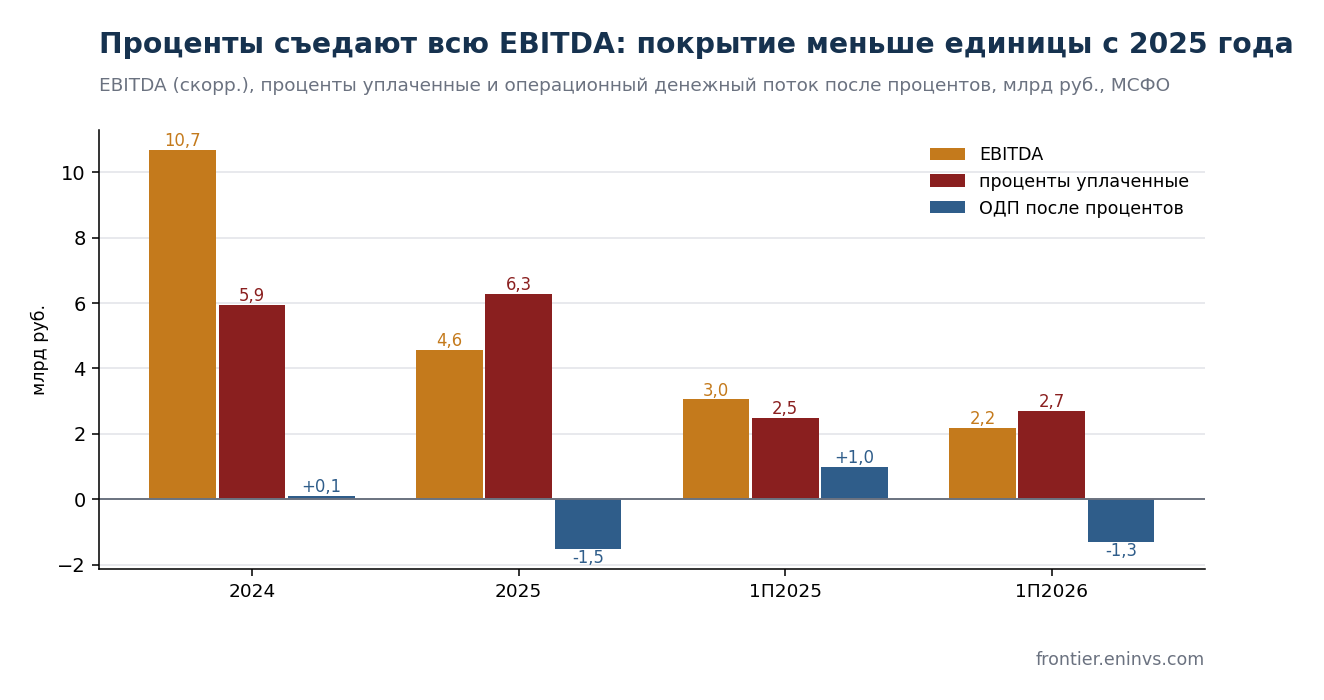
Fact. Interest paid: RUB 5.93bn in 2024, RUB 6.29bn in 2025, RUB 2.71bn for the first half of 2026. Operating cash flow after interest: plus RUB 0.10bn in 2024, minus RUB 1.53bn in 2025, minus RUB 1.32bn for the first half of 2026.
Authors' estimate. Interest coverage (EBITDA to interest paid) was 1.80 in 2024, 0.73 in 2025 and 0.81 in the first half of 2026. Even in the group's best year, 2024, operating cash flow after interest was about zero, while shareholders received RUB 3.46bn of dividends. The average cost of debt for the first half of 2026 is about 17.3% a year.
Fact. The share of floating rate in debt at the end of 2025 was 95%. Of RUB 30.3bn, RUB 28.8bn is tied to the central bank key rate plus a margin, and the fixed rate applies only to dollar loans and bonds.
Authors' estimate. This works in both directions. Each percentage point of the key rate costs the group about RUB 290mn of interest expense a year. A cut in the rate from the current 14% to 9% would save about RUB 1.4bn a year, roughly a third of the current cash gap.
Fact. On 11 September 2026 the central bank left the key rate at 14%, interrupting its cutting cycle: annual inflation accelerated, and the regulator's forecast for 2026 is 6-7%. The next meeting is on 23 October. For an issuer with a floating rate this means that the main source of relief for the coming month has been postponed.
One-offs in the half-year flatter the result more than they understate it
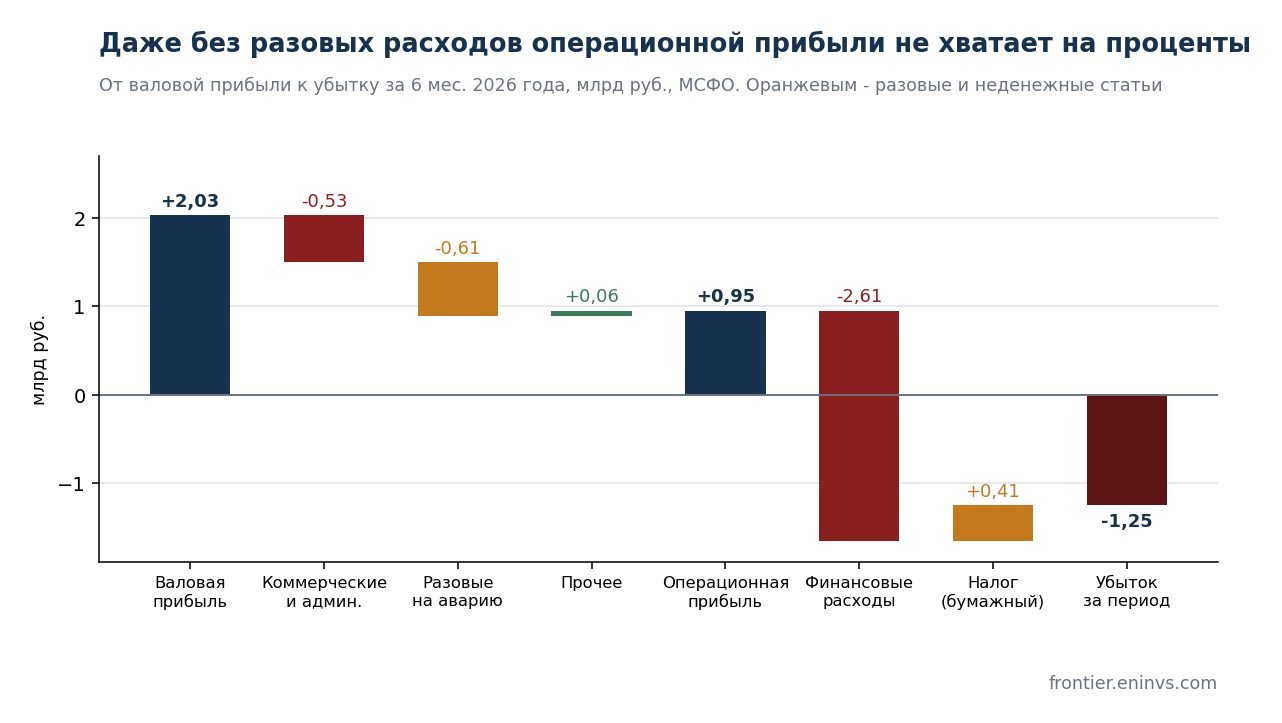
Fact. In the first half of 2026 the statements contain four non-standard amounts. Costs of eliminating the consequences of the emergency of RUB 607mn, of which RUB 553mn the company adds back to its EBITDA. Income tax income of RUB 413mn, within which a deferred tax recognition of RUB 541mn, exactly the item on which the auditor gave a qualification. Foreign exchange differences of plus RUB 28mn against minus RUB 312mn a year earlier. Depreciation of RUB 675mn against RUB 1,178mn: after the revaluation of fixed assets on 31 December 2025, accumulated depreciation was reset to zero, and the half-year charge fell by 43%. Separately, the discounting of participants' loans of RUB 188mn is reflected directly in equity, bypassing the income statement.
Authors' estimate. If the one-offs are removed, the picture worsens. Half-year EBITDA without the add-back for the accident is RUB 1.63bn, and interest coverage falls from 0.81 to 0.60. The loss without the paper tax income would be RUB 1.66bn instead of RUB 1.25bn. Had depreciation stayed at last year's level, the loss would be about RUB 0.5bn larger still, although this affects neither EBITDA nor cash. The only item that works the other way is the cost of the accident, and it has already been cleaned out in the company's calculations.
Spot EBITDA is higher than LTM, but adjusted for inflation debt is still six EBITDA
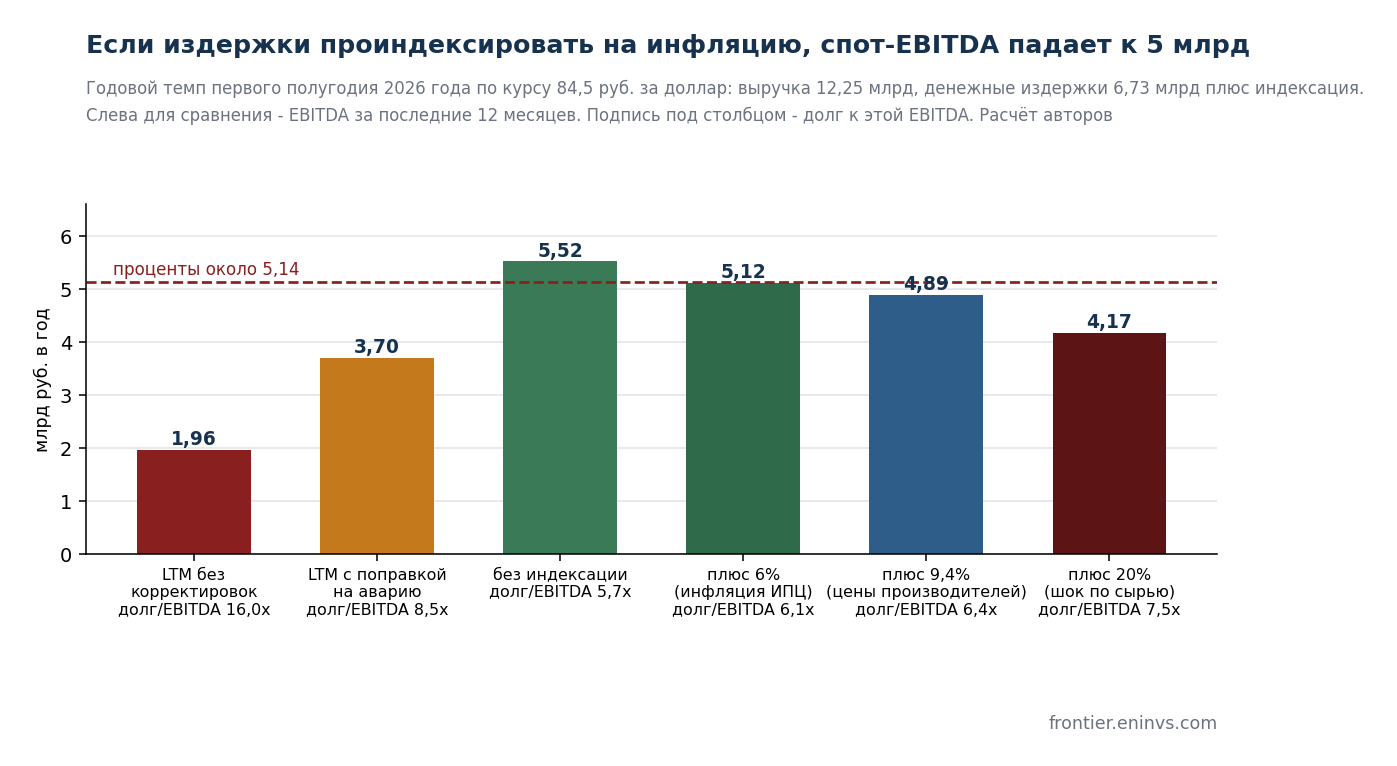
Authors' estimate. The trailing-12-month figure looks backward: it contains the disastrous second half of 2025 and the strong ruble of the first half of 2026. Let us take the volume and dollar price of the first half of 2026 as an annual run rate, and the current exchange rate, RUB 84.5 per dollar against an average of 76.3 in the reporting half-year. We keep ruble cash costs unchanged, RUB 6.73bn a year. This gives EBITDA of RUB 5.52bn against RUB 3.70bn for the last 12 months adjusted for the accident and RUB 1.96bn unadjusted.
Authors' estimate. Leaving costs at the level of the reporting half-year is wrong: between the middle of the first half of 2026 and a year ahead there are about twelve months of inflation. We index them in two ways. By consumer inflation of 6.0% a year (July 2026 to July 2025): costs of RUB 7.14bn, EBITDA of RUB 5.11bn. By producer prices of 9.4% (June 2026 to June 2025): costs of RUB 7.36bn, EBITDA of RUB 4.89bn.
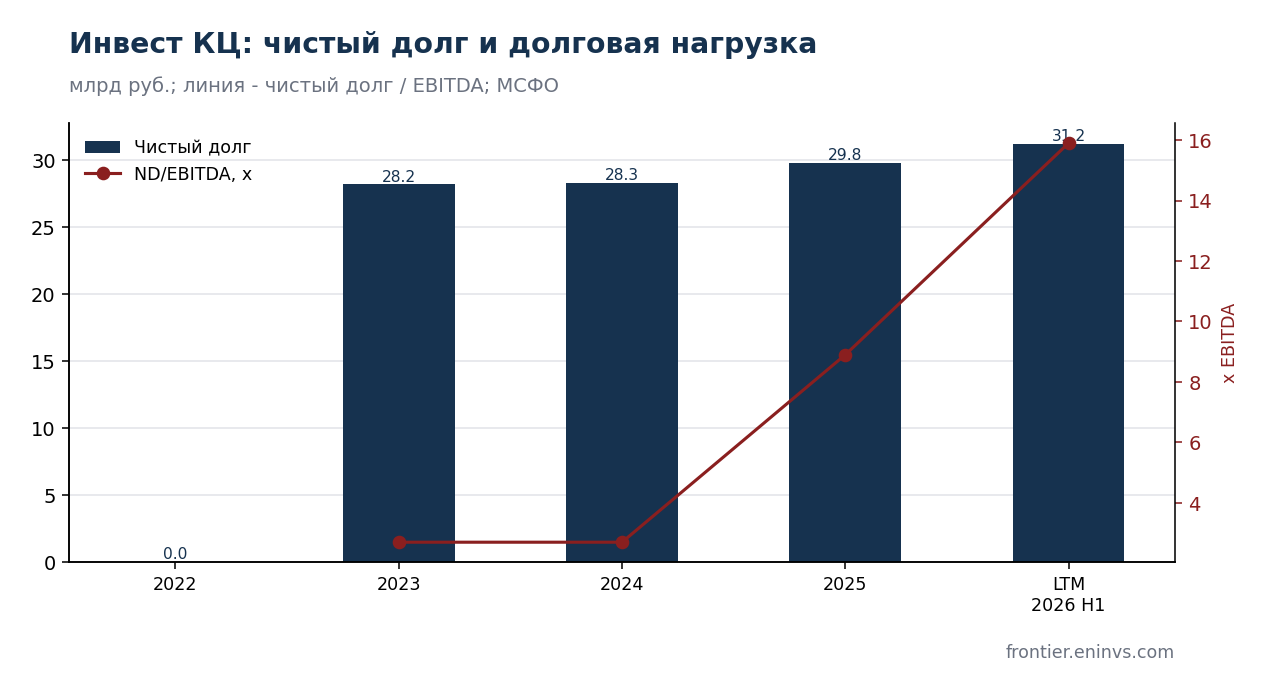
Authors' estimate. Debt load in these scenarios comes out as follows. Total debt of RUB 31.37bn to spot EBITDA is 5.7 without indexation, 6.1 at 6% inflation and 6.4 at 9.4%, and 7.5 with a 20% rise in the basket. Net debt to spot EBITDA is 5.7 / 6.1 / 6.4 / 7.5 respectively. For comparison, on the last 12 months total debt to EBITDA is 8.5 adjusted for the accident and 16.0 unadjusted.
Authors' estimate. The interest burden at a 14% key rate is estimated at RUB 5.14bn a year: bank debt of RUB 24.9bn at the key rate plus a margin of about 3.9 percentage points (this follows from the actual interest of the half-year), plus the bond coupon of USD 7.4mn, which becomes more expensive in rubles with a weak ruble. Interest coverage is 1.07 without indexation, 0.99 at 6% inflation and 0.95 at 9.4%. After interest, plus RUB 0.38bn remains in the first case and minus RUB 0.25bn in the third.
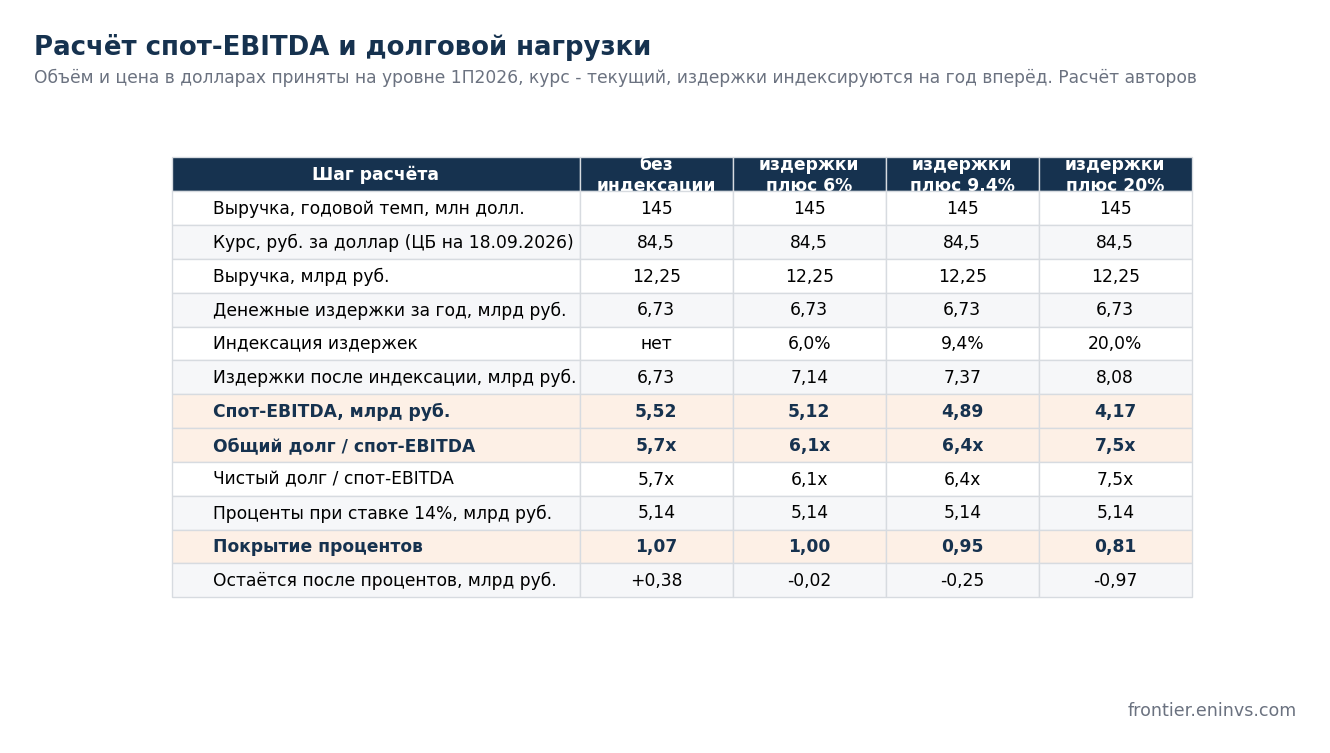
Authors' assumption. None of the scenarios creates free cash. Even in the mildest, RUB 0.4bn remains after interest against capital expenditure of about RUB 0.7bn a year: free cash flow is negative, and there is nothing to repay the principal with. The calculation is conservative in one direction: the product's dollar price is held unchanged, while the American benchmark has added about 7% over the year. If the price rises by the same amount, revenue would be RUB 13.1bn, EBITDA with costs indexed by 9.4% about RUB 5.8bn, and debt to EBITDA 5.4. Ruble weakening helps revenue, but at the same time revalues RUB 6.4bn of dollar debt.
The main question: what to pay with over the next 12 months
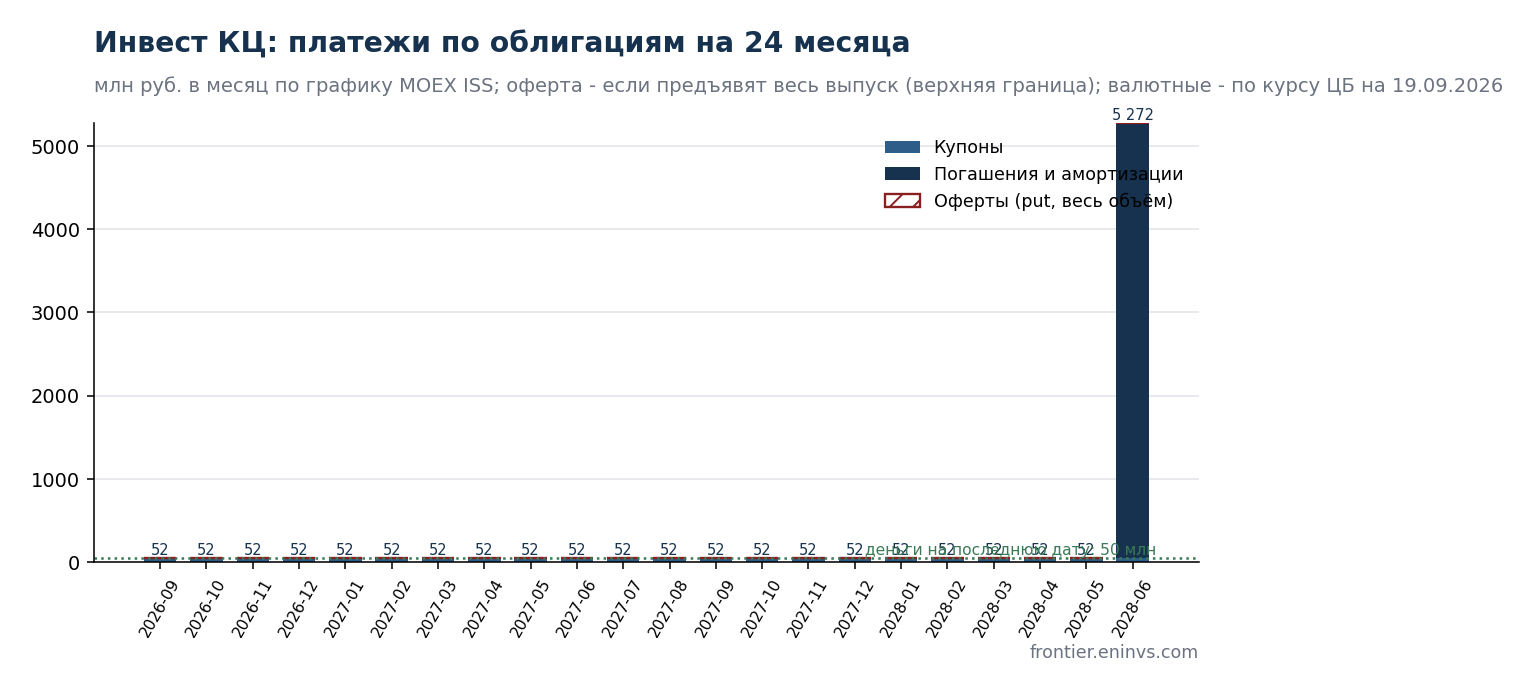
Authors' estimate. Mandatory payments from July 2026 through June 2027 add up as follows. Interest on loans and borrowings at the first-half pace is about RUB 4.75bn. Bond coupons cost USD 7.4mn, or RUB 0.63bn at the current rate. The short-term part of debt at 30 June 2026 is RUB 2.81bn. In total about RUB 8.19bn.
Sources on the other side: EBITDA for the last 12 months of RUB 3.70bn, cash in accounts of RUB 0.18bn, undrawn credit-line limits of RUB 0.12bn. In total about RUB 4.0bn. The gap is about RUB 4.2bn, and it can be closed only with new loans. This is exactly how the group lives: in the first half of 2026 it raised RUB 3.84bn of new borrowings while repaying RUB 2.41bn.
Fact. The bond principal itself is not repaid in the coming year. USD 62mn (about RUB 5.3bn at the current rate) is paid in a single payment on 19 June 2028, and until then the holder receives only a coupon of USD 0.99 per bond monthly. The company pays all coupons on time; the last payment was disclosed on 31 August 2026.
Authors' assumption. The real test is not the next year but 2027. According to the contractual payment schedule at the end of 2025, RUB 21.8bn of payments including interest fell in the one-to-two-year period. This is the amount that will have to be refinanced, and the decision on it is made not by the market but by the main lending bank.
Covenants are breached, and the holding's net assets have gone negative
Fact. The credit agreements require two things. First, net financial debt of Korund-Cian JSC and Invest KC LLC to EBITDA of Korund-Cian JSC under Russian standards of no more than 3.5 from 1 July 2024. Second, net assets of Invest KC LLC no lower than charter capital, that is, no lower than RUB 1.6bn.
Fact. Neither condition is met. For the leverage covenant the breach was recorded both for 2025 and for the first half of 2026, and the bank gave a written waiver of early demand for 12 months after each reporting date. The holding's net assets: RUB 3.39bn at the end of 2023, RUB 2.12bn at the end of 2024, RUB 0.51bn at the end of 2025 and minus RUB 0.46bn at 30 June 2026. The accumulated uncovered loss reached RUB 2.06bn.
Authors' estimate. The actual ratio of net debt to EBITDA in mid-2026 is 8.4 against a covenant of 3.5. If the costs of the consequences of the emergency are not cleaned out of EBITDA, the figure for the last 12 months is 16. A gap to the covenant of this size means the bank's letter is not a formality but the only thing keeping RUB 20.2bn of debt from turning into short-term debt.
Fact. The auditor Kept JSC issued a qualified opinion on both the annual and the half-year statements. The reason is the same. The group recognised deferred tax assets (RUB 1.32bn at the end of 2025 and RUB 1.65bn in mid-2026) against carried-forward tax losses, even though there are signs of insufficient future taxable profit, and the company did not assess the probability of obtaining it. Put simply, the auditor does not confirm that this asset on the balance sheet is justified.
Fact. In June 2026 intragroup loans to the holding were reissued at 0% per year retroactively from 1 January 2025. This made it possible to reverse RUB 921.5mn of accrued interest, of which RUB 560mn for 2025, and book it in other income as prior-year profit. This does not affect the group's consolidated result, but improves the issuer's own statements, on which the net asset covenant is calculated.
The bondholder stands last in line
Fact. The 001R-01 bonds are secured by neither a guarantee nor a pledge; this is stated directly in the prospectus. The bank lender's security is exhaustive: a mortgage on land plots, a pledge of real and movable property with a book value of RUB 6.86bn, a pledge of 100% of Korund-Cian JSC shares in favour of Sberbank, and the plant's guarantee for the holding of RUB 17.1bn.
Authors' estimate. A practical conclusion follows. The plant earns the money, while the bonds were issued by the holding standing above the plant. The plant's creditors reach its revenue and assets before the holding's creditors. If it comes to enforcing pledges, the bondholder will be left with neither production nor property, only a claim on a company whose only asset is already pledged.
Fact. The group has no full insurance cover for production stoppages. The contract of 8 April 2026 covers property for RUB 21.8bn, and no compensation for the 2025 accident is visible in the statements.
Goodwill of RUB 21bn rests on an assumption that no longer holds
Fact. The company ran the 2025 goodwill impairment test at a pre-tax discount rate of 16.7%, a terminal growth rate of 2% and an average EBITDA margin of 44.8% for five years ahead. The headroom between recoverable and book value was RUB 916mn. A year earlier the rate was 29.2% and the assumed margin 57%.
Authors' estimate. A headroom of RUB 916mn is about 3% of the value of the tested assets, that is, the test was passed on the edge. At the same time the actual EBITDA margin for the last 12 months is 40%, not 44.8%. If the margin stays at the current level, a goodwill impairment becomes likely already for 2026. This does not affect cash flow, but it would wipe out the group's equity and make net assets negative already at the consolidated level.
Industry backdrop: demand is growing, while the issuer is losing volume and price
Fact. Gold production in Russia in the first half of 2026 rose by 4.2% year on year according to Rosstat, and output of gold-bearing concentrates by 6.5%. At Polyus half-year output was 1,287 thousand ounces with a full-year forecast of 78-81 tonnes, and at Seligdar output of alloy gold rose by 20%. Demand for the reagent has not shrunk, and ore depletion even strengthens it: the poorer the ore, the more reagent per gram of metal.
Fact. At the same time imports of sodium cyanide into Russia in 2025 grew by 37%, dominated by Chinese products (ROIF Expert estimate). The issuer's own estimate in the prospectus is that regional capacity will grow by about 80 thousand tonnes in 2027-2028 through projects in Russia, Kazakhstan and Uzbekistan, against current 119-120 thousand tonnes and consumption of 141 thousand tonnes in 2023.
Authors' estimate. Two things follow. First, the fall in Korund-Cian's revenue was caused not by an industry downturn but by loss of market share and price. Second, the prospectus thesis of premium pricing stops working. While the market was in deficit, the plant sold at a high price; with the arrival of Chinese imports and plans for new capacity, the premium has begun to disappear. Whether the group can service its debt depends on price, not volume.
Both rating agencies downgraded within two weeks
Fact. On 24 August 2026 NKR downgraded the issuer and the 001R-01 issue from A.ru to BBB+.ru, outlook stable. The agency pointed to rising leverage (debt to OIBDA from 2.7 to 9.0), lower short-term liability coverage from 1.5 to 0.4, a short-lived covenant breach and intensifying competition from Chinese imports.
Fact. On 7 September 2026 ACRA downgraded the rating from A(RU) to BBB+(RU), outlook stable. In September 2025 the same agency had upgraded the rating, from A-(RU) to A(RU), assuming production of 60 thousand tonnes a year and debt to FFO of 3.1. Now ACRA has debt to FFO of 5.1, interest coverage above 1.1, and positive free cash flow expected after 2027. The agency links a further downgrade to interest coverage below 1.0 or loss of access to external liquidity.
Authors' estimate. The gap between the agencies and the market remains large. A BBB+ bond trades at 29% a year in dollars, while interest coverage on the last 12 months is already below 1.0, that is, below ACRA's own threshold for a further downgrade.
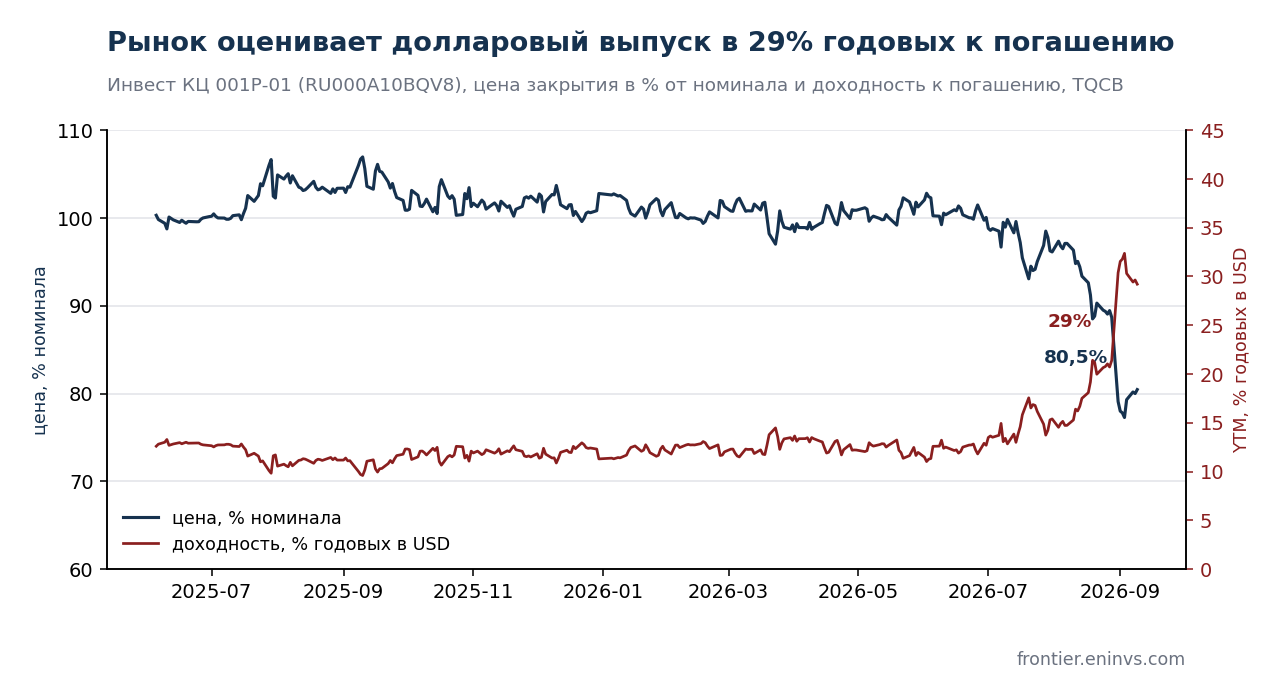
By our methodology the issuer falls into the red zone
Method. We have a third-tier scoring calibrated on companies that have already defaulted: the last statements published before non-payment are taken and checked for which signs were present. There are six signs: interest coverage below 1.5, negative operating cash flow, paper profit with negative cash flow, equity below 10% of assets, debt growing faster than revenue, and cash in accounts of less than two months of interest.
Authors' estimate. Invest KC triggers five of the six signs. Interest coverage is 0.10 on operating profit for the last 12 months. Operating cash flow is minus RUB 3.83bn over the same period. Equity is 6% of assets for the group, while at the issuer itself assets exceed equity by 55.7 times. Debt grew by 9% while the issuer's revenue fell by 66%. Cash in accounts is RUB 0.18bn against RUB 5.6bn of interest a year, which is less than half a month. Only paper profit does not trigger, because the group has a loss. On top comes the auditor's qualification on the 2025 statements, which in our scheme is an independent ground for the red level.
Conclusion. On the traffic light this is the red level. Our own credit quality assessment on the issuer's card is weak, 33 points out of 100.
Caveat. By our own calibration, the signs determine the tier, not the date of non-payment: 43% of living issuers in the segment have five or more such signs and keep paying. The red level means that we do not give new money to the bond, not that a default will happen tomorrow.
There is one issue, and it is second by yield among liquid foreign-currency bonds
Fact. The group has one exchange-traded issue, so there will be no multi-series table. Below is the full passport, including terms that are not in the terminal.
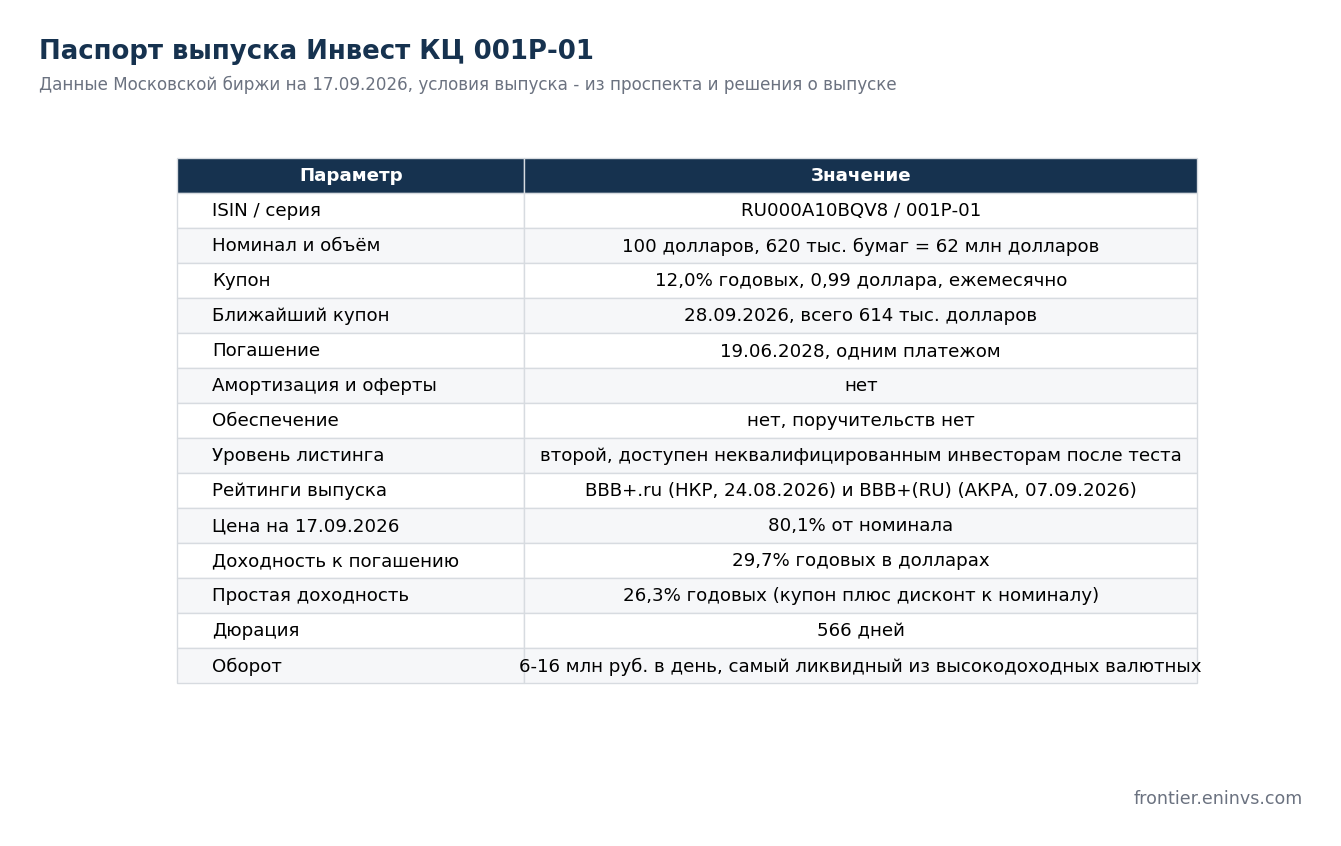
Authors' estimate. The simple yield, that is, the coupon plus an even discount to par, is 26.3% against 29.7% effective: the difference comes from the assumption of coupon reinvestment. What reaches the hand is the first figure, and we compare issues by it.
Fact. Among the Moscow Exchange's foreign-currency issues with turnover above RUB 0.5mn a day, only Slavyansk ECO stands higher in yield, at 31.7%. Next is Ural Steel, rated BB-(RU), at 27.2%. Formally two more bonds have higher yields, but they hardly trade: Agropromkomplektatsiya's dollar issue with turnover of RUB 0.2mn and the Belarusian sovereign issue with turnover of RUB 0.1mn. Invest KC is the most liquid bond in the group of yields above 20%: RUB 6-16mn a day against 1-6mn for its neighbours.
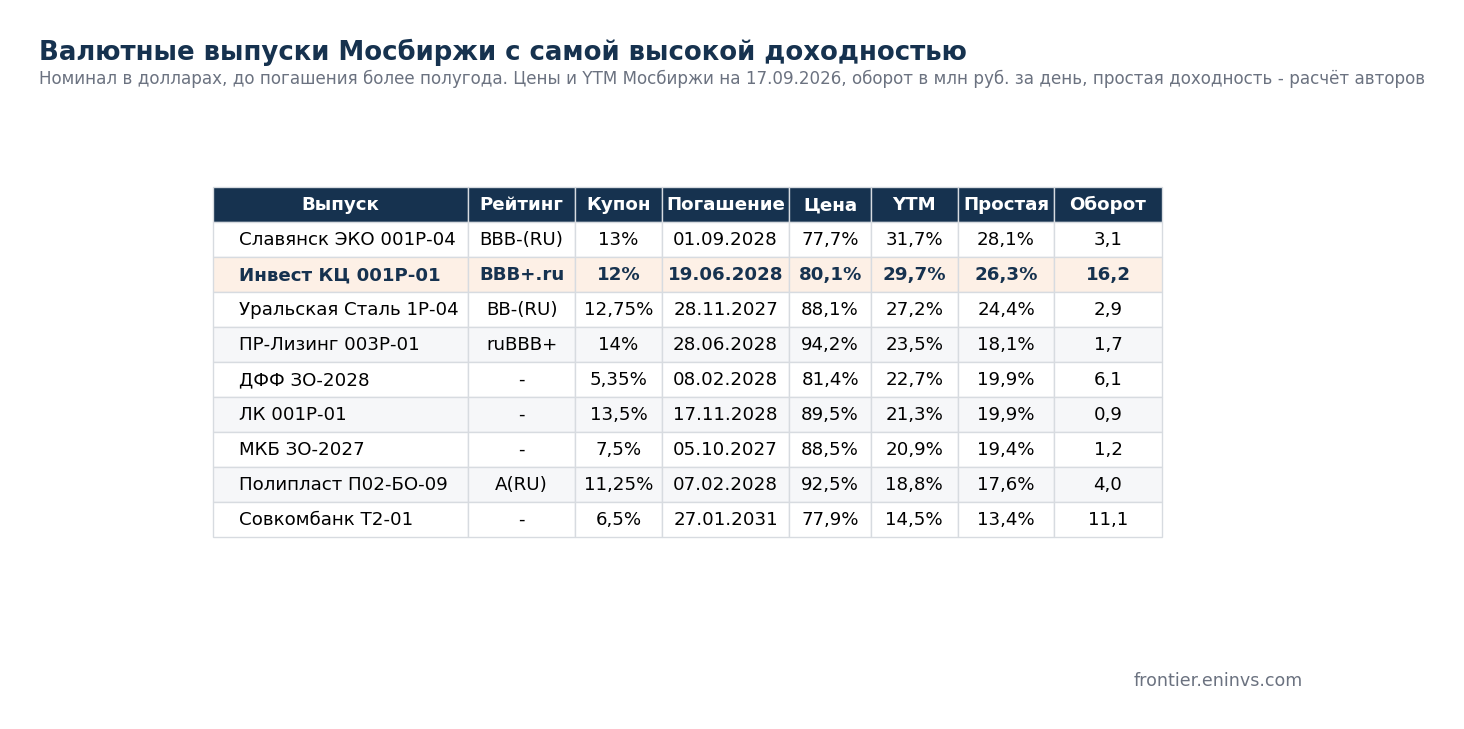
Authors' estimate. The market puts Invest KC in the same row as BBB- and BB-, although formally the issue is BBB+. The quote reflects not the rating, but that interest coverage has fallen below one and the covenants are held up by bank letters.
Taxes and courts: no arrears, the case file could not be checked
Fact. According to Federal Tax Service open data as of 25 August 2026, neither Invest KC LLC, nor Korund-Cian JSC, nor Korund-Cian 2 LLC has any tax, penalty or fine arrears, and there is no information on tax offences either. An important signal: at troubled borrowers payroll taxes usually stop being paid before the coupon is missed.
We could not check the arbitration case file, as the resource is closed to automated access. According to aggregators, Korund-Cian JSC has dozens of cases, but we could not confirm the breakdown into plaintiff and defendant or the current amounts from a primary source, so we do not take them into the assessment.
Holders on forums argue not about the business but about whether the coupon will arrive
Fact. The discussion on Smart-Lab and in brokers' social networks is characteristic: they hardly talk about the plant and cyanide, they talk about payments. On 1 September the coupon arrived with a delay within the day, and this was discussed in a separate thread. People also ask there about the site's protection against drones: the company has not disclosed the nature of the emergency, and the market is building versions itself.
Authors' position. A forum is not a source of facts, but it shows what the holder lives by. When the discussion comes down to whether the coupon arrived on the business day, that is itself a characteristic of credit quality. There is one verifiable part: all coupons have been paid, the last payment was disclosed on 31 August.
What could change the picture for the better
- A cut in the key rate. 95% of debt is at a floating rate. Each percentage point of cut saves about RUB 290mn a year. The fastest and most likely source of improvement.
- A weaker ruble. Revenue is tied to the dollar, while costs are in rubles. The flip side is revaluation of debt: the net foreign-currency position is minus RUB 5.95bn, and a 20% ruble weakening produces RUB 1.19bn of paper loss, which hits equity and covenants.
- A recovery of volumes after the accident. Half-year EBITDA has already rebounded from RUB 1.52bn to RUB 2.18bn. A return to 2024 utilisation would give the group roughly twice the EBITDA.
- Support from participants. Intragroup loans have already been moved to 0%; the next step could be a recapitalisation or conversion of participants' debt into equity. No one has given commitments of this kind.
- A sale of the asset. The plant is profitable and strategically important; a change of owner with repayment of the debt would close the question. Nothing has been disclosed about this.
Risks to keep in mind
- Withdrawal of the bank's consent. The letter is valid for 12 months after the reporting date. If it is not renewed, RUB 20.2bn of long-term debt becomes short-term.
- The net assets covenant. The issuer's net assets are already negative against charter capital of RUB 1.6bn. For an LLC this is also a corporate trigger under law.
- Structural subordination. The unsecured bonds were issued by the holding, while all the plant's assets are pledged to the bank.
- One site and one product. All revenue is sodium cyanide from a single site in Dzerzhinsk, where an accident has already happened, and insurance cover for production stoppage is incomplete.
- Customer concentration. Three customers provide 71% of revenue, and their names are not disclosed.
- Goodwill write-off. The 2025 test was passed with headroom of RUB 916mn on an assumed margin of 44.8%, while the actual margin is 40%.
- Deferred tax asset. RUB 1.65bn on the balance sheet; the auditor has twice noted that its recognition is not confirmed.
- The expansion project. Capacity was planned to reach 100 thousand tonnes, and capital expenditure in such a debt situation would have to be financed with loans.
Conclusion
Korund-Cian is a good plant in a bad financial structure. The production business remains profitable: even in the disastrous 2025 operating profit is positive, the EBITDA margin holds above 40%, and market share is more than half. The problem is not the plant, but the RUB 31bn of debt that was loaded onto the holding when the asset was bought in 2020 and that the plant no longer services from its own flow.
Authors' position. We are not taking this bond for ourselves now. The 29.7% annual yield in dollars reflects not a premium for nerves but the probability that in a year or two the conversation will be about moving the maturity dates. At the same time the bond benefits from a weaker ruble and from a lower key rate through two channels at once: revenue is tied to the dollar, and 95% of debt is at a floating rate. If the ruble goes to 95-100 and the rate to 10%, the credit picture changes before our eyes, and then the conversation about this bond will be different. For now both factors work against it: on 11 September the central bank left the rate at 14%, and the ruble has been stronger than 85 since July. What to watch is the 2026 reporting and whether the bank extends its waiver of early repayment after 30 June 2027.
Sources
- [Consolidated IFRS statements of Invest KC LLC for 2025](https://www.e-disclosure.ru/portal/fileload.ashx?fileid=1925582) (auditor Kept JSC, qualified opinion, 30.04.2026)
- [Interim consolidated IFRS statements for 6 months of 2026](https://www.e-disclosure.ru/portal/fileload.ashx?fileid=1943348) (28.08.2026)
- [The issuer's statements and notes for the first half of 2026](https://www.e-disclosure.ru/portal/fileload.ashx?fileid=1939857), [annual report for 2025](https://www.e-disclosure.ru/portal/fileload.ashx?fileid=1923703) and [prospectus](https://www.e-disclosure.ru/portal/fileload.ashx?fileid=1881978)
- [NKR press release of 24.08.2026](https://ratings.ru/ratings/press-releases/Invest-kts-RA-240826/)
- [ACRA press release of 07.09.2026](https://www.acra-ratings.ru/press-releases/7244/) and [release of 11.09.2025](https://www.acra-ratings.ru/press-releases/6074/)
- Open Federal Tax Service data on arrears (as of 25.08.2026), Moscow Exchange (prices and issue parameters), Rosstat and [Interfax](https://www.interfax.ru/business/1106370) on gold production
- [IMARC](https://www.imarcgroup.com/sodium-cyanide-price-trend) on world sodium cyanide prices, ROIF Expert on imports into Russia, the global ammonia price index and central bank exchange rates for conversion into dollars
More reviews and company cards are on the portal frontier.eninvs.com.
See also: market overview · valuation map · stock screeners