L-Start: the 28 August technical default was cured on 4 September and RUB 41.9mn was paid – but cash is RUB 15mn against RUB 390mn of annual coupons, and a price of 40-46% of par prices a restructuring, not the coupon
Update of 9 September 2026
On 9 September NCR downgraded L-Start's credit rating from B.ru to CCC.ru and changed the outlook to "rating under review – uncertain outlook". The release cites a material deterioration in corporate governance and liquidity management assessments. Cash to current liabilities is 0.2%, and total debt is 4.1 times OIBDA.
The same day, bond prices fell to 36–47% of par at yields of 98–141% a year (Moscow Exchange data). We score the outcome against our two earlier pieces. Three L-Start issues were on our 15 August list of 14 bonds with the most risk flags: from the close on 14 August, BO-01 is down 52%, BO-02 down 54% and BO-03 down 52%, against a Moscow Exchange high-yield bond index (VDO) decline of 8%; the median across all five issues is −52%. After our separate review on 5 September, four of the five issues lost a further 5–18%, while 001P-1 rose 14%.
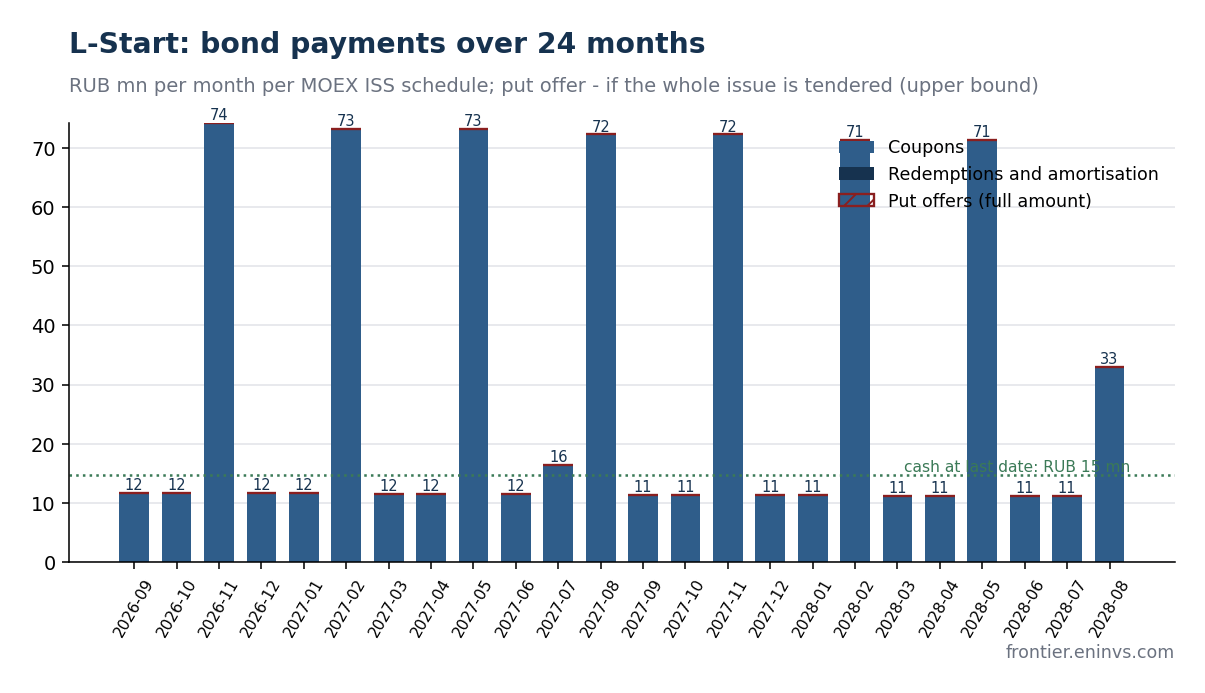
The next coupons are due on 19 and 27 September and 4 October, about RUB 12mn in total. In November the quarterly coupons on BO-01 and BO-02 add RUB 62.5mn. The conclusions of the review do not change: the 4 September payment resolved the question of the week, not the question of the year.
The arranger of the issues is not writing the case off. In the [Ivolga | VDO](https://t.me/ivolgavdo) chat they write that everything depends on the issuer's work with banks, and that if the current liquidity problem is closed through them, positive prospects are possible. Participants there also discuss an arbitration case for RUB 9mn (No. A43-21640/2026), which the company lost in the first instance on 8 September. We have not checked this case against the primary source – the arbitration court case file is blocked by anti-bot protection – so we cite chat participants.
Takeaways. A technical default is rarely a one-off: it was followed by a two-notch rating downgrade. Risk flags work as a priority for review, not as a prediction: three issues from the list lost half their price, while one issue rose 14% after the review. What matters is the payment calendar, not the coupon: the company gets through September and October on RUB 12mn, and the bottleneck is November.
[Four-minute video update](https://www.youtube.com/watch?v=hAUJTx0P0Zg)
L-Start is a Moscow-based manufacturer of equipment for the oil and gas industry (mobile drilling rigs, high-voltage frequency converters, blower units), operating since 2005. Within a year the company placed five bond issues (BO-03 and 002P-01 for qualified investors only, the other three open to everyone after testing) totalling RUB 1.31bn with coupons of 28.5-31%, and on 28 August 2026 it allowed a technical default on two of them for RUB 41.85mn – "a shortage of cash due to delayed receipts from counterparties". On 4 September both coupons were paid in full, curing the technical default on the fifth business day; the BO-03 coupon was paid on time the same day. NCR rating B.ru (07.11.2025); Expert RA withdrew its ruB- (12.11.2025). After the payment the bonds bounced from 27-41% to 40-46% of par. Verdict: this is no longer a credit case but a recovery case: revenue is growing 55-68% a year, but 2025 operating cash flow was minus RUB 1.76bn because of receivables, cash is RUB 15mn against RUB 391mn of payments over the next year, and equity is RUB 0.38bn against assets of RUB 5.4bn. The 4 September payment resolved the question of that week, not of the year: the company has not disclosed where the RUB 42mn came from, and before the quarterly BO-01 coupon at the end of November it must find about RUB 100mn more for the monthly coupons. Meanwhile the sales market is shrinking: drilling footage in 2025 fell to a three-year low, TMK lost 37% of revenue in the first half, and oilfield services reported profit declines of 19-81% – L-Start's customers are cutting purchases and delaying payment. There are no tax claims, but RUB 13mn of arrears on payroll taxes suggest the cash gap began before 28 August. Assets of RUB 5.4bn against debt of RUB 1.8bn look like a cushion, but 96% of assets are inventories and receivables, and the auditor has been unable to confirm the inventories two years running. A price of 40-46% of par and a yield to maturity of 100-116% reflect this uncertainty.
The issuer card on the portal with financials by period, our credit analysis and all issues: L-Start. Below are Enhanced Investments' calculations based on the issuer's IFRS and RAS statements, the MOEX payment schedule and disclosures; where a figure is the authors' estimate, it is marked as such.
What happened: revenue growth of 2.6x in two years was financed by bonds and settled in receivables
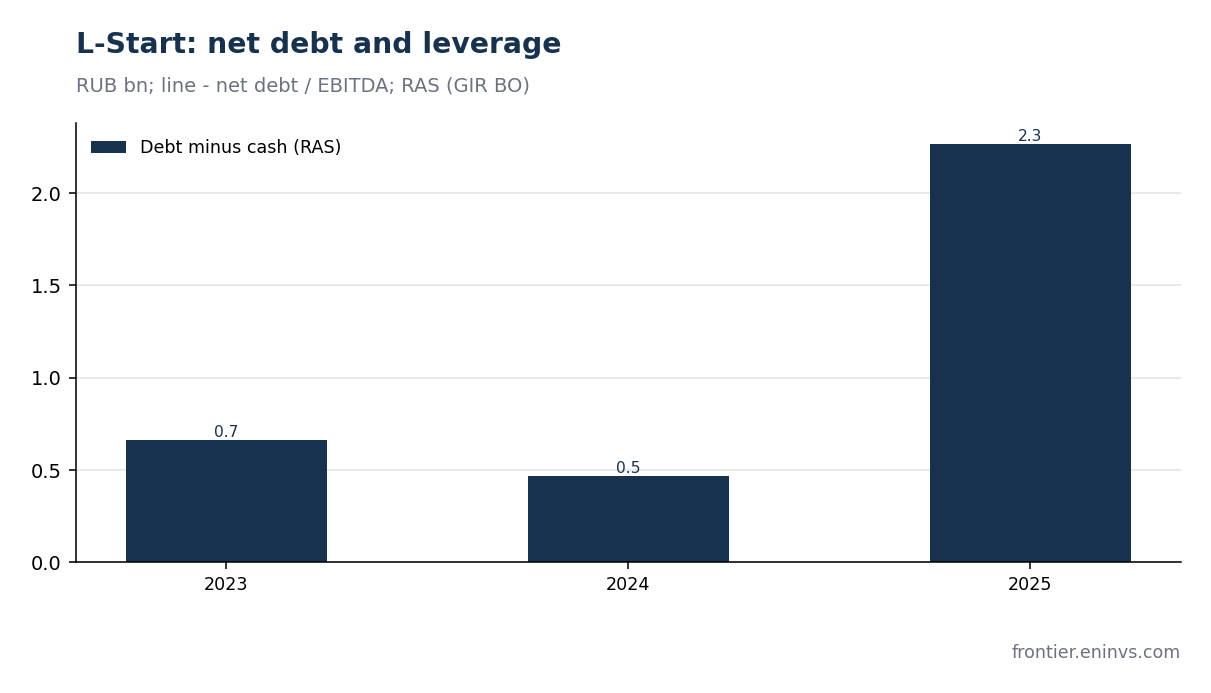
Fact (RAS). Revenue was RUB 0.90bn in 2023, RUB 1.52bn in 2024 and RUB 2.36bn in 2025 (+55%), and RUB 1.63bn in 1H2026 (+68% year on year). Operating profit was RUB 387mn in 2025 (16% margin) and RUB 411mn in 1H2026 (+215%). But net profit is only RUB 24mn for the year and RUB 15mn for the half-year: interest consumes almost everything. Borrowings rose from RUB 0.49bn at the end of 2024 to RUB 2.28bn at the end of 2025, and 2025 operating cash flow was minus RUB 1.76bn: the money from the placements went into receivables and inventories for contracts.
Fact. Assets at 30.06.2026 are RUB 5.38bn, equity RUB 0.38bn, and liabilities to equity 13.2x. Cash on accounts at the end of 2025 was RUB 15mn, less than a month of interest payments. The auditor qualified the 2025 financial statements. Tax debt according to the Federal Tax Service is RUB 13.0mn.
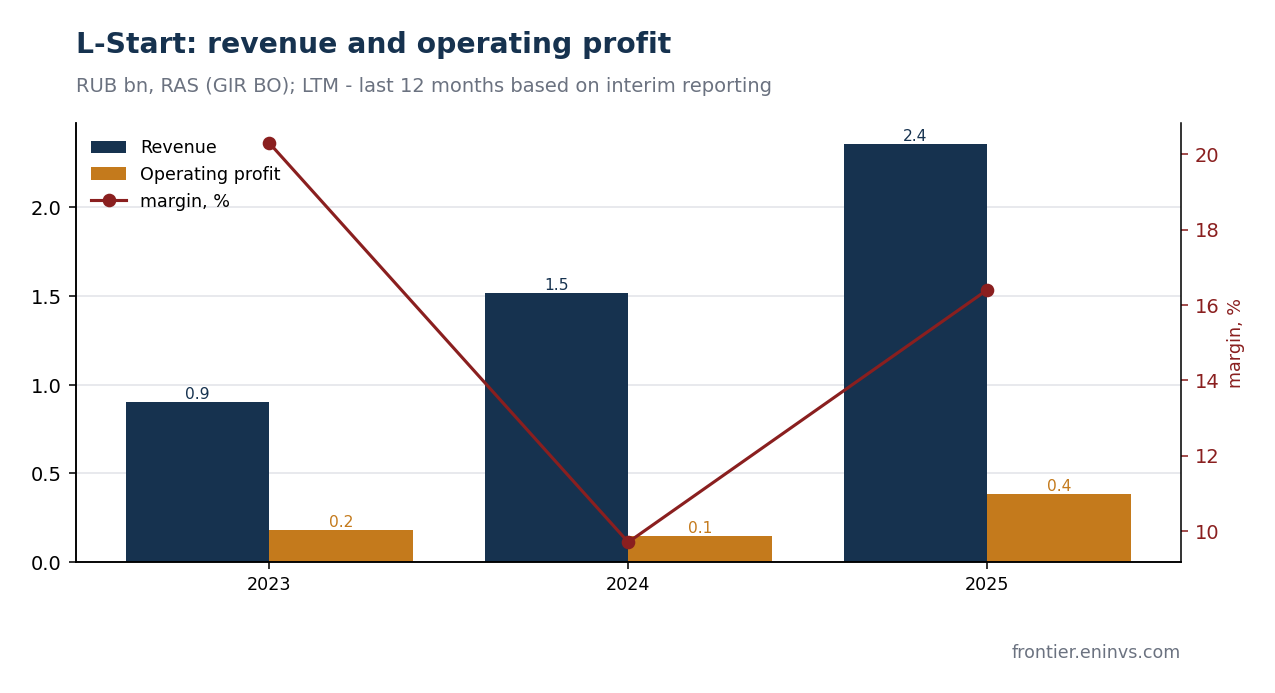
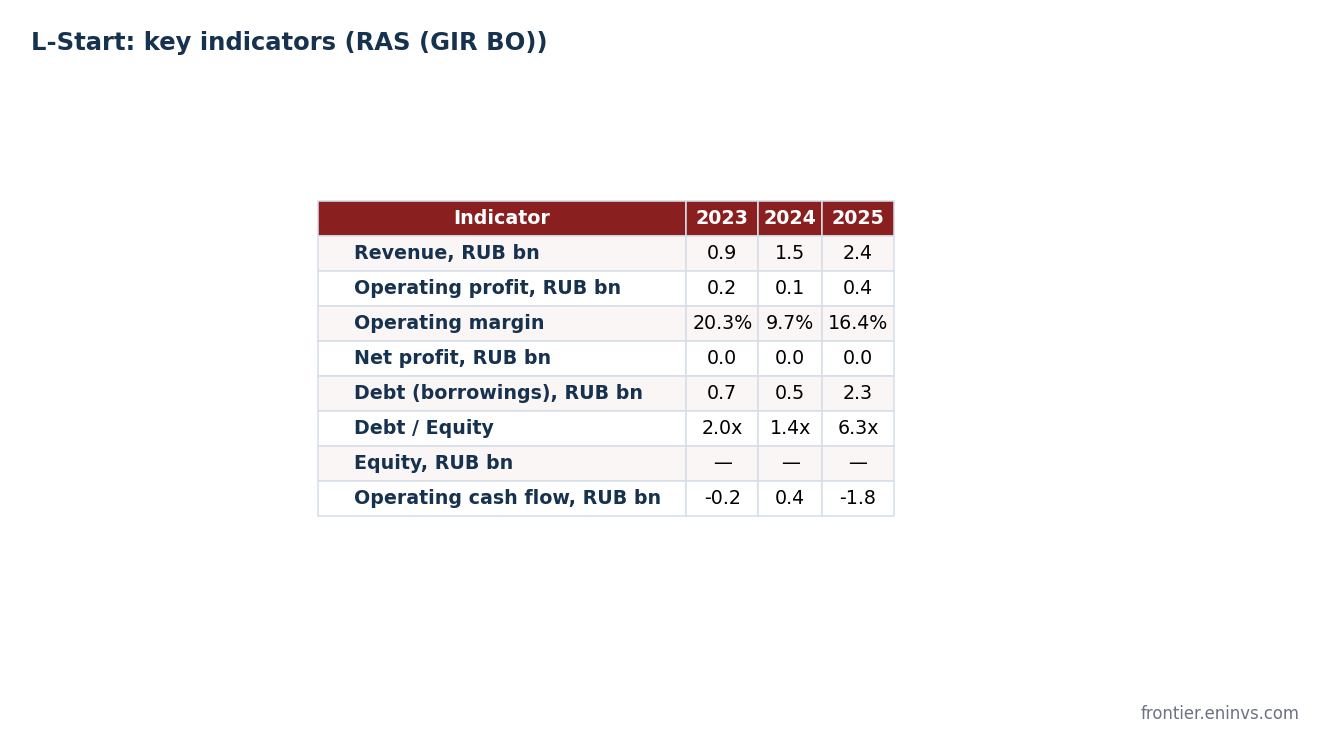
Assets of RUB 5.4bn against debt of RUB 1.8bn: why this is not a cushion – 96% of assets are inventories and receivables, and the auditor could not confirm the inventories two years running
Fact (balance sheet at 30.06.2026, RAS). Assets are RUB 5,383mn. Of this: receivables RUB 3,089mn (57%), inventories RUB 2,081mn (39%), interest-free loans issued RUB 87mn, capitalised borrowing costs RUB 57mn, deferred tax assets RUB 18mn, fixed assets RUB 23mn (0.4%), intangible assets RUB 18mn (0.3%), cash RUB 9mn (0.2%). The company has practically no intangibles or goodwill, which usually inflate a balance sheet – the problem is different: there are no hard assets (land, workshops, equipment) either, the company rents its site, and 96% of the balance sheet is what customers have not yet paid for and what has not yet been shipped.
Fact. Borrowings at 30.06.2026 are RUB 1,791mn (long-term 402, short-term 1,389), accounts payable RUB 2,178mn, equity RUB 380mn. During the half-year about RUB 1bn of borrowings moved from long-term to short-term (long-term 1,418 -> 402, short-term 861 -> 1,389) – even though all five bond issues mature in 2029-2030. The interim statements contain no explanation; either these are bank loans with maturities under a year, or a reclassification of bonds. Either way, RUB 1.39bn comes due in the next 12 months against cash of RUB 9mn.
Authors' estimate. Formally, assets cover debt three times and total liabilities (RUB 3.9bn) 1.4 times. But receivables of RUB 3.1bn are 1.3 years of annual revenue, meaning customers on average pay with a delay of more than a year; the list of debtors is not disclosed, and according to the NCR release more than 75% of orders come from three regions (Tyumen Region, Perm Krai, Bashkortostan), with some projects carried out through a sister company, Idel Neftemash, under informal arrangements. Inventories of RUB 2.1bn are drilling rigs and converters made for specific contracts: if a contract falls through, a finished product sells at a discount and work in progress at scrap-metal value. The inventories are also exactly what the auditor could not confirm two years in a row (see below). Stressed asset value under our methodology: receivables at 50-70% of face value with a recovery horizon of one to two years, inventories at 30-50%, giving RUB 2.2-3.2bn against RUB 3.9bn of liabilities – bondholders, as unsecured third-rank creditors, share what is left after secured banks and after current payments.
Fact: who had assets above debt and still did not pay. Obuv Rossii (default January 2022): per its 2021 statements equity was RUB 11bn, a third of the balance sheet, with inventories of RUB 16.5bn against revenue of RUB 8.2bn – a turnover of 2.5 years; even before the default analysts estimated hidden inventory losses at RUB 11.5bn, meaning real equity was negative. Naftatrans Plus (stopped payments in June 2025): assets of RUB 5.0bn against RUB 1.23bn of bonds, but receivables shrank from RUB 2.36bn to RUB 0.89bn over 2024-2025 and cash to RUB 125 thousand; holders were offered a four-year restructuring. Garant-Invest (default March 2025, RUB 14.5bn across six issues): its balance sheet holds the Perovo Mall and Galereya Aeroport shopping centres, yet in March the company could not satisfy a RUB 2.8bn put offer; PSB filed for bankruptcy, and the bondholders' association made claims against the auditor Unicon over RUB 4bn of debt not reflected in the 1H2024 statements. EuroTrans (default 05.08.2026): at the IPO its 55 filling stations were valued at RUB 53bn, but 55 of 78 leases were for the stations themselves, i.e. the stations did not belong to the company; net debt rose from RUB 27bn to RUB 60bn in two years, with RUB 11.7bn of dividends paid out of new debt.
Authors' estimate. What all four share: the assets were either illiquid (inventories, pledged real estate) or paper (related-party receivables, leased facilities, revaluations), and there was no cash on the accounts. Default comes not when assets are lower than debt but when cash is lower than the next payment, and assets cannot be turned into cash faster than the payment falls due. L-Start has cash of RUB 9mn, a next payment of RUB 12mn in three weeks, and RUB 1.39bn of short-term debt within a year.
Auditor: the third in three years, two consecutive qualified opinions, both on the main asset
Fact. The 2023 statements were audited by one auditor with an unmodified opinion. For 2024 it was OOO Auditorskaya Gruppa 2K (Moscow, 30th in the RAEX ranking of auditors by 2024 revenue, RUB 105mn): an opinion dated 05.08.2025 with a qualification – the auditor did not observe the inventory count for RUB 1,221mn, did not obtain confirmation of the impairment test of the investment in OOO L-Petro of RUB 80.8mn, or data on leave balances for provisions. For 2025 it was AO Auditorskaya Kompaniya Institut Problem Predprinimatelstva (St Petersburg, operating since 1993, SRO AAS member, 44th in the RAEX ranking, revenue RUB 59mn): an opinion dated 05.03.2026 with a qualification – the auditor again did not observe the inventory count, now for RUB 1,680mn, because it was engaged after the reporting date, and again did not obtain leave data. The opinion contains no paragraph on material uncertainty regarding going concern. The investment in L-Petro was written down to zero on the balance sheet at the end of 2025.
Authors' estimate. The auditors themselves are ordinary firms from the top hundred, not shell companies, and we have no complaints about them. The signal is elsewhere: the company changes auditor every year and each time hires it after year-end, so nobody has seen the inventory count; the opinion for 2024 was signed on 5 August 2025, three weeks before the debut issue was placed. Two consecutive qualified opinions on inventories of RUB 1.2bn and RUB 1.7bn mean that the 39% of assets a holder is looking at has been checked by no one but the company itself. An unmodified auditor opinion is rare in our sample of high-yield bond defaults; a qualification on inventories or receivables is almost the norm.
What the company itself says: two lines in a disclosure and no comments
Fact. The issuer's only explanation is the wording in the notices of non-performance of 28.08.2026: "inability to perform the obligation due to a shortage of cash; the absence of cash at the issuer on the date of performance was caused by a delay in receipts from counterparties". The notices of payment on 04.09.2026 do not name the source of funds. The company has given no comments to Interfax or Vedomosti, has no investor channel, and its website is a product catalogue without news. According to aggregators, the company has 132 employees and public contracts under Laws 44-FZ and 223-FZ worth RUB 105mn.
Fact (NCR, 07.11.2025). The only public description of the business is the agency's release on assigning B.ru: 61% of revenue is mobile drilling rigs, 17% high-voltage frequency converters, 9% blowers; the company is one of few producers of mobile rigs in the 200-275 tonne class, with a 4% market share in 2024; there is no board of directors, no IFRS, and risk and liquidity management are not formalised; cash to short-term liabilities is 2%, and free cash flow is negative.
Authors' assumption. For an issuer that borrowed RUB 1.3bn from private investors at 30% in a year, silence after a technical default is information in itself. Three questions holders need answered before the next coupons: where the RUB 42mn on 4 September came from, who owes the company how much out of RUB 3.1bn of receivables, and what the RUB 1.39bn of short-term borrowings that appeared on the balance sheet at 30 June are.
Technical default: RUB 37.4mn on BO-01 and RUB 4.46mn on 001P-1 were not paid on 28 August and were cured on 4 September – on the fifth business day out of ten
Fact. On 28.08.2026 the issuer did not pay the fourth coupon on BO-01 (RUB 37.4mn) or the seventh coupon on 001P-1 (RUB 4.46mn). The reason given by the company was delayed receipts from counterparties. On 4 September the issuer disclosed payment of both coupons in full (notices on e-disclosure at 14:20 and 14:21 Moscow time), and earlier that morning it paid the fifth coupon on BO-03 on time. The technical default was cured in 5 business days out of 10, and default status did not occur. The source of the money is not named: under the RAS half-year statements cash was RUB 15mn, so either delayed receivables came in, or the owner or a bank provided the money. According to the Moscow Exchange index the issuer has 4 disclosure violations, 3 uncured, including incomplete disclosure of the issuer's 2025 report.
Authors' estimate. Annual coupons on the five issues are about RUB 390mn (30% on RUB 1.31bn), more than the entire 2025 operating profit. Redemptions begin in 2029-2030, so before then the company must pay 30% for three years on borrowed money that sits in receivables. The business model works only if customers pay on schedule; one slip in timing and there is no cash, which is what happened.
Taxes and courts: no Federal Tax Service claims, but RUB 13mn of arrears on payroll taxes and contributions – the same cash shortage in a different window
Fact (Federal Tax Service open data as of 25.08.2026). Debt to the budget is RUB 13.0mn: arrears RUB 12.95mn, penalties RUB 48 thousand, no fines. Composition of arrears: insurance contributions RUB 5.77mn, profit tax RUB 3.90mn, personal income tax RUB 2.66mn, VAT RUB 0.60mn, transport tax RUB 15 thousand. There are no tax offences in the Federal Tax Service register, no special tax regimes, no information on suspension of account operations as of 28.08.2026, and the status in the Unified State Register of Legal Entities is active, information reliable. There is, however, a precedent: on 24.07.2026 Cbonds reported that the Federal Tax Service had blocked the accounts of L-Start and the related Idel Neftemash on a claim of RUB 6.5mn, and the bonds sagged; the company explained this by a delayed desk audit of amended returns and promised to lift the block before the next coupon.
Authors' estimate. This is not a tax claim following an audit but overdue current payments: two-thirds of the amount is contributions and personal income tax, that is, payroll taxes of 132 employees for one or two months. A company that has cash does not delay payroll taxes – they are debited automatically. So the cash gap began not on 28 August but earlier, in July-August, and the coupons were not the only overdue payment. With RUB 13mn of debt, the Federal Tax Service's next step is a demand and an account block; with monthly coupons this is a separate execution risk.
Fact (arbitration case file, public aggregators). There are no claims by the tax authority against the company. In total the company has about two dozen arbitration cases over its history, in small amounts; the latest is A60-55452/2026 of 02.09.2026, in which a transport company claims RUB 110 thousand and L-Start is the defendant. The claim is small but telling: contractors began collecting debts through the courts the same week as the technical default. Automated collection of the case file is currently unavailable to us, so we have not aggregated the 2026 claim amounts – this is worth checking manually before buying.
Industry context: oil companies are cutting drilling and purchases – footage at a three-year low, TMK revenue down 37%, oilfield services profit down 19-81%
Fact. Production drilling footage in Russia in 2025 was 29.1mn m, down 3.4% from 2024 and a three-year low; in December 2025 it was down 16.2% year on year. The reasons cited by industry sources: US sanctions against Rosneft and LUKOIL in October 2025, oil discounts, the key rate and the strong rouble. The effect on contractors arrives with a lag in the second and third quarters of 2026. Output declined from 9.43mn barrels a day in November 2025 to 9.28 in January 2026.
Fact (TMK, IFRS). The largest producer of pipes for oil companies reported 1H2026 revenue of RUB 149bn, down 37% year on year, and a net loss of RUB 30bn; for 2025 revenue fell 24% to RUB 404bn, with a loss of RUB 24.5bn and debt of 3.9x EBITDA. The company and analysts expect demand to stabilise in the second half on deferred projects, but acknowledge that expensive money is holding back customers. The only segment growing in the first half is OCTG oil-grade pipe.
Fact (oilfield services, 2025). The Russian units of Schlumberger cut net profit by 81% on revenue down 24%, Burservis (formerly Halliburton) by 19% on revenue up 11%, and Weatherford by 27%. The reasons per industry publications: pressure from oil companies on service prices and tougher contract terms, a key rate around 19% that adds RUB 1-3bn of interest a year for mid-sized contractors, and limited access to technology. The industry did not expect a recovery in 1H2026.
Fact (capex). Gazprom approved a 2026 investment programme of RUB 1.1tn against RUB 1.6tn in 2025, down 32%. Rosneft cut net profit by 18% in 1H2026, and its capital expenditure of RUB 858bn is growing only because of Vostok Oil. At Borets, which we reviewed separately, 2025 free cash flow is negative even though ACRA assumes revenue growth of 8% a year.
Authors' estimate. Against this backdrop, L-Start's revenue growth of 55% in 2025 and 68% in 1H2026 is growth against the market, and it is explained not by demand but by terms: the company makes equipment for contracts with its own and borrowed money and gives customers deferred payment, hence receivables of RUB 1.3bn at the end of 2024 and operating cash flow of minus RUB 1.76bn in 2025. In exactly this kind of market, oil companies and drilling contractors are the first to stretch payments to suppliers – the "delay in receipts from counterparties" with which the issuer explained the technical default is not a one-off glitch but standard customer behaviour when budgets are cut. Until drilling turns around, each next L-Start coupon depends on which contractors the oil companies pay first.
Market: 40-46% of par after the payment – a rebound of a third, but still far from par
Fact. At the close on 3 September, before the payment, the bonds traded at 27-41% of par. On the last trades of 4 September (19:20 Moscow time), price and yield to maturity on actual cash flows (XIRR, as on eninvs.com): BO-01 (30%, August 2029, RUB 500mn) – 45.8%, yield 110.8%; BO-02 (31%, November 2029, RUB 325mn) – 39.6% and 115.5%; 001P-1 (31%, January 2030, RUB 175mn) – 41.3% and 116.4%; BO-03 (28.5%, September 2030, RUB 210mn) – 41.0% and 112.3%; 002P-01 (28.5%, October 2030, RUB 98mn) – 44.0% and 100.8%. A yield of 100-116% a year is arithmetic, not an expectation: even after the payment the market prices in a restructuring, and the difference between issues reflects order-book liquidity, not credit quality.
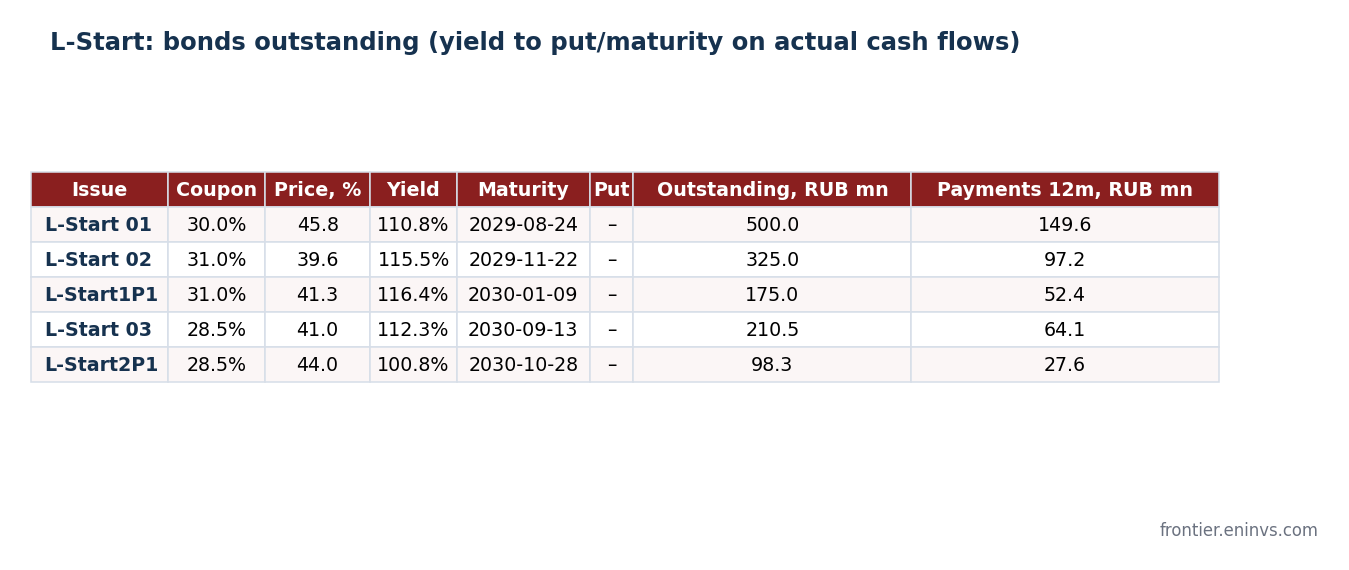
Authors' estimate. Assets of RUB 5.4bn against RUB 1.31bn of bonds and, under RAS, about RUB 1bn of other borrowings give formal coverage, but the assets are receivables and inventories for contracts whose liquidity under stress is unknown. The 4 September payment supports the temporary-delay scenario, and the market responded with a rise of a third. But each month the company must pay about RUB 12mn of coupons on 001P-1, BO-03 and 002P-01, and at the end of November the quarterly coupons on BO-01 and BO-02 of RUB 62mn; with cash of RUB 15mn and a negative flow of RUB 1.76bn over the year, this is a race between receipts from customers and the schedule. We would still not put the probability of the full schedule being met through the 2029-2030 redemptions above one half: one paid coupon does not close the hole in working capital.
Risks and what to watch
- Next dates. 001P-1 coupons on 28 September, BO-03 on 4 October, then monthly; quarterly coupons on BO-01 and BO-02 at the end of November, about RUB 74mn together for the month. Each delay restarts the 10-day countdown.
- Asset quality. 96% of assets are receivables of RUB 3.1bn and inventories of RUB 2.1bn; the inventories were not confirmed by the auditor for 2024 and 2025, and the debtors are not disclosed. Under stress, by our estimate, asset coverage of liabilities is 0.6-0.8x, not 1.4x.
- Short-term debt. RUB 1.39bn of borrowings maturing within a year at 30.06.2026, against bonds maturing in 2029-2030 – what these are and to whom, the company has not explained.
- Taxes. Arrears of RUB 13mn in contributions, personal income tax and profit tax as of 25.08.2026: a Federal Tax Service demand and account block is a workable scenario that would stop coupon payments regardless of the company's wish to pay.
- Industry. Drilling and oil company capex have been falling since 2H2025, TMK and oilfield services have already shown declines; L-Start's customers will pay later and bargain on price.
- Receivables. RUB 1.3bn of receivables at the end of 2024 against revenue of RUB 1.5bn; the structure of customers (oilfield services, drilling contractors) is not disclosed.
- Rating. NCR B.ru and the withdrawn Expert RA rating: under Kulikov's rule "rating withdrawn – sell", the signal was already there in November 2025.
- Audit and disclosure. Three auditors in three years, two consecutive qualified opinions, nobody observed the inventory count; an incomplete 2025 issuer report in the exchange violations index – signs that appear in most defaults in our sample.
Bottom line: a coupon payment is relief, not a turn; do not buy for the coupon, participate only as a recovery play
L-Start is a classic high-yield case of growth on borrowed money at 30%: the business is growing, there is profit, there is no cash. Under the selection rules from Kulikov's broadcast, the bond was screened out three times: rating below BB+, issues under RUB 1bn, rating withdrawal. The 4 September payment shows that customers and the owner still prefer to pay, and that is the best possible signal of the week. But it does not change the main point: debt of RUB 2.3bn at 30% on a balance sheet with equity of RUB 0.4bn and cash of RUB 15mn is a position for those who knowingly buy restructuring risk at 40-46% of par and are prepared for a bondholders' meeting; for a coupon portfolio the bonds remain unsuitable. Of the eight issuers we have reviewed, L-Start is second in risk after Anterra.
Sources and caveats
- RAS statements of OOO L-Start for 2023-2025 and 1H2026 (GIR BO of the Federal Tax Service, e-disclosure), balance sheet at 30.06.2026 – the issuer's interim statements of 03.08.2026.
- Audit opinions: OOO Auditorskaya Gruppa 2K of 05.08.2025 (for 2024), AO AK Institut Problem Predprinimatelstva of 05.03.2026 (for 2025); RAEX ranking of audit organisations by 2024 revenue.
- Default examples: publications on Obuv Rossii (vc.ru, 2022), Naftatrans Plus (Smart-Lab, 2025), Garant-Invest (InvestFuture, 09.2025), our review of EuroTrans (08.2026).
- Issuer notices of technical default of 28.08.2026 and of coupon payment of 04.09.2026 (e-disclosure), the Moscow Exchange disclosure violations index, Federal Tax Service open data.
- Rating actions: NCR B.ru (07.11.2025), Expert RA – withdrawal of ruB- (12.11.2025).
- Federal Tax Service open data (arrears, offences, special regimes) as of 25.08.2026 and the "Transparent Business" service; information on suspension of account operations as of 28.08.2026; arbitration case file via public aggregators (case A60-55452/2026).
- Industry: CDU TEK data on drilling footage for 2025 (neftegaz.ru publication of 20.02.2026), TMK IFRS for 1H2026 and 2025, Kommersant's oilfield services review of 06.05.2026, Gazprom's 2026 investment programme (board of directors 23.12.2025), Rosneft IFRS for 1H2026, ACRA release on Borets of 09.07.2026.
- Coupon schedule – MOEX ISS; prices and yields of the issues – last MOEX trades at 19:20 Moscow time on 04.09.2026 in the table and in the text; yield to maturity is calculated on actual cash flows (XIRR), as on eninvs.com.
Reviews of other issuers and weekly analytics are in the Telegram channel Enhanced Investments @eninv, and extended cards of all issuers are on the portal.
See also: market overview · valuation map · stock screeners