Ozon Pharmaceuticals 1H2026: 50% margin, profit up 90%, and factoring instead of debt
On 25 August Ozon Pharmaceuticals published its IFRS results for the first half of 2026 and, on the same day, a dividend recommendation. Revenue rose 12%, net profit grew 90%, and leverage fell to 0.4x EBITDA. Below is a breakdown of what these figures are made of.
Revenue grew 12%, while unit sales fell 1%
First-half revenue was RUB 14.8 bn against RUB 13.3 bn a year earlier. At the same time 151.1 mn packs were sold, 1% fewer than last year. The entire increase came from the average price per pack and a shift of the mix towards expensive drugs.
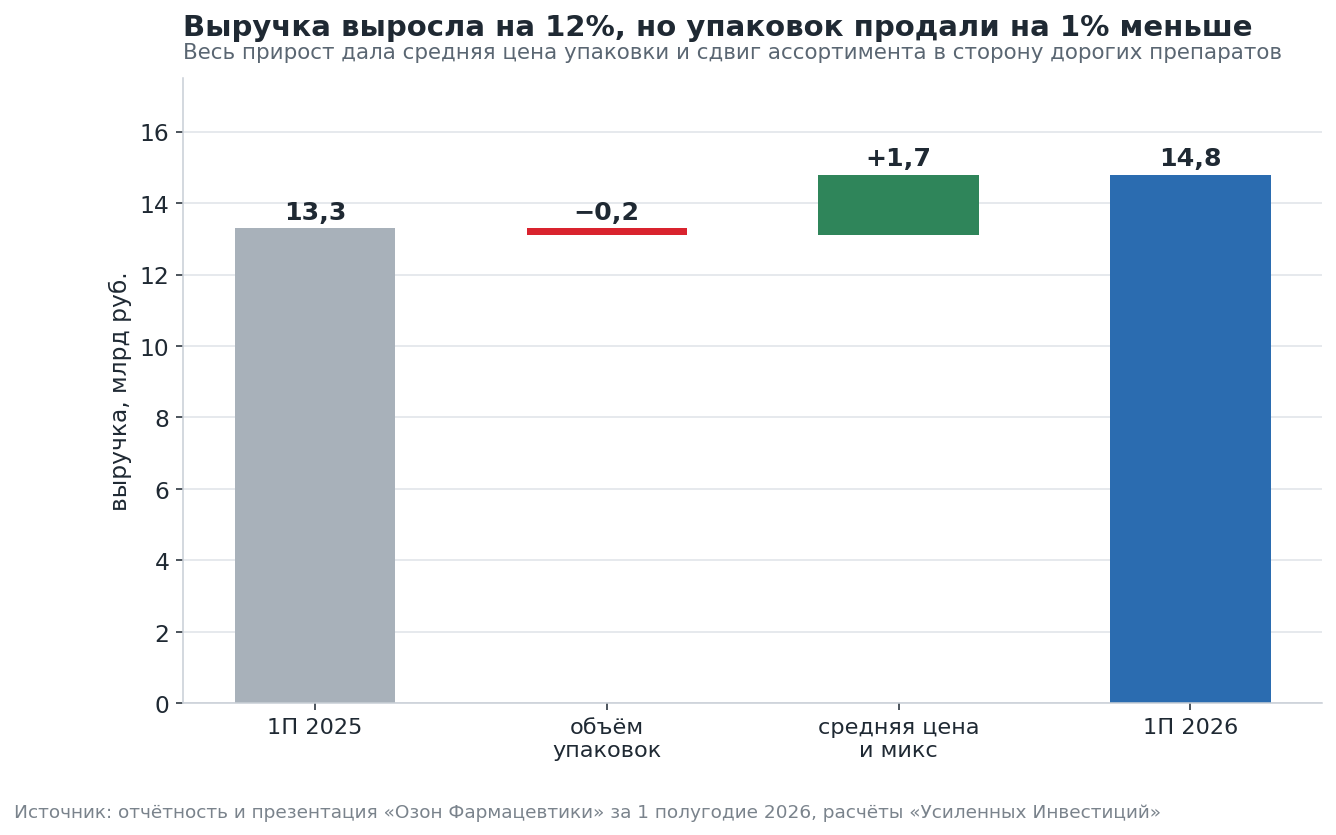
The company explains the fall in volumes by last year's high base, low seasonal morbidity and a move to larger packs. The statements put it directly: revenue growth was driven by higher drug prices and increased sales of high-value products.
By channel, government procurement gained the most, from RUB 5.4 bn to RUB 6.4 bn. Offline retail rose from RUB 7.2 bn to RUB 7.5 bn, online from RUB 0.7 bn to RUB 0.9 bn. The number of tenders won grew 35% to 22.4 thousand. According to DSM Group, sales to end consumers grew 14.4% against 11.8% for the market, so on the shelf the company really is outpacing the market.
A 50% gross margin is the half-year's one real achievement
Cost of sales fell 1.4% to RUB 7.4 bn while revenue grew. Gross margin rose from 43.4% to 50.0%. Within cost of sales, raw materials and supplies became 22.7% cheaper at once, from RUB 5.9 bn to RUB 4.6 bn, thanks to a switch to direct purchasing, a tender platform and a stronger rouble. Payroll meanwhile rose 13.8%.
This is the only line where genuine operating progress is visible, and it explains almost all of the improvement in adjusted EBITDA margin.
Profit rose 90%, but eight of the nine points of margin came from debt, not the business
Net profit was RUB 3.25 bn against RUB 1.71 bn. Net margin rose from 12.9% to 21.9%. Breaking down these nine points shows where they came from.
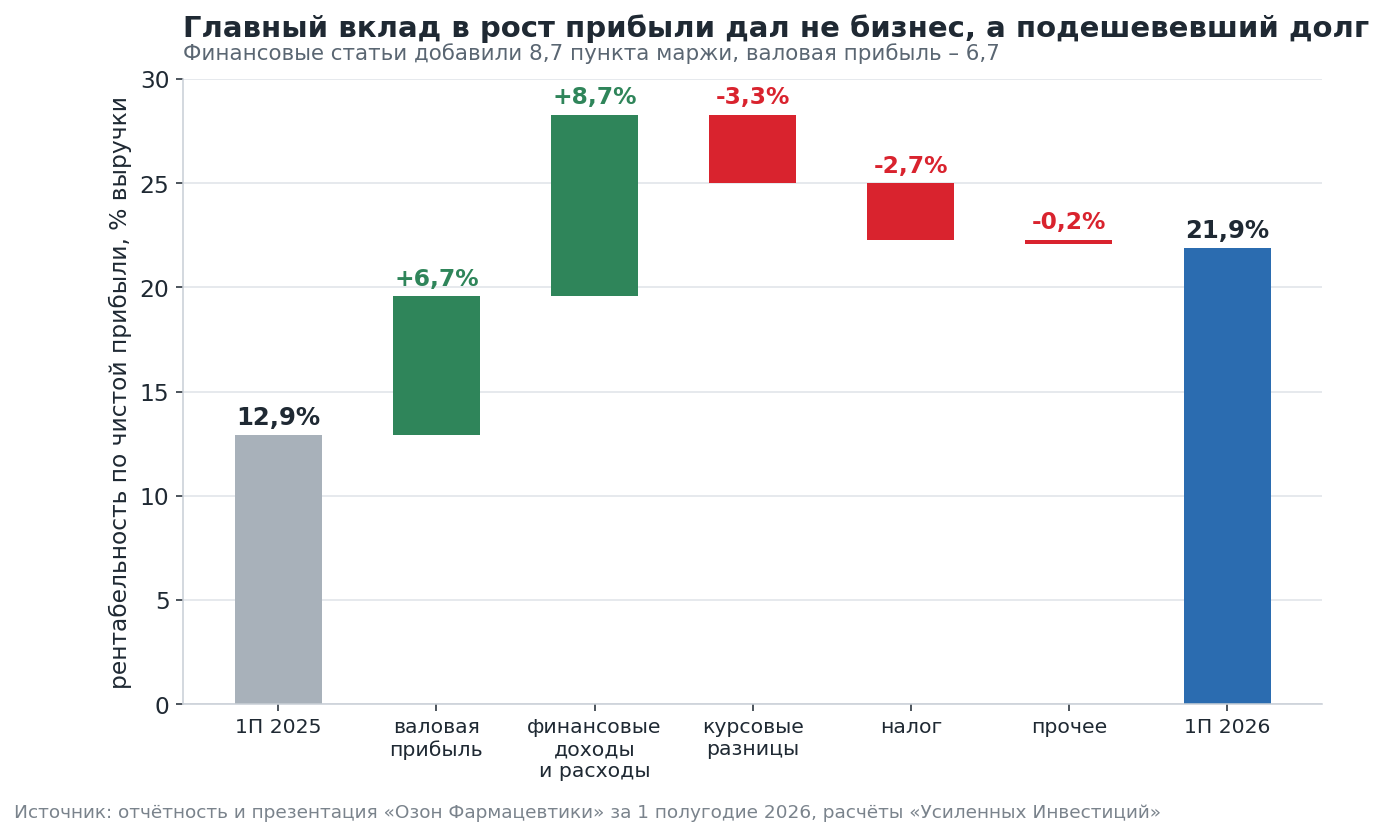
Finance income and expenses added 8.7 points and gross profit 6.7 points. Foreign exchange differences took away 3.3 points and tax 2.7. Finance expenses almost halved, from RUB 2.04 bn to RUB 1.03 bn, and this is a consequence of the lower key rate and debt repayment, not of work on the product range.
Earnings per share grew more modestly than profit, from RUB 1.55 to RUB 2.78, up 79%. The difference was eaten by the 2025 additional share issue: the weighted average number of shares rose from 1,103 mn to 1,168 mn.
Adjusted EBITDA of 39% is calculated without biotech expenses
The company reports adjusted EBITDA of RUB 5.8 bn with a margin of 39.2% against 33.0% a year earlier. A note to the presentation says the adjustment is made for research and development expenses on biologics, foreign exchange differences and non-recurring events.
A direct calculation, operating profit plus depreciation and amortisation, gives RUB 5.47 bn and a 36.9% margin against RUB 4.53 bn and 34.1%. Growth on this basis is 20.8%, not 33%. The difference between the two growth rates is almost entirely explained by FX: in 1H2025 operating profit contained RUB 395 mn of positive FX differences, this year RUB 53 mn of negative ones. If FX is removed from both periods, the company's figure is confirmed.
More contentious is the other part of the adjustment. Spending on biologics development is not a one-off event but a permanent item of the growth strategy, for the sake of which Ozon Medica and Mabscale are being built. By excluding it from EBITDA, the company shows the margin of a business that does not yet exist.
Debt halved, off-balance-sheet non-recourse factoring grew, and the company acknowledged it
Financial debt on the balance sheet fell from RUB 11.8 bn to RUB 7.7 bn. Cash is RUB 2.7 bn. Net debt to 12-month EBITDA fell to 0.4x against 0.8x at the end of 2025.
In parallel, non-recourse factoring grew; it is not on the balance sheet: receivables are sold to a factor and no liability is recognised. Over a year and a half its volume grew from RUB 3.6 bn to RUB 5.5 bn, while balance-sheet debt fell from RUB 15.5 bn to RUB 7.7 bn.
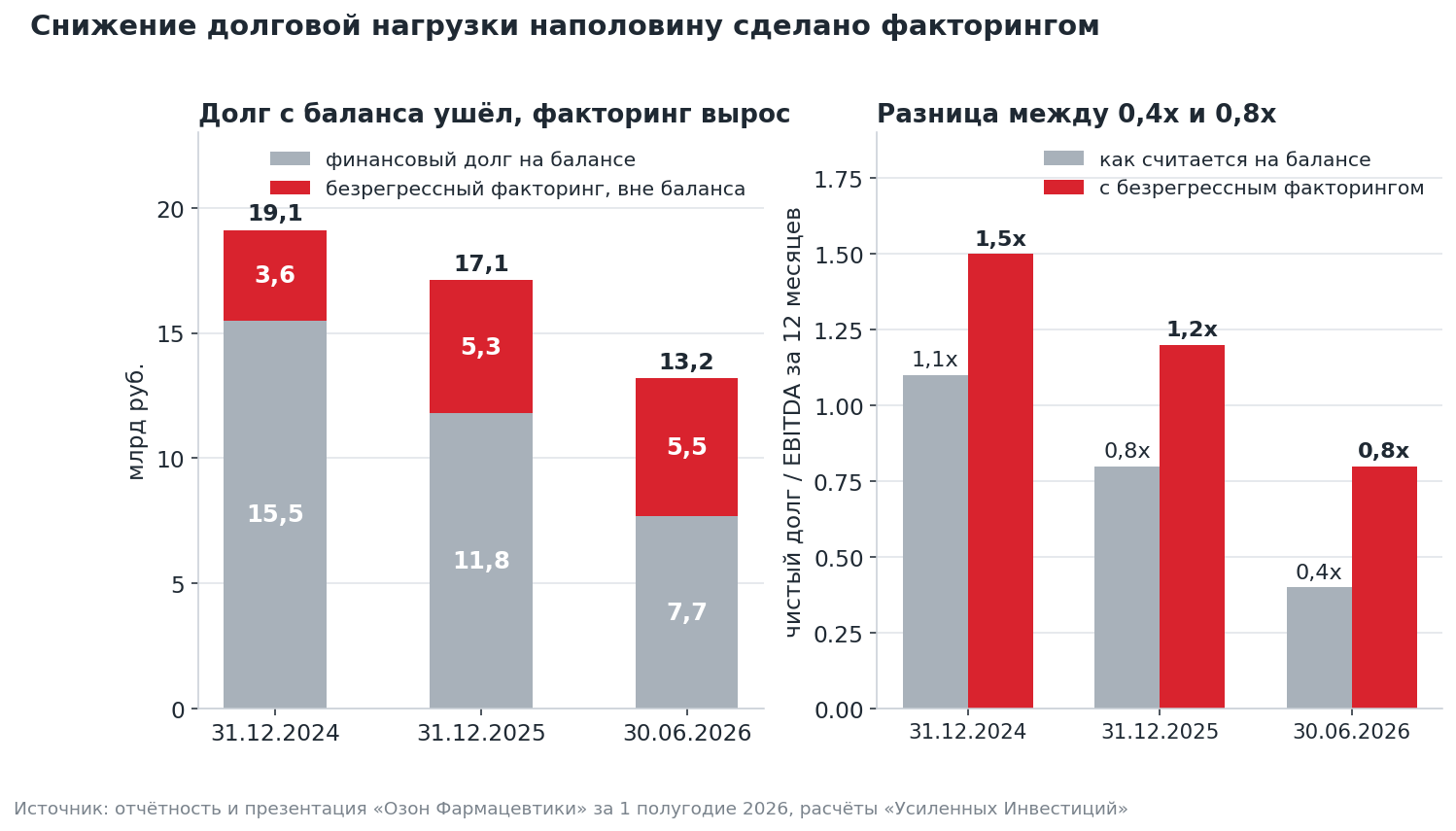
It is telling that on 12 August the company itself rewrote its dividend policy and introduced an adjusted net debt measure that includes non-recourse factoring. On this measure leverage at 30 June is 0.8x, not 0.4x. The weighted average rate on all debt and factoring is 16.8%, and 90% of obligations carry a floating rate.
Two thirds of interest expense never reached the income statement
Interest expense on loans in the income statement is only RUB 251 mn against RUB 788 mn a year earlier, a fall of 68% with debt down 34%. The explanation is in the notes: another RUB 472 mn of interest was capitalised into the cost of assets, RUB 134 mn into property, plant and equipment and RUB 338 mn into intangible assets. The capitalisation rate is stated directly – 16.70%.
So the real cost of servicing debt for the half-year is about RUB 723 mn, and a third of that amount is reflected in profit. Formally everything follows the standard: the company is building plants and registering drugs. In practice it means that operating profit and EBITDA look better than the cash outflow on interest, and the interest will later come back through depreciation and amortisation.
The largest finance expense item is now not bank interest but the fee on non-recourse factoring – RUB 491 mn for the half-year.
Free cash flow of RUB 4.5 bn was produced by releasing receivables
Operating cash flow rose from RUB 2.8 bn to RUB 6.8 bn. The company estimates free cash flow at RUB 4.5 bn. This is how it was put together.
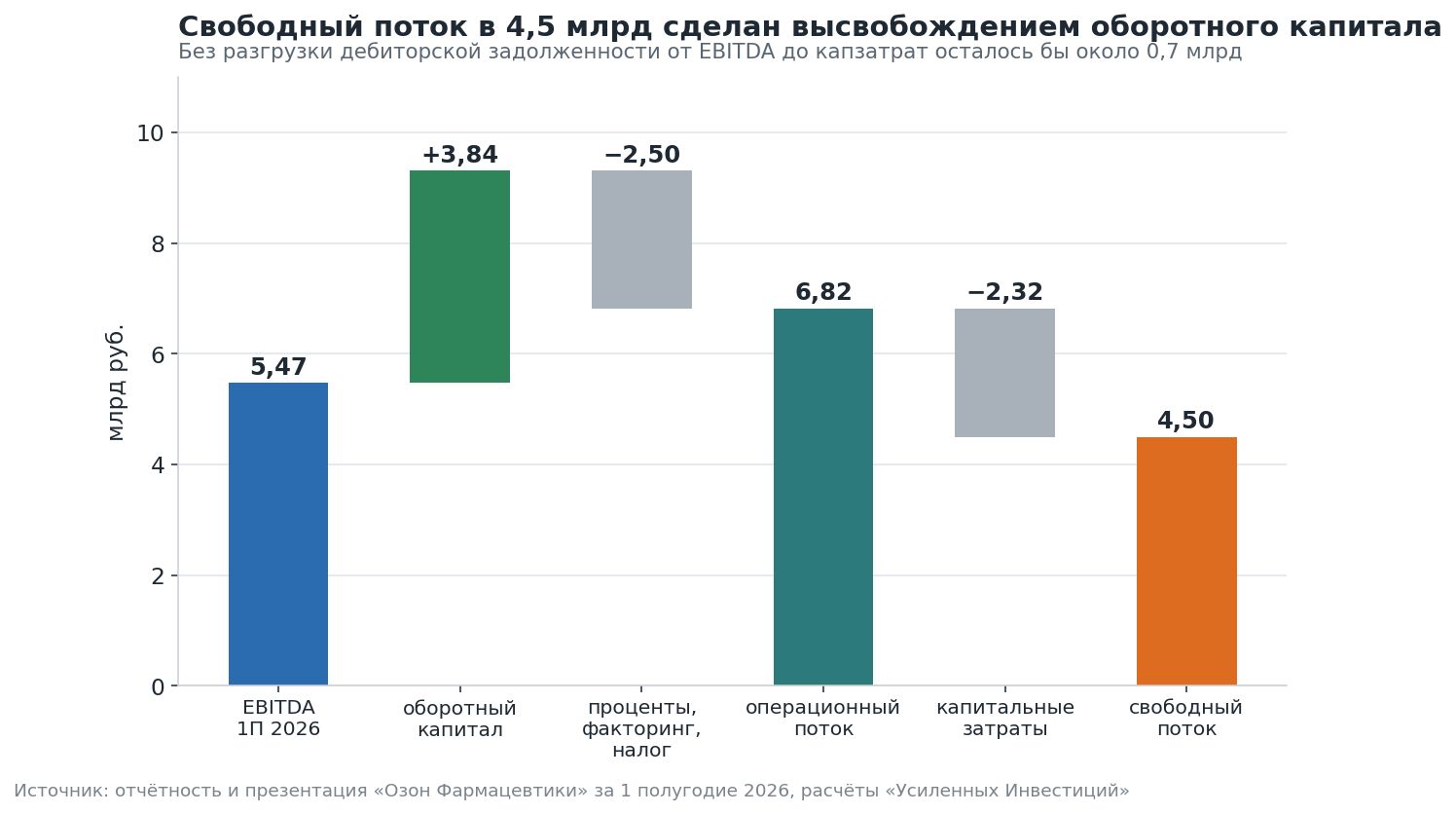
Of RUB 6.8 bn of operating cash flow, RUB 3.8 bn came from the release of working capital. Receivables fell 19%, from RUB 16.9 bn to RUB 13.7 bn, and turnover improved from 181 to 135 days, mainly thanks to the same factoring. Inventories barely changed, and their turnover even worsened, from 252 to 270 days.
Without the release of working capital, about RUB 0.7 bn would have been left from EBITDA after interest, factoring, taxes and capital expenditure. This is not a reproach, as seasonality in pharma is real, but repeating such a flow in the second half from the same source will not be possible.
A dividend of 49 kopecks and a new formula tied to adjusted debt
The board of directors recommended RUB 572.2 mn, or 49 kopecks per share, for the six months of 2026. The record date is proposed for 29 September. Together with the 27 kopecks already paid for the first quarter, the total for the half-year comes to 76 kopecks.
The company discloses the calculation in full. The base is IFRS net profit for the last 12 months, RUB 7,704 mn, divided by four quarters, that is RUB 1,926 mn per quarter. An adjusted leverage of 0.8x corresponds to a payout ratio of 30% on the new scale. That gives RUB 578 mn, and after rounding RUB 572 mn.
The new policy also removed free cash flow from the criteria. The company's wording is that FCF dynamics in a single period do not always reflect profitability and sustainability. Given what this half-year's FCF was made of, the caveat looks appropriate, but it also removes the only constraint tied to cash rather than accounting profit.
The full-year guidance requires growth to almost double in the second half
The company confirmed its 2026 revenue growth guidance of 15–25%. Growth in the first half was 12%. To reach even the lower bound, the second half has to add about 17%, and for the upper bound about 35%.
The stated supports for acceleration are: a wider product range, pharmacy presence up to 23% since the start of the year, a portfolio of marketing authorisations that reached 587, up 22 over the half-year, and tender activity growing 35%. Capital expenditure rose 17% to RUB 2.3 bn, with investment in Ozon Medica 2.2 times last year's, at RUB 839 mn, and in Mabscale 27% lower. The company expects commercial production of biosimilars from 2027.
Multiples: about six earnings and 4.3 EBITDA
At a price of about RUB 42.8 and 1,167.7 mn shares, market capitalisation is about RUB 49.9 bn. Profit for the last 12 months is RUB 7.7 bn, that is about 6.5 years of earnings. Enterprise value with reported net debt is about RUB 55 bn, which is 4.3x 12-month EBITDA; with adjusted debt including factoring, about 4.7x. Equity at 30 June is RUB 36.0 bn, that is 1.4x book value.
The quarterly dividend of 49 kopecks gives about 4.6% on an annualised basis at the current price, provided that profit and leverage stay where they are.
Tickers
Companies mentioned: Ozon Pharmaceuticals. An extended card with financial history and multiples is on our Frontier portal.
Conclusion
The half-year is strong on margin and weak on volumes. A 50% gross margin has been earned honestly, through purchasing and the rouble. Everything else in the report needs adjusting: three quarters of the 90% profit growth came from cheaper debt, two thirds of interest went to the balance sheet bypassing profit, free cash flow was built by releasing receivables through factoring, and factoring itself grew exactly when balance-sheet debt was falling. The company is behaving carefully, though: it introduced adjusted debt into the dividend formula itself and discloses the interest capitalisation rate. The key question for the second half is whether volume growth can be restored, because the price lever is not infinite.
Weekly analysis of Russian issuers is in the Telegram channel "Enhanced Investments" @eninv.
See also: market overview · valuation map · stock screeners