PIK is being bought out at RUB 551.40 while sector multiples imply RUB 1,327 and up
PIK is leaving the exchange, and two prices have been announced for the same share. RUB 551.40 will go to those whose shares are simply written off. RUB 537.90 will go to those who vote against the delisting. Both are below the market: on the eve of the announcement the stock cost RUB 571.80. Both are below book equity of RUB 644.20 per share. On the multiples of comparable competitors, calculated with an escrow adjustment, the stock is worth RUB 1,327 to RUB 1,536. A shareholder who has collected 98% pays for control not a premium but a discount.
On 20 October shares will be written off for everyone left in the register
On 4 September JSC "Nedvizhimye Aktivy", which together with affiliates controls 98.0071% of PIK, sent a demand to buy out the remaining shares at RUB 551.40. The record date for holders of the shares being bought out is set for 20 October. This is Article 84.8 of the Joint-Stock Companies Law. It does not require the consent of minority holders, refusal is not possible, and a vote at a meeting means nothing here.
The buyout covers 1.9929% of capital, that is 13.16 mn shares out of 660.5 mn. At the announced price the entire remainder costs the buyer about RUB 7.3 bn, while the whole company is valued at RUB 364 bn.
On 7 September the board of directors took the decision on delisting, unanimously with five votes, and called an absentee extraordinary meeting for 13 October. The agenda is a single block: remove the reference to public status from the charter, apply to the Bank of Russia for an exemption from the disclosure obligation, and file an application to delist all shares.
The second price is meant for those who vote against, and it is lower than the first
By the same decision the board determined the buyback price under Article 75, for shareholders who vote against or do not take part in the vote. It came to RUB 537.90.
This is a different mechanism with a different anchor. Under Article 84.8 the majority holder buys, and the price cannot be lower than the highest price at which it bought shares itself in the offer. In spring it paid RUB 551.40. Under Articles 75 and 76 the company itself buys, and the price is set by the board on the basis of a valuer's report, but not lower than the six-month weighted average exchange price. Different grounds produced different figures. The difference was RUB 13.50, and not in favour of the one who expressed disagreement.
The market counted this the same day. On 4 September PIK closed at RUB 571.80, on 7 September at RUB 537.00, on turnover of RUB 744 mn against the usual forty to seventy. The stock moved toward the lower of the two prices, not the upper one.
RUB 537.90 is exactly the lower bound the law allows
We calculated the weighted average price from Moscow Exchange data for the six months preceding the board's decision, from 7 March to 4 September. The result was RUB 538.5. The board set RUB 537.90.
A match to within half a rouble means that the basis taken was exactly the value below which the law does not allow the price to fall. The price contains no premium for the shares being taken against the owner's will and no add-on for the loss of liquidity.
The averaging window lies entirely inside the transaction
The six months over which the average was calculated are March-September 2026. All this time the stock was already living inside the transaction. The majority holder gathered control, announced an offer at RUB 551.40, and free float shrank to about two percent of capital. A quote in such an order book reflects the parameters of the offer itself, not an independent valuation of the business.
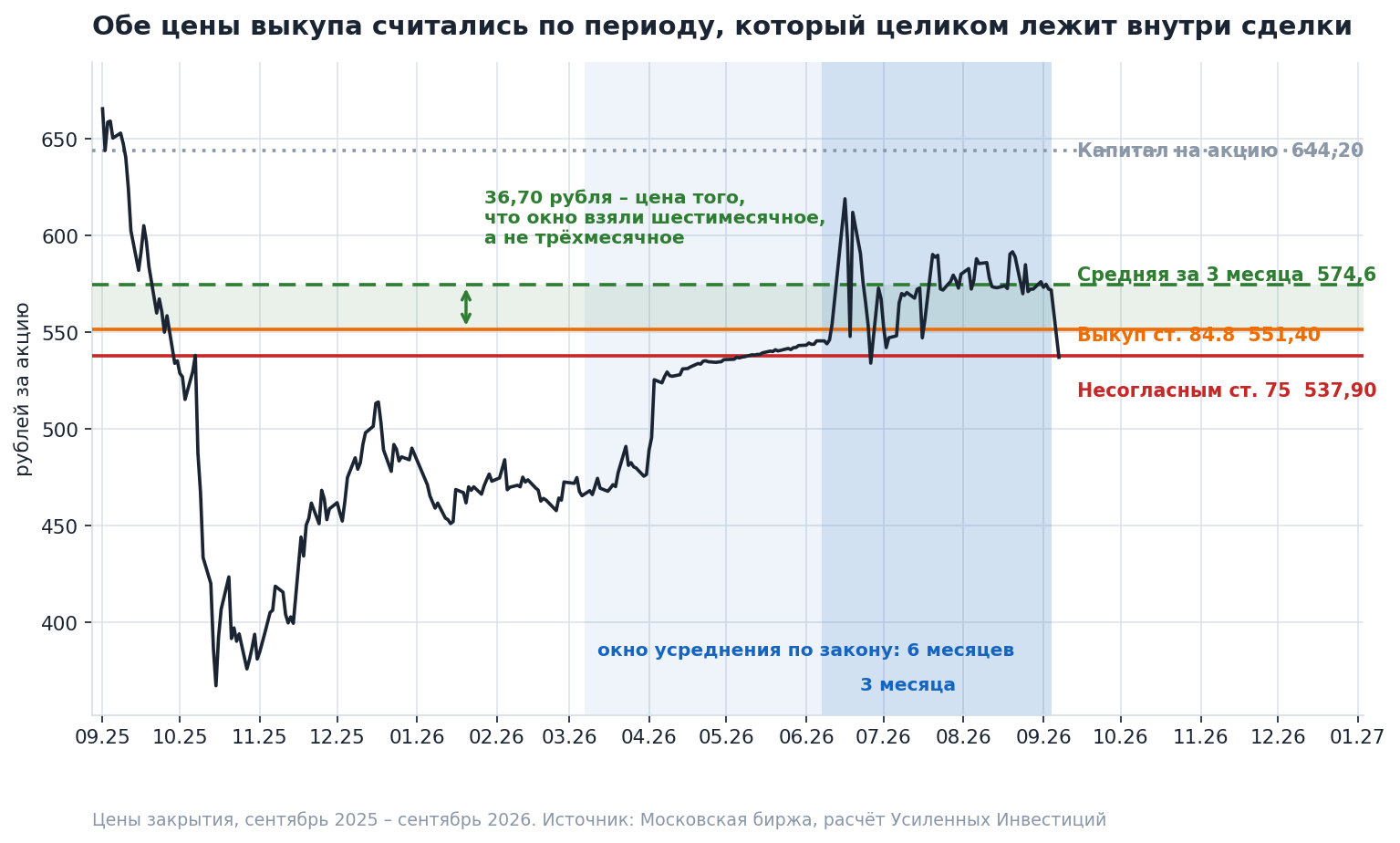
German law is arranged differently. There the compensation floor is calculated from the three-month weighted average before the announcement of the transaction, that is before the price began to reflect the coming buyout. The German Federal Court of Justice added one more rule in the Stollwerck case. If a long time passes between the announcement and the meeting's decision, the three-month period is shifted and indexed, otherwise the majority holder benefits from its own slowness.
On PIK's data a shorter and fresher window gives noticeably more. The three-month weighted average before the board's decision was RUB 574.6. Choosing the six-month window instead of the three-month one costs the minority holder RUB 36.70 per share.
Why RUB 551.40 is too little
Five arguments, each verifiable from published data.
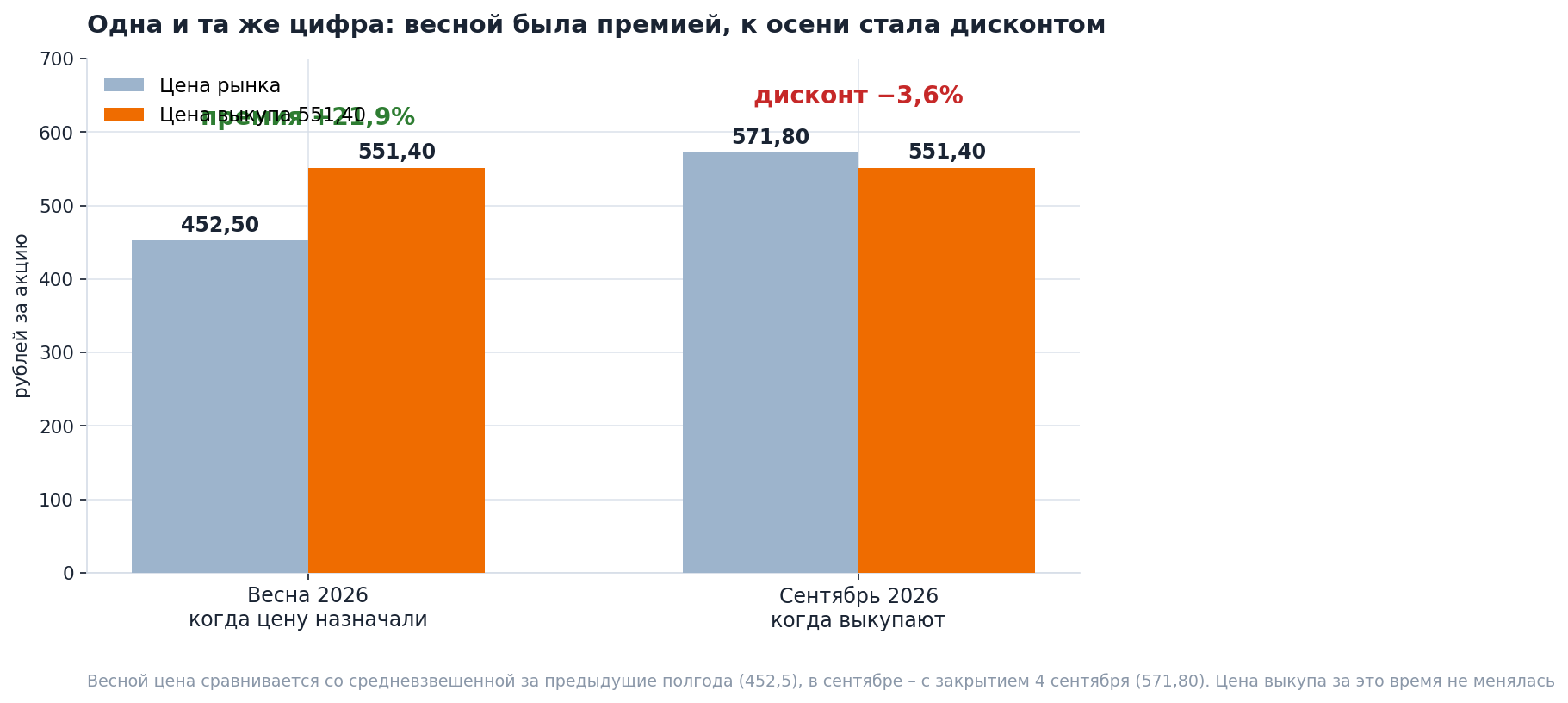
First. This is a discount to the market, not a control premium. On the eve of the announcement, 4 September, the stock closed at RUB 571.80. The squeeze-out is at RUB 551.40, that is 3.6% cheaper, and the price for dissenters is 5.9% cheaper. The buyer gets control over the whole company, and worldwide a premium is paid for that, usually a double-digit one.
Second. The price has not been indexed for half a year. RUB 551.40 is the figure of the spring offer. When it was announced it was a premium: the weighted average for the previous six months was RUB 452.5, and the mark-up reached 22%. Over the months since, the stock has repriced upward, while the figure stayed the same and turned into a discount.
Third. The price is below the company's own equity. Under IFRS at 30 June it is RUB 425.5 bn, or RUB 644.20 per share. Each share is being taken RUB 92.80 cheaper than what stands behind it on the balance sheet.
Fourth, and this is the main one. The equity itself is understated for a developer. The notes to the first-half statements disclose the balance on escrow accounts: RUB 543,992 mn, and state directly that it is not recognised in the consolidated statement of financial position. Apartment buyers' money sits in authorised banks and reaches the company when the accounts are released. At the same time the project financing that this same money repays is carried on the balance sheet in full. This is where the net debt of RUB 474.1 bn comes from.
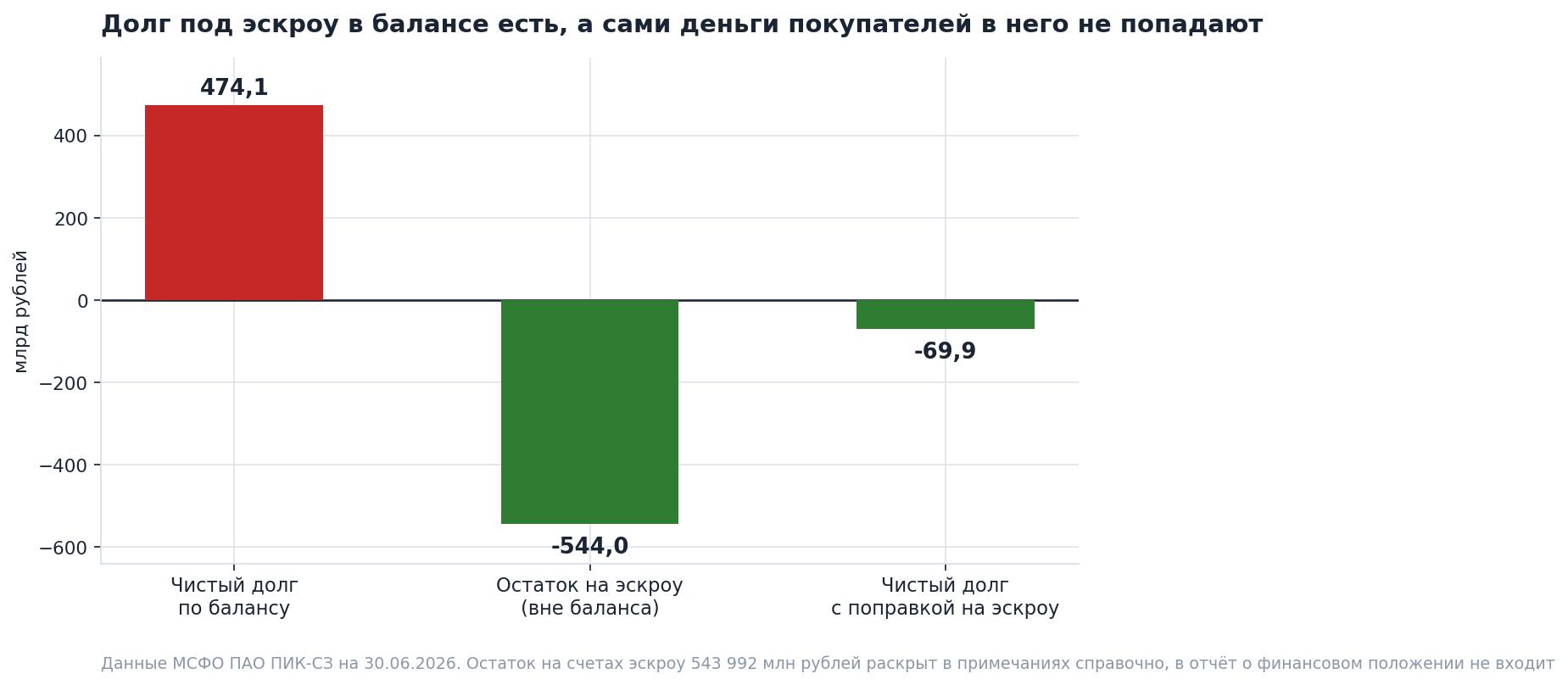
If we make the adjustment standard for the sector and subtract escrow balances, we get not debt but a net cash position of about RUB 70 bn.
Escrow exists at all developers, but it covers debt very differently. At 30 June the balances were: PIK RUB 544.0 bn, Samolet 338.8, LSR 172.4, Etalon 48.5. Reported net debt is at the same time 474.1, 777.6, 355.4 and 190.4 bn respectively.
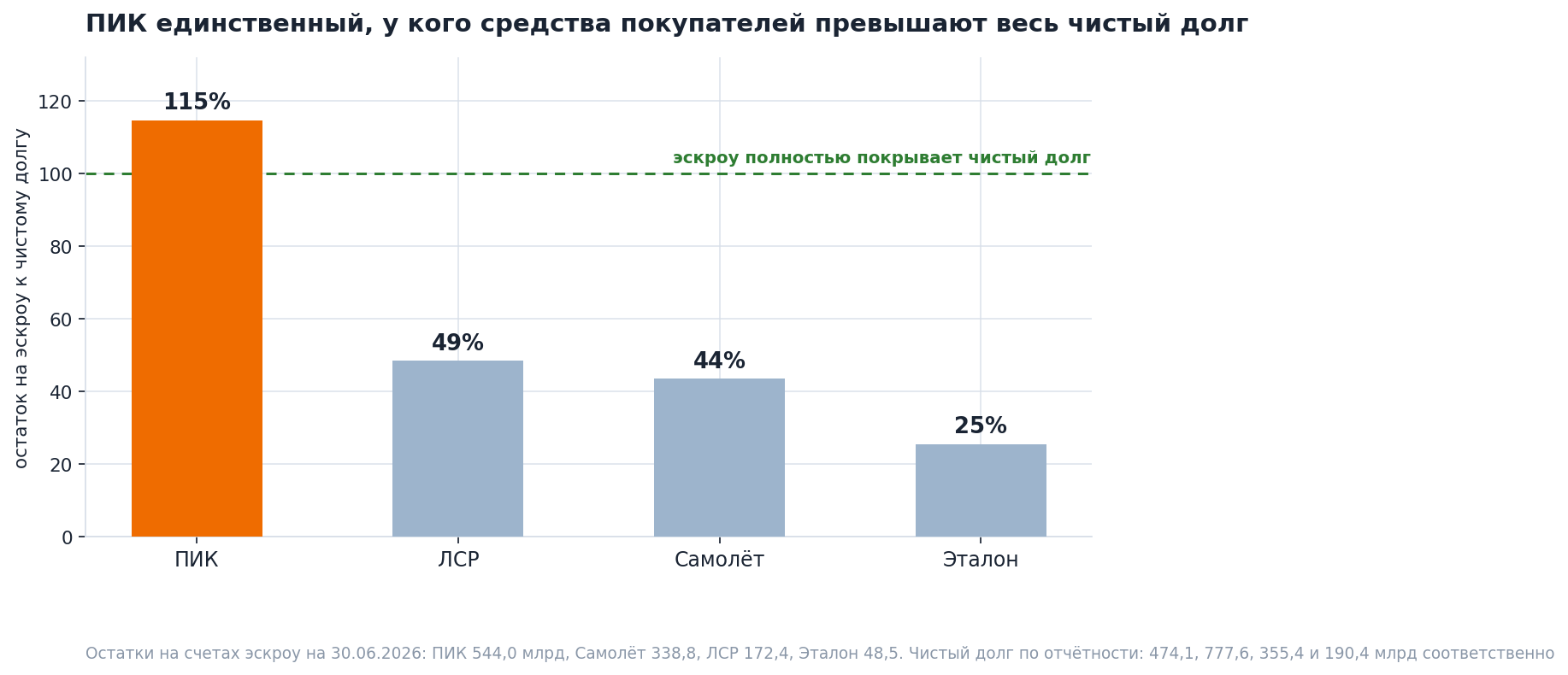
Of the four companies with disclosure, PIK is the only one whose buyers' funds exceed all of its net debt.
Fifth. The price is below both the three-month average of RUB 574.6 and the twelve-month high of RUB 653.00.
The opposite argument has to be named as well. The business is weak. In the first half of 2026 revenue fell 11.6% to RUB 290.1 bn, net profit more than halved to RUB 14.7 bn, and operating cash flow was minus RUB 120.7 bn against minus RUB 97.5 bn a year earlier. But a weak business is an argument for a low market price, not for buying out below that price.
An independent valuation is in the statements, but not where it is needed
The company discloses that the fair value of investment property was determined with the involvement of external independent real estate valuers. The model assumptions are disclosed too: rouble flows are discounted at a pre-tax rate averaging 23.5%, price growth is set at the inflation level of 5%, investment cost growth at 6.5%, brokerage costs at 4%.
The trouble is that this values a negligible part of the portfolio. The main assets, inventories of RUB 634.2 bn, of which RUB 580.8 bn is work in progress for sale, are carried at cost. Investment property at the last disclosed date was worth RUB 7.2 bn.
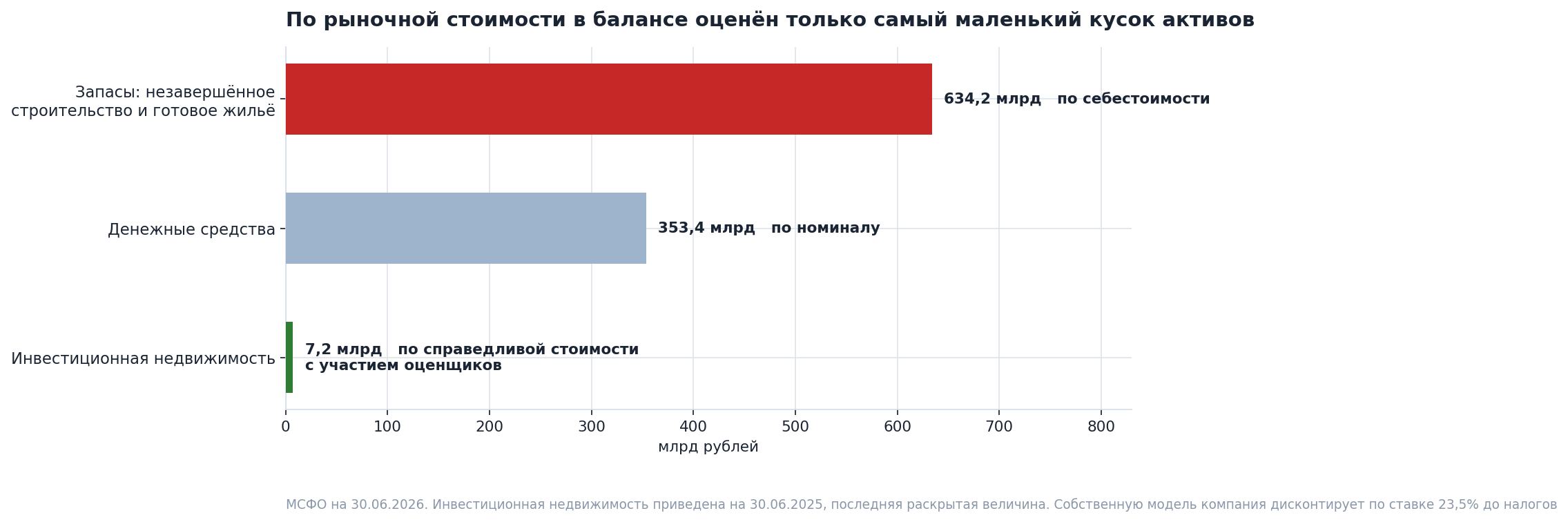
The company knows how to value its projects by discounted cash flows and does so with valuers, but applies the approach to the smallest piece of the balance sheet. PIK does not currently publish a valuation of the whole land bank or an NPV of the project portfolio. The valuer's report on which the buyback price was set is by law attached to the demand, but it is not in the disclosure feed.
This is exactly the point where Western regimes are arranged differently. The US Rule 13E-3, when a company goes private, requires disclosure of valuers' opinions and a direct answer to whether the company considers the transaction fair to unaffiliated shareholders.
The last independent valuation of the PIK portfolio was published for 2020
The company posted valuation reports six years in a row, from 2014 to 2020, in a separate section of its website: a valuation of the real estate portfolio and of assets at each 31 December. The valuation was done by Cushman & Wakefield.
The last published figures relate to the end of 2020. The project portfolio was valued at RUB 683.0 bn against RUB 426.5 bn a year earlier, the land bank was about 16.5 mn square metres against 11.1 mn, and the value of real estate and business including intragroup loans reached RUB 916.7 bn. After 2020 publication stopped. Today the whole company is being taken for RUB 364 bn.
These numbers cannot be compared head-on, and we do not do that. Six years have passed since the end of 2020, the portfolio has changed, the key rate has risen from 4.25 percent to fourteen, and a valuation of a project portfolio is not the value of shareholders' equity, as debt has to be subtracted from it. What matters is something else. The company had a mechanism of independent valuation, it worked and was disclosed publicly. It disappeared exactly at the moment when valuation began to determine the price at which shares would be taken from minority holders.
If debt is counted correctly, the company is being taken for 1.75 EBITDA
Last-twelve-month EBITDA is RUB 168.4 bn. Capitalisation at the buyback price is RUB 364.2 bn.
If net debt is taken as printed, RUB 474.1 bn, enterprise value comes to RUB 838.3 bn and the multiple is 4.98 EBITDA. If the escrow adjustment is made, enterprise value falls to RUB 294.3 bn, and the company is being taken for 1.75 EBITDA.
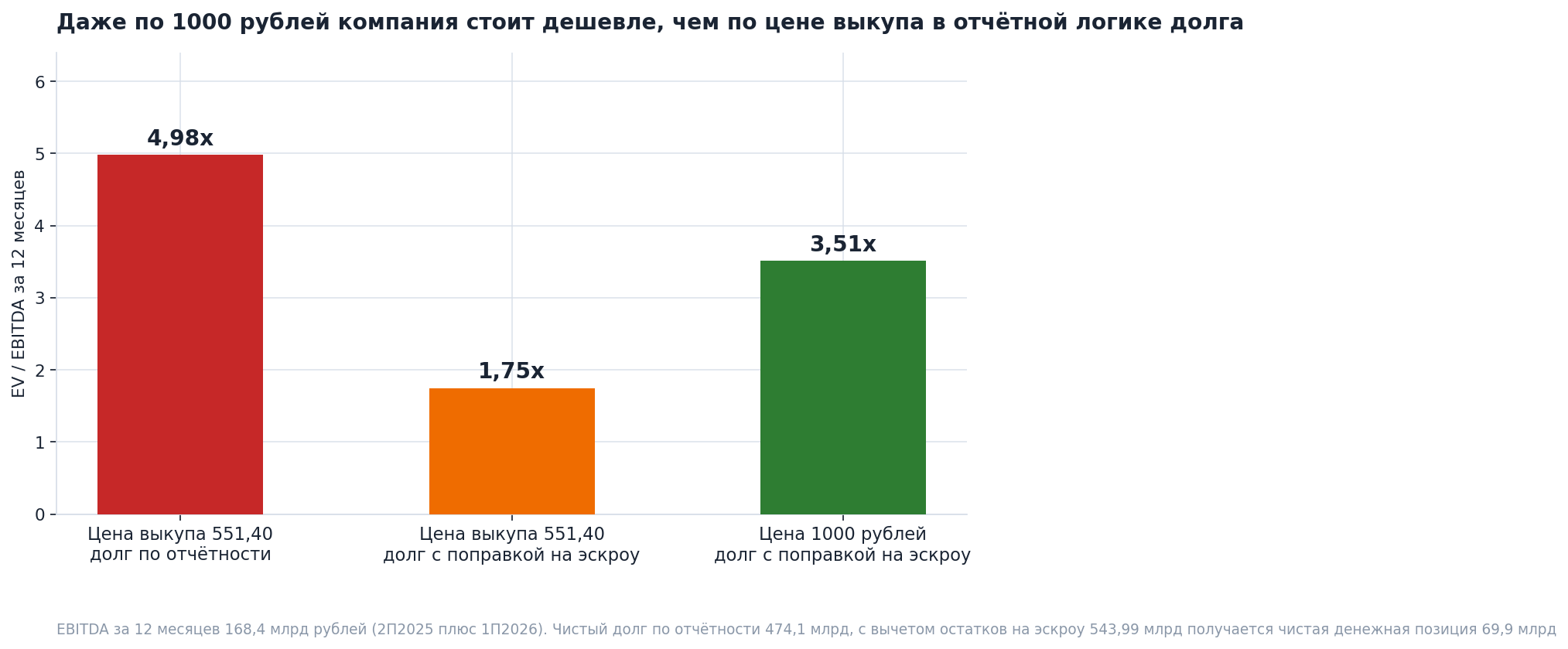
A price of RUB 1,000 per share gives 3.51 EBITDA on the same adjusted basis. That is, a price almost twice as high still leaves the company cheaper than it looks in the buyout if the balance sheet is read literally.
An honest caveat. Both extremes distort the picture in different directions. Full net debt overstates leverage, because RUB 544 bn against it has already been collected from buyers. The full escrow adjustment understates it, because that money will arrive together with revenue not yet recognised and cost not yet recognised. The fair value lies between 1.75 and 4.98, closer to the lower bound, but the point cannot be fixed without a schedule of project completions.
What PIK would be worth on competitors' multiples
We calculated EV/EBITDA by one method for all large developers: capitalisation plus net debt minus escrow balances, divided by twelve-month EBITDA. The balances are taken from the notes to first-half statements, not estimated.
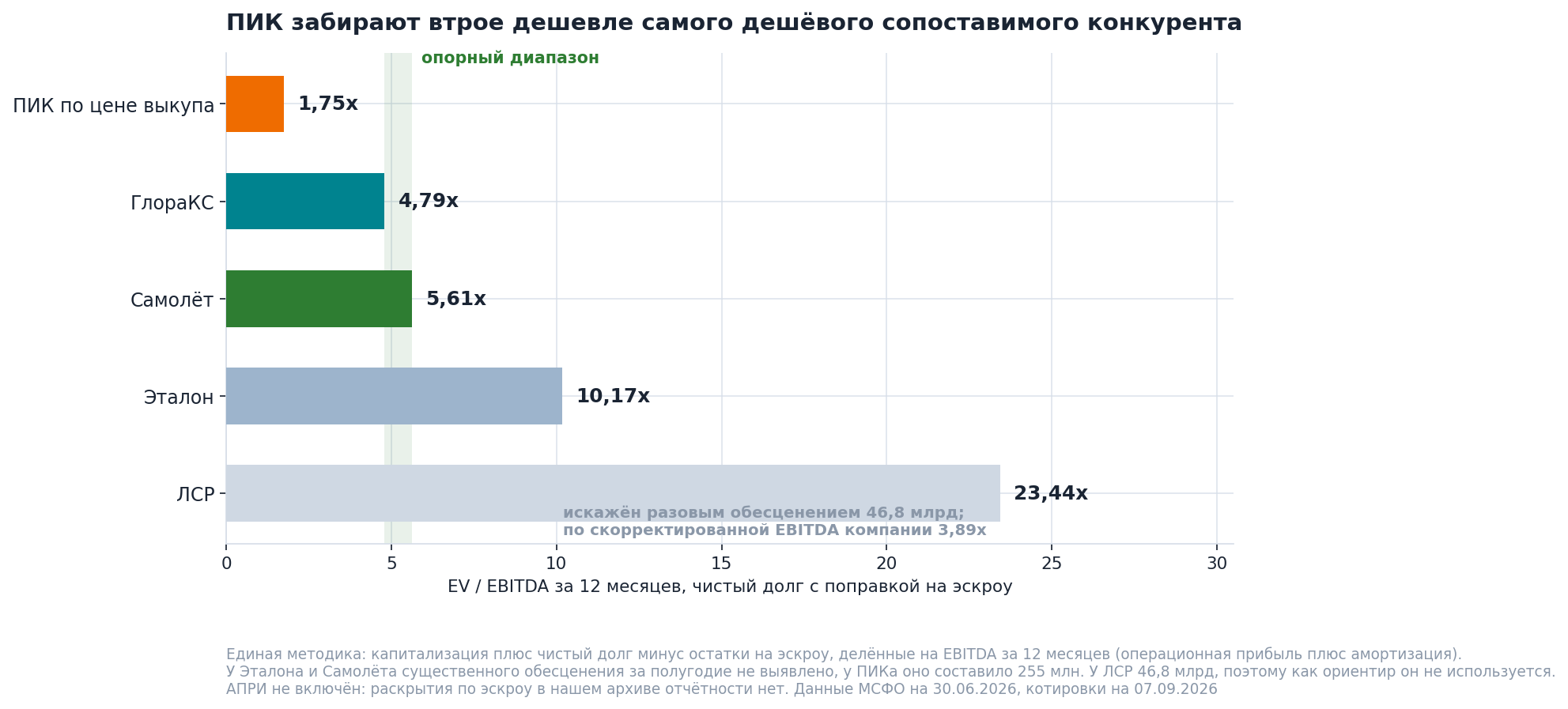
One of the four cannot be compared. At LSR the half-year operating result went negative because of a one-off impairment of RUB 46.8 bn, and under the single method the multiple comes out at 23.44. If the impairment is added back, as the company itself does in its adjusted EBITDA, it is 3.89. A spread from four to twenty-three means LSR cannot serve as an anchor, and we do not use it.
At GLORAX, Samolet and Etalon the half-year impairments are immaterial: at Samolet and Etalon this is stated directly in the statements, and at GLORAX write-offs were RUB 144.6 mn against half-year EBITDA of RUB 6.6 bn. At PIK itself impairment was RUB 255 mn. So these companies are comparable with each other.
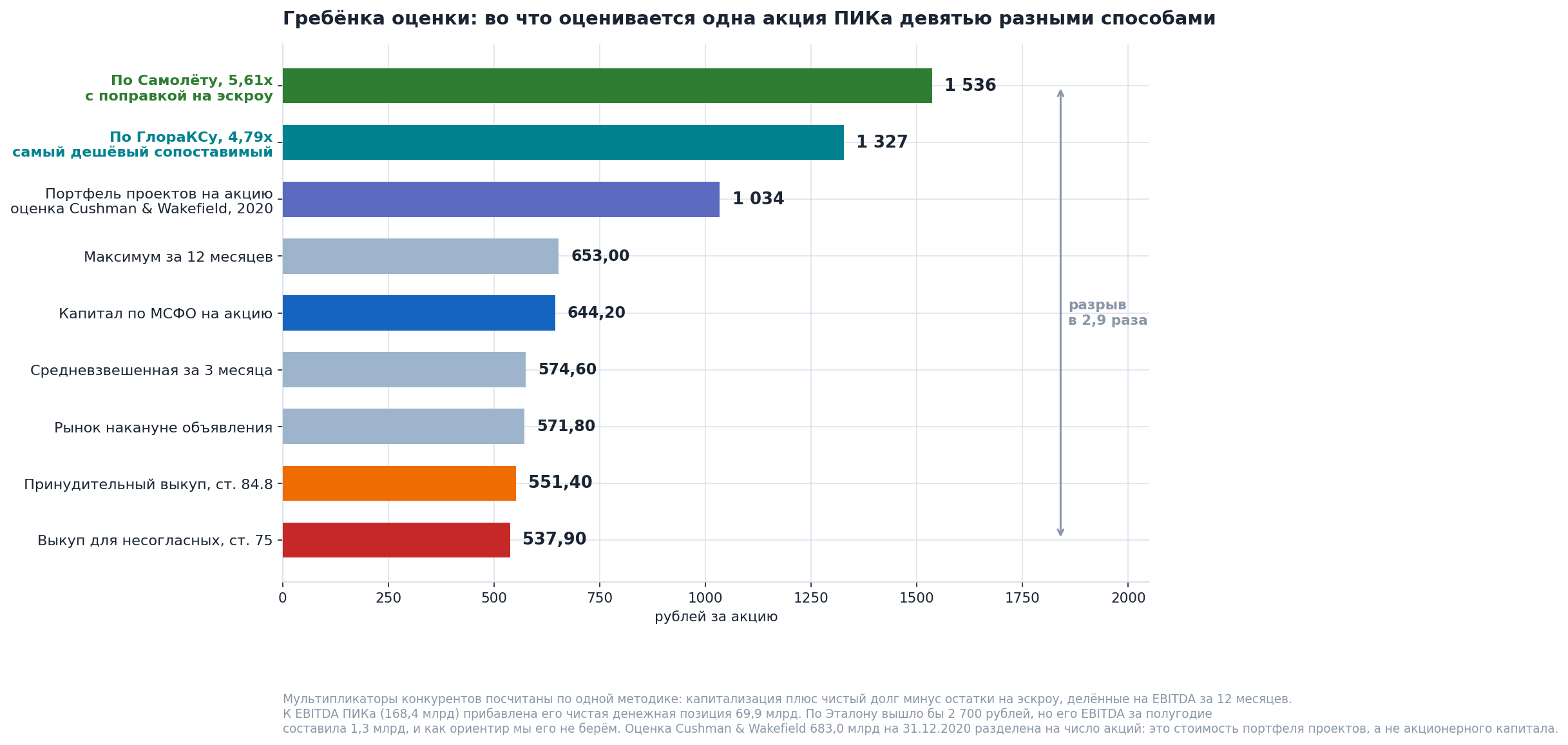
If we apply their multiples to PIK's twelve-month EBITDA of RUB 168.4 bn and add its net cash position of RUB 69.9 bn, the share price comes out as follows. On GLORAX, RUB 1,327. On Samolet, RUB 1,536. On Etalon, RUB 2,699, but Etalon's half-year EBITDA is only RUB 1.3 bn, and we do not take it as a reference.
APRI is not included in the calculation: there is no escrow disclosure in our statements archive, and we did not try to estimate the amount.
PIK used to be worth more than a thousand, and not only in 2021
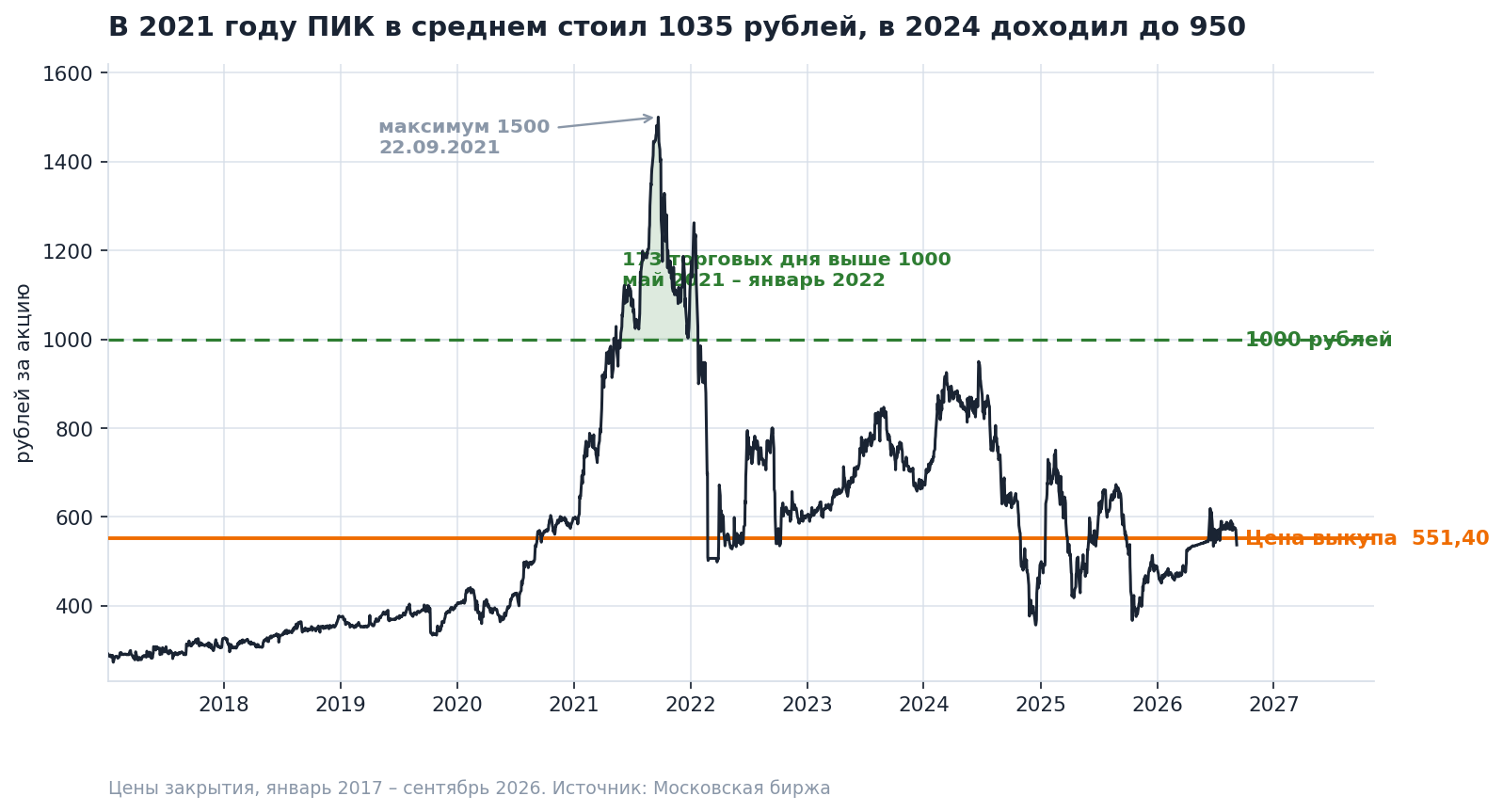
From May 2021 to January 2022 the stock spent 173 trading days above RUB 1,000. The average price in 2021 was RUB 1,035, and the closing high of RUB 1,500 was reached on 22 September 2021.
A direct transfer of those levels to today is incorrect, and this has to be admitted. Then the key rate was about six percent, subsidised mortgages were in place, and the sector was at the peak of the cycle. But even without 2021 the picture is not in favour of the buyout price. In 2024, already under tight monetary policy, PIK reached RUB 949.9 with an average of RUB 726.6, and the 2023 average was RUB 704.5.
Below RUB 551.40 the stock traded systematically in 2025 and the first half of 2026. This is exactly the time when the company was changing owner: in spring 2025 Sergey Gordeev cut his stake to 15.1%, by April 2026 Nedvizhimye Aktivy with affiliates controlled 84.8%, and now 98.0071%.
Where minority holders defend the price and how it is arranged
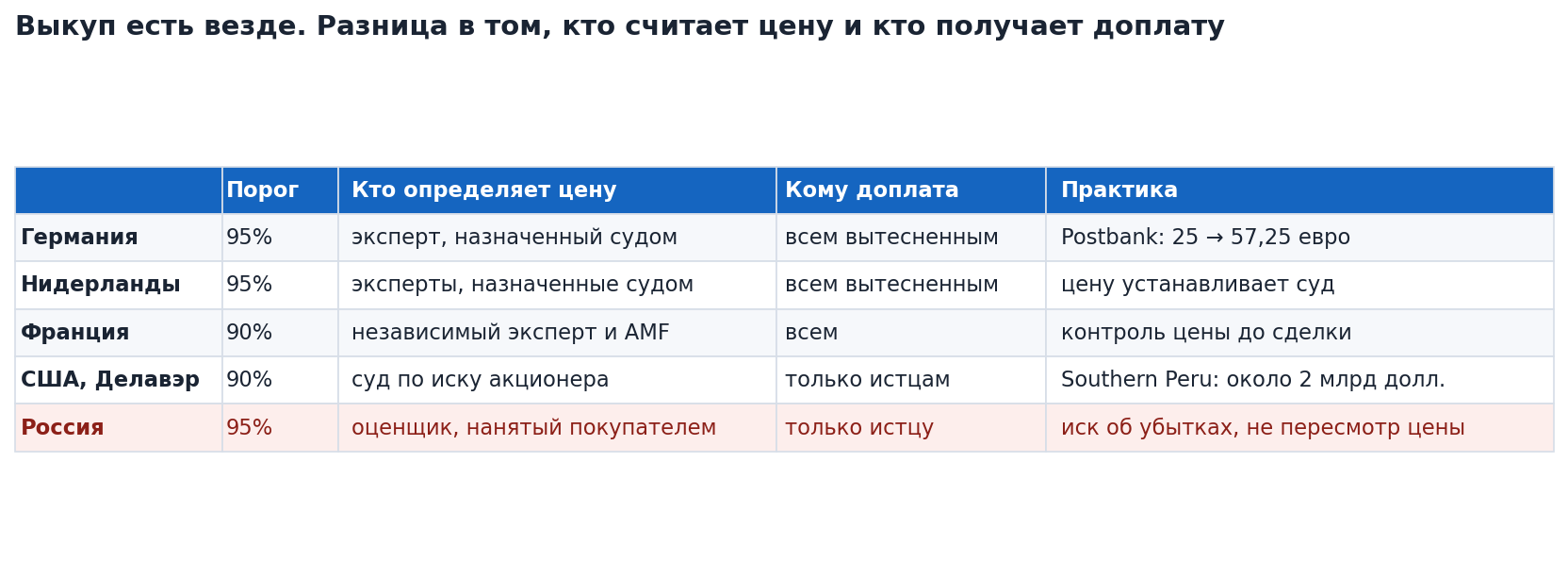
Germany. A buyout cannot be challenged there on the ground of an understated price. The dispute is deliberately moved to a separate proceeding, the Spruchverfahren, so that it does not block the transaction. The application is filed within three months after registration, the court appoints its own expert and checks the valuation. The main difference from our design is that the additional payment goes to all squeezed-out shareholders, including those who did not go to court.
The biggest recent example is the dispute around Deutsche Bank's offer for Postbank shares. The bank offered EUR 25 per share in 2010. Minority holders sued for more than ten years, and in 2022 the German Federal Court of Justice sided with them, recognising EUR 57.25 as the fair price. The bank had to reserve hundreds of millions of euros and pay. Twelve years is the price of such a mechanism, but it works.
USA. The mechanism is called appraisal, Section 262 of the Delaware General Corporation Law. The procedure is strict. You must not vote for the transaction, you must demand appraisal in writing before the vote, keep the shares and file a claim within 120 days. The court determines fair value and awards interest, but only the applicants receive it.
The big minority wins are tied precisely to controlling shareholder transactions. In 2012 the Delaware Supreme Court upheld an award of about USD 1.26 bn plus interest, around two billion in all, against Grupo Mexico for selling its private subsidiary to its own public company Southern Peru at an inflated price. In 2015 in the Dole case the court found a fair value of USD 16.24 against the offered 13.50 and awarded the minority USD 148 mn, finding that the controlling shareholder had misled the committee of independent directors. In 2012 in the Orchard Enterprises case fair value came out at USD 4.67 against 2.05, more than twice as high.
But this is not a free option. In 2019 in the Aruba Networks case the court awarded USD 17.13 against a deal price of 24.67. The applicants received less than if they had simply agreed.
Netherlands. Squeeze-out cases are handled by a special enterprise chamber that appoints experts and sets the price itself. France. The threshold is 90%, and the price must be confirmed by an independent expert whose opinion is checked by the regulator AMF before the transaction, not after.
The common denominator is simple. Either the expert is appointed by the court, or the valuation is checked by the regulator at the entry, or the court's decision extends to all affected holders. None of the three elements exists in the Russian design.
Why such a dispute is almost never won in Russia
In 2007 the Constitutional Court recognised the squeeze-out as consistent with the Constitution, specifically stipulating that the guarantee of a minority holder's rights is effective judicial control over the price.
In practice this control works as follows. Paragraph 4 of Article 84.8 gives the former owner the right to go to court with a claim for losses caused by an improper determination of the price, within six months from the day they learned of the write-off. Three consequences follow. This is a claim for damages, not a revision of the price, so the claimant must prove both that the valuation is wrong and the size of their own loss. The shares are not returned, and the transaction is not unwound. The win goes only to the claimant, and the other squeezed-out holders get nothing.
We could not name publicly known cases in which a Russian court forced an additional payment under Article 84.8. They may exist, and this is worth checking in the arbitration case register.
A year ago the exchange had already pointed out a violation to the company
On 8 October 2025 PIK's board of directors decided to cancel the dividend policy. The next day, 9 October, Moscow Exchange found that the ordinary shares did not meet the corporate governance requirements for first-level listing securities: the rules require a first-level issuer to have a separate document defining the dividend policy. The issuer was given a period to remedy it.
The violation was not remedied. Eleven months later, instead of restoring the dividend policy, the company puts to the meeting the question of leaving the exchange altogether, of removing the reference to public status from the charter, and of release from the disclosure obligation.
PIK has not paid dividends since 2021. The last payment was RUB 45.43 per share, with a record date of 13 May 2021. This also answers the objection that the Cushman & Wakefield valuation is outdated: since then the company has not distributed a rouble to shareholders, and all the result earned over five years stayed inside. There is an argument here that the portfolio has not lost value in this time. It cannot be checked without a fresh independent valuation, and there is none.
Our fair price reference: RUB 1,300 to RUB 1,550
The range is set by two comparable competitors whose EBITDA is not distorted by one-off write-offs. GLORAX gives RUB 1,327, Samolet RUB 1,536. Both figures are obtained by the same method and rest on disclosed escrow balances, not assumptions. This is the conservative edge: Etalon gives RUB 2,699 by the same method, and LSR on its adjusted EBITDA gives RUB 1,098.
Three independent supports converge in one direction. Comparable competitors' multiples give RUB 1,327 and RUB 1,536. Book equity gives RUB 644.20, and this is the floor, because work in progress of RUB 580.8 bn is carried at cost. The last independent valuation of the project portfolio, RUB 683 bn for 2020, comes to RUB 1,034 per share, and since then the company has not paid dividends.
Against the reference play the state of the business and the cost of money: revenue is falling, profit has halved, the rate is fourteen percent. So we speak of a range, not a point. But even its lower bound is 2.4 times higher than what has been offered to minority holders.
The claim is twofold: about the price and about who set it
On price. RUB 551.40 is below the market on the eve of the announcement, below the three-month average, below book equity per share. And a developer's equity is also understated by the amount of buyers' funds lying off the balance sheet and by the difference between cost and market value of the portfolio. A discount has been paid for control of the company where a premium is paid elsewhere in the world.
On procedure. The price was set by the one who buys. He chose the moment, he formed the quote to which the price was then tied, he hired the valuer, and he also set the second, lower price for those who express disagreement. There is no independent committee of directors, no separate vote of the minority, the calculation is not published, and the ultimate beneficiaries are not disclosed. In spring 2025 part of Sergey Gordeev's stake was bought by a group of Russian investors whose names were decided not to be disclosed.
The second makes correcting the first impossible. While the valuer is hired by the buyer and the court hears a claim for damages instead of revising the price, there is simply nowhere to argue about the fairness of RUB 551.40.
Dates to keep in the calendar
On 13 October the absentee extraordinary shareholder meeting on delisting will be held. On 20 October the list of holders of the shares subject to the squeeze-out at RUB 551.40 will be fixed.
We analyse such stories before they close. We calculated the buyback price for GLORAX dissenters in advance and got RUB 44.3-44.6 against a market price of 39, and the officially announced price was 44.57. Reviews and calculations are published in the channel "Усиленные Инвестиции".
See also: market overview · valuation map · stock screeners