PIR: a dealer of mining dump trucks that moved from coal to gold in a market shrinking along with coal – debt at 7.6x EBITDA, interest twice profit, cash of RUB 38mn. Why we would not buy even at 60%
PIR (OOO Partnership, Investments, Development) is a distributor of SANY mining dump trucks (until 2023 all shipments went to coal miners; in 2025, 74% went to gold miners), with seven bond issues totalling RUB 1.64bn and coupons of 18.5-30%, rated BB|ru| by NRA with a stable outlook (confirmed 21.11.2025). The bonds trade at 74-84% of par with yields of 48-67% to maturity; the short 1P1 trades at 97% and 30%. Verdict: this is a credit that held up in 2025 on the yuan exchange rate, not on the business. On consolidated IFRS, EBITDA fell 57% to RUB 0.76bn, while interest expense rose to RUB 1.17bn – operating profit covers interest 0.57x, and FX differences of RUB 0.86bn pushed the company into profit. In 1H2026 the exchange rate no longer helped: net profit under RAS was RUB 40mn against RUB 202mn, operating cash flow was minus RUB 360mn, and cash on accounts was RUB 38mn against RUB 0.9bn of bond payments over the next 12 months and RUB 3.8bn of short bank lines. Net debt is 7.6x EBITDA. Our view is moderately negative: we would not put in new money, because this is a dealer business selling someone else's product on a thin margin in an industry that has been cutting investment for a third year, and the structure resembles the distributor stories that ended badly this year – EuroTrans and Oil Resource. For holders: the short 1P1, maturing in February 2027, can be held to maturity; the long issues at 75-84% should not be added to and should be kept within a small speculative allocation.
The issuer card on the portal with financials by period, our credit analysis and all issues: PIR. Below are Enhanced Investments' calculations based on the issuer's IFRS and RAS statements, the MOEX payment schedule and disclosures; where a figure is the authors' estimate, it is marked as such.
Correction of 07.09.2026. In the first version of the review we wrote that 60% of PIR's customers are coal miners. This is inaccurate: 60% is management's estimate of coal's share in the Russian mining equipment market as a whole (ABO broadcast of 04.09.2026), while in PIR's own shipments the coal share fell from 100% in 2022-2023 to 16% in 2025 and 15% in 2026 (forecast 9%), and the main customer is now gold miners (74% in 2025). Thanks to the participants of the Good Bonds chat for pointing out the error. This does not change the conclusion of the review: the mining equipment market is shrinking along with coal, and PIR's debt burden, interest coverage and cash flow do not depend on the customer mix.
What we are buying: a dealer of Chinese mining dump trucks that switched in two years from coal (100% of shipments in 2022-2023) to gold (74% in 2025) because coal is in crisis
Fact. The company has operated since 2010 (St Petersburg, Moscow since 2020); the beneficiary and director is Mikhail Zusman, and a board of directors with an independent chairman was created in 2025. The main product is hybrid SANY SET150S mining dump trucks with 150-tonne capacity and SET240S, plus Sinomach graders; PIR is the official SANY distributor in Russia, and more than 100 SET150S machines operate in the country. The group includes the service company PIR-Servis and a distributor of oversize tyres, Pershina. Customers are coal open-pit mines in Kuzbass and Yakutia, gold miners, iron ore companies and open-pit mining contractors; according to NRA, most of the equipment operates in Yakutia, Sakhalin, and the Novosibirsk and Kemerovo regions.
Fact (NRA, 21.11.2025). Sales in 2024 were 45 machines, and 20 in the first nine months of 2025; the contract portfolio is RUB 13.5bn; receivables turnover is 233 days (251 days in 2024); interest coverage is 2.2x against 4.7x a year earlier; current ratio is 1.3x. The company received the BB|ru| rating on 29.11.2023, when net debt was 1.9x EBITDA.
Management view (ABO broadcast of 04.09.2026). In 1H2026, 16 SET150 trucks were shipped against 19 a year earlier, so revenue is down 12-13% on volume and a further 10-11% on the exchange rate: contract prices are fixed in yuan at the central bank rate on the payment date, and the rate fell from 13.1 at the start of 2025 to about 11 in 1H2026. The expectation for the year is revenue at the 2025 level. By management's estimate, coal has historically accounted for more than 60% of the Russian mining equipment market ("probably 60% of all consumption was coal miners"), and with coal stagnating the market as a whole is shrinking. PIR itself has already left coal: per the company presentation, coal deposits accounted for 100% of equipment shipments in 2022-2023, 59% in 2024, 16% in 2025 and 15% since the start of 2026 (forecast for 2026: 9%); gold is 74% in 2025 and 65% in 2026, ore and polymetals 20%. The bet is on gold and ore: a long-term agreement with Nordgold was signed in April 2026, and the first large order under it is expected in 2026.
IFRS 2025: revenue down 15%, EBITDA down 57%, interest of RUB 1.17bn, and the profit was made by FX differences
Fact (consolidated IFRS, auditor Rusaudit). Revenue was RUB 6.97bn against RUB 8.21bn (the auditor excluded from revenue about RUB 2bn of resales of ten machines that had already been shipped to a leasing company in 2024 and were then reversed). Gross profit RUB 1.96bn (margin 28% against 34%), operating profit RUB 0.66bn against RUB 1.67bn, EBITDA RUB 0.76bn against 1.75. Finance costs RUB 1.17bn against RUB 0.50bn, finance income RUB 0.19bn. FX differences plus RUB 0.86bn (minus 0.40 in 2024). Profit before tax RUB 0.54bn, net profit RUB 0.38bn against 0.79, while dividends for the year were RUB 0.29bn.
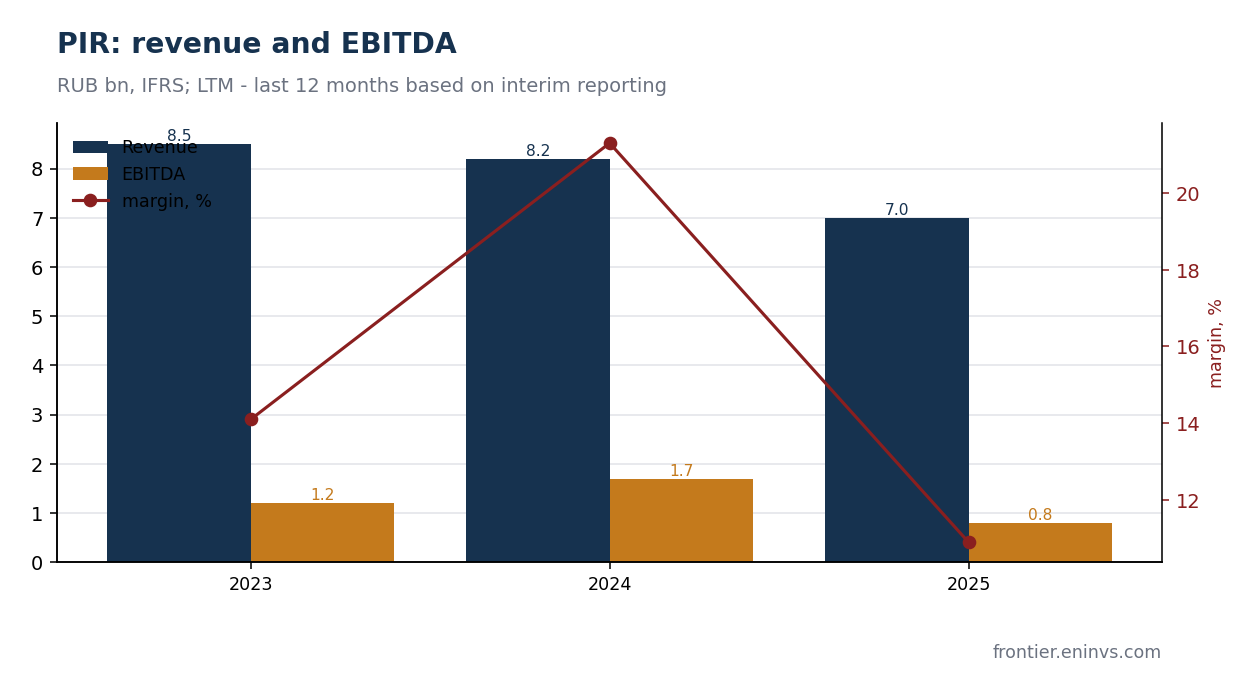
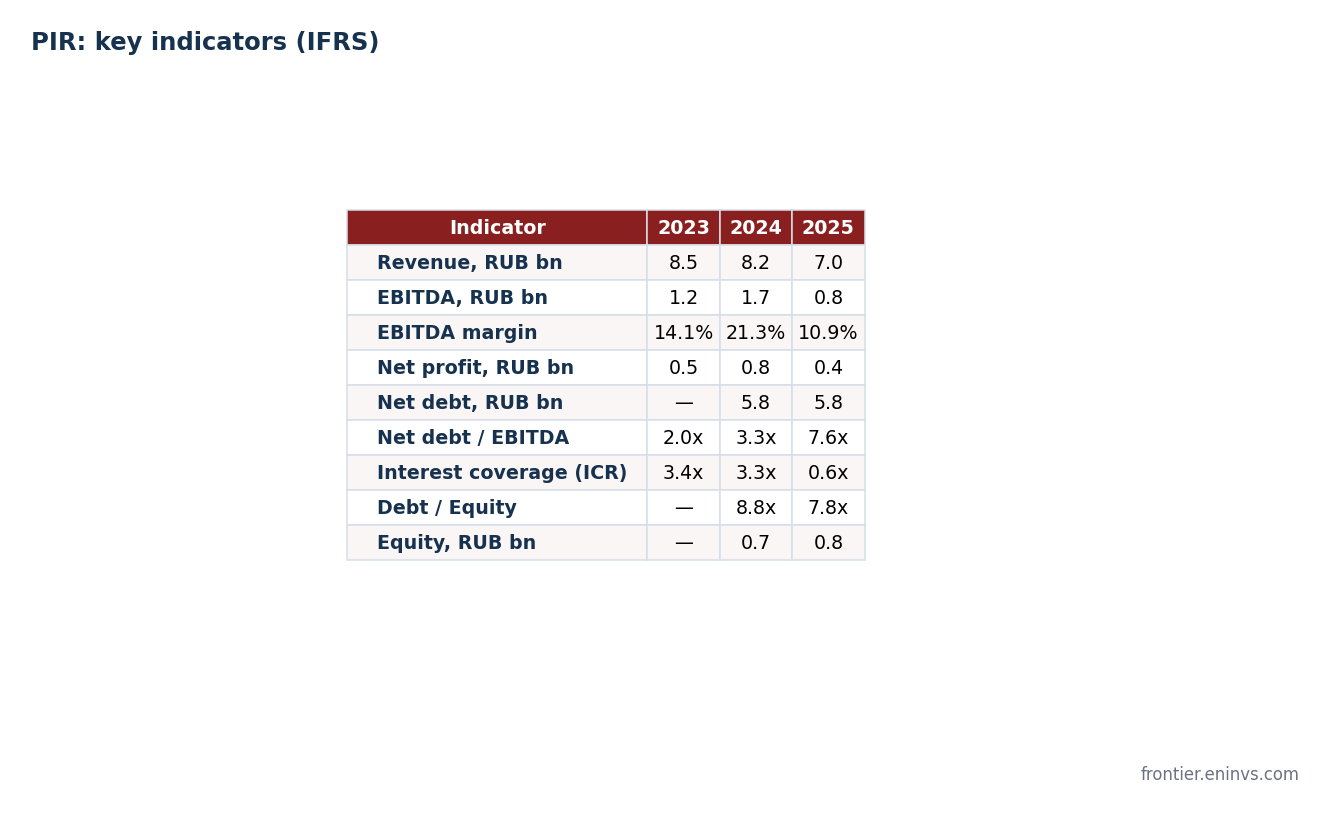
Authors' estimate. Operating profit of RUB 660mn against interest of RUB 1,167mn gives coverage of 0.57x; against interest paid in cash (RUB 822mn), 0.80x. On cards where coverage is computed through profit before tax, PIR comes out at 5.7x: FX income of RUB 861mn consumes almost all the interest. This is the arithmetic of yuan debt while the rouble strengthens, not a business result: 48% of net debt at the end of 2025 is yuan loans, and each rouble of rouble strengthening against the yuan gave the company a positive revaluation. In 2026 the rate stood at 11-12, and under RAS for the half-year other income fell from RUB 894mn to RUB 11mn – this is exactly what wiped out profit.
Fact. Operating cash flow in 2025 was plus RUB 73mn after minus RUB 2.19bn in 2024: receivables fell by RUB 0.76bn, but inventories rose by RUB 1.01bn. Interest paid was RUB 822mn, loans issued RUB 464mn (RUB 139mn repaid), bonds raised RUB 985mn, dividends paid RUB 294mn. The auditor's opinion for 2025 is unqualified, but with an emphasis of matter: 2024 data were restated because fines and penalties had not been fully accrued. The opinion for 2024 was qualified – the auditor did not observe the inventory count of RUB 2.67bn.
1H2026 under RAS: revenue down 20%, profit RUB 40mn, operating cash flow minus RUB 360mn, cash RUB 38mn
Fact (RAS of OOO PIR, 1H2026). Revenue was RUB 3.26bn against RUB 4.07bn: special equipment RUB 2.69bn (down 16%), spare parts RUB 0.45bn (down 31%). Gross profit RUB 1.04bn (up 7%), profit from sales RUB 0.65bn (up 21%) – the margin rose because machines bought at a low exchange rate went into cost of sales. Interest payable RUB 496mn (up 10%), other income RUB 11mn against RUB 894mn a year earlier (then it was FX differences). Profit before tax RUB 68mn against 290, net profit RUB 40mn against RUB 202mn.
Fact. Cash flow from operating activities was minus RUB 360mn against plus RUB 343mn a year earlier; interest paid RUB 499mn. At 30.06.2026: inventories RUB 2.27bn (up 18% over the half-year), receivables RUB 6.24bn, of which RUB 3.26bn are from customers and RUB 2.45bn are advances to suppliers, loans issued RUB 0.34bn, cash RUB 38mn (at the end of 2025 it was RUB 259mn, of which RUB 252mn in a deposit). Equity is RUB 1.31bn against assets of RUB 10.2bn, liabilities to equity 6.8x.
Authors' estimate. The seasonality here is real: contracting in the second half, deliveries in the first, and management says so openly. But the half-year shows the main thing: without the FX cushion the business earns roughly zero after interest, and cash was eaten by inventories and advances for future deliveries. The expectation of "revenue at the 2025 level" implies EBITDA of about RUB 0.75-0.8bn against interest of about RUB 1bn – coverage again below one.
Debt of RUB 6.0bn: 83% short-term, half in yuan, all loans unsecured, rate 17.5%
Fact (IFRS at 31.12.2025). Loans and borrowings are RUB 6.03bn: long-term bonds RUB 1.02bn; short-term – rouble bank loans RUB 0.65bn, yuan bank loans RUB 2.92bn, bonds maturing within a year RUB 0.09bn, rouble loans RUB 0.18bn, yuan loans RUB 0.16bn. Plus leases of RUB 0.38bn. Separately within loans, RUB 345mn is owed to AO Business Alliance: an advance under a terminated supply contract, reclassified as a commercial loan. Bank loan rates are 6-25%, and 18.5-21% on floating ones against a key rate of 16%; the loans are unsecured, with a RUB 50mn credit line backed by an owner guarantee. The yuan share of net debt is 48% (71% a year earlier), and the first currency-interest swap was concluded in the fourth quarter of 2025.
Management view (ABO, 04.09.2026). The weighted average rate on the portfolio is 17.5% including the latest issue; bank debt is almost entirely in revolving credit lines, so 80-90% of debt is formally short-term; in August 2026 a bank cut the rate on yuan loans by one percentage point; there are no significant legal disputes. Under RAS at 30.06.2026 borrowings are RUB 6.15bn: rouble bank loans RUB 0.91bn, yuan RUB 2.87bn, bonds RUB 1.36bn, accrued interest RUB 0.28bn; in April a rouble loan of RUB 0.5bn was received, and in July two loans of RUB 1.0bn were repaid and RUB 0.82bn of new ones received.
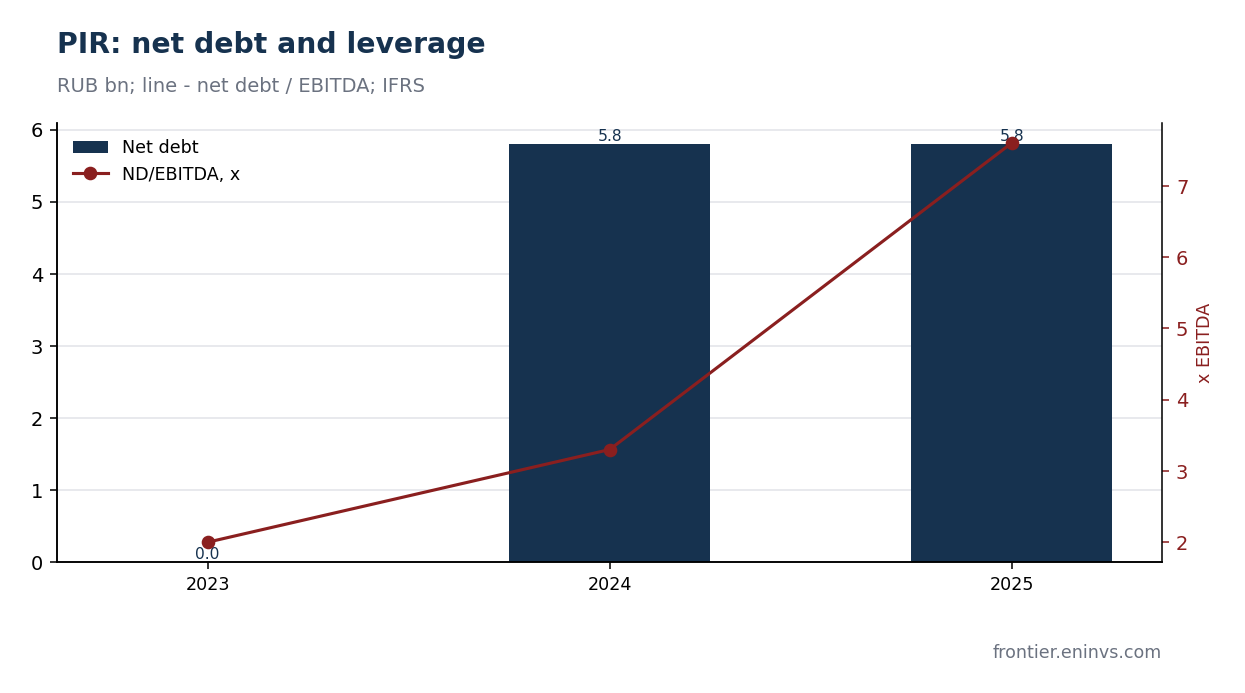
Authors' estimate. Net debt of RUB 5.77bn is 7.6x EBITDA and 7.6 times group equity (RUB 0.76bn). Revolving lines are convenient as long as the bank renews them; with such interest coverage each renewal is a credit committee decision, not automatic. Dividends of RUB 294mn for 2025 and RUB 338mn for 2024 with leverage above 3x are money that is now missing from cash.
Debt is growing again: RUB 2.8bn at the end of 2023, 6.0 at the end of 2025, 6.15 at 30 June and another RUB 0.3bn in August
Fact. Borrowings under RAS: RUB 2.75bn at the end of 2023, 5.86 at the end of 2024, 5.65 at the end of 2025, RUB 6.15bn at 30.06.2026 – up 9% over the half-year. Net debt per the portal's quarterly data: RUB 5.14bn at the end of 2025, 5.23 at the end of March, 5.77 at the end of June 2026 (up 12% over the half-year, up 26% year on year). The source of growth is bonds: RUB 573mn was placed in the first half (1P6 and the remainder of 1P5), and RUB 300mn more on 13 August (1P7), so bond debt rose from 1.1 to 1.64bn, while bank debt stayed around RUB 3.8bn. In 2025 debt stood still only because receivables shrank by RUB 0.76bn, and the bond proceeds (RUB 0.99bn) went into inventories and loan repayment.
Authors' estimate. The company is not deleveraging: each new issue replaces not old debt but working capital and dividends. With EBITDA of RUB 0.76bn, debt growth of RUB 0.9bn in eight months of 2026 adds another 1.2x to leverage if EBITDA does not grow.
Signs of cash extraction and reporting quality: dividends of RUB 0.63bn over two years, loans to owners, a stake in the service company sold for RUB 725
Fact (IFRS, note 26 "Related parties"). At 31.12.2025 short-term loans of RUB 229mn (218 a year earlier) and long-term loans of RUB 30mn had been issued to the company's owners, with receivables of RUB 80mn and advances of RUB 14mn outstanding; associates owe receivables of RUB 286mn (437 a year earlier). Total assets with related parties are RUB 515mn against RUB 723mn a year earlier. Finance income from owners in 2025 was RUB 61mn, and other expenses on transactions with owners were RUB 205mn (no breakdown). Dividends: RUB 338mn paid in 2024, RUB 294mn in 2025, and another RUB 25mn in January 2026 – with net debt at 7.6x EBITDA. In February 2026 the group sold 7.25% of the service company PIR-Servis to a group participant, Kirill Gaydukov, at par, for RUB 725; the non-controlling interest accounted for RUB 90mn of the group's RUB 383mn profit in 2025.
Fact (reporting quality). The parent company's RAS shows revenue of RUB 9.2bn, operating profit of RUB 1.47bn and equity of RUB 1.3bn, while consolidated IFRS shows 7.0, 0.66 and 0.76bn: the auditor excluded about RUB 2bn of resales of machines already included in 2024 revenue. The 2024 IFRS data were restated: fines and penalties had not been fully accrued. The opinion for 2024 was qualified on inventories (the auditor did not observe the count of RUB 2.67bn), and for 2025 unqualified. Advances to foreign suppliers of RUB 616mn are carried over from 2022-2024, with a provision of RUB 70mn against them. The RUB 345mn debt to AO Business Alliance is an advance from a leasing company under a terminated contract, reissued as a commercial loan.
Authors' estimate. There are no direct signs of falsification here, such as at Oil Resource with its revaluation of patents: the consolidation is audited, there are no qualifications for 2025, and loans to related parties are disclosed. But the picture of cash leaking to owners exists, and it is measurable: dividends of RUB 0.66bn over two years plus loans to owners of RUB 0.26bn make RUB 0.9bn against bond debt of RUB 1.64bn, that is, more than half of the money taken from bondholders went to shareholders and not into the business. The sale of a stake in the group's most profitable part for RUB 725 and RUB 90mn of minority profit are another channel through which value leaves from under the bonds. In addition, RAS, by which most retail investors judge an issuer, shows twice as much profit and equity as the consolidation. This is not an accusation but an assessment of structure: PIR's creditors have neither collateral nor dividend covenants, and money moves within the group at the decision of one person.
Assets of RUB 9.3bn against equity of 0.76: inventories of RUB 3.7bn, of which spare parts 2.6, and RUB 0.6bn of advances abroad have been outstanding since 2022
Fact (IFRS at 31.12.2025). Inventories are RUB 3.66bn: spare parts RUB 2.61bn (0.62 a year earlier), goods RUB 1.04bn; RUB 0.45bn is pledged. Trade receivables are RUB 2.42bn after provision, other RUB 0.25bn (provision of RUB 172mn, unchanged for two years). Advances issued are RUB 1.36bn, including RUB 616mn (EUR 6.9mn) to foreign suppliers for 2022-2024 – delivery dates were extended to mid-2026, and the company is looking for buyers outside Russia so as to sell the goods without importing them; the provision against advances is RUB 70mn. Short-term financial investments of RUB 0.48bn are loans issued. Fixed assets are RUB 0.22bn, intangible assets RUB 13mn.
Authors' estimate. Assets cover debt 1.5 times, but consist of spare parts for future service, receivables with 233-day turnover and advances, part of which have been outstanding for a fourth year. The growth of spare parts from RUB 0.6bn to 2.6bn in a year is both a strategy (service as a business, warehouses at customers' sites) and the main reason operating cash flow does not cover interest: inventories are financed by loans at 17.5%. Auditors: for IFRS, Rusaudit (Moscow); for RAS, the St Petersburg firm Prominvest-Audit, the same as at Oil Resource; both opinions for 2025 are unqualified, and the qualification was on inventories for 2024.
Taxes and disclosure: RUB 31mn of arrears at 25 August, a promise to clear them by 1 October, and half of the seventh issue went through negotiated deals at 98
Fact (Federal Tax Service open data). Arrears at 25.08.2026 are RUB 31.0mn: VAT RUB 10.1mn, profit tax 8.8, insurance contributions 6.3, personal income tax 5.0, property and transport tax 0.8; penalties RUB 43 thousand, no fines or violations. At 01.07.2026 the Federal Tax Service list showed RUB 57.5mn. On the broadcast, management called this "a carried-over balance of short-term tax debt" and promised that from 1 October the company would not be on the Federal Tax Service list.
Fact. The seventh issue of RUB 300mn at 28% was placed on 13.08.2026 under a RUB 10bn programme; according to Andrey Zakharov's observation, half of the volume went through negotiated deals at 98-98.5% of par, that is, below the primary placement price. The sixth issue in May raised RUB 273mn of the announced RUB 400mn. Since 13 August, forums have recorded large sales in 1P7, and since 31 August across the whole line; of four mentions of PIR by Dmitry Manka over the summer, three were negative.
Authors' estimate. Arrears on contributions and personal income tax are the same sign we examined at L-Start: payroll taxes are delayed by whoever has no money on the account. With cash of RUB 38mn at the end of June, RUB 31mn of taxes is almost all the cash. The promise to clear them by 1 October is easy to check in the next Federal Tax Service release.
Industry: coal has been cutting investment for a third year, the dump truck market has been shrinking since 2026, and only gold is growing
Fact. Coal miners' investment in extraction and processing: RUB 275bn in 2023, 248 in 2024, RUB 201bn in 2025; the government estimates the industry's 2026 loss at RUB 576bn, 23 coal companies had closed by December 2025 and another 53 are under threat. Coal open pits accounted for about half of demand for mining dump trucks (2023), Chinese brands held more than 48% of the market, and even then the forecast for 2026 was a demand contraction after fleet renewal. The road-construction equipment market fell 30% in 1H2026, and leasing companies expect a 40-50% decline in deal volume.
Authors' estimate. For PIR this means that the former core customer (coal, 100% of shipments as recently as 2023 and more than 60% of the market by the company's own account) will not buy for another year or two, while gold and ore, to which the company has reoriented, are demanding buyers with long tenders and deferred payments. The Nordgold agreement is a real chance, but the first order under it has not yet been paid, and management promises to show the result only in the annual report.
A dealer in a crisis industry is the most vulnerable type of borrower: what PIR has in common with EuroTrans and Oil Resource
Fact. In the past six weeks the high-yield bond market has gone through two large distributor cases. EuroTrans is wholesale fuel trading with a margin of about 3%; net debt rose from RUB 27bn to 60bn in two years, RUB 11.7bn of dividends was paid from new debt, and it defaulted on 5 August 2026. Oil Resource is a wholesale fuel trader with a paper profit of RUB 1.96bn for 2025 against operating cash flow of minus RUB 4.55bn and equity made up of revalued patents worth RUB 4tn; in August the company acknowledged the revaluation was unjustified, placements were halted, and the bonds lost 40% in a day. Earlier, Obuv Rossii went the same way: inventories of RUB 16.5bn against revenue of 8. What they all share: resale of someone else's goods, a thin margin, working capital funded by borrowed money at 25-30%, profit in the report and a negative in the cash account, dividends to the owner before settling with creditors.
Authors' estimate. PIR fits this template on every point. The goods are someone else's – SANY's – and the manufacturer can pass dealer status to someone else. The EBITDA margin is 11% against 21% a year earlier. Working capital – a spare parts warehouse of RUB 2.6bn, receivables of 233 days and advances of RUB 1.4bn – is financed by loans at 17.5% and bonds at 25-30%. The 2025 profit is paper (FX differences), and operating cash flow for the half-year is minus RUB 360mn. Dividends of RUB 294mn with interest coverage below one. One more detail: PIR's RAS auditor is Prominvest-Audit, the same one that signed Oil Resource's statements. This does not mean default is inevitable: unlike those two, PIR has real goods, real customers and audited IFRS without qualifications. But structurally the business does not yet service debt of 7.6x EBITDA from its own cash flow, while coal, which until 2023 bought all of its equipment and, by the company's own account, gave more than 60% of the Russian mining dump truck market, is cutting investment for a third year; the bet on gold has not yet compensated for the loss – half-year shipments are 16 machines against 19. A yield of 50-67% looks generous, but it pays for a dealer's working capital, not for value creation, and in similar stories such a premium was not enough.
Fact. In our sample of high-yield bond defaults, distributors and wholesalers with a median EBITDA margin below 10% and negative free cash flow are the most frequent category among defaulters of the last two years; on the portal's cards such issuers are marked with a "low-margin wholesale" business model flag, and PIR has this flag.
What pays: RUB 0.9bn on bonds over 12 months against cash of RUB 38mn and negative cash flow, then RUB 0.85bn of amortisations in 2027
Fact. Per the MOEX schedule, from September 2026 to August 2027 PIR must pay about RUB 0.43bn of coupons and RUB 0.46bn of amortisations: 1P1 is redeemed at 12.5% in November and February, 1P3 amortises at 5% monthly from 18.12.2026, 1P4 at 5% from February 2027, 1P5 at 25% quarterly from March 2027. After that, 1P6 (15% quarterly from August 2027), 1P7 (from May 2028) and 1P2 (from May 2028). There are no put offers. The nearest coupons are on 12, 13, 16, 19 and 21 September.
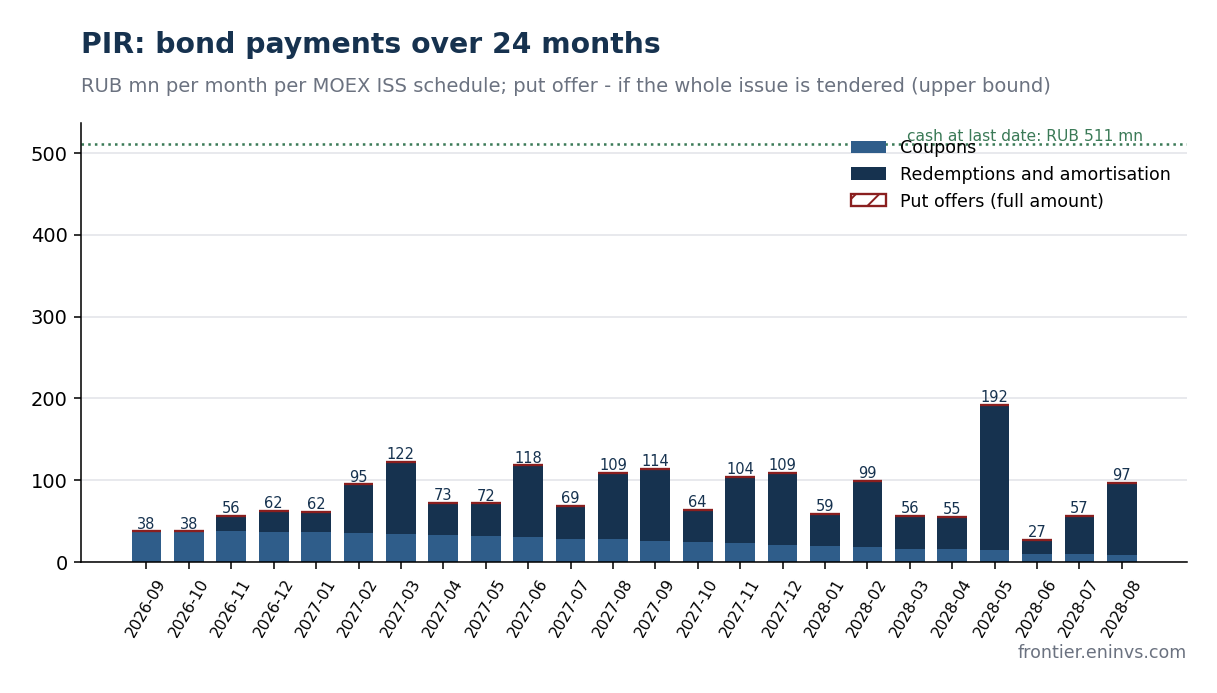
Authors' estimate. There are three sources: operating cash flow (minus RUB 360mn for the half-year), revolving bank lines (RUB 3.8bn of short loans that must be renewed) and new issues (the seventh sold at a discount). Coverage of annual bond payments by cash and flow is about zero; everything rests on the banks. This is PIR's credit risk: it is not the bondholders who decide first whether the story continues, but the banks holding RUB 3.8bn of unsecured short loans.
Market: 48-67% to maturity and a premium of 3,300-5,250 bp – default-zone prices for a BB rating
Fact (MOEX close 04.09.2026). 1P1 (18.5%, February 2027) – 97.4% and 30% to maturity; 1P2 (24.5%, March 2029) – 76.5% and 48%; 1P3 (30%, May 2028) – 84.0% and 64%; 1P4 (28.5%, July 2028) – 81.4% and 63%; 1P5 (27%, December 2027) – 81.8% and 67%; 1P6 (25.5%, October 2028) – 74.6% and 62%; 1P7 (28%, July 2029) – 78.3% and 52%. The premium to OFZ is 3,300-5,250 bp.
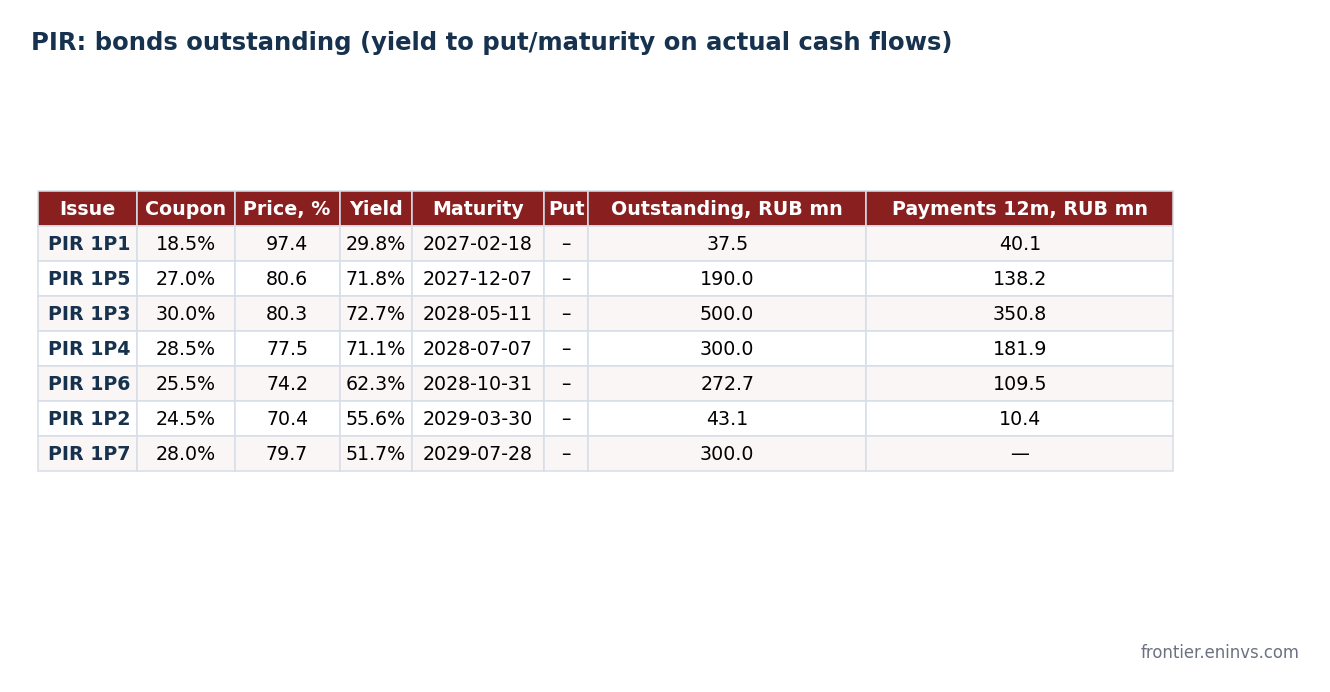
Authors' estimate. In three weeks the market moved PIR from the BB basket into the basket of issuers with restructuring risk: yields of 60%+ on amortising bonds mean holders expect payments to stop in 2027. The short 1P1, maturing in half a year, trades almost at par – the only issue where risk is limited by the calendar.
Where we may be wrong
- Yuan. The rate has returned to 12.8-12.95, and according to management this is already visible in the third quarter: a weak rouble raises both revenue and FX income. Each rouble against the yuan is about RUB 0.25bn of debt revaluation, but to the downside.
- Rate. The key rate is 14.25% and yuan rates are down a point: with debt of RUB 6bn each point is RUB 60mn of interest a year.
- Nordgold. A large order under the April 2026 agreement, plus service and spare parts for a fleet of 100 machines, half of which is out of warranty, could return EBITDA to RUB 1.5bn, as in 2024.
- Banks. As long as lines are renewed, the company pays. NRA holds BB with a stable outlook, and the agency sees bank covenants that we do not.
- Caveat. All four factors are external: the exchange rate, the rate, one customer and credit committee decisions. They could improve the picture noticeably, but do not change the structure in which debt of 7.6x EBITDA is today serviced by refinancing.
Risks and what to watch
- Coupons of 12-21 September. Five issues pay within ten days with cash of RUB 38mn at the end of June; the first technical default would be visible immediately.
- Federal Tax Service release at 1 October. The management promise is checked with a single line.
- Renewal of bank lines. RUB 3.8bn of short unsecured loans; the signal is a rising share of bonds in debt and new issues at a discount.
- 9-month results and annual IFRS. The Nordgold order, receivables turnover, the fate of the RUB 616mn of advances abroad.
- Dividends and loans to owners. RUB 0.9bn over two years against bond debt of RUB 1.64bn; there are no covenants on payouts.
Bottom line: an elevated-risk zone, we would not buy with new money and would not add to long issues
PIR is a dealer business caught in a pincer: coal-mining customers have stopped buying, the rouble has strengthened, and debt at 17.5% finances a spare parts warehouse of RUB 2.6bn and receivables of 233 days. In 2025 FX differences saved the reporting; in 2026 there is nothing to save it: interest coverage is 0.57x, cash flow is negative, cash is RUB 38mn, and there are arrears on payroll taxes. Structurally this resembles the distributor stories that ended badly this year – EuroTrans and Oil Resource: someone else's goods, a thin margin, working capital funded by bonds at 25-30%, dividends to the owner. There are also differences in PIR's favour: real customers, an audited consolidation, a BB rating with a stable outlook and an open dialogue with holders. Our view is moderately negative: under our methodology this is an elevated-risk zone, comparable to L-Start, and in our view a yield of 50-67% does not pay for this risk. We would not buy with new money; those who hold 1P1 can hold to February, and long issues should not be added to. The checkpoints that could change our view are the coupons of 12-21 September, the Federal Tax Service list at 1 October, the Nordgold order in the 9-month results and the renewal of bank lines.
Sources and caveats
- Consolidated IFRS of OOO PIR for 2024 and 2025 (auditor OOO Rusaudit), RAS for 2025 and 1H2026 (auditor OOO Prominvest-Audit) – e-disclosure, GIR BO of the Federal Tax Service.
- NRA: press releases of 29.11.2023 (upgrade to BB|ru|) and 21.11.2025 (confirmation); Federal Tax Service open data on arrears at 25.08.2026 and 01.07.2026.
- Broadcast of the Association of Bond Owners with PIR of 04.09.2026 (host Konstantin Novik; Mikhail Zusman, Marat Tereshchenkov, Ivan Serbaev) – the company's position is given with attribution to the source: https://www.youtube.com/watch?v=xjDIIaLDUec
- Industry: Vedomosti and Kommersant on investment and losses in the coal industry (2026), the RBC Research review of the mining dump truck market (2024), Kommersant on the road-construction equipment market for 1H2026.
- Parallels: our review of the EuroTrans default (08.2026) and our review of Oil Resource (05.2026), the open appeal of Kirillitsa Group of 20.08.2026; Enhanced Investments' sample of high-yield bond defaults (08.2026).
- Coupon and amortisation schedule – MOEX ISS, quotes – MOEX close on 04.09.2026; observations of Andrey Zakharov and Dmitry Manka – the authors' Telegram channels.
Reviews of other issuers and weekly analytics are in the Telegram channel Enhanced Investments @eninv, and extended cards of all issuers are on the portal.
See also: market overview · valuation map · stock screeners