Promomed: revenue up 76%, yet the stock trades at its IPO price
Promomed has turned in two years from a mid-tier player in the Russian pharmaceutical market into the number one company by sales. Revenue for 1H2026 was RUB 22.8 bn, up 76% year on year. The stock trades at RUB 414, roughly where the company priced its IPO in July 2024 at RUB 400. Revenue has nearly tripled over that time.
We hold this stock in our Russian strategy and doubled the position in August, buying into the market sell-off ahead of a strong second half. Its weight in the model portfolio rose from 5% to almost 11%, and the average price of the August and September purchases is about RUB 385. The conclusions below are based on financial statements, independent market data, leading indicators and direct communication with the company.
Key points:
- Revenue grew 76%, and all of the increase came from one segment, endocrinology. Oncology fell 39% because tenders shifted to the second half.
- The Russian market for obesity drugs tripled in a year and has run several years ahead of the company's own plans. Promomed holds more than half of it.
- The 1H EBITDA margin was 34% against full-year guidance of 45%. This shape of the year is normal for the company; the whole question is how strong the fourth quarter will be.
- Cash flow remains negative, and growth is funded with working capital and debt. Leverage is 1.79x EBITDA against a covenant of 3.0x.
- On EV/EBITDA the stock trades at 6.4x versus its own three-year average of 9.4x. A consensus of six brokers points to about RUB 650; our model gives RUB 792.
What the company is
Promomed manufactures and develops medicines. Its portfolio covers obesity and diabetes drugs, oncology, antibiotics, antivirals and neurology. Its production site is the Biokhimik plant in Saransk. The company has been listed since July 12, 2024, ticker PRMD, second-tier quotation list, with a current market capitalisation of RUB 88 bn.
The main product of the last year and a half is Tirzetta, the first Russian drug with the active ingredient tirzepatide. It belongs to the GLP-1 receptor agonists. This class was originally developed for type 2 diabetes but became a mass-market product as a weight-loss treatment; the global analogues are Ozempic and Mounjaro. It is a once-weekly injection, with a course of six months or longer. According to DSM Group, Tirzetta became the number one brand by pharmacy sales in Russia as early as January 2026, and in June it accounted for 2.7% of the country's entire retail drug sales in value terms. That is a record share for a single brand.
Rights to the molecules of the two key drugs in this class work differently. Tirzepatide is freely available in Russia: the patent on it was terminated in November 2024, and several Russian manufacturers registered their own products with this ingredient at once. Semaglutide is covered by compulsory licensing, under which the state permits production of a drug without the patent holder's consent. Promomed has drugs in both groups.
Revenue: up 76%, with all of the increase from one segment
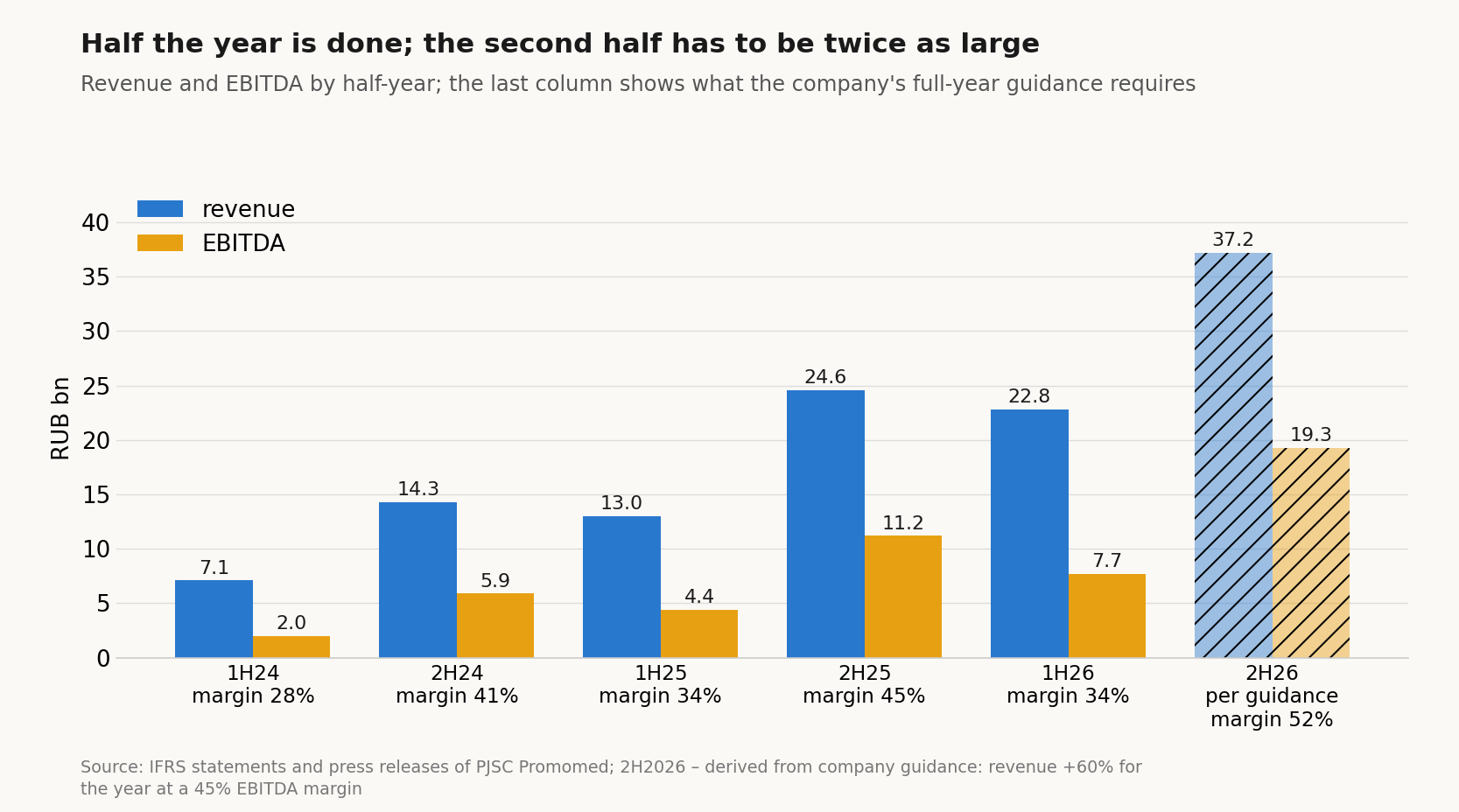
1H revenue was RUB 22.8 bn, EBITDA RUB 7.7 bn and net income RUB 2.6 bn; all three grew by roughly 80%. Gross margin rose from 61% to 67%. The second quarter delivered RUB 15.5 bn of revenue and 83% growth, so the pace accelerated after the first quarter.
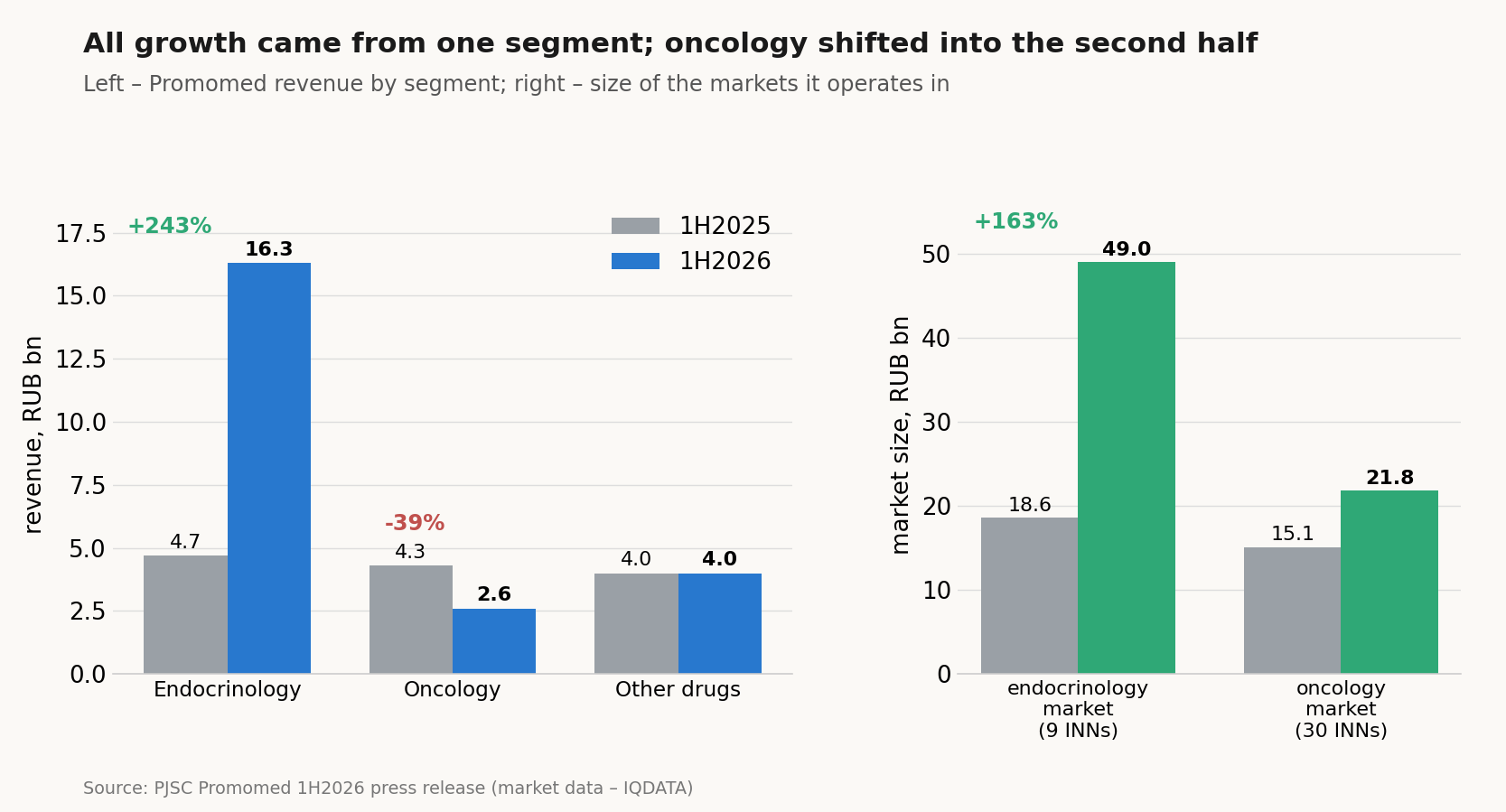
Endocrinology brought in RUB 16.3 bn against RUB 4.7 bn a year earlier, a 3.4x increase. The endocrinology market relevant to the company, covering nine active ingredients, grew over the same period from RUB 18.6 bn to RUB 49.0 bn. The company grew even faster than its own market and, according to IQDATA, holds 59% of retail GLP-1 sales in value terms.
Oncology fell 39% to RUB 2.6 bn, and this is not a loss of demand but a shift in the calendar. Oncology drugs are sold through state tenders, and the auctions that matter most to the company in 2026 are concentrated in the second half. The oncology programme budget is not being cut but indexed, and for the full year the company expects the segment to grow by around 40%.
The other drugs segment did not grow at all: RUB 4.0 bn, the same as a year ago. This is the old base portfolio of antibiotics, general therapy and neurology. It has been flat for the second year in a row, and it shows how dependent the business now is on a single drug class.
The sales mix has changed radically. The split between the commercial and the budget channel is now 83/17 versus 49/50 a year earlier. The share of drugs on the vital and essential list, where prices are regulated by the state, fell from 75% to 37% of revenue. The price of Tirzetta is not regulated.
Growth outlook: the market has outrun the company's own plans
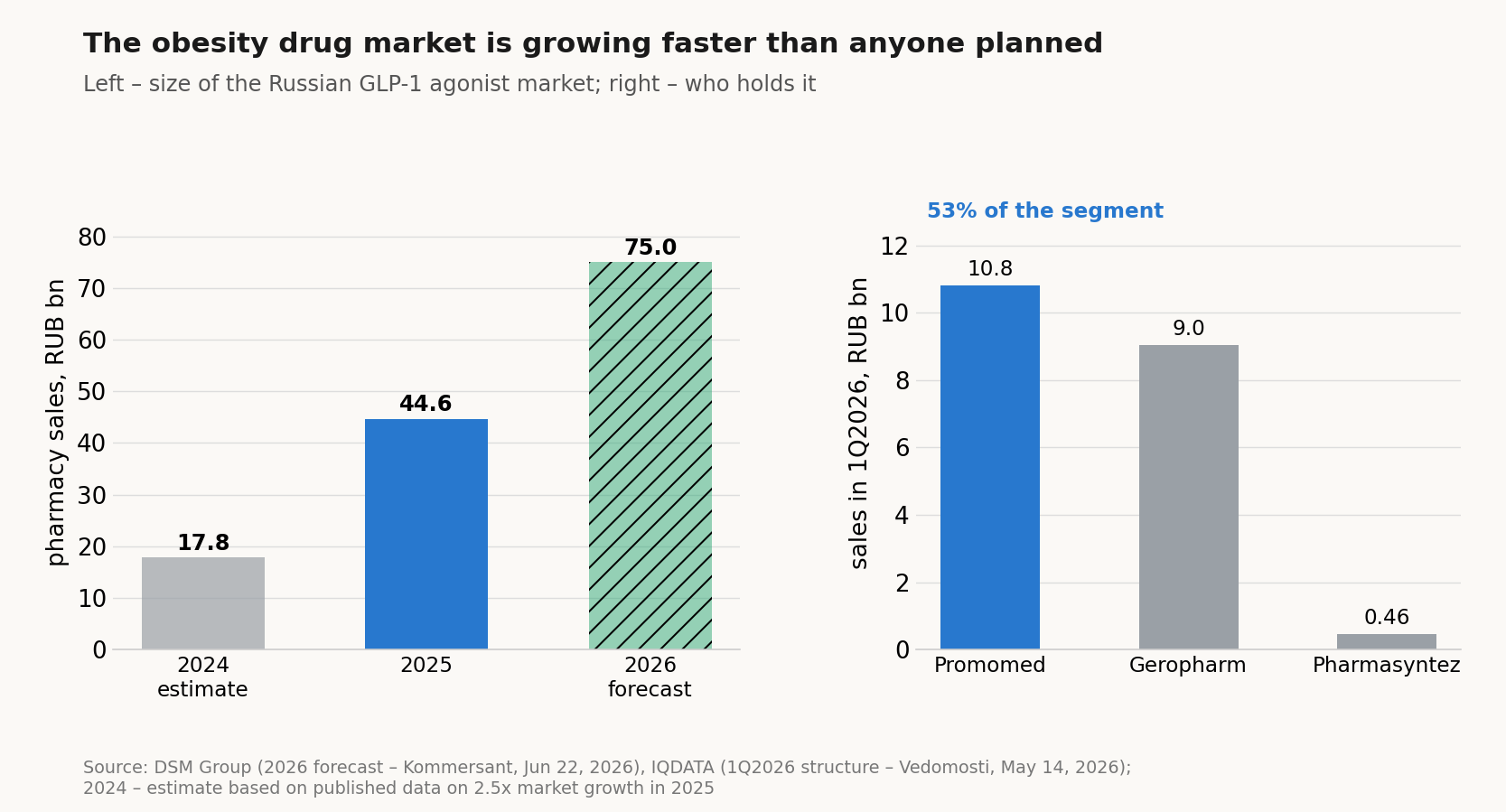
The Russian market for GLP-1 class drugs was RUB 44.6 bn in 2025, and in 1Q2026 sales grew 3.5x year on year to RUB 20.3 bn. According to IQDATA, tirzepatide overtook semaglutide for the first time in the first quarter, RUB 10.6 bn versus RUB 9.6 bn. Promomed sold RUB 10.8 bn of drugs in this class, Geropharm RUB 9.04 bn, and the other seven manufacturers together less than half a billion.
DSM Group expects about RUB 75 bn in this segment for 2026. In January-April the market already reached RUB 28.3 bn, up 3.2x year on year in value and 2.8x in packs. For comparison, the entire Russian pharmacy market is growing at 15.8% a year.
This pace has also outrun the company's own plan. The medium-term target of revenue growth above 40% a year in 2027-2029 assumed that the GLP-1 market would reach RUB 100 bn gradually, over several years. At the current pace that mark will be passed much sooner. Internal plans were revised upward during the year.
The company's full-year guidance looks rather conservative. Publicly it is unchanged: revenue growth of 60% at an EBITDA margin of 45%. According to DSM Group, in the first seven months of 2026 tirzepatide alone generated RUB 33 bn in pharmacies, 27 times more than a year earlier, and over eight months the entire obesity drug segment approached RUB 50 bn versus RUB 44.6 bn for the whole of 2025. The company does not yet see a slowdown. Indirectly, this means the public guidance was set with a margin of safety.
A separate driver for the next two years is orphan drugs. These are medicines for rare diseases, purchased by the state through the high-cost nosologies programme and the Krug Dobra foundation. A single auction there is worth RUB 2-5 bn. A couple of such drugs launch at the end of 2026, and another four or five in 2027. The company mentioned this area in its communication before, but has only recently started presenting it as a separate group.
During the half-year the company obtained registration certificates for seven drugs, including the first Russian analogue of upadacitinib and long-acting HIV drugs. In September it registered tirzepatide in Kazakhstan, meaning it is starting to expand beyond the Russian market. It does not plan to build or acquire new capacity; the existing capacity is sufficient.
Management does not disclose the projected structure of growth, citing competition. The market, however, can be analysed independently, including by the nosologies in the pipeline, using data from IQVIA, DSM and the public procurement portal. Each investor determines the company's share in each niche based on their own understanding of the market and level of conservatism. A useful detail for those who do their own numbers: the analyst databook on the company's website now includes links to DSM reports and procurement data, and it is updated quarterly.
Leading data: retail is accelerating, public procurement is growing more steadily
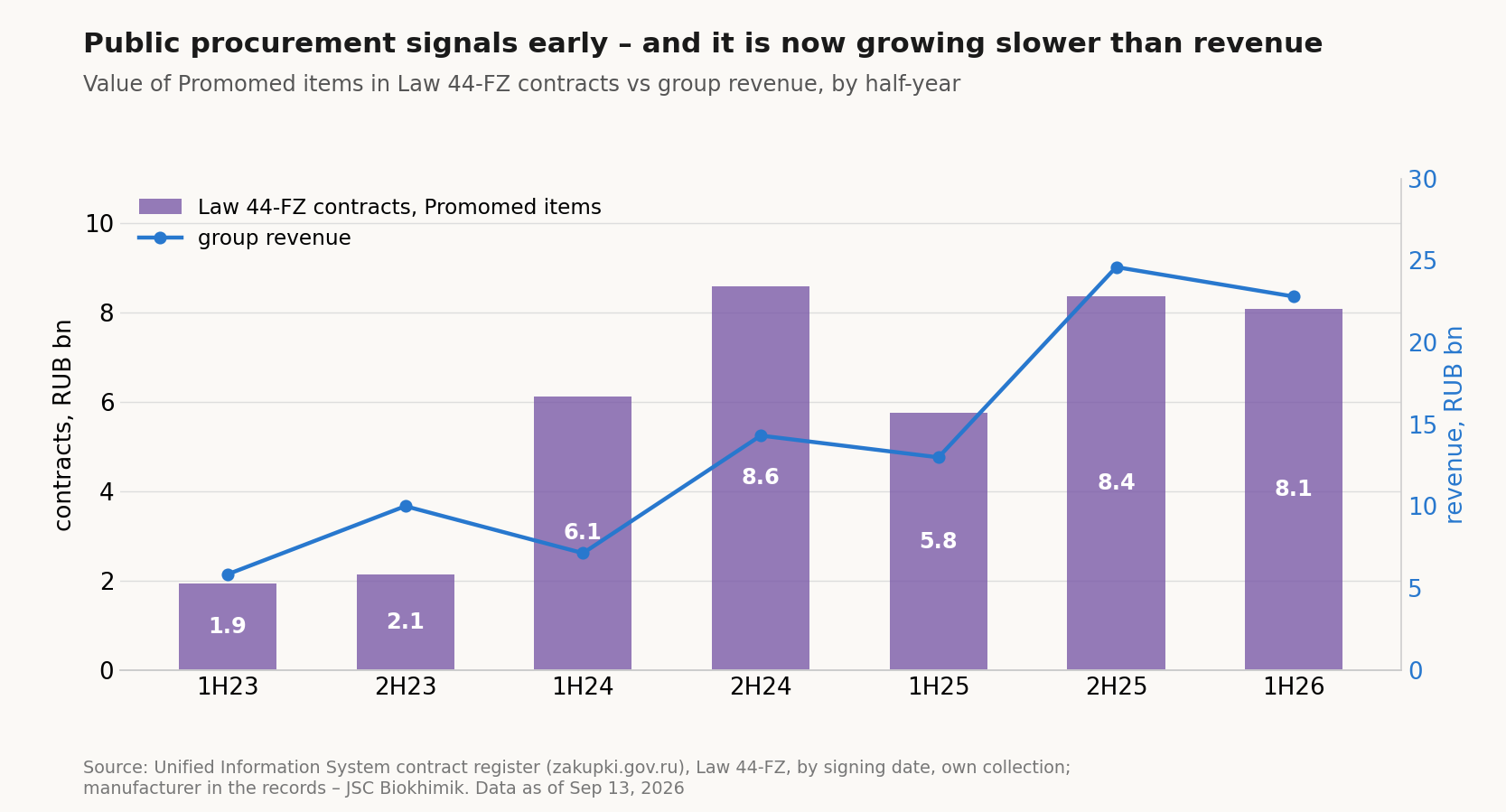
The company publishes full financial statements twice a year, and seasonality is such that quarterly comparisons say little. It therefore makes sense to look at data that appear ahead of the reports.
Pharmacy sell-out is growing faster than shipments. According to DSM, sales of the company's drugs to end consumers grew 207.5% year on year, 214% according to the MDLP drug labelling system, and distributor sales according to IQDATA rose 156%. Group revenue grew 76% over the same period. When goods leave pharmacies faster than the company ships them, channel inventory is being drawn down. This is a good sign, not overstocking.
The state channel is growing steadily, without acceleration. We collect Law 44-FZ contracts for the manufacturer Biokhimik directly from the Unified Procurement Information System. Over the last twelve months this amounts to 13.1 thousand contracts worth RUB 32.8 bn, up 37% year on year. The latest data are more modest: July and August 2026 brought RUB 2.4 bn against RUB 2.1 bn a year earlier. The main oncology auctions take place in autumn, so September and October will give the final picture for the budget channel. The correlation of half-yearly contract totals with group revenue is 0.74 over seven observations, meaning the indicator works but is not precise. A contract is not a shipment, and federal procurement comes in bursts.
The third indicator is consumer spending on medicines according to SberIndex. The last week to September 12 showed +8.3% year on year, and the third-quarter average was +10.2%. This is the backdrop for the whole market rather than the revenue of a specific manufacturer, but it shows that pharmacy demand overall is not sagging.
Profitability: the first half is structurally weaker than the full year
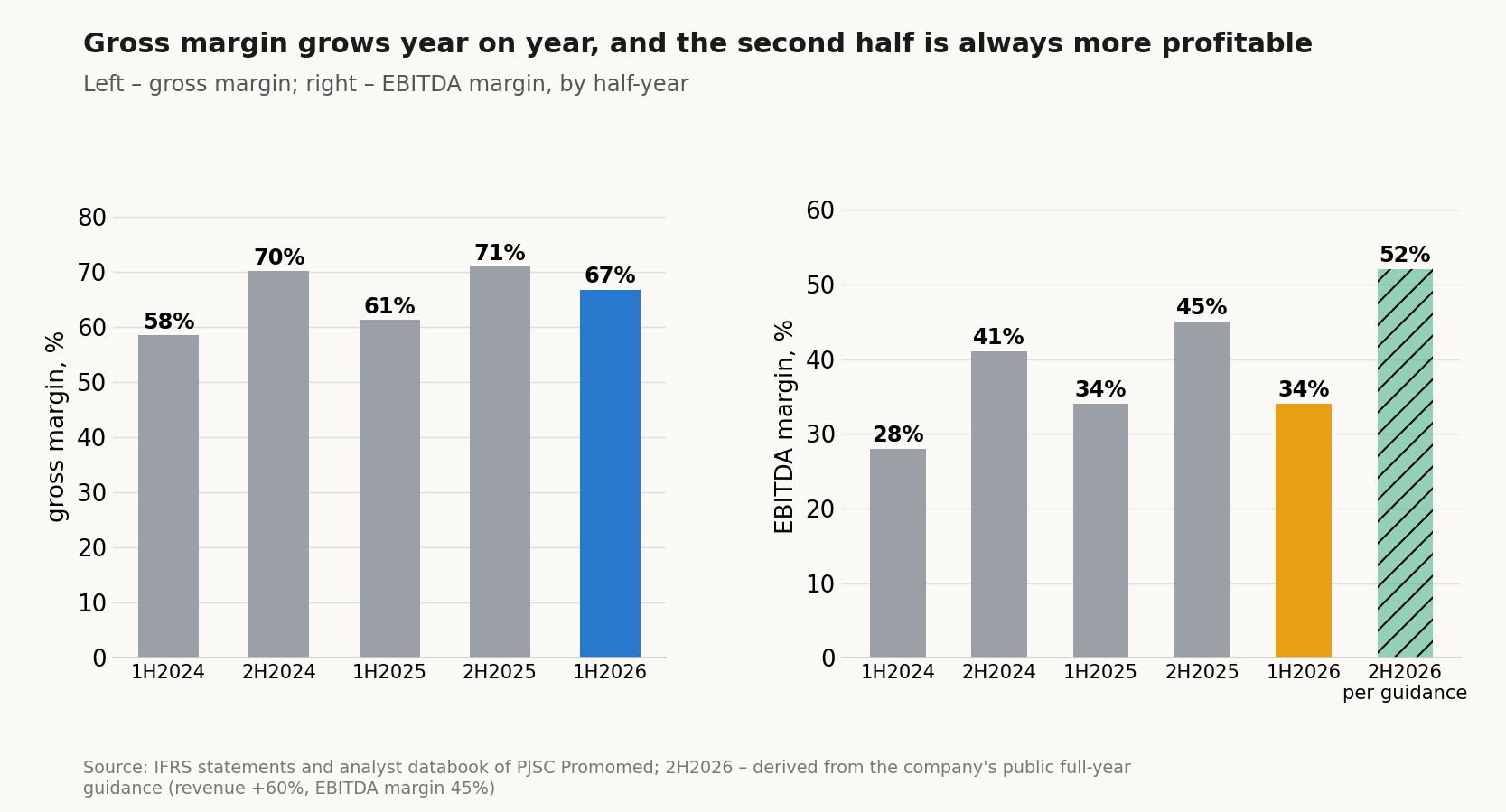
The 1H EBITDA margin was 34%, exactly the same as a year earlier, against full-year guidance of 45%. This is not a deterioration but the company's usual shape of the year. About half of annual revenue falls in the fourth quarter, because public procurement takes place in autumn and distributors stock up ahead of January. TV advertising and promotion costs, by contrast, are contracted and expensed early in the year. In 2025 the picture was the same, 34% in the first half and 45% in the second; in 2024 it was 28% and 41%.
Gross margin, meanwhile, is rising year on year, from 61% to 67%. This answers the main question about growth of this kind. Sales have shifted to retail, the commercial channel has reached 83% of revenue, and working with pharmacy chains always costs money. If the company were buying growth with price, gross margin would be falling. Instead, it gained six percentage points in a year.
The strategic goal is clear: make Tirzetta a well-known brand in the fight against excess weight. The benchmark here is Nurofen, which generates RUB 6-9 bn of sales with two to three dozen generics on the market. About 40% of Tirzetta sales are starter doses, which is the picture of a growing market where inflow comes from new patients rather than dose increases for existing ones.
Two technical details are worth keeping in mind when comparing periods. 1H EBITDA included a RUB 0.86 bn release of the provision for doubtful debts; without it the margin would be about 30%. And the share of general and administrative expenses in revenue fell by 0.5 percentage points to 13.1%, meaning administrative leverage is already working.
Cash flows, debt and dividends
Operating cash flow was negative at minus RUB 1.8 bn, and minus RUB 4.5 bn after capital expenditure. The income statement shows a profit, but the company does not yet have real cash. The reason is not losses but working capital. Payment terms for distributors reach 120-150 days, and cash for goods sold arrives more than a quarter after shipment. Free cash flow has been negative for the fourth year in a row, and the company funds growth with bank debt and factoring.
Factoring has become the main tool for managing working capital. It is non-recourse, it covers almost the entire commercial channel, the liability does not go on the balance sheet, and only the interest expense is visible in the income statement. In the summer the company disclosed two material factoring transactions. These are renewals and expansions of limits rather than one-off operations; disclosure was required because of the size of the limits, as happens with large credit lines. The disclosure contains no data on actual drawdowns, so the effect on working capital will only be visible in the financial statements.
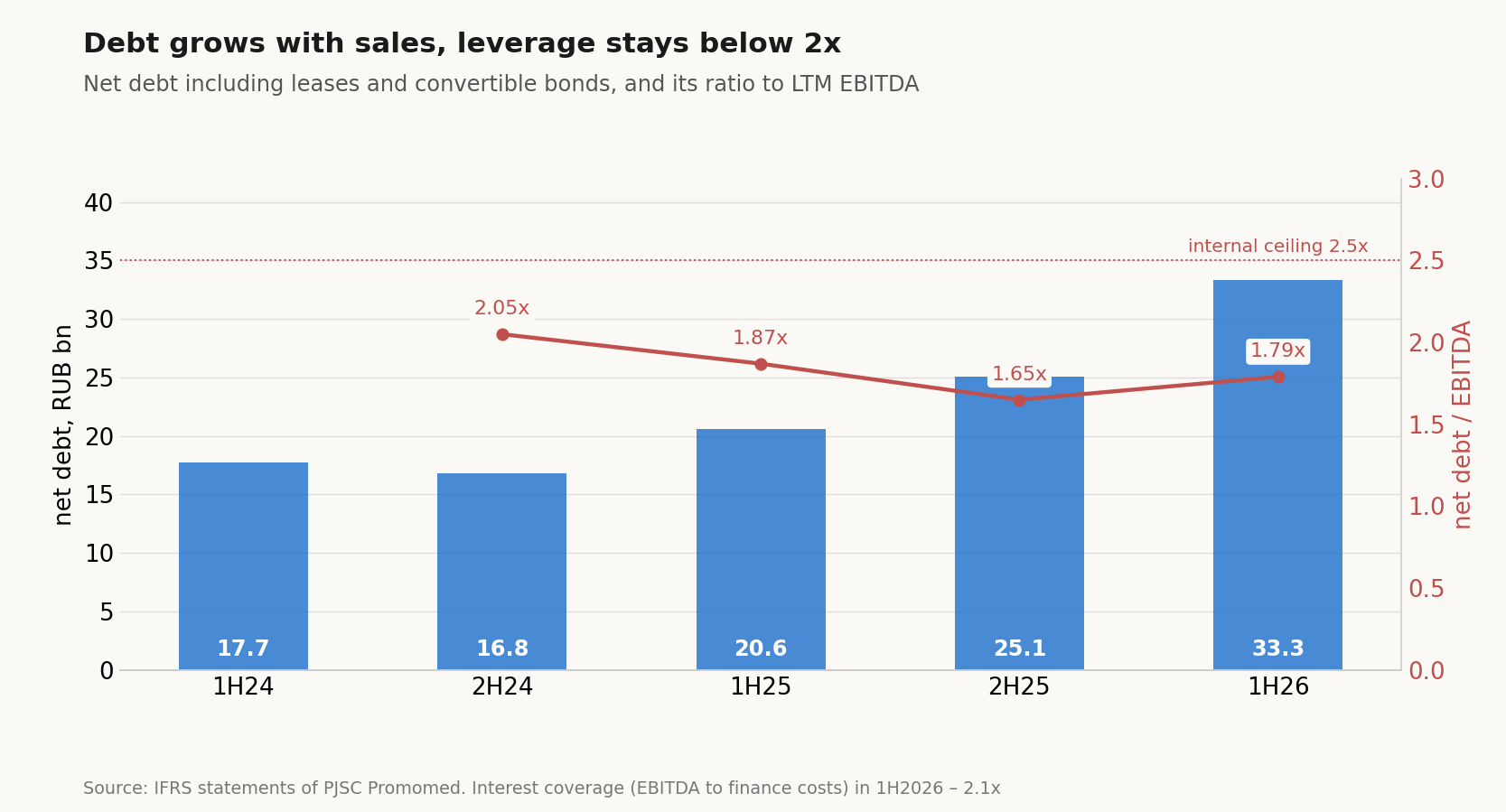
Net debt rose to RUB 33.3 bn from RUB 25.1 bn at the end of 2025, and the ratio to EBITDA increased from 1.65x to 1.79x. That is far from the 3.0x bond covenant; the covenant on bank loans is about 3.5x, and the company's internal target is no more than 2.5x. Interest coverage is RUB 2.1 of EBITDA per rouble of finance costs. Finance costs themselves were RUB 3.73 bn for the half-year, up 73%. At the same time, 91% of the portfolio is at floating rates, so key rate cuts benefit the company directly, and part of the debt is on concessional terms: structured bonds at 0% until August 2027 and Industrial Development Fund loans at 1-3%. The credit rating is ruA with a stable outlook, upgraded in June 2026.
The company paid dividends for the first time in its history, RUB 8 per share, a 2% yield at the current price. The payout base is not net income but income less investment in fixed assets and development, plus their depreciation. The dividend policy is tiered, and the top tier, with a payout of at least half the base, kicks in when leverage is below 1.0x EBITDA. The company does not rule out reaching that level based on 2027 results.
Valuation: cheaper than its own history, and the consensus agrees
The company is currently valued at 6.4x LTM EV/EBITDA versus its own three-year average of 9.4x. P/E is 10.5x. A business growing 76% a year trades at a noticeable discount to how the market valued the same business one and two years ago.
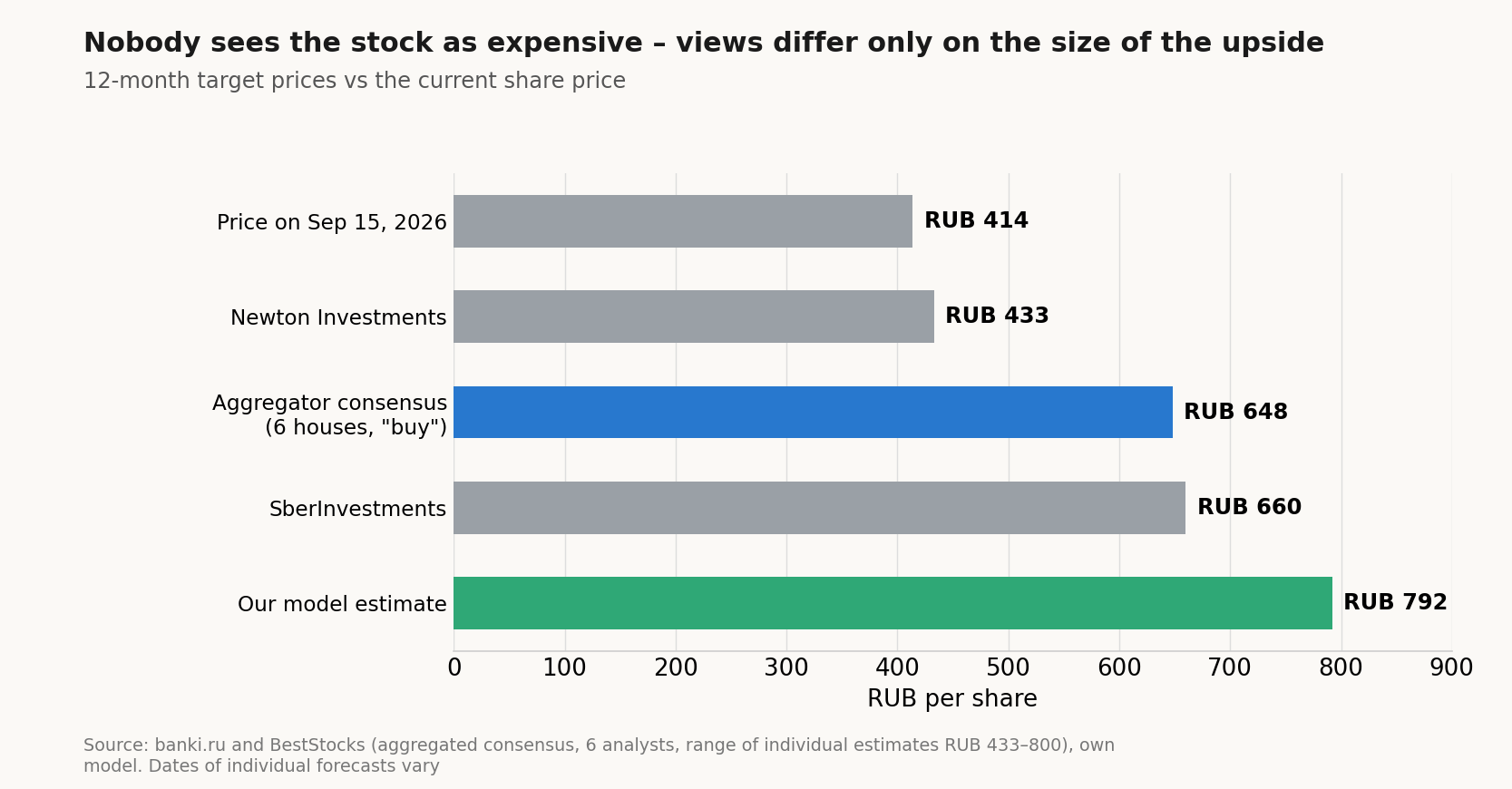
The analyst consensus says "buy", with a target price of about RUB 650 on a one-year horizon. According to aggregators, the consensus includes six brokers, with an average target of RUB 648-660 and individual estimates ranging from RUB 433 at Newton Investments to RUB 800; SberInvestments has RUB 660. Nobody recommends selling. An important caveat: the dates of individual forecasts differ, and some may have been issued before the 1H report, so the consensus here is a directional guide rather than a precise number.
Our model gives RUB 792 on a one-year horizon. A three-year model with an exit at the current multiple gives an internal rate of return of about 57% a year, with revenue of RUB 73.7 bn in a year and leverage falling to 0.9x EBITDA. The model also penalises the company by 18% for earnings quality, because operating cash flow does not cover accounting profit, and this is deducted from the upside in full.
The weak spot of our own model should also be named. In six historical checks it systematically underestimated this company: the median EBITDA forecast was 0.74 of the actual figure. The error is one-sided, meaning the valuation is more likely understated, but that does not make it more precise.
What we did in the portfolio
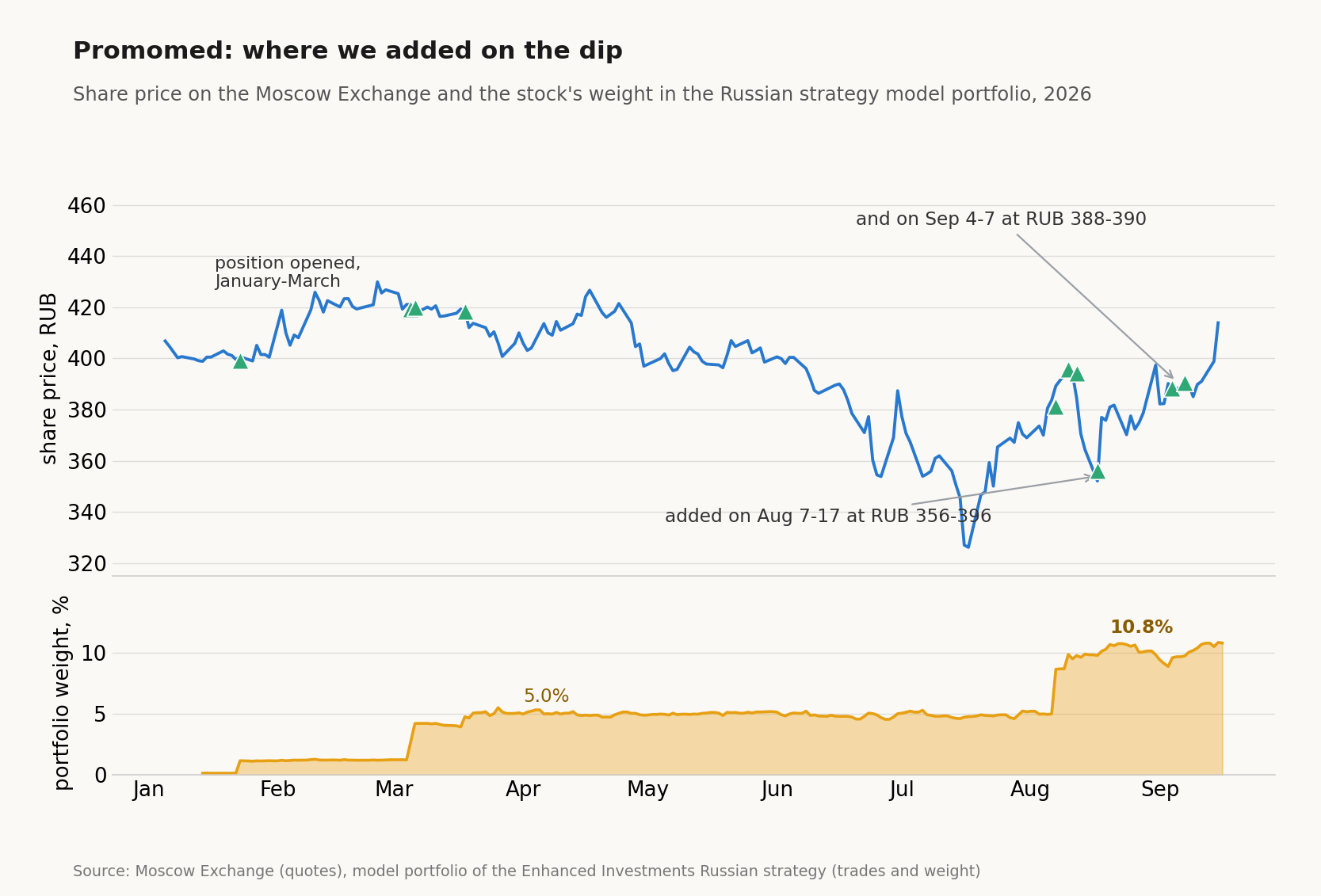
We built the position in January and March, and in August, when the entire Russian market was falling, we doubled it. Promomed's weight in the Russian strategy model portfolio rose from 5.0% in early August to 10.8% now, making it one of the largest positions in the book. We added on August 7-17 at RUB 356-396 and in early September at RUB 388-390; the average price of these purchases is about RUB 385 against the current quote of RUB 414.
The logic was simple. In July the MOEX Index fell to 1,958 points, down 28% from the start of the year, and Promomed fell with the market to RUB 326. Yet a week before the low, the company had pre-announced 76% revenue growth for the half-year, and the bulk of its annual revenue comes in the second half. The gap between the price and the operating results is exactly why one adds to a stock.
Since then the index has recovered part of the decline, and Promomed has gained about 27% from the July low. Year to date the stock is slightly up against minus 14% for the MOEX Index.
What could go wrong
The second-half margin may fall short of guidance. In that case the full-year EBITDA margin will be closer to 40% than to 45%, and the valuation will shift down. This can only be checked in the annual financial statements.
Cash flow remains negative for the fourth year in a row. The company grows on bank money and factoring and pays dividends with negative free cash flow. While revenue is doubling, this works. If growth slows, the structure will become heavy.
The business is concentrated in one drug class. The base portfolio is not growing, oncology depends on the procurement schedule, and all the momentum rests on weight-loss drugs. Competition in this class is intensifying: Geropharm sells only slightly less, and other manufacturers have announced plans to enter. Part of the portfolio operates under a compulsory licence for semaglutide, which is a regulatory decision that may change. There is no such risk for tirzepatide, where the patent was withdrawn by the rights holder.
The share count is growing. The long-term incentive programme is sized at up to 1% of share capital, and there is also a second series of structured bonds with a threshold of RUB 411 and a date in August 2027. Above the threshold the bonds convert into shares and free float rises to about 10%; below it, investors choose between cash and shares. In the first series, all holders converted. Over two years the number of shares has grown by about 2.8% a year.
The company is not aiming for low leverage. The target is not to exceed 2.5x EBITDA rather than to get down to 1.0x. With this approach, the top tier of the dividend policy will not kick in before the 2027 results.
Calendar: what November will show and what only the annual report will
The company reports semi-annually. It publishes IFRS statements twice a year: for the half-year at the end of August and for the full year in April. This means we will next see margins, cash flow and debt only in the annual report in spring 2027.
On November 20 the company releases operating results for nine months. They will include group revenue, a breakdown into the key and base portfolios, the shares of endocrinology and oncology, and confirmation or revision of full-year guidance. Last year this release contained exactly this set. It will allow us to check the main points: whether the autumn oncology tenders turned into shipments and whether the revenue pace is holding.
Before that, in early November, the Russian-standards (RAS) statements of the group's legal entities will appear. This is neither the group nor a consolidation, so it is useful only as a directional signal. And we continue to track Law 44-FZ contracts monthly; they are visible ahead of any reporting.
So far the data are adding up in the company's favour. The market is growing faster than its own plan, its share of that market is more than half, pharmacy sell-out is outpacing shipments, and the share price is still roughly at the level of the IPO two years ago. We are holding the position and adding on dips.
Company card with live multiples, financial statements and model: https://frontier.eninvs.com/company/RU_PRMD?lang=en
We run ideas like this in the strategies on the portal. A subscription opens the composition of the Russian book, trade signals and upside estimates for every stock; you can subscribe here: [https://eninvs.com/upgrade.php](https://eninvs.com/upgrade.php)
See also: market overview · valuation map · stock screeners