Promomed: the half-year confirmed growth and showed what it costs
Revenue rose 76% against a full-year plan of +60%, guidance is confirmed, and growth accelerated further in the second quarter. But the report also showed the price of that growth. RUB 17.1 bn of discounts and bonuses went to the sales channel, 43% of gross shipments; the EBITDA margin was held at 34% by a provision release; operating cash flow is negative again; and net debt rose by RUB 8.2 bn in the half-year. The cheapness case is not broken: on our model the stock trades at 5.5x forecast 2026 earnings. But the list of questions for management has become longer.
On 31 August Promomed published its IFRS results for 1H2026, operating results and an updated analyst databook. We go through the report using the statements, the notes and the databook. We have held the position since July and added to it in August; the market met the figures with a 4% rise in the share price.
In short, the whole report comes down to eight points:
- Growth is real and accelerating. Demand is confirmed by pharmacy sell-out, not by shipments into the channel.
- There is one driver, endocrinology. The segment grew 243% y/y and is now 71% of revenue; oncology fell on the state procurement schedule and is waiting for second-half tenders.
- The channel is getting more expensive. Discounts and bonuses to distributors and pharmacies are growing noticeably faster than revenue. This is the main finding of the report.
- Earnings quality is below the headline. EBITDA includes a RUB 0.86 bn provision release; without it the margin is about 30%, not 34%.
- Revenue guidance is achievable; margin guidance requires a record. The second half needs a 52% EBITDA margin, which the company has never delivered.
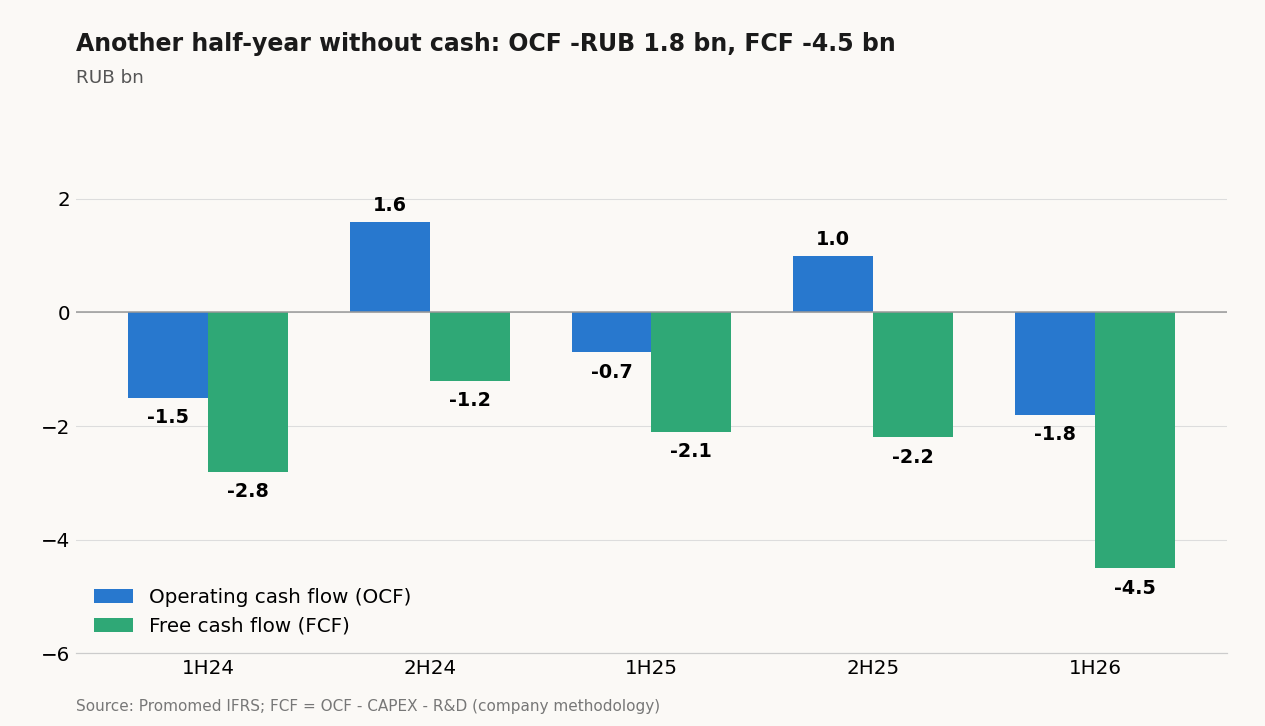
- The half-year brought no cash. OCF was -RUB 1.8 bn and FCF -RUB 4.5 bn; the factoring turnaround of late July is not yet in the report.
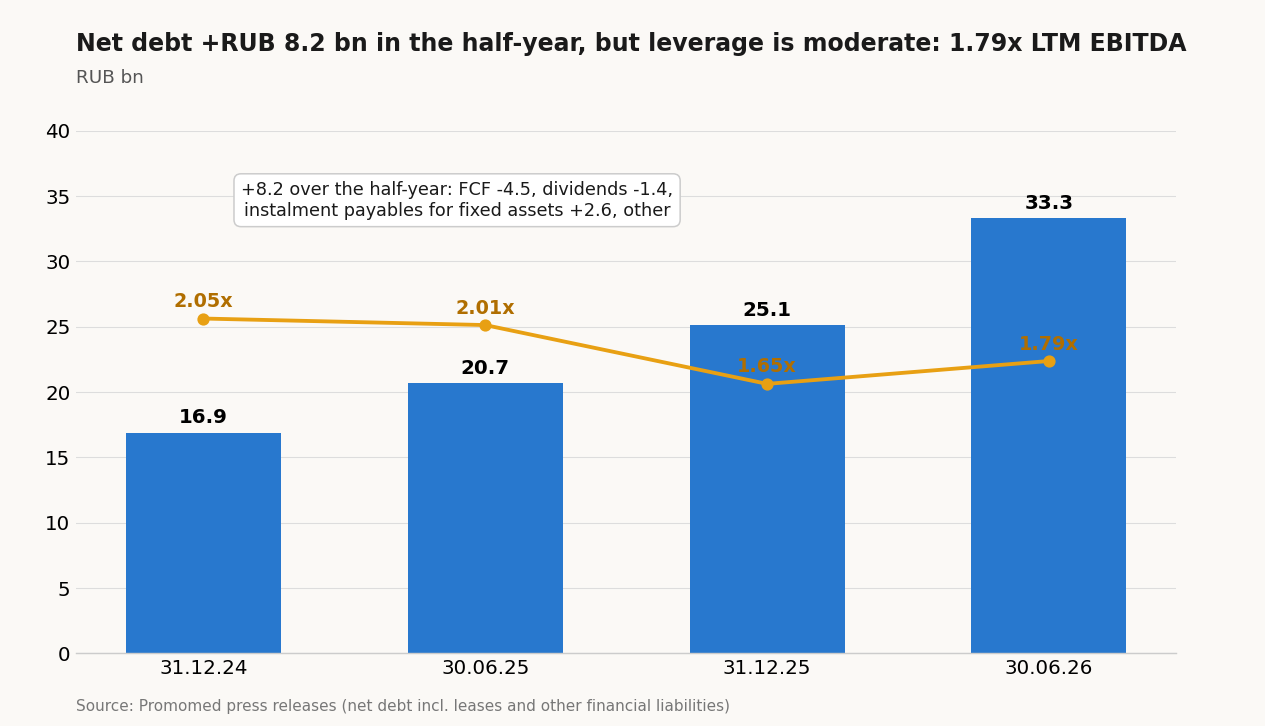
- Net debt is RUB 33.3 bn (+8.2 bn in the half-year) with moderate leverage of 1.79x; a new instalment liability for construction has appeared.
- We are not changing the RUB 620-650 target price yet. Calls with management are scheduled this week, and we will update the model after them.
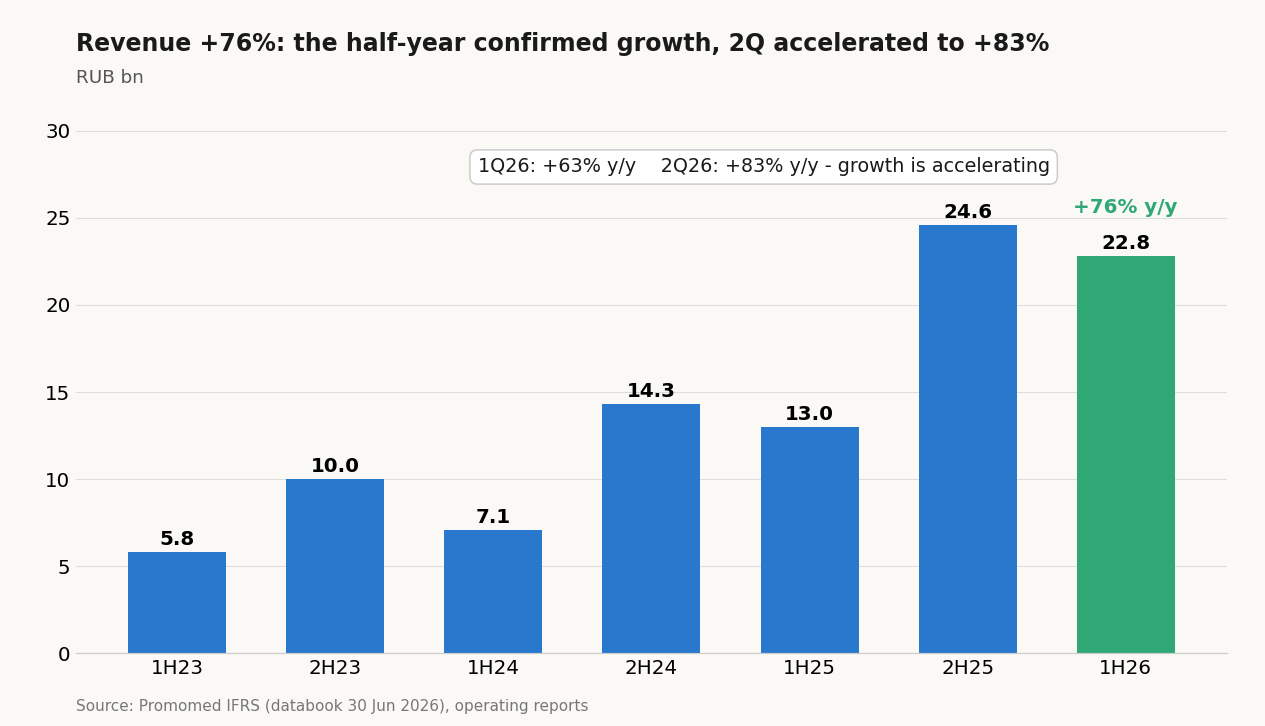
Point 1. Growth is confirmed by facts, not forecasts: RUB 22.8 bn (+76%), second quarter +83%
Revenue for the half-year was RUB 22.8 bn, growing 5 times faster than the pharmaceutical market (+14.5% per IQDATA). The second quarter implicitly contributed RUB 15.5 bn (+83% y/y) after +63% in the first, so the pace is not fading but accelerating. And this is not channel stuffing. Sales by the distributors themselves are growing faster than the company's shipments (+156% per IQDATA), and pharmacy sell-out is faster still (+207% per DSM, +214% per MDLP). Tirzetta has remained the best-selling drug in Russian pharmacies throughout 2026, and Promomed is the first manufacturer on the country's commercial pharmaceutical market for the half-year, with a 4.83% share.
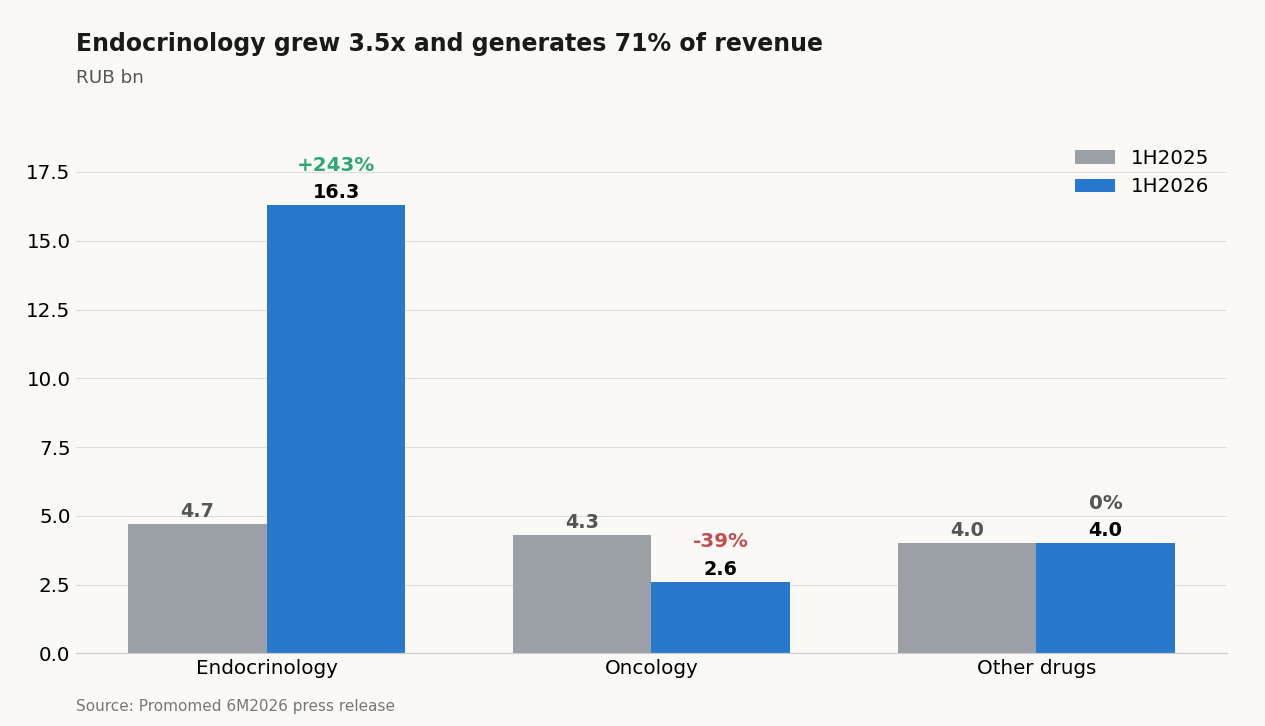
Point 2. All of the growth came from endocrinology: RUB 16.3 bn (+243%) and 71% of revenue
The relevant endocrinology market (9 INNs) grew 163% to RUB 49 bn, and Promomed takes a third of it. The semaglutide line (Velgia, Quinsenta, Semaltara) added 38% to RUB 3.7 bn, which means tirzepatide drives most of the growth. Oncology fell 39% to RUB 2.6 bn, as key 2026 state procurement was moved to the second half, where the company also plans new launches. Other drugs showed no growth (RUB 4.0 bn).
The flip side is concentration. One segment, in effect one molecule, delivers practically all of the growth, and the risk of a price war with Geropharm described in the August review has not gone away. There is also a structural gain. The share of the VED list (essential drugs) in revenue fell from 75% to 37% as sales shifted to the commercial segment without price regulation, which explains the 67% gross margin (+5 pp y/y).
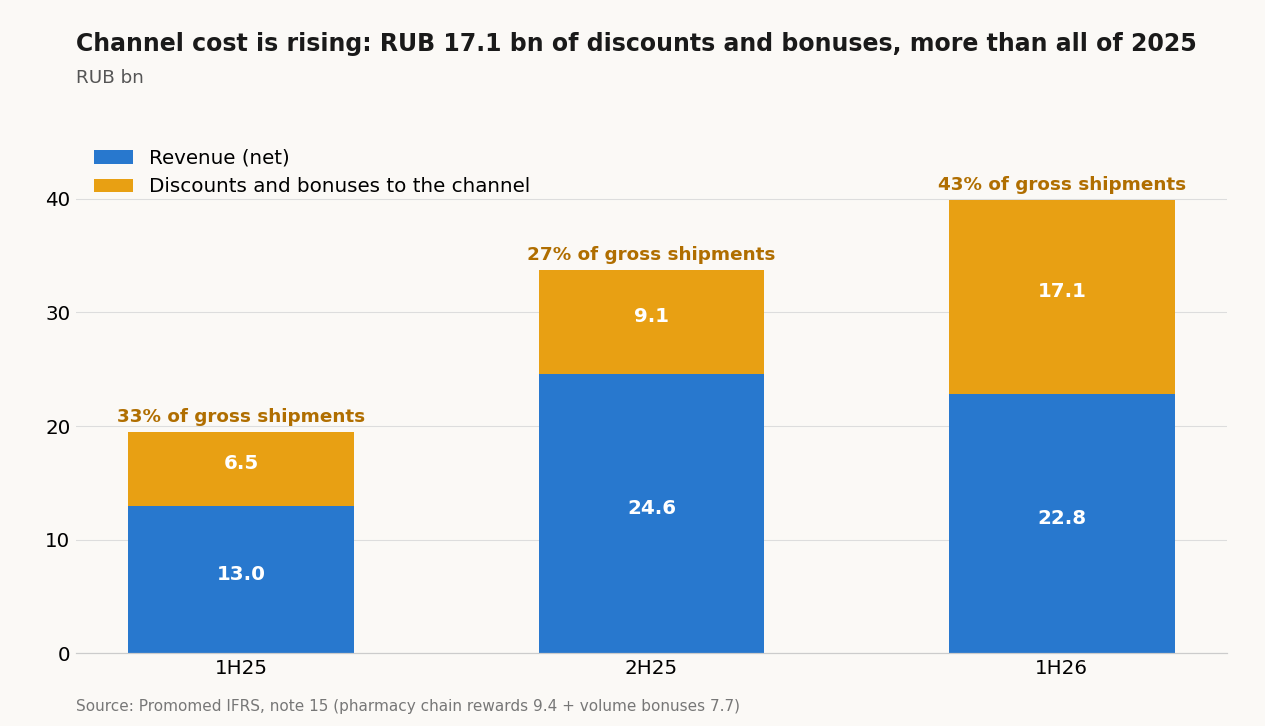
Point 3. The main finding of the report: RUB 17.1 bn of discounts and bonuses went to the channel, 43% of gross shipments
The note on revenue discloses what it was reduced by. Rewards to pharmacy chains for promotion were RUB 9.4 bn (RUB 2.4 bn a year earlier), and financial bonuses to distributors for purchase volumes were RUB 7.7 bn (RUB 4.1 bn a year earlier). The total is RUB 17.1 bn against RUB 6.5 bn a year ago, a 2.6x increase when revenue grew 76%. In six months the channel received more than in all of 2025 (RUB 15.6 bn, when this line became a key audit matter in the annual audit opinion).
Gross shipments before discounts grew to about RUB 39.9 bn (+105%), but of every rouble shipped, 43 kopecks go to the channel against 33 kopecks a year ago. Part of these costs is the price of launching a new class of drugs in pharmacies, and it should fall as the product matures; part is the price of competition, and it may stay for a long time. This is the first question for management.
The scale of the accruals is also visible indirectly in the tax note. Channel bonuses are deductible for tax purposes when paid, not when accrued, so current tax of RUB 3.2 bn was accrued for the half-year against an income tax expense of only RUB 0.9 bn in the income statement; the difference settled in a deferred tax asset (+RUB 2.1 bn in the half-year).
Point 4. EBITDA +76%, but it includes a RUB 0.86 bn provision release; without it the margin is 30%, not 34%
The release of the provision for expected credit losses added RUB 0.86 bn to operating profit (a year ago a small provision was in fact charged). For the balance sheet this is good news: problem receivables reserved in prior years are being collected. But this money has nothing to do with the operating work of the half-year. Without the release, EBITDA is about RUB 6.8 bn (+54% y/y), and the margin is about 30% against 34% a year earlier.
The margin is eaten by selling expenses of RUB 5.7 bn, up 2.2x, including advertising and marketing of RUB 3.5 bn (up 2.3x). Administrative expenses, meanwhile, are disciplined at 13.1% of revenue against 13.6% a year ago. Net profit of RUB 2.6 bn (+83%) carries the same provision effect.
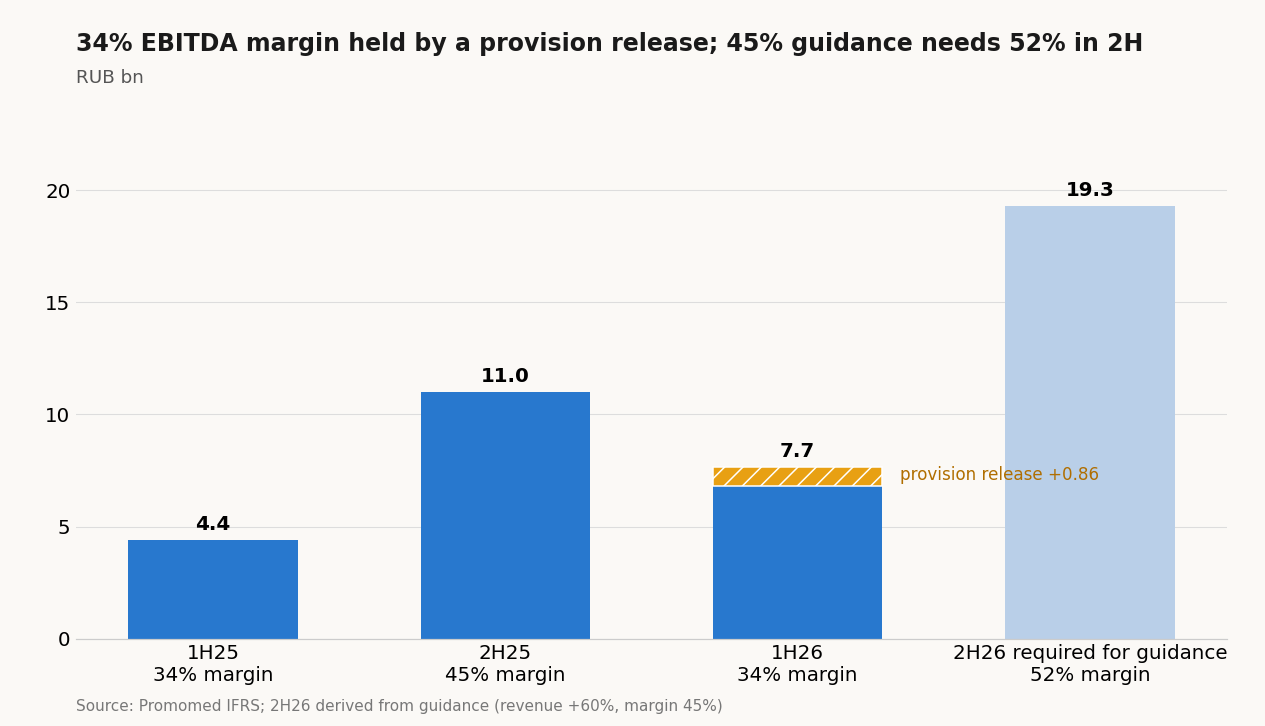
Point 5. Revenue guidance is achievable; margin guidance requires a historic record
The company confirmed its 2026 guidance of revenue growth of 60% (about RUB 60 bn) at a 45% EBITDA margin. On revenue, the second half only needs to grow 51%, noticeably less than already achieved, while seasonality (half of annual revenue falls in the fourth quarter) and the postponed oncology tenders work in its favour.
On margin the arithmetic is tougher. To reach 45% for the year, the second half must deliver RUB 19.3 bn of EBITDA at a 52% margin, against 45% in 2H2025, which was the historical maximum. The shift of revenue to the high-margin commercial segment helps, but our base case assumes the revenue plan is met and the margin target is missed.
Point 6. The half-year again brought no cash: OCF -RUB 1.8 bn, FCF -RUB 4.5 bn
In the previous review we assumed the half-year statements would show a sharp improvement in operating cash flow thanks to factoring. That did not work out on timing. Both large factoring deals (RB Factoring on 24 July, Sber Factoring on 30 July) were concluded after the reporting date and did not make it into the half-year figures. We will look at their effect in the 9M report.
Within the half-year, before changes in working capital, the business earned RUB 8.0 bn, 1.65 times more than a year ago. Then RUB 5.4 bn went into inventories (finished goods are up 1.65 times since the start of the year, the warehouse is stocked for second-half sales), RUB 3.8 bn into income tax paid (settlements for the profitable end of 2025), and RUB 3.7 bn into interest. Receivables grew by only RUB 1.0 bn in cash flow terms, partly because non-recourse factoring is already working during the period: interest expense on it was RUB 1.0 bn for the half-year (+52% y/y). Net working capital is RUB 29.7 bn, or 63% of LTM revenue against 73% at the end of 2025. The relative improvement began before the July deals.
Point 7. Net debt rose RUB 8.2 bn in the half-year; a RUB 2.6 bn instalment liability for construction has appeared
Net debt at 30 June is RUB 33.3 bn, 1.79x LTM EBITDA (1.65x at year-end; 2.01x a year ago). The increase consists of FCF of -RUB 4.5 bn, dividends of -RUB 1.4 bn and a new balance sheet line of RUB 2.6 bn of "other financial liabilities", instalment payments for fixed assets with a term of over a year. This is the construction of the oncology building, financed by suppliers. Cash CAPEX for the half-year is only RUB 1.5 bn, while fixed assets on the balance sheet grew by RUB 3.8 bn. Trade payables doubled to RUB 9.2 bn, so suppliers are financing inventories as well.
The safety margin is nevertheless wide. Unused credit limits are RUB 20.8 bn, and after the reporting date Sberbank expanded its facility to RUB 20.8 bn with a maturity to 2030, and Alfa-Bank to RUB 5.0 bn. Covenants are met. Most of the debt is linked to the key rate, so the rate-cutting cycle works for the company: each percentage point saves about RUB 0.3 bn of interest expense a year.
Dividend arithmetic, however, is running ahead of cash flow for now: the first-ever RUB 8 per share (RUB 1.7 bn) was paid in the half-year with negative FCF, that is, on borrowed money. The base under the dividend policy formula (net profit minus CAPEX and R&D plus depreciation) is about RUB 0.7 bn for the half-year. At 1.79x, the policy requires at least 25% of the base; the doubling of the ratio to 50% waits for the 1.0x threshold.
Point 8. The notes: the INCAMPHARM purchase, subsidiaries in three countries and an incident at Domodedovo
- On 7 July, 50% of INCAMPHARM (rheumatology) was bought for RUB 125 mn, a continuation of the portfolio build-out.
- In the half-year, an advance of RUB 650 mn was paid for a stake in a subsidiary; the sellers are among the Group's shareholders (a related-party transaction), plus a buyout of minority stakes for RUB 225 mn.
- In July-August, 100% subsidiaries were registered in Kazakhstan, China and Uzbekistan, building export infrastructure; the plants are already GMP-certified in the UAE and Uzbekistan.
- The second series of structured bonds (RUB 1.7 bn, maturing in August 2027) carries a put option at a price of about RUB 412 per share, a continuation of the mechanism for raising the free float (currently 8.5% after the first series was redeemed in shares).
- In August, at the Severnoye Domodedovo warehouse complex, an "abnormal event" occurred, in the company's wording; the company states that deliveries continue in full and operations are not affected. We will clarify the details and insurance coverage with management.
Valuation has not stopped being low; we are keeping the RUB 620-650 target until we speak to management
At RUB 394 (+4% on the report), market capitalisation is RUB 83.7 bn and EV is about RUB 117 bn. That is 6.3x EV/EBITDA LTM and about 10x P/E LTM. In the base scenario of our model from the August review (revenue of RUB 64 bn, net profit of RUB 15.3 bn in 2026), 2026 P/E is 5.5x. The report confirms the model on revenue; the key forks are the second-half margin, the durability of channel discounts and the effect of factoring on working capital.
The metric we track across the whole coverage is the growth in fundamental value: annualised EBITDA growth multiplied by the target multiple, plus cash flow to the balance sheet, as a percentage of current market capitalisation. With the report it rose from 52% to 64% a year. The half-year EBITDA increase (+RUB 3.6 bn vs 1H2025) annualises to +RUB 8.7 bn against +RUB 7.2 bn on end-2025 data; the target multiple is 6.3x, the average of the current EV/EBITDA of 6.2x and the 6.5x norm for the Russian market. In other words, even after the cash outflow into working capital, the company creates in a year value of almost two thirds of its own market capitalisation. On this metric, a re-rating upwards remains a matter of time and of confirmation of the margin.
Calls with IR and the company's CFO are scheduled this week. We will discuss discounts, the construction instalment liability, the guidance margin and the dividend trajectory, and then update the model. Until then, the RUB 620-650 target price (upside of 57-65%) remains in force.
The full review of the company, with the model, three scenarios and the target price calculation, is in the August article: [https://telegra.ph/Promomed-PRMD-Review-08-2026-08-10](https://telegra.ph/Promomed-PRMD-Review-08-2026-08-10)
Tickers
PRMD is the issuer card with the financial model: https://frontier.eninvs.com/company/RU_PRMD?lang=en. Extended cards of Russian issuers are on our portal: https://frontier.eninvs.com/region/ru?lang=en
See also: market overview · valuation map · stock screeners