Renessans: insurance business grows, but investments and finance costs drive the loss

On August 21, 2026, PJSC Group Renessans Insurance released its interim consolidated financial information for the first half of 2026. Insurance revenue rose 9.2% to RUB 56.5 billion, but the net loss was RUB 1.4 billion versus a profit of RUB 5.9 billion a year earlier. This review examines what drove the loss and what factors will shape the second half.
Key takeaways
— Insurance revenue grew 9.2% to RUB 56.5 billion, but net profit turned into a loss of RUB 1.4 billion.
— The investment and finance result swung to a negative RUB 3.5 billion due to negative revaluation and insurance finance expenses.
— The half-year net loss drove net margin to -27.0% versus +6.4% a year earlier.
— Equity fell by RUB 2.4 billion in the half-year, mainly due to the loss and share buybacks.
— Trailing dividend yield stood at 12.18%, while the model's fair yield is 10.5%.
— Cash and equivalents rose to RUB 34.2 billion at the end of the half-year, providing a buffer for payouts and investments.
Key figures, RUB bn
| Metric | H1 2025 | H1 2026 | Change |
|---|---|---|---|
| Revenue | 92.2 | 5.19 | -94.4% |
| Net profit | 5.92 | -1.40 | -123.7% |
| Net margin | 6.4% | -27.0% | -33.4 pp |
Insurance revenue grew 9.2% to RUB 56.5 billion, but net profit turned into a loss of RUB 1.4 billion.
In the first half of 2026, insurance revenue reached RUB 56.5 billion, up 9.2% from RUB 51.7 billion a year earlier. Growth was driven by higher premiums in life and non-life insurance, with the life insurance segment contributing RUB 19.4 billion and non-life RUB 37.1 billion.
However, at the net profit level, the company posted a loss of RUB 1.4 billion versus a profit of RUB 5.9 billion in H1 2025. The main reason is the negative investment and finance result, which outweighed the positive insurance service result.
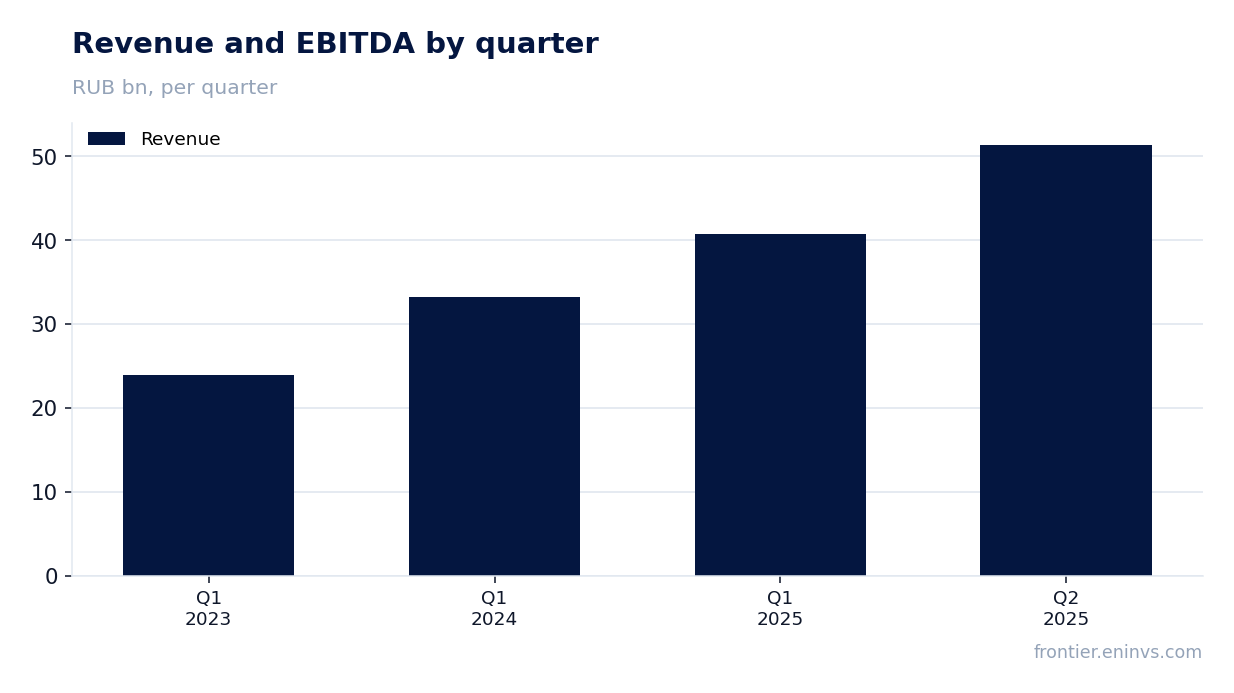
The investment and finance result swung to a negative RUB 3.5 billion due to negative revaluation and insurance finance expenses.
The investment and finance result for H1 2026 was negative RUB 3.5 billion versus positive RUB 4.5 billion a year earlier. Key drivers were a decline in income from financial assets at fair value through profit or loss to RUB 5.8 billion from RUB 18.9 billion, and insurance finance expenses of RUB 14.3 billion.
Income from financial assets at fair value fell more than threefold, reflecting market volatility and the CBR key rate cut from 16% to 14.25% in H1 2026. Insurance finance expenses remained high, typical for life insurers with long-term liabilities.
The half-year net loss drove net margin to -27.0% versus +6.4% a year earlier.
Net margin for H1 2026 was -27.0%, versus a positive 6.4% in the same period last year. A loss of RUB 1.4 billion on revenue of RUB 56.5 billion means the company lost 27 kopecks per ruble of revenue.
The negative margin is not due to operations – the insurance service result remained positive at RUB 4.8 billion – but to the investment and finance block. This highlights the sensitivity of the financial result to market conditions.
Equity fell by RUB 2.4 billion in the half-year, mainly due to the loss and share buybacks.
Equity at June 30, 2026 stood at RUB 53.9 billion, down from RUB 56.3 billion at the start of the year. The RUB 2.4 billion decline was driven by a net loss of RUB 1.4 billion, share buybacks of RUB 0.7 billion, and negative other comprehensive income of RUB 0.3 billion.
Share buybacks continued: the company spent RUB 725.6 million in the half-year, down from RUB 1.9 billion a year earlier. Nevertheless, the capital reduction amid a loss may constrain future dividend capacity.
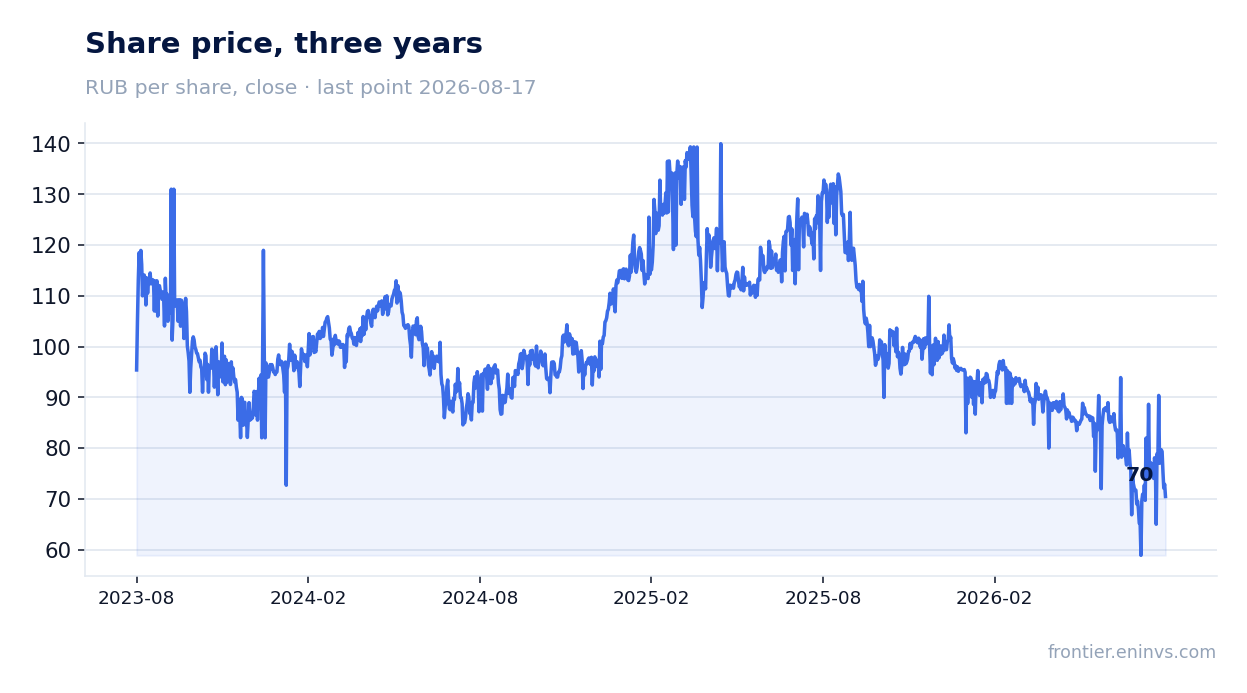
Trailing dividend yield stood at 12.18%, while the model's fair yield is 10.5%.
Over the last 12 months, the company paid dividends of RUB 4.1 per share, providing a yield of 12.18% at the current market cap of RUB 37.4 billion. Our model estimates a fair dividend yield for this issuer at 10.5%, below the actual.
The next payout is estimated at RUB 0.0 per share, which may signal a risk of dividend cuts or suspension in the coming periods. The implied payout ratio is 0.49 of profit, but with a half-year loss, payouts from profit are unlikely.
Cash and equivalents rose to RUB 34.2 billion at the end of the half-year, providing a buffer for payouts and investments.
Cash and equivalents at June 30, 2026 stood at RUB 34.2 billion, up from RUB 9.8 billion at the start of the year. The 3.5x increase is due to insurance premiums received, investment income, and higher short-term deposits.
Operating cash flow for the half-year was RUB 31.9 billion, well above RUB 4.1 billion a year earlier. However, for an insurance company, operating cash flow is not a profit measure – it reflects client funds and reserves. Nevertheless, high liquidity allows the company to meet policyholder obligations and fund investments.
Valuation on the latest reported figures
| Metric | Value |
|---|---|
| Market cap | 37.4 bn ₽ |
| P/B | 0.66 |
| ROE | -5.1% |
| Dividend yield (12m) | 12.2% |
Bottom line
Bottom line: Renessans's insurance business continues to grow – revenue rose 9.2% in the half-year, and the insurance service result remained positive. However, a loss of RUB 1.4 billion due to negative revaluation and insurance finance expenses overshadowed the operational success. Trailing dividend yield is high, but future payouts are uncertain. The key question for shareholders is whether the company can restore profitability in the second half through market stabilisation and lower finance expenses.
Open the company's financial profile RENI →
See also: market overview · valuation map · stock screeners