Tatneft: profit tripled, but the quarter rests on a single cost line
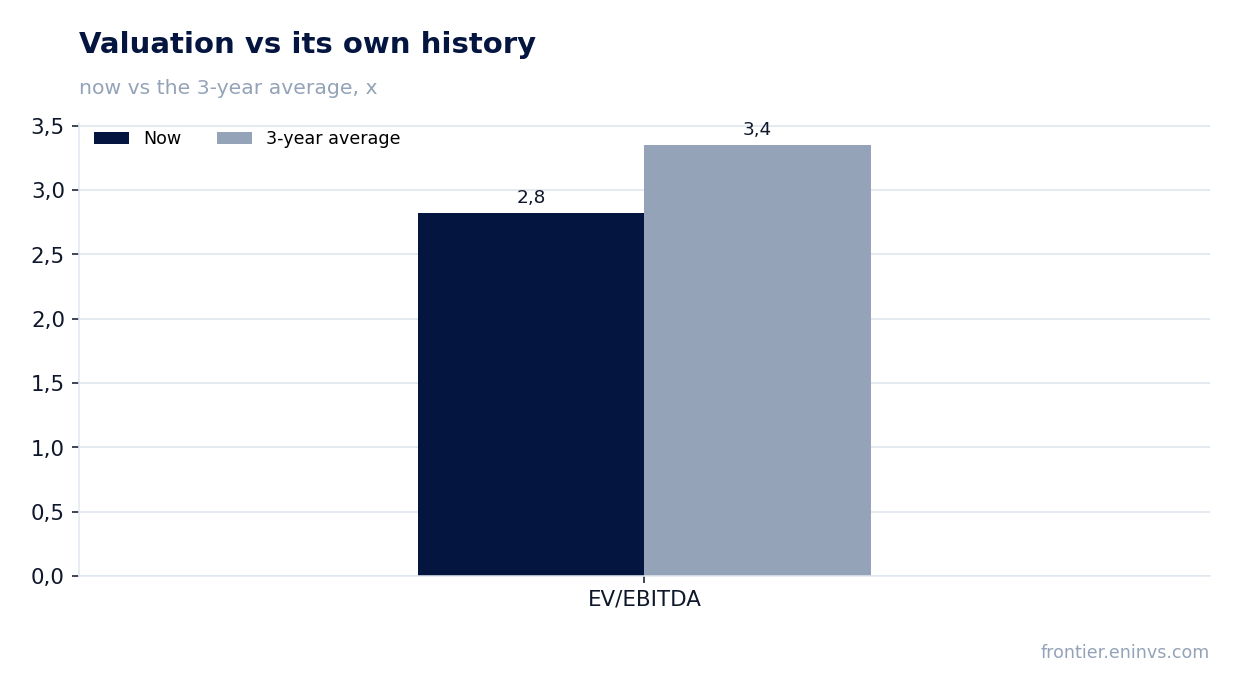
On 31 August Tatneft reported results for the second quarter of 2026. Revenue rose 36.9% year on year to RUB 440.8 bn, EBITDA by 81.8% to RUB 129.6 bn and net profit by 205.2% to RUB 82.7 bn, with an EBITDA margin of 29.4% against 22.1% a year earlier. The stock trades at 2.8x EV/EBITDA against its own three-year average of 3.4x and yields 8.7% on payments over the last twelve months, so at the current price the share looks rather attractive, even though half of the quarterly profit jump comes from a tax line rather than from oil.
Key takeaways
— Revenue added 36.9% not from production but from selling oil and refined products abroad
— EBITDA rose 81.8%, and half of the profit gain came from a tax line, not from oil
— Half-year operating cash flow of RUB 207.9 bn was absorbed by a RUB 68.7 bn receivables build
— Net debt turned negative at RUB 154.1 bn, but that is cash, not debt repayment
— The 2025 dividend is RUB 34.09 per share, and our current-year estimate gives a 9.6% yield
— The 2.8x EV/EBITDA multiple is 16% below its own three-year average of 3.4x
Attractiveness
Key figures, RUB bn
| Metric | Q2 2025 | Q2 2026 | Change |
|---|---|---|---|
| Revenue | 322 | 441 | +36.9% |
| EBITDA | 71.3 | 130 | +81.8% |
| Operating profit | 55.7 | 111 | +99.5% |
| Net profit | 27.1 | 82.7 | +205.2% |
| Operating cash flow | -7.38 | -2.03 | — |
| Capex | 33.9 | 31.2 | -7.9% |
| EBITDA margin | 22.1% | 29.4% | +7.3 pp |
| Net margin | 8.4% | 18.8% | +10.4 pp |
Revenue added 36.9% not from production but from selling oil and refined products abroad
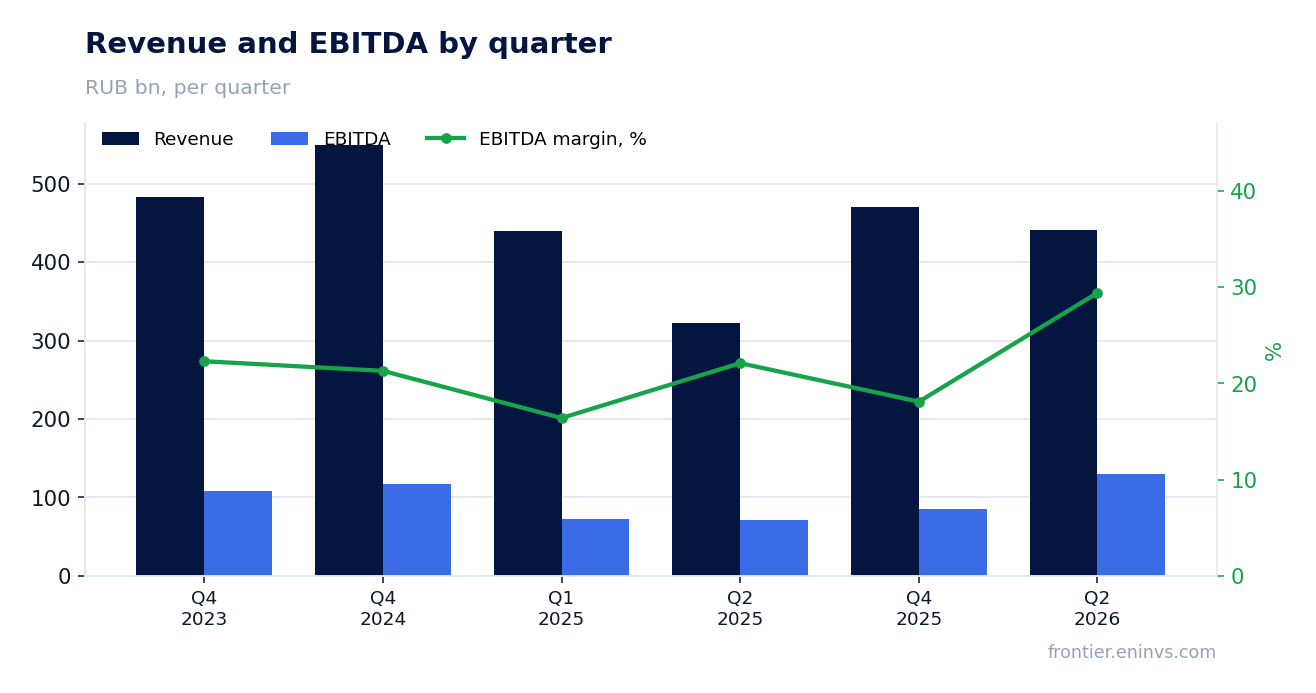
Second-quarter 2026 revenue was RUB 440.8 bn against RUB 322.1 bn a year earlier, a 36.9% increase. The report shows where it came from: in the first half, sales of oil and refined products to near and far abroad reached RUB 338.2 bn against RUB 256.7 bn a year earlier, so exports added about RUB 81.5 bn against a half-year revenue increase of RUB 120.5 bn.
Within the segments, refining and marketing grew most: RUB 538.8 bn of sales in the half against RUB 468.8 bn, with a new line for purchased crude oil at RUB 17.9 bn. Exploration and production added less: RUB 522.4 bn against RUB 482.6 bn, and almost all of that came from own crude oil (RUB 310.0 bn against RUB 257.6 bn).
Two external customers accounted for 25% and 14% of continuing-operations revenue – RUB 230.3 bn and RUB 129.9 bn in the half. That concentration means quarterly revenue depends on their shipment schedule as much as on the oil price.
EBITDA rose 81.8%, and half of the profit gain came from a tax line, not from oil
Second-quarter EBITDA was RUB 129.6 bn against RUB 71.3 bn a year earlier, with the margin up to 29.4% from 22.1%. Operating profit rose to RUB 111.0 bn from RUB 55.7 bn. Part of this is a low-base effect: in the second quarter of 2025 the result was weighed down by currency movements, while in this half the net foreign-exchange loss was RUB 4.3 bn against RUB 24.9 bn a year earlier.
The main contribution to profit came not from operations but from taxes. Taxes other than income tax fell to RUB 249.2 bn in the half from RUB 263.6 bn, with the tax on additional income from hydrocarbon extraction down to RUB 62.0 bn from RUB 74.6 bn and the reverse excise up to RUB 117.6 bn from RUB 105.2 bn. The gap between those two lines is about RUB 25 bn for the half, and it runs straight through EBITDA.
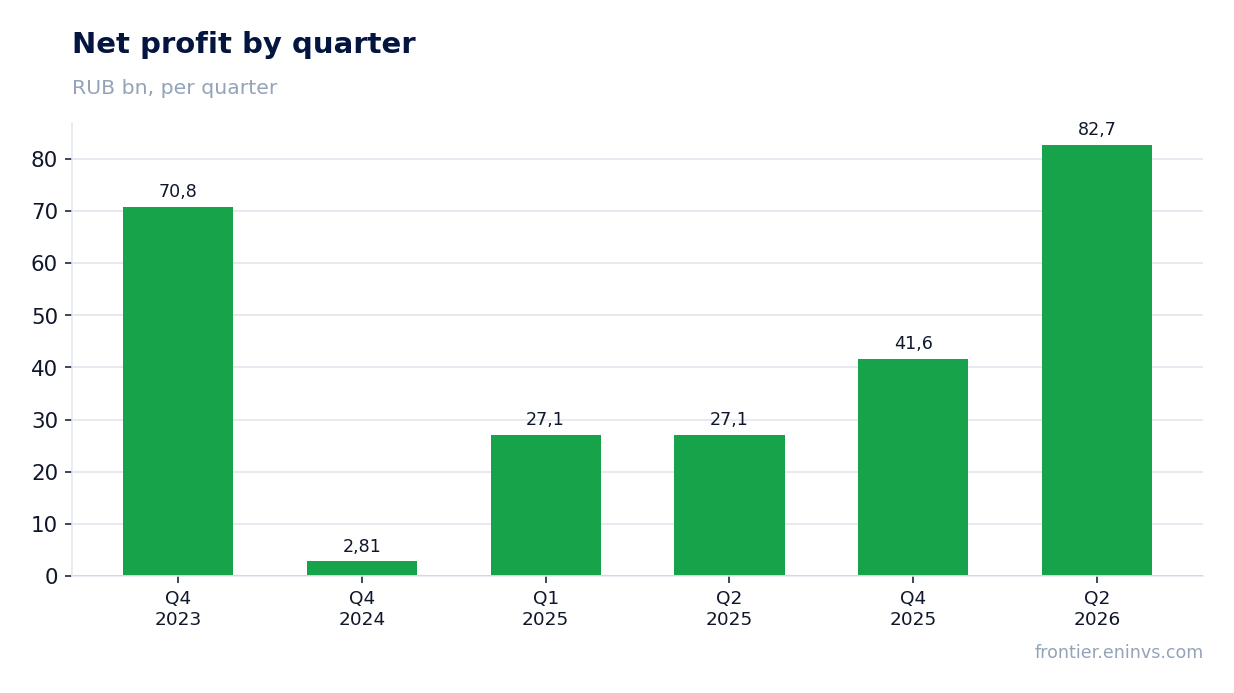
Quarterly net profit was RUB 82.7 bn against RUB 27.1 bn, a margin of 18.8% against 8.4%. But the half-year profit of RUB 165.5 bn includes RUB 4.0 bn from discontinued operations – the tyre business sold in the first quarter. Without that line, profit from continuing operations is RUB 161.5 bn, and it still nearly tripled.
Half-year operating cash flow of RUB 207.9 bn was absorbed by a RUB 68.7 bn receivables build
Operating activities brought in RUB 207.9 bn in the first half against RUB 104.7 bn a year earlier. But the flow is skewed inside: receivables rose by RUB 68.7 bn, whereas a year earlier they fell by RUB 45.6 bn. The difference is RUB 114.3 bn, and it absorbed almost the entire increase in cash flow.
In the second quarter alone operating cash flow was negative at minus RUB 2.0 bn. That is not a loss but working-capital movement: shipments rose and the cash had not yet arrived. Capital expenditure was RUB 31.2 bn in the quarter and RUB 59.8 bn in the half against RUB 65.6 bn a year earlier, so investment is shrinking, not growing.
Free cash flow for the half is therefore positive but thin: RUB 207.9 bn of operating flow minus RUB 59.8 bn of capex. That matters for the dividend story: the payout rests not on a record cash flow but on the company spending less on construction than a year ago.
Net debt turned negative at RUB 154.1 bn, but that is cash, not debt repayment
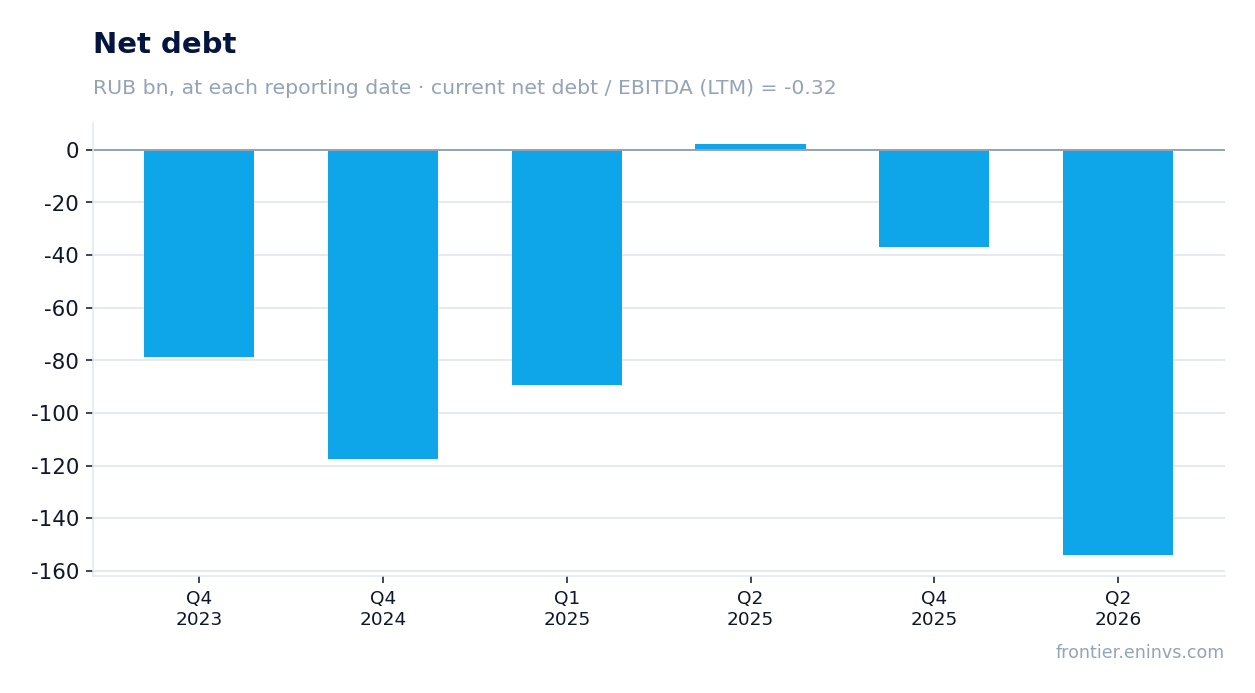
At 30 June 2026 net debt was minus RUB 154.1 bn against minus RUB 36.9 bn at 31 December 2025, a change of minus RUB 117.3 bn over six months. A year earlier, at 30 June 2025, it was plus RUB 2.3 bn, so over twelve months the figure moved by minus RUB 156.5 bn. Net debt to EBITDA for the last twelve months is minus 0.32.
The nature of the shift is cash accumulation, not debt repayment. Cash and equivalents rose to RUB 144.2 bn from RUB 66.9 bn at the start of the year, while the company raised RUB 54.1 bn of new debt and repaid RUB 70.0 bn of old debt. Debt was falling, but cash grew faster thanks to operations and asset sales.
For a dividend stock, negative net debt is a cushion: the payout does not depend on refinancing. But it also means part of the profit sits on accounts rather than being distributed. The question for management is how much cash it needs to hold to feel comfortable at a 14.0% key rate.
The 2025 dividend is RUB 34.09 per share, and our current-year estimate gives a 9.6% yield
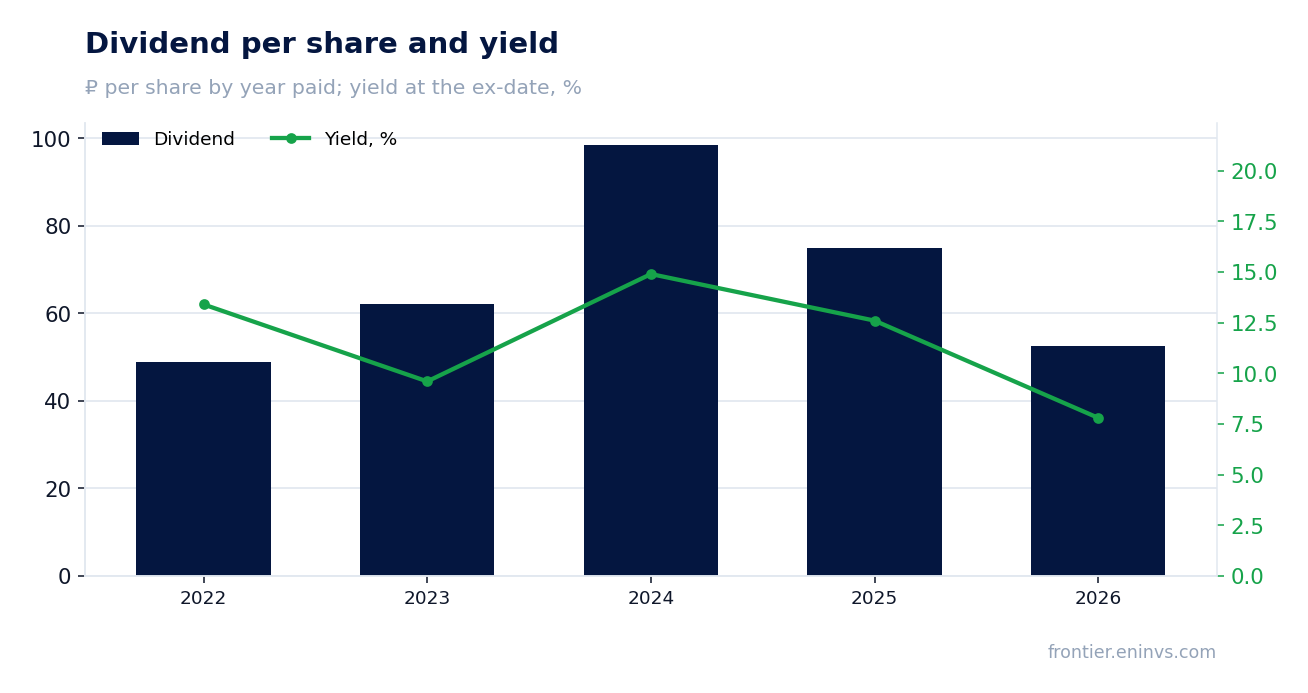
For 2025 shareholders approved RUB 34.09 per share, including previously paid interim dividends for the six and nine months of 2025 of RUB 22.48. Payments over the last twelve months were RUB 52.62 per share, a yield of 8.7% at the current price of RUB 606.8. By calendar year of payment, the peak was 2024 at RUB 98.54 per share, after which the payout fell to RUB 74.85 in 2025 and RUB 52.62 in 2026.
Our estimate of the annual dividend is RUB 58.09 per share, or 9.6% at the current price. It is built on a payout of 0.48 of profit and a profit base of RUB 263.3 bn over the last twelve months. The estimate does not strip out one-offs such as the tax line and the sale of the tyre business, so the actual payout could be lower if profit returns to a more modest level.
The 9.6% yield is below the 10.5% we consider fair for this name and below the 14.0% key rate. The history of yields at the ex-date shows the market is used to double digits: 13.4% in 2022, 9.6% in 2023, 14.9% in 2024, 12.6% in 2025 and 7.8% in 2026. The current level is one of the lowest in five years.
A smaller payout could come from lower profit: if the tax line returns to its previous level, the RUB 263.3 bn base will prove inflated. A second risk is higher capital expenditure: it is falling now, but petrochemical construction could demand more money. A third is the board's decision, which is not formally bound by our estimate.
The 2.8x EV/EBITDA multiple is 16% below its own three-year average of 3.4x
On the last twelve months EV/EBITDA is 2.8x against its own three-year average of 3.4x, so the stock trades 16% below its history. P/E for the same period is 5.3x and return on equity is 23.5%. The market values the company at RUB 1,408.0 bn against EBITDA of RUB 485.7 bn over twelve months.
That looks modest for a business with negative net debt and a return on equity above 20%. But the twelve-month base includes a quarter with a one-off tax effect: if profit returns to normal, the multiples will be higher. On the portal's model, which reprices EBITDA at current commodity prices at the target EV/EBITDA, the upside to fair value is plus 91%.
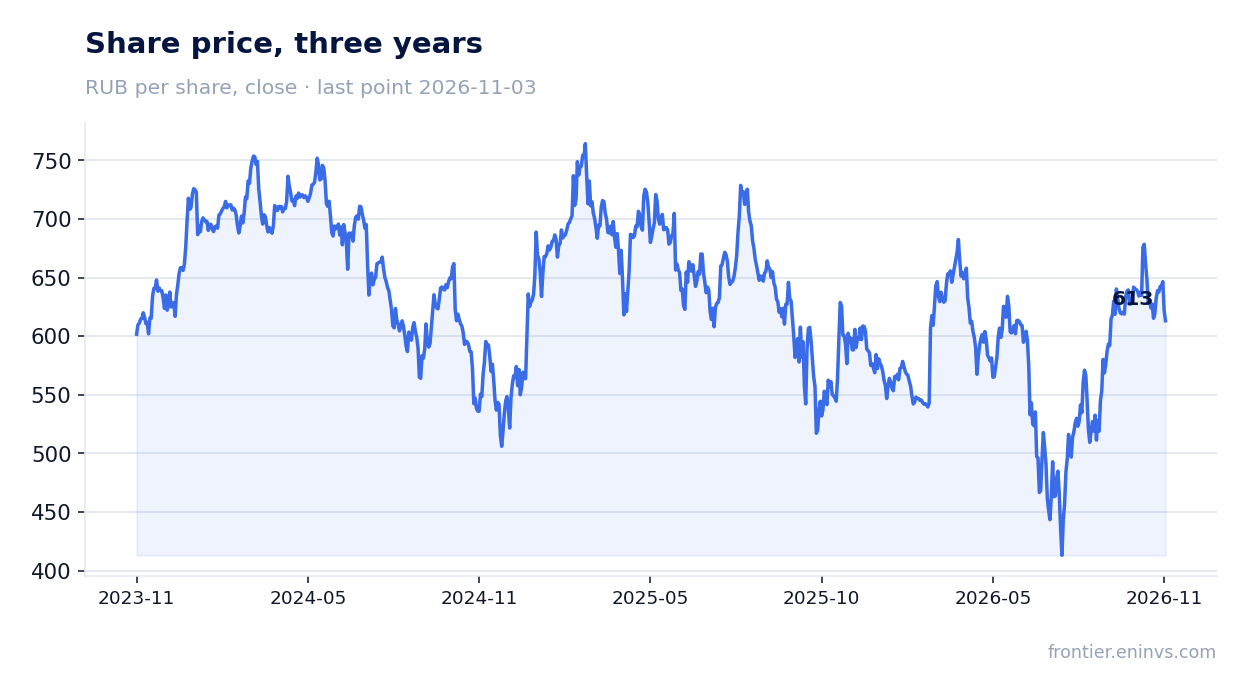
The market reaction to the report was restrained: the share added 4.8% on the publication day and 10.8% from the release to 3 November 2026. That is less than the upside our model sees and suggests investors are in no hurry to price in the durability of the quarterly profit.
Valuation on the latest reported figures
| Metric | Value |
|---|---|
| Market cap | 1 408 bn ₽ |
| P/E (LTM) | 5.3 |
| EV/EBITDA (LTM) | 2.8 |
| P/B | 1.06 |
| Net debt / EBITDA (LTM) | -0.32 |
| Operating cash flow (LTM) | 272 bn |
| ROE | 23.5% |
| Dividend yield (12m) | 8.8% |
| EV/EBITDA, 3-year average | 3.4 |
Dividend per share, ₽, and yield at the ex-date
| Year paid | Dividend | Yield |
|---|---|---|
| 2022 | 48.85 | 13.4% |
| 2023 | 62.11 | 9.6% |
| 2024 | 98.54 | 14.9% |
| 2025 | 74.85 | 12.6% |
| 2026 | 52.62 | 7.8% |
Bottom line
What was strong in the report was everything tied to price and taxes: revenue rose 36.9%, EBITDA by 81.8% and the EBITDA margin to 29.4%. But half of the profit gain is a tax line, not production, and quarterly operating cash flow is negative. Net debt turned negative at RUB 154.1 bn, a cushion for the dividend, but the 9.6% yield on our estimate is below the fair 10.5% and the 14.0% key rate. The main question for a holder is whether profit holds at RUB 263.3 bn over twelve months if the tax line normalises; at 2.8x against its own 3.4x average the share looks rather attractive, but with no margin for error in profit.
Open the company's financial profile TATN →
See also: market overview · valuation map · stock screeners