Transneft put RUB 40 bn into Gazprombank's capital
Transneft's IFRS statements for 1H2026 contained a line on the purchase of 7.52% of the voting shares of an organization ultimately controlled by the Russian Federation. The name was not disclosed. On 28 August it became known that the organization is Gazprombank.
This is a subscription to an additional share issue, not the purchase of a stake from a previous owner. The money went into the bank's capital, not to a seller.
Transneft bought the entire additional issue, 50.65 mn shares at RUB 790 against a par value of RUB 450.
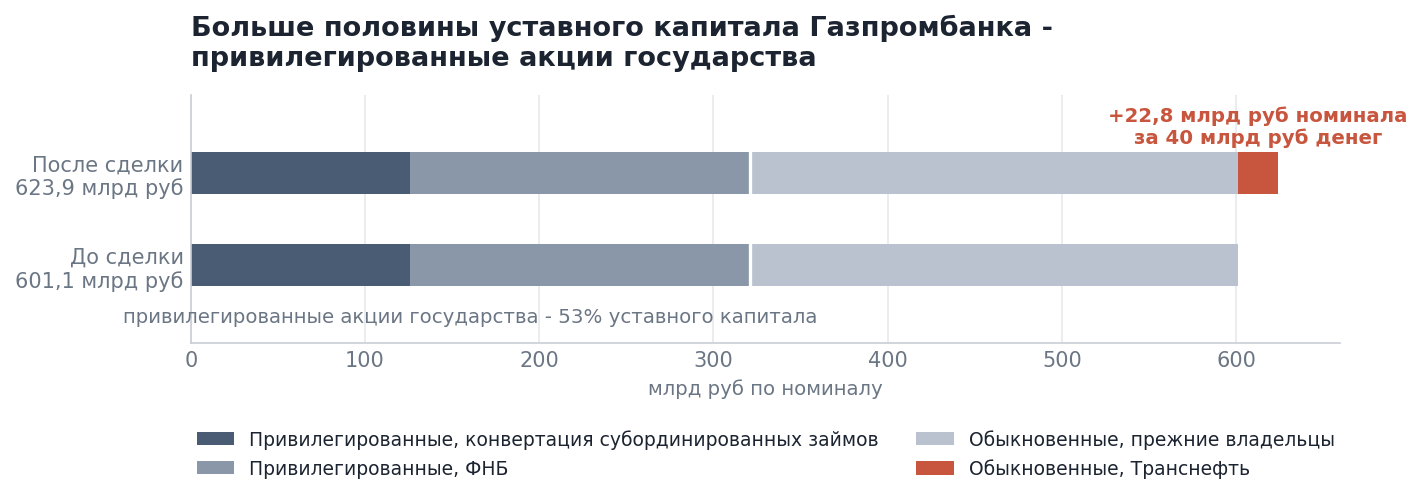
The 7.52% of votes received gives only 3.65% of the charter capital, because more than half of Gazprombank's capital consists of the state's preferred shares.
The price to book value came out at 0.48, below book, so formally this is not an overpayment.
The state put its money into preferred shares, while Transneft received ordinary shares. In the queue for the bank's profit it stands last.
It is hard to expect dividends on this stake precisely because the bank lacked capital.
Transneft bought the bank's entire additional share issue
On 27 July 2026 the Bank of Russia registered an additional issue of Gazprombank shares of 50.6 mn shares with a par value of RUB 450. The charter capital rose from RUB 601.1 bn to RUB 623.9 bn. Shareholders had approved the decision on 2 December 2025.
The bank had 623.03 mn ordinary shares. Adding the new issue gives the buyer exactly 7.51%, the very stake Transneft disclosed. A match to the second decimal means that a single participant took the whole issue. The RUB 40 bn paid for 50.65 mn shares gives RUB 790 per share.
More than half of the bank's charter capital is the state's preferred shares
Preferred shares carry no vote at the shareholder meeting, but they receive dividends ahead of ordinary shares and also get their money back ahead of them in liquidation.
Of the RUB 601.1 bn of charter capital before the deal, ordinary shares accounted for RUB 280.4 bn (623.03 mn shares at RUB 450). The remaining RUB 320.7 bn is preferred shares. The calculation is consistent with the known state injections. The National Wealth Fund put RUB 194.95 bn into preferred shares in 2022–2023, and about RUB 125.8 bn more came from the earlier conversion of subordinated loans from VEB, Gazfond and Gazprom.
Hence the gap between the stakes. By votes Transneft received 7.52%, but by charter capital only 3.65%.
A 52% discount to capital, but there is nothing to compare this price with
The valuation of all the bank's ordinary shares at the deal price is RUB 532 bn. Gazprombank's IFRS equity at 30 June 2026 was RUB 1,393.3 bn, and Transneft's money arrived already in July. Net of preferred shares at par and including the RUB 40 bn contributed, about RUB 1,113 bn is attributable to ordinary shares.
The book value of the acquired stake comes to about RUB 84 bn against RUB 40 bn paid. The price to book is 0.48. For reference: Sovcombank trades on the exchange at RUB 226 bn against shareholders' equity of RUB 425.8 bn, or 0.53 of equity.
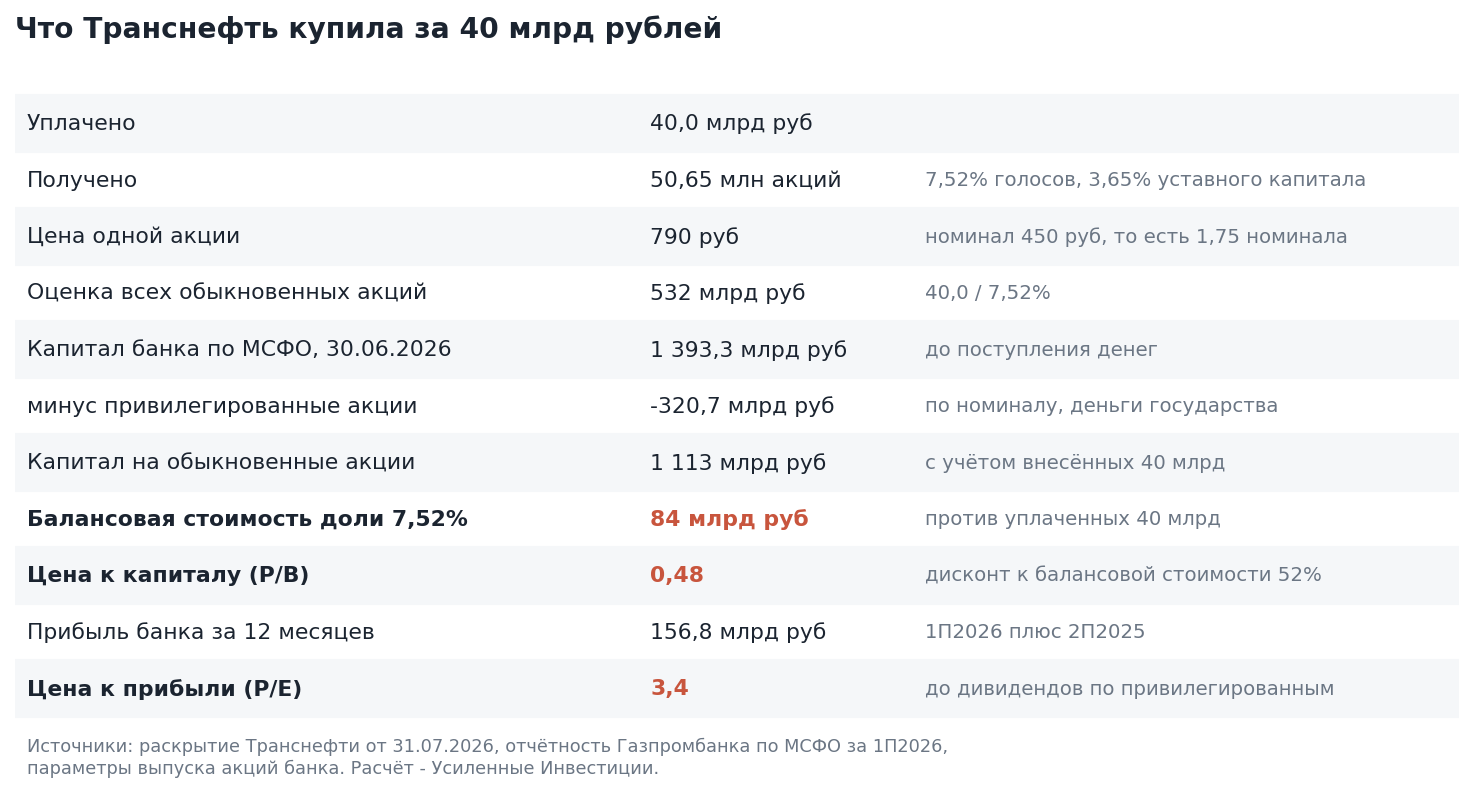
The figure looks comfortable, but it cannot be verified. The buyer was the only one, there was no competition for the issue, and the placement price was set within the owner's single perimeter. The discount to book value here is not the result of bargaining.
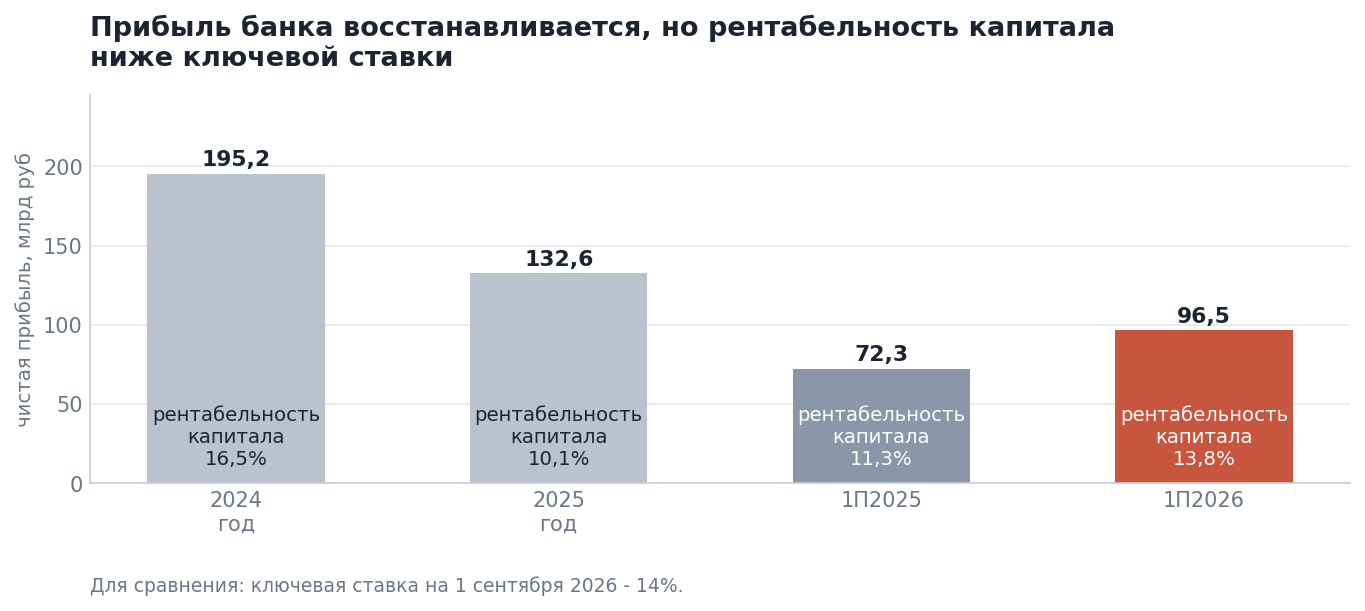
The bank earns less on its equity than the key rate
Gazprombank's return on equity was 13.8% in 1H2026 and 10.1% for 2025. The key rate is currently 14%.
Profit is recovering, RUB 96.5 bn for the half-year against RUB 72.3 bn a year earlier. But a rouble invested in the capital of such a bank works worse than the same rouble on deposit.
Transneft received the most junior instrument in the bank's capital
The National Wealth Fund put RUB 194.95 bn into preferred shares. In January 2026 it added RUB 82.6 bn as a subordinated deposit. The bank repays such money last, after all ordinary creditors, and therefore counts it as capital. Both structures rank ahead of ordinary shares in the queue.
Transneft put RUB 40 bn into the most junior instrument. The dividend on ordinary shares is paid last and only if the bank decides to distribute profit at all.
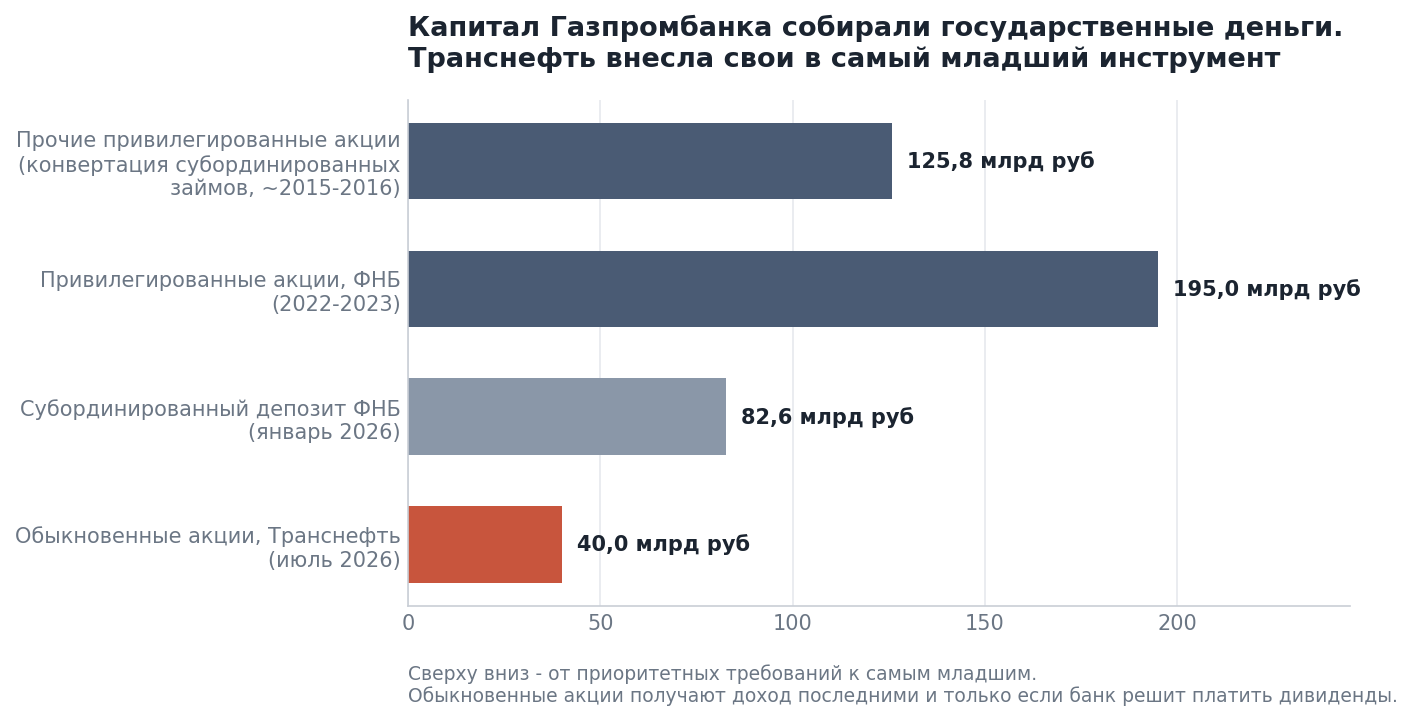
The choice of instrument is explained by regulatory requirements. Common equity, the highest-quality part of capital, is formed precisely by ordinary shares and retained earnings. Gazprombank's common equity adequacy ratio at 30 June 2026 was 8.6%, the narrowest of the three. The bank needed ordinary shares, and Transneft paid for them.
The deal closes the bank's capital gap without a burden on the budget
Gazprombank has been under US blocking sanctions since November 2024, lends to the fuel and energy sector and infrastructure projects, and its common equity is thin. The state has already put almost RUB 280 bn into the bank through the National Wealth Fund. The next round was paid for by a company with surplus free cash.
At 30 June 2026 Transneft had RUB 340 bn in deposits and RUB 111 bn in cash. The company pays income tax at a rate of 40% until 2030, so it cannot freely dispose of this money anyway.
The version about synergy with the servicing bank should be assessed with restraint. Transneft was a client of Gazprombank even without a stake in its capital.
A one-off outflow of 27% of the annual dividend, then the payout loses about 1% a year
Forty billion is 8.9% of the company's cash position and 27% of the dividend for 2025 (RUB 147.99 bn, RUB 204.17 per share). This is a one-off effect. The liquid cash from which the company pays was replaced by a stake that cannot be sold. In terms of market capitalization, if calculated at the preferred share price for all issued shares, it is about 5%.
The annual effect is smaller. The forgone interest income at a 14% rate will be about RUB 5.6 bn a year, RUB 3.4 bn after tax. With a payout of half of profit, this is about RUB 2.3 per share against a dividend of RUB 204.17, about one percent of the payout itself and 0.2 percentage points of dividend yield.
The significance of the deal lies elsewhere. Gazprombank has a chronic shortage of common equity, and Transneft has just become its source. The open question is whether there will be a second tranche.
What is worth checking next
How the investment is reflected in Transneft's accounts and whether the dividend base is adjusted for it. The terms of dividends on the National Wealth Fund's preferred shares, on which depends how much profit actually reaches ordinary shares. The list of acquirers of the additional issue in Gazprombank's disclosure, to confirm that Transneft really took the whole issue.
The number of the bank's ordinary shares and the breakdown of preferred shares were obtained by calculation from data on the issue and the charter capital, not from direct disclosure by the bank.
Issuer reviews and quantitative analysis are in the Telegram channel Enhanced Investments @eninv. Company cards with financial indicators are on our portal.
See also: market overview · valuation map · stock screeners