Progressive: monthly profit doubled, but quarterly revenue fell 67% — the report mixes a month and a quarter
Contents

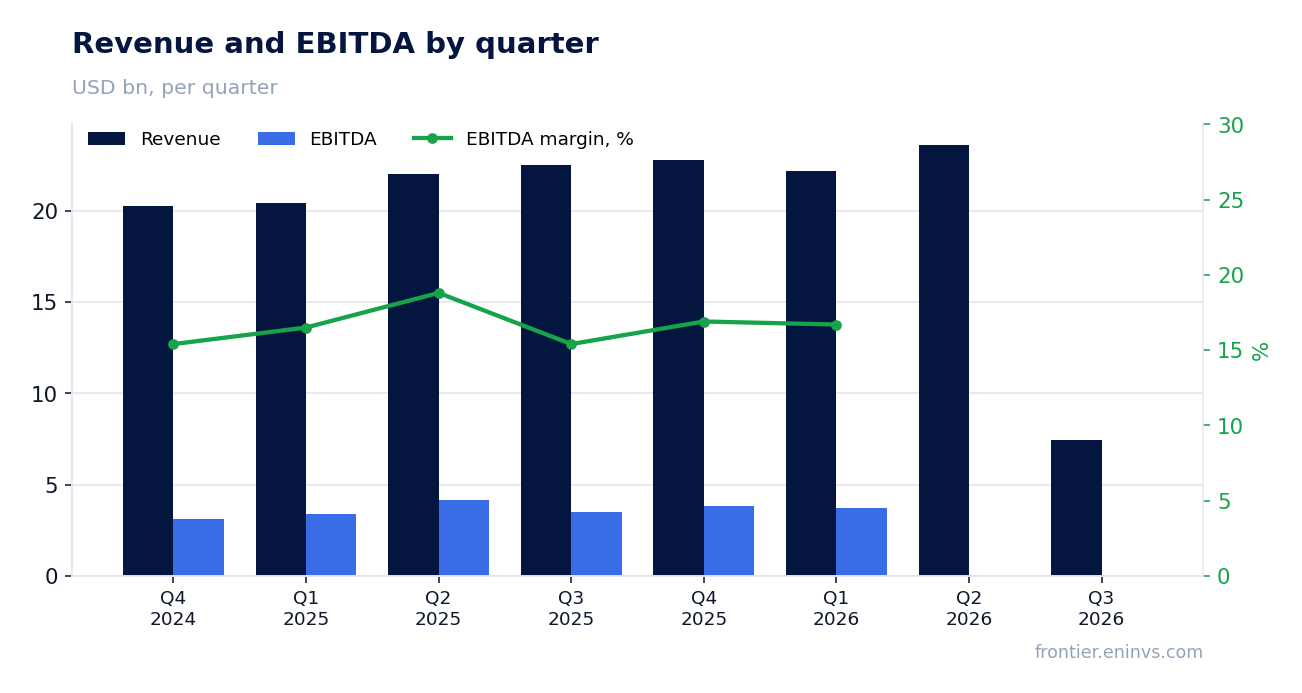
On October 14, Progressive published results for September and the third quarter ended September 30, 2026. For the reported quarter, revenue was $7,434.0 million, net income — $630.0 million, down 67.0% and 75.9% respectively year-on-year. At the same time, the release itself shows September net income more than doubled to $630 million, with the combined ratio improving to 90.0%. The quarterly decline is explained by the fact that the release discloses only one month, not the full quarter, so the comparison with last year's quarter is not meaningful. The share looks neutral: strong monthly dynamics and a 6% increase in policies in force are balanced by the lack of full quarterly data and the revenue decline in the reported period.
Key takeaways
— Reported quarterly revenue fell 67.0% because the release discloses only September, not the full quarter
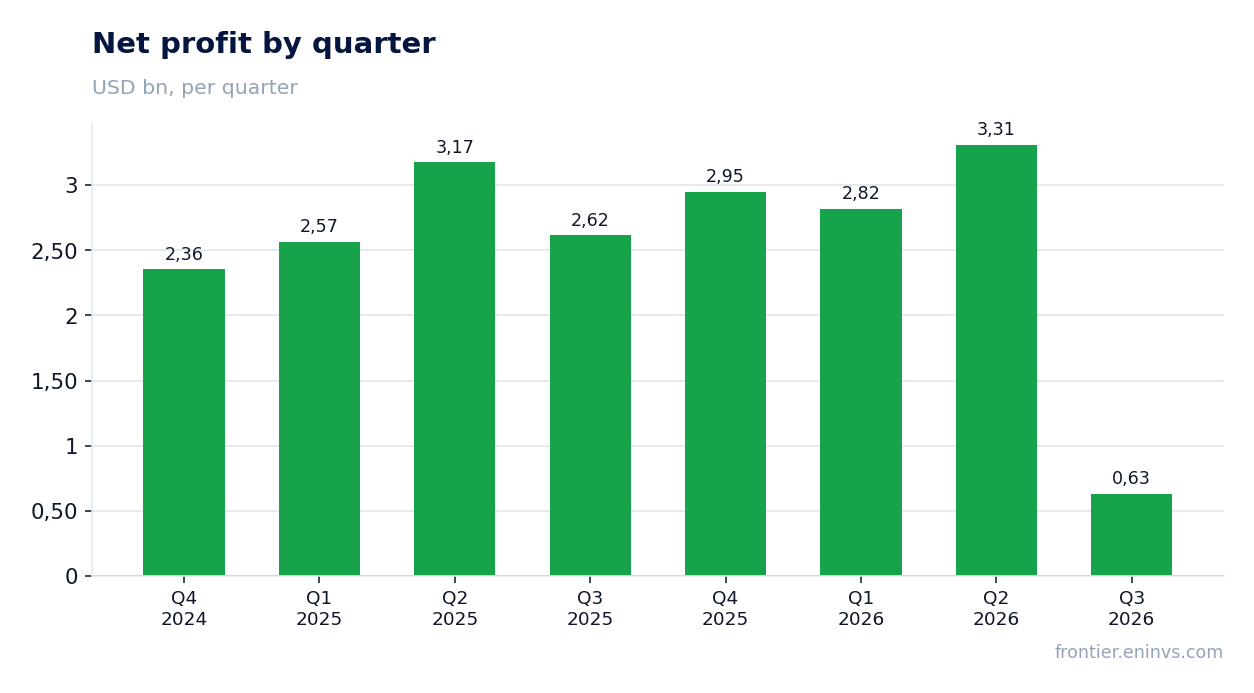
— September net income more than doubled to $630 million, and the combined ratio improved to 90.0%
— Policies in force rose 6% to 40.5 million, with commercial lines up 5%
— The investment portfolio lost $231 million due to negative mark-to-market on securities
— Leverage remains moderate: debt-to-capital ratio at 19.6%, and trailing 12-month ROE at 34.4%
— The share trades at a neutral valuation, as strong monthly data do not offset the lack of a full quarterly report
Attractiveness
Key figures, USD bn
| Metric | Q3 2025 | Q3 2026 | Change |
|---|---|---|---|
| Revenue | 22.5 | 7.43 | -67.0% |
| EBITDA | 3.47 | — | — |
| Net profit | 2.62 | 0.63 | -75.9% |
| Operating cash flow | 5.20 | — | — |
| Capex | 0.07 | — | — |
| EBITDA margin | 15.4% | — | — |
| Net margin | 11.6% | 8.5% | -3.1 pp |
Reported quarterly revenue fell 67.0% because the release discloses only September, not the full quarter
In the reported period, the third quarter of 2026, revenue was $7,434.0 million, down 67.0% from the same period a year earlier. However, the press release itself states that these figures relate only to September 2026, not the full quarter. For September, revenue consisted of earned premiums of $7,160 million, investment income of $352 million, and other revenues. Thus, the decline is explained not by a deterioration in the business but by incomplete disclosure: the release presents only monthly data, while the comparison base for the third quarter of 2025 includes three months.
The comparison with the previous quarter also shows a deceleration: in the second quarter of 2026, revenue growth was 7.3% year-on-year, while in the reported period it was minus 67.0%. This deceleration is caused solely by the change in basis: the second quarter included three full months, while the third quarter includes only one. Therefore, it is impossible to draw a conclusion about a slowdown in the business based on these figures.
The monthly data for September, on the contrary, point to growth: earned premiums increased by 5% to $7,160 million, and policies in force rose by 6% to 40.5 million. This confirms that the operating business continues to grow, and the fall in quarterly revenue is an artifact of reporting.
September net income more than doubled to $630 million, and the combined ratio improved to 90.0%
For September 2026, net income was $630.0 million, up 107% from September 2025. This growth was driven by an improvement in the combined ratio to 90.0% from 100.4% a year earlier. The combined ratio shows the share of expenses and losses in earned premiums: a decrease of 10.4 percentage points means the company spends less on claims and operating expenses.
In the reported quarter, net income was the same $630.0 million, but that is only one month. A year earlier, for the third quarter of 2025, net income was $2,615.0 million, which included three months. Therefore, the 75.9% decline in quarterly profit is also explained by incomplete disclosure, not by a deterioration in results.
The net profit margin in the reported period was 8.5% versus 11.6% a year earlier. This decline is also due to the fact that the reported period includes only one month, while the comparison base includes a quarter. On a monthly basis, the margin for September was 8.5% ($630 million out of $7,434 million), which is lower than last year's 11.6%, but the improvement in the combined ratio points to positive shifts in underwriting.
Policies in force rose 6% to 40.5 million, with commercial lines up 5%
As of September 30, 2026, total policies in force reached 40.5 million, up 6% from a year earlier. Growth was recorded in all segments: personal auto through agents — up 7%, direct — up 8%, special lines — up 6%, commercial lines — up 5%. This indicates sustained demand for the company's products.
In commercial lines, policies in force rose to 1.25 million, and earned premiums for September increased by 8% to $959 million. The combined ratio in this segment was 90.8%, slightly higher than in personal lines (89.8%). This suggests continued profitability in the commercial direction.
Growth in policies in force is an important leading indicator for an insurer, as it determines future premiums. The 6% year-on-year increase supports expectations of further revenue growth, despite the distortion in quarterly figures.
The investment portfolio lost $231 million due to negative mark-to-market on securities
In September 2026, the company recorded a net investment loss of $231 million, compared with a gain of $138 million a year earlier. The loss consisted of a negative mark-to-market on securities of $228 million and a loss on sales of $3 million. This is due to unfavorable market dynamics: the fixed-income portfolio return for September was minus 1.6%, and the total portfolio — minus 1.5%.
Despite the monthly loss, for the nine months of 2026 the overall investment result remains positive: the portfolio return was minus 0.3%, but including interest income the total return may be higher. Investment income for September was $352 million, providing a stable cash flow.
The impact of the investment loss on net income was partially offset by the tax effect, but it still reduced profit. It is important to note that this is a non-operating factor and does not reflect the quality of the insurance business.
Leverage remains moderate: debt-to-capital ratio at 19.6%, and trailing 12-month ROE at 34.4%
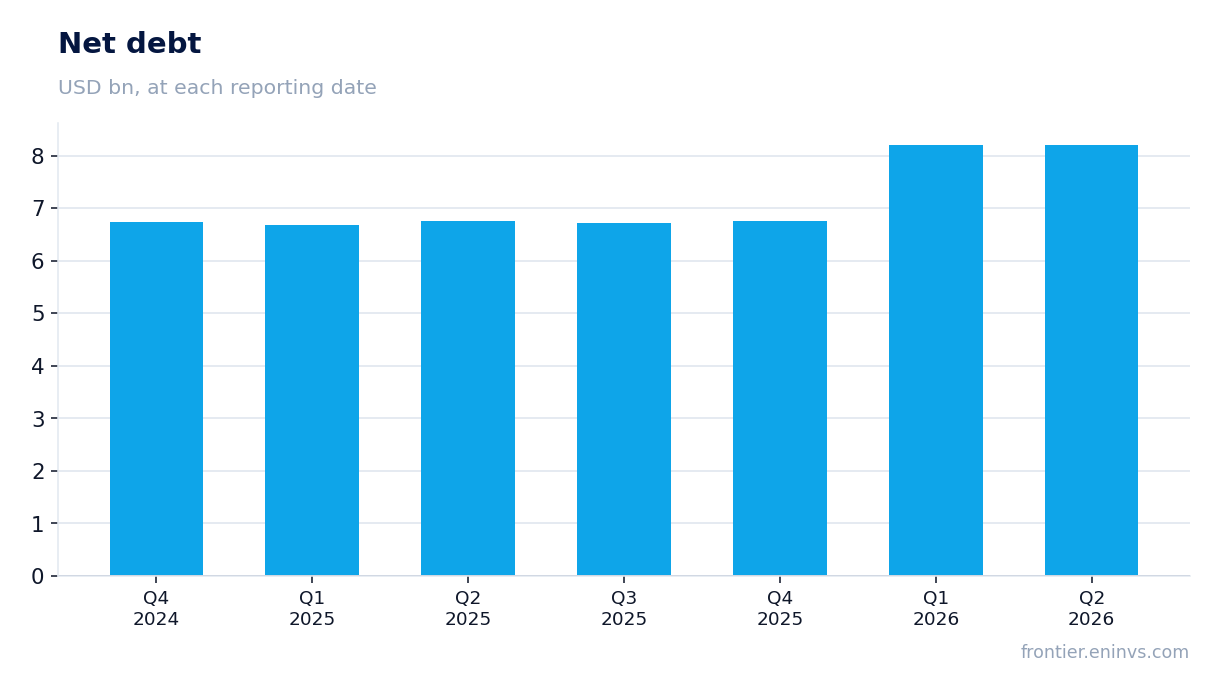
As of September 30, 2026, the company's debt was $8,389.0 million, and the debt-to-capital ratio was 19.6%. This is a moderate level for an insurer, allowing it to maintain financial stability. Net debt at the end of 2025 was $6,759.0 million, but since then it has increased to $8,389.0 million due to higher borrowings.
The return on average common shareholders' equity over the trailing 12 months was 34.4% based on net income and 25.7% based on comprehensive income. Such a high figure reflects the efficiency of the business, despite the volatility of investment results. For comparison, a 34.4% return on equity significantly exceeds the cost of capital, creating value for shareholders.
Interest expense for September was $29 million, which is insignificant compared to operating profit. Moderate leverage and high return on equity support the company's credit quality.
The share trades at a neutral valuation, as strong monthly data do not offset the lack of a full quarterly report
The valuation of the share remains neutral, as current multiples are not comparable with historical ones due to distorted reporting. The facts do not include P/E or EV/EBITDA data, so we cannot claim the share is cheap or expensive. However, the high return on equity of 34.4% and 6% growth in policies in force indicate fundamental business strength.
The main risk to valuation is incomplete quarterly disclosure. Investors do not see the full picture for the third quarter, which may cause share price volatility until the full 10-Q report is published on November 2, 2026. After that, comparison with last year's quarterly data will become meaningful.
The dividend policy is not disclosed in the provided facts, so we cannot assess the dividend yield. This is another uncertainty for income-oriented investors.
Bottom line
Progressive showed strong monthly results for September: net income more than doubled to $630 million, the combined ratio improved to 90.0%, and policies in force rose 6%. However, the reported quarter contains only one month, which distorts the comparison with last year's quarter and creates the appearance of a 67.0% revenue decline and a 75.9% profit decline. The investment loss of $231 million is a one-off factor related to mark-to-market on securities. The underlying business remains strong: return on equity of 34.4%, moderate debt, and a growing customer base. The question for a holder now is how fully the quarterly data will confirm the positive dynamics after the 10-Q is published.