ADNOC Drilling: revenue turns negative for the first time in a year, but profit holds on margin
On 30 October ADNOC Drilling released its third-quarter 2026 results: revenue came in at USD 1,247.3 million, down 1.0% year on year, net profit at USD 365.4 million (–0.8%), operating profit at USD 417.5 million. Revenue turned negative for the first time in a year after decelerating from +2.9% in the second quarter, yet the net margin held at 29.3% versus 29.2% a year earlier. With EV/EBITDA LTM at 11.95 and P/E LTM at 17.27, the share looks neutral: margin resilience and low leverage support the valuation, but zero revenue growth leaves no case for an upward revision.
Key takeaways
— Revenue fell for the first time in a year – by 1.0% to USD 1,247.3 million – after decelerating from +2.9% in the second quarter
— Net profit held at USD 365.4 million thanks to a 29.3% margin that kept the top-line decline from dragging the result down
— Operating profit rose to USD 417.5 million, the strongest quarterly figure in the last four quarters
— Free cash flow remains positive: operating cash flow of USD 459.8 million covers capital expenditure
— Net debt fell from USD 2.1 billion on 30 June to USD 0.9 billion on 30 September, with the ratio to EBITDA LTM at 0.38
— Valuation at 11.95 EV/EBITDA LTM and 17.27 P/E LTM offers no clear advantage when revenue growth is zero
Attractiveness
Key figures, USD bn
| Metric | Q3 2025 | Q3 2026 | Change |
|---|---|---|---|
| Revenue | 1.26 | 1.25 | -1.0% |
| EBITDA | 0.53 | — | — |
| Operating profit | 0.40 | 0.42 | +4.8% |
| Net profit | 0.37 | 0.37 | -0.8% |
| Operating cash flow | 0.67 | 0.46 | -31.0% |
| Capex | 0.21 | -0.15 | -172.8% |
| EBITDA margin | 42.1% | — | — |
| Net margin | 29.2% | 29.3% | +0.1 pp |
Revenue fell for the first time in a year – by 1.0% to USD 1,247.3 million – after decelerating from +2.9% in the second quarter
In the third quarter of 2026 ADNOC Drilling's revenue came in at USD 1,247.3 million, 1.0% below the year-earlier level. This is the first negative reading in a year: in prior quarters growth decelerated steadily – from +22.8% in Q3 2025 to +7.5% in Q4, +5.0% in Q1 2026 and +2.9% in Q2.
The slowdown turned into a decline against a high base: Q3 2025 revenue reached USD 1,259.8 million. A 1.0% drop is a moderate contraction rather than a collapse, but it marks a turning point after several quarters of growth.
For an investor the fact of the minus matters less than the fact that it occurred with operating profit broadly stable. Revenue has stopped being the driver, and further dynamics will depend on whether it returns to growth next quarter.
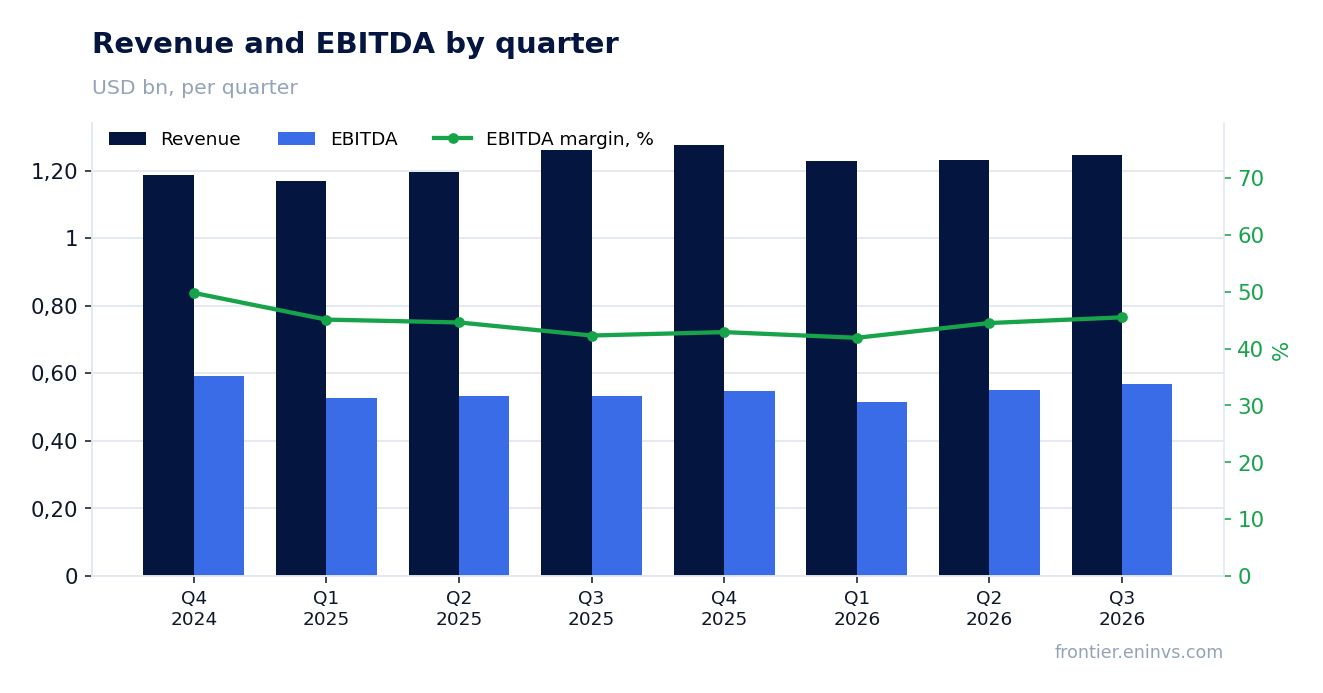
Net profit held at USD 365.4 million thanks to a 29.3% margin that kept the top-line decline from dragging the result down
Net profit for Q3 2026 was USD 365.4 million, down just 0.8% year on year while revenue fell 1.0%. The net margin stayed essentially flat – 29.3% versus 29.2% a year earlier.
Margin resilience means the company did not lose efficiency on lower revenue. Judging by the stable profitability, the cost base contracted in proportion to or slightly faster than revenue, which kept profit at last year's level.
For valuation this is an important signal: the business retains the ability to generate profit even with zero revenue growth. But a stable margin by itself does not create growth – it only protects the current level of earnings.
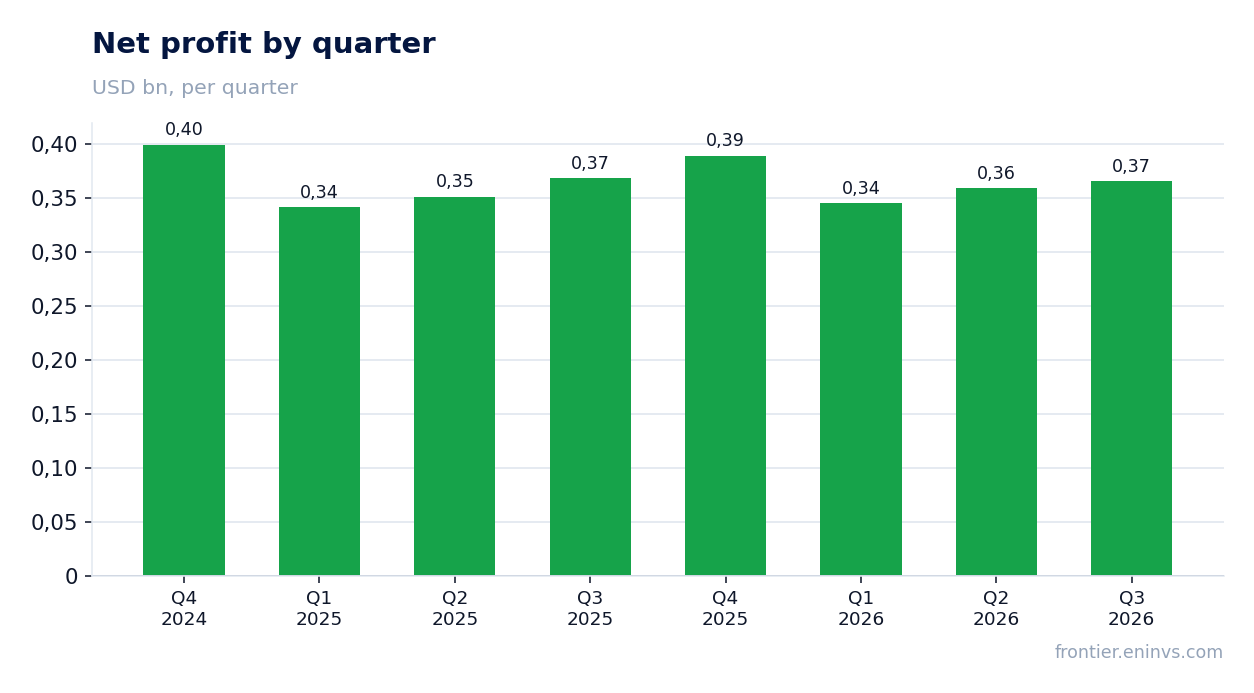
Operating profit rose to USD 417.5 million, the strongest quarterly figure in the last four quarters
Operating profit in Q3 2026 was USD 417.5 million – the strongest result in four quarters: Q4 2025 saw 433.6 million, followed by 389.1 million in Q1 2026 and 413.9 million in Q2. Operating profit rising on falling revenue points to improved operating efficiency.
Quarterly EBITDA came in at USD 567.5 million, also the highest in four quarters. This means the company cut operating costs or improved its cost structure, offsetting the modest revenue decline.
Falling revenue combined with rising operating profit is a rare combination that shows management is working on profitability, not just volumes. It supports the valuation but does not remove the question of when revenue will return to growth.
Free cash flow remains positive: operating cash flow of USD 459.8 million covers capital expenditure
Operating cash flow in Q3 2026 was USD 459.8 million, above the prior quarter (403.9 million) and close to the year-earlier figure (666.5 million in Q3 2025). Capital expenditure for the quarter was negative at –152.3 million, meaning a return of funds or asset sales rather than new investment.
With that ratio, quarterly free cash flow remains firmly positive. This matters for the dividend base and for the company's ability to service debt without new financing.
Negative capex is an unusual line: it may reflect asset sales or refunds of advances, but in any case it does not pressure liquidity. For an investor it means cash flow in the reported period was stronger than one might expect given falling revenue.
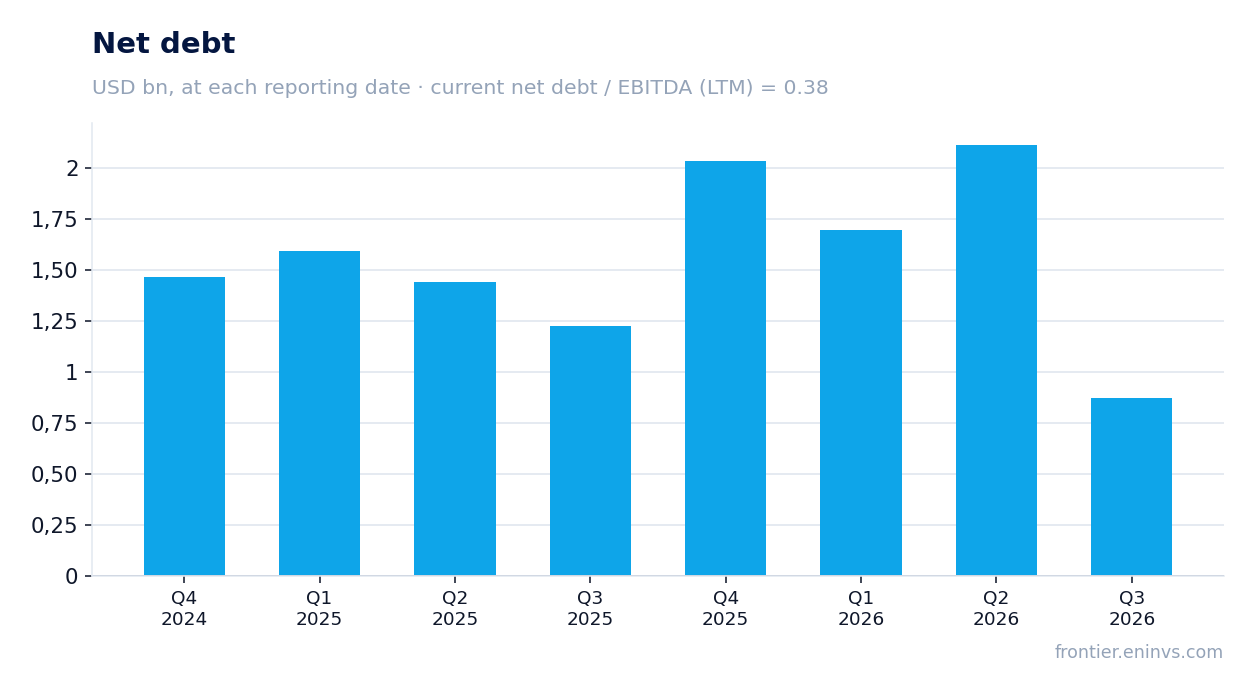
Net debt fell from USD 2.1 billion on 30 June to USD 0.9 billion on 30 September, with the ratio to EBITDA LTM at 0.38
Net debt on 30 September 2026 was USD 873.6 million versus USD 2.1 billion on 30 June – a reduction of USD 1.2 billion over the quarter. A year earlier, on 30 September 2025, net debt stood at USD 1.2 billion, so over 12 months it fell by USD 0.4 billion.
The ratio of net debt to EBITDA LTM is 0.38 – a low level that leaves the company substantial headroom on leverage. This is one of the factors supporting the valuation: even with zero revenue growth, debt poses no risk to financial stability.
The quarterly debt reduction coincided with strong operating cash flow and negative capex. The company directed free funds to cutting liabilities, which will reduce interest expense in future periods.
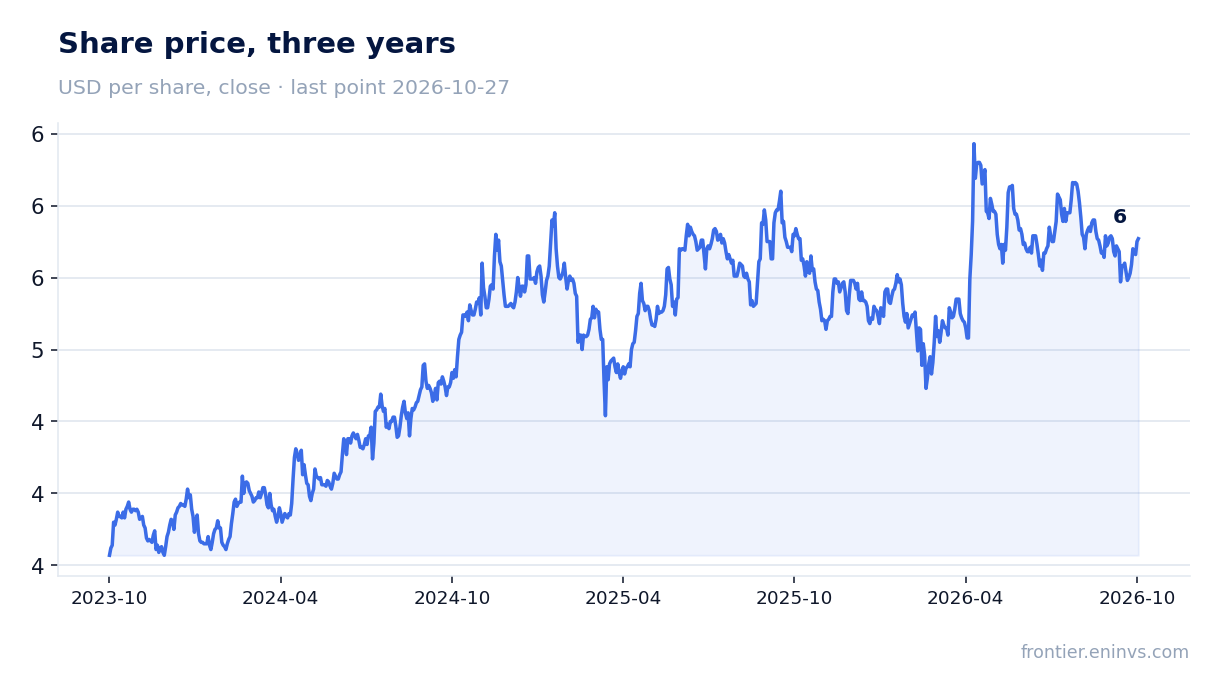
Valuation at 11.95 EV/EBITDA LTM and 17.27 P/E LTM offers no clear advantage when revenue growth is zero
On trailing-twelve-month multiples, EV/EBITDA stands at 11.95 and P/E at 17.27. Return on equity (ROE) is 11.2%. These levels look neither clearly cheap nor overheated, but with zero revenue growth they offer no margin for upside.
Market capitalisation is USD 25.2 billion. With LTM net profit of USD 1,457.8 million and LTM EBITDA of USD 2,275.7 million, the valuation corresponds to a mature business with a stable margin but no pronounced growth.
An upward re-rating would require either a return of revenue to growth or a further reduction in debt that frees up profit for dividends or investment. Until both factors fully materialise, the multiples reflect the current status quo.
Valuation on the latest reported figures
| Metric | Value |
|---|---|
| Market cap | 25.2 bn USD |
| P/E (LTM) | 17.3 |
| EV/EBITDA (LTM) | 12.0 |
| P/B | 6.14 |
| Net debt / EBITDA (LTM) | 0.38 |
| Operating cash flow (LTM) | 1.69 bn |
| ROE | 11.2% |
Bottom line
The strong side of the report was profit resilience: net profit fell just 0.8% while revenue dropped 1.0%, and the margin held at 29.3%. Operating profit and EBITDA rose to four-quarter highs, and net debt fell to USD 0.9 billion with the ratio to EBITDA LTM at 0.38. The weak spot is revenue, which turned negative for the first time in a year, and negative capex, which may prove one-off. For a holder the key question now is whether revenue returns to growth next quarter; without that, multiples of 11.95 EV/EBITDA and 17.27 P/E offer no case for an upward revision.
Open the company's financial profile ADNOCDRILL →
See also: market overview · valuation map · stock screeners