Alcoa: record EBITDA at the cycle peak, but the cheapness proved an illusion
Alcoa entered our focus list as one of the cheapest commodity companies in the US. A quick screen showed EV/EBITDA of about 5x against a historical median above 7x, and the latest quarter was a multi-year record. We took a careful look at the company, and the picture turned around.
Main conclusion. At the current ~USD 50 per share Alcoa offers no margin of safety. The apparent cheapness came from an outdated share count in screeners, record EBITDA rests on the tariff premium and a spot price near the top of the cycle, and under our conservative approach fair value is below the current price.
The sub-theses we cover below.
The 2Q record was delivered by tariffs and prices, not by operational improvements.
The cheapness in screeners proved an artefact of the share issuance; the real multiple is near the historical median.
Total debt is 3.5 times the "net" figure because of leases, pensions and electricity derivatives.
On conservative EBITDA there is no upside, and the mine life adds a discount.
The USD 4.7bn South32 deal doubles the bet on alumina at the top of the cycle.
The 2Q record was delivered by tariffs and prices
Revenue in 2Q2026 rose to USD 3.97bn (+31% y/y), and adjusted EBITDA to USD 901mn against USD 313mn a year earlier. Free cash flow was USD 422mn, and the company redeemed the remaining 2028 bonds.
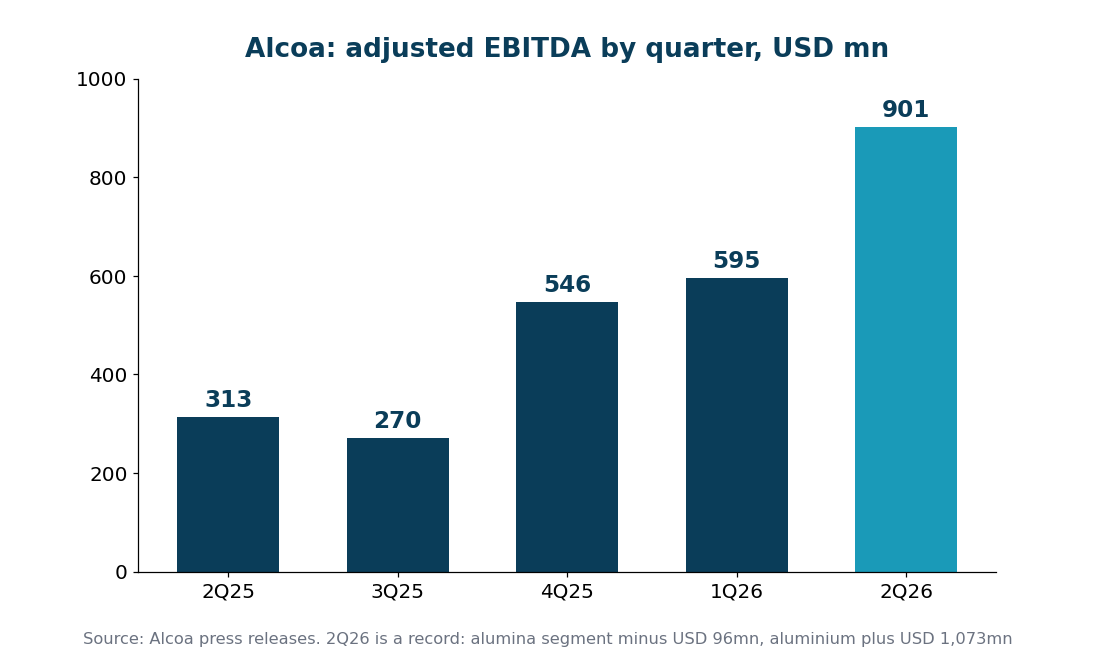
The whole record came from the aluminium segment, with EBITDA of USD 1,073mn and a margin of 32%. The realised aluminium price reached USD 4,752 per tonne against an average of USD 3,376 in 2025. The difference is almost entirely explained by two external factors. First, LME rose to USD 3.2k per tonne. Second, the US Midwest premium, after the Section 232 tariff increase to 50% in June 2025, soared to a record ~USD 2.1k per tonne. It is paid by all aluminium buyers in the US, and Alcoa, as the largest local producer, collects this rent from both its US and Canadian smelters (net of tariff costs on Canadian metal).
The alumina segment, meanwhile, is loss-making, with EBITDA of minus USD 96mn for the quarter. Alumina prices fell from a peak of USD 700+ in late 2024 to ~USD 350, and Alcoa's Australian plants went through a hard half-year with a cyclone, gas interruptions and unstable operation at Pinjarra, because of which the company cut its annual production plan to 9.5–9.6mn t.
The cheapness in screeners proved an artefact of the share issuance
In August 2024 Alcoa bought out the minorities of Australia's Alumina Ltd, paying in shares, and the share count rose from ~182 to 264mn. Some screeners and manually maintained databases still calculate market capitalisation on the old count, understating it by about a third. This is exactly why Alcoa looked anomalously cheap, with EV/EBITDA of about 5x.
On the actual 263.9mn shares and a price of ~USD 50, market capitalisation is ~USD 13.1bn. The next question is what counts as debt. Net debt in the narrow sense is modest, USD 0.9bn (USD 2.2bn of debt minus USD 1.4bn of cash). But to it are added leases of ~USD 0.3bn, pension and medical obligations of ~USD 0.6bn and a net liability of USD 1.3bn on derivatives. These are terms embedded in long-term electricity contracts and tied to the LME price, which become more expensive precisely when aluminium rises. The full debt stack comes to ~USD 3.0bn and EV to ~USD 16.1bn.
This gives LTM EV/EBITDA of about 7x against a historical median of ~7.3x. That is not cheap. The company trades roughly in the middle of its own history, and on peak EBITDA at that.
On conservative EBITDA there is no upside
Our standard approach to commodity companies is to calculate the target valuation not on spot but on conservative EBITDA, the minimum of spot and the average of spot and 3-year prices. For Alcoa this matters more than ever. Spot LME is ~USD 3.2k per tonne against an average of ~USD 2.4k for 2023–2025. We estimate EBITDA at spot at ~USD 2.7bn and at 3-year prices at only ~USD 1.6bn, so conservative EBITDA is ~USD 2.2bn.
The second factor is reserves. According to the 2025 10-K, proven bauxite reserves are 547mn t against output of 37.5mn t, which is ~15 years. At the same time, the detailed plan for the key Australian hub, Darling Range, covers only 9 years, and the move to the new areas of Myara North and Holyoake depends on Western Australian environmental approvals. Ministerial decisions are expected by the end of 2026, and mining in the new areas is reportedly not to start before 2029. For a company that supplies its own refineries with bauxite, this is no formality.
Taking conservative EBITDA and an adjustment for mine life into account, our model gives a fair price of around USD 35–42 per share, 15–30% below the current level. Even in the neutral scenario, multiplying conservative EBITDA by the historical median multiple gives the current price. The market is already paying in full for an average cycle, and a premium on top is supported only by faith that spot will hold.
The spot that supports the result has already started to fade
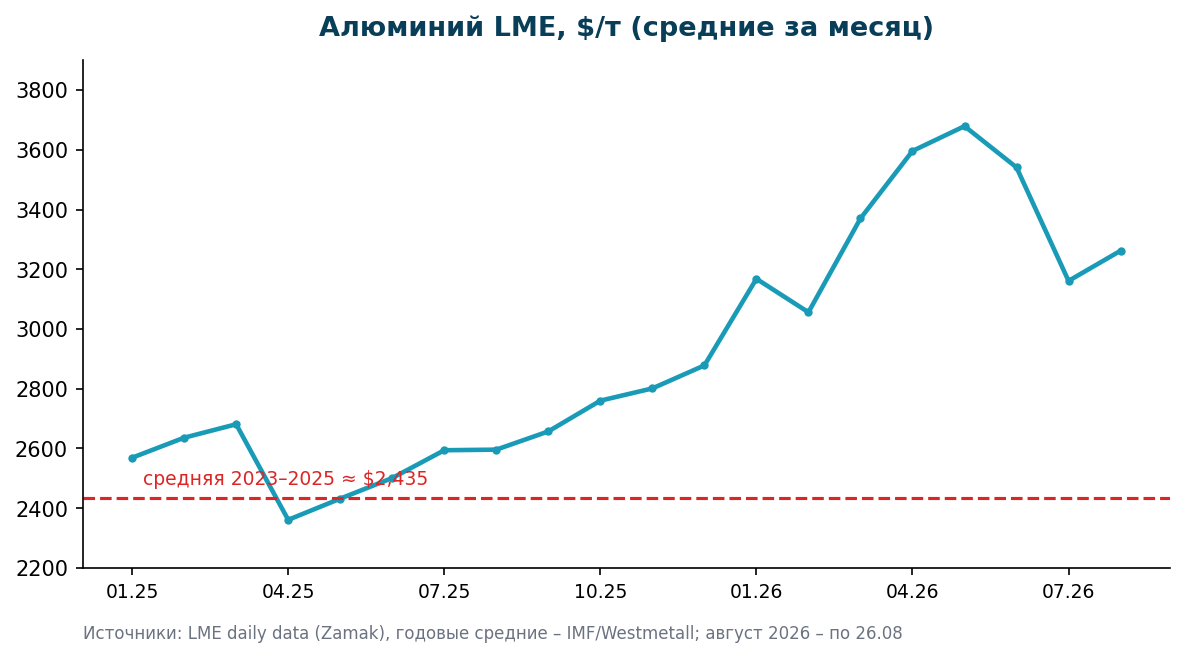
The weakness of the case is that both price pillars look overheated. The US premium fell 8% in a day on 20 August on news of a possible cut in the tariff on Canadian aluminium from 50% to 25%. Canada supplies more than half of US imports, and the agreement has not yet been finalised, but the direction is set. In parallel, Congress is demanding an investigation into the pricing of the Midwest premium itself.
On LME the consensus is also below spot. Goldman Sachs expects USD 2,950 in 4Q2026 and an average of USD 2,700 in 2027, and the World Bank assumed an average of USD 3,200 for 2026. Alcoa's sensitivity is large: about USD 237mn of annual EBITDA for every USD 100 change in LME and almost USD 100mn for every USD 100 of Midwest premium. A pullback of LME to USD 2,700 with a normalisation of the premium eats more than a third of current annual EBITDA.
It is also worth remembering the share's 52-week range of USD 30–84. The market has already radically revalued this case twice within a year.
South32 doubles the bet on alumina at the top of the cycle
On 30 June Alcoa announced the largest deal in its history, the purchase of South32's bauxite, alumina and aluminium assets for USD 4.1bn (USD 3.1bn in cash plus ~17mn new shares) with a deal EV of USD 4.7bn and an additional payment of up to USD 750mn under a CVR. The deal will add +53% to alumina capacity and +37% to aluminium capacity, closing is expected in 1H2027, and the post-closing leverage target is ~2.0x.
Strategically this is a logical consolidation of the industry at a moment when alumina is cheap. But for the shareholder it means that all current cash flow will go to the deal rather than to buybacks. There was no buyback in 1H2026, and the dividend is a token USD 0.40 a year (a yield of 0.8%). Interest burden is added too, a ticking fee of ~5% per annum on the cash portion after the South32 shareholder vote, and the classic execution risk of large M&A.
Among potential positives, the company has a cushion in the form of a Ma'aden stake of ~USD 1.36bn (it can be sold in three tranches from July 2028), talks on the sale of the Massena East site and an asset monetisation programme of USD 0.5–1bn through 2030. San Ciprian in Spain, after the restart, has for the first time stopped being a black hole: since 2Q the smelter covers the losses of the alumina production, and the complex is expected to turn profitable in late 2027.
Summary
Alcoa looks like a well-managed company in a phase of aggressive expansion, but at current levels it is a bet that the tariff premium and LME above USD 3k will persist for a long time. Under our conservative approach there is no margin of safety at ~USD 50; the share becomes interesting for entry nearer USD 40 and below, or after an actual pullback in the premium, when the market revalues the company on normalised EBITDA. Fresh analyst targets after the 2Q report have moved into a USD 51–55 range, including a "sell" recommendation from BofA with a USD 51 target.
See also: market overview · valuation map · stock screeners