The Andersons: profit more than doubled, but half of quarterly EBITDA came from 45Z tax credits

On November 3, The Andersons reported third-quarter 2026 results: revenue of $2,833.7 million (+5.8% year on year), adjusted EBITDA of $101.4 million (+73.3%) and net income of $46.4 million (+130.6%). The improvement came from both segments at once – Renewables posted a record third-quarter pretax profit of $63 million, while Agribusiness earned $5 million against $1 million a year earlier. Yet $27 million of the Renewables result is 45Z tax credits, a one-off item rather than operating cash flow. In our view the share looks neutral at the current price: multiples are undemanding against their own history, but the portal's model puts fair value 31% below the market.
Key takeaways
— Revenue accelerated to +5.8% year on year from −1.2% a quarter earlier, with both segments contributing
— EBITDA rose 73.3%, but $27 million of it came from 45Z tax credits
— Renewables delivered a record third-quarter pretax profit of $63 million
— Agribusiness earned $5 million pretax against $1 million a year earlier
— Operating cash flow turned negative at $124 million on inventory and derivative build
— Net debt rose to $1.1 billion, with net debt / EBITDA LTM at 3.2
— A 0.96% dividend yield does not offset the risk embedded in the valuation
Attractiveness
Key figures, USD bn
| Metric | Q3 2025 | Q3 2026 | Change |
|---|---|---|---|
| Revenue | 2.68 | 2.83 | +5.8% |
| EBITDA | 0.06 | 0.10 | +73.3% |
| Operating profit | 0.03 | — | — |
| Net profit | 0.02 | 0.05 | +130.6% |
| Operating cash flow | 0.23 | -0.12 | -153.0% |
| Capex | 0.07 | 0.06 | -10.2% |
| EBITDA margin | 2.2% | 3.6% | +1.4 pp |
| Net margin | 0.8% | 1.6% | +0.8 pp |
Revenue accelerated to +5.8% year on year from −1.2% a quarter earlier, with both segments contributing
In the third quarter of 2026 revenue reached $2,833.7 million, up 5.8% year on year. That is a marked acceleration from −1.2% in the second quarter of 2026 and −1.2% in the first. The top line had been shrinking for two quarters; now it is growing again.
Both segments contributed. Agribusiness revenue was $1,848.9 million against $1,988.9 million a year earlier – the segment shrank, but its pretax profit rose from $1.5 million to $5.2 million. Renewables, by contrast, grew: $984.8 million against $688.8 million a year earlier, up 43%. Renewables was the driver of overall revenue growth.
For a company with $11.1 billion of trailing-twelve-month revenue, quarterly growth of 5.8% is moderate, but its durability matters. In the press release management attributes the improvement to higher commodity prices and increased volatility, which created merchandising opportunities. The next quarter will show whether that effect persists.
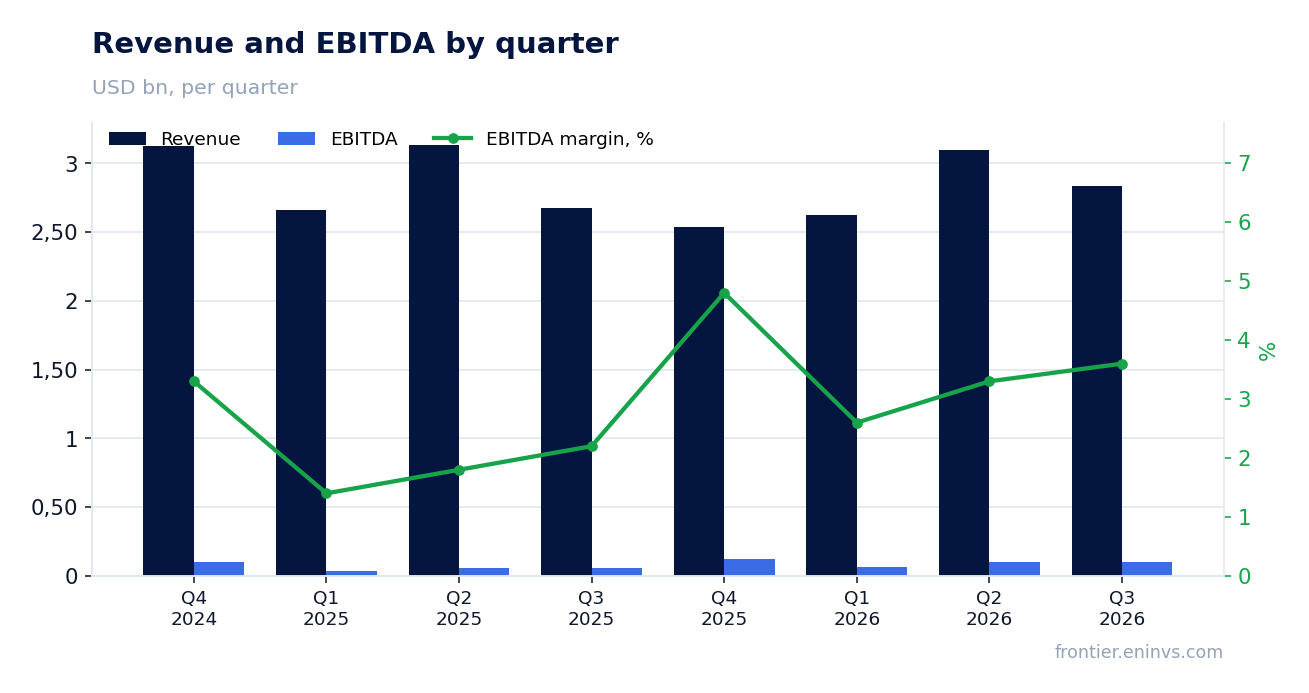
EBITDA rose 73.3%, but $27 million of it came from 45Z tax credits
Adjusted EBITDA in the third quarter of 2026 was $101.4 million against $78.3 million a year earlier, up 73.3%. The EBITDA margin rose to 3.6% from 2.2%. The jump looks strong, but its source needs unpacking.
In the Renewables segment the company recognised $27 million of 45Z tax credits for low-carbon strategies. That amount boosts profit but is not operating cash flow. Without it, Renewables EBITDA would be markedly lower: the segment generated $77.6 million of adjusted EBITDA, and a third of that is the credits.
Management also announced an agreement to sell most of the 45Z credits generated in 2026, with cash expected later this year. That confirms the credits convert into cash, but the one-off nature of the effect remains. To gauge sustainable earnings, an investor should look at EBITDA excluding this line.
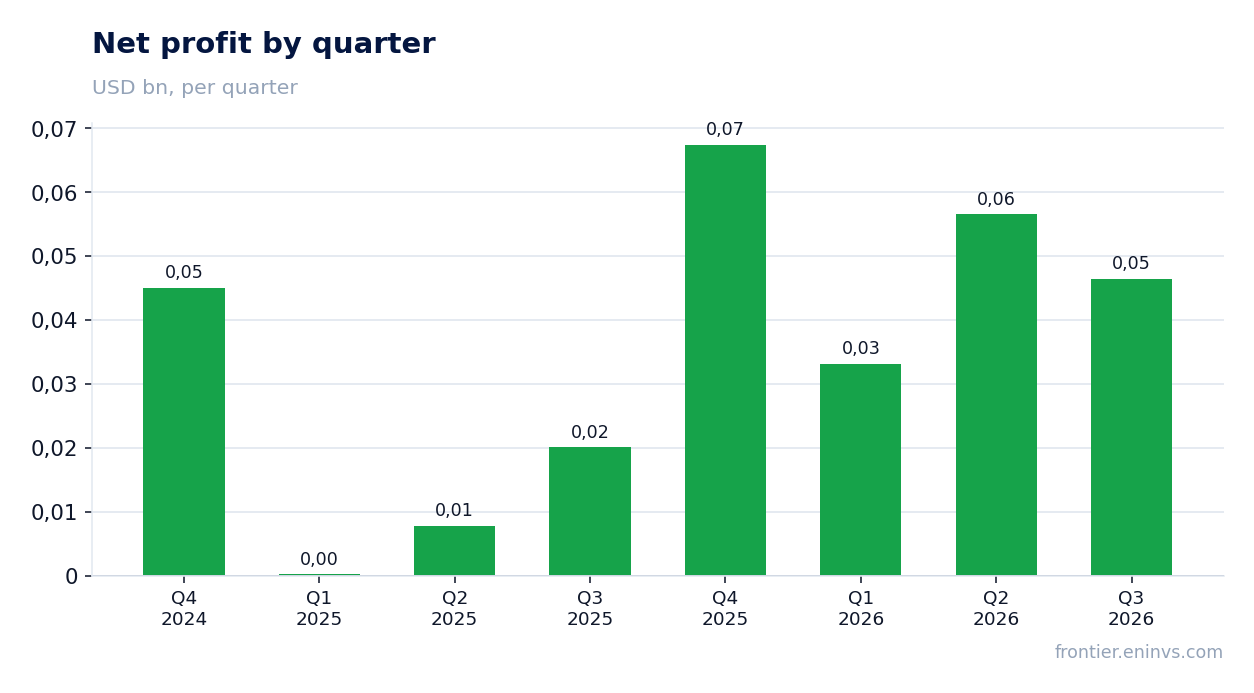
Renewables delivered a record third-quarter pretax profit of $63 million
Renewables pretax profit was $63.0 million against $43.5 million a year earlier, up 45%. The company calls the result a record for a third quarter. Segment adjusted EBITDA rose to $77.6 million from $66.5 million.
The drivers are listed in the press release: efficient plant operations, higher co-product values and lower corn basis at eastern plants. Ethanol and corn-oil yields improved year on year. All four plants completed scheduled autumn shutdowns, including an extended shutdown at Clymers, Indiana, ahead of debottlenecking.
Part of the result is the $27 million of 45Z credits. Without them segment profit would be around $36 million, which is still above last year's $43.5 million only under certain assumptions. The operational improvement is real, but its scale in the report is amplified by the tax line.
Agribusiness earned $5 million pretax against $1 million a year earlier
Agribusiness posted pretax profit of $5.2 million against $1.5 million a year earlier. Adjusted pretax profit attributable to the company was $8.8 million against $2.5 million. Segment adjusted EBITDA rose to $40.4 million from $29.1 million.
The improvement came from merchandising: higher commodity prices and increased volatility driven by weather variability in the western grain belt and crop uncertainty. Grain assets, by contrast, performed worse because of a late eastern harvest and lower wheat storage income. The third quarter is seasonally weak for fertiliser, and results were comparable with last year.
Management expects market dislocations and a good eastern harvest to create opportunities in the fourth quarter and into 2027. The soybean meal export project at the Port of Houston is now operational, and the company is booking shipments for the rest of 2026 and into 2027. That adds resilience to the segment, but the effect will show gradually.
Operating cash flow turned negative at $124 million on inventory and derivative build
Operating cash flow in the third quarter of 2026 was negative at −$124.0 million against +$233.9 million a year earlier. The cause is working capital: inventories rose by $249.8 million, derivatives produced an outflow of $140.6 million, and receivables fell by $86.7 million.
Cash flow before working capital changes was positive at $83.4 million against $68.5 million a year earlier. That means operations generate cash, and the outflow reflects seasonal inventory build and derivative revaluation rather than losses.
Capital expenditure was $60 million against $67 million a year earlier. Over nine months of 2026 capex reached $186.8 million. The company funds both growth and maintenance, and with negative quarterly cash flow that raises the need for borrowing.
Net debt rose to $1.1 billion, with net debt / EBITDA LTM at 3.2
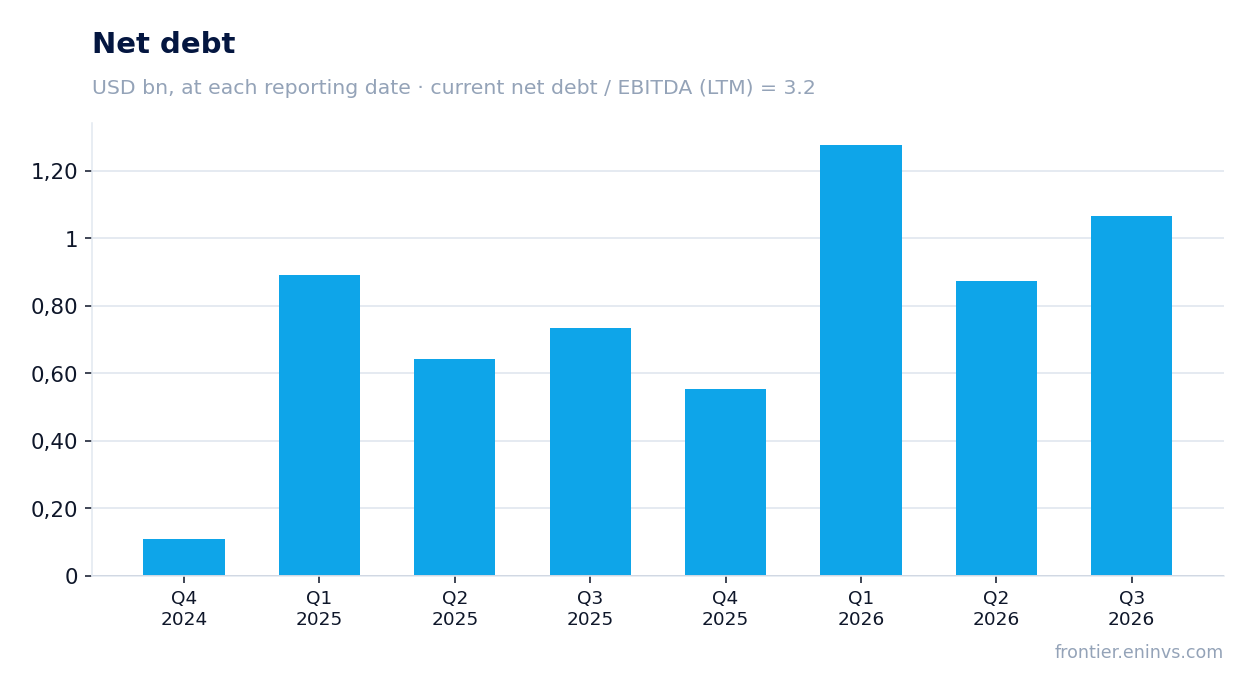
Net debt at September 30, 2026 was $1,066.3 million. From June 30, 2026 it rose from $0.9 billion to $1.1 billion (+$0.2 billion), and over twelve months from $0.7 billion at September 30, 2025 to $1.1 billion (+$0.3 billion). The rise coincided with negative quarterly operating cash flow.
The ratio of net debt to trailing-twelve-month EBITDA is 3.2. That is a level to record as fact: there is no prior value in our data, so we do not assess the direction of the ratio. In the press release the CFO says long-term debt to EBITDA remains below the 2.5x target, but that is a different metric – it excludes short-term borrowings.
Interest expense for the quarter was $13.4 million against $10.5 million a year earlier. With trailing-twelve-month EBITDA of $333.7 million, debt service remains manageable, but the rise in short-term debt to $495.2 million from $141.4 million a year earlier warrants attention.
A 0.96% dividend yield does not offset the risk embedded in the valuation
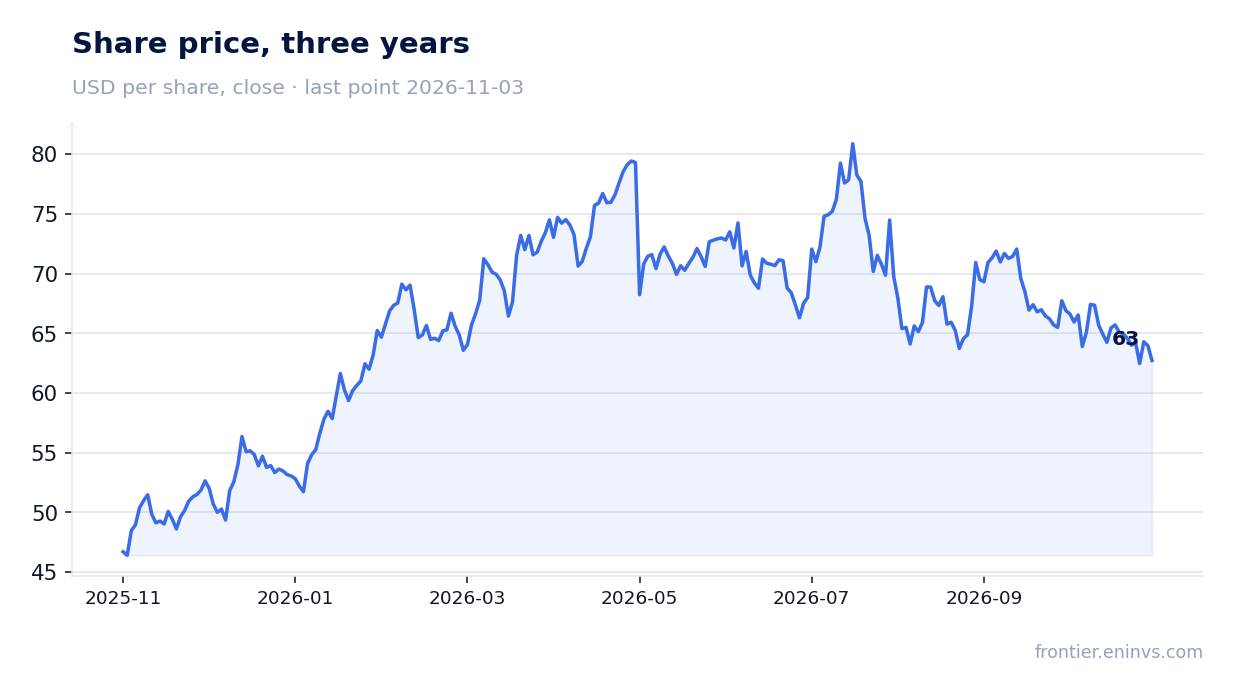
The trailing-twelve-month dividend yield is 0.96%. Over nine months of 2026 the company paid $20.4 million in dividends. Against a market capitalisation of $2,131 million the payout is modest and is not the main argument for the share.
Our estimate for the current year's dividend is based on profit: adjusted net income for nine months of 2026 was $158.9 million, and with the current payout practice the dividend will remain small. The key risk is one-off items such as the 45Z credits, which inflate profit but may not recur.
A 0.96% yield is lower than one might expect from a company with a trailing P/E of 11.6. That means the market values the share on earnings rather than on the dividend, and if earnings fall there will be no support from payouts. For an income-oriented investor this is a weak argument.
Valuation on the latest reported figures
| Metric | Value |
|---|---|
| Market cap | 2.13 bn USD |
| P/E (LTM) | 11.6 |
| EV/EBITDA (LTM) | 9.6 |
| P/B | 1.49 |
| Net debt / EBITDA (LTM) | 3.20 |
| ROE | 13.7% |
| Dividend yield (12m) | 1.0% |
Bottom line
The strong side of the report is genuine improvement in both segments: Renewables and Agribusiness posted higher pretax profit, and revenue accelerated to +5.8%. But a significant part of quarterly EBITDA – $27 million – came from 45Z tax credits, and operating cash flow turned negative at $124 million. Debt rose to $1.1 billion, with net debt / EBITDA LTM at 3.2. At a trailing P/E of 11.6 and EV/EBITDA of 9.6 the share is undemanding against its own history, but the portal's model puts fair value 31% below the market. The verdict is neutral: the arguments for and against balance out, and a change in assessment would require either sustainable cash flow without one-offs or a reduction in debt.
Open the company's financial profile ANDE →
See also: market overview · valuation map · stock screeners