B2Gold: 2026 is engineered to look bad - three drags end within months, and the shares price none of it
B2Gold produced 203,648 ounces in the second quarter and received $3,767 for each of them, against a gold price near $4,650. Operating cash flow was negative $78.8m. On the face of it the quarter was poor. It was poor for three specific, dated reasons that all end within months: the last ounces owed under prepaid gold contracts were delivered on 30 June, the gold collars settle finally in January 2027, and the new Goose mine is running at nearly double its design cost while it ramps. Strip those and the company is a 900,000-ounce producer trading at roughly three times its own cash margin. Figures as at 21 August 2026.
1. The company: four mines, four countries, one of them brand new
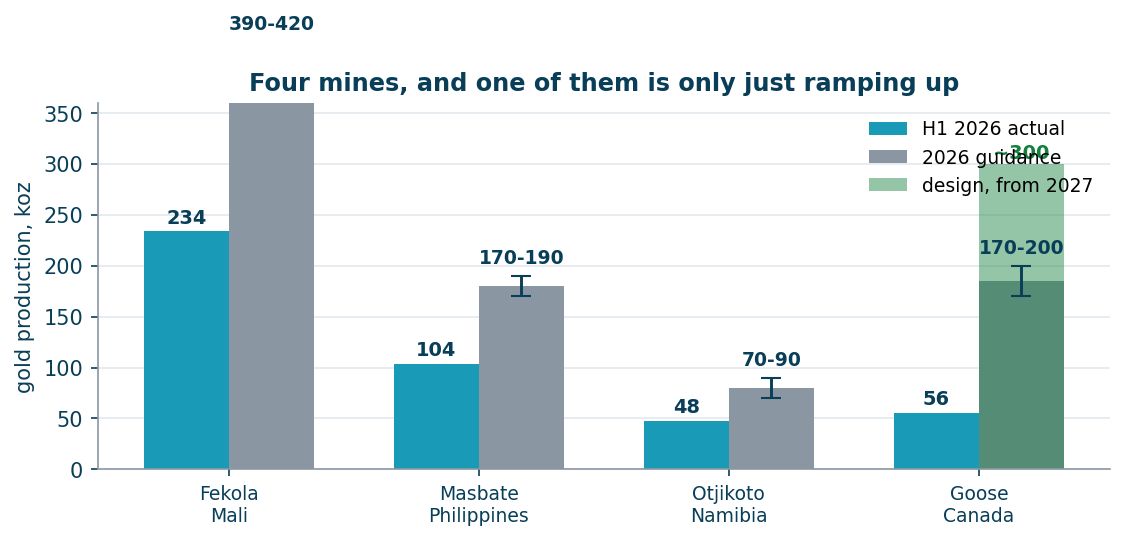
Fekola in Mali is the base - 233,731 ounces in the first half, guided to 390,000-420,000 for the year, a 9.6 million tonne mill on a 1.76 g/t reserve. Masbate in the Philippines is the cheap one: 103,947 ounces in the half at an all-in sustaining cost of $1,244, on a 0.72 g/t reserve that works because the pit is large and shallow. Otjikoto in Namibia is the small, steady one at 47,967 ounces. Goose in Nunavut, Canada, poured first gold in 2025 and reached commercial production in October: 55,766 ounces in the half, guided to 170,000-200,000 this year and designed for about 300,000 a year from 2027.
2. The prepaid gold ended on 30 June - and it was worth $881 an ounce
This is the single most misread number in the accounts. B2Gold had sold gold forward under prepay contracts, and the final 264,768 ounces were delivered by 30 June 2026. Because those ounces were priced years ago, the second quarter realised $3,767 while spot ran near $4,650 - a gap of $881 an ounce. On roughly 210,000 ounces a quarter that is about $185m of revenue the company produced but did not receive. The first quarter realised $4,873, above spot, because fewer prepay ounces landed in it.
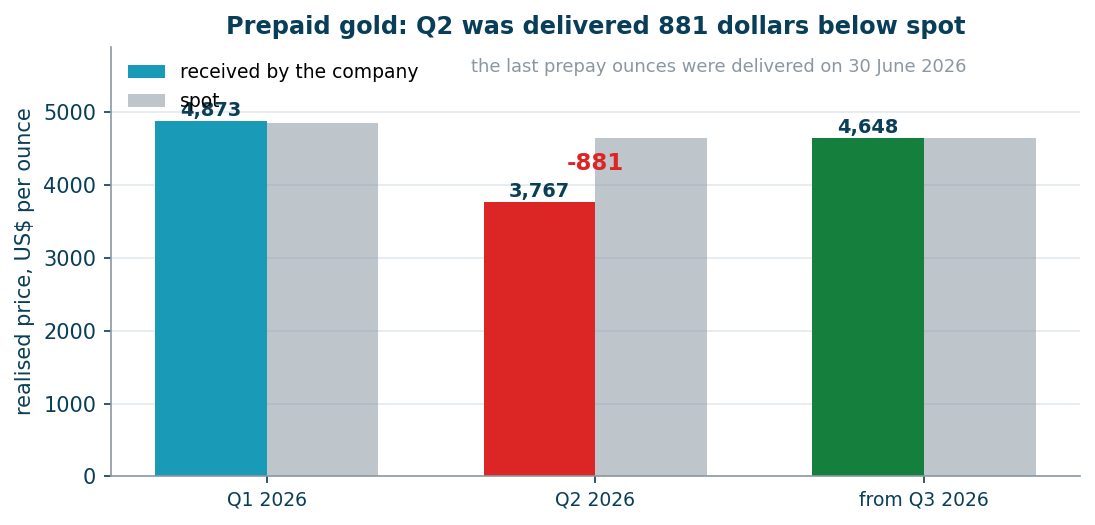
Management put it plainly: with all future gold sales expected at spot prices, free cash flow is anticipated to improve in the second half. One residual remains - realised losses on gold collars were $71m in the second quarter and those contracts settle finally in January 2027. So the drag halves now and disappears in January.
3. Goose is expensive because it is new, not because it is bad
Goose cost $6,390 an ounce on an all-in sustaining basis in the second quarter and is guided to $2,670-2,970 for the year. Its life-of-mine technical report puts all-in sustaining cost at $1,547 and cash operating cost at $1,129, on 270,000 ounces a year over nine years and 311,000 a year in the 2027-2031 steady state. The gap is ramp-up: a fire in the crushing circuit in April, repairs on track for the third quarter, and a phased upgrade - $11m to reach 3,200 tonnes a day by the third quarter of 2026, $25m more to reach the 4,000 tonnes a day design by mid-2027.
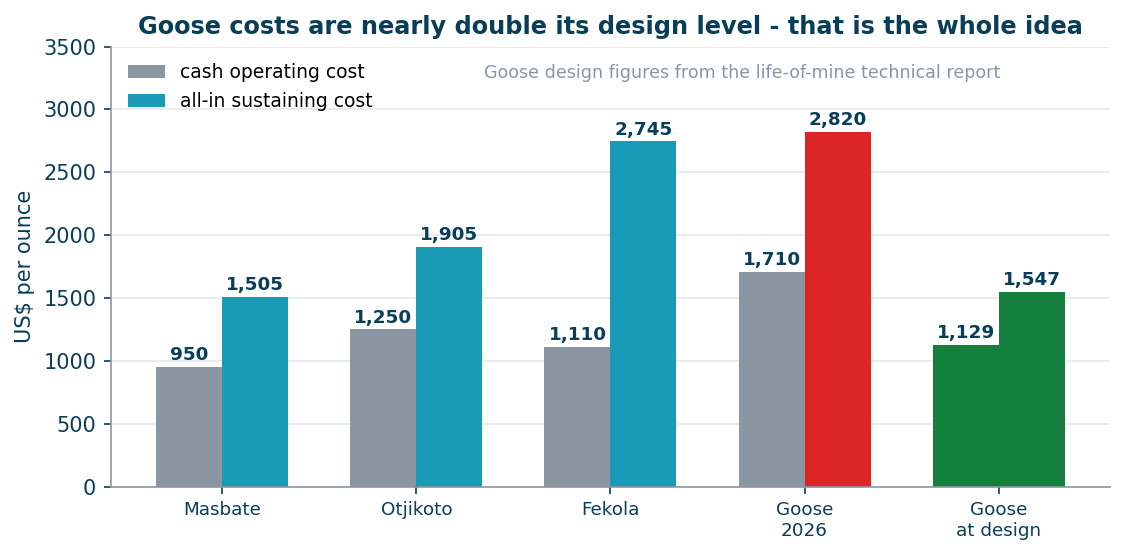
Note what the chart also shows about Fekola: a cash cost of about $1,110 against an all-in sustaining cost near $2,745. That $1,600 gap is sustaining capital - underground development and stripping - and it is why the consolidated all-in number looks so heavy this year. Masbate at $1,505 and Otjikoto at $1,905 are the normal shape.
4. Reserves and life of mine: Goose brought grade to the scale of Fekola
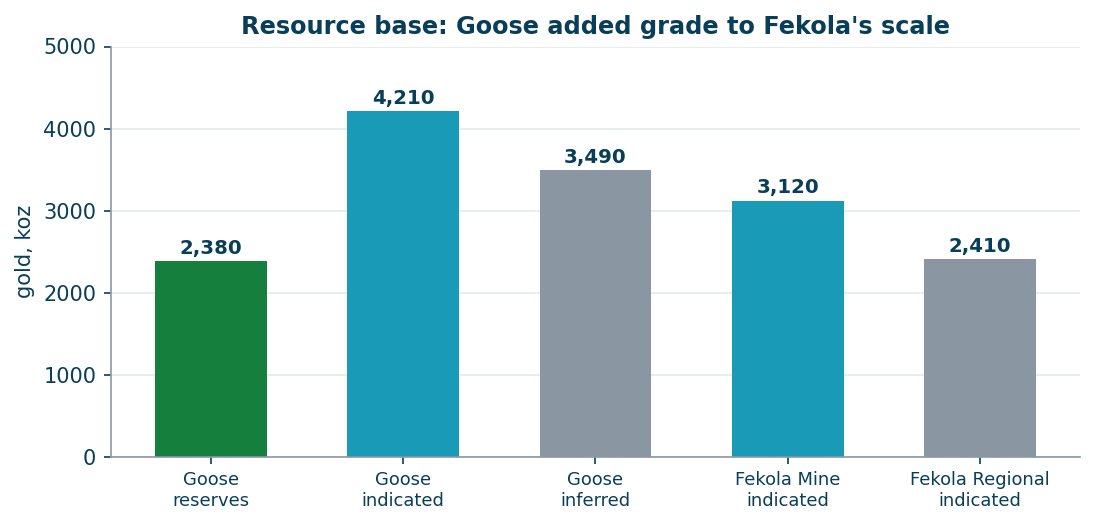
Goose carries probable reserves of 10.9 million tonnes at 6.79 g/t for 2.38 Moz - one of the highest reserve grades among recently built mines - and the life-of-mine plan runs nine years for 2.29 Moz produced. Above the reserve sits an indicated resource of 17.56 million tonnes at 7.45 g/t for 4.21 Moz and an inferred resource of 13.5 million tonnes at 8.05 g/t for 3.49 Moz, with a $51m exploration budget for the district this year. Fekola is the opposite shape - low grade, large tonnage: an indicated resource of 75.7 million tonnes at 1.28 g/t for 3.12 Moz at the mine itself, plus 64.1 million tonnes at 1.17 g/t for 2.41 Moz across Fekola Regional.
5. Mali: the overhang is being lifted, on paper at least
Mali is 49% of production and has been the reason the shares carry a discount. Two things changed. The agreement with the state gave the Fekola Complex what the company calls a clean slate on income tax and customs going forward. And on the Menankoto exploitation permit, which unlocks Fekola Regional, the company said in late July that all required steps to finalise approval have been completed and the permit awaits approval by the Council of Ministers. Fekola Regional is expected to contribute more than 100,000 ounces a year from 2027 and 60,000-80,000 already in 2026.
6. What it costs, once you use numbers that are not contaminated
A warning about the data first, because we tripped over it ourselves. The quarterly feed we use books gains on asset sales and derivatives into the operating line: it shows EBITDA of $763.6m on revenue of $789.4m for the second quarter, a 97% margin against a 43-63% range over the previous eight quarters. The company reported net income of $417.3m for the quarter and adjusted net income of $41m. Any multiple built on that feed is wrong, and we withdrew one that was.
So we value on figures the company discloses directly. Market capitalisation is about $7.1bn on 1.32 billion shares; total debt is $456.1m against cash of $286.6m, so net debt is $166m and enterprise value about $7.27bn - with the full $800m revolver undrawn and $405m of working capital behind it. On 2026 guidance of 820,000-920,000 ounces and an all-in sustaining cost of $2,370-2,550, the cash margin over all-in cost at the current gold price is roughly $1.9bn, which puts the company at about 3.8 times that margin.
2027 is the first year without any of the three drags. If production lands between 950,000 and a million ounces - Goose at its 300,000 design rate and Fekola Regional contributing - and all-in sustaining cost falls to $1,900-2,100 as Goose reaches its own life-of-mine level, the cash margin is $2.4-2.7bn and the same enterprise value is 2.6 to 3.0 times it. That is the whole investment case in one sentence: you are paying a 2026 multiple for a business whose 2027 looks structurally different, and the difference is dated rather than hoped for.
What would break it
Three things, in order of how much they matter. Mali: 49% of production sits with a government that has already renegotiated terms once, and the Menankoto permit is awaiting a Council of Ministers that has not yet met on it. Goose: the ramp has already slipped once on a fire, the guidance range was cut from 820,000-970,000 to 820,000-920,000 on exactly that, and a mine at $6,390 an ounce burns cash while it is late. And the gold price itself: an all-in sustaining cost near $2,460 this year means the margin halves if gold returns to $3,500, which is where it traded eighteen months ago.
Open the company's financial profile BTG →
See also: market overview · valuation map · stock screeners