Okeanis Eco Tankers: revenue tripled, but the multiple is already three times its own history
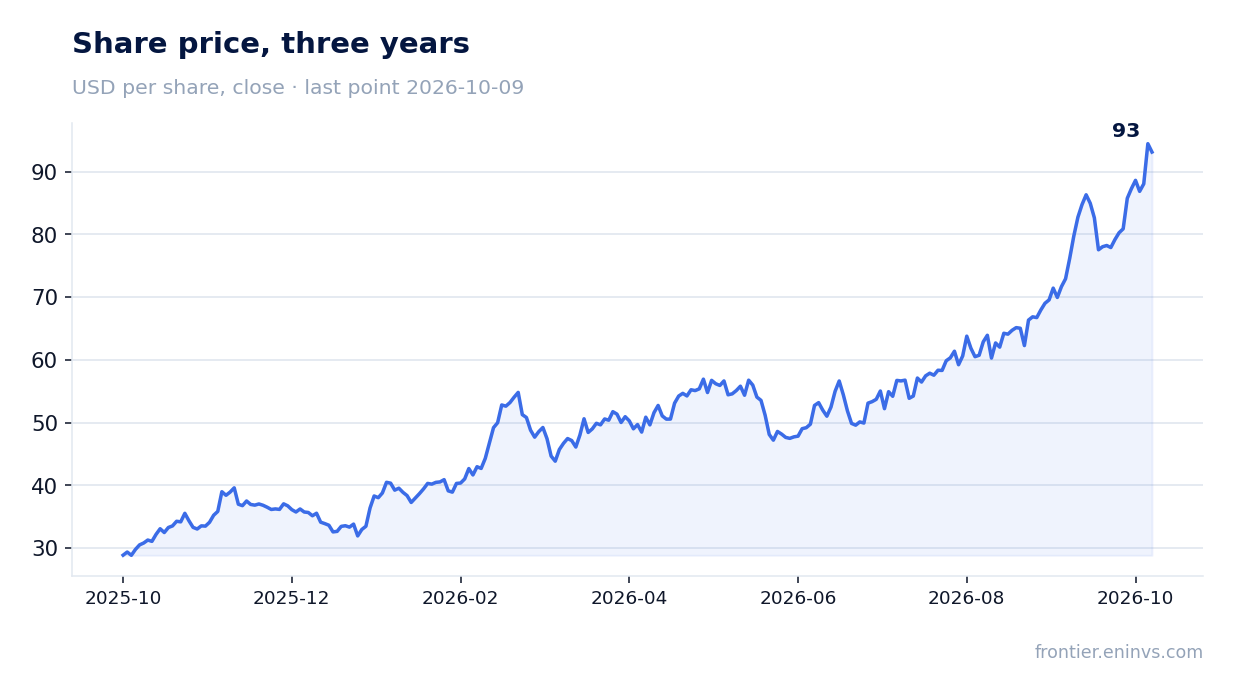
Okeanis Eco Tankers has reported results for the second quarter of 2026. Revenue rose 239.4% year on year to USD 318.9 million, EBITDA by 432.6% to USD 251.8 million, and the EBITDA margin reached 79.0% versus 50.3% a year earlier. Net debt stood at USD 0.5 billion as of 30 June 2026, with net debt to LTM EBITDA at 2.55. On an EV/EBITDA of 18.6 the stock trades three times its own three-year average of 6.6, and with a dividend yield of 9.5% the valuation already prices in much of the quarterly spike – at the current price the share looks rather unattractive.
Key takeaways
— Revenue rose 239.4% year on year, an acceleration from 112.3% a quarter earlier
— EBITDA margin of 79.0% versus 50.3% a year earlier – almost all revenue reaches EBITDA
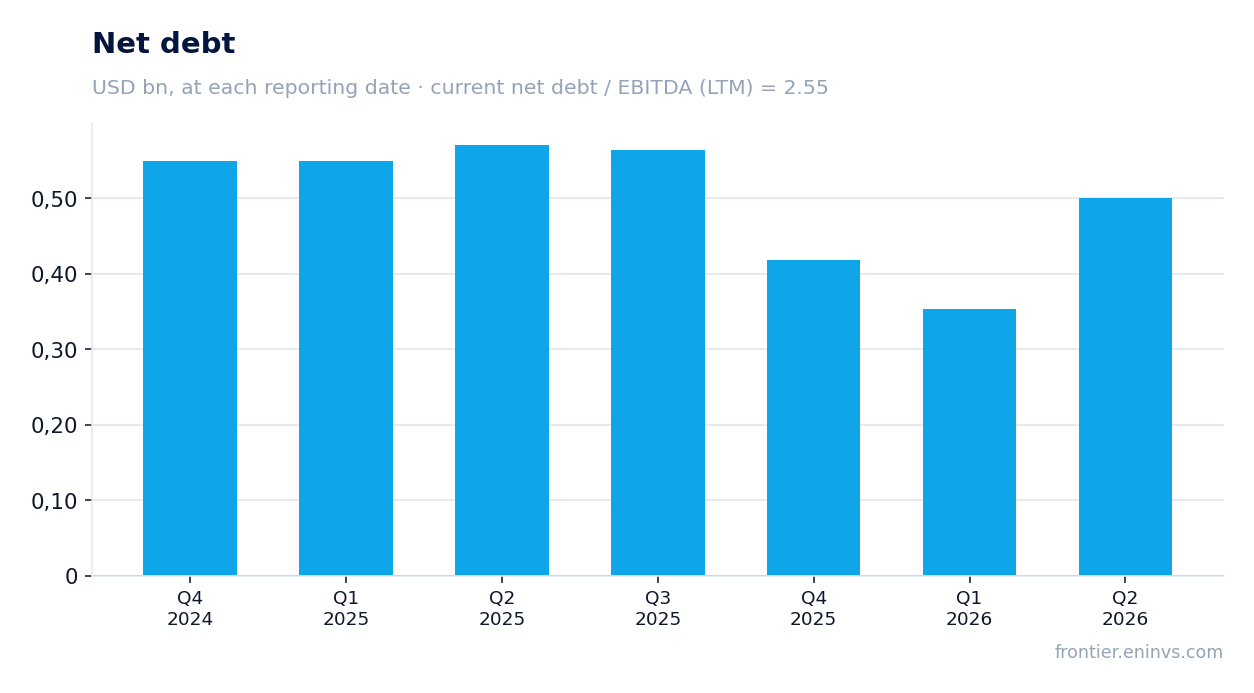
— Net debt of USD 0.5 billion as of 30 June 2026, with net debt to LTM EBITDA at 2.55
— Dividend yield of 9.5% over the last 12 months – above the key rate
— EV/EBITDA of 18.6 versus a three-year average of 6.6 – the stock is three times its own history
— The portal's model puts upside to fair value at +140%
— Return on equity of 54.4% – the quarter ran at a peak of the freight market
Attractiveness
Key figures, USD bn
| Metric | Q2 2025 | Q2 2026 | Change |
|---|---|---|---|
| Revenue | 0.09 | 0.32 | +239.4% |
| EBITDA | 0.05 | 0.25 | +432.6% |
| Operating profit | 0.04 | 0.24 | +547.2% |
| EBITDA margin | 50.3% | 79.0% | +28.7 pp |
Revenue rose 239.4% year on year, an acceleration from 112.3% a quarter earlier
In the second quarter of 2026, Okeanis Eco Tankers' revenue reached USD 318.9 million, up 239.4% year on year. This is a clear acceleration: in the first quarter growth was 112.3%, and in the fourth quarter of 2025 it was 48.9%. Quarterly revenue is more than double the first quarter of 2026 figure of USD 170.2 million.
The acceleration is primarily explained by the freight market: tanker rates in the reporting period were substantially higher than a year earlier. The company does not disclose segment details in the provided facts, but the scale of growth – revenue tripled – indicates the quarter hit a cycle peak. Such a pace is unlikely to be sustainable: it reflects market conditions, not fleet expansion or higher transport volumes.
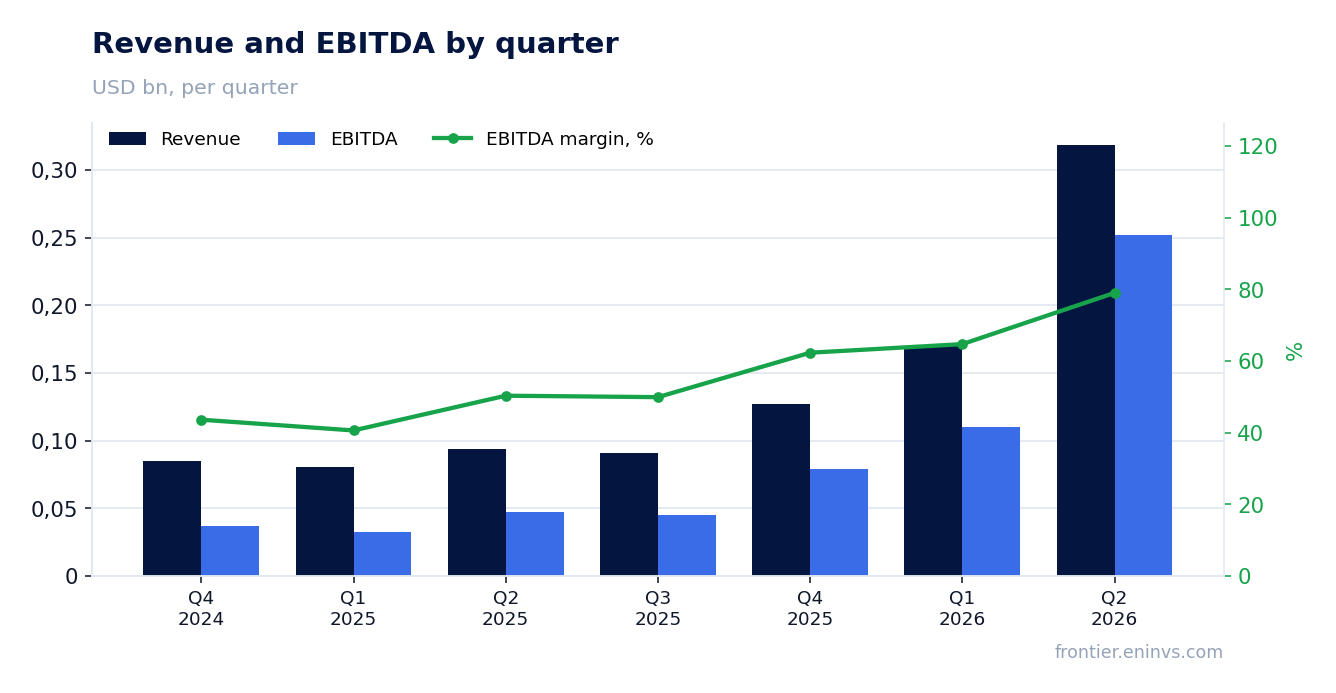
EBITDA margin of 79.0% versus 50.3% a year earlier – almost all revenue reaches EBITDA
EBITDA in the second quarter of 2026 was USD 251.8 million, up 432.6% year on year. The EBITDA margin rose to 79.0% from 50.3% a year earlier. This means almost 80 cents of every revenue dollar convert into EBITDA – an extremely high level even for the tanker business.
Such a margin jump is explained by operating leverage: with revenue tripling, fixed and variable costs grow much more slowly. The company does not disclose its cost structure in the facts, but the 28.7 percentage point margin increase indicates that most of the additional revenue flowed to profit. This is typical for shipping at peak rates, when fuel and crew costs are relatively stable.
Operating profit was USD 239.1 million, meaning almost all of EBITDA is operating result rather than one-off items. The gap between EBITDA and operating profit (USD 12.7 million) is small and likely reflects depreciation. This confirms that quarterly profitability is operational in nature, not one-off.
Net debt of USD 0.5 billion as of 30 June 2026, with net debt to LTM EBITDA at 2.55
Net debt as of 30 June 2026 stood at USD 0.5 billion. Over the quarter it rose from USD 0.4 billion on 31 March 2026 to USD 0.5 billion on 30 June 2026, a change of +USD 0.1 billion. Over the year, from 30 June 2025, net debt fell from USD 0.6 billion to USD 0.5 billion, a change of -USD 0.1 billion.
Net debt to LTM EBITDA is 2.55. This is a moderate level for a capital-intensive shipping business. The company does not disclose the prior-year value of this ratio in the facts, so its direction is not given. Absolute debt rose over the quarter but remains below the level of a year ago.
Interest expenses and the repayment schedule are not disclosed in the facts. With LTM EBITDA of USD 196.1 million and net debt of USD 0.5 billion, the debt burden appears serviceable, but the quarterly increase of USD 0.1 billion warrants attention: it may reflect either investment or seasonal working capital needs.
Dividend yield of 9.5% over the last 12 months – above the key rate
The dividend yield over the last 12 months is 9.5%. This is above the key rate, making the stock interesting for income-oriented investors. However, the facts do not contain data on specific payments for the reporting period or on the company's dividend policy.
Our estimate of the dividend for the current year is based on profit: with an EBITDA margin of 79.0% and revenue of USD 318.9 million, the quarter generates significant cash flow. If the company allocates a share of profit comparable to last year, the payout could be substantial. But this is our estimate, and it depends on the board's decision and on how much profit will be reinvested in fleet maintenance.
What could make the payout smaller: falling freight rates, higher capex for drydocking, or debt repayment. The facts do not contain data on capital expenditures for the second quarter of 2026, so their impact on the dividend cannot be assessed. The 9.5% yield is a retrospective figure and does not guarantee future payments.
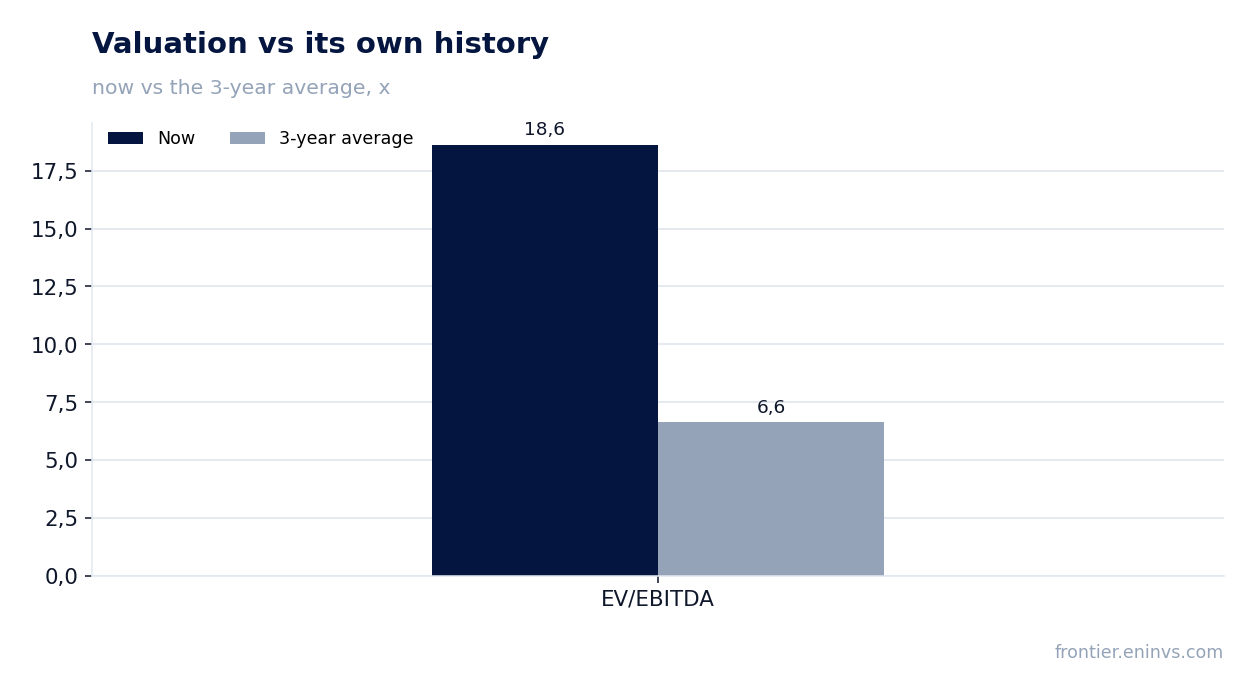
EV/EBITDA of 18.6 versus a three-year average of 6.6 – the stock is three times its own history
EV/EBITDA over the last 12 months is 18.6, which is 180% above the three-year average of this multiple – 6.6. The stock trades three times its own history. This is a key argument against buying at current levels: the market has already priced in peak earnings.
For comparison, the LTM P/E is 26.8. With a market capitalisation of USD 3.3 billion and LTM EBITDA of USD 196.1 million, the current valuation implies that the market expects high profitability to persist. If freight rates return to average levels, the multiple could rise further as EBITDA falls, putting pressure on the share price.
According to the portal's model, which re-prices EBITDA at current commodity prices at the target EV/EBITDA, the upside to fair value is +140%. This is our own model, not a market consensus. It assumes that current high rates will persist, and that is its main assumption.
The portal's model puts upside to fair value at +140%
Our model, which re-prices EBITDA at current commodity prices at the target EV/EBITDA, gives upside to fair value of +140%. This means that if current freight rates and the target capital structure persist, the share could be worth significantly more.
However, this estimate contrasts with the market multiple: EV/EBITDA of 18.6 versus a three-year average of 6.6. The market does not believe in the sustainability of current earnings, and that is understandable – quarterly revenue growth of 239.4% year on year reflects a cycle peak, not a new normal. The portal's model is a scenario, not a forecast.
For the upside to materialise, high rates must persist longer than the market expects. If rates start to decline, EBITDA will fall and the multiple will be even higher. Thus, +140% is an estimate under a favourable scenario, and it does not remove the risks of the current valuation.
Return on equity of 54.4% – the quarter ran at a peak of the freight market
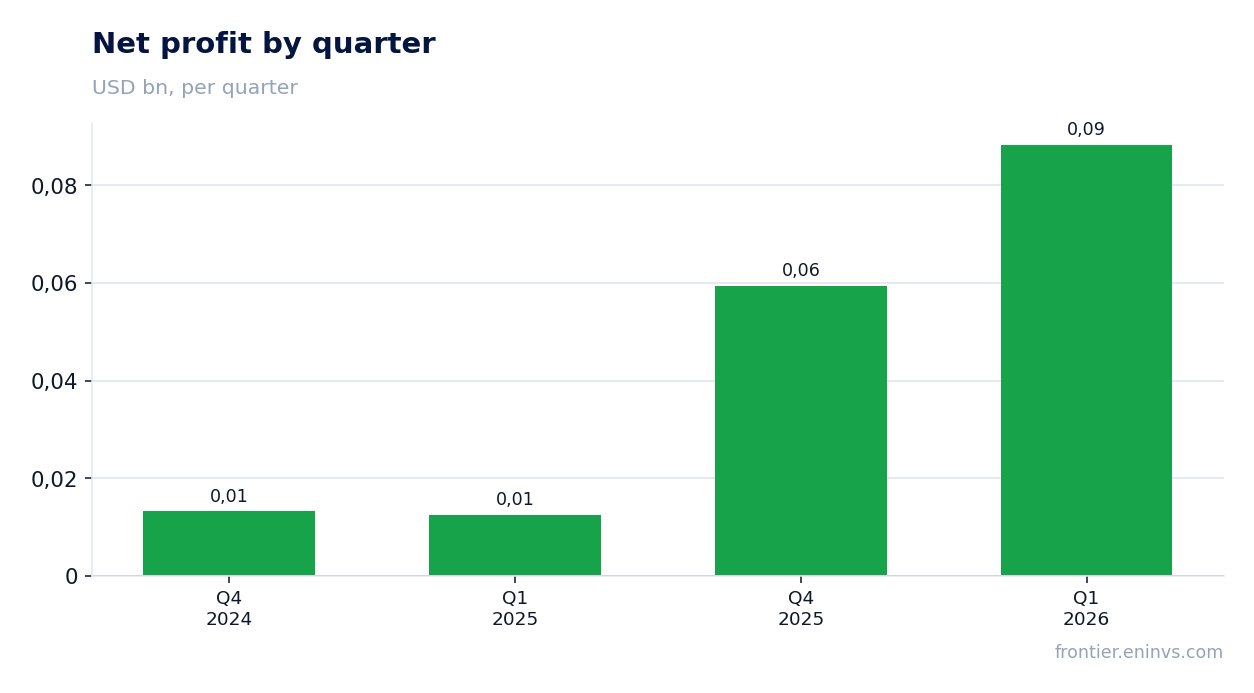
Return on equity (ROE) over the last 12 months is 54.4%. This is an exceptionally high figure, reflecting peak profitability in the tanker market. For comparison, net profit over the last 12 months was USD 123.0 million on revenue of USD 391.5 million.
Such a ROE level is attractive, but it is cyclical. Quarterly revenue of USD 318.9 million is almost equal to revenue for the entire last 12 months (USD 391.5 million), underscoring the abnormality of the reporting period. If rates normalise, ROE will return to more modest levels.
For an investor, this means that current profitability is not a sustainable basis for valuation. The 9.5% dividend yield and 54.4% ROE look attractive, but they were achieved at a cycle peak. The question is how long this peak will last.
Valuation on the latest reported figures
| Metric | Value |
|---|---|
| Market cap | 3.30 bn USD |
| P/E (LTM) | 26.8 |
| EV/EBITDA (LTM) | 18.6 |
| P/B | 5.76 |
| Net debt / EBITDA (LTM) | 2.55 |
| ROE | 54.4% |
| Dividend yield (12m) | 9.5% |
| EV/EBITDA, 3-year average | 6.6 |
Bottom line
The quarter was exceptionally strong: revenue rose 239.4% year on year, the EBITDA margin reached 79.0%, and ROE was 54.4%. However, these results reflect a peak in the freight market, not a sustainable norm. The valuation already prices in much of this spike: EV/EBITDA of 18.6 is three times the three-year average of 6.6. The 9.5% dividend yield is attractive, but it is retrospective and depends on high rates persisting. At the current price the share looks rather unattractive: the portal's model upside (+140%) is a scenario, not a guarantee, and it requires rates to stay above market expectations.
Open the company's financial profile ECO →
See also: market overview · valuation map · stock screeners