Intrepid Potash: revenue fell 4.2%, but profit leans on Trio and interest income

On November 3, Intrepid Potash reported third-quarter 2026 results. Revenue came in at $51.0 million, down 4.2% year on year, adjusted EBITDA rose 5.5% to $11.7 million, and net profit fell 53.8% to $1.7 million. The pace of the revenue decline slowed: minus 4.2% versus minus 6.7% a quarter earlier, an acceleration compared with the second quarter. In our view the share looks neutral at the current price: a strong balance sheet and Trio growth are offset by weak revenue dynamics and a rich P/E.
Key takeaways
— Revenue fell 4.2% on lower potash shipments, while Trio rose 5%
— EBITDA margin rose to 22.9% thanks to Trio, whose gross margin grew 33%
— Net profit fell 53.8%, but a year ago $3.0 million from discontinued operations inflated it
— Operating cash flow went to minus $4.8 million on seasonal working-capital build
— Capex rose to $11.3 million, with another $36 million planned for 2027
— No debt, net cash of $161.4 million, and buybacks accelerated after the report
— Valuation at 17.1 P/E and 4.0 EV/EBITDA, with the portal model showing 3% downside
Attractiveness
Key figures, USD bn
| Metric | Q3 2025 | Q3 2026 | Change |
|---|---|---|---|
| Revenue | 0.05 | 0.05 | -4.2% |
| EBITDA | 0.01 | 0.01 | +5.5% |
| Operating profit | 0.00 | 0.00 | -93.7% |
| Net profit | 0.00 | 0.00 | -53.8% |
| Operating cash flow | -0.00 | -0.00 | — |
| Capex | 0.01 | 0.01 | +45.8% |
| EBITDA margin | 20.8% | 22.9% | +2.1 pp |
| Net margin | 7.0% | 3.4% | -3.6 pp |
Revenue fell 4.2% on lower potash shipments, while Trio rose 5%
Third-quarter 2026 revenue was $51.0 million versus $53.2 million a year earlier, down 4.2%. Versus the second quarter the pace slowed: minus 4.2% versus minus 6.7%, an acceleration. The report itself calls sales "in-line with the prior year", and the gap with the facts is rounding: $51.0 million versus $50.8 million in the report.
The main source of weakness is the potash segment. Its sales fell to $31.3 million from $32.5 million, shipment volume dropped 5% to 59 thousand tons, while the average price rose 3% to $394 per ton. The company attributes the decline to shipment timing in late September. Potash production fell to 34 thousand tons from 41 thousand because the company delayed the start of the Moab harvest to allow additional evaporation.
The Trio segment grew 5% to $19.1 million. Sales volume stayed at 36 thousand tons, while the price rose to $408 per ton from $402. Trio production rose 19% to 83 thousand tons on improvements at the East mine. Trio kept total revenue from a deeper decline.
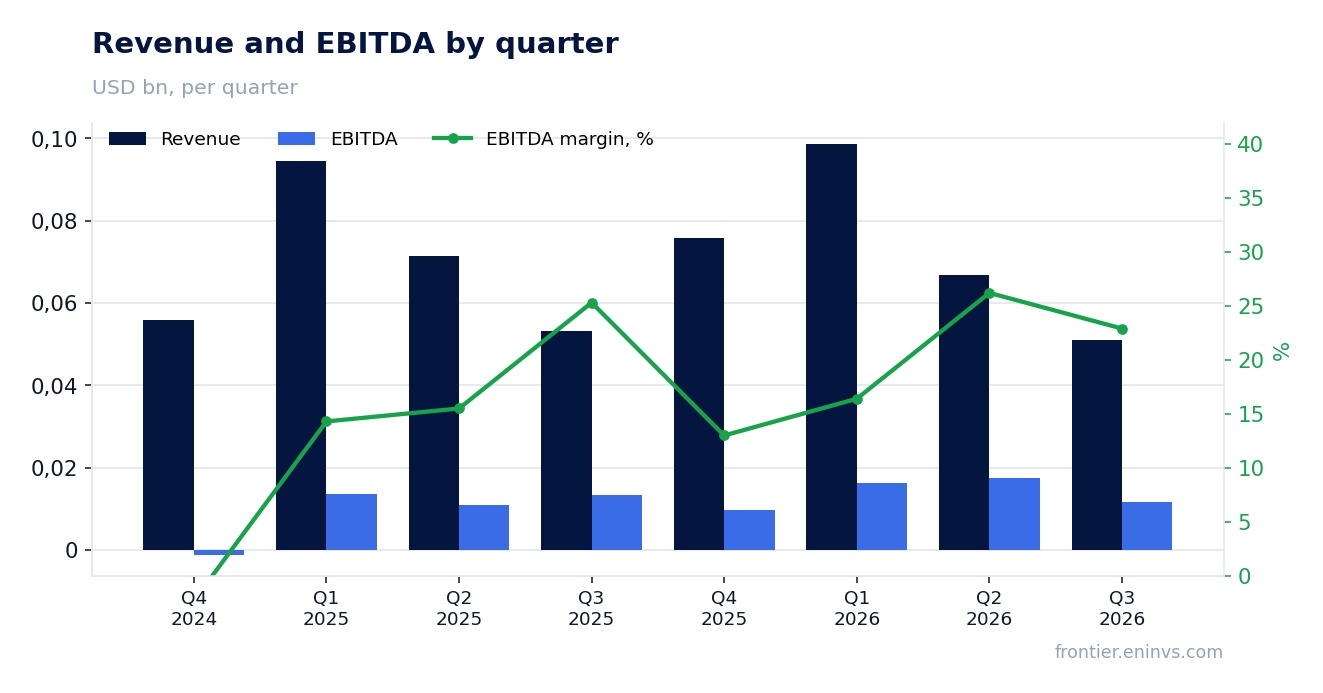
EBITDA margin rose to 22.9% thanks to Trio, whose gross margin grew 33%
Adjusted EBITDA rose 5.5% to $11.7 million, and the margin climbed to 22.9% from 20.8% a year earlier. Gross profit stayed at $10.0 million, but its composition shifted: Trio gross margin grew 33% to $5.8 million, while potash gross margin fell to $3.6 million from $6.3 million.
The driver of Trio's margin growth was a drop in cost per ton to $224 from $257. Higher production and stronger prices for sulfate and low-chloride potassium helped. Potash moved the other way: cost per ton rose to $384 from $340 as sales shifted toward higher-cost sites.
Operating profit was only $0.2 million versus $0.5 million a year earlier. It was eaten by selling and administrative expenses of $9.7 million and depreciation of $9.1 million. The EBITDA improvement did not reach the operating line: the gap between them is depreciation and one-off items excluded from EBITDA.
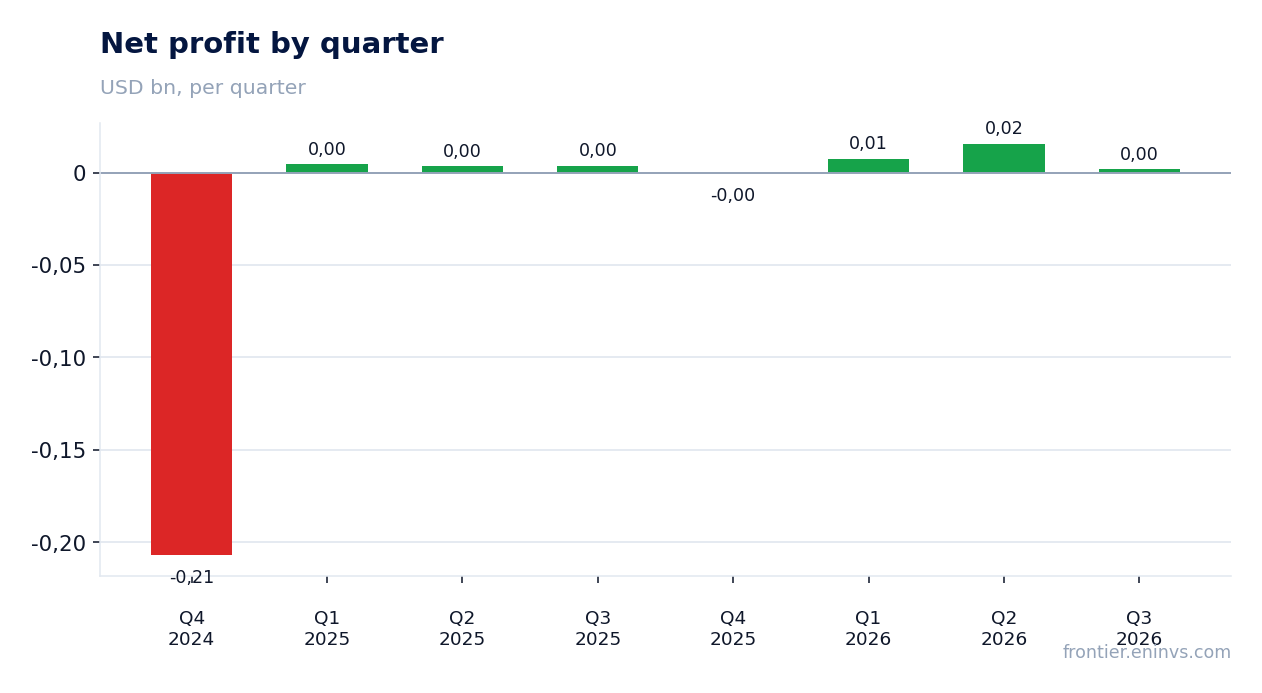
Net profit fell 53.8%, but a year ago $3.0 million from discontinued operations inflated it
Net profit was $1.7 million versus $3.7 million a year earlier, down 53.8%. The comparison is misleading: third-quarter 2025 profit included $3.0 million from discontinued operations. Profit from continuing operations, by contrast, rose to $1.7 million from $0.7 million.
Interest income of $1.4 million versus $0.8 million supported net profit. The company holds $152.3 million of cash and $9.1 million of short-term investments, and income from them is now a material part of the result. Operating profit of $0.2 million is not comparable to the interest income.
Net margin fell to 3.4% from 7.0%, but here too the base effect: a year ago the margin was calculated with profit from discontinued operations. On a continuing basis the margin rose. One-off items in the quarter were minimal: $0.1 million from asset sales.
Operating cash flow went to minus $4.8 million on seasonal working-capital build
Operating cash flow from continuing operations was minus $4.8 million versus minus $5.6 million a year earlier. A negative figure in the third quarter is typical for the company: it is the seasonally weakest period for profit and the heaviest for working capital ahead of the fall fertilizer application.
Within the quarter inventories rose $10.8 million and receivables $7.6 million. Over nine months the flow remains positive: $50.5 million versus $37.3 million a year earlier. The quarterly minus is the calendar, not a deterioration in customer settlements.
Capex rose to $11.3 million from $7.7 million. Together with negative operating cash flow that produced minus $16.1 million of free cash flow for the quarter. Over nine months capex was $24.9 million versus $18.8 million, and the company raised its full-year guidance to approximately $45 million.
Capex rose to $11.3 million, with another $36 million planned for 2027
The company raised its 2026 capex guidance to approximately $45 million from approximately $40 million. For 2027 it plans an additional $16 million for Trio production growth and $20 million for potash mine development. These investments should add 30 thousand tons of Trio per year and 20–30 thousand tons of potash.
Trio production guidance for 2026 was raised to 305–315 thousand tons from 295–305 thousand. The increase is attributed to the new continuous miner at the East mine and longer operating hours. For 2027 the company expects 320–330 thousand tons of Trio and 310–330 thousand tons of potash.
Separately, the company said it was selected by the U.S. Department of Agriculture for approximately $139 million of matching funding under the FIELDS program for a potential sulfate of potash plant in New Mexico with capacity of about 220 thousand tons per year. A final investment decision is targeted for late 2027, and until then it is an option, not a commitment.
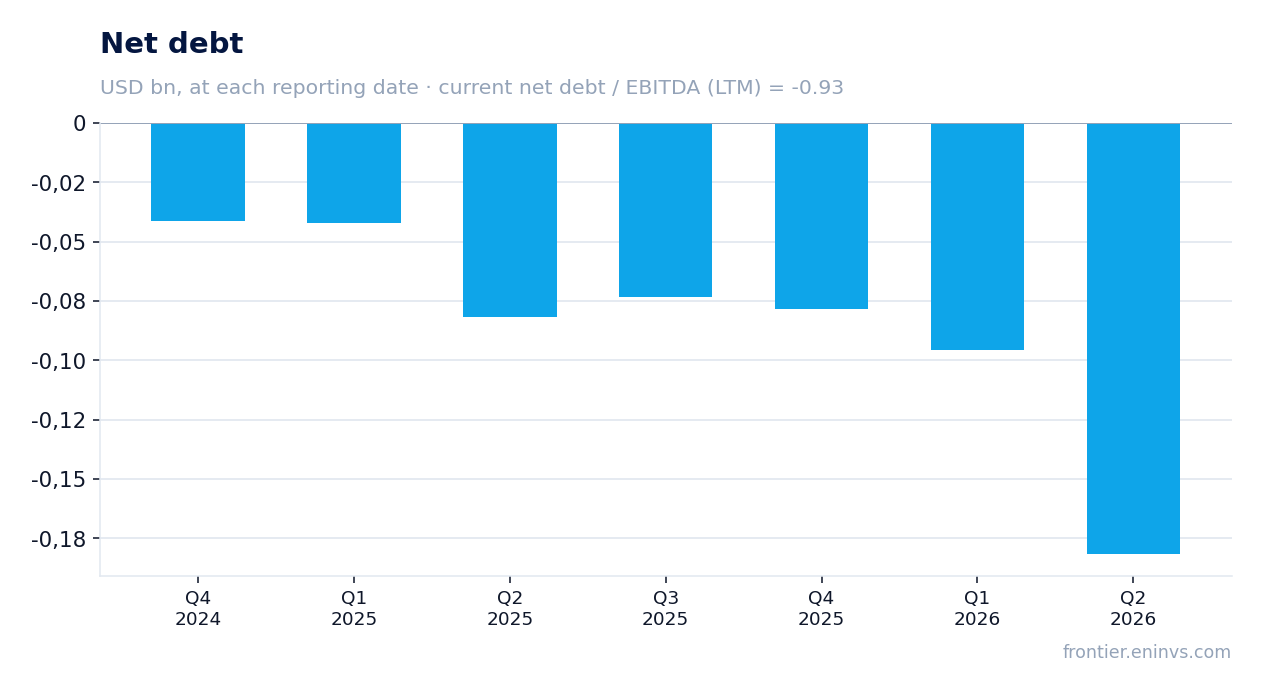
No debt, net cash of $161.4 million, and buybacks accelerated after the report
As of September 30, 2026, the company had no borrowings under its revolving facility, with $149.5 million available out of $150 million. Cash and short-term investments produced a net cash position of $161.4 million. On the latest annual balance sheet net debt was negative: minus $78.2 million, and net debt to trailing-twelve-month EBITDA was minus 0.93.
The company repurchased about 22 thousand shares for $0.8 million in the third quarter and another 66 thousand for $2.1 million after the report, through October 31. The board expanded the buyback program to $50 million in June. Management says outright it sees the shares as undervalued and has accelerated repurchases.
Interest expense is zero, and interest income of $1.4 million for the quarter is income on the cash cushion. With no debt and such a cash balance, financial risk is minimal, and the flexibility lets the company fund capex and buybacks without borrowing.
Valuation at 17.1 P/E and 4.0 EV/EBITDA, with the portal model showing 3% downside
On multiples the share trades at 17.1 times trailing-twelve-month earnings and 4.0 times EBITDA. Trailing-twelve-month profit was $24.3 million, but it included $13.7 million from discontinued operations over nine months. Without that one-off, P/E would be materially higher, meaning the current multiple rests on profit that will not repeat.
EV/EBITDA of 4.0 looks cheap, but the company trades with a net cash position, so EV is below market capitalization. On the portal's model, which reprices EBITDA to current commodity prices at the target EV/EBITDA, the upside to fair value is minus 3%. This is our own estimate, not a market consensus.
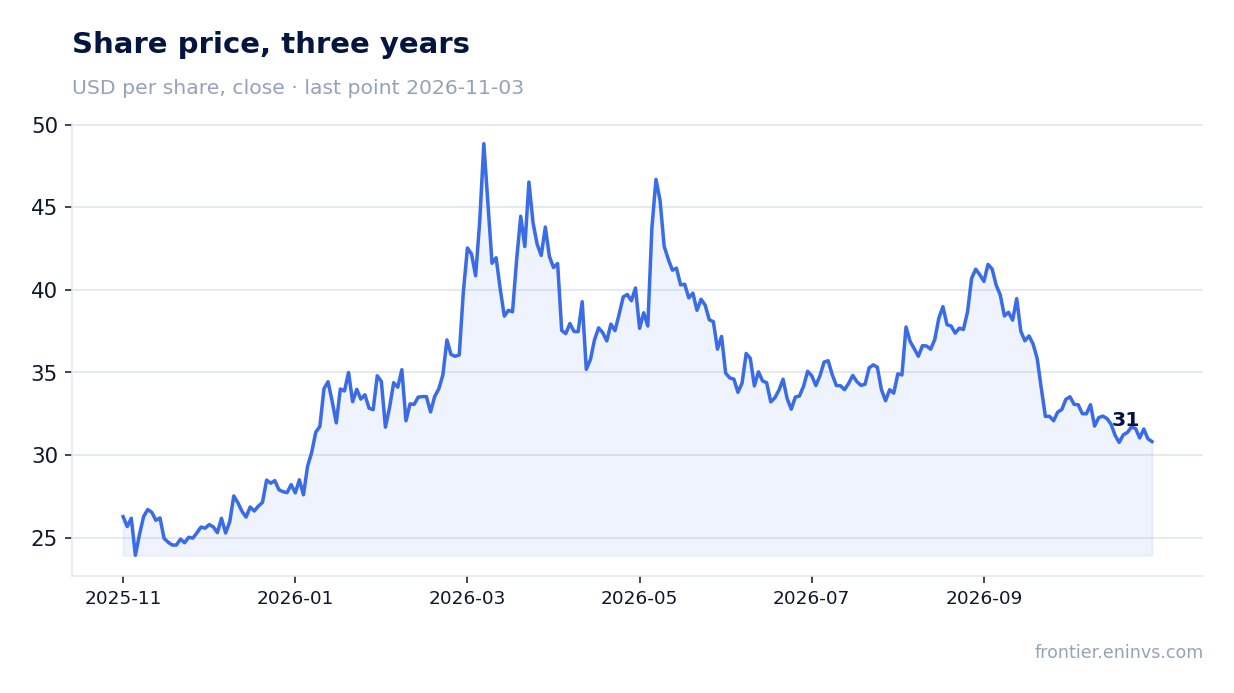
Return on equity is 1.3%, low for a company with a market capitalization of $414.7 million. The reason is the large cash cushion, which earns no operating return. The market reaction to the report was muted: the share lost 0.5% on the publication day and 0.5% from the report to November 3.
Valuation on the latest reported figures
| Metric | Value |
|---|---|
| Market cap | 0.41 bn USD |
| P/E (LTM) | 17.1 |
| EV/EBITDA (LTM) | 4.0 |
| P/B | 0.84 |
| Net debt / EBITDA (LTM) | -0.93 |
| Operating cash flow (LTM) | 0.06 bn |
| ROE | 1.3% |
Bottom line
The quarter's strength was Trio: production rose 19%, gross margin 33%, and the company raised its 2026 output guidance. The balance sheet is impeccable: no debt, net cash of $161.4 million, buybacks accelerated. But revenue fell 4.2%, operating profit was only $0.2 million, and net profit dropped 53.8% partly on last year's base with $3.0 million from discontinued operations. The 17.1 P/E rests on trailing-twelve-month profit that includes $13.7 million of one-off gains, and the portal model shows minus 3% to fair value. The verdict is neutral: a strong balance sheet and Trio growth are offset by weak revenue and a rich valuation, and a change of view needs sustained potash shipment growth or confirmation that profit holds without one-offs.
Open the company's financial profile IPI →
See also: market overview · valuation map · stock screeners