Mercer International: the loss halved, but on one-off support rather than the market
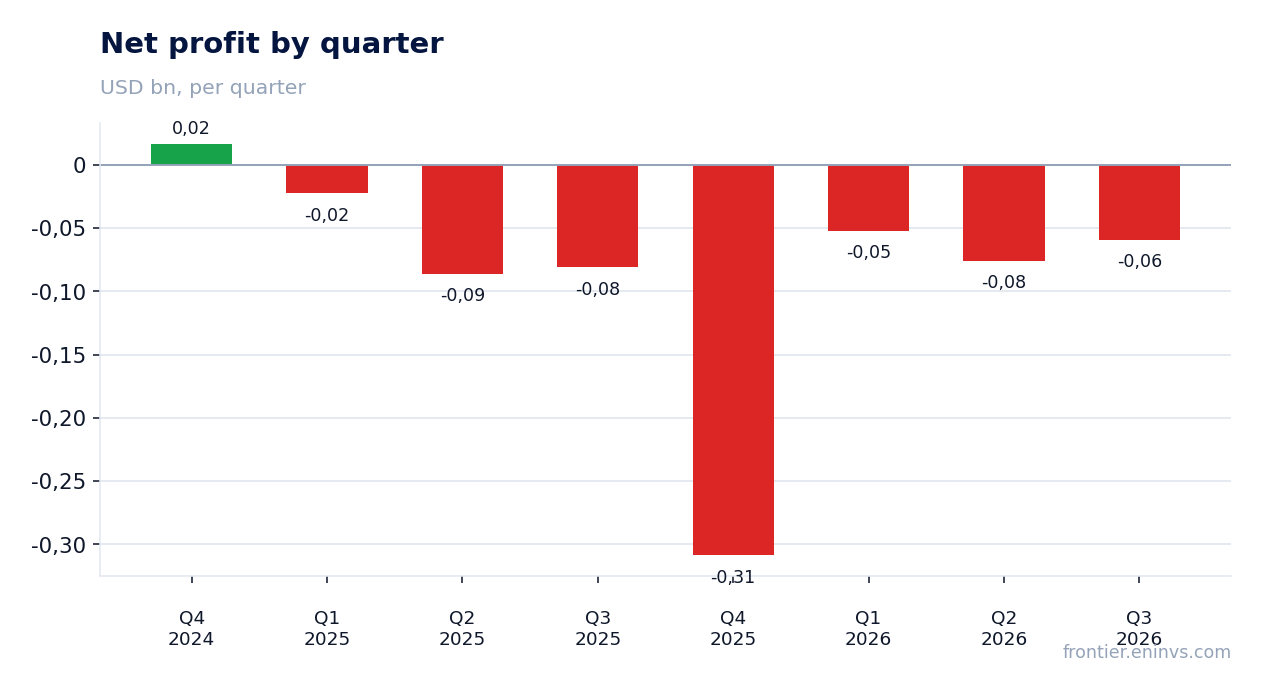
On November 5 Mercer International reported third-quarter 2026 results. Revenue fell 3.8% year on year to $440.7 million, adjusted EBITDA stayed negative at minus $2.9 million versus minus $28.1 million a year earlier, and the net loss narrowed to $59.2 million from $80.8 million. The improvement rests almost entirely on $13.0 million of government grants and the cost-cutting programme rather than on a pulp price recovery; with a $14.8 million market cap against $1.6 billion of net debt, the share looks unattractive.
Key takeaways
— EBITDA stayed negative, and the $25.2 million improvement came from grants and savings, not prices
— The pulp segment turned EBITDA-positive only thanks to a one-off effect
— Free cash flow is negative: $20.0 million operating outflow against $13.3 million of capex
— Net debt rose to $1.6 billion, and interest alone consumes $32.3 million a quarter
— The $1.275 billion recapitalisation will wipe out equity that is already negative
Attractiveness
Key figures, USD bn
| Metric | Q3 2025 | Q3 2026 | Change |
|---|---|---|---|
| Revenue | 0.46 | 0.44 | -3.8% |
| EBITDA | -0.03 | -0.00 | — |
| Operating profit | -0.07 | -0.04 | — |
| Net profit | -0.08 | -0.06 | — |
| Operating cash flow | -0.03 | -0.02 | — |
| Capex | 0.03 | 0.01 | -55.5% |
| EBITDA margin | -6.1% | -0.6% | +5.5 pp |
| Net margin | -17.6% | -13.4% | +4.2 pp |
In the third quarter of 2026 revenue was $440.7 million against $458.1 million a year earlier, down 3.8%. The second quarter had shown 1.5% growth, so the trend decelerated. The decline came from pulp and pallets, while lumber and manufactured wood products grew.
The pulp segment brought in $310.2 million, 8% less than a year earlier: pulp sales fell 12% to $281.1 million on lower volumes and realisations. The average NBSK price dropped 8% to $671 per tonne and sales volumes fell 7% to 421,413 tonnes. Energy and chemicals supported revenue, rising 43% to $29.1 million.
The solid wood segment grew 10% to $128.6 million: lumber added 11% and manufactured products 53% on a shift toward higher-value projects. That was not enough to offset the pulp decline, which remains the backbone of revenue.
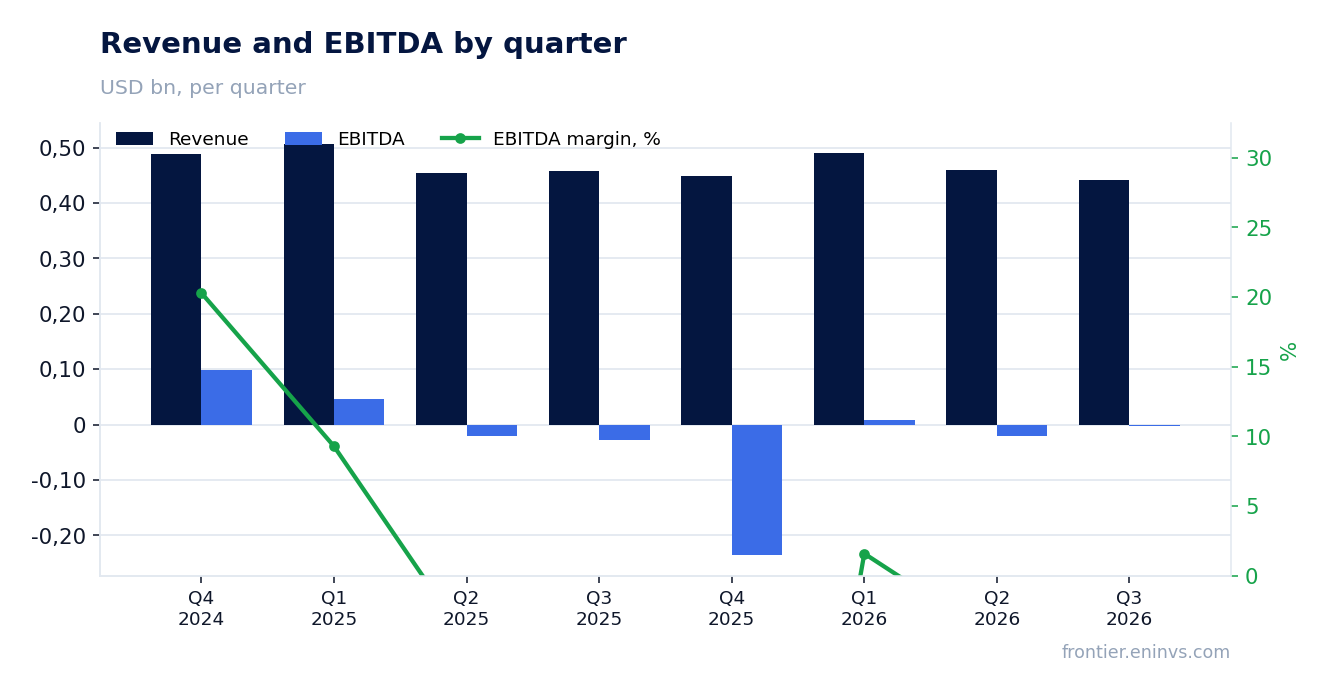
EBITDA stayed negative, and the $25.2 million improvement came from grants and savings, not prices
Adjusted EBITDA in the third quarter of 2026 was minus $2.9 million against minus $28.1 million a year earlier. The $25.2 million improvement looks substantial, but its sources are one-off: costs include $13.0 million of government grants for the Peace River mill, and the One Goal One Hundred programme delivered $22.0 million of savings in the quarter.
The EBITDA margin stayed negative at minus 0.6% versus minus 6.1% a year earlier. The reported quarter's EBITDA included an $8.0 million non-cash inventory impairment versus $20.4 million a year earlier. Without the grants and adjusted for the impairment, the result would have remained deeply negative.
Cost pressure persists: unit fibre costs rose 7% year on year on expensive wood in Germany, and 44 days of planned maintenance downtime cost about $34.1 million of EBITDA. Pulp prices fell in North America and China, while in Europe higher list prices were offset by discounts.
The pulp segment turned EBITDA-positive only thanks to a one-off effect
Pulp segment operating EBITDA was plus $5.9 million against minus $12.7 million a year earlier. The swing came from the same Peace River grants, cost savings and higher energy realisations, partly offset by higher unit fibre costs and lower pulp realisations.
Within the segment, EBITDA included a $7.0 million inventory impairment versus $18.9 million a year earlier. Pulp production fell 11% to 406,519 tonnes on more maintenance days, reduced output in Germany amid expensive fibre and mechanical issues at the Celgar mill.
The solid wood segment stayed negative at minus $7.0 million versus minus $9.3 million a year earlier. The improvement came from higher realisations across products and cost savings, but unit fibre costs rose 15%, and fibre is about 80% of lumber cash production costs.
Free cash flow is negative: $20.0 million operating outflow against $13.3 million of capex
Operating cash flow in the third quarter of 2026 was negative at minus $20.0 million versus minus $30.1 million a year earlier. The outflow forms against a $59.2 million net loss, partly offset by $35.9 million of depreciation and an $11.0 million tax recovery.
Capex was $13.3 million versus $30.0 million a year earlier: the company is deliberately cutting investment to preserve cash. Free cash flow remains negative, and liquidity at September 30, 2026 was about $143.5 million, including $71.0 million of cash.
Interest is the main drain: $32.3 million in the quarter versus $28.5 million a year earlier. With that burden even zero EBITDA cannot service debt from operations, and the company bridges the gap with revolver drawdowns of $25.7 million in the quarter.
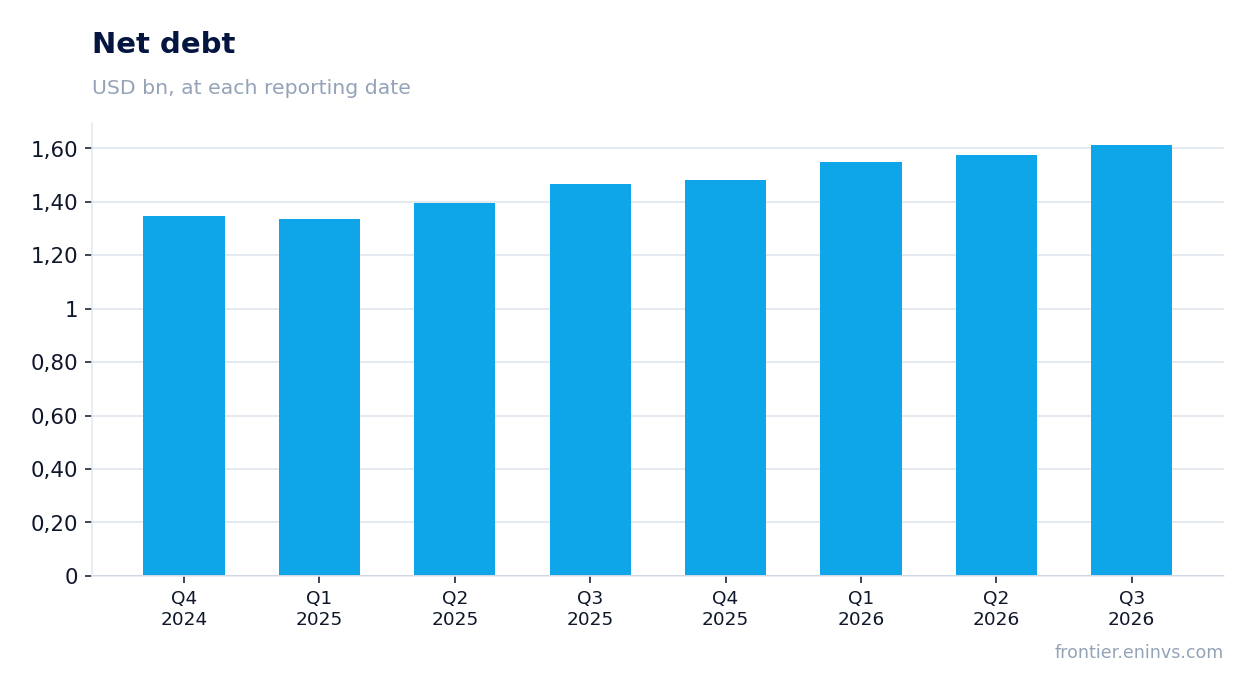
Net debt rose to $1.6 billion, and interest alone consumes $32.3 million a quarter
Net debt at September 30, 2026 was $1.6 billion against $1.6 billion at June 30, 2026, a zero change for the quarter. Over the year, from September 30, 2025, debt rose from $1.5 billion to $1.6 billion, or $0.1 billion.
Shareholders' equity is negative at minus $158.2 million at quarter-end versus plus $68.1 million at end-2025. The accumulated deficit reached $464.2 million, and current debt rose to $354.7 million from $13.7 million at end-2025.
The key event is the recapitalisation announced on November 2, 2026. Agreements with holders of more than 87% of the $1.275 billion senior notes and a majority of shareholders provide for exchanging about $1.1 billion of notes for equity, eliminating about $96 million of annual cash interest and raising $400 million of new capital through a fully backstopped senior secured notes offering.
The $1.275 billion recapitalisation will wipe out equity that is already negative
The plan provides for voluntary prepackaged Chapter 11 cases in the Southern District of Texas for Mercer International Inc. and the non-operating subsidiary Mercer International (Texas) LLC. Operating subsidiaries will continue in the ordinary course with no impact on customers, suppliers and employees, and the company expects to complete the process by the end of 2026.
For shareholders this means dilution: exchanging $1.1 billion of notes for equity against negative shareholders' equity of minus $158.2 million leaves existing holders with a stake in a company already carried below zero on the balance sheet. The $14.8 million market cap reflects an option on closing the deal, not the value of the business.
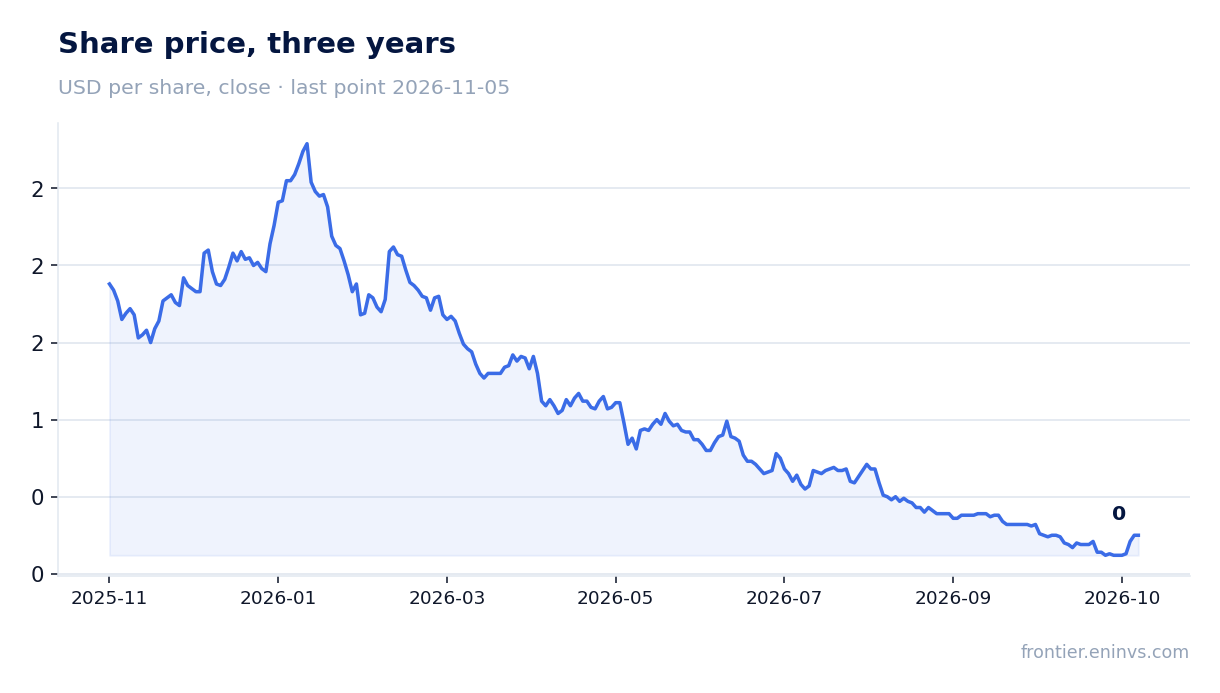
The share closed at $0.25 before the release and did not move on the release day or through November 5, 2026. The market is waiting for the recapitalisation outcome, not quarterly results: without the deal, $1.6 billion of debt against negative cash flow leaves shareholders no value.
Valuation on the latest reported figures
| Metric | Value |
|---|---|
| Market cap | 0.01 bn USD |
| P/B | 0.22 |
| ROE | -232.9% |
Bottom line
The quarter delivered a real narrowing of the loss: EBITDA improved by $25.2 million, the net loss fell to $59.2 million from $80.8 million, and the savings programme delivered $22.0 million. But the improvement rests on one-off grants of $13.0 million and cost cuts rather than a price recovery: revenue fell 3.8%, operating cash flow is negative, and net debt is $1.6 billion. The key question for a holder now is not quarterly momentum but completion of the recapitalisation: exchanging $1.1 billion of notes for equity against negative shareholders' equity of minus $158.2 million leaves existing shareholders only an option on the deal's outcome. The share looks unattractive: value for the shareholder is set by the restructuring terms, not by current multiples.
Open the company's financial profile MERC →
See also: market overview · valuation map · stock screeners