Martin Midstream Partners: revenue up 37.3%, but interest and sulfur carried the quarter
On October 21, Martin Midstream Partners reported third-quarter 2026 results: revenue of $231.7 million (+37.3% year on year), adjusted EBITDA of $23.6 million (+22.7%), and a net loss of $4.1 million versus $8.4 million a year earlier. The loss narrowed, but $14.7 million of interest expense and a weak fertilizer segment kept the bottom line negative. At the current price the unit looks neutral: an EV/EBITDA of 6.15 with net debt at 5.28x EBITDA and a dividend yield below 1% leaves little margin of safety.
Key takeaways
— Revenue rose 37.3% on sulfur products and lubricants, not on terminals
— Adjusted EBITDA grew 22.7%, but the margin compressed to 10.2%
— The net loss narrowed to $4.1 million, and interest of $14.7 million absorbs almost all of it
— Debt at 5.28x EBITDA and the credit facility rate leave little room to manoeuvre
— The $0.005 per unit dividend yields less than 1%
— An EV/EBITDA of 6.15 does not look cheap with negative free cash flow
Attractiveness
Key figures, USD bn
| Metric | Q3 2025 | Q3 2026 | Change |
|---|---|---|---|
| Revenue | 0.17 | 0.23 | +37.3% |
| EBITDA | 0.02 | 0.02 | +22.7% |
| Operating profit | 0.01 | 0.01 | +48.0% |
| Net profit | -0.01 | -0.00 | — |
| Operating cash flow | -0.00 | -0.00 | — |
| Capex | 0.01 | — | — |
| EBITDA margin | 11.4% | 10.2% | -1.2 pp |
| Net margin | -5.0% | -1.8% | +3.2 pp |
Revenue rose 37.3% on sulfur products and lubricants, not on terminals
Third-quarter 2026 revenue was $231.7 million versus $168.7 million a year earlier. Growth accelerated: it was 18.2% in the second quarter and 37.3% now. Almost all of the increase came from two product lines: sulfur product sales rose to $57.4 million from $28.6 million, and specialty product revenue to $89.5 million from $62.4 million.
Terminalling and storage was flat at $25.9 million versus $25.8 million. Transportation added 14% to $61.1 million, but mostly through the marine fleet, while land transportation declined. Service revenue in the sulfur segment grew only 4% to $4.2 million – the effect is entirely in products.
That mix means revenue is sensitive to sulfur prices and lubricant volumes, not to contracted terminal services. Next quarter compares against a higher base: fourth-quarter 2025 revenue was already $174.2 million.
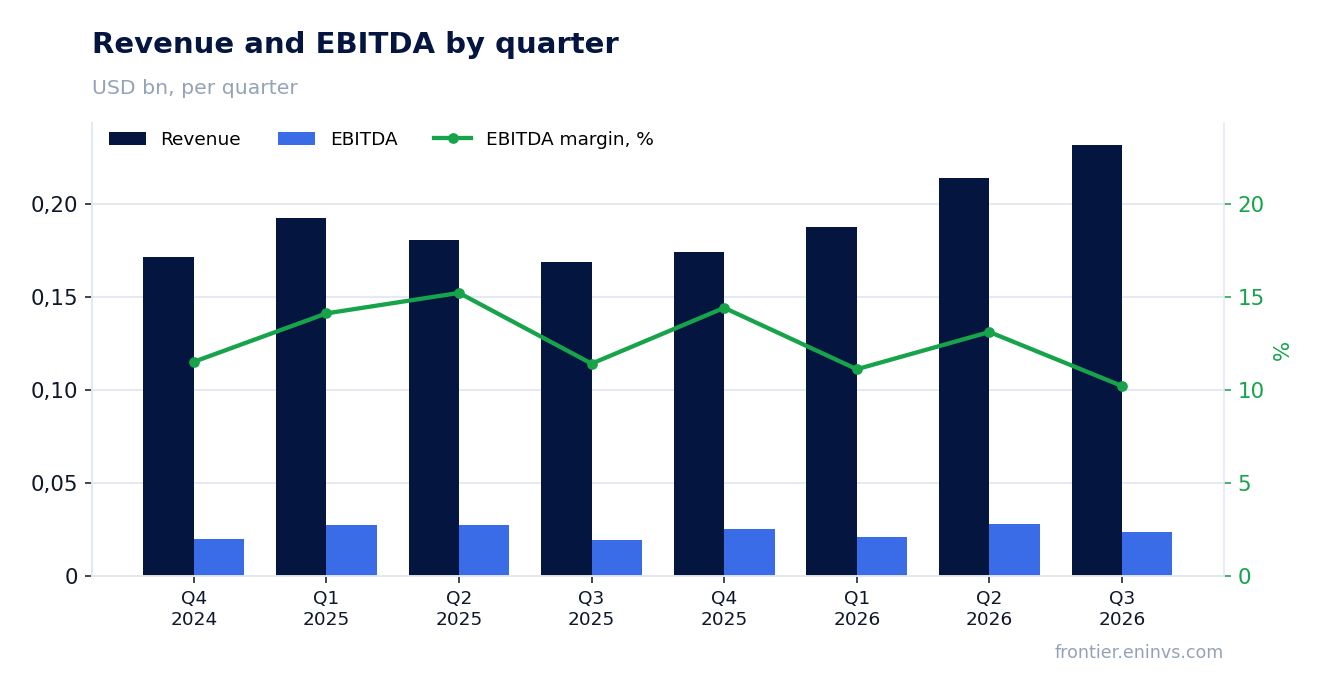
Adjusted EBITDA grew 22.7%, but the margin compressed to 10.2%
Adjusted EBITDA was $23.6 million versus $19.3 million a year earlier. It grew, but slower than revenue: the margin fell to 10.2% from 11.4%. The reason is the mix – lower-margin product lines are growing faster than services.
The segments were uneven. Sulfur delivered $5.8 million versus $3.9 million: pure sulfur added $4.5 million, while fertilizer lost $3.4 million on compressed margins and lower volumes. Specialty products rose to $5.9 million from $3.9 million on lubricants. Terminalling fell to $8.3 million from $9.7 million, and transportation rose to $7.2 million from $5.3 million.
Operating profit was $10.2 million versus $6.9 million. The gap between EBITDA and operating profit is depreciation of $13.1 million, up from $12.3 million. The EBITDA margin is lower than a year ago, which is the main argument against treating the revenue growth as a clean improvement.
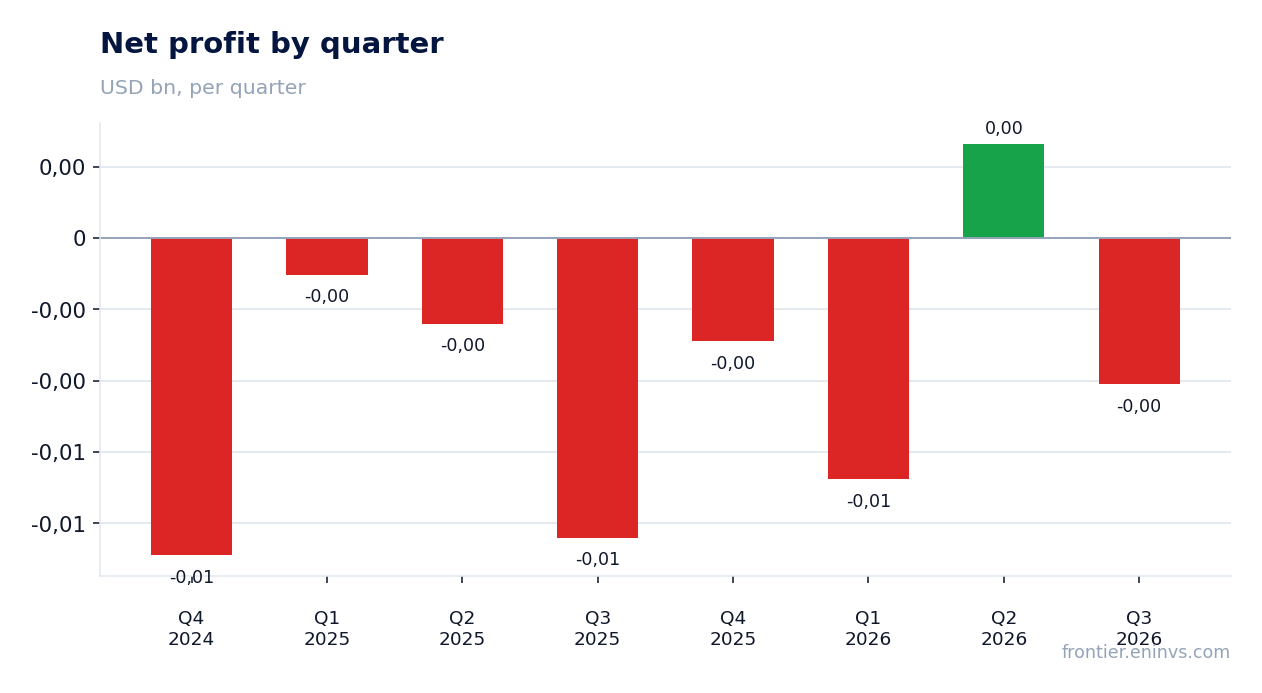
The net loss narrowed to $4.1 million, and interest of $14.7 million absorbs almost all of it
The third-quarter net loss was $4.1 million versus $8.4 million a year earlier. Loss per unit was $0.10 versus $0.21. The improvement came from operating profit, up $3.3 million, and from a tax effect: a $0.6 million benefit this quarter versus a $0.7 million expense a year ago.
Interest expense was almost unchanged at $14.7 million versus $14.6 million. That is more than the entire operating profit. With $483.5 million of debt and an 11.5% coupon on the senior secured notes, interest remains the main constraint on earnings.
Operating cash flow for the quarter was negative at minus $4.9 million versus minus $1.2 million a year earlier. The company attributes this to annual maintenance turnarounds at the fertilizer plants and the semi-annual interest payment on the notes, which temporarily increase revolver borrowings.
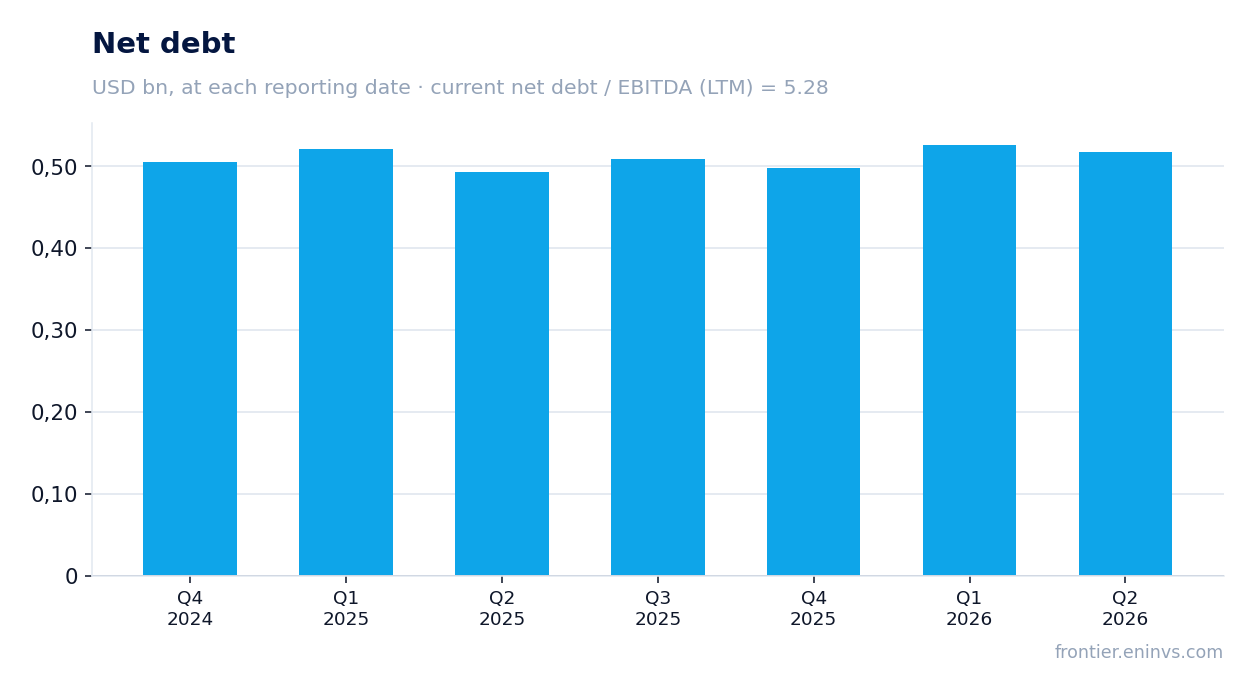
Debt at 5.28x EBITDA and the credit facility rate leave little room to manoeuvre
Net debt at the latest annual balance sheet was $498.4 million, or 5.28x trailing-twelve-month adjusted EBITDA. Total debt at September 30, 2026 was $483.5 million, including $400 million of senior notes and $83.5 million on the revolver. Available liquidity was $21.9 million against a $115 million facility.
The covenant interest coverage ratio is 1.86x and total leverage 4.96x. The company notes the ratio was unchanged from the second quarter as trailing-twelve-month Credit Adjusted EBITDA improved for the second consecutive quarter. The absolute rise in debt from $439.1 million at end-2025 to $483.5 million reflects seasonal borrowings.
Free cash flow is negative: minus $10.1 million for the first nine months of 2026 after capital spending, turnarounds and the investment in the DSM Semichem joint venture. Until cash flow turns positive, debt reduction depends on EBITDA growth.
The $0.005 per unit dividend yields less than 1%
A dividend of $0.005 per unit was declared for the third quarter of 2026, payable November 13, 2026. At a price of $2.05 the yield is about 0.94%. It is a token payment: $0.6 million went to distributions over nine months against negative free cash flow of $10.1 million.
Our estimate for the current year is that the quarterly payment stays at $0.005, or about $0.02 annually. It rests not on profit, which is absent, but on the minimum payout the company can afford at current debt. Everything left after interest and turnarounds goes to maintaining infrastructure.
The yield is below the key rate and below what we consider fair for a company with leverage above 5x. A further cut could come from continued pressure on fertilizer or higher capital spending: the company has already raised its 2026 capex estimate on higher labour and material costs.
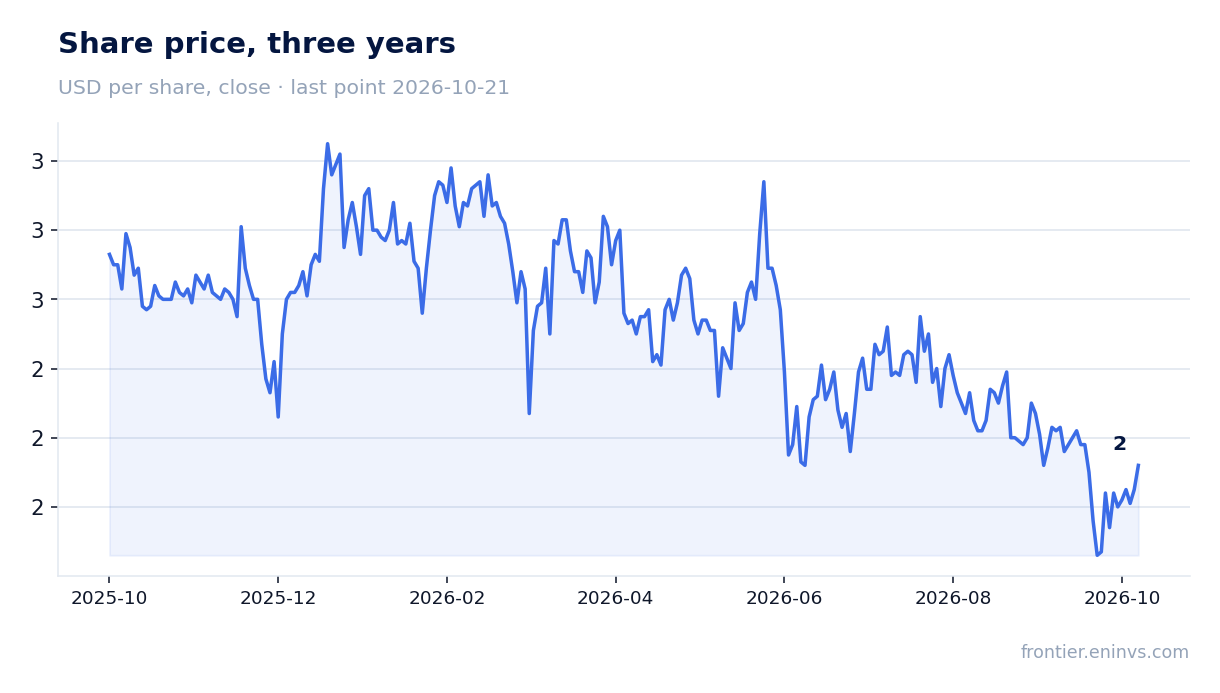
An EV/EBITDA of 6.15 does not look cheap with negative free cash flow
EV/EBITDA on a trailing-twelve-month basis is 6.15. Return on equity is 5.9%. With a market capitalisation of $82.4 million and net debt of $498.4 million, the enterprise is worth about $580.8 million, nearly seven times equity. The multiple itself is not high, but it rests on EBITDA that does not convert into free cash flow.
We cannot compare it with its own three-year history: the facts contain no three-year average. Even without it, negative free cash flow of $10.1 million over nine months and interest expense of $43.1 million over the same period leave no room for a premium.
The price closed at $2.05 before the release, rose 3.4% on the day and has held that level since. The reaction was muted: the market saw EBITDA growth but neither profit nor positive cash flow.
Valuation on the latest reported figures
| Metric | Value |
|---|---|
| Market cap | 0.08 bn USD |
| EV/EBITDA (LTM) | 6.2 |
| Net debt / EBITDA (LTM) | 5.28 |
| Operating cash flow (LTM) | 0.02 bn |
| ROE | 5.9% |
| Dividend yield (12m) | 0.9% |
Bottom line
The strong side of the report is sulfur and lubricants: they delivered almost all of the EBITDA growth, and without them the quarter would have been noticeably weaker. The weak side is fertilizer and terminals, plus interest expense that absorbs all of operating profit. Revenue rose 37.3%, but the margin fell to 10.2% and free cash flow stayed negative. At 6.15x EV/EBITDA and a dividend yield below 1%, the unit is fairly valued but without a cushion. Verdict: neutral – an improvement needs sustained EBITDA growth in sulfur and lubricants and at least zero free cash flow.
Open the company's financial profile MMLP →
See also: market overview · valuation map · stock screeners