SSR Mining: revenue accelerated to +16.0%, but costs are eating the cash flow
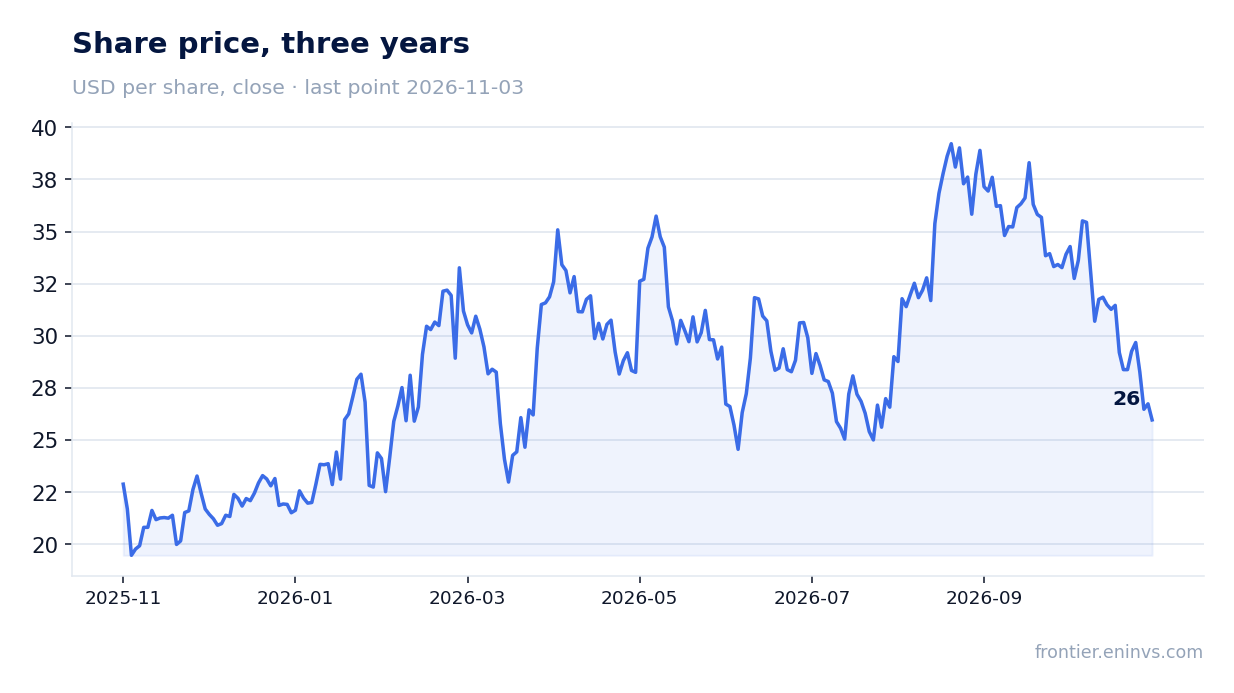
On November 3, SSR Mining reported third-quarter 2026 results. Revenue came in at $447.7 million (+16.0% year on year), EBITDA at $156.0 million (+39.8%), and net profit at $79.9 million (+22.1%). Revenue growth accelerated from the second quarter (+9.5%), but free cash flow was almost nil at $5.8 million, and all-in sustaining costs are trending roughly 10% above the upper end of full-year guidance. At an EV/EBITDA of 4.0 and with net cash of $1.6 billion, the share looks rather attractive – but only if costs are brought back into the guided range.
Key takeaways
— Revenue accelerated to +16.0% on the back of an average realised gold price of $4,247 per ounce
— EBITDA rose 39.8% as the margin reached 34.8% versus 28.9% a year earlier
— Net profit of $79.9 million includes a $14.9 million loss from discontinued operations
— Free cash flow almost vanished: $5.8 million against capital expenditure of $100.2 million
— Net cash position of $1.6 billion with no long-term debt outstanding
— All-in sustaining costs of $2,527 per ounce are trending roughly 10% above the upper end of guidance
— A dividend of $0.03 per share was declared, a yield of 0.11%
Attractiveness
Key figures, USD bn
| Metric | Q3 2025 | Q3 2026 | Change |
|---|---|---|---|
| Revenue | 0.39 | 0.45 | +16.0% |
| EBITDA | 0.11 | 0.16 | +39.8% |
| Operating profit | 0.08 | 0.12 | +46.6% |
| Net profit | 0.07 | 0.08 | +22.1% |
| Operating cash flow | 0.06 | 0.09 | +61.1% |
| Capex | 0.06 | 0.10 | +68.2% |
| EBITDA margin | 28.9% | 34.8% | +5.9 pp |
| Net margin | 17.0% | 17.8% | +0.8 pp |
Revenue accelerated to +16.0% on the back of an average realised gold price of $4,247 per ounce
Third-quarter revenue came in at $447.7 million, up 16.0% year on year. That is an acceleration from the second quarter, when growth was 9.5%. The price did the heavy lifting: the average realised gold price rose to $4,247 per ounce from $3,503 a year earlier, while silver sold at $58.39 per ounce versus $41.92.
In volume terms, output barely moved: 103,585 gold-equivalent ounces versus 102,673 a year earlier. Gold sales were 76,923 ounces and silver sales 1.87 million ounces. In other words, all of the revenue increase came from prices, not volumes.
For the nine months, revenue reached $1,473.2 million against $1,107.9 million a year earlier. The company reaffirmed full-year production guidance of 450,000–535,000 gold-equivalent ounces and expects a strong fourth quarter.
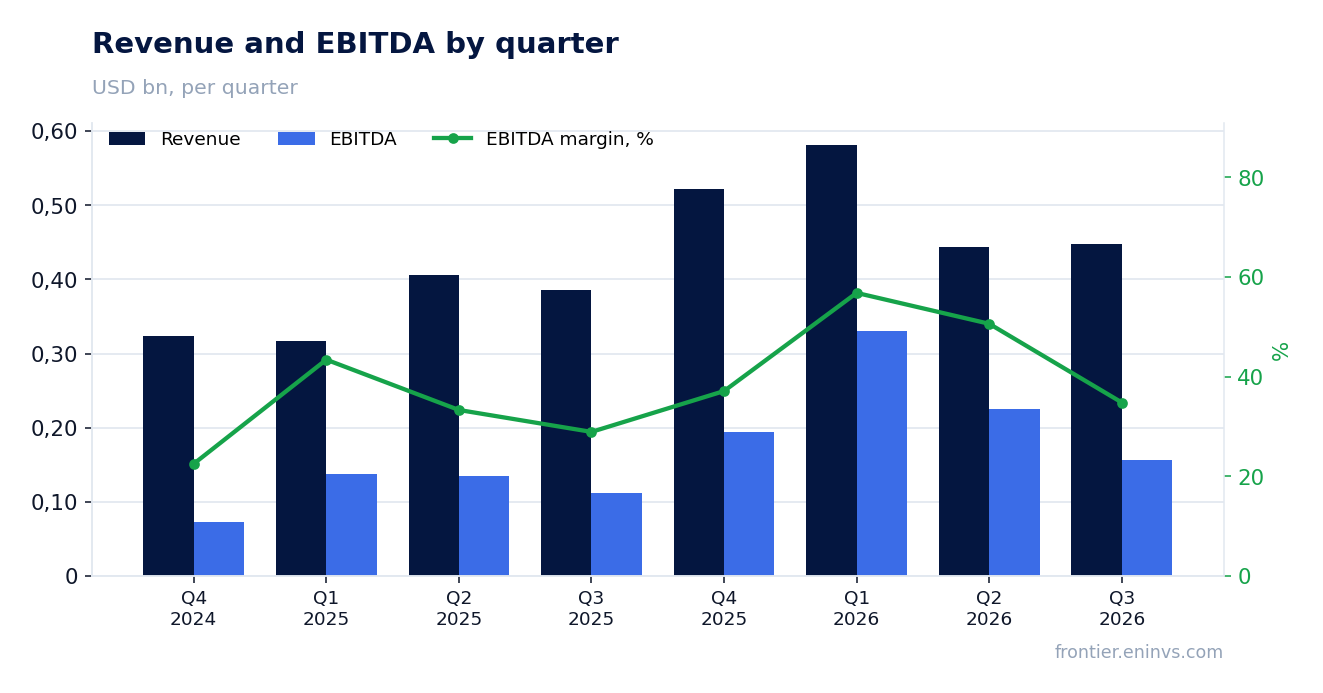
EBITDA rose 39.8% as the margin reached 34.8% versus 28.9% a year earlier
Third-quarter EBITDA reached $156.0 million, up 39.8% year on year. The EBITDA margin rose to 34.8% from 28.9%. Operating profit was $122.1 million.
The margin expansion came from prices rather than cost cuts: cost of sales per gold-equivalent ounce rose to $1,755 from $1,585, and all-in sustaining costs (AISC) climbed to $2,527 from $2,114. Price growth outpaced cost growth, and that was enough to widen the margin.
For the nine months, AISC was $2,523 per ounce. The company explicitly warned that the full-year figure will trend roughly 10% above the upper end of guidance because of higher royalties, diesel prices and cost inflation in Argentina.
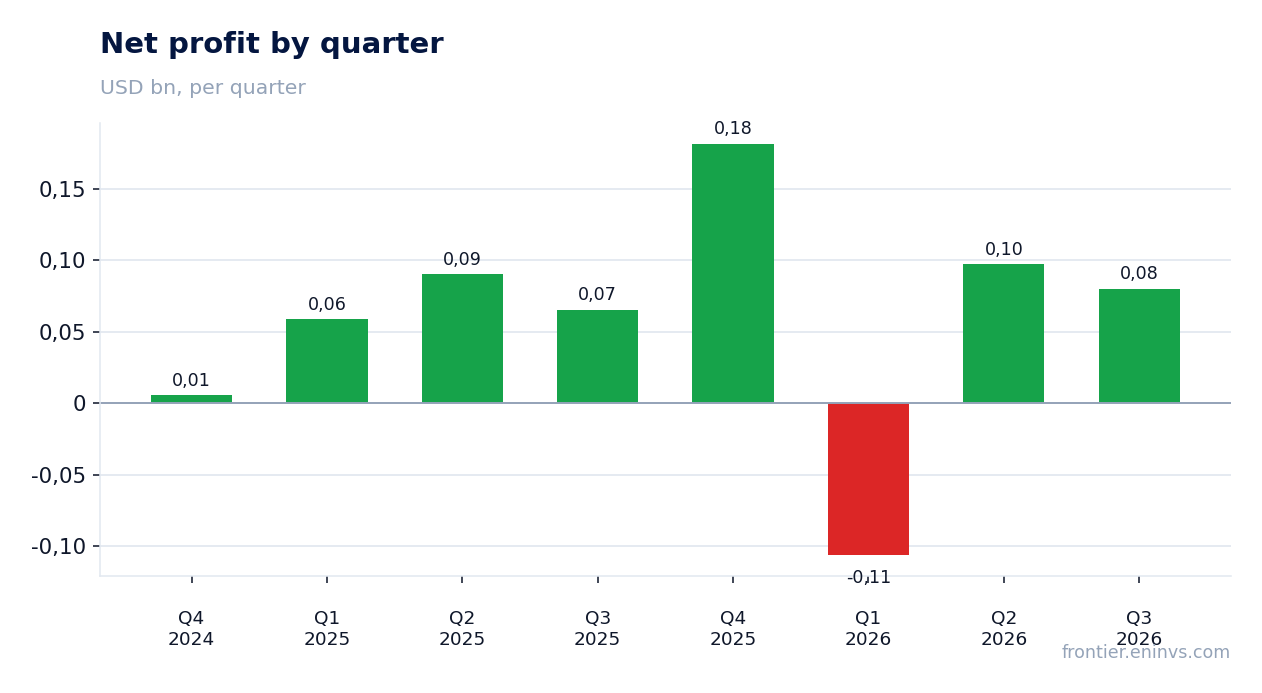
Net profit of $79.9 million includes a $14.9 million loss from discontinued operations
Net profit was $79.9 million, up 22.1% year on year. But inside that figure sits a $14.9 million loss from discontinued operations tied to the Turkish assets. Profit from continuing operations was $94.8 million, and that is what reflects the current business.
Adjusted net profit from continuing operations was $130.7 million, or $0.64 per diluted share. The gap to GAAP profit is $35.9 million, mainly share-based compensation expense of $23.0 million and other adjustments.
The net margin rose to 17.8% from 17.0%. The increase is modest because profit from continuing operations barely changed – $94.8 million versus $93.9 million a year earlier – and the entire GAAP profit increase is explained by a smaller loss from discontinued operations.
Free cash flow almost vanished: $5.8 million against capital expenditure of $100.2 million
Operating cash flow from continuing operations was $106.0 million, almost unchanged from $105.9 million a year earlier. But capital expenditure rose to $100.2 million from $59.6 million, and free cash flow shrank to $5.8 million.
Operating cash flow before working-capital changes was $211.0 million, and free cash flow before working-capital changes was $110.8 million. The gap between those figures and the final free cash flow is the working-capital outflow and higher capex.
For the nine months, operating cash flow was $526.5 million and free cash flow $304.9 million. The company attributes the capex increase to the Buffalo Valley, Cortaderas and Porky projects and to construction at Marigold. It is capital expenditure, not operations, that is consuming the cash flow.
Net cash position of $1.6 billion with no long-term debt outstanding
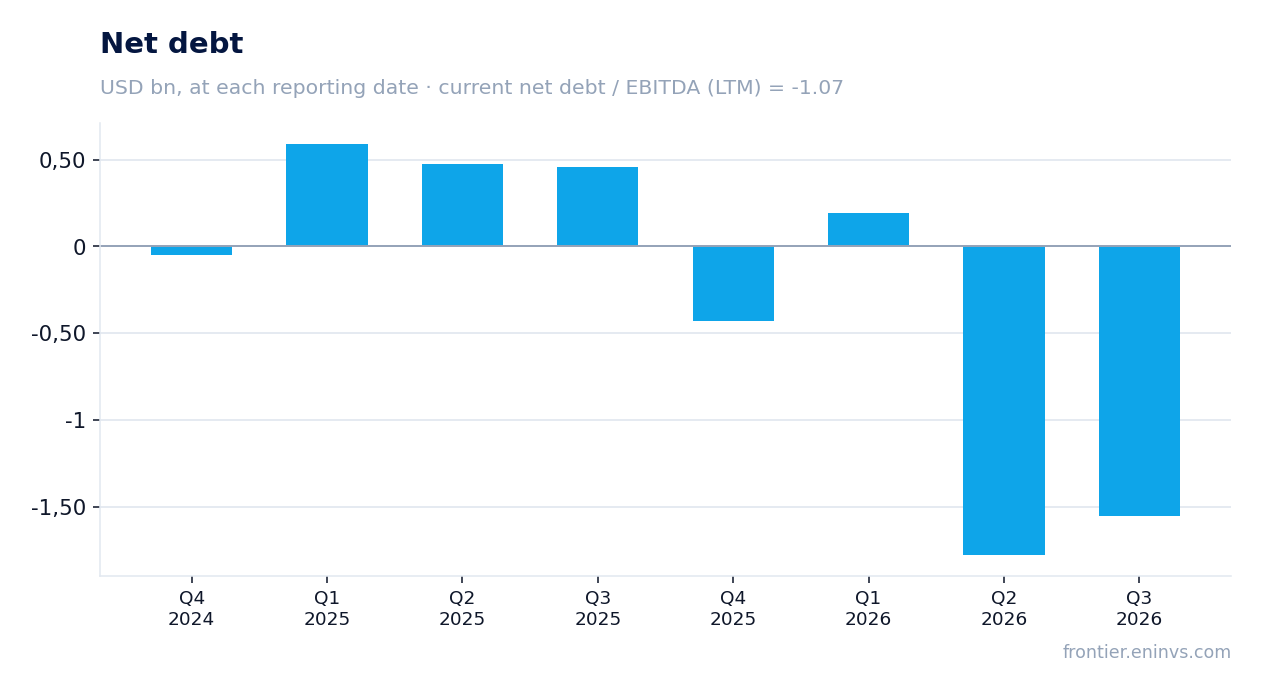
As of September 30, 2026, cash and equivalents stood at $1,554.8 million, with no long-term debt. The net cash position is $1,554.8 million, or minus $1.6 billion in the usual sign convention. Net debt to trailing-twelve-month EBITDA is minus 1.07.
Over the quarter, net debt moved from minus $1.8 billion on June 30, 2026 to minus $1.6 billion on September 30, a change of plus $0.2 billion. Over twelve months it moved from plus $0.5 billion on September 30, 2025 to minus $1.6 billion, a change of minus $2.0 billion. The improvement came from the sale of the Hod Maden stake and the Çöpler mine.
Total liquidity, including the undrawn $600 million credit facility, is $2.2 billion. That cushion allows the company to fund capital expenditure and buybacks without raising debt.
All-in sustaining costs of $2,527 per ounce are trending roughly 10% above the upper end of guidance
Third-quarter AISC was $2,527 per gold-equivalent ounce versus $2,114 a year earlier. The company stated plainly that the full-year figure will trend roughly 10% above the upper end of guidance. The reasons given are higher royalties, diesel price pressure and inflation in labour and materials.
At Puna, the company deferred processing of lower-cost stockpiled ore to extend the mine life, and that, together with inflation in Argentina, pushed AISC at the silver asset to $25.64 per ounce from $13.54 a year earlier. At Marigold, AISC was $2,714 per ounce versus $1,840; at Seabee, $2,094 versus $3,003; at CC&V, $2,126 versus $1,756.
Rising costs are the main risk to profit and cash flow. If gold prices stay at current levels and costs do not return to the guided range, the margin will compress as early as the fourth quarter.
A dividend of $0.03 per share was declared, a yield of 0.11%
The board declared a quarterly dividend of $0.03 per share, payable on December 11, 2026. The trailing-twelve-month yield is 0.11%. This is a token payment, not the main channel of capital return.
The main channel is buybacks: in the third quarter the company repurchased 6.2 million shares for $193.6 million, and over nine months 16.6 million shares for more than $530 million. The company estimates total capital returned to shareholders over nine months at an effective yield of about 10%.
Our estimate for the current year's dividend is the same $0.03 per quarter, or about $0.12 per share, if the board keeps the policy. The payment rests on profit from continuing operations and does not require debt. A fall in gold prices or further cost growth could cut it, but with a net cash position of $1.6 billion the risk is small.
Valuation on the latest reported figures
| Metric | Value |
|---|---|
| Market cap | 5.18 bn USD |
| P/E (LTM) | 20.6 |
| EV/EBITDA (LTM) | 4.0 |
| P/B | 1.20 |
| Net debt / EBITDA (LTM) | -1.07 |
| Operating cash flow (LTM) | 0.63 bn |
| ROE | 9.6% |
| Dividend yield (12m) | 0.1% |
Bottom line
The strong part of the report was revenue growth to $447.7 million and EBITDA to $156.0 million at a 34.8% margin. But the increase came entirely from gold prices rather than volumes, and free cash flow almost vanished because of $100.2 million in capital expenditure. Net cash of $1.6 billion and no debt provide a cushion, but costs are already 10% above guidance. The question for a holder now is whether costs return to the guided range and whether the gold price holds. At an EV/EBITDA of 4.0 and 6% upside on the portal's model, the share looks rather attractive.
Open the company's financial profile SSRM →
See also: market overview · valuation map · stock screeners