Var Energi: revenue up 66.6%, but almost all of it went to EBITDA, not profit
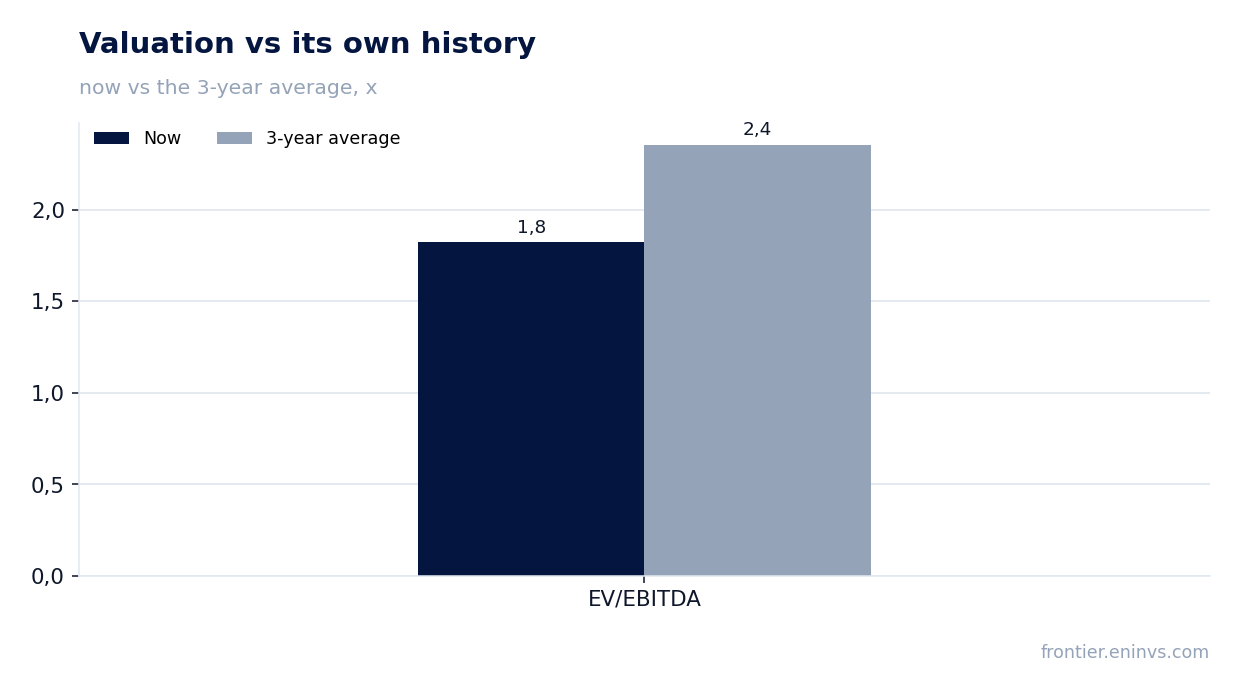
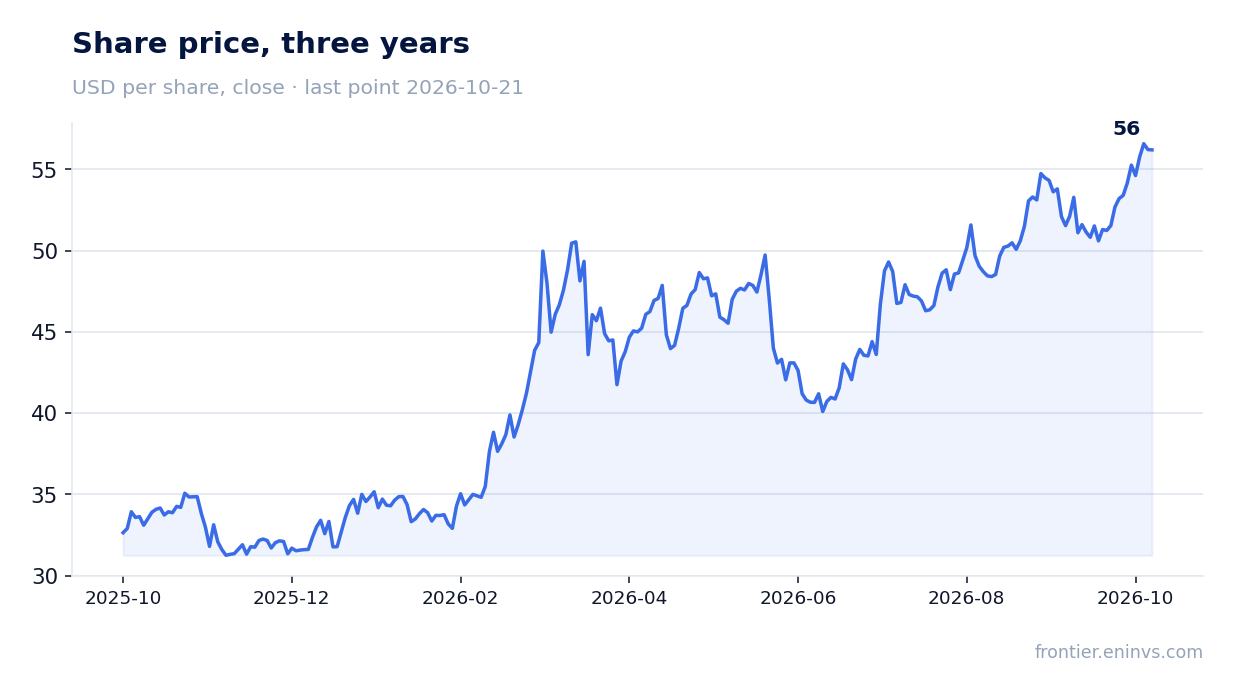
On 30 September 2026, Var Energi reported results for the third quarter of 2026. Revenue was USD 3,566.5 million, EBITDA – USD 3,032.3 million, net profit – USD 293.2 million. Revenue grew 66.6% year on year, EBITDA – 56.8%, net profit – 93.3%. At the same time, the EBITDA margin fell to 85.0% from 90.3% a year earlier, and the net margin remained low at 8.2%. Leverage is low: net debt of USD 3,110.3 million, net debt/EBITDA for the last twelve months – 0.28. On an EV/EBITDA multiple of 1.8, the share is cheaper than its own three-year average of 2.4, and the trailing twelve-month dividend yield is 8.6%. On the portal's model, the upside to fair value is +33%. Given the cheap valuation, low leverage and high dividend yield, the share looks attractive, although the weak net margin and the decline in the EBITDA margin hold back the rating.
Key takeaways
— Revenue grew 66.6% year on year to USD 3,566.5 million, but growth decelerated from 102.7% in the second quarter
— EBITDA added 56.8% to USD 3,032.3 million, but its margin fell to 85.0% from 90.3%
— Net profit rose 93.3% to USD 293.2 million, while the net margin remained low at 8.2%
— Net debt fell from USD 5.1 billion on 30 September 2025 to USD 3.1 billion on 30 September 2026
— The trailing twelve-month dividend yield is 8.6%, above the yield on most debt instruments
— At EV/EBITDA of 1.8, the share trades below its own three-year average of 2.4, i.e. cheaper than its own history
— On the portal's model, the upside to fair value is +33%
Attractiveness
Key figures, USD bn
| Metric | Q3 2025 | Q3 2026 | Change |
|---|---|---|---|
| Revenue | 2.14 | 3.57 | +66.6% |
| EBITDA | 1.93 | 3.03 | +56.8% |
| Operating profit | 1.07 | 2.21 | +106.7% |
| Net profit | 0.15 | 0.29 | +93.3% |
| Operating cash flow | 1.23 | 1.52 | +23.0% |
| EBITDA margin | 90.3% | 85.0% | -5.3 pp |
| Net margin | 7.1% | 8.2% | +1.1 pp |
Revenue grew 66.6% year on year to USD 3,566.5 million, but growth decelerated from 102.7% in the second quarter
In the third quarter of 2026, Var Energi's revenue was USD 3,566.5 million, up 66.6% from a year earlier. That is a strong result, but it is more modest than the 102.7% growth in the second quarter. The deceleration is explained primarily by the high base: in the second quarter of last year revenue was low, and the base effect was stronger.
A sequential comparison shows that revenue in the third quarter was almost unchanged from the second quarter of 2026, when it was USD 3,704.8 million. This suggests that the main growth came in the first half of the year, and in the third quarter the company reached a plateau.
Oil and gas prices and production volumes matter for the future dynamics. These factors are not disclosed in the report, so it is premature to draw conclusions about the causes of the deceleration. However, the very fact of decelerating revenue growth is a signal that the momentum of the first half of the year may be fading.
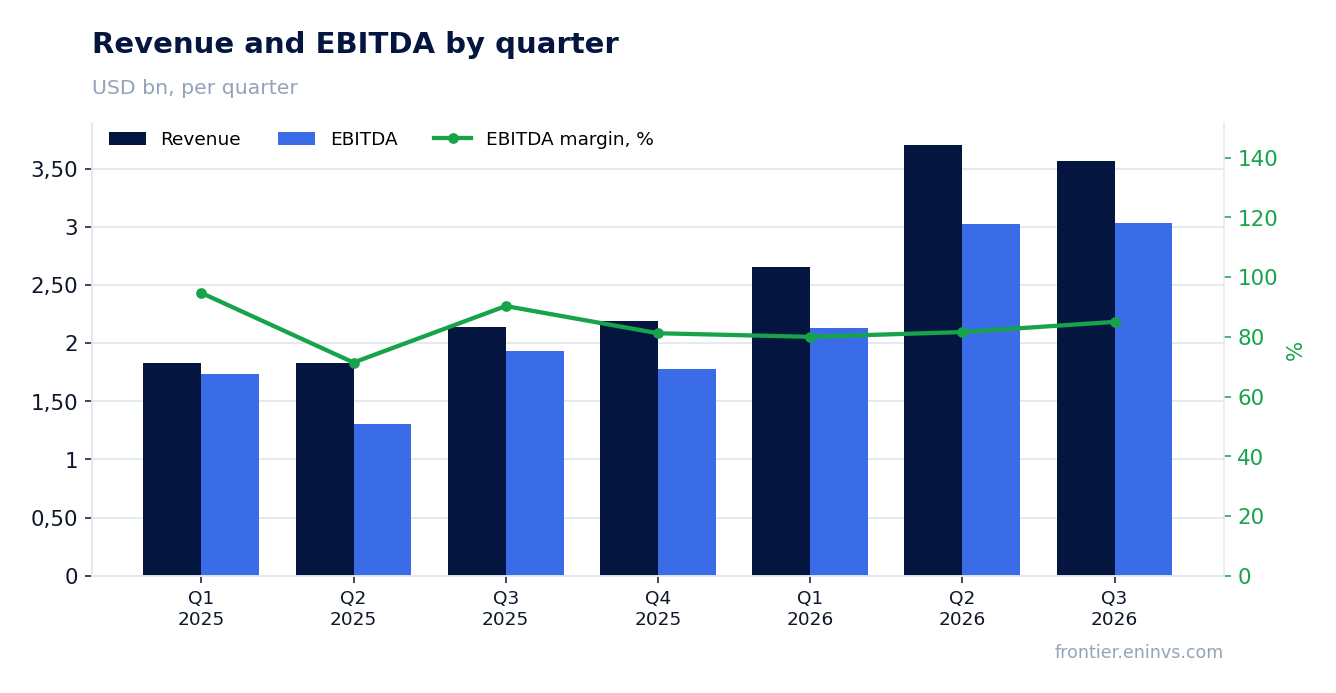
EBITDA added 56.8% to USD 3,032.3 million, but its margin fell to 85.0% from 90.3%
EBITDA in the third quarter of 2026 was USD 3,032.3 million, up 56.8% from a year earlier. EBITDA growth lags revenue growth, and this led to a decline in the EBITDA margin to 85.0% from 90.3% in the third quarter of 2025.
A 5.3 percentage point decline in the margin means costs grew faster than revenue. The report does not disclose which costs increased, but with such a high base any change in the cost structure has a noticeable effect on the margin. Operating expenses or royalties may have risen, but there is no confirmation in the facts.
For the investor, it is important that even with the margin decline, EBITDA remains very high at 85.0%. This is still one of the highest margins in the industry, indicating low production costs. However, the downward trend in the margin may continue if commodity prices remain under pressure.
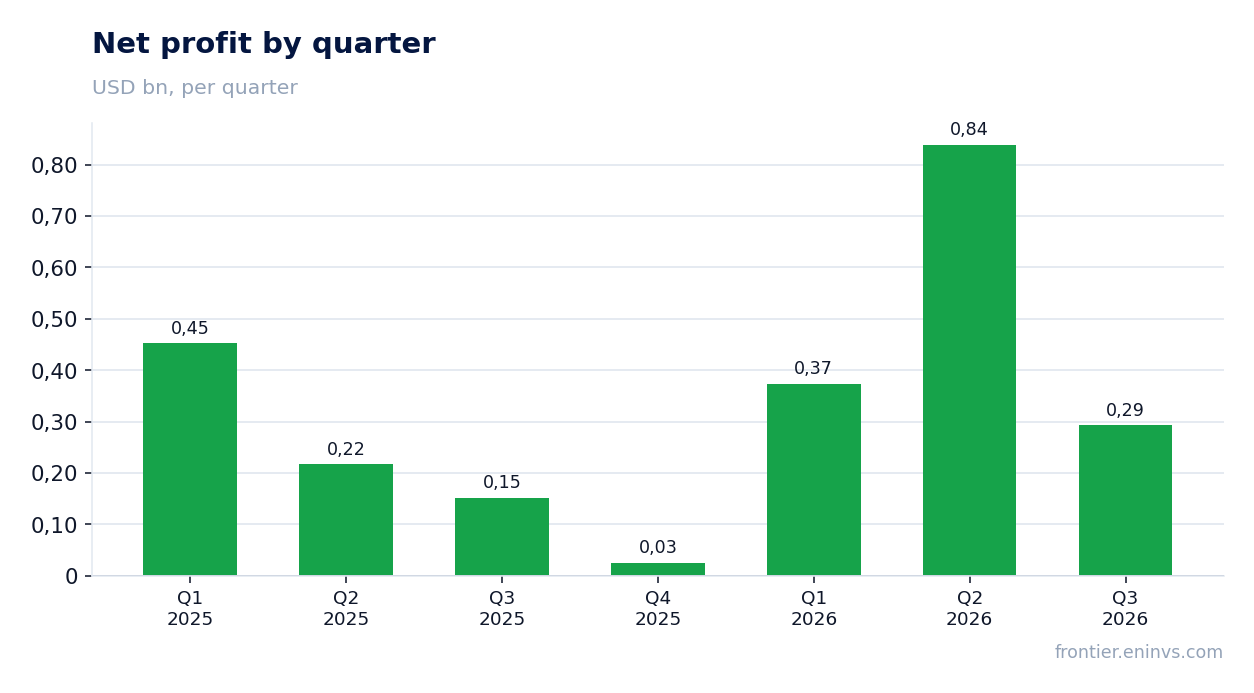
Net profit rose 93.3% to USD 293.2 million, while the net margin remained low at 8.2%
Net profit in the third quarter of 2026 was USD 293.2 million, up 93.3% from a year earlier. Profit growth is almost double revenue growth, which is due to the low base effect: in the third quarter of 2025 net profit was only USD 151.7 million.
The net margin in the reporting quarter was 8.2% versus 7.1% a year earlier. Despite the improvement, the margin remains low: out of USD 3,566.5 million of revenue, only USD 293.2 million reaches net profit. The main reason is high depreciation, interest expenses and taxes, which are not visible in EBITDA.
Net profit growth of 93.3% looks impressive, but it was achieved mainly due to the low base of the previous year. In absolute terms, profit remains small relative to revenue, and this limits the company's ability to increase dividends.
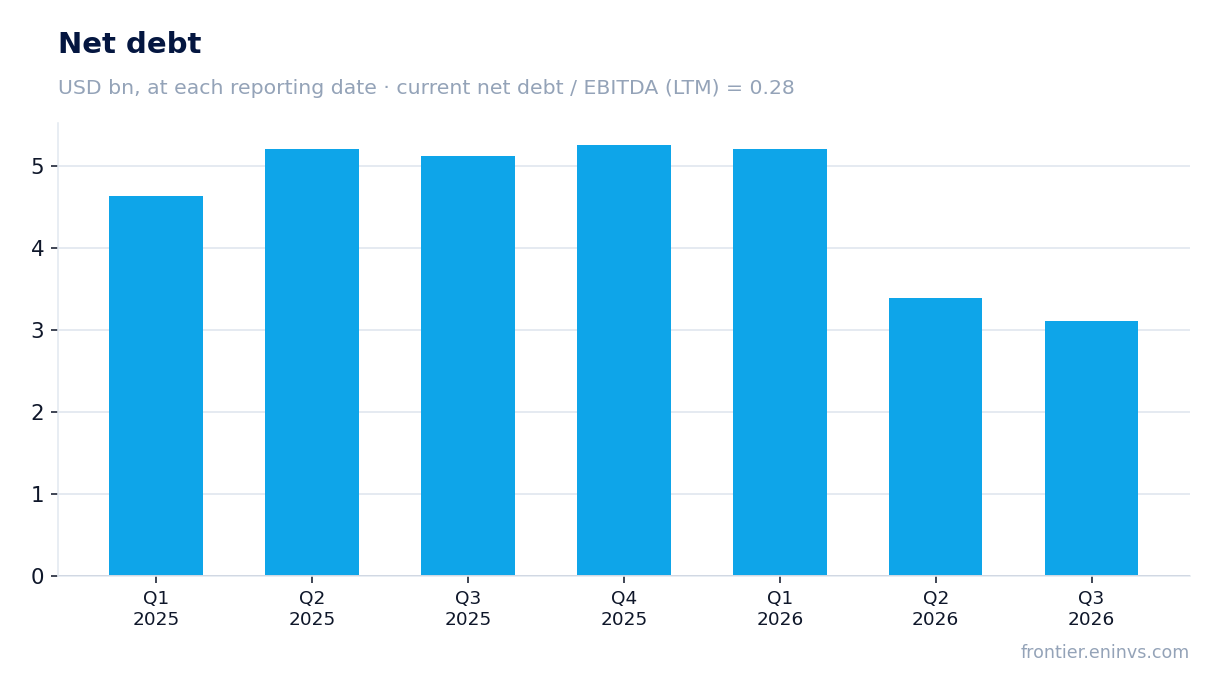
Net debt fell from USD 5.1 billion on 30 September 2025 to USD 3.1 billion on 30 September 2026
Var Energi's net debt as of 30 September 2026 was USD 3,110.3 million. A year earlier, on 30 September 2025, it was USD 5.1 billion, i.e. it fell by USD 2.0 billion over 12 months. The reduction in debt occurred against the backdrop of revenue and EBITDA growth, which allowed the company to allocate part of the funds to repay obligations.
The ratio of net debt to EBITDA for the last twelve months is 0.28. This is a very low level, indicating high financial stability. For comparison, many companies in the industry have this ratio above 1.0. Low leverage gives Var Energi a margin of safety and the ability to maintain high dividends.
Operating cash flow in the third quarter of 2026 was USD 1,517.9 million. This is more than enough to service debt and finance capital expenditures. Combined with low debt, this creates comfortable conditions for paying dividends.
The trailing twelve-month dividend yield is 8.6%, above the yield on most debt instruments
Var Energi's trailing twelve-month dividend yield is 8.6%. This is a high figure, exceeding the yield on most debt instruments and the average market yield. The company pays dividends regularly, and their size is significant for investors.
Our estimate of the dividend for the current year is based on trailing twelve-month profit (USD 1,530.9 million) and the payout ratio. If the company maintains the current level of payments, the dividend yield will remain near 8.6%. However, payments depend on profit, which was low in the third quarter – USD 293.2 million. This creates a risk that the dividend may be cut if profit does not recover.
The high dividend yield is one of the main arguments in favour of investing in Var Energi. But the sustainability of the dividend depends on the company's ability to generate profit. With a net margin of 8.2% and volatile commodity prices, dividend payments may be under pressure.
At EV/EBITDA of 1.8, the share trades below its own three-year average of 2.4, i.e. cheaper than its own history
Var Energi's EV/EBITDA multiple for the last twelve months is 1.8. This is 23% below the company's three-year average of 2.4. Thus, the share trades cheaper than on average over the last three years. This may be due to both the general decline in energy prices and the market's concerns about profit sustainability.
For comparison, the trailing twelve-month P/E is 9.8. This is a moderate level that does not look overheated. The combination of low EV/EBITDA and moderate P/E indicates that the market values the company conservatively.
On the portal's model, which reprices EBITDA at current commodity prices and the target EV/EBITDA, the upside to fair value is +33%. This is our own estimate, not a market consensus. It shows that at current commodity prices the share may be undervalued.
On the portal's model, the upside to fair value is +33%
Our model values Var Energi's fair value based on current commodity prices and the target EV/EBITDA multiple. According to the calculation, the upside to the current market price is +33%. This means that if current commodity prices persist, the share could rise by a third.
The model is sensitive to oil and gas prices. If prices fall, fair value will decrease and the upside will shrink. If prices rise, the upside will increase. The model also depends on the chosen target multiple: we use the current EV/EBITDA level, which is below the historical average.
The 33% upside is not a guarantee but an estimate. It shows that the market may be undervaluing the company, but catalysts are needed to realise this potential: rising commodity prices, improved profit or a revision of the dividend policy.
Valuation on the latest reported figures
| Metric | Value |
|---|---|
| Market cap | 15.0 bn USD |
| P/E (LTM) | 9.8 |
| EV/EBITDA (LTM) | 1.8 |
| P/B | 26.86 |
| Net debt / EBITDA (LTM) | 0.28 |
| Operating cash flow (LTM) | 5.94 bn |
| ROE | 20.1% |
| Dividend yield (12m) | 8.6% |
| EV/EBITDA, 3-year average | 2.4 |
Bottom line
Var Energi showed strong revenue and EBITDA growth in the third quarter of 2026, but growth decelerated from the second quarter and the EBITDA margin declined. Net profit almost doubled but remains low relative to revenue. The company has low leverage (0.28 to EBITDA) and a high dividend yield (8.6%). The EV/EBITDA valuation is below its historical average, and the portal's model points to a 33% upside. Given these factors, the share looks attractive, but the weak net margin and decelerating revenue growth are the main risks.
Open the company's financial profile VAR →
See also: market overview · valuation map · stock screeners