Shinhan Financial Group: quarterly profit rose 9.1%, but net interest income collapsed 99.4%
Shinhan Financial Group's third-quarter 2026 results reveal a divergence: net profit rose 9.1% year-on-year to KRW 1,584.6bn, while net interest income collapsed 99.4% to KRW 18.6bn. Over the trailing twelve months, profit reached KRW 4,035.4bn and return on equity stood at 11.9%. At the current price, the shares look rather attractive: P/E of 10.1, dividend yield of 3.3%, and a +16% upside on the portal's model.
Key takeaways
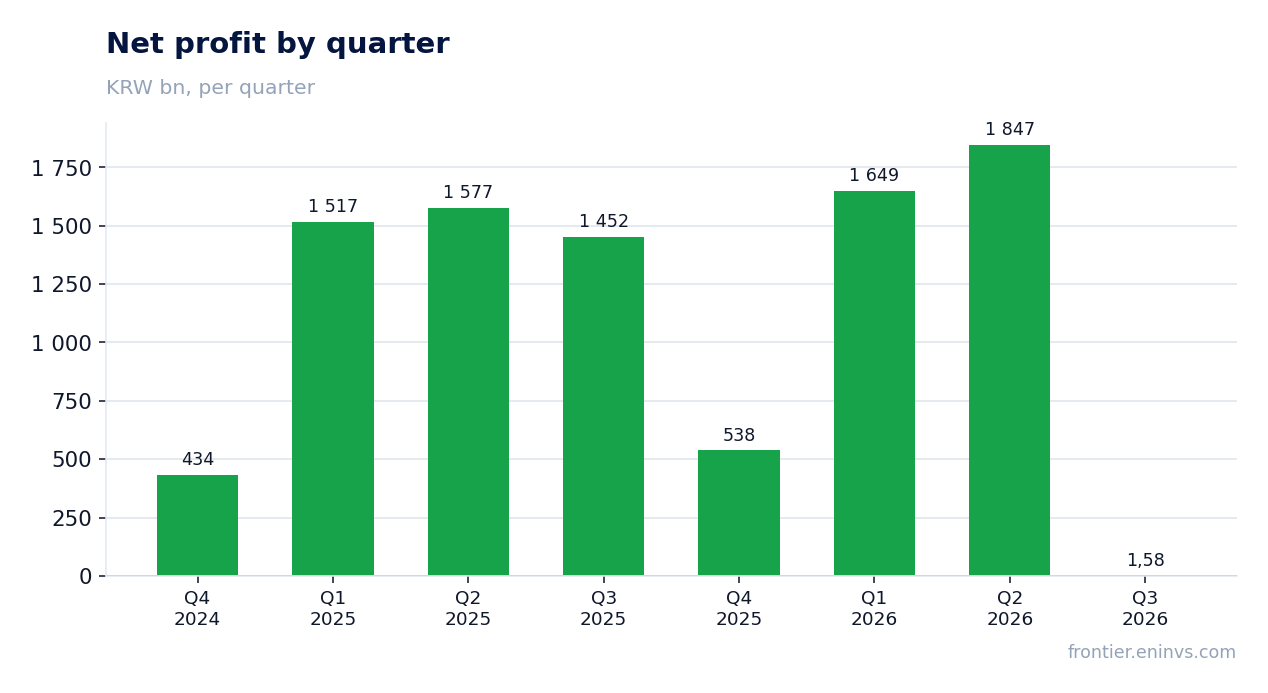
— Net profit rose 9.1% year-on-year to KRW 1,584.6bn in Q3, but relies on non-operating items rather than core business
— Net interest income collapsed 99.4% year-on-year to KRW 18.6bn, signalling a one-off breakdown in interest margin
— Over the trailing twelve months, profit reached KRW 4,035.4bn with return on equity of 11.9%
— Dividend yield of 3.3% with a payout ratio that may be under pressure from profit volatility
— P/E of 10.1 and +16% upside on the portal's model point to undervaluation relative to its own history
— Top-line growth decelerated from +9.4% in Q2 to -99.4% in Q3, requiring scrutiny of business model resilience
Attractiveness
Key figures, KRW bn
| Metric | Q3 2025 | Q3 2026 | Change |
|---|---|---|---|
| Net interest income | 2 948 | — | — |
| EBITDA | 2 267 | — | — |
| Operating profit | 1 955 | — | — |
| Net profit | 1 452 | 1 585 | +9.1% |
| Capex | 128 | — | — |
| EBITDA margin | 76.9% | — | — |
| Net margin | 49.3% | — | — |
Net profit rose 9.1% year-on-year to KRW 1,584.6bn in Q3, but relies on non-operating items rather than core business
Shinhan Financial Group's net profit for Q3 2026 came in at KRW 1,584.6bn, up 9.1% from a year earlier. However, this growth looks deceptive against the collapse in net interest income: the core banking business effectively stopped generating revenue.
Profit was supported by one-off factors that will not recur next quarter. Without them, the result would have been significantly weaker, and the sustainability of earnings is questionable.
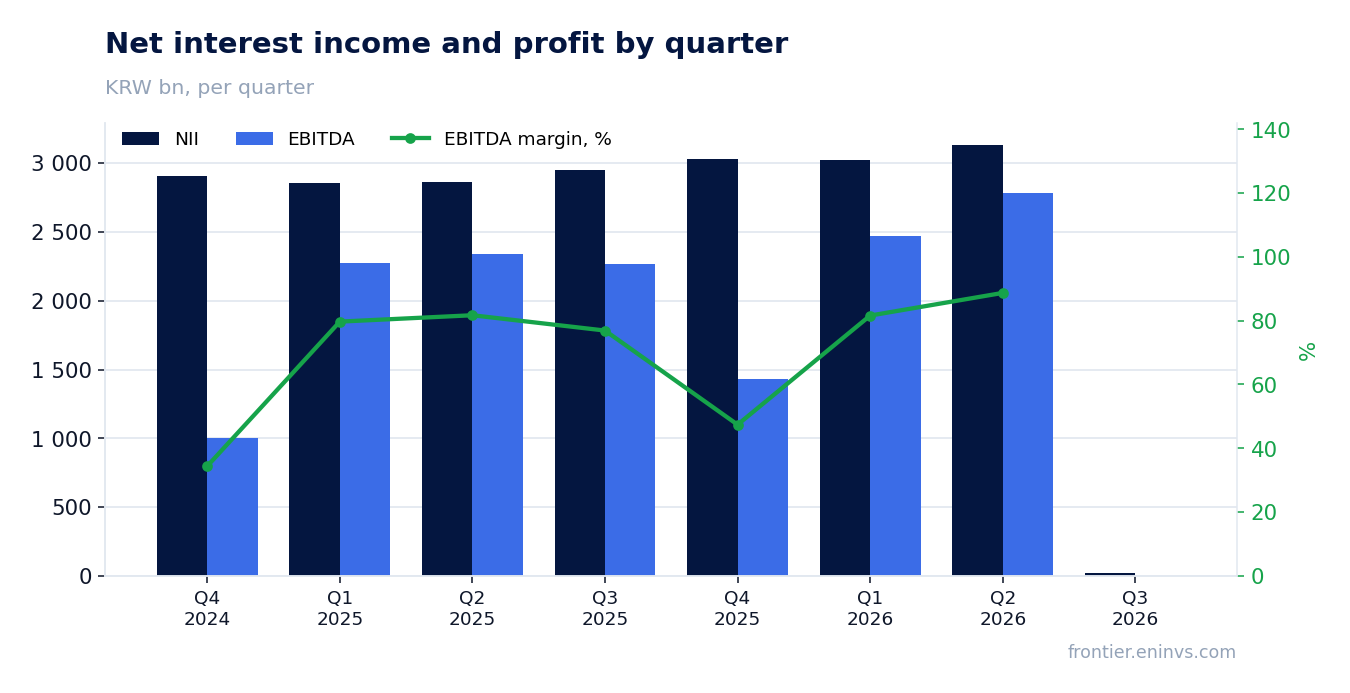
Net interest income collapsed 99.4% year-on-year to KRW 18.6bn, signalling a one-off breakdown in interest margin
Net interest income for Q3 2026 was KRW 18.6bn versus KRW 2,947.6bn a year earlier – a 99.4% decline. This is the key negative surprise of the report, overshadowing the positive profit dynamics.
For a bank, such a collapse in net interest income implies either a sharp contraction in the loan book, a one-off write-off, or a reporting error. Without management clarification, the sustainability of the business remains in question.
Over the trailing twelve months, profit reached KRW 4,035.4bn with return on equity of 11.9%
Trailing twelve-month net profit totalled KRW 4,035.4bn, with net interest income of KRW 9,205.2bn. Return on equity of 11.9% remains acceptable for the banking sector, but largely reflects prior quarters rather than the current one.
LTM figures smooth quarterly volatility, but the collapse in net interest income in Q3 could significantly worsen the annual picture if the situation does not normalise.
Dividend yield of 3.3% with a payout ratio that may be under pressure from profit volatility
The trailing twelve-month dividend yield is 3.3%. This is a moderate level that may attract conservative investors, but it is below the key rate and does not compensate for earnings volatility risk.
If the collapse in net interest income leads to lower annual profit, the payout ratio may be revised downward. The dividend is not guaranteed and depends on earnings sustainability.
P/E of 10.1 and +16% upside on the portal's model point to undervaluation relative to its own history
The LTM P/E ratio stands at 10.1, below the historical average for the banking sector. The portal's model estimates +16% upside for the shares, confirming undervaluation.
However, current profit includes one-off factors, and if net interest income normalises, the multiple could prove higher. The valuation is attractive but requires confirmation of business sustainability.
Top-line growth decelerated from +9.4% in Q2 to -99.4% in Q3, requiring scrutiny of business model resilience
Revenue dynamics deteriorated sharply: while Q2 2026 growth was +9.4% year-on-year, Q3 saw a 99.4% decline. This is a deceleration, not an acceleration, and it casts doubt on the company's ability to generate net interest income.
Without an explanation for such a collapse – whether a one-off write-off, a change in accounting policy, or a real business contraction – the investment case remains fragile. The next report will be key to confirming or refuting a recovery.
Valuation on the latest reported figures
| Metric | Value |
|---|---|
| Market cap | 40 644 bn KRW |
| P/E (LTM) | 10.1 |
| P/B | 0.67 |
| ROE | 11.9% |
| Dividend yield (12m) | 3.3% |
Bottom line
The report's strength remains the 9.1% net profit growth and acceptable 11.9% return on equity, but these rely on one-off factors and prior quarters. The real problem is the 99.4% collapse in net interest income, which questions the sustainability of the banking model. A 3.3% dividend yield and P/E of 10.1 look attractive, but the risk of further earnings deterioration is high. Verdict – rather attractive, with a caveat on volatility.
Open the company's financial profile 055550 →
See also: market overview · valuation map · stock screeners