Lion Finance Group: Q2 2026 profit up 20.6%, but its quality rests on net interest income
Lion Finance Group has reported its results for the second quarter of 2026. Net profit came in at 618.8 million lari, up 20.6% year on year, while net interest income reached 1,282.7 million lari, adding 20.8% to the level of the second quarter of 2025. Over the last twelve months the bank earned 2,340.7 million lari of net profit with a return on equity of 27.1%. On a P/E of 8.9 and with the portal's model putting upside at 40%, the share looks attractive, but the main contribution to the result still comes from interest income rather than fees.
Key takeaways
— Q2 2026 net profit rose 20.6% year on year to 618.8 million lari, with all growth coming from interest income
— Net interest income added 20.8% year on year to reach 1,282.7 million lari, while fee and commission income is not disclosed in the report
— A return on equity of 27.1% combined with a P/E of 8.9 creates scope for a re-rating of the share
— Trailing twelve-month dividend yield stands at 2.3%, which is modest against the key rate and the payout history
— The portal's model estimates 40% upside from the current price, well above the market's valuation
Attractiveness
Key figures, GEL bn
| Metric | Q2 2025 | Q2 2026 | Change |
|---|---|---|---|
| Net profit | 0.51 | 0.62 | +20.6% |
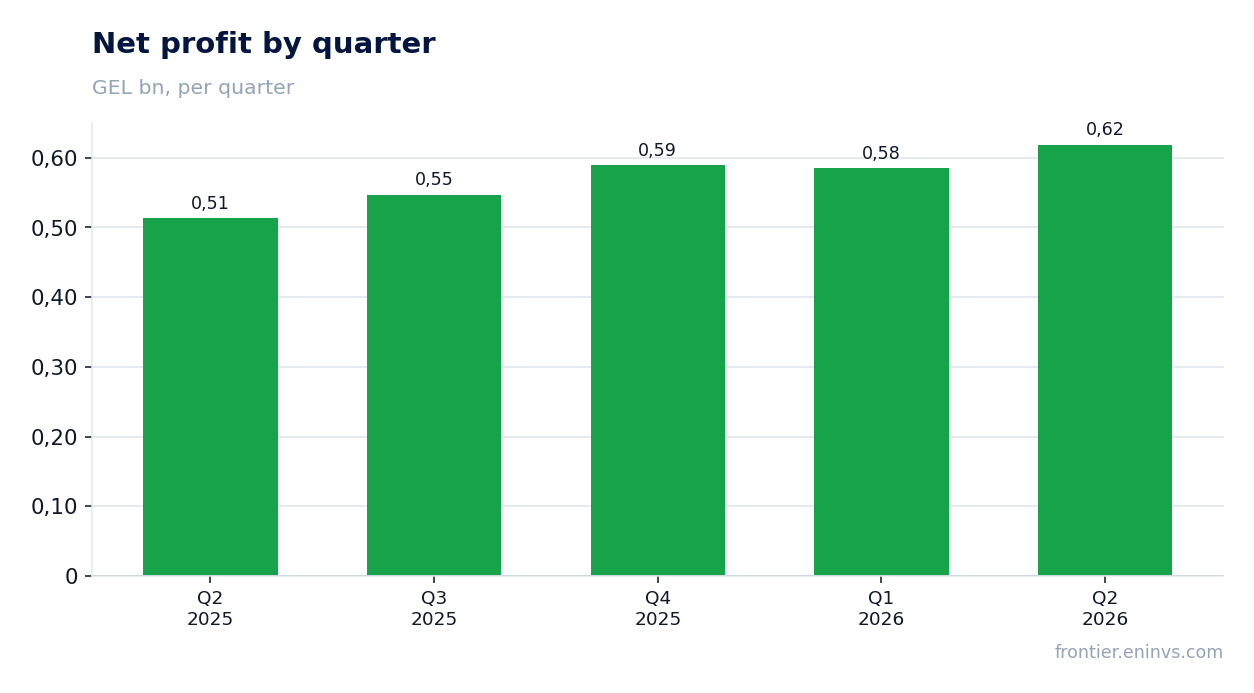
Q2 2026 net profit rose 20.6% year on year to 618.8 million lari, with all growth coming from interest income
In the second quarter of 2026, Lion Finance Group earned 618.8 million lari of net profit, up 20.6% from a year earlier. This is an acceleration from the first quarter of 2026, when profit was 585.0 million lari, and from the fourth quarter of 2025 with 589.7 million lari. Profit growth fully matches the dynamics of net interest income, which increased by 20.8% year on year.
The main contribution to the result comes from interest income: for the quarter it amounted to 1,282.7 million lari versus 1,061.7 million lari a year earlier. Fee and commission income is not disclosed in the report, so its contribution cannot be assessed. Over the last twelve months, net profit reached 2,340.7 million lari, and net interest income – 4,700.0 million lari, confirming a stable dependence on the interest business.
Profit growth of 20.6% with net interest income up 20.8% means that non-interest items had no significant impact on the result. This suggests that the bank has not yet diversified its income towards fees, and its profit is sensitive to the dynamics of interest rates and lending volumes.
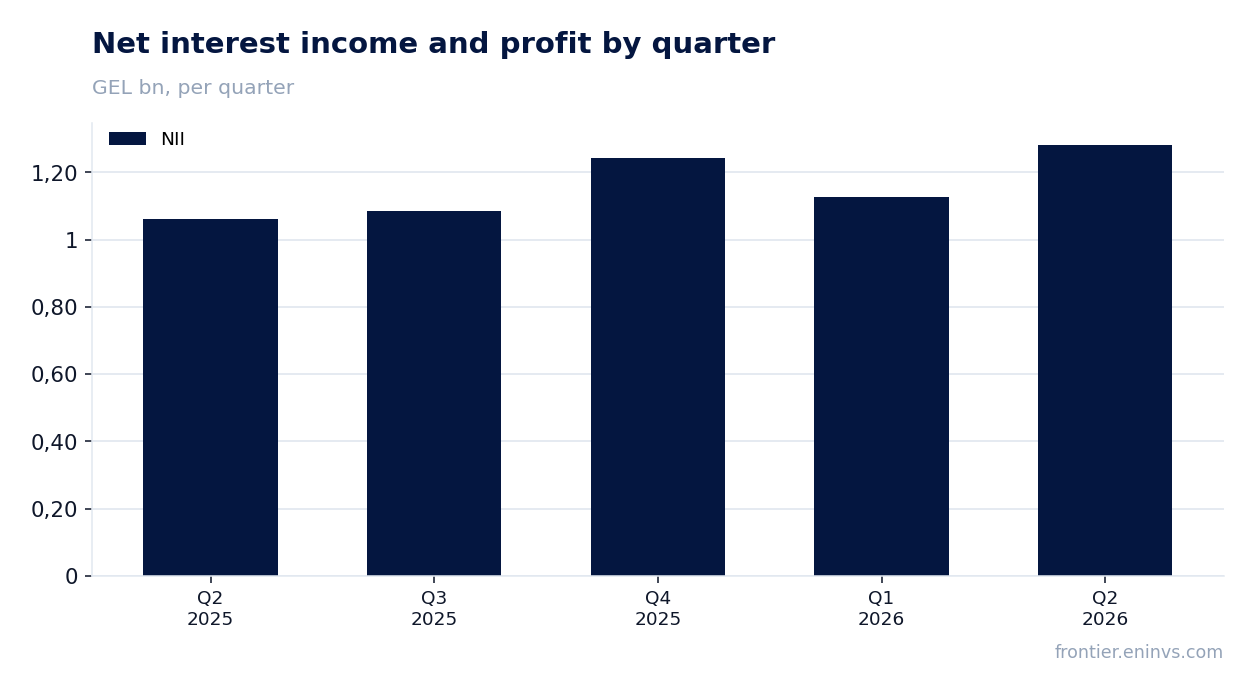
Net interest income added 20.8% year on year to reach 1,282.7 million lari, while fee and commission income is not disclosed in the report
Net interest income in the second quarter of 2026 amounted to 1,282.7 million lari, up 20.8% from 1,061.7 million lari in the second quarter of 2025. This is the highest quarterly figure over the last five quarters: in the third quarter of 2025 it was 1,084.2 million lari, in the fourth – 1,242.3 million lari, in the first quarter of 2026 – 1,125.8 million lari. Growth accelerated relative to the first quarter, when the year-on-year increase was less significant.
Fee and commission income is not disclosed in the provided reporting, so it is impossible to assess how diversified the bank's income is. However, the fact that net profit grows at almost the same pace as interest income indicates that non-interest sources are either absent or have no noticeable impact. For a bank, this means increased sensitivity to the interest margin and the cost of funding.
Over the last twelve months, net interest income reached 4,700.0 million lari, confirming the resilience of the interest business. However, without disclosure of fee income, it is impossible to judge the quality of the revenue base and its sustainability in the event of falling rates.
A return on equity of 27.1% combined with a P/E of 8.9 creates scope for a re-rating of the share
Lion Finance Group's return on equity over the last twelve months is 27.1%, a high figure for the banking sector. At the same time, the share trades at a P/E of 8.9, implying a significant discount to fundamental value. A combination of high profitability and a low multiple usually indicates undervaluation, unless the market is pricing in risks related to the sustainability of profit.
The portal's model estimates upside of 40% from the current price. This estimate is based on comparing return on equity and the price-to-book ratio. If profit remains at the current level and the multiple stays unchanged, the share could be re-rated by the market. However, the model does not account for possible pressure on the interest margin or deterioration in asset quality.
The company's market capitalisation is 20,754.3 million lari, which, with net profit of 2,340.7 million lari over the last twelve months, gives the stated P/E. For comparison with its own history, the FACTS do not contain data on the average P/E over three years, so it cannot be stated whether the current multiple is above or below its historical level. This limits the assessment of attractiveness.
Trailing twelve-month dividend yield stands at 2.3%, which is modest against the key rate and the payout history
Lion Finance Group's dividend yield over the last twelve months is 2.3%. This is a low figure, especially given the high return on equity of 27.1% and the low P/E of 8.9. With such profitability, the company could allocate a larger share of profit to dividends, but the actual payout is modest.
The FACTS do not contain data on the dividend for 2025 or on the dividend policy, so it is impossible to assess what share of profit the company plans to distribute. Our estimate of future payouts can only be made on the basis of the current yield and profit, but without a confirmed payout ratio it remains speculative. If the company maintains the current level of dividends, the yield will remain around 2.3%, which is below the key rate.
For an income-oriented investor, such a yield is unlikely to compensate for the risks associated with the concentration of profit in interest income. However, if the company increases its payout ratio, the dividend yield could rise. For now, the dividend is not the main factor in the share's attractiveness.
The portal's model estimates 40% upside from the current price, well above the market's valuation
According to the portal's model, the upside for Lion Finance Group shares is 40% from the current price. This estimate is based on comparing the return on equity of 27.1% and the price-to-book ratio. The model assumes that the market underestimates the sustainability of the bank's profit and its ability to generate high returns on capital.
However, the model is not a market consensus or a target price. It reflects only one possible scenario in which the company's multiples approach historical averages. If profit remains at the level of the last twelve months and the market valuation stays unchanged, the share could rise. But if the interest margin narrows or asset quality deteriorates, the forecast may not materialise.
For the investor, it is important to understand that the portal's model is an analytical tool, not a guarantee of returns. It provides a benchmark, but the decision should also take into account other factors: the dividend yield of 2.3%, the concentration of income and the lack of data on fee income.
Valuation on the latest reported figures
| Metric | Value |
|---|---|
| Market cap | 20.8 bn GEL |
| P/E (LTM) | 8.9 |
| P/B | 2.46 |
| ROE | 27.1% |
| Dividend yield (12m) | 2.3% |
Bottom line
Lion Finance Group delivered strong profit growth in the second quarter of 2026: net profit rose 20.6% to 618.8 million lari, while net interest income increased 20.8% to 1,282.7 million lari. A return on equity of 27.1% and a P/E of 8.9 make the share undervalued, and the portal's model points to 40% upside. However, profit still depends on interest income, fee income is not disclosed, and the dividend yield is only 2.3%. The question for a holder now is whether the high interest margin will persist and whether the bank will increase income diversification.
Open the company's financial profile BGEO →
See also: market overview · valuation map · stock screeners