Bank of Nova Scotia: profit up 18.8%, but net interest income is growing faster than the bank can deploy it
Bank of Nova Scotia reported third-quarter 2026 results. Net profit came in at CAD 2,908 million, up 18.8% year on year, while net interest income rose 10.5% to 10,313 million. Return on equity remains low at 4.4%, and the stock trades at a trailing twelve-month price-to-earnings ratio of 20.5. With a dividend yield of 3.4% and the portal model implying 7% upside, the share looks rather attractive for income-oriented investors, though not for multiple expansion.
Key takeaways
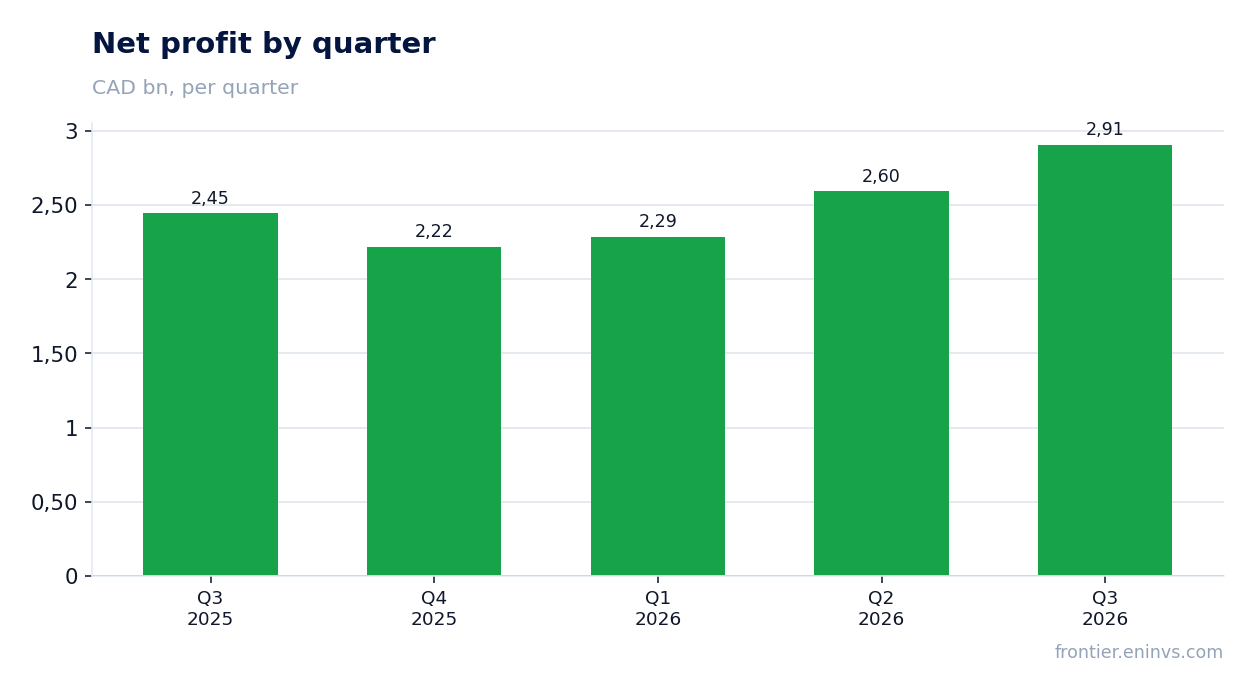
— Net profit rose 18.8% year on year to CAD 2,908 million, but the growth rests on a low base from a year earlier
— Net interest income added 10.5% year on year to 10,313 million, and it remains the bank's main revenue driver
— Return on equity at 4.4% is low and leaves little cushion above the dividend payout
— The 3.4% dividend yield, with a payout ratio close to 100% of earnings, offers limited room for manoeuvre
— The portal model implies 7% upside to the current price, only slightly above the dividend yield
Attractiveness
Key figures, CAD bn
| Metric | Q3 2025 | Q3 2026 | Change |
|---|---|---|---|
| Net profit | 2.45 | 2.91 | +18.8% |
| Capex | -0.07 | -0.13 | — |
Net profit rose 18.8% year on year to CAD 2,908 million, but the growth rests on a low base from a year earlier
In the third quarter of 2026, Bank of Nova Scotia earned CAD 2,908 million in net profit, up 18.8% from the same quarter a year earlier. For comparison, profit a year ago was 2,447 million. The growth looks impressive, but it starts from a weak third-quarter 2025 result, when the bank faced elevated credit loss provisions.
The quarterly sequence shows profit rising for several quarters: from 2,219 million in Q4 2025 to 2,287 million in Q1 2026, then 2,595 million in Q2 and 2,908 million in Q3. This is a steady recovery, not a one-off jump. Even at the current level, however, profit remains below the average of recent years, indicating the recovery is not yet complete.
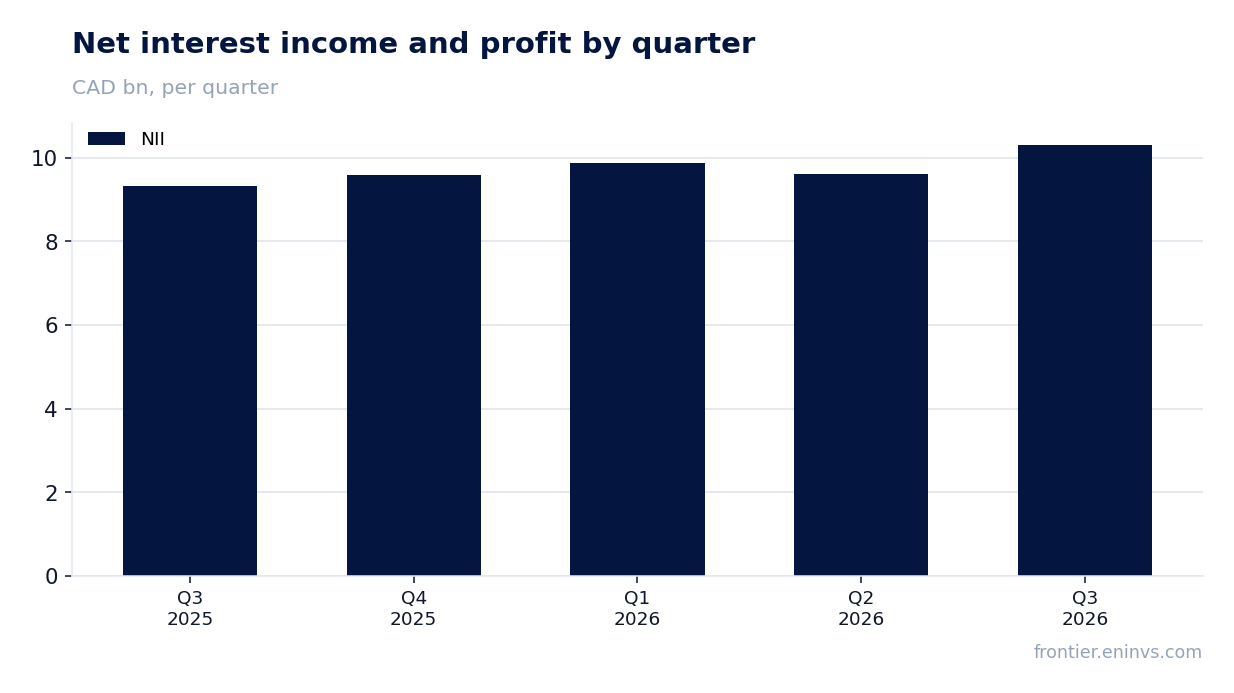
Net interest income added 10.5% year on year to 10,313 million, and it remains the bank's main revenue driver
Net interest income in Q3 2026 was CAD 10,313 million, up 10.5% from 9,329 million a year earlier. This is the bank's core revenue line, and its trend matters more than one-off items in profit. Growth in net interest income means the bank is either expanding lending volumes or improving the spread between funding costs and asset yields.
On a quarterly basis, net interest income has risen steadily: 9,579 million in Q4 2025, 9,880 million in Q1 2026, 9,615 million in Q2, and 10,313 million in Q3. A slight dip in Q2 gave way to a new high, showing the bank can grow revenue even in a shifting rate environment. Over the trailing twelve months, net interest income reached 37,100 million, confirming the scale of this business.
Return on equity at 4.4% is low and leaves little cushion above the dividend payout
Bank of Nova Scotia's return on equity over the trailing twelve months is 4.4%. For a bank, this is low: it means the bank earns less than five cents for every dollar of equity. At this level of profitability, the ability to build capital organically is limited, and the bank must rely on external funding or asset reduction to maintain capital adequacy.
The low ROE reflects profit still recovering from a period of elevated provisions. If profit continues to grow at the same pace, ROE could improve, but for now it remains below the cost of equity that the market typically demands from banks. This is a key argument against aggressive re-rating of the stock.
The 3.4% dividend yield, with a payout ratio close to 100% of earnings, offers limited room for manoeuvre
Bank of Nova Scotia's trailing twelve-month dividend yield is 3.4%. This is a moderate level for a Canadian bank, but it is attractive relative to current rates. However, with a return on equity of 4.4% and a price-to-earnings ratio of 20.5, the payout ratio is close to 100% of earnings: the bank distributes almost everything it earns. This means dividend growth is possible only with a substantial increase in profit.
For an income-oriented investor, it is important that the dividend is covered by earnings, but it does not create a cushion. If profit declines, the bank may face the need to either cut payments or raise capital. For now, the dividend remains one of the main arguments in favour of the stock, but its sustainability depends on continued profit recovery.
The portal model implies 7% upside to the current price, only slightly above the dividend yield
According to the portal model, which compares return on equity with the price-to-book ratio, the fair value of Bank of Nova Scotia shares is 7% above the current market price. This is moderate upside, only slightly above the 3.4% dividend yield. In other words, an investor could expect a total return of around 10% per year if the valuation holds and the dividend is maintained.
The trailing twelve-month price-to-earnings ratio is 20.5. For a bank with a return on equity of 4.4%, this is a fairly high multiple: the market is already pricing in profit recovery. If profit does not grow as expected, the multiple could compress, and the upside implied by the model would prove unattainable. For now, the valuation looks balanced, without clear over- or undervaluation.
Valuation on the latest reported figures
| Metric | Value |
|---|---|
| Market cap | 160 bn CAD |
| P/E (LTM) | 20.5 |
| P/B | 1.84 |
| ROE | 4.4% |
| Dividend yield (12m) | 3.4% |
Bottom line
Bank of Nova Scotia delivered a strong quarter: profit rose 18.8% and net interest income grew 10.5%, indicating a recovery in the core business. However, return on equity remains low at 4.4%, and the dividend absorbs almost all earnings, leaving no cushion. The portal model implies 7% upside, slightly above the 3.4% dividend yield, but the 20.5 P/E already prices in a lot of good news. For an income-oriented investor, the stock looks rather attractive, but for a bet on multiple expansion, it is neutral.
Open the company's financial profile BNS →
See also: market overview · valuation map · stock screeners