Sistema: EBITDA up 38.7%, but interest costs and negative equity consumed the entire gain
On 27 August, Sistema published its results for the first half of 2026. Revenue rose 6.5% to RUB 639.5 bn, EBITDA – by 38.7% to RUB 250.3 bn, with the margin up from 30.0% to 39.1%. But the net loss persisted at RUB 4.4 bn, operating cash flow went negative at RUB -222.3 bn, and equity attributable to shareholders is negative at RUB -205.8 bn. With EV/EBITDA at 4.3 and no dividends, the stock looks neutral: leverage of 4.28x EBITDA and negative equity outweigh the operating progress.
Key takeaways
— EBITDA grew 38.7%, but the entire gain went to debt servicing
— Revenue added 6.5%, and the pace has barely changed since late 2024
— Operating cash flow went negative at RUB -222.3 bn due to a rise in restricted cash
— Net debt of RUB 1,260.9 bn equals 4.28x EBITDA, and leverage is not declining
— Shareholder equity is negative at RUB -205.8 bn, limiting financial flexibility
— No dividends were paid over the last 12 months, and none are planned this year
— EV/EBITDA of 4.3 looks cheap, but negative equity and debt make the valuation deceptive
Attractiveness
Key figures, RUB bn
| Metric | H1 2025 | H1 2026 | Change |
|---|---|---|---|
| Revenue | 601 | 640 | +6.5% |
| EBITDA | 180 | 250 | +38.7% |
| Operating profit | 92.6 | 157 | +69.7% |
| Net profit | -81.8 | -4.42 | — |
| Operating cash flow | 40.6 | -222 | -648.1% |
| Capex | 84.2 | 98.2 | +16.7% |
| EBITDA margin | 30.0% | 39.1% | +9.1 pp |
| Net margin | -13.6% | -0.7% | +12.9 pp |
EBITDA grew 38.7%, but the entire gain went to debt servicing
EBITDA for H1 2026 reached RUB 250.3 bn, up 38.7% year-on-year. The margin rose to 39.1% from 30.0%. This growth looks impressive, but it barely reached net profit: financial expenses amounted to RUB 166.7 bn, down RUB 39.3 bn from a year earlier, but still consuming most of operating profit.
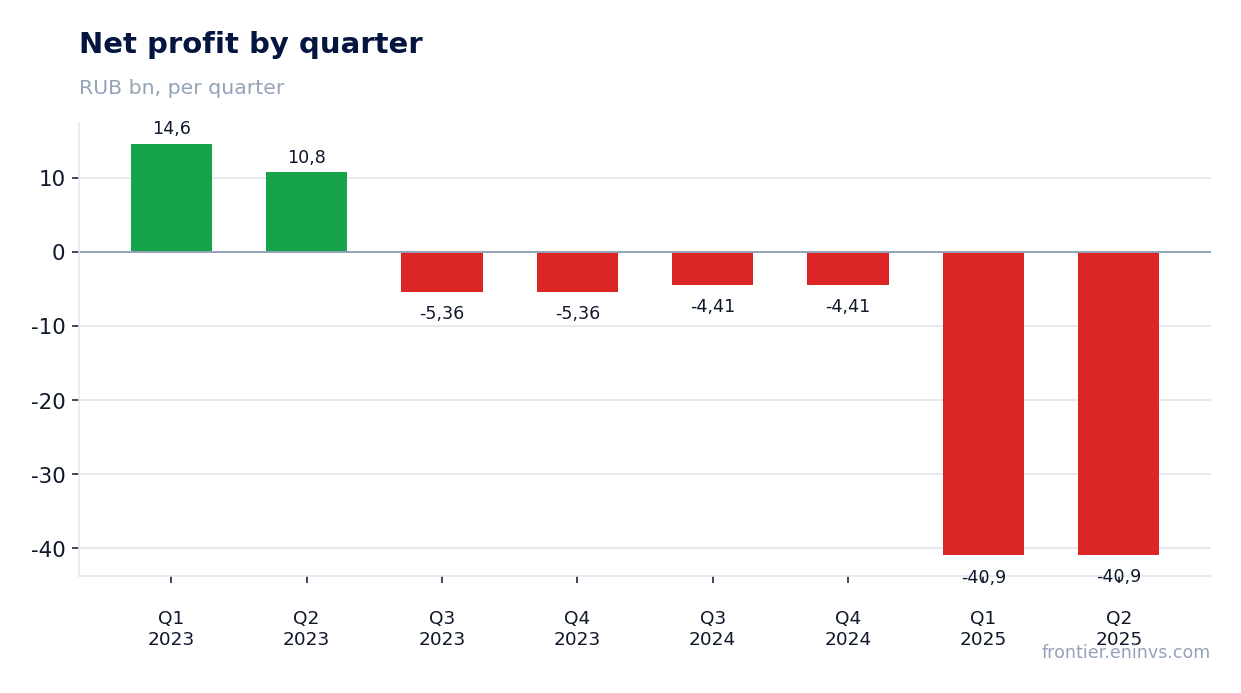
Operating profit rose to RUB 157.1 bn from RUB 92.6 bn a year earlier. However, after deducting financial expenses and foreign exchange differences, pre-tax profit was only RUB 6.6 bn. The net loss was RUB 4.4 bn, though a year earlier it was RUB 81.8 bn. There is improvement, but it has not yet led to a positive result.
Revenue added 6.5%, and the pace has barely changed since late 2024
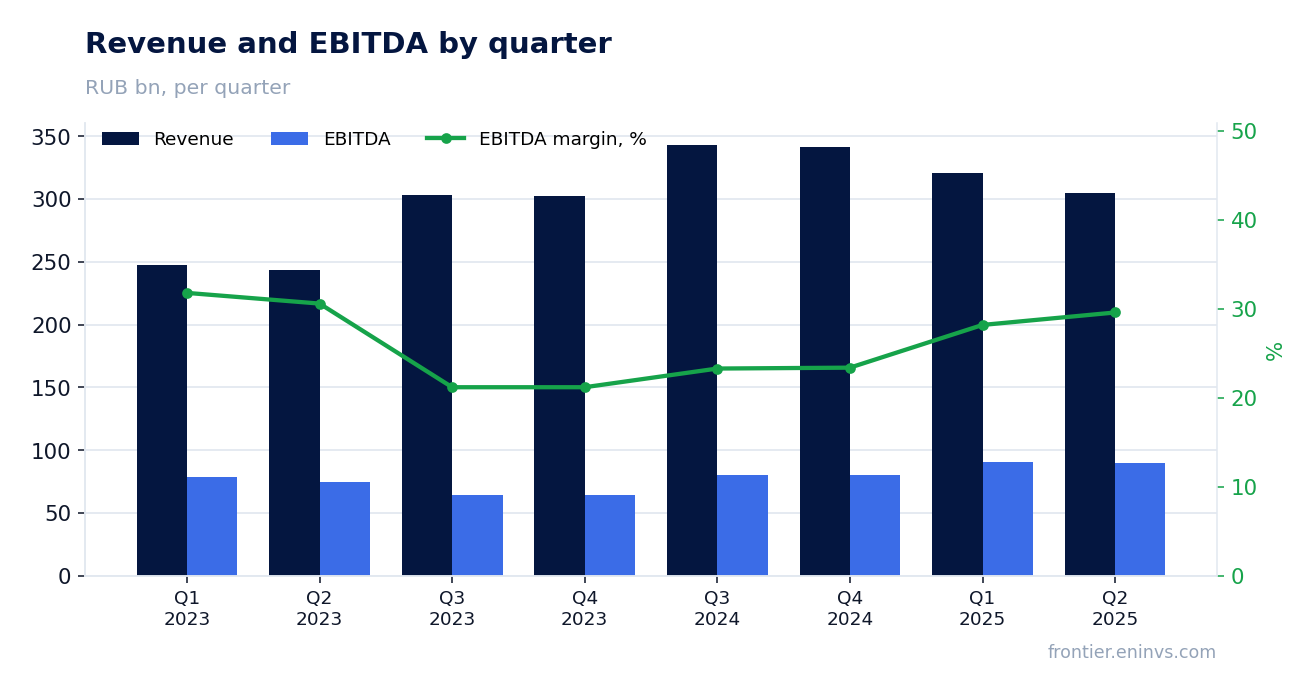
Revenue for H1 2026 was RUB 639.5 bn, up 6.5% year-on-year. For comparison: in Q4 2024 growth was 12.9%, in Q3 2024 – 13.3%. So the growth rate has roughly halved, although at the end of 2024 they were almost the same.
The slowdown is due to a high base effect and possibly a change in sales mix. The report does not disclose segment revenue, so it is impossible to say exactly which business is slowing. But the overall dynamics show that double-digit growth rates are a thing of the past.
Operating cash flow went negative at RUB -222.3 bn due to a rise in restricted cash
Operating cash flow for H1 2026 was RUB -222.3 bn versus RUB +40.6 bn a year earlier. The main reason is a RUB 119.8 bn increase in restricted cash, as well as an outflow on bank deposits and liabilities of RUB 88.4 bn. These items are related to the financial activities of subsidiary banks and do not reflect the operating efficiency of industrial assets.
Capital expenditures were RUB 98.2 bn, up RUB 10.6 bn from a year earlier. Free cash flow is therefore deeply negative. The company finances investments and covers gaps through new borrowings: proceeds from loans and borrowings amounted to RUB 552.7 bn.
Net debt of RUB 1,260.9 bn equals 4.28x EBITDA, and leverage is not declining
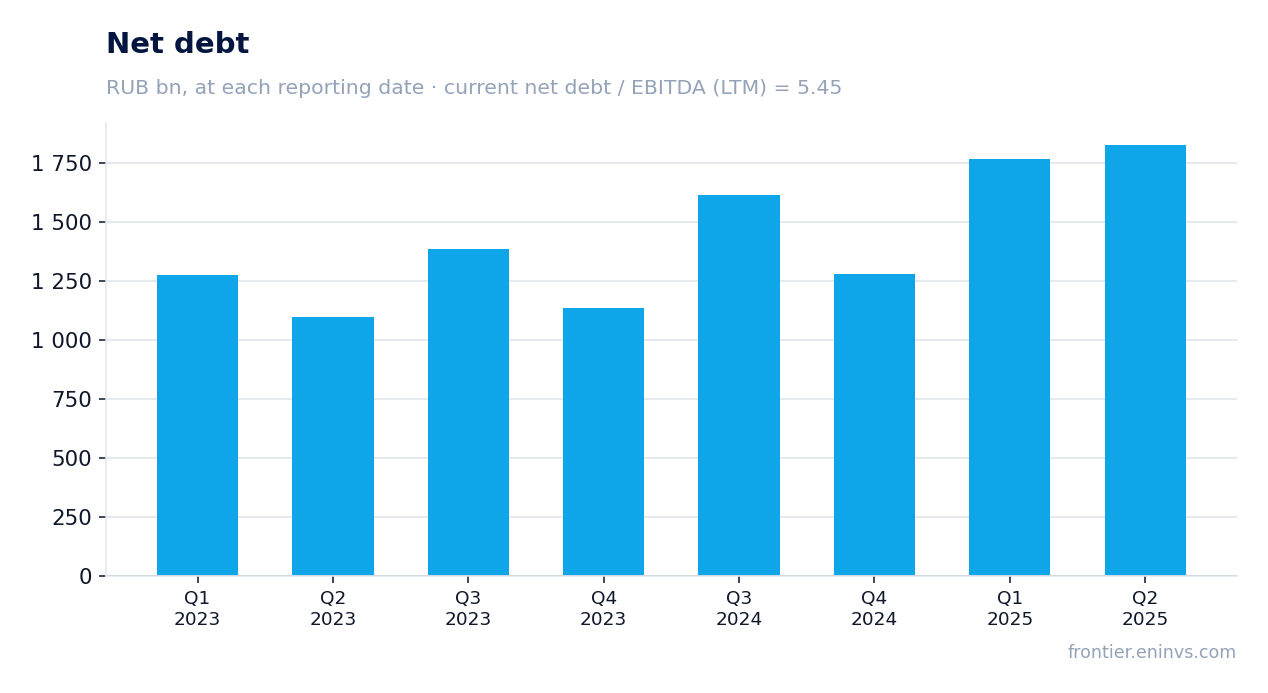
Net debt as of 30 June 2026 was RUB 1,260.9 bn. That is 4.28x EBITDA for the trailing twelve months. A year earlier, on 30 June 2025, net debt was RUB 1,828.5 bn, so over 12 months it decreased by RUB 567.6 bn. However, compared to 31 December 2025 (RUB 1,209.1 bn), it increased by RUB 51.8 bn. The year-on-year decline was achieved through EBITDA growth, not debt repayment.
Current liabilities exceed current assets by RUB 853.6 bn. This creates refinancing risk. The company notes that unused credit lines of RUB 1,166.5 bn are available, and after the reporting date an additional RUB 40 bn was raised as part of a structured deal. But the debt level remains high, and interest expenses will continue to pressure profit.
Shareholder equity is negative at RUB -205.8 bn, limiting financial flexibility
Equity attributable to Sistema shareholders as of 30 June 2026 is negative at RUB -205.8 bn. This is RUB 33.0 bn worse than at the end of 2025. Negative equity is a consequence of accumulated losses (RUB 330.1 bn) and large dividend payables of subsidiaries (RUB 61.4 bn).
Negative equity limits the company's ability to raise new financing and increases the cost of debt. It also means that the book value of assets does not cover liabilities, and any downward revaluation of assets could worsen the situation.
No dividends were paid over the last 12 months, and none are planned this year
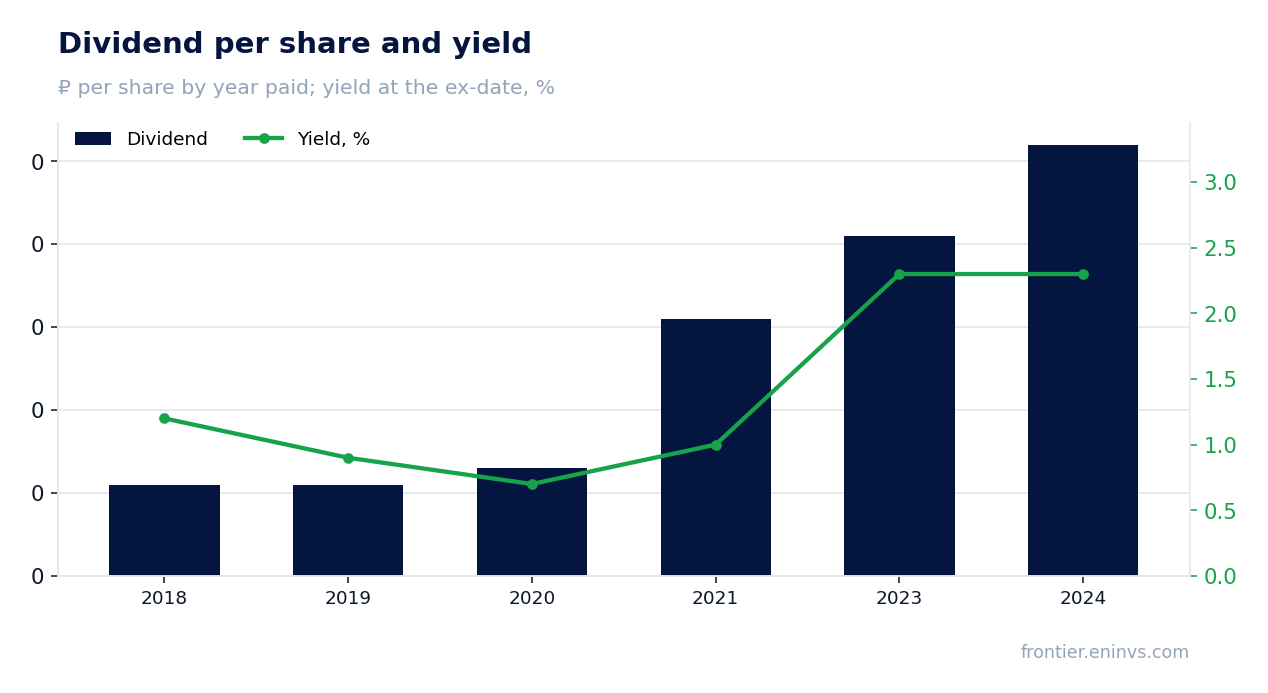
No dividends were paid over the last 12 months. There were also no payments this calendar year, and no further payments are planned. For a company that historically paid dividends (RUB 0.52 per share in 2024, RUB 0.41 in 2023), this is a significant change.
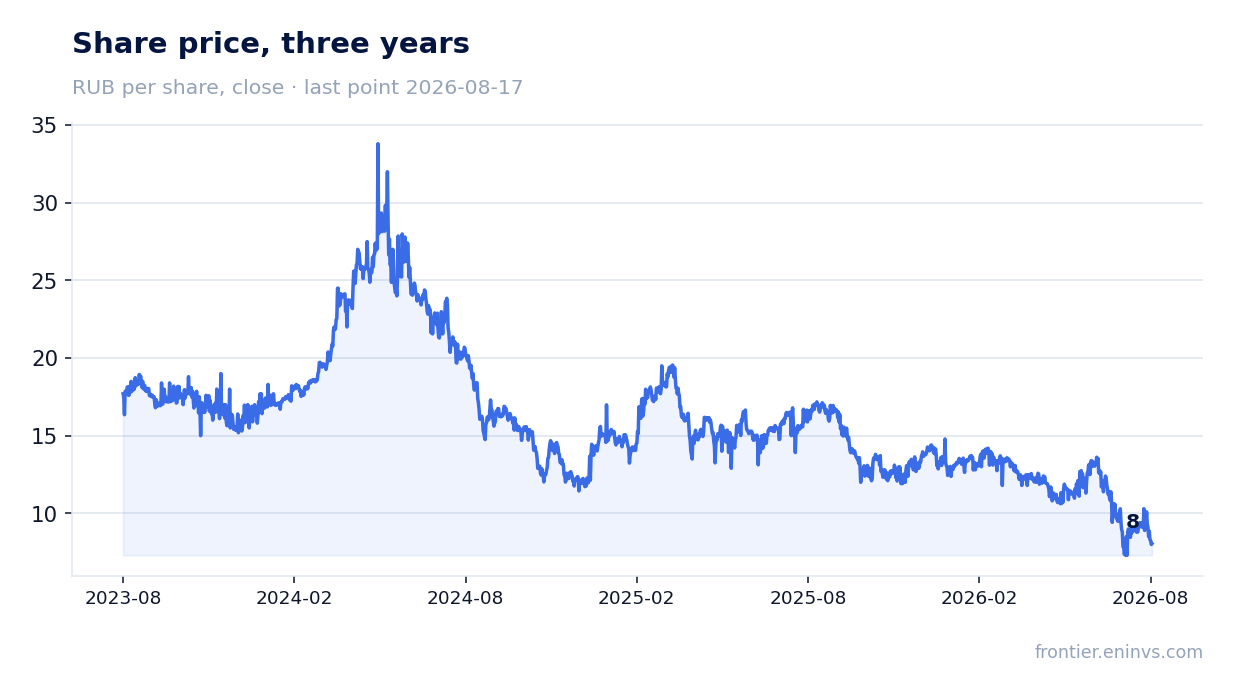
The fair yield for this stock, in our estimate, is 7.0%. At the current price and with no payments, the dividend yield is zero. This makes the stock unattractive for income-oriented investors. The central bank key rate is 14.0%, and without dividends the stock underperforms even risk-free instruments.
EV/EBITDA of 4.3 looks cheap, but negative equity and debt make the valuation deceptive
EV/EBITDA for the trailing twelve months is 4.3. This is a low multiple, which may indicate undervaluation. However, it does not account for negative equity and high net debt. With a market capitalisation of RUB 69.5 bn and net debt of RUB 1,260.9 bn, EV is about RUB 1,330.4 bn.
It is impossible to compare the current multiple with its three-year historical average, as these data are not in the FACTS. But even without comparison, it is clear that the market values the company at a large discount to its assets, reflecting the risks of debt burden and corporate governance. A re-rating would require sustainable positive free cash flow and debt reduction, not a one-off EBITDA increase.
Valuation on the latest reported figures
| Metric | Value |
|---|---|
| Market cap | 69.5 bn ₽ |
| EV/EBITDA (LTM) | 4.3 |
| Net debt / EBITDA (LTM) | 4.28 |
| ROE | 6.5% |
Dividend per share, ₽, and yield at the ex-date
| Year paid | Dividend | Yield |
|---|---|---|
| 2018 | 0.11 | 1.2% |
| 2019 | 0.11 | 0.9% |
| 2020 | 0.13 | 0.7% |
| 2021 | 0.31 | 1.0% |
| 2023 | 0.41 | 2.3% |
| 2024 | 0.52 | 2.3% |
Bottom line
The strong points in the report are EBITDA growth of 38.7% and margin improvement to 39.1%. However, this growth is almost entirely consumed by interest expenses, and the net loss persists. Operating cash flow is negative, shareholder equity is negative, and no dividends are paid. The real question for a holder now is whether the company can reduce debt and achieve positive free cash flow, or whether EBITDA growth will remain merely an accounting achievement. At EV/EBITDA of 4.3, the stock looks neutral – cheap, but with high risks.
Open the company's financial profile AFKS →
See also: market overview · valuation map · stock screeners