Sistema: net result nearly breaks even, but on an asset sale rather than operations
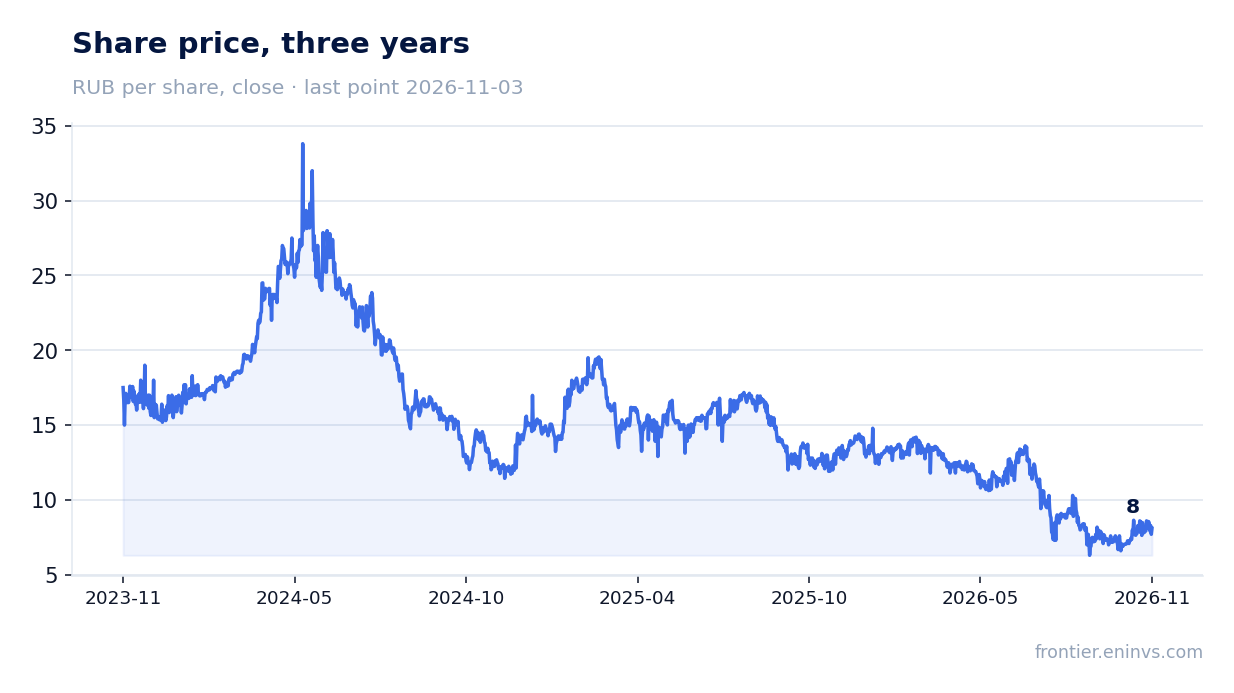
On 27 August Sistema reported results for the second quarter of 2026. Revenue rose 10.2% year on year to RUB 336.2 bn, EBITDA by 38.7% to RUB 125.1 bn, while net profit narrowed to minus RUB 2.2 bn from minus RUB 40.9 bn a year earlier. The improvement rests on one-off disposal and revaluation gains, while operating cash flow was negative in the quarter and leverage remains high; with the share below RUB 7 and no dividend paid over the last 12 months, the stock looks neutral.
Key takeaways
— Revenue added 10.2%, but growth rests on inorganic gains rather than organics
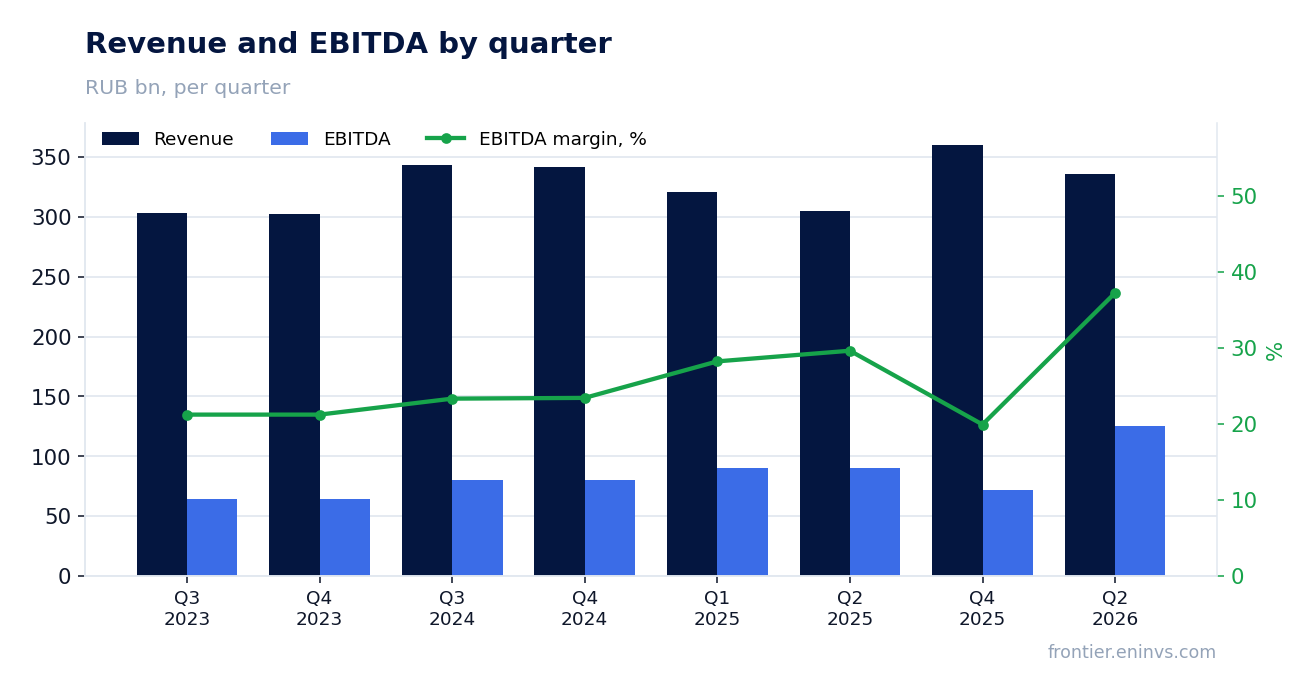
— EBITDA rose 38.7% with a 37.2% margin versus 29.6% a year earlier
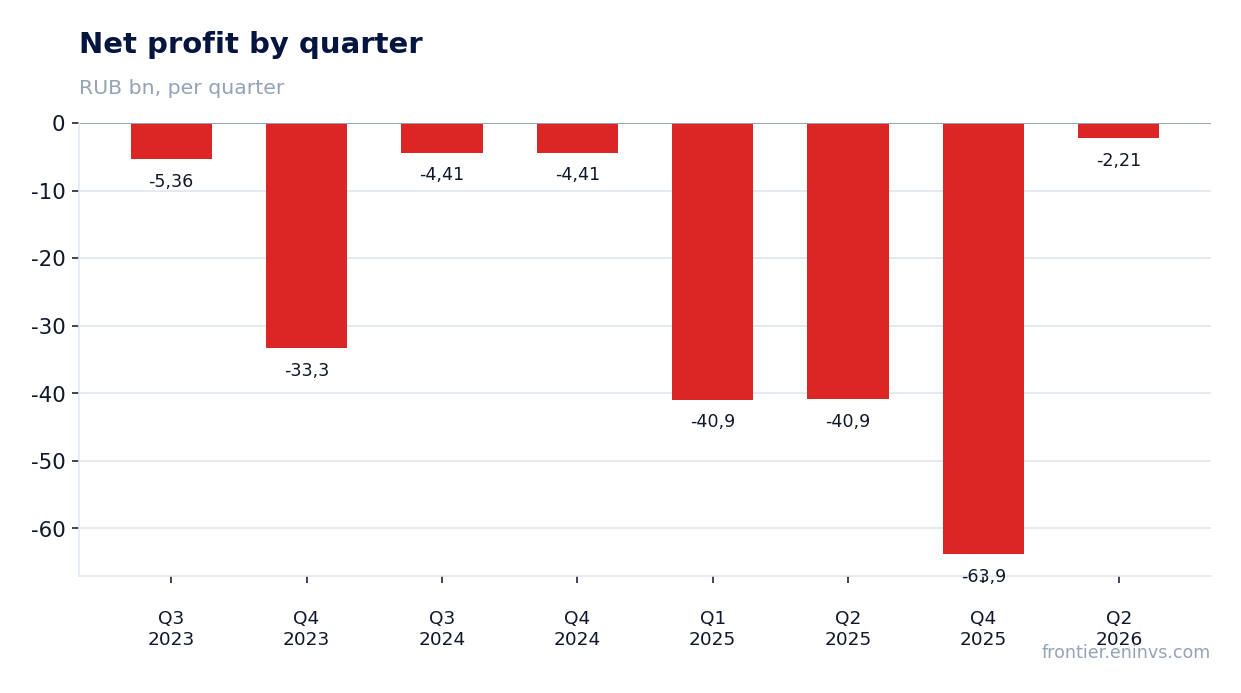
— Net loss narrowed to RUB 2.2 bn largely on the sale of stakes in associates
— Operating cash flow was negative in the quarter – minus RUB 111.2 bn against capex of RUB 49.1 bn
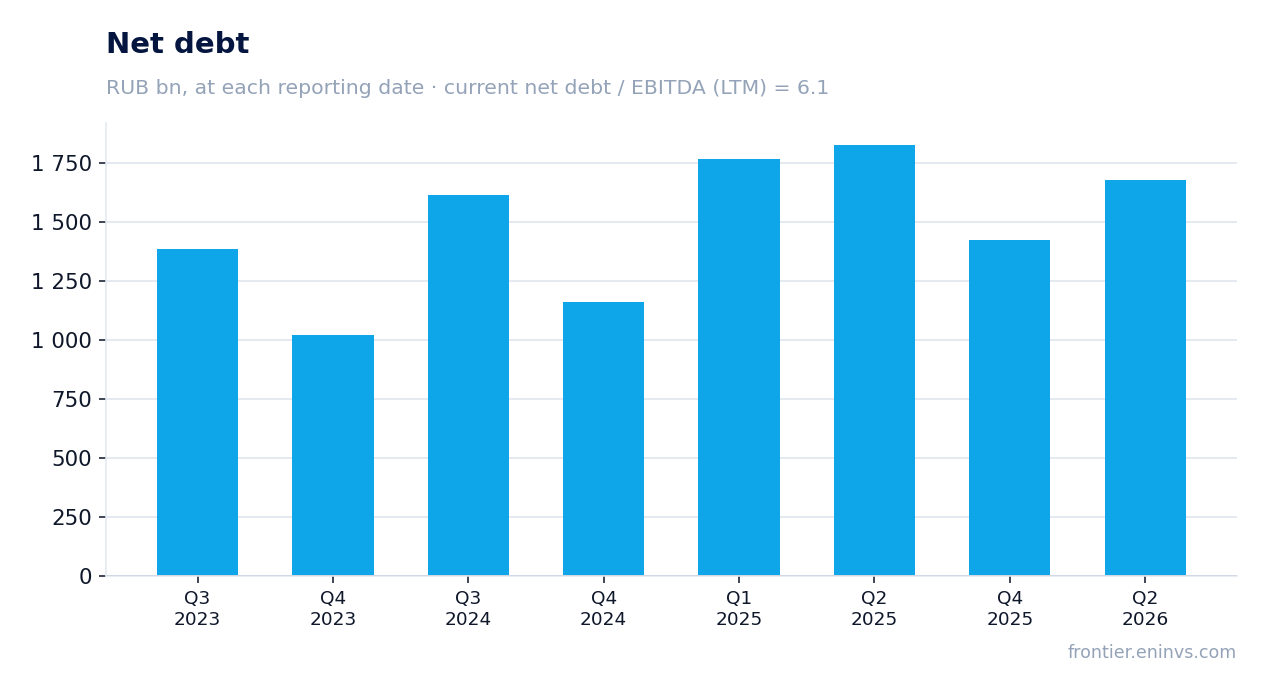
— Net debt rose to RUB 1,679.6 bn from RUB 1,423.5 bn at end-2025
— No dividends were paid over the last 12 months, and our model puts payout potential at zero
— An EV/EBITDA of 4.7 looks cheap, but debt at 6.1x EBITDA caps re-rating
Attractiveness
Key figures, RUB bn
| Metric | Q2 2025 | Q2 2026 | Change |
|---|---|---|---|
| Revenue | 305 | 336 | +10.2% |
| EBITDA | 90.2 | 125 | +38.7% |
| Operating profit | 46.3 | 78.5 | +69.7% |
| Net profit | -40.9 | -2.21 | — |
| Operating cash flow | 20.3 | -111 | -648.1% |
| Capex | 42.1 | 49.1 | +16.7% |
| EBITDA margin | 29.6% | 37.2% | +7.6 pp |
| Net margin | -13.4% | -0.7% | +12.7 pp |
Revenue added 10.2%, but growth rests on inorganic gains rather than organics
Revenue for the second quarter of 2026 was RUB 336.2 bn, 10.2% higher than a year earlier. That is noticeably faster than the 5.4% growth in the fourth quarter of 2025, but the year-on-year comparison is distorted by a restated base: comparative information for the first half of 2025 was cut by RUB 16.0 bn due to a change in revenue recognition for low-payment instalment contracts.
For the first half of 2026 revenue was RUB 639.5 bn against RUB 600.7 bn a year earlier. The gap between half-year and quarterly growth is small, pointing to an even trend without marked acceleration towards the end of the period.
The main contribution to growth comes from deals rather than operating segments: the report separately discloses a gain on disposal of a subsidiary of RUB 53.3 bn and a profit on the sale of stakes in associates of RUB 26.2 bn. These amounts sit on other lines, but they drive the gap between revenue growth and profit growth.
EBITDA rose 38.7% with a 37.2% margin versus 29.6% a year earlier
EBITDA for the second quarter of 2026 was RUB 125.1 bn, 38.7% higher than a year earlier. The margin rose to 37.2% from 29.6%, a gain of 7.6 percentage points. Such a jump in profitability on revenue growth of only 10.2% means most of the improvement came not from revenue but from cost reduction or one-off items below operating profit.
Operating profit for the quarter was RUB 78.5 bn against RUB 46.3 bn a year earlier. The difference between EBITDA and operating profit is depreciation, which for the first half amounted to RUB 93.2 bn and grew 6.0% year on year. Depreciation is growing slower than revenue, mechanically supporting the margin.
In the first-half report other income was RUB 97.1 bn against RUB 33.2 bn a year earlier. It is this line, not operating efficiency, that explains most of the increase in EBITDA and operating profit: it includes the gain on disposal of a subsidiary and the profit on the sale of stakes.
Net loss narrowed to RUB 2.2 bn largely on the sale of stakes in associates
Net loss for the second quarter of 2026 was RUB 2.2 bn against RUB 40.9 bn a year earlier. The net margin improved to minus 0.7% from minus 13.4%. The improvement is almost entirely due to one-off gains: without the RUB 53.3 bn gain on disposal of a subsidiary and the RUB 26.2 bn profit on the sale of stakes, the result would have remained deeply negative.
Financial expenses for the first half were RUB 166.7 bn against RUB 206.1 bn a year earlier. The RUB 39.3 bn decline is partly explained by the restated base, but even so the interest burden remains heavy: it is roughly twice operating profit for the same period.
The share in losses of associates and joint ventures was minus RUB 12.4 bn against plus RUB 1.0 bn a year earlier. This is another factor weighing on the result and unrelated to core operations.
Operating cash flow was negative in the quarter – minus RUB 111.2 bn against capex of RUB 49.1 bn
Operating cash flow for the second quarter of 2026 was minus RUB 111.2 bn, whereas a year earlier it was positive. For the first half the outflow was RUB 222.3 bn against an inflow of RUB 40.6 bn a year earlier. Negative cash flow with positive EBITDA means profit is not converting into cash.
The main reasons for the outflow are visible in the cash flow statement: restricted cash rose by RUB 119.8 bn, bank deposits and liabilities fell by RUB 88.4 bn, and interest paid was RUB 159.4 bn. These items are not related to operating efficiency, but they determine the sign of the flow.
Capex for the quarter was RUB 49.1 bn, for the half RUB 54.3 bn on property and RUB 44.0 bn on intangibles. With negative operating cash flow the company funds investment and debt service through new borrowing: loan proceeds for the half were RUB 552.7 bn against repayments of RUB 503.6 bn.
Net debt rose to RUB 1,679.6 bn from RUB 1,423.5 bn at end-2025
Net debt at 30 June 2026 was RUB 1,679.6 bn against RUB 1,423.5 bn at 31 December 2025, an increase of RUB 256.1 bn. Over 12 months debt declined: from RUB 1,828.5 bn at 30 June 2025 to RUB 1,679.6 bn at 30 June 2026, a fall of RUB 148.9 bn.
The ratio of net debt to EBITDA over the last 12 months is 6.1. That is a high level, which limits the company's ability to pay dividends and raises the cost of new financing. With the key rate at 14.0%, servicing such debt is expensive.
Current liabilities exceed current assets by RUB 853.6 bn – negative working capital. The report explains this by the maturity in the second half of 2026 and in 2027 of loans and irrevocable offers on exchange-traded bonds. The company has open but unused credit lines totalling RUB 1,166.5 bn, and after the reporting date raised an additional RUB 40 bn under a structured transaction.
No dividends were paid over the last 12 months, and our model puts payout potential at zero
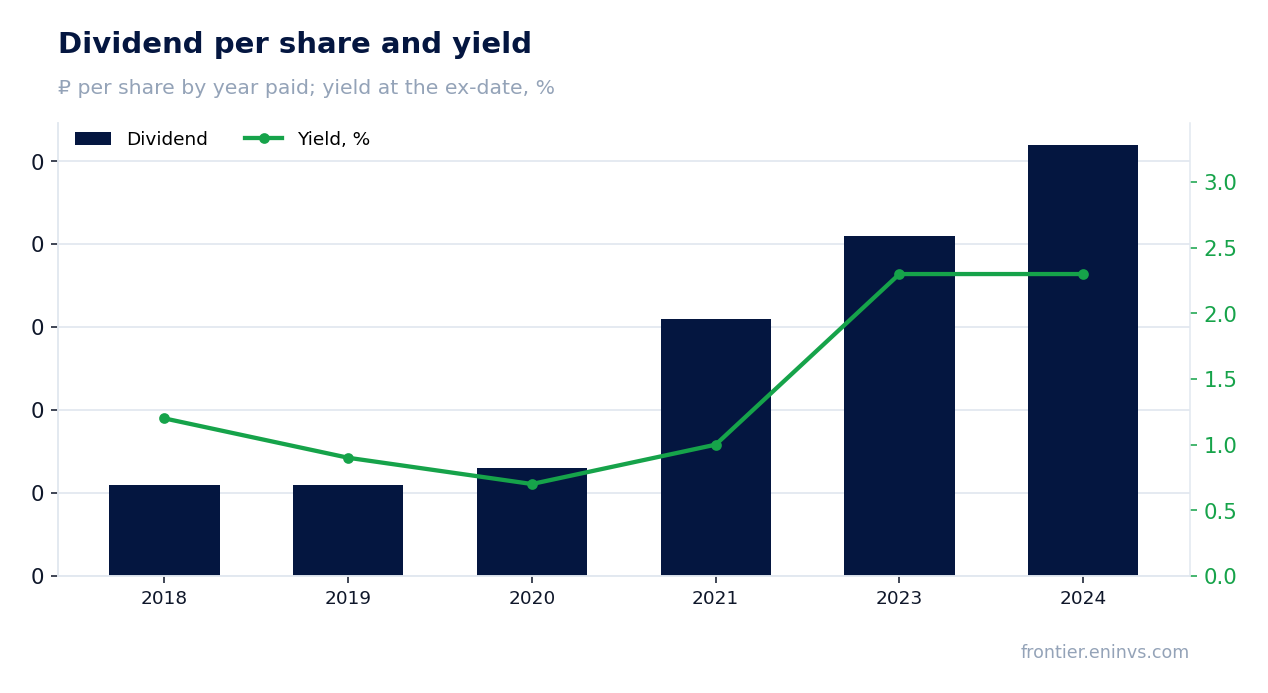
No dividends were paid over the last 12 months: the payment per share was RUB 0.0, the current yield 0.0%. The payment history is uneven: RUB 0.52 per share for 2024, RUB 0.41 for 2023, RUB 0.31 for 2021. The yield at the ex-date never exceeded 2.3%.
Our estimate of the annual dividend is RUB 0.0 per share. The dividend-potential model is built on a profit base of minus RUB 155.2 bn and a payout ratio of 0.19; with negative profit and the free cash flow cap binding, payout potential is zero. This is our estimate, not a declared dividend: the board decides.
The yield we consider fair for this name is 7.0% per annum. With the key rate at 14.0% and a zero current payment, the stock offers no dividend premium. To return to payments the company first needs to restore positive free cash flow and reduce leverage.
An EV/EBITDA of 4.7 looks cheap, but debt at 6.1x EBITDA caps re-rating
EV/EBITDA over the last 12 months is 4.7. That is a low level for a company with revenue of RUB 1,371.3 bn and EBITDA of RUB 275.4 bn over the same period. However, the multiple already reflects high debt: with net debt of RUB 1,679.6 bn and a market capitalisation of RUB 79.6 bn, the enterprise value consists almost entirely of liabilities.
Return on equity is 5.8% – low relative to the key rate of 14.0%. Equity attributable to shareholders is negative – minus RUB 205.8 bn at 30 June 2026. This means book value provides no support for valuation, and the investor is paying for future cash flows rather than assets.
Since the report was published the share has gained 18.5% and trades around RUB 8.25 against RUB 6.84 before publication. The rise reflects a general improvement in sentiment rather than a fundamental turnaround: operating cash flow remains negative and the dividend is zero.
Valuation on the latest reported figures
| Metric | Value |
|---|---|
| Market cap | 79.6 bn ₽ |
| EV/EBITDA (LTM) | 4.7 |
| Net debt / EBITDA (LTM) | 6.10 |
| Operating cash flow (LTM) | -145 bn |
| ROE | 5.8% |
Dividend per share, ₽, and yield at the ex-date
| Year paid | Dividend | Yield |
|---|---|---|
| 2018 | 0.11 | 1.2% |
| 2019 | 0.11 | 0.9% |
| 2020 | 0.13 | 0.7% |
| 2021 | 0.31 | 1.0% |
| 2023 | 0.41 | 2.3% |
| 2024 | 0.52 | 2.3% |
Bottom line
The strong side of the report was EBITDA growth of 38.7% and a margin of 37.2%, along with a narrowing of the net loss to RUB 2.2 bn. However, the profit improvement rests on one-off gains from the sale of stakes and disposal of a subsidiary, not on operations. Operating cash flow is negative, net debt rose to RUB 1,679.6 bn, and no dividends were paid over the last 12 months. At an EV/EBITDA of 4.7 the stock looks cheap, but debt at 6.1x EBITDA and a zero payout limit interest. Verdict – neutral: there is re-rating potential, but realising it requires positive free cash flow and a return to dividends.
Open the company's financial profile AFKS →
See also: market overview · valuation map · stock screeners