Baltic Leasing: IFRS 2025 Deep Dive – Profit Halved, Dividends Above Profit
Baltic Leasing is one of the oldest (since 1990) and largest private leasing companies in Russia. We received a request for a detailed fundamental review of the issuer, so we look not at the "rating label" but at the consolidated IFRS statements for 2025 themselves (auditor TeDo, formerly PwC, unqualified opinion dated 17.03.2026), with particular attention to risks and market context.
Leasing market: the worst year since 2009 – and the company's relative resilience
The context is harsh. According to Expert RA, new leasing business in Russia fell by 39.9% in 2025, to RUB 2.0 trn (the worst result since 2009), and the market's total leasing portfolio shrank by 10.9% for the first time in years. The cause is the key rate, which reached 21% and hit both demand and funding costs. Heavy trucks (-62.6%), railway (-53.2%) and water equipment fell the most; passenger cars held up better (-15.7%).
Against this backdrop Baltic Leasing looks solid: 4th place by new business in 2025 (RUB 135.5 bn) with a decline of only 9%, the smallest among the top four (the state-bank-backed leaders GTLK and Gazprombank Leasing fell 43-54%). In other words, the company gained share in a falling market. The portfolio is about RUB 300 bn, market share 3.1%, 82-83 branches across the country, the client base is mainly small and medium business, and the portfolio is built on motor vehicles (about 49%).
An important contrast for the bond side: 2025-2026 brought a wave of defaults among small high-yield leasing issuers (about 21 technical defaults in 1H2026; a showcase case is Sobi-Leasing). Baltic Leasing, with ratings at the "double-A minus" level, is in a fundamentally different weight class – but its fundamentals also weakened in 2025, and this is visible in the numbers.
Fundamentals under IFRS 2025: profit halved
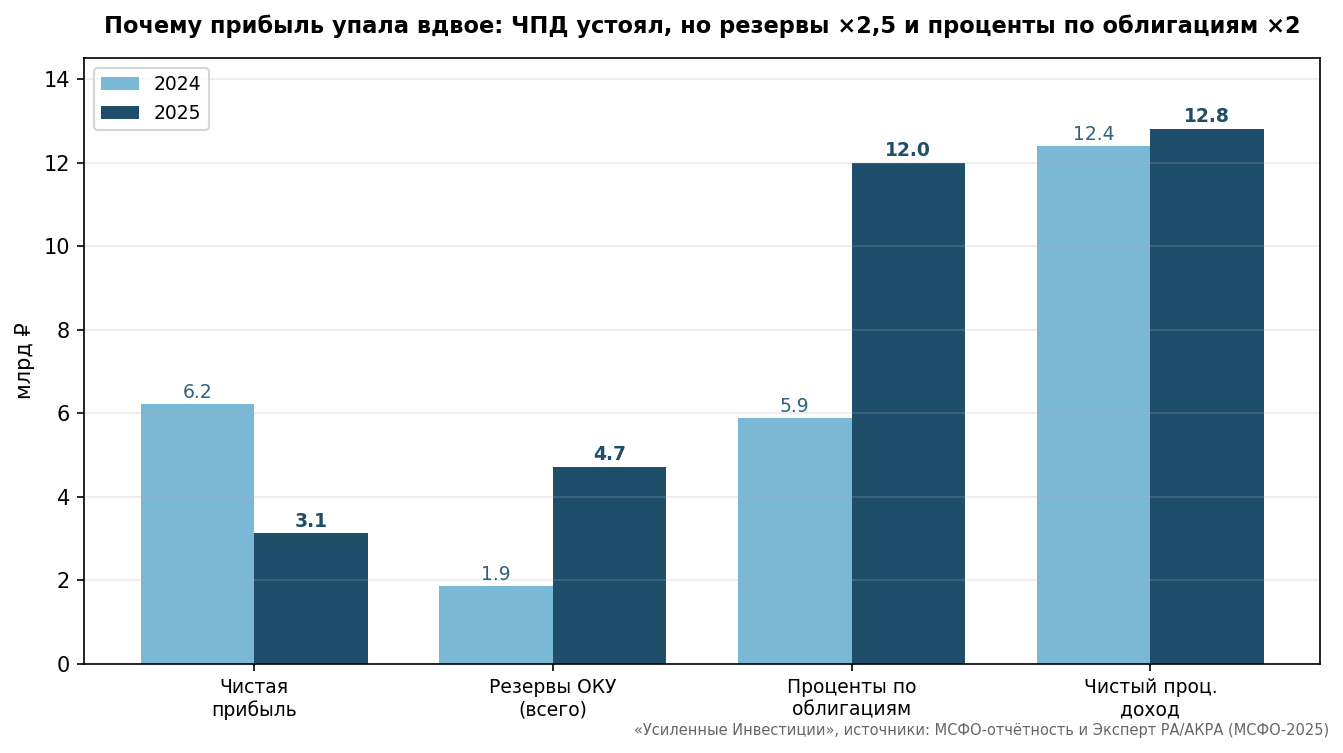
The key result of the year is net profit of RUB 3.13 bn versus RUB 6.22 bn in 2024, a fall of 49.6%. Net interest income barely changed (12.8 versus 12.4 bn), so the operating core held up. Two items ate the profit:
- Interest expense on bonds doubled – from 5.9 to 12.0 bn RUB (plus 20.0 bn of bank loan expense). This is a direct consequence of expensive market funding.
- Provisions for expected credit losses (ECL) tripled – on lease receivables alone 2.56 bn was charged versus 0.84 bn; another 2.16 bn relates to terminated contracts (versus 1.02). Total provisions were 4.7 bn versus 1.9 bn.
- Costs of holding repossessed property (0.71 bn versus 0.17) and its impairment were added.
Profit before tax was 4.19 bn versus 8.09 bn. Return on equity (ROE), according to Expert RA, fell from 27% to 18%, and return on the leasing business from 8% to 5.1%. The margin is compressing – a typical story for the sector at a high rate, but at Baltic it is amplified by other factors (see below).
Balance sheet: growth has stopped, capital has declined
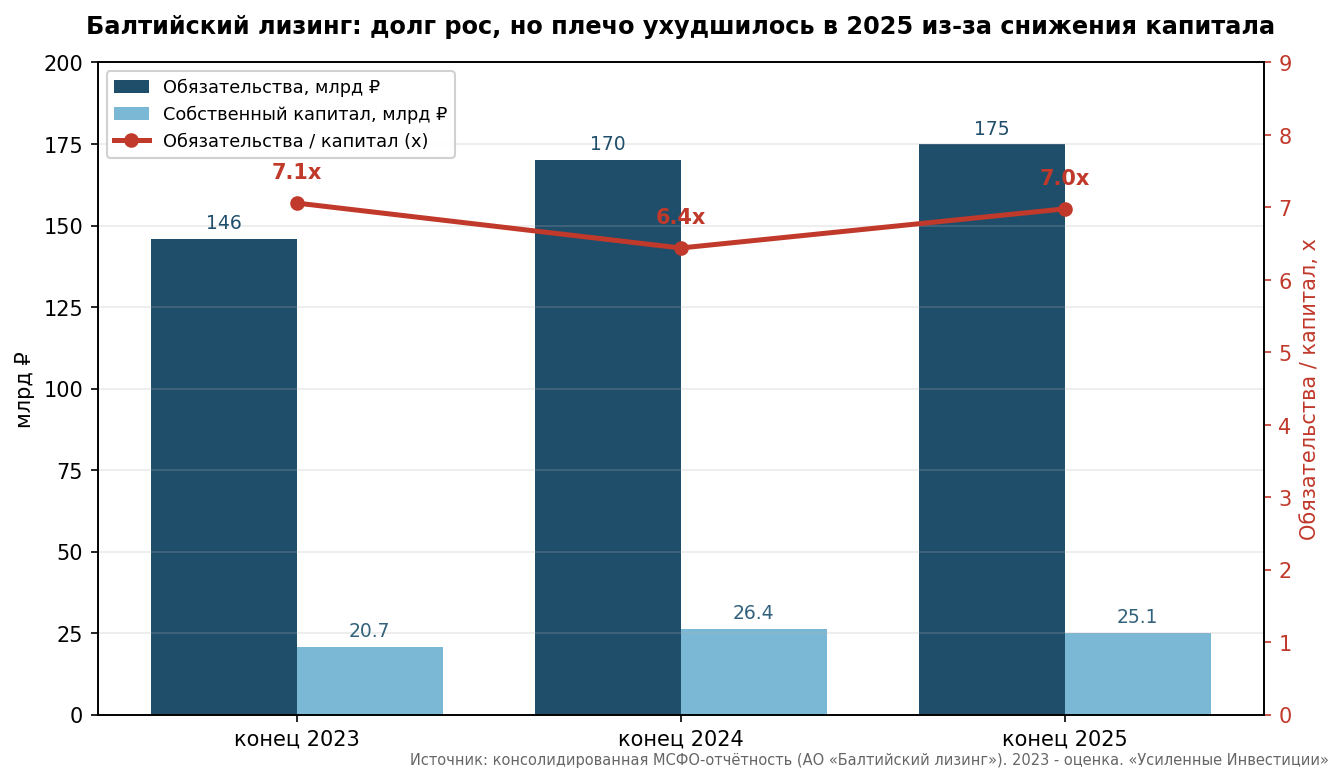
Assets barely grew – RUB 200.0 bn versus 196.6 bn, and net investment in leases (NIL) even shrank slightly (161.4 bn net versus 164.4). After the aggressive growth of 2023-2024 the company entered a phase of portfolio stagnation.
Liability structure: bank loans 92.4 bn (was 100.9), bonds and digital financial assets issued – 68.0 bn (up from 56.6). Total liabilities are 174.9 bn. Equity is 25.1 bn, and it FELL from 26.4 bn – despite a profitable year. The reason is dividends (see the separate section). The liabilities-to-equity ratio is about 7.0x (high leverage is normal for leasing, but the safety cushion is shrinking).
Another market signal: bonds are carried on the balance sheet at 68.0 bn, but their fair value is only 47.5 bn. The gap shows that the market values the company's already placed debt at a substantial discount amid rising rates.
How debt and leverage changed. The company's debt grew actively in 2023-2024 (the portfolio expansion phase) and stabilised in 2025: liabilities barely changed (about RUB 175 bn), but within debt there was a shift from bank loans (100.9 -> 92.4 bn) to bonds (56.6 -> 68.0 bn). The key point is leverage: the liabilities-to-equity ratio improved in 2024 (from about 7.1x to 6.4x, when equity grew from retained profit), but returned to 7.0x in 2025. And it returned not because of debt growth – debt practically did not grow – but because of the DECLINE in equity after dividends that exceeded profit. That is, leverage was worsened by dividend policy, not by debt expansion.
Portfolio quality: provisions tripled, "stage two" rose to 9%
This is the main fundamental signal of deterioration. Under the IFRS 9 model (three credit risk stages), at the end of 2025:
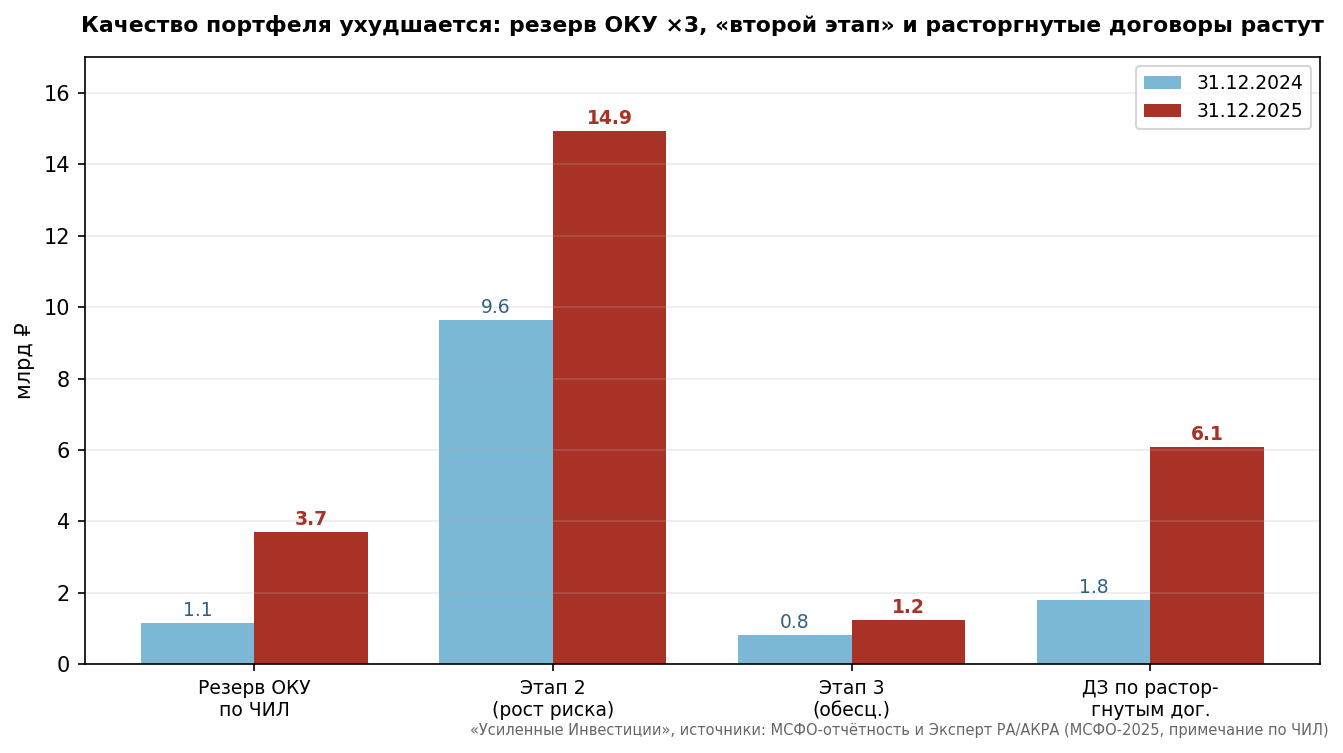
- The ECL provision on NIL tripled – from 1.15 to 3.70 bn RUB; provision coverage of the portfolio rose from 0.69% to 2.24%.
- Stage 2 (significant increase in credit risk) rose from 9.6 to 14.9 bn RUB, which is already about 9% of the gross portfolio (versus 5.8% a year earlier).
- Stage 3 (impaired) is 1.23 bn versus 0.82.
- Receivables on terminated contracts and claims grew 3.4 times – from 1.81 to 6.09 bn RUB.
- Repossessed property on the balance sheet is 3.78 bn; according to ACRA, it reached 27% of capital in mid-2025.
At the same time portfolio concentration remains low (the top 10 lessees are about 5% of NIL, the top 3 industries 42%), and non-overdue receivables are fully covered by the leased assets. So quality is historically high, but the trend has been downward for the second year in a row, and it has already materialised in provisions and profit.
Dividends and capital: the payout exceeded profit
This is the focus of the fundamental risk. In 2025 the company paid dividends of RUB 4.48 bn on net profit of RUB 3.13 bn, a payout of about 143%: all of the year's profit plus part of accumulated profit went to dividends. For comparison, no dividends were paid at all in 2024. The payout was made with negative operating cash flow (-2.35 bn), i.e. the dividend funds were in effect raised with debt.
The result is visible in capital: it declined, and internal capital generation (ACRA's ICG ratio) has been falling for several years in a row (312 -> 213 -> 199 basis points). The capital adequacy ratio (CAR) is 14% against the 12% threshold that ACRA uses; the margin is only about 2 percentage points. This is exactly why ACRA changed its outlook to "developing" in December 2025, explicitly pointing to the "level of dividend payments" and the risk of lower capital adequacy.
Owner and related parties – an area of particular attention
Control of the company changed in October 2023: Baltic Leasing was acquired from Trust Bank by Mikhail Zharnitsky (Control Leasing group); he also became CEO. The direct shareholder per the statements is LLC Pribylnye Investitsii (73.35%). The new beneficiary controls a group of three leasing companies.
A key fact from the IFRS notes: at the end of June 2024 an "organisation under state control" obtained significant influence over the group. It is NOT named in the statements themselves (the business press mentions PSB, to which companies of the Zharnitsky group were pledged in July 2024 – but the primary source, the statements, does not confirm the name). The scale of the link is significant: this state entity accounts for about RUB 45.7 bn of bank loans – roughly half of all bank debt, with interest expense of 8.1 bn for the year.
The risk is twofold. First, ACRA explicitly names as one downgrade trigger an "outflow of liquidity in favour of other structures of the shareholder" – and a 143% payout illustrates this channel vividly. Second, the segment itself is under pressure: the market notes problems at the Control Leasing group linked to the beneficiary. At the same time, no loans "upstream" to the shareholder or guarantees in his favour are disclosed in the statements, and related-party transactions are stated to be on market terms.
Signs of reporting manipulation? A forensic view
We see no direct signs of misstated reporting, and this is important to state: the statements are audited by TeDo (formerly PwC) with an unmodified opinion (no qualifications), and related parties, the fair value of bonds and dividends are disclosed in detail – the level of disclosure is high. Nevertheless, a rigorous review singles out several areas of heightened scrutiny – this is not an accusation but points worth monitoring:
- Problem exposure is wider than the NIL "headline". Overdue 90+ on NIL looks fine (about 1.3%, Stage 3 only 0.7%), but part of the problem assets has been moved OUTSIDE the NIL perimeter: receivables on terminated contracts grew 3.4 times to 6.1 bn, repossessed property is 3.8 bn. Together with Stage 3 this is already about 11 bn (roughly 7% of the portfolio), and taking into account the "watch" Stage 2 (14.9 bn, 9% of the portfolio) the risk picture is noticeably less rosy than the overdue metric shows. The company's thesis of a "high-quality portfolio" rests on a narrow definition.
- Low provision coverage of impaired assets. Only about 18% of Stage 3 is provisioned, and 2.24% of the whole portfolio. If quality keeps deteriorating, further charges are likely, which would again hit profit and capital (in 2025 it was the 2.5-fold rise in provisions that became one of the two reasons for the halving of profit).
- Related-party transactions in assets. The company bought assets for resale from structures controlled by the beneficiary, with a plan to sell them in 2026. The deals are stated to be on market terms and are disclosed, but purchases and sales of assets inside the owner's perimeter are a classic area of heightened attention in forensic analysis.
- A sharp rise in "property, plant and equipment transferred under operating lease" – 6-fold (from 1.5 to 9.4 bn). In itself this is not a violation, but a change in deal structure (operating lease versus finance lease) changes the income recognition profile and requires an understanding of the driver.
- Dividends above profit financed with debt (payout 143% with negative operating cash flow) is an aggressive policy of extracting capital by the owner rather than a misstatement of reporting, but it is exactly what erodes the capital safety margin fastest.
The forensic conclusion: there are no "red flags" at the level of falsified reporting, the audit opinion is clean, disclosure is full. But the real risk picture lies not in the benign overdue metric on NIL but in terminated contracts, repossessed property and Stage 2, plus dividend policy and related-party transactions. These are the areas worth tracking in quarterly reporting.
Debt and liquidity
Bank loans are from 12 banks, rates 10.1-25.1%, maturities 2026-2031; bonds and digital financial assets carry coupons of 11.0-23.7% (some issues are floating, linked to the key rate), maturing in 2026-2028. Collateral pledged to banks is RUB 114.4 bn. The agencies assess liquidity as adequate: there are no peak repayments or refinancing needs over a 24-month horizon; current liquidity is about 1.2. But interest coverage (ICR) is declining – from 142% to 119% over two years.
Bonds on the market. Baltic Leasing is one of the most active issuers: about 26 series, around 16 outstanding, a mix of fixed and floating coupons. The bonds trade at a discount to par (about 89-97%), and floaters give a current yield of about 19-24%. For an investment grade at the "double-A minus" level this is a noticeable premium – the price of the factors listed above and of general sector stress.
How the sector reports for 1H2026 – and why Europlan looks better
The first half of 2026 for the sector is not an acute crisis but stabilisation near the bottom: both ACRA and Expert RA record a softer decline (the number of new contracts about -5% after a 35% collapse a year earlier, the number of items transferred even +6%), but there is no recovery yet. At the same time profit fell at almost all lessors – and against this backdrop it is important to understand whose report holds up and why.
- Europlan – profit rose (RUB 4.3 bn, +129%), but this is a rebound from a low base. The growth came not from margin but from lower provisions for expected losses (from 12.7 to 4.9 bn RUB, i.e. +7.8 bn to profit) and stable non-interest income (insurance and agency commissions are about half of revenue, a structural cushion for Europlan). The interest core fell 32%, and the leasing portfolio 17%. That is, profit doubled on a provision release, not on a recovery of the business.
- DeltaLeasing – profit fell (1.2 bn versus 2.1 a year earlier), ROE from 23% to 13% (while its capital is the strongest in the industry).
- Sovcombank Leasing – profit almost vanished (ROE 0.7%), Stage 3 overdue jumped from 1.2% to 6.2%.
- Interleasing – profit -94% for 2025, Stage 3 rose from 2.6% to 8.5%.
- GTLK – a record loss of RUB 14.2 bn for the first half of 2026 (provisions above 20 bn); its investment-grade rating rests on state support.
- Baltic Leasing – under RAS for the first half of 2026 (consolidated IFRS for the half-year was not published) profit shrank almost to zero – about RUB 40 mn versus roughly 2.1 bn a year earlier, and the portfolio contracted.
Conclusion: Baltic's weakness in 2025-2026 is largely a SECTOR story (expensive funding and a rising cost of risk hit everyone), not the failure of a particular company; the halving of profit under IFRS 2025 is even milder than at a number of competitors. Europlan's resilience is an exception, and to a large extent owed to diversification into commission income, which the monoline Baltic does not have.
Capital versus debt: where Baltic stands among competitors
For a bondholder the key question is how much capital the company has relative to debt, i.e. what the safety margin is. By the autonomy ratio (equity to assets; the higher, the more conservative) at the latest available dates, the picture is as follows:
- DeltaLeasing – about 27-31% (net debt/equity about 2.0x) – the most conservative.
- Europlan – about 27% (debt/equity about 2.7x).
- Interleasing – about 21.7%.
- RESO-Leasing – about 20.7%.
- Baltic Leasing – about 13% (CAR 14%), liabilities/equity about 7.0x.
- Sovcombank Leasing – about 11% (stability rests on the support of the banking group).
- Gazprombank Leasing and GTLK – capitalisation is low or opaque, investment ratings rest on state support.
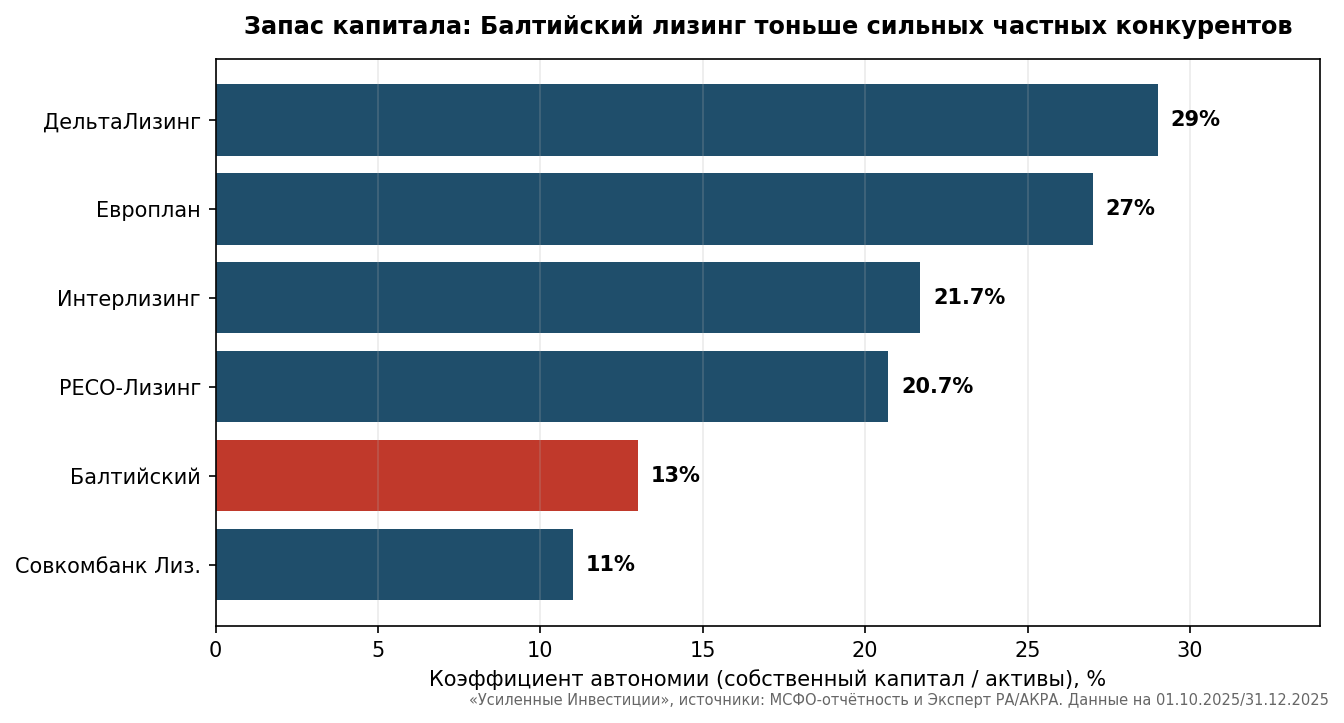
So Baltic Leasing is in the lower-middle part by capital cushion: its buffer is noticeably thinner than that of strong private competitors (Delta, Europlan, Interleasing, RESO with autonomy of 20-31%), although stronger than Sovcombank Leasing and the state companies living on support. And Baltic is the only one of those listed that paid dividends above profit in such a year, additionally spending an already middling buffer. This is the main thing that distinguishes its credit profile from the more conservative Delta and Europlan.
The regulatory angle and the question of capital adequacy. It is worth answering separately the natural question: since capital relative to assets is small, is there a regulatory risk and a capital adequacy issue here? Today – formally no: leasing in Russia is NOT yet supervised by the Bank of Russia, there is no mandatory capital adequacy ratio for leasing companies, and the "CAR of at least 12%" threshold is an internal benchmark of the rating agency, not a law. But the reform of central bank supervision of leasing is at the final stage: companies are to be moved to the status of non-credit financial institutions, included in the Bank of Russia register, required to join an SRO, switch to IFRS reporting with audit and – what is key for our topic – meet minimum capital requirements. If the reform is adopted in this form, the companies with thin capital will be under the most pressure – Baltic Leasing (autonomy about 13%), Sovcombank Leasing (11%), Gazprombank Leasing: they will have to either build capital or limit dividends. For Baltic, which pays dividends above profit, this is a direct forward risk – unlike Delta and Europlan with autonomy of 27-31%, whose margin against any future requirements is many times larger. That is, the capital adequacy question is a rating issue today, and tomorrow may become a regulatory one.
The main question: will Baltic get through autumn 2026
The most practical question about the issuer is not the rating but money: will the company have enough funds to get through the nearest repayment window if holders put everything they can to redemption. We compiled the schedule from Moscow Exchange data.
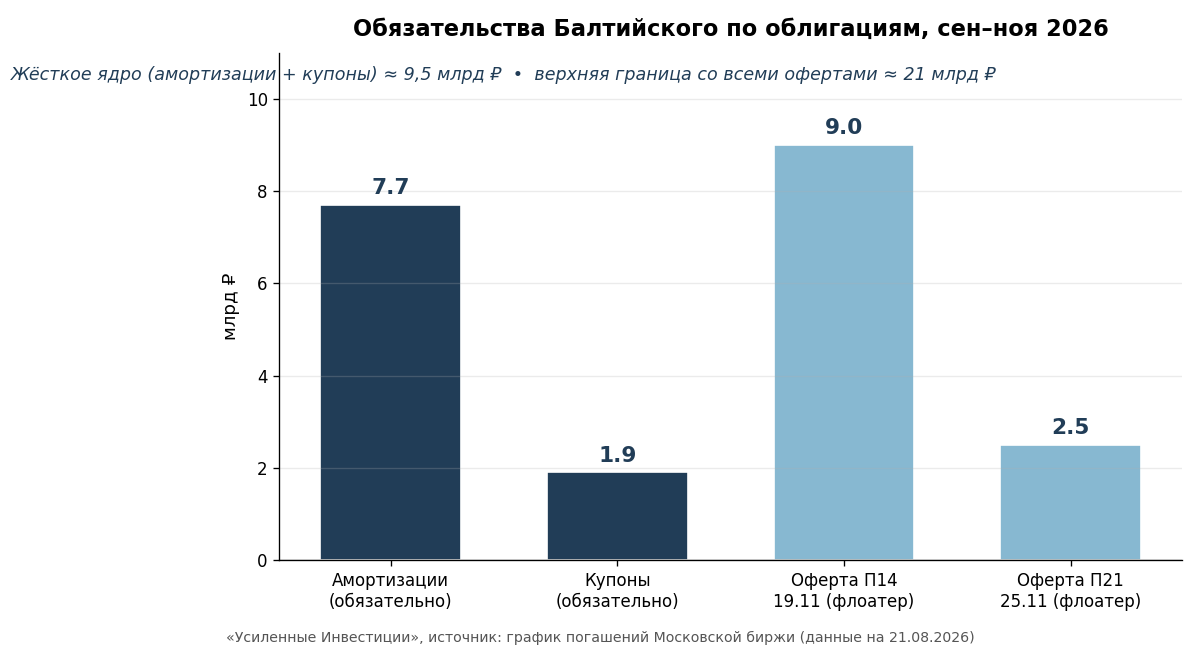
What lies ahead in September–November 2026. Mandatory payments are amortisations of about RUB 7.7 bn (the largest are P10 at 2.4 and P19 at 3.3) and coupons of about RUB 1.9 bn, in total about RUB 9.5 bn for the quarter. Plus two floater offers: P14 (19 November, up to 9.0 bn) and P21 (25 November, up to 2.5 bn). If holders tender the entire amount at the offers, the upper bound of the requirement is about RUB 21 bn.
Will the company find this money. First: the hard core – amortisations and coupons, about RUB 9.5 bn for the quarter – is covered by own receipts from the existing portfolio. Baltic's net investment in leases is about RUB 165 bn, and monthly payments from lessees many times exceed the quarterly repayments if new business origination is slowed. This is how the leasing model repays debt in a contracting market – by not originating new business and directing receipts from the old portfolio to repayments; the whole market is doing this now (new business nationwide -40%, Baltic -9%).
Second: floater offers are a manageable quantity, not a fixed one. Under an irrevocable offer the issuer itself sets the coupon for the next period, and at a market spread most holders stay in the bond rather than tendering it. So RUB 11.5 bn is a theoretical maximum "if everything is tendered", not a base case. Third: bank credit lines secured by leased motor vehicles are the most stable source (about half of liabilities), and it is these that are used to top up liquidity.
Where the real risk is. Besides the price of refinancing (to keep investors at the offers and place new bonds, the company will have to pay dearly – bank demand for floaters has been depressed by regulation, the retail investor is cautious, and interest expenses have already doubled and eaten half of profit), there is also a direct liquidity question. And here there are public data after all: the interim RAS statements for the first half of 2026 show that the safety margin shrank sharply over six months. Let us go through the facts.
Checking against facts: what RAS 1H2026 shows
Commenters rightly pointed out that one should look not at nice words but at what happened to the money over the half-year. We look – and the picture is sobering.
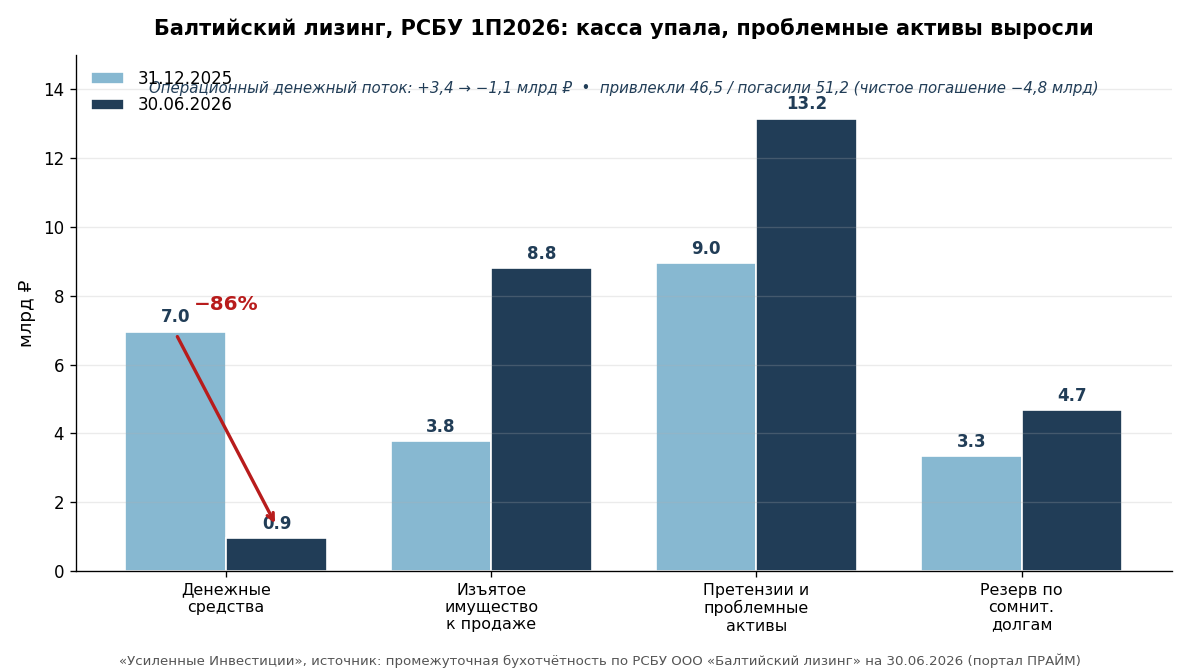
The cash cushion is almost exhausted. The cash balance fell from RUB 6.96 bn on 31.12.2025 to RUB 0.95 bn on 30.06.2026 – minus 86% over the half-year (plus about 0.45 bn of short-term financial investments). That is, free cash at the end of June is about one billion, which is very little for a 194 bn balance sheet.
Operating cash flow turned negative. The balance of cash flows from operating activities for 1H2026 is minus RUB 1.12 bn versus plus 3.37 bn a year earlier. In financing activities the company raised 46.5 bn and repaid 51.2 bn of loans and borrowings, plus 14.2 bn of interest – that is, on a net basis it did not raise but repaid debt (about −4.8 bn), financing this from accumulated cash. This is how the cushion melted: the balance of all flows for the half-year is −RUB 6.0 bn.
Problem assets are growing. Claims and problem assets in receivables rose from 8.96 to 13.15 bn RUB (+47% over the half-year), the provision for doubtful debts from 3.34 to 4.67 bn, and repossessed property, recorded as "non-current assets held for sale", from 3.78 to 8.80 bn RUB (+133%). At the same time over the half-year the company already sold repossessed equipment for RUB 4.5 bn (visible in the cash flow statement) – that is, the inflow of repossessed property outpaces its sale. Net profit under RAS for 1H2026 is a symbolic RUB 40 mn versus 2.1 bn a year earlier.
One more detail on debt. Total debt over the half-year fell from 165.6 to 160.9 bn RUB, but within it 22.9 bn RUB was moved from the long-term to the short-term portion – that is, noticeably more comes due for repayment/refinancing in the next 12 months than a year earlier. Current assets are smaller than current liabilities – working capital is negative.
An approximation for 2H2026 – and an honest conclusion. If the same economics are applied to the second half, the picture is as follows. The mandatory amortisations and coupons of the autumn (about RUB 9.5 bn for the quarter) and possible offers (up to 11.5 bn if the whole amount is tendered) were passed by the company in the first half thanks to three things: large collections on the portfolio (lease receipts of about 60 bn over the half-year), sales of repossessed property and – chiefly – the consumption of the cash cushion by 6 bn. In the second half the third source is almost exhausted: a cushion of 0.95 bn is no longer enough to close gaps as before. So everything depends on whether banks keep rolling credit lines (so far they do – 46.5 bn raised) and whether collections on a shrinking portfolio are sufficient. We therefore adjust our earlier thesis: an acute default scenario for the autumn is still not visible from these data – gross collections on the portfolio are large, there is 8.8 bn of repossessed property for sale and working bank lines. But the safety margin shrank sharply over the half-year: cash is almost exhausted, operating cash flow is negative, the company is in a net debt repayment mode, and problem assets are growing. This is a noticeably tenser picture than "there is plenty of money". Any further deterioration (banks slow the lines, collections slow, many are tendered at the offers) will leave the company with nothing to repay with in the second half – the cushion that saved it in the first is no longer there. We track cash and borrowing dynamics for 9M2026 separately.
Issue yields: 30–44% according to Moscow Exchange data
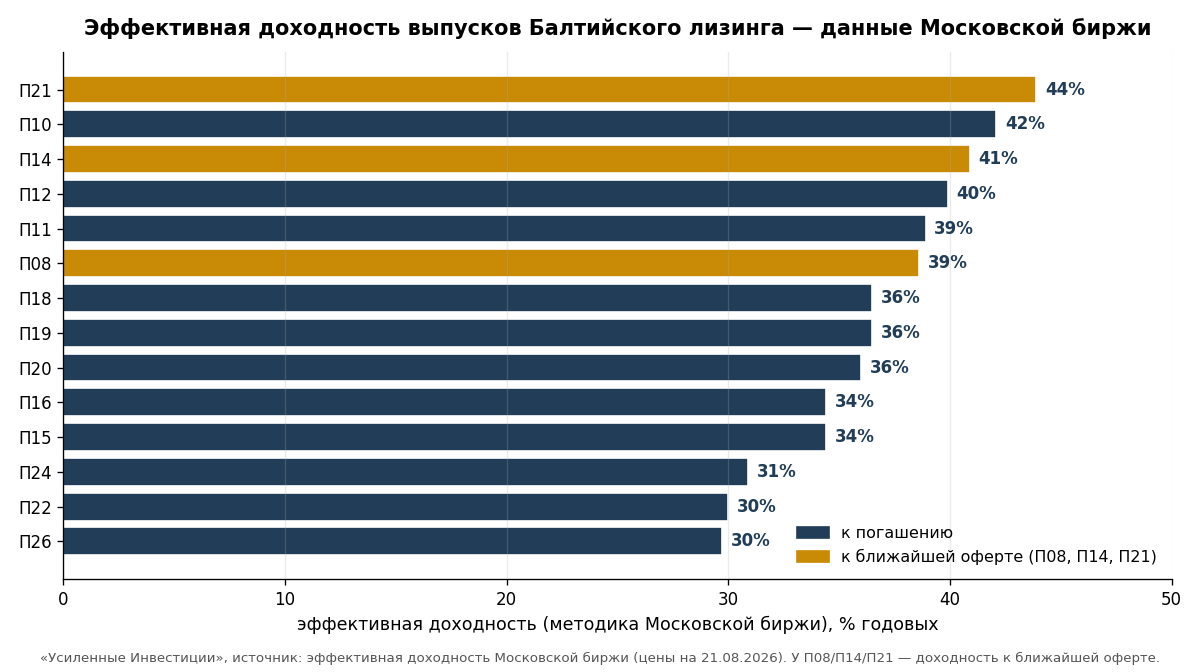
The benchmark for comparison is the same effective yield to maturity or to the nearest offer shown by the exchange and brokerage terminals. For Baltic's issues it is about 30–44% per annum (per Moscow Exchange data): P21 – 44%, P10 – 42%, P14 – 41%, P12 – 40%, P08 and P11 – about 39%, P18/P19/P20 – 36–37%, amortising P15 and P16 – 34%, P22/P24/P26 – 30–31%.
Where such levels come from. Three sources of premium. First, the discount to par: the bonds trade at 88–97% of par, and the pull-up toward 100 is added to the coupon. Second, the short horizon to the nearest offer: for P14 and P21 the offer is already in November 2026, for P08 in May 2027, while the formal maturity is as late as 2033–2035; the yield is calculated to the offer, and a return to par within a few months gives a high annual figure. Third, amortisation: part of the issues return principal in instalments, and early repayment at 100 from a price of about 90 raises the internal yield.
An important caveat on what actually "reaches the hand". The effective yield assumes that at the offer the investor tenders the bond for redemption at par and reinvests the proceeds at the same rate. In practice the issuer sets a new coupon at the offer, and if it is at market the investor stays in the bond – then the realised yield is closer to the coupon (about 15–24%) than to the yield-to-offer. So 30–44% is a correct exchange benchmark when buying with the offer in mind, not a guaranteed yield for someone who holds until 2033. We also note a technical detail: for amortising issues different calculators give a spread (at some terminals the annual figure is overstated relative to the exchange's) – we use the Moscow Exchange's own methodology as an independent benchmark.
Risks – summary
- Capital and dividends: payout of 143% with falling profit; capital has already declined; CAR 14% against the agency's internal threshold of 12% (margin ~2 pp). The direct reason for ACRA's "developing" outlook.
- Capital adequacy and upcoming regulation: autonomy of about 13% – thinner than at strong competitors (20-31%); there is no formal ratio yet, but the reform of central bank supervision (minimum capital, IFRS, SRO) is at the final stage, and thin capital together with a 143% payout makes the company more vulnerable than the leaders under future requirements.
- Portfolio quality: ECL provisions tripled, Stage 2 about 9% of the portfolio, growth of terminated contracts and repossessed property. The trend has been downward for the second year.
- Profitability: net profit -50% under IFRS 2025, ROE 27% -> 18%, leasing margin 8% -> 5%; under RAS for 1H2026 profit shrank almost to zero. Pressure from expensive funding.
- Liquidity (RAS 1H2026): cash cushion -86% (6.96 -> 0.95 bn RUB), operating cash flow turned negative (-1.12 bn), the company is in a net debt repayment mode (raised 46.5 / repaid 51.2 bn), 22.9 bn of debt moved to short-term. The safety margin for 2H2026 has shrunk sharply.
- Owner and related parties: risk of liquidity outflow to the shareholder's structures (named by ACRA as a trigger); the Control Leasing group is under market scrutiny; half of bank debt is from a state entity that entered the capital (not identified in the statements).
- Industry: the leasing market -40% in 2025, a wave of defaults among small high-yield issuers, problem assets across the market rising to 8.7% of NIL; the VAT increase to 22% from 2026 makes deals more expensive.
- Rating divergence: ACRA – "developing" (December 2025), Expert RA – "stable" (January 2026). Two views of the same set of facts; no upgrade is built into the base case.
Conclusion
Baltic Leasing is a private lessor strong in franchise (top 4 in the market, a stable share, a diversified retail portfolio, an audit without qualifications) that holds up noticeably better than competitors amid the market collapse. But its fundamentals objectively weakened in 2025: profit halved, portfolio quality is deteriorating, and capital is shrinking because of dividends above profit – against the background of control by a new owner and a state entity that entered the capital.
Our conclusion: this is not a "quiet harbour" but a quality, yet not risk-free issuer, whose trajectory in 2026 depends on three things – a lower key rate (will relieve the margin and new business), dividend discipline (otherwise capital will keep melting) and stabilisation of portfolio quality. For a bond investor the yield premium over the nominal "double-A minus" reflects exactly these factors; a position is appropriate as a moderate share and with monitoring of ACRA's rating action, dividend policy and the quarterly dynamics of provisions.
How critical this is for the sector. The market is objectively under serious pressure – profit fell at almost everyone, problem assets across the market doubled in 2025 to 8.3%. But both ACRA and Expert RA describe the first half of 2026 as stabilisation near the bottom, not an acute crisis; the wave of defaults is among small high-yield issuers (a characteristic case is Sobi-Leasing), not among names at the "double-A minus" level. For Baltic this means: elevated but not critical risk – provided the key rate falls (will relieve the margin and new business) and dividends are disciplined. Its weak point is not the quality of the business but capital that is thinner than the leaders' and is actively spent on dividends.
Analysis of issuers and bonds is in the Telegram channel Enhanced Investments @eninv.
See also: market overview · valuation map · stock screeners