Brusnika: 24-26% yields on bonds of a developer rated A- with equity at 5% of the balance sheet
Yekaterinburg-based developer Brusnika is among Russia's ten largest homebuilders by volume of housing under construction. The company has eight bond issues outstanding with a total face value of RUB 31.4 bn, all available to non-qualified investors. Coupons are 21-22.75% p.a., ratings are A- from ACRA and NCR. After the sell-off in developer bonds on 18 September, the long issues trade at 94-99% of par and yield 24.7-26.5% p.a. to maturity or put, 10.7-12.5 pp above the key rate. The short issue 002P-02 maturing in March 2027 trades near par and yields 23.3%.
Short verdict. The business is real and growing faster than the market. Half-year revenue doubled, the financial statements carry an unmodified opinion from one of the country's largest auditors, escrow covers 68% of project debt, in line with the national average, and non-project debt is small. The weak point is the structure. Equity is 5% of the balance sheet, interest accrued is 3.5 times the interest paid in cash, covenants under several loans rest on waiver letters from banks, ACRA has a negative outlook, and the owner has taken money out of the group. Over the next 12 months the bonds require up to RUB 12.8 bn against RUB 4 bn of cash, and the company will pay from escrow releases and new placements. The short 002P-02 looks calm. The long issues at 24.7-26.5% are a bet that the bond market stays open for refinancing. On the portal's traffic light this is the yellow zone.
The issuer's card on the portal, with financials by period, credit metrics and all bond issues: https://frontier.eninvs.com/issuer/6685151087. Below are calculations by Enhanced Investments based on IFRS statements for 2024, 2025 and the first half of 2026, company disclosures, rating agency releases and Moscow Exchange data. Where a figure is our estimate, it is marked as such.
Eight issues: the short one trades at par, the long ones yield 24.7-26.5%
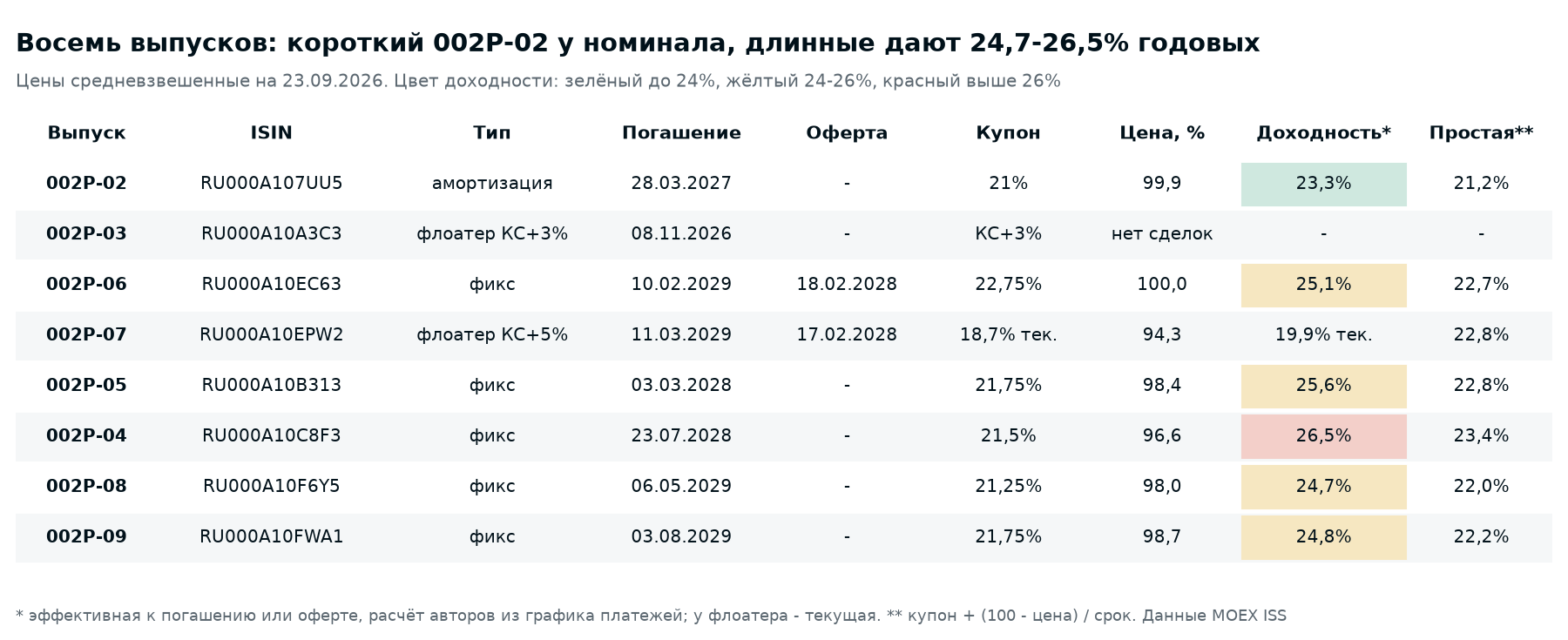
| Issue | Maturity | Put | Coupon | Price, % | Yield | Simple |
|---|---|---|---|---|---|---|
| 002P-02 | 28.03.2027 | - | 21% | 99.9 | 23.3% | 21.2% |
| 002P-03 | 08.11.2026 | - | Key rate+3% | no trades | - | - |
| 002P-06 | 10.02.2029 | 18.02.2028 | 22.75% | 100.0 | 25.1% | 22.7% |
| 002P-07 | 11.03.2029 | 17.02.2028 | Key rate+5% (18.7%) | 94.3 | 19.9% current | 22.8% |
| 002P-05 | 03.03.2028 | - | 21.75% | 98.4 | 25.6% | 22.8% |
| 002P-04 | 23.07.2028 | - | 21.5% | 96.6 | 26.5% | 23.4% |
| 002P-08 | 06.05.2029 | - | 21.25% | 98.0 | 24.7% | 22.0% |
| 002P-09 | 03.08.2029 | - | 21.75% | 98.7 | 24.8% | 22.2% |
Fact. The put on issue 002P-05 took place on 14 September. The company set the coupon for the following periods at 21.75% p.a. versus 24.75% before, and the bond fell below par. The company has not publicly disclosed how many bonds were tendered.
The next test is in November: 002P-03 maturity and 002P-02 amortization
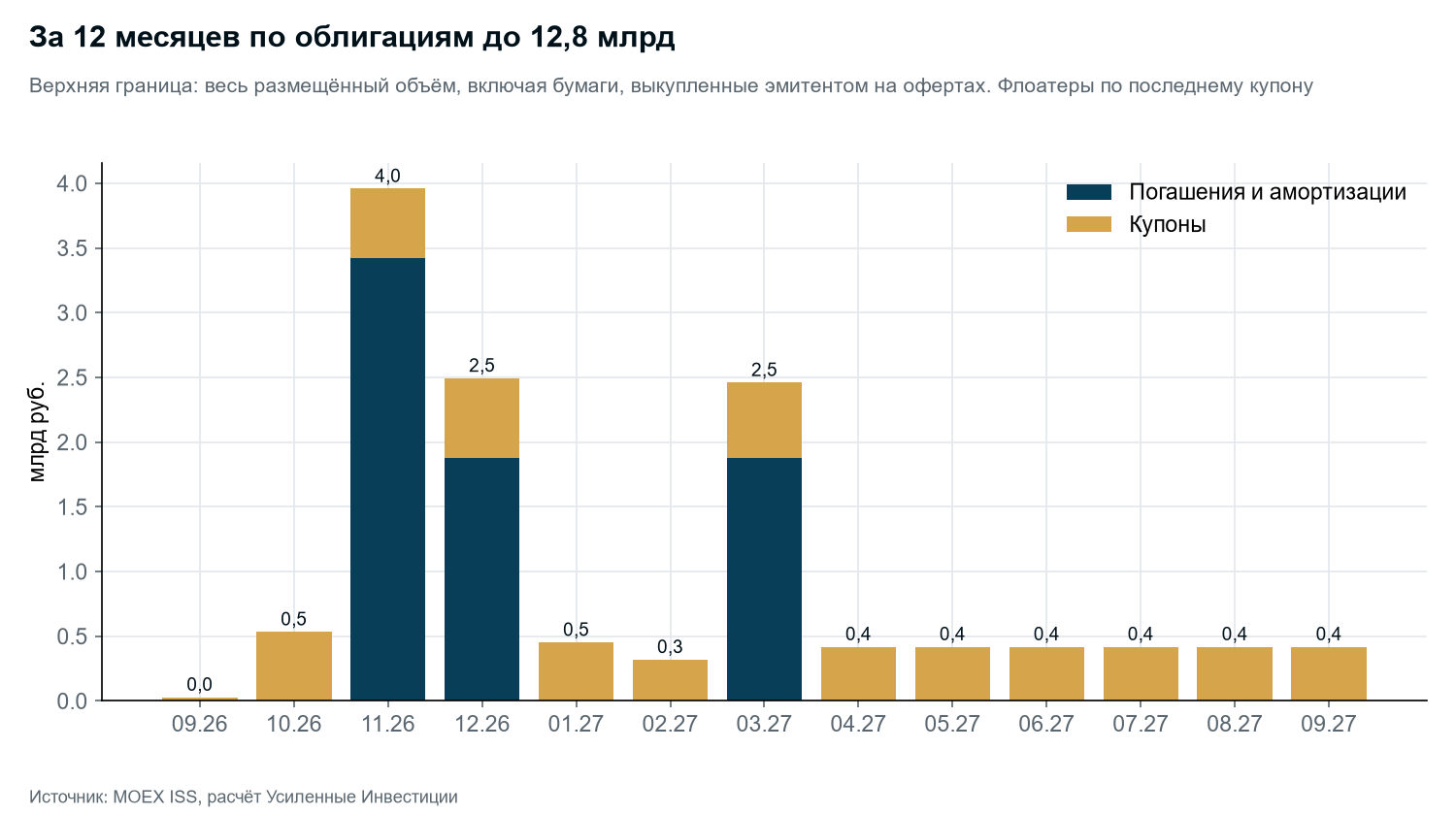
Authors' calculation. From October 2026 to September 2027 the bonds require RUB 5.6 bn of coupons and RUB 7.2 bn of redemptions and amortization, up to RUB 12.8 bn in total. The peak is 8 November 2026, when the floater 002P-03 matures for RUB 3.4 bn (how many bonds were bought back at the November 2025 put is not disclosed). In December 2026 and March 2027, 25% of the face value of 002P-02 is repaid each time, up to RUB 1.9 bn. The next puts on 002P-06 and 002P-07 are only in February 2028.
Fact. The group's cash as of 30 June 2026 was RUB 4.0 bn. Off balance sheet there is RUB 154.1 bn in escrow, but the company cannot use it until the buildings are commissioned, and on release this money first repays project loans. In the first half, escrow releases brought the group RUB 16.6 bn, and RUB 43.3 bn in 2025.
What this means. The company gets through the next year if it delivers buildings on schedule and can place new issues. Since the start of 2026 it has placed four issues for RUB 13.75 bn. For 002P-08 and 002P-09 the volume exceeded the target, for 002P-06 RUB 1.5 bn was placed against a RUB 2 bn target. Without new placements, the November redemption is almost equal to all the cash as of 30 June.
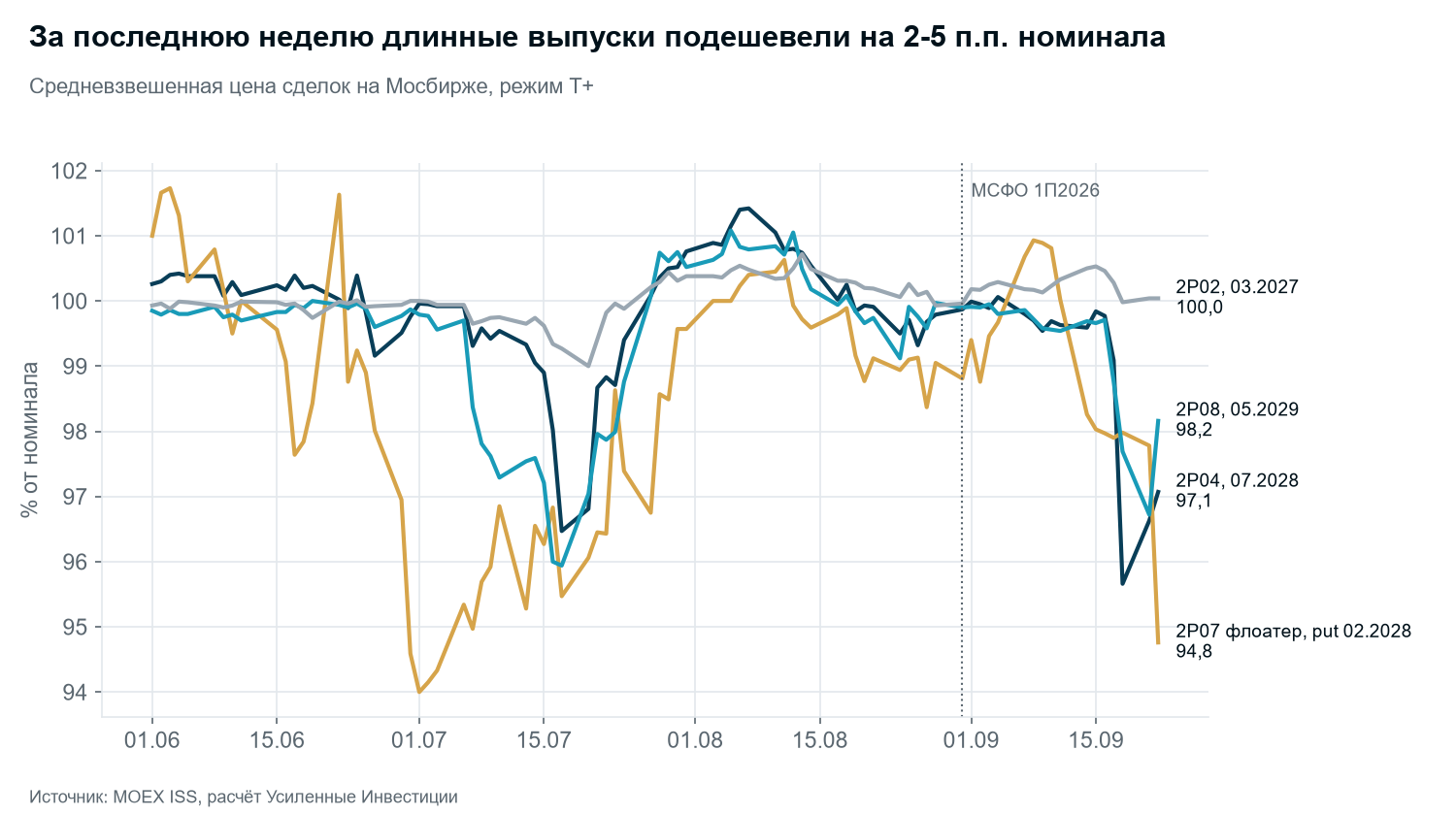
The market repriced the bonds on 18 September together with the whole sector
Fact. Until 17 September, Brusnika's long issues traded at 99-100% of par. On 18 September, 002P-04 lost 3.4 pp on turnover of RUB 87 mn versus the usual RUB 20-35 mn, while 002P-05 and 002P-08 fell 1-2 pp. On the same day bonds of almost all developers and leasing companies were being sold, and Brusnika had no disclosures or rating actions of its own on those days. On 22 September the floater 002P-07 dropped to 94.8% on thin turnover.
Revenue doubled, profit is made in the second half
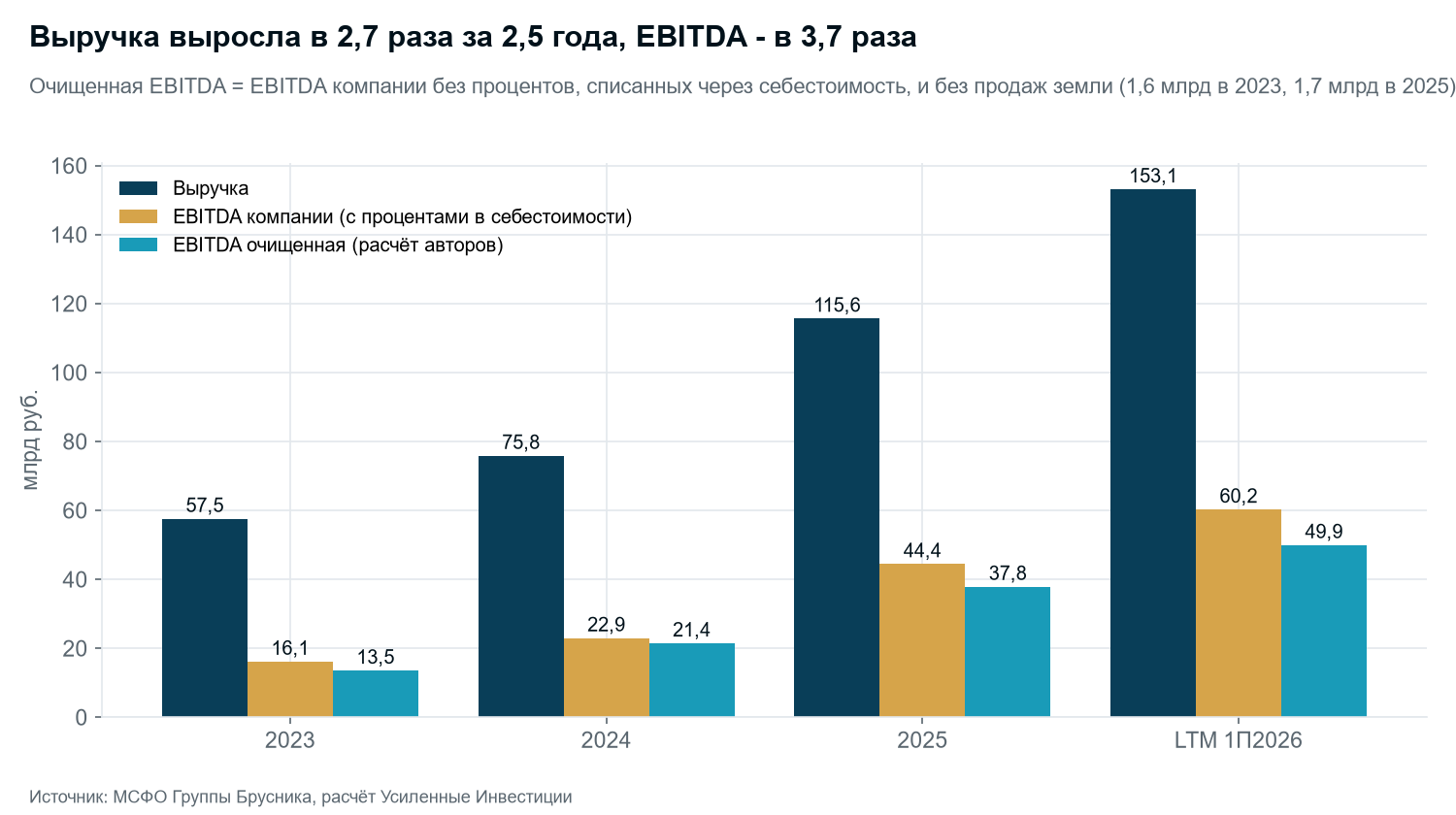
Fact. Revenue for the first half of 2026 was RUB 73.6 bn versus RUB 36.0 bn a year earlier, gross margin 38.7%. Revenue for the 12 months to 30 June was RUB 153.1 bn, versus RUB 57.5 bn for 2023. Sales in the half year were 281.9 thousand sq m (+77%) worth RUB 56.5 bn (+84%), mortgage share 78%. Completions fell by 32.5% to 112 thousand sq m; the company plans most deliveries for the second half.
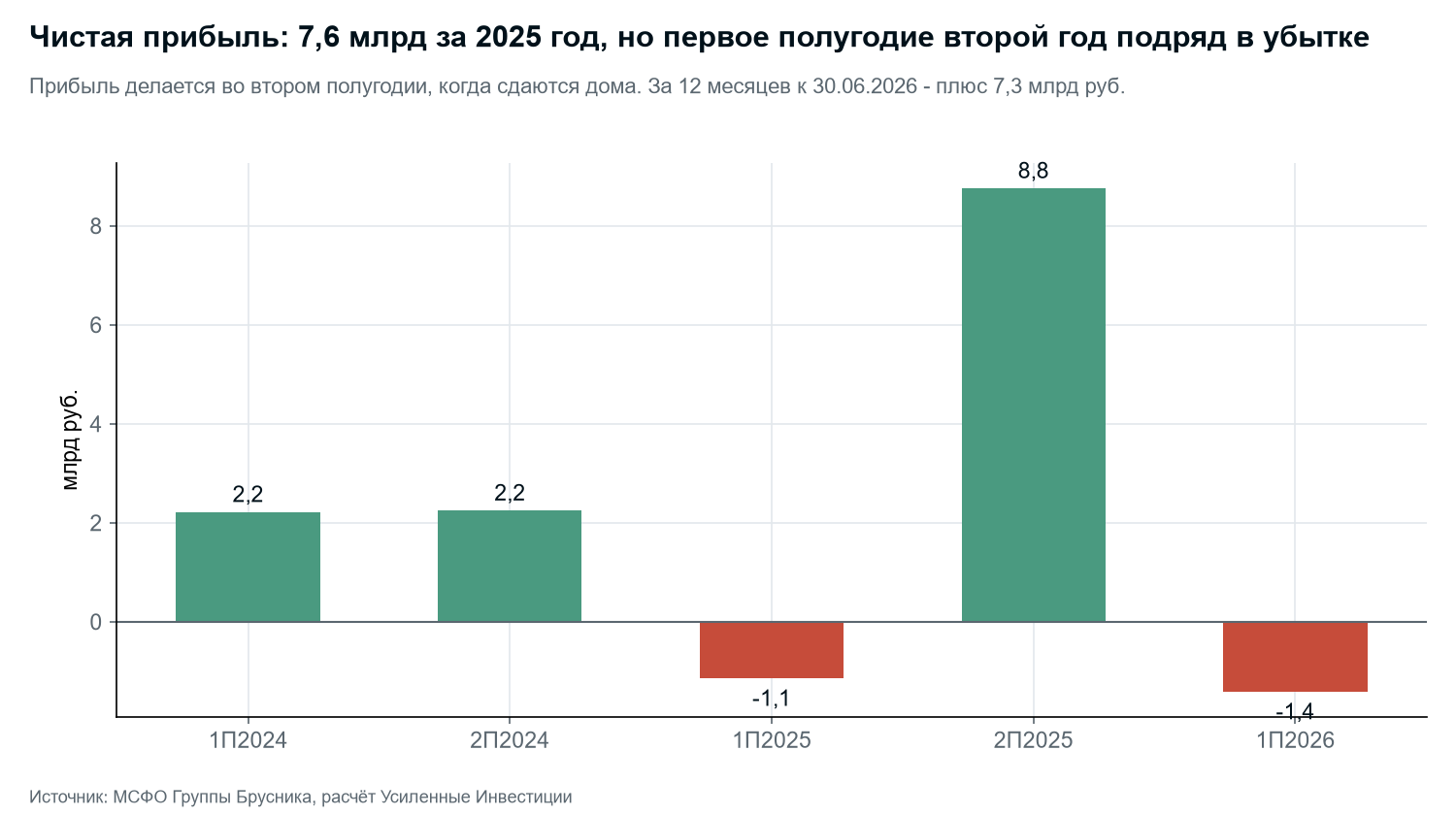
Fact. Net profit for 2025 was RUB 7.6 bn (RUB 4.5 bn in 2024, RUB 7.6 bn in 2023). The first half was loss-making for the second year in a row: minus RUB 1.1 bn in 2025 and minus RUB 1.4 bn in 2026. Profit for the 12 months to 30 June 2026 was RUB 7.3 bn. The company attributes the half-year loss to the cost of servicing debt: finance costs doubled to RUB 23.4 bn against operating profit of RUB 20.9 bn.
Three measures of debt: 2.98x EBITDA by the company's count, 3.7x by ours, 6.8x without netting escrow
Fact. In its half-year results release, the company reported 12-month EBITDA of RUB 60.2 bn and said net debt net of escrow to EBITDA fell to 2.98 from 3.92 at the start of the year. The company's EBITDA includes interest that was capitalized into the cost of apartments and written off through cost of sales: RUB 5.0 bn in the first half of 2026 and RUB 4.9 bn in 2025. In 2025 operating profit also included RUB 1.7 bn from the sale of land.
Authors' calculation. Excluding these items, 12-month EBITDA is RUB 49.9 bn. All ratios to EBITDA further in this review are calculated from this figure. The company's net debt (RUB 179.6 bn) is loans and borrowings minus cash and escrow, excluding leases. Three measures as of 30 June 2026: - the company's count: 179.6 bn to the company's EBITDA of 60.2 bn - 2.98; - our count: the same net debt plus leases of 5.3 bn, i.e. 184.8 bn, to adjusted EBITDA of 49.9 bn - 3.7. This is the main measure of the review; - our count without netting escrow: loans, borrowings and leases of 343.0 bn minus cash of 4.0 bn, i.e. 339.0 bn, to the same EBITDA - 6.8. This is how the burden looks if the buildings are not delivered and escrow is not released.
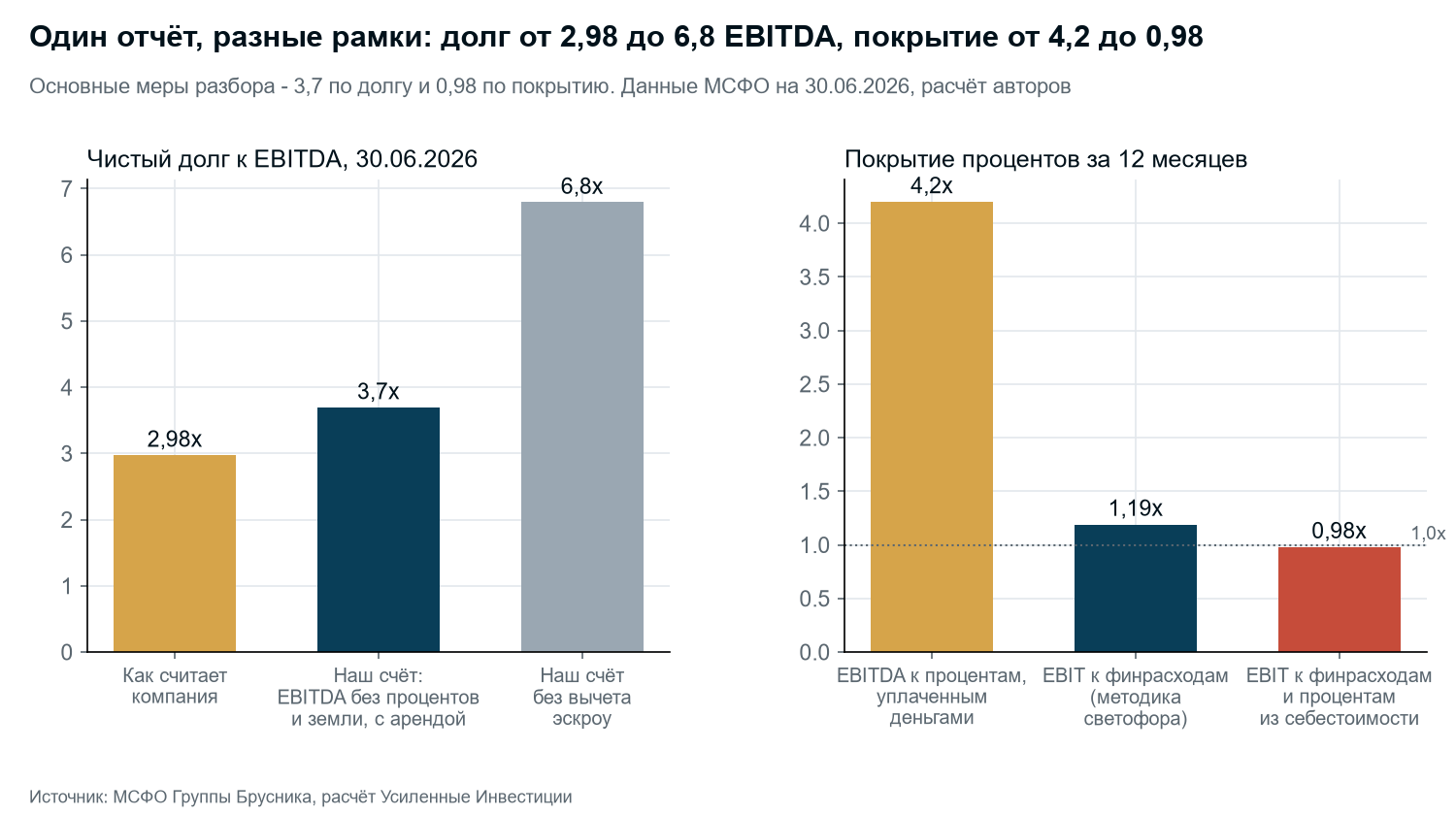
Authors' calculation. Interest coverage for the 12 months to 30 June 2026: - adjusted EBITDA (RUB 49.9 bn) to interest paid in cash (RUB 11.8 bn): 4.2; - operating profit (RUB 49.8 bn) to finance costs (RUB 41.9 bn), as the portal's traffic light counts it: 1.19; - operating profit to finance costs together with interest written off through cost of sales (RUB 50.6 bn): 0.98. This is the main measure of the review, and the comparison table with developers is calculated on it too.
Finance costs include a non-cash escrow effect (RUB 13.5 bn in the first half), but the same non-cash effect sits in revenue (RUB 14.0 bn), so numerator and denominator are comparable.
What this means for bondholders. In cash terms interest is covered with a margin, because most interest is capitalized into project debt and repaid from escrow when buildings are delivered. On the full measure, operating profit for the year covers interest expense exactly once (0.98), and 0.74 times in the first half. Brusnika's profit comes in the second half, but there is no cushion: if the key rate stays at 14% and sales slow, coverage will remain below one (authors' assumption).
Among 12 developers: debt at the median by the company's count, equity among the thinnest, escrow growing fastest
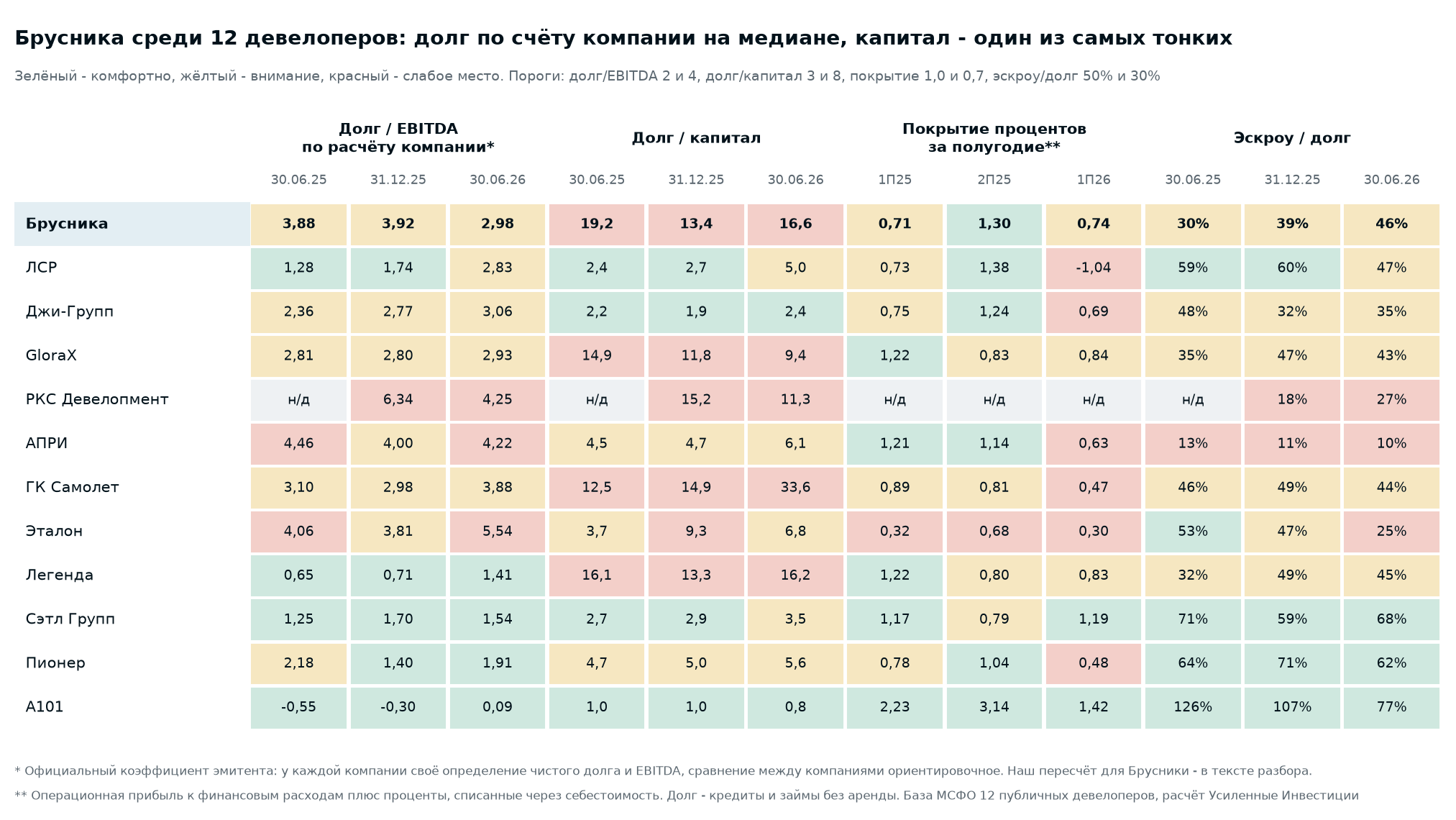
Authors' calculation. Brusnika's trends point in different directions: - debt to EBITDA by the company's count is improving: 3.88 as of 30 June 2025, 3.92 at year-end, 2.98 as of 30 June 2026, because EBITDA grows faster than debt. By our count as of 30 June 2026 - 3.7; - escrow to debt is improving: 30%, 39%, 46%, the best trend in the sample; for most developers the share fell over the half year; - interest coverage is deteriorating: 1.28 for 2024, 1.08 for 2025, 0.98 for the 12 months to 30 June 2026; - debt to equity is high: 19.2, 13.4, 16.6; equity is eaten by the half-year loss and payments to the owner.
As of 30 June 2026, Brusnika's debt by the company's count (2.98) is exactly at the median of 12 public developers (2.96). Interest coverage for the first half (0.74) is above the median (0.69): only A101 and Setl Group are above one. The weak point is equity: 4.9% of assets against a median of 9.8%; only Samolet (2.2%) and Legenda (4.4%) are lower. By the share of escrow in debt (46%) Brusnika is mid-table, but it is the only company in the sample whose share has grown for three periods in a row. For comparison, LSR and G-group keep debt to equity at 5.0 and 2.4, Glorax at 9.4, APRI at 6.1.
Escrow covers 68% of project debt, almost the market average
How it works. Buyers' money under shared-construction contracts sits in escrow at a bank until the building is commissioned, and the more of it there is, the lower the rate on the project loan.
Fact. As of 30 June 2026, project loans secured by escrow were RUB 225.9 bn, and another RUB 65.4 bn of project financing was drawn before escrow accounts were opened. Escrow held RUB 154.1 bn. For the industry, coverage as of 1 July 2026 was 69.6%, a six-year low (ERZ.RF).
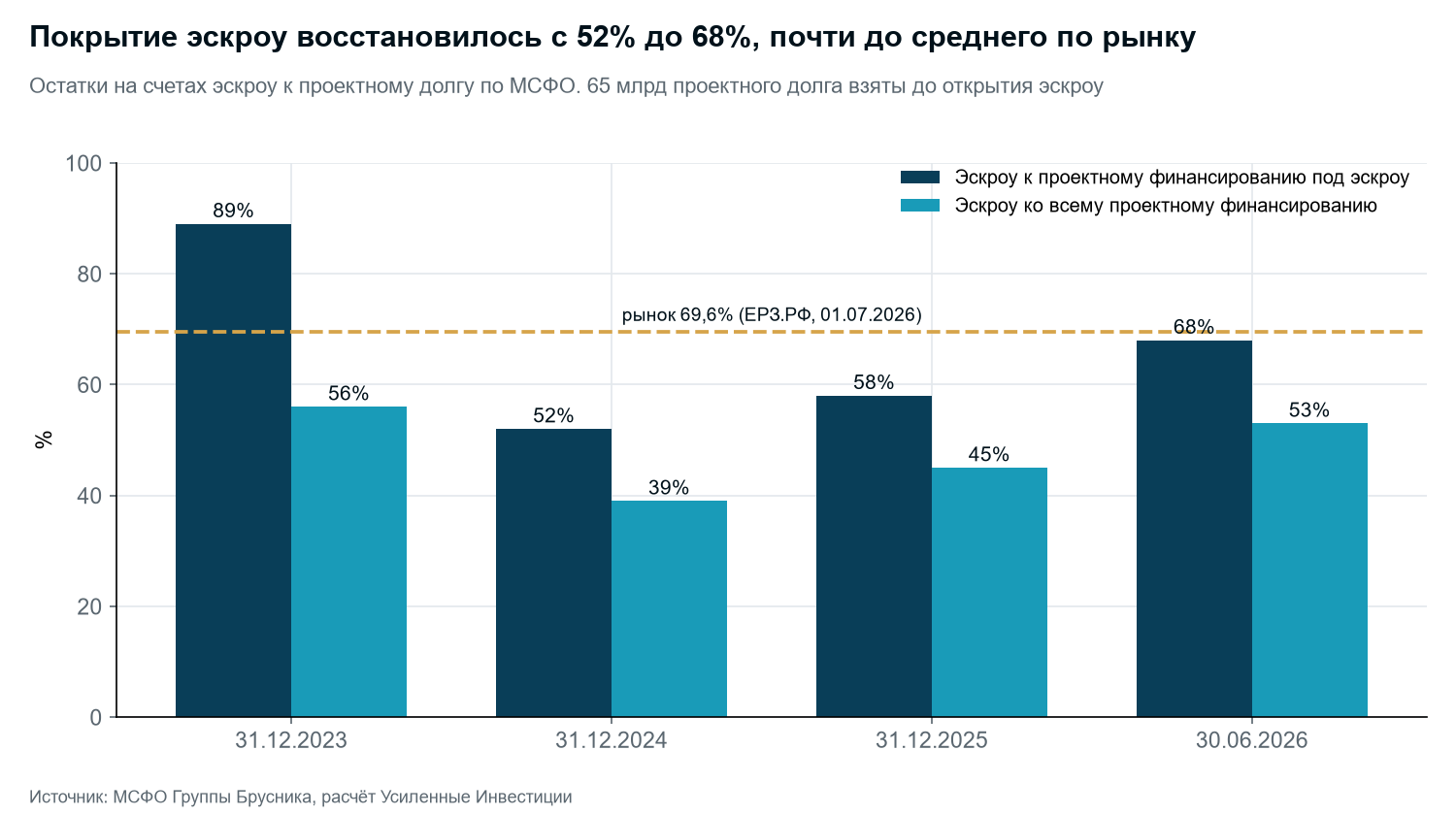
Authors' calculation. Coverage of escrow-backed loans was 89% at the end of 2023, fell to 52% in 2024, when project debt almost doubled, and recovered to 68%. Coverage of total project debt is 53%.
Debt of RUB 343 bn, of which RUB 46 bn is non-project
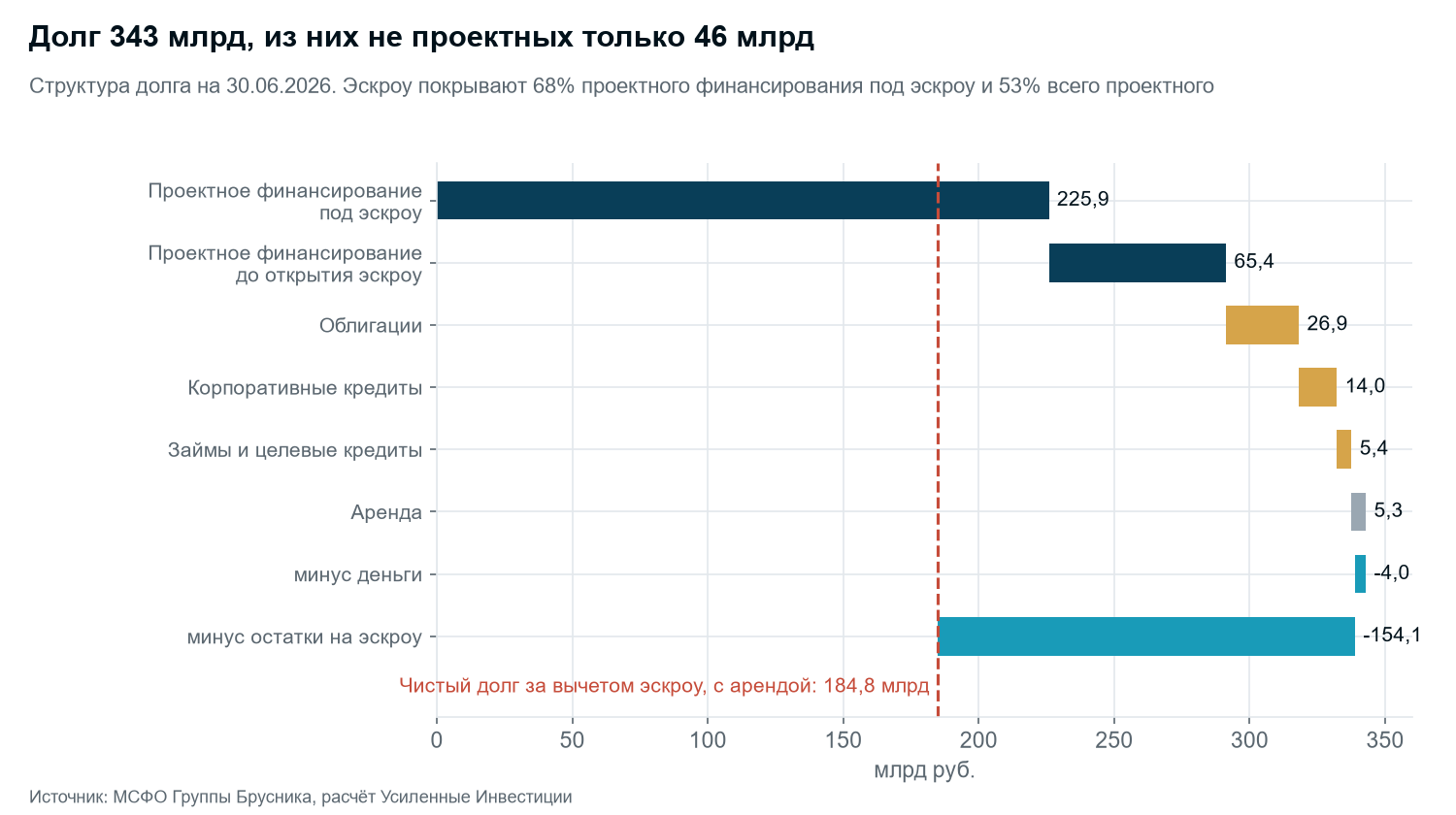
Fact. Bonds amount to RUB 26.9 bn on the balance sheet, corporate loans RUB 14.0 bn, borrowings and targeted loans RUB 5.4 bn, leases RUB 5.3 bn. The rate on 90% of debt (RUB 305 bn) depends on the key rate. Unused credit lines including project finance limits are RUB 664.6 bn. Loans of RUB 21.8 bn are secured by the beneficiary's guarantee.
Authors' calculation. Non-project net debt (bonds, corporate loans, borrowings and leases minus cash) is RUB 47.6 bn, 0.95x EBITDA. Each percentage point of the key rate adds up to RUB 3 bn of interest a year, part of which is offset by the subsidized rate on escrow-backed loans. Project finance limits are allocated to specific buildings and cannot be used to repay bonds (authors' assumption; the company does not disclose a breakdown of the limits).
Balance sheet: 81% of assets are construction and settlements with buyers, 82% of liabilities and equity is debt
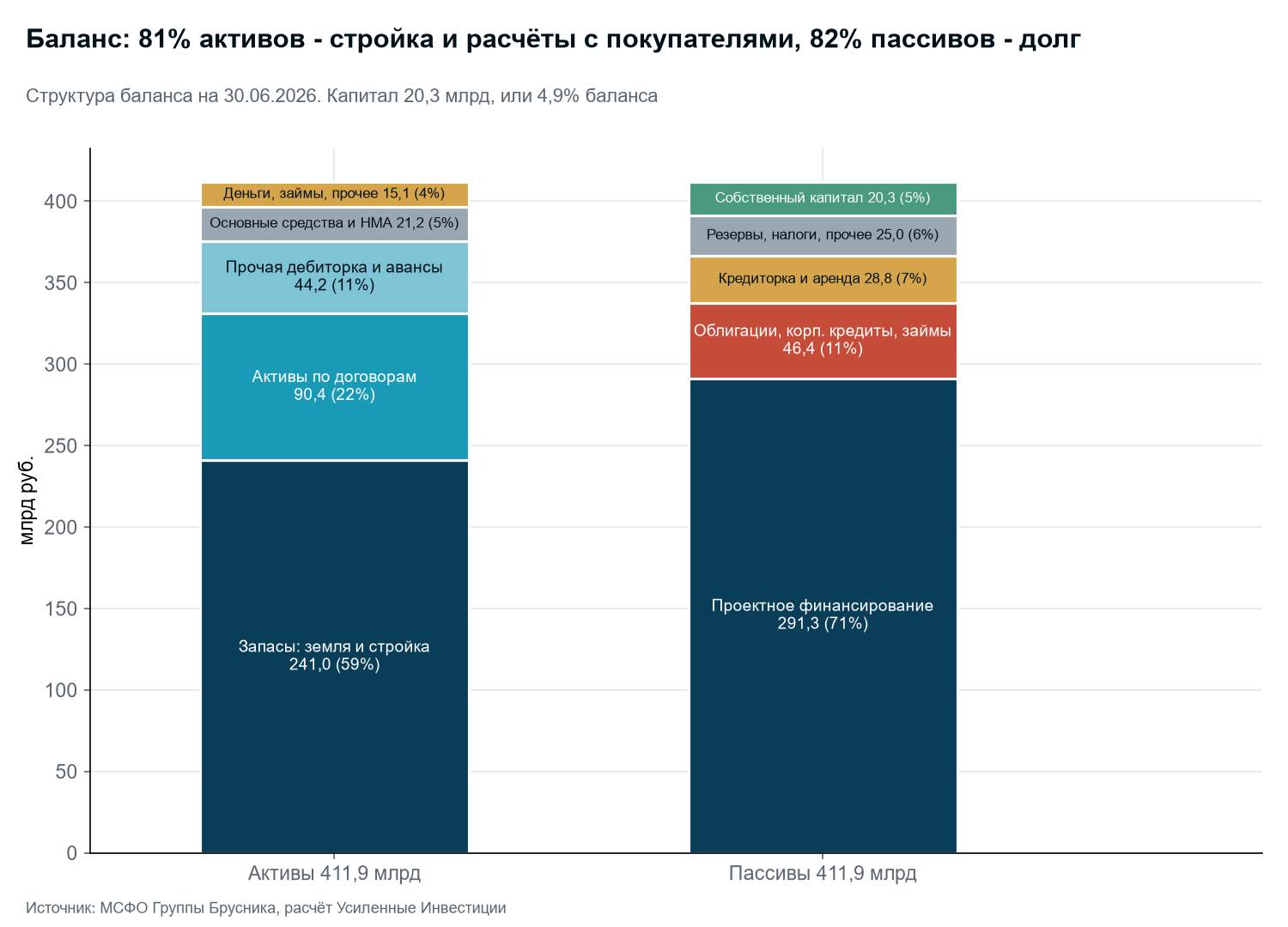
Fact. Of RUB 411.9 bn of assets, RUB 241.0 bn is inventory (land, construction in progress, finished apartments), RUB 90.4 bn is contract assets, i.e. revenue recognized as construction progresses but not yet paid by buyers or released from escrow. Another RUB 44.2 bn is other receivables and advances to contractors, of which RUB 14.5 bn is a financial asset from the subsidized rate on escrow loans. The land bank in inventory is valued at RUB 176.7 bn. Cash is RUB 4.0 bn, 1% of assets.
Fact. Liabilities include RUB 337.7 bn of loans and borrowings, of which RUB 291.3 bn is project debt. Payables and leases are RUB 28.8 bn, provisions (mainly for building social facilities for cities) RUB 14.3 bn. Equity is RUB 20.3 bn.
What this means. Almost the entire balance sheet is unfinished construction, land and settlements with buyers, which turn into cash only when buildings are delivered. The safety margin against a revaluation of land or a rise in construction costs is small: an 8.4% write-down of inventory would wipe out all equity (authors' calculation: 20.3 / 241.0).
Operating cash flow is negative, but including buyers' money in escrow it has turned positive
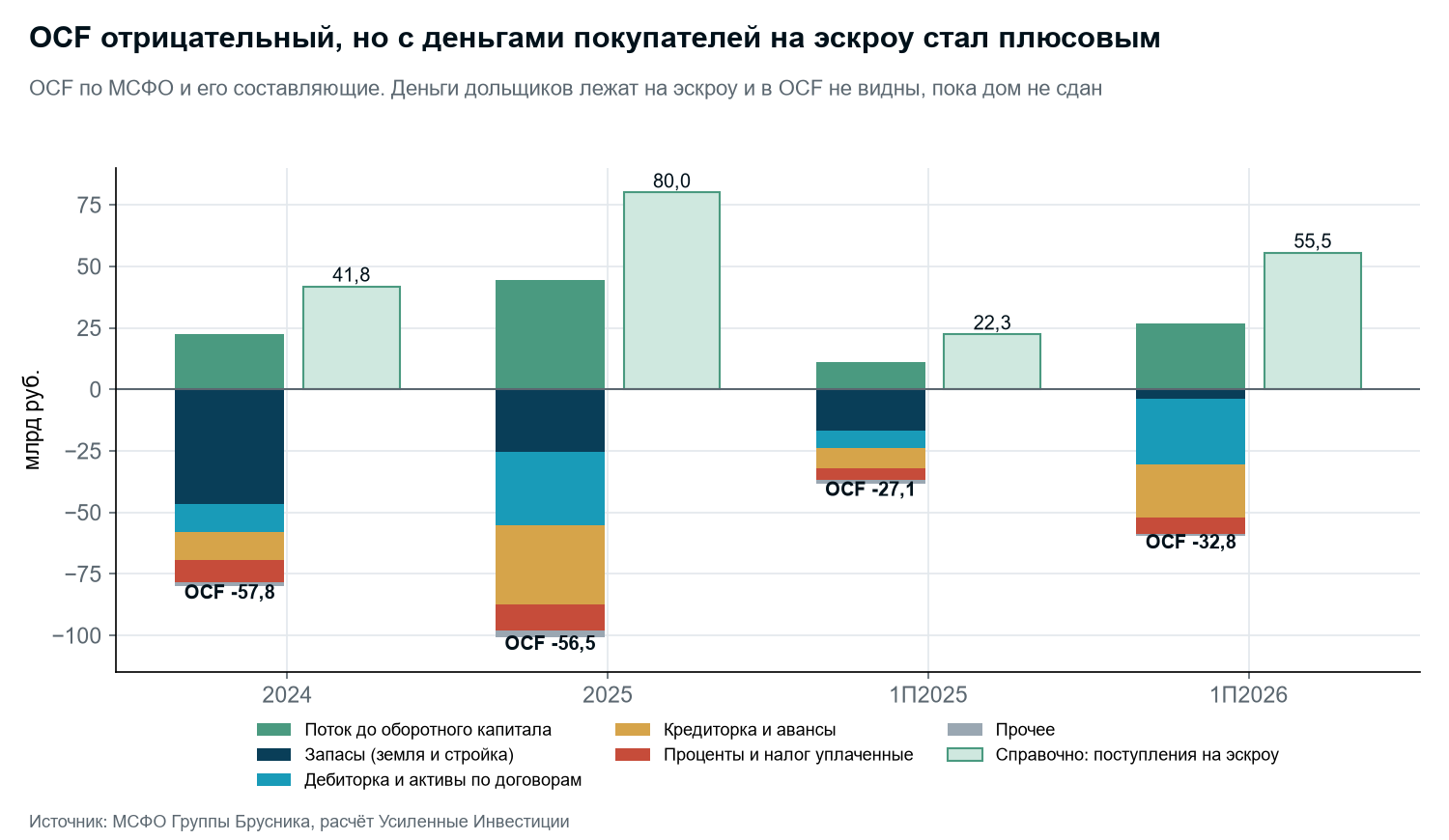
Fact. The group's operating cash flow was minus RUB 57.8 bn in 2024, minus RUB 56.5 bn in 2025 and minus RUB 32.8 bn in the first half of 2026. Cash flow before working capital changes is growing: RUB 22.4 bn in 2024, RUB 44.3 bn in 2025, RUB 26.8 bn in the half year. Three items eat it up: - inventory: investment in land and construction fell from RUB 46.7 bn in 2024 to RUB 3.7 bn in the first half of 2026, the company is buying less land; - receivables and contract assets: minus RUB 26.9 bn in the half year, revenue is recognized with construction progress faster than escrow is released; - payables and advances: minus RUB 21.5 bn in the half year and minus RUB 31.9 bn in 2025, the group is paying down debts to contractors and working off buyers' advances.
Fact. Buyers' money held in escrow does not enter operating cash flow until the building is delivered. The company separately discloses cash flow including it: minus RUB 15.9 bn in 2024, plus RUB 23.4 bn in 2025 and plus RUB 22.7 bn in the first half of 2026.
What this means. The turn to positive is real and is explained by sales growth. But the plus sits in escrow, and the company will get access to it only after buildings are commissioned, which this year has been shifted to the second half.
The financial statements look reliable: a major auditor with no qualifications, revenue converts into cash
Fact. The group's statements for 2024 and 2025 were audited by JSC "Kept" (the former Russian arm of KPMG), which also reviewed the first half of 2026. The 2025 opinion is unmodified, without qualifications and without a material uncertainty related to going concern section. The auditor named as key audit matters the recognition of revenue over the construction period and the calculation of interest savings on escrow loans in contract prices. These are the most subjective areas in any developer's statements, and the auditor separately checked construction budgets and primary documents. The issuer's RAS statements for 2025 were audited by JSC "EATs", also with an unmodified opinion.
Authors' calculation. Overall, revenue is backed by cash. Cash receipts from buyers per the company's operating releases were RUB 95.7 bn for 2025 and RUB 62.0 bn for the first half of 2026, 83-84% of IFRS revenue. The gap is explained by recognizing revenue over the construction period: it shows in contract assets growing from RUB 64.9 bn to RUB 90.4 bn in six months. The group pays income tax in cash (RUB 0.7 bn for 2025), revenue is spread across six regions, and no single buyer accounts for more than 10%.
What this means. There are no signs of fabricated revenue. The main question about the statements is not reliability but estimates: the cost of future buildings, the value of land and interest savings. These are judgments the auditor checked, but they are the first to be revised if housing prices fall.
The company borrows at 21-25%, while money went to the beneficiary and related parties
Fact. In 2024 the group paid RUB 5.0 bn for a stake in its own subsidiary, which it had previously consolidated under a preliminary sale and purchase agreement. The deal is recorded directly in equity as a transaction with the beneficiary, A. N. Krukovsky. A land plot bought from the beneficiary was written down by RUB 0.8 bn to its possible sale price in the same year. The cash outflow under the line "transactions with the beneficiary" for 2024 was RUB 6.1 bn. Dividends for the first half of 2024 were declared at RUB 1.75 bn, RUB 0.8 bn was paid, and a dividend payable of RUB 0.96 bn has been on the balance sheet since the end of 2024. No dividends were declared in 2025 or the first half of 2026.
Fact. Loans to related parties and the beneficiary grew to RUB 4.2 bn from RUB 3.3 bn at the start of the year. In 2024 they were issued at 16.4%, cheaper than the group's own bonds (coupons of 19-24.75%), in 2025 at 23.6%. Interest on them is mostly accrued rather than paid: in the first half RUB 0.13 bn was received in cash.
Fact. After the reporting date the group bought from a related party 100% of the company developing the "Kvartal Gertsena" project in Moscow. Before the deal Brusnika was the general contractor and technical client on the project. According to the company, the group's assets and liabilities will change by no more than 15%. The statements do not disclose the price or the method of payment.
What matters here. In December 2025 ACRA's forecast of positive free cash flow for 2026-2028 assumed zero dividends. Paying the dividend debt to the owner or an increase in loans to related companies would be a departure from that plan. The main risk on the loans is repayment, not the rate. The terms of the "Kvartal Gertsena" purchase are a question for the annual statements: it is a common-control transaction with the owner at equity of 5% of the balance sheet.
Equity of RUB 20 bn on RUB 412 bn of assets, covenants rest on waiver letters from banks
Fact. The group's equity is RUB 20.3 bn, 4.9% of assets; it shrank by RUB 1.4 bn in six months because of the loss. In October 2025 NCR also named the low share of equity, about 5% of liabilities and equity, among the constraints on the rating.
Fact. As of 30 June 2026 and 31 December 2025 the group breached the terms of several loan agreements. In June 2026 and December 2025 the banks waived their right to demand early repayment. Which covenants were breached is not disclosed in the statements.
What this means. A breach by itself does not lead to early repayment, but each subsequent report requires a new letter from the banks.
Taxes and courts: no tax arrears, the largest dispute is a halted project in Lipetsk
Fact. The issuer does not appear in the Federal Tax Service's open data on tax arrears as of 1 July 2026; LLC "Brusnika. Construction and Development" has no arrears. The check covers the parent company, subsidiary developers are not included. The Moscow Exchange lists seven disclosure violations for the issuer, all from 2020-2022 (late notices of related-party transactions and reporting). They have not been remedied, but the exchange did not classify them as material.
Fact. On 29 January 2026 the Arbitration Court of the Lipetsk Region, acting on a prosecutor's claim, revoked the building permit for the "Turist 2" residential complex on the site of a former hotel in central Lipetsk. The prosecutor cited a lack of infrastructure and parking spaces. On 11 March Brusnika said it would not appeal, the project was halted and contracts with buyers were being terminated. Buyers' money is protected by escrow. The other disputes found are routine settlements with contractors for amounts up to RUB 7 mn, one case was closed by a settlement agreement.
What this means. The lost project in Lipetsk is a reputational blow in a new region and a write-off of the investment in the site, but not a threat to solvency: all revenue of the "New Cities" segment, which includes Lipetsk, Perm, Chelyabinsk and Saint Petersburg, was RUB 8.5 bn for the half year, 11% of the group.
The agencies hold A-, but ACRA's outlook is negative
Fact. On 1 December 2025 ACRA affirmed the A-(RU) rating and kept the negative outlook, in place since December 2024. The agency sees a risk of missing the sales plan under a prolonged high rate and names FFO interest coverage below 4 as a downgrade trigger. Among the strengths are sales progress at 93% of construction readiness versus 69% for the market, and geographic diversification. The next review is expected by early December 2026. On 17 October 2025 NCR affirmed the A-.ru rating with a stable outlook and expects the debt burden to decline in 2026-2027.
Fact. In November 2025 the issuer disclosed a technical default on the third coupon of 002P-04 for RUB 132.5 mn: the money was sent on 6 November, reached the NSD on 7 November, and holders received the payment on 11 November. According to the company, the payment was delayed by the issuer's bank. ACRA classified the incident as a technical failure unrelated to liquidity. No other payment delays were reported.
Regions: Brusnika is among the leaders in the Urals and Siberia, but those markets are oversupplied
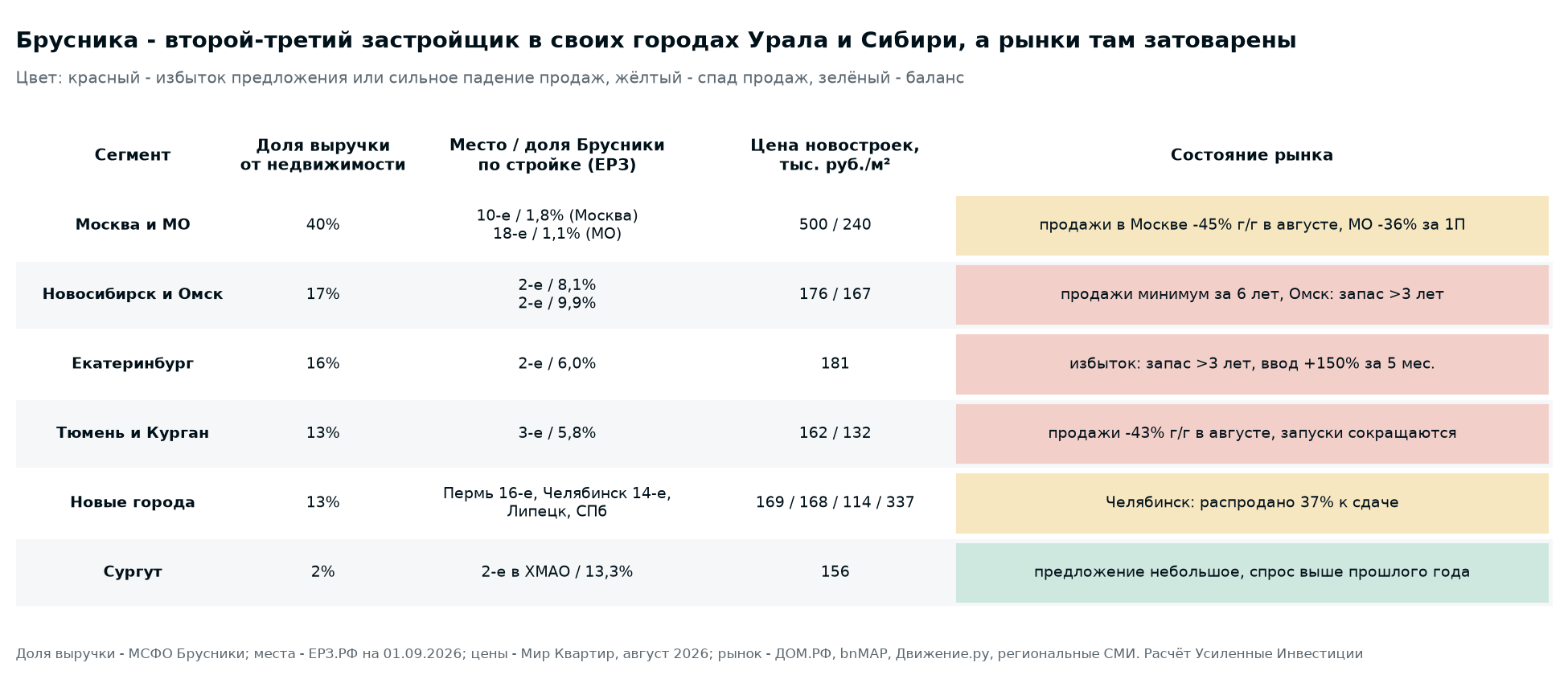
Fact. By volume under construction Brusnika ranks 8th in Russia with 1.79 mn sq m (ERZ.RF as of 01.09.2026). In its home regions it is among the leaders: 2nd in the Sverdlovsk region (6.0% of the market), the Novosibirsk region (8.1%), the Omsk region (9.9%) and KhMAO (13.3%), 3rd in the Tyumen region (5.8%). In Moscow it is 10th (1.8%); this is the market where the company is still growing. Moscow and the Moscow region account for 40% of revenue from real estate sales.
Fact. In almost all of the company's key cities supply is now ahead of demand: - Yekaterinburg: according to bnMAP.pro, "Makon" and Cian analysts, at the first-half sales pace the stock of new-build housing would take more than three years to sell. Completions in January-May 2026 grew 2.5 times. According to Mikhail Khorkov of the Ural Chamber of Real Estate, the market's problem is not a lack of demand but an excess of supply; - Tyumen: new-build sales in August fell 43% year on year according to DOM.RF, and in the first quarter developers' revenue under shared-construction contracts halved. Developers are cutting new project launches; - Novosibirsk: the fewest units in six years were sold over eight months, buyers are moving to the secondary market; - Moscow: 45% fewer units were sold in August than a year earlier, the lowest since May 2020 (bnMAP.pro); - Surgut: the market is small, demand is above last year.
Prices, however, are not falling: in Yekaterinburg the average asking price is RUB 181 thousand per sq m, in Novosibirsk RUB 176 thousand, in Tyumen RUB 162 thousand, in Moscow RUB 500 thousand. According to Cian, new-build prices in cities with over a million people rose 11% over the year. Developers hold prices and reduce apartment sizes to keep the purchase budget in reach.
How Brusnika differs from competitors. The company is first in Russia in the ERZ.RF consumer quality ranking of residential complexes (79.5 points, versus 63.7 for second place), first in Tyumen and Novosibirsk, second in the Sverdlovsk region. It builds whole blocks with car-free courtyards and its own social infrastructure, and has its own production: general contracting, design, prefab elements. According to ACRA, Brusnika's projects are sold at 93% of construction readiness versus 69% for the market. This is the main thing that keeps its sales above the market in oversupplied cities.
What this means. Brusnika's sales in square meters grew 77% in the half year in a falling market, meaning the company is taking share from competitors. But it does so partly at a cost: its own family mortgage at 3.5% for the entire term (with the subsidized rate at 6%, the developer pays the difference), and discounts on unsold units in completed buildings. According to CEO Alexander Shchigol, the company decided to cut the share of unsold apartments in buildings being delivered from 20-30% to 7% and offered discounts of up to 20% on such apartments for full payment. Sales growth bought with discounts and rate subsidies weighs on margins in the following periods.
If the family mortgage is tightened, the nearest payments will not suffer, but the long issues and the rating will
Fact. The share of mortgages in Brusnika's sales in the first half of 2026 was 78% (55% a year earlier). The company does not disclose how much of this is family mortgage. For the market as a whole, subsidized mortgages accounted for 48% of lending in the first half, of which about 85% was family mortgage (DOM.RF via RBC). Family mortgage terms are kept until 1 October 2026. The government is discussing a differentiated rate: 10% with one child, 8% with two, 6% with three or more (2 pp lower in the regions), and a subsidy for only 15 years. As of 23 September no decision has been made.
Fact. DOM.RF estimates the drop in family mortgage lending after the reform at 20% on average, 30-35% in a harsh scenario. ACRA believes the tightening could significantly worsen the position of developers that still have most of their housing under construction unsold. In August 2026 Expert RA assigned the sector a negative outlook and said stabilization is possible with a key rate of about 10%.
Authors' calculation. If the family mortgage accounts for about 40% of Brusnika's sales (authors' assumption: half of the company's mortgage deals), then: - DOM.RF base scenario (family lending minus 20%): sales minus 8%, about RUB 9 bn of contracts a year at the current pace of about RUB 113 bn; - harsh scenario (minus 35%): sales minus 14%, about RUB 16 bn a year; - de facto end of the subsidy (minus 60% of family demand): sales minus 24%, about RUB 27 bn a year.
What this means. Over the next 12 months the bonds hardly depend on the reform. Money for apartments already sold sits in escrow (RUB 154 bn), and the buildings being delivered in 2026-2027 are 93% sold relative to construction readiness. The reform hits new sales and does so one to two years out. A 14-24% drop in sales would slow the filling of escrow and raise rates on project loans, and with interest coverage around one (0.98) there is no cushion for that. In addition, ACRA lists among the rating downgrade triggers a fall of more than 15% in primary-market prices in the regions where the company operates. With equity at 5% of the balance sheet, such a price fall would require money from the owner. For the short issues the family mortgage reform is a secondary risk, for the 2028-2029 issues it is one of the main ones.
What the critics say: where they are right and where they are not
Brusnika's bonds had both opponents and supporters in 2025-2026. Below are the main arguments and how they check out against the financial statements.
- "With capitalized interest, 2025 profit turns into a loss of about RUB 21 bn" (IF Bonds, August 2026). Partly right. The arithmetic is correct: in 2025 the group capitalized RUB 28.3 bn of interest, and 7.6 − 28.3 gives about minus 21 bn. But subtracting the whole amount from profit is incorrect: capitalized interest becomes the cost of apartments and has partly already passed through the income statement (RUB 4.9 bn in 2025). The correct conclusion is different: about RUB 43 bn of interest was accrued for the year against adjusted EBITDA of RUB 37.8 bn, and full interest coverage is close to one (authors' calculation).
- "The owner took out about RUB 8 bn with equity of RUB 14 bn" (IF Bonds, August 2025). Right. According to the 2024 statements, RUB 5.8 bn of transactions with the beneficiary and RUB 1.75 bn of declared dividends went through equity, RUB 7.6 bn in total, with year-end equity of RUB 14.1 bn.
- "Debt to equity is about 23x, the business survives only on new loans, an external rescuer is possible" (URBC, December 2025). The direction is right, the conclusion is exaggerated. Debt to equity as of 30 June 2026 is 16.6, higher only at Samolet among 12 public developers. But operating cash flow including buyers' money in escrow was positive in 2025 (plus RUB 23.4 bn), the A- rating has been affirmed by two agencies, and there are no signs of preparation for restructuring in the statements.
- "Interest coverage is below or around one" (Vitaly Bykov, Bondovichok, 2025-2026). Right. Over 12 months operating profit covers finance costs together with interest from cost of sales 0.98 times, and 1.19 times by the portal's traffic light method.
- "Debt to EBITDA is 5.8 and rising" (Ivolga Capital, 2025). Outdated. This was true for 2024. Since then EBITDA has grown faster than debt: 2.98 by the company's count and 3.7 by our strict count as of 30 June 2026.
- "Completions fell by a third in the half year" (IF Bonds, 2026). Right. Completions fell by 32.5%, the company is shifting deliveries to the second half. Escrow releases, from which debts are paid, depend on this.
- "The debt burden is declining, 002P-09 could return 26.5% over a year" (BCS World of Investments, August 2026). Partly right. Leverage to EBITDA is indeed declining, but the calculation relies on the key rate falling to 12.75%, while interest coverage is deteriorating.
- "Interest coverage is 2.4x, debt is under control" (Raptor Capital, April 2026). Overstated. This is coverage excluding interest that passed through cost of sales. Including it, the figure is 0.98.
What holders think: they like the yield, the loss and a broker's risk rating worry them
How we collected it. Discussions of Brusnika bonds on Smart-Lab in August and September 2026. Some threads are behind bot protection, so the sample is limited. Opinions are given anonymously and are not our assessment.
- Who is discussing. Mostly retail investors with small positions; some write about their first months in the bond market. A few participants analyze the statements themselves.
- For. A yield of 23-26% with an A- rating looks generous. After 18 September some participants bought more 002P-04, counting on a price rebound of 3-3.5 pp within a month.
- Against. The half-year loss is growing while revenue doubles. Participants write that the app of one large broker assigned the bonds a "critical" risk level; others dispute this assessment.
- 18 September. Holders attribute the sell-off to general market nervousness rather than company news.
What this means. The holder base is the mass retail investor, who reacts faster to price and sector news than to financial statements. Such a base amplifies declines in sell-offs, and for a company that needs regular placements this is a separate risk to the cost of refinancing.
What to watch next
- 002P-03 redemption on 8 November 2026. Up to RUB 3.4 bn against RUB 4 bn of cash as of 30 June. The disclosure will also show how much of the issue remains after last year's put.
- ACRA's decision by early December 2026. A downgrade from the negative outlook would hit the cost of new placements.
- Annual statements for 2026. Building completions in the second half, escrow releases, new letters from banks on covenants, loans to related parties and the terms of the "Kvartal Gertsena" purchase.
- New placements. The company places an issue every two to three months. A book below target or a rate above 25% would be the first signal of deterioration.
- Family mortgage. The decision on program terms after 1 October 2026 directly affects sales and the filling of escrow.
- Dividends. Any payment to the owner with equity at 5% of the balance sheet would be a negative signal.
Portal traffic light: yellow
How the scale works for homebuilders. Negative operating cash flow is structural for a developer, as buyers' money sits in escrow, so the traffic light judges it by group profit and interest coverage: - red: a group loss over 12 months, interest coverage below 1 or problems with the audit opinion; - yellow: debt to EBITDA above 5, coverage of bond payments below 1, interest coverage below 1.5 or tax arrears; - green: everything else.
Brusnika is in the yellow zone. There is profit over 12 months (RUB 7.3 bn), operating profit covers finance costs 1.19 times (as the traffic light counts it), and the auditor gave an unmodified opinion, so it does not reach red. What makes it yellow is debt without netting escrow above 5x EBITDA (6.8 by our count) and coverage below 1.5. The margin to the red zone is small: if interest written off through cost of sales is added, coverage is already 0.98. Of 181 issuers yielding 20% p.a. or more in the portal's screen, 59 are red, 44 yellow, 18 green and 60 grey, for which the method does not apply.
- Would move it to red: a 12-month loss, interest coverage below 1, a delay in the 002P-03 redemption or a coupon.
- Would return it to green: interest coverage above 1.5 and debt to EBITDA below 5, i.e. growth in second-half profit without growth in debt.
Bottom line: a strong developer with a thin structure, and the long issues are a bet on an open market
Brusnika does not look like a company on the edge. It sells faster than the market, keeps escrow coverage at the national average, pays coupons on time, its statements are confirmed by an auditor without qualifications, and non-project debt is less than annual EBITDA. There are no signs of preparation for restructuring in the statements or disclosures.
What remains tight is the structure. Equity of RUB 20 bn on RUB 412 bn of assets, interest is capitalized into project debt, covenants rest on waiver letters from banks, and the owner has taken money out through stake deals, loans and dividends. The model is stable as long as buildings are delivered on schedule, banks keep extending covenant waivers, mortgages remain affordable and the market buys new issues.
The short 002P-02 maturing in March 2027 yields 23.3% and depends mainly on the nearest escrow releases. The long 2028-2029 issues at 24.7-26.5% offer a premium of 11-12 pp over the key rate, and that is a fair price for the risks listed, not a gift. The next checkpoints are the 002P-03 redemption in November and ACRA's decision by early December.
Sources and caveats
- Consolidated IFRS financial statements of Brusnika Group for 2024 and 2025 with audit reports, and interim statements for 6 months of 2026 with a review report (JSC "Kept", 28.08.2026): brusnika.ru, "Investors" section.
- The company's operating results for 2025 and the second quarter of 2026, IFRS press releases.
- Moscow Exchange (ISS) prices, turnover and payment schedules as of 23.09.2026, Cbonds on the 002P-05 put.
- ACRA (01.12.2025) and NCR (17.10.2025) releases, Interfax reports on the technical default (November 2025).
- Federal Tax Service open data on tax arrears (as of 01.07.2026), Moscow Exchange data on disclosure violations, rulings of the Arbitration Court of the Lipetsk Region on the "Turist 2" complex (MK Lipetsk, ploschadnews.ru).
- Bank of Russia, DOM.RF and Ministry of Finance data; ERZ.RF developer rankings as of 01.09.2026; "Mir Kvartir" and Cian prices; bnMAP.pro, "Makon", Dvizhenie.ru via RIA Real Estate, Vedomosti, Kommersant, URBC, NGS, URA.ru; interview with A. Shchigol (Monocle, 29.06.2026); Expert RA sector review (13.08.2026).
- IFRS statements of Samolet, PIK, LSR, Glorax, G-group and APRI (the portal's EI1 database).
- Publications by IF Bonds, Ivolga Capital, URBC, Klerk.ru, vc.ru, BCS World of Investments, Smart-Lab discussions for August-September 2026.
Support us with a like or a subscription if you find this useful! Reviews of other issuers and weekly analytics are in the Telegram channel Enhanced Investments, and extended cards of all issuers are on the portal https://frontier.eninvs.com/region/ru.
This review was prepared by Enhanced Investments based on the issuer's public financial statements, company disclosures and Moscow Exchange data as of 23.09.2026. The mark "authors' calculation" means our estimate using the portal's methodology, not company data. This is not an individual investment recommendation.
Open the issuer's bond profile Brusnika →
See also: market overview · valuation map · stock screeners