2027 draft budget: RUB 5.5 trn deficit, RUB 7.7 trn of OFZ and a USD/RUB rate of 87 in the government's forecast
Updated on October 1. On September 30 the government submitted the draft to the State Duma. The 2027 figures did not change. The 2028-2029 parameters and the cost of servicing public debt have been added, in a new section near the end of the article.
On September 24 the government approved the draft federal budget for 2027-2029, and on September 30 it submitted it to the State Duma ([Vedomosti](https://www.vedomosti.ru/economics/articles/2026/09/30/1233234-proekt-byudzheta-na-20272029-godi)). According to Mikhail Mishustin, 2027 revenues are RUB 43.3 trn, expenditures RUB 48.8 trn, and the deficit about RUB 5.5 trn, or 2.2% of GDP ([Interfax](https://www.interfax.ru/business/1118243)). By 2029 revenues are due to rise to RUB 48.6 trn and expenditures to RUB 53.9 trn.
We have already covered the tax part of the package and the cut in the cutoff price to $50 separately: [what changes for companies](https://telegra.ph/Corporate-Taxes-2027-Miners-09-24), [for private investors](https://telegra.ph/Investor-Tax-15-to-22-09-24) and [for the fiscal rule and the ruble](https://telegra.ph/Budget-2027-Cutoff-50-Taxes-09-24). This article is about the budget itself: its expenditures, debt and forecast.
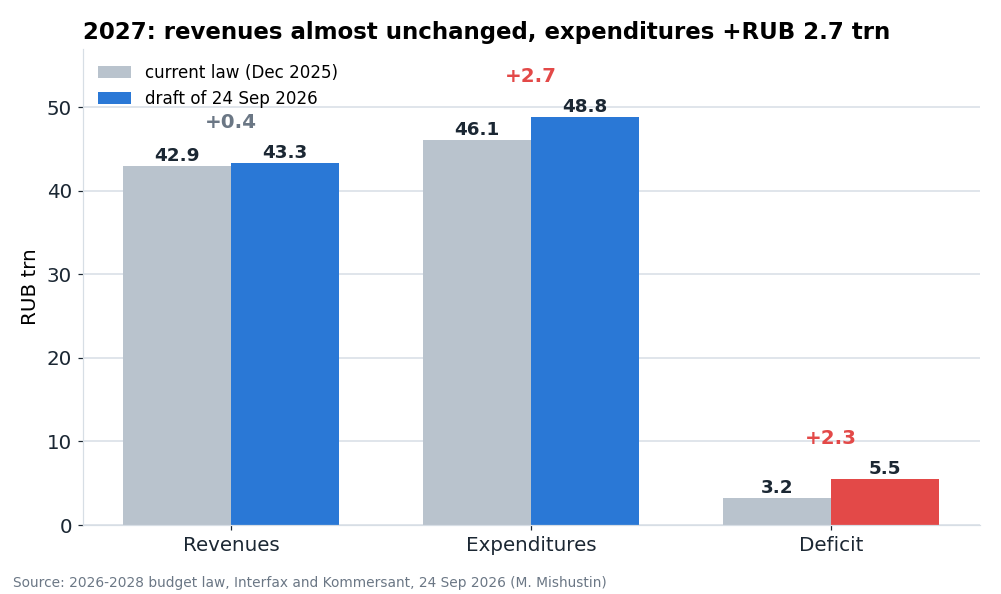
The 2027 budget is drawn up with a deficit 1.7 times larger than in the current law, and it will be financed mainly by debt on the domestic market.
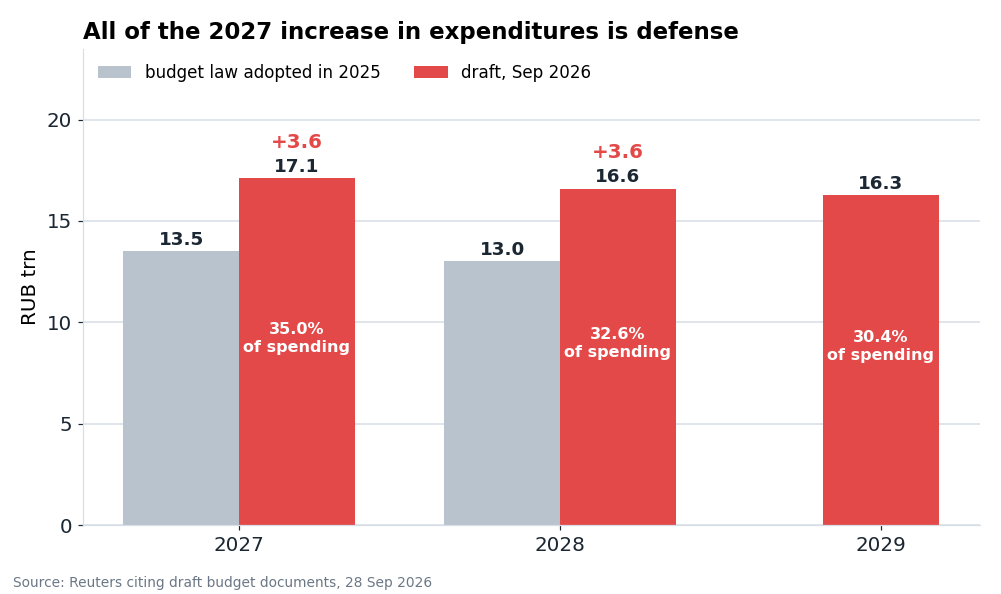
- 2027 revenues are almost unchanged against the law, while expenditures are up RUB 2.7 trn, and all of that increase goes to defense. Defense spending is RUB 17.1 trn instead of RUB 13.5 trn, and the other items are cut against the law.
- Three years in a row the actual deficit came in 1.8-4.7 times larger than planned. For 2026, instead of RUB 3.8 trn, the Ministry of Finance expects about 3% of GDP, roughly RUB 7 trn.
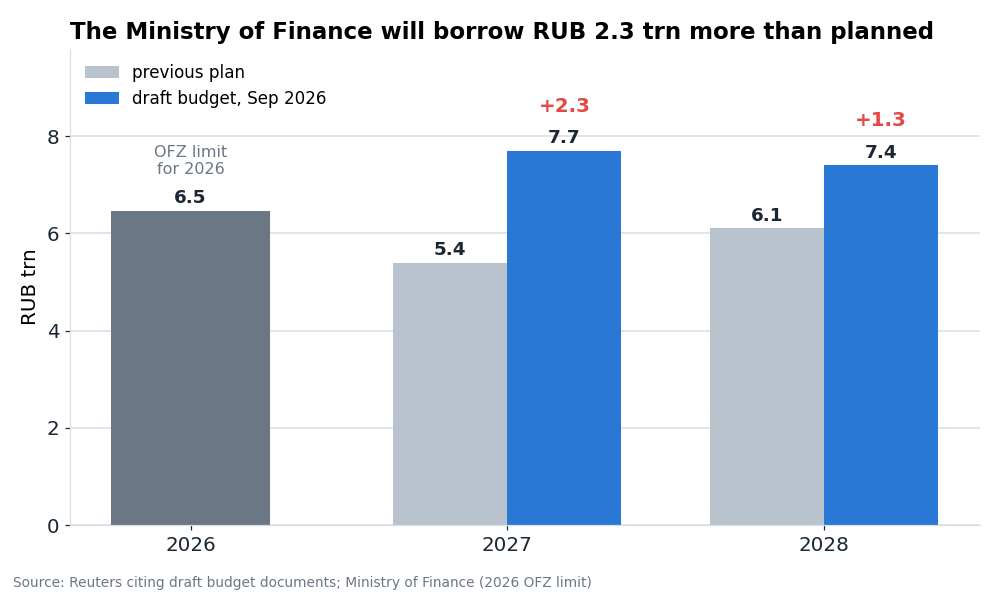
- Domestic borrowing in 2027 will rise to RUB 7.7 trn, RUB 2.3 trn more than the previous plan. The supply of OFZ will weigh on long-dated bonds even if the key rate falls.
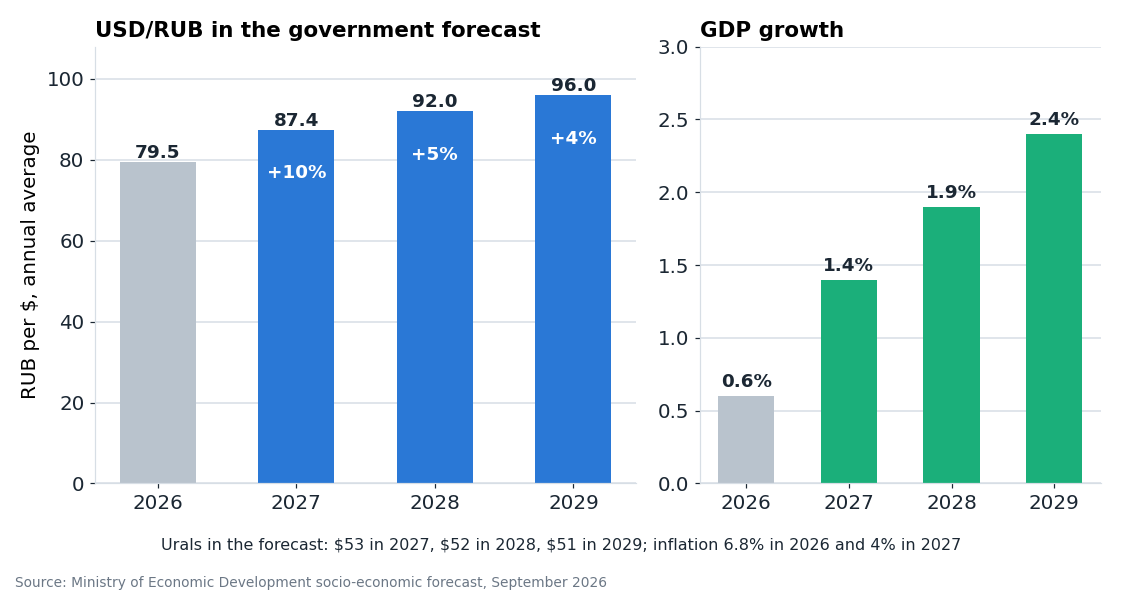
- In the government's forecast the dollar costs RUB 87.4 in 2027 and Urals is $53. Oil currently trades near $110, and if prices hold, FX purchases for the National Wealth Fund will be many times larger than assumed.
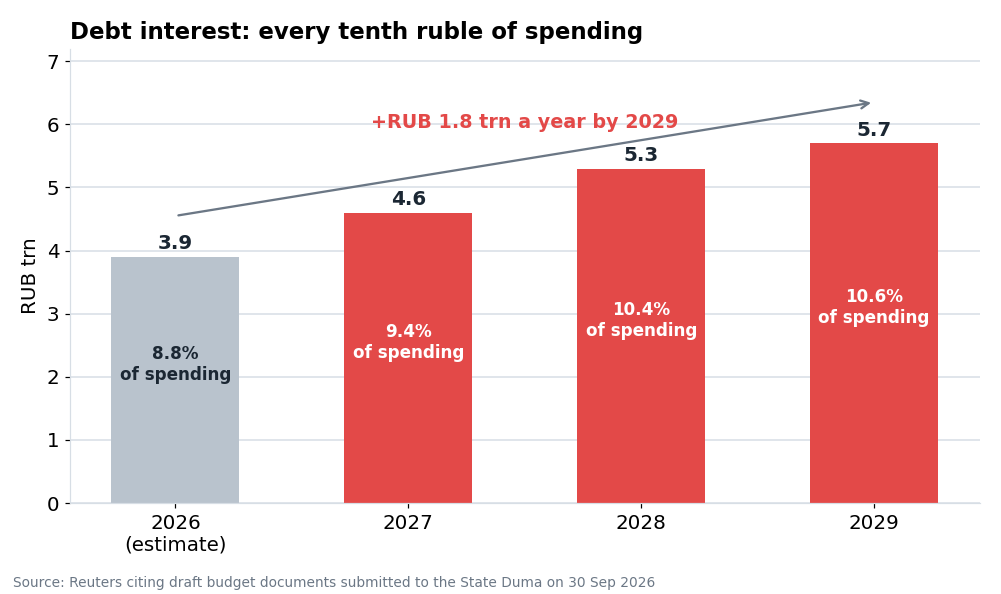
- Interest on public debt will grow from RUB 3.9 trn in 2026 to RUB 5.7 trn in 2029, or 10.6% of all expenditures. Already in 2027 the increase, RUB 0.7 trn, is comparable to the whole new tax package. Debt is getting more expensive faster than taxes are growing, which raises the risk of new tax measures. For OFZ and equities this is a moderate negative.
- In nominal terms 2027 expenditures stay at the 2026 level, and in real terms they shrink. The budget stops stimulating the economy, hence GDP growth of only 1.4%.
In practical terms this means the following. Short OFZ have already priced in a rate cut and pay less than deposits and floaters. Long OFZ yield about 17% and suit those ready to hold them to maturity, but one should not count on a quick rise in their price. The dollar at RUB 84.4 has almost reached the government's average forecast for 2027, and the foreign-currency part of savings is better held in coupon-paying bonds than in cash. In equities the 2027 budget favors exporters and works against companies that depend on state orders and household demand. Details are in the section on practical conclusions.
2027 expenditures are RUB 2.7 trn higher than in the law, and all of the increase goes to defense
The current budget law, adopted at the end of 2025, already contained 2027 parameters: revenues of RUB 42.9 trn, expenditures of RUB 46.1 trn and a deficit of RUB 3.2 trn (1.2% of GDP). The new draft keeps revenues at almost the same level but adds RUB 2.7 trn to expenditures. As a result the deficit rose by RUB 2.3 trn.
Revenues stand still even though they already include the tax package. In our estimate it yields RUB 0.6-0.8 trn in 2027. Without the new taxes revenues would have been below the law: cheaper oil and an economy growing more slowly than expected a year ago both weigh on them.
Where the extra spending comes from is shown by budget documents that Reuters obtained on September 28. Defense spending is set at RUB 17.1 trn in 2027 instead of RUB 13.5 trn in the current law, RUB 16.6 trn in 2028 instead of RUB 13 trn, and RUB 16.3 trn in 2029 ([Reuters](https://www.investing.com/news/economy-news/exclusiverussia-raises-2027-military-spending-by-27-budget-documents-show-4920973)). That is 35% of all 2027 expenditures. The increase in defense, RUB 3.6 trn, is larger than the total rise in expenditures of RUB 2.7 trn. This means all other items together are cut against the law by about RUB 0.9 trn.
Part of the revenues in the draft rests on measures whose results are not yet known. Anton Siluanov named about RUB 500 bn a year from bringing the economy out of the shadows. Revenues from managing and selling confiscated assets, by contrast, almost disappear: RUB 384.9 bn in 2026 and RUB 9.5 bn in 2027.
The government names the same priorities as before: social obligations, defense and security, technological leadership. The breakdown of expenditures by section is given in the explanatory note to the submitted draft, and we will add our analysis of it. Already announced are about RUB 2 trn over three years for national projects on technological leadership, RUB 4.4 trn for roads, and pension indexation of 6.8% from February and a further 3.3% from April 2027 ([Ministry of Finance](https://minfin.gov.ru/ru/press-center/?id_4=40635-minfin_rossii_vnes_v_pravitelstvo_rf_byudzhetnyi_paket)). At the same time the government promises to cut and redistribute more than RUB 2 trn of expenditures a year ([Kommersant](https://www.kommersant.ru/doc/8974577)).
For three years in a row the deficit came in 1.8-4.7 times larger than planned
A deficit of 2.2% of GDP for 2027 looks moderate, but it is worth viewing through the history of budget execution. The 2024 law set a deficit of RUB 1.6 trn, and the actual outcome was RUB 3.5 trn. For 2025 the plan was RUB 1.2 trn, and the result was RUB 5.6 trn. For 2026 the law set RUB 3.8 trn (1.6% of GDP). On September 21 Anton Siluanov acknowledged that the deficit would be larger but would stay within 3% of GDP ([Interfax](https://www.interfax.ru/business/1117529)). That is about RUB 6.9 trn, and according to the budget documents cited by Reuters the estimate is even higher, RUB 7.3 trn. In the first eight months of 2026 the deficit was already RUB 5.8 trn.
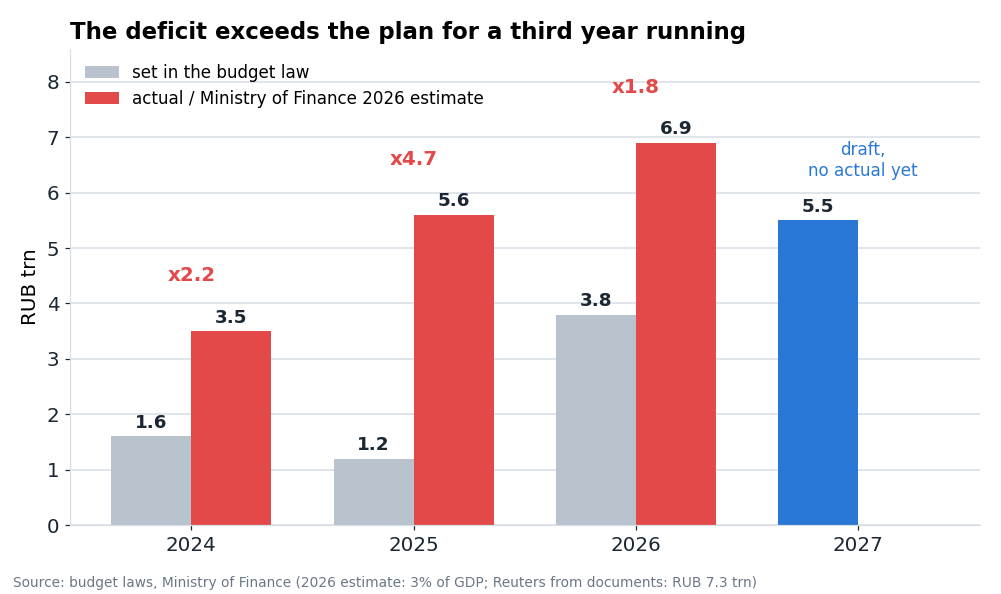
The overrun is explained the same way every time. During the year spending appears that was not in the law, and oil and gas revenues come in below forecast. In 2026 oil and gas revenues, according to Reuters, have been cut in the estimate from RUB 8.9 trn to RUB 7.6 trn. There is no reason yet to consider 2027 an exception. For an investor it is more sensible to assume that the actual deficit will come in above RUB 5.5 trn.
The gap will be closed by OFZ: RUB 7.7 trn on the domestic market in 2027
According to Reuters, the Ministry of Finance raised its domestic borrowing plan for 2027 by RUB 2.3 trn to RUB 7.7 trn, and for 2028 by RUB 1.3 trn to RUB 7.4 trn. Net borrowing for 2026 was increased by RUB 1 trn to RUB 5 trn. For comparison, the maximum OFZ placement volume for the whole of 2026 was approved at RUB 6.47 trn ([Ministry of Finance](https://minfin.gov.ru/ru/press-center/?id_4=40137-utverzhdeny_predelnye_obemy_razmeshcheniya_ofz_v_2026_godu)). Public debt will rise from 19.9% of GDP in 2026 to 21.7% in 2027.
The market already demands a premium for such a volume. At September auctions the Ministry of Finance placed fixed-coupon OFZ at 15.5-16.4% a year, while the [key rate](https://www.cbr.ru/press/keypr/) was held at 14% on September 11. The yield on new issues is 1.5-2.4 pp above the rate, and the market is pricing the large supply of bonds into this premium. Siluanov, for his part, says that a deficit of 2% of GDP does not prevent the central bank from easing policy.
A lower key rate will reach long OFZ more slowly than short bonds and deposits. In 2027 the Ministry of Finance needs to sell on average about RUB 640 bn of government bonds a month. For the market to take them, yields on long OFZ must stay well above the rate. What follows from this for choosing bonds is discussed below.
New debt costs the budget almost as much as all the new taxes bring in. Net borrowing in 2026, according to Reuters, is RUB 5 trn. At a placement yield of about 16%, this debt alone will cost the budget around RUB 0.8 trn in interest every year. The whole 2027 tax package, in our estimate, yields RUB 0.6-0.8 trn. The 2027 borrowing will be added on top. The result is a loop: the deficit is closed with loans at 16%, interest increases the next deficit, and the risk grows that taxes will be raised again. The 2026-2027 tax package is already the second in two years.
The documents for the submitted draft confirm this estimate. According to Reuters, debt servicing costs will rise from RUB 3.9 trn in 2026 to RUB 4.6 trn in 2027, RUB 5.3 trn in 2028 and RUB 5.7 trn in 2029. The 2027 increase, RUB 0.7 trn, matches our estimate, and by 2029 interest costs the budget RUB 1.8 trn a year more than now.
For OFZ this is a ceiling: long issues will lag behind the decline in the rate, and if the deficit again comes in above plan and the borrowing plan is raised, the pressure will grow. For equities it is a moderate negative through three channels. The risk-free yield stays high and holds back valuations. Government debt absorbs part of the money that could have gone into equities and corporate bonds. The risk of new taxes for companies rises. The counterweight is oil: if Urals holds near $100, the pressure on borrowing and taxes in 2028 will ease.
The government itself assumes a dollar at RUB 87.4 in 2027 and RUB 96 in 2029
In the [Ministry of Economic Development forecast](https://www.economy.gov.ru/material/directions/makroec/prognozy_socialno_ekonomicheskogo_razvitiya/) on which the budget is built, the average exchange rate in 2026 is estimated at RUB 79.5 per dollar. After that the ruble weakens gradually: RUB 87.4 in 2027, RUB 92 in 2028 and RUB 96 in 2029. The Urals forecast is $53, $52 and $51 per barrel. Inflation slows from 6.8% in 2026 to 4% in 2027.
A weak ruble is good for the budget. Depreciation raises ruble-denominated oil and gas revenues and VAT on imports, so revenues in the forecast grow faster than the economy. In addition, with the $50 base the Ministry of Finance buys foreign currency for the National Wealth Fund at any oil price above this level. Both factors work against the ruble.
Oil is now twice as expensive as assumed in the forecast, and this is the main source of uncertainty for the exchange rate. On September 28 Urals traded at about $112 a barrel and Brent at $106-108 ([Mail.ru Finance](https://finance.mail.ru/article/neft-brent-podorozhala-do-10726-za-barrel-69229866/)). Each dollar of price above the base adds roughly RUB 7 bn a month of FX purchases. If oil holds above $100, in 2027 the Ministry of Finance will buy hundreds of billions of rubles of currency a month rather than tens of billions, as follows from the $53 forecast. This is a strong argument for a weak ruble. The opposite risk exists too: expensive oil brings export revenue that supports the ruble, and last year's government forecast of RUB 92.2 per dollar for 2026 did not come true, with the rate around RUB 76 in the first half.
The government's exchange rate forecast should not be read as a limit to depreciation. Simple models that account only for the volume of FX purchases under the fiscal rule give just a few percent a year. We expect noticeably more depreciation: FX purchases will be joined by a lower key rate, which makes ruble assets less attractive. The closest historical reference is 2018, when after the fiscal rule base was lowered the dollar rose 23% over the year.
2027 expenditures are nominally at the 2026 level, and in real terms the budget is shrinking
According to the estimate cited by Reuters, 2026 expenditures with all amendments will be RUB 48.6 trn, or 20.9% of GDP. The 2027 draft gives RUB 48.8 trn. With inflation of 4-6% this is a real-terms cut in expenditures of a few percent. As a share of GDP, expenditures fall from roughly 21% to 19.5%.
This is consistent with the government's goal of reaching a zero structural primary deficit by 2029. In other words, expenditures excluding interest on debt should be covered by revenues at the base oil price. The deviation from this goal is planned at RUB 1.5 trn in 2027 and RUB 0.5 trn in 2028 ([Kommersant](https://www.kommersant.ru/doc/8974577)).
For companies that live off state orders and budget construction, 2027 will be harder than 2026. In the forecast the economy grows 1.4%, and fixed investment barely grows (+0.2% after a 5.4% fall in 2026). Business has two supports. A lower rate makes credit cheaper and benefits companies with large debt. A weak ruble helps exporters: oil companies, metals producers, chemical producers. For miners, part of this effect will be taken by the windfall tax.
Practical conclusions: long OFZ to hold to maturity, foreign currency through bonds, exporters in equities
Short OFZ have already priced in a rate cut and pay less than floaters and deposits. As of September 28, the zero-coupon OFZ yield was 12.2% for three months, 13.7% for one year and 15% for two years ([Moscow Exchange](https://www.moex.com/ru/marketdata/indices/state/g-curve/)). The key rate is 14%, and floaters, whose coupon is tied to the RUONIA rate, pay about the same for now. For money placed for a year to a year and a half, fixed-coupon short OFZ give no extra yield. They will pay off only if the central bank cuts the rate faster than the market already expects, and the tax package and the weak ruble rather work against that.
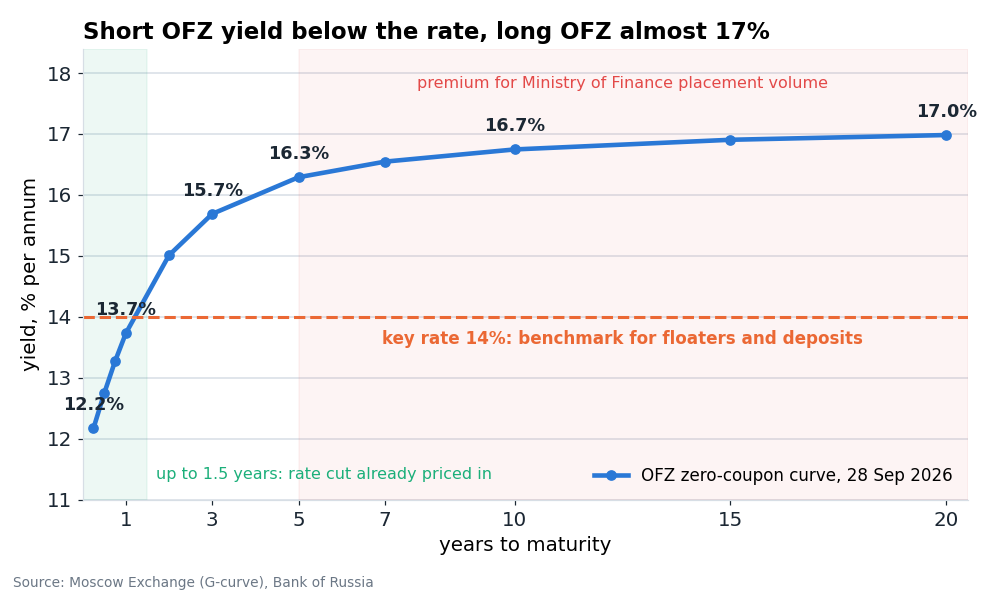
Long OFZ at 16.3-17% suit locking in a yield for years, but not a bet on a quick rise in price. With inflation of 4%, which the central bank and the government assume for 2027, this is about 12% real yield for 5-20 years ahead. A holder to maturity will receive this yield regardless of the placement volume. The price, however, will rise slowly while the Ministry of Finance sells about RUB 640 bn of bonds a month. If the deficit again comes in above plan, long issues may fall further, so it is more sensible to buy them gradually, including at Ministry of Finance auctions, where with large supply it often offers a premium to the market.
From 2027 coupons are taxed on the personal income tax scale of up to 22%, so bonds are better held in a type 3 IIA (individual investment account). Coupons and gains from sales in an IIA-3 are exempt from tax if the holding period is met. The IIA does not protect dividends from the new tax. Calculations on the scale are in our [analysis of taxes for private investors](https://telegra.ph/Investor-Tax-15-to-22-09-24).
The dollar at RUB 84.4 has almost reached the government forecast for 2027. The official rate on September 29 is RUB 84.41. The average of RUB 87.4 in 2027 means depreciation of only 3.6% from the current level, RUB 92 in 2028 means 9%, and RUB 96 in 2029 means 14%. A weak ruble is good for the budget, FX purchases at the $50 base work against the ruble, and the forecast most likely understates depreciation. The foreign-currency part of savings is better held not in cash but in dollar and yuan bonds: they pay a coupon in currency on top of changes in the exchange rate. We calculate yields, duration and credit quality of Moscow Exchange foreign-currency issues on the foreign-currency bonds page.
In equities the 2027 budget favors exporters and works against companies that live off state orders and household demand. The tax package does not directly affect oil companies, and a weak ruble raises their ruble revenue. For metals and fertilizer producers, part of the currency gain will be taken by the windfall tax. According to the budget documents cited by Reuters, it should bring in about RUB 200 bn a year in 2027-2029. The size of the tax by company is calculated in our [analysis of taxes for companies](https://telegra.ph/Corporate-Taxes-2027-Miners-09-24). Under pressure are contractors for state orders and budget construction, for whom government spending is shrinking in real terms, and the consumer sector. For its customers 2027 brings higher taxes on savings, more expensive foreign purchases and slow economic growth. Companies with large debt will be helped by a lower rate, but more slowly than seemed before the budget was published.
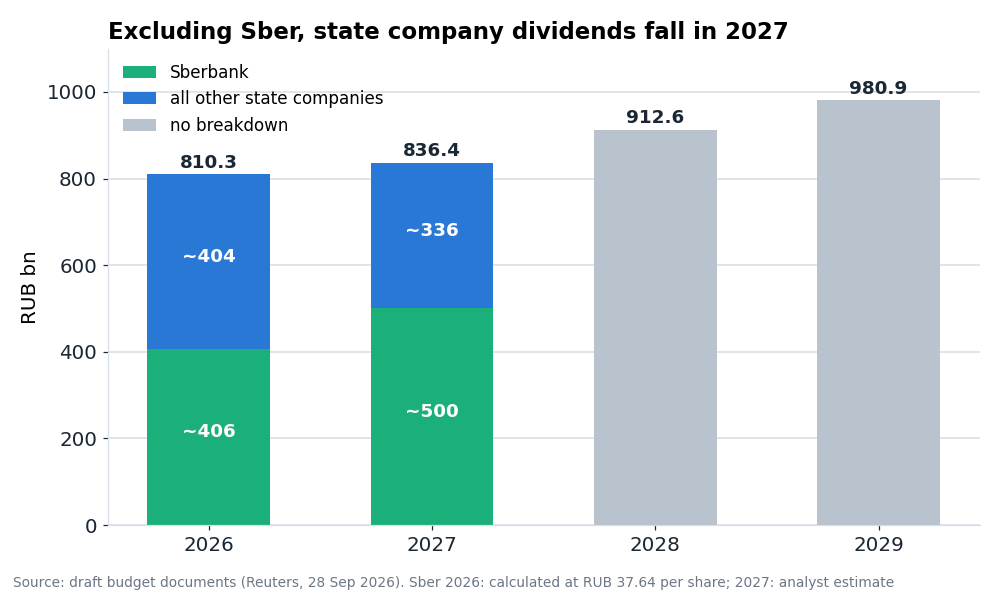
The budget does not expect Gazprom dividends in 2027 either. According to the draft documents cited by Reuters, dividends of state companies will give the budget RUB 836.4 bn in 2027 against RUB 810.3 bn in 2026, then RUB 912.6 bn and RUB 980.9 bn. More than half of this amount is Sberbank. The state owns 50% plus one share of its ordinary shares, and the 2025 dividend of RUB 37.64 per share brought the budget about RUB 406 bn. For 2026 analysts expect about RUB 500 bn. That leaves about RUB 336 bn for all other state companies in 2027, against roughly RUB 404 bn this year.
There is no room for Gazprom in such a sum. Rosimushchestvo directly owns 38.4% of its shares, and even a modest dividend of RUB 20 per share would give the budget about RUB 180 bn, more than half of everything assumed for companies other than Sber. Gazprom did not pay dividends for 2023 and 2024, and the budget, judging by the figures, does not count on them for 2026 either. There is one caveat. The Ministry of Finance traditionally budgets dividends cautiously, and the figure in the budget reflects only its expectations, while the decision to pay is made by the company itself. For a dividend portfolio the anchor among state companies remains Sber.
What was added after submission to the State Duma: the deficit does not shrink until 2029, and debt interest rises to RUB 5.7 trn
On September 30 the government submitted the budget package to the State Duma ([RIA Novosti](https://ria.ru/20260930/gosduma-2121326719.html)). The 2027 parameters are the same as those named by Mishustin. New are the figures for the planning period:
- 2028: revenues of RUB 45.8 trn, expenditures of RUB 50.9 trn, deficit of RUB 5.1 trn;
- 2029: revenues of RUB 48.6 trn, expenditures of RUB 53.9 trn, deficit of RUB 5.3 trn.
A deficit of about RUB 5 trn is built in for all three years, and the government does not plan to reduce it. This means the Ministry of Finance's demand for market money will persist until the end of 2029, not only in 2027. For long OFZ this is one more argument to buy gradually and hold to maturity. Interest on debt meanwhile grows faster than revenues: over three years revenues add 12% and interest adds 24%.
On the social side: the minimum wage and the subsistence minimum rise 6.8% in 2027, to RUB 28,935 and RUB 20,227, pensions are indexed by 6.8% from February and by 3.3% from April, more than RUB 7 trn a year is set aside for healthcare including the compulsory medical insurance fund, and more than RUB 10 trn over three years for payments to families with children ([Vedomosti](https://www.vedomosti.ru/economics/articles/2026/09/30/1233234-proekt-byudzheta-na-20272029-godi)).
What else to check in the explanatory note
The full tables for the draft were published together with its submission to the State Duma, and we will add to the article as we work through them. The following is worth looking for in them.
- expenditures by section (defense, security, social policy, economy) and where the savings are concentrated;
- the volume of domestic borrowing: Reuters reports RUB 7.7 trn for 2027, other retellings give RUB 7.3 trn, and the exact figure will come from the borrowing program;
- oil and gas and non-oil and gas revenues by year and the contribution of the tax package;
- the borrowing program: the shares of fixed-coupon OFZ, floaters and linkers, and possible yuan issues;
- the liquid part of the National Wealth Fund at the end of 2027-2029, taking into account FX purchases at the $50 base.
The draft will still go through the State Duma of the new convocation. The budget parameters and the tax amendments may change by the second reading.
See also: market overview · valuation map · stock screeners