Family Mortgage and Developer Bonds: Who the Reform Threatens Most
For most residential developers the new family mortgage is a moderate negative, and it is barely priced into bonds yet. It hits hardest the issuers with little cash against 2027 maturities and thin escrow coverage of project debt. Shareholders take the losses first, and for bonds everything is decided by maturity dates.
The chain is short. A fall in sales in October-December immediately reduces inflows to escrow, the bank recalculates the project loan rate every month, and every escrow rouble not received adds 12-15 kopecks of interest a year for the developer. By our estimate, with sales down 20-30% by the end of the year the industry reaches a run-rate of RUB 140-210 bn of additional interest a year. Over the first 12 months about half as much accumulates, because the escrow shortfall builds up gradually.
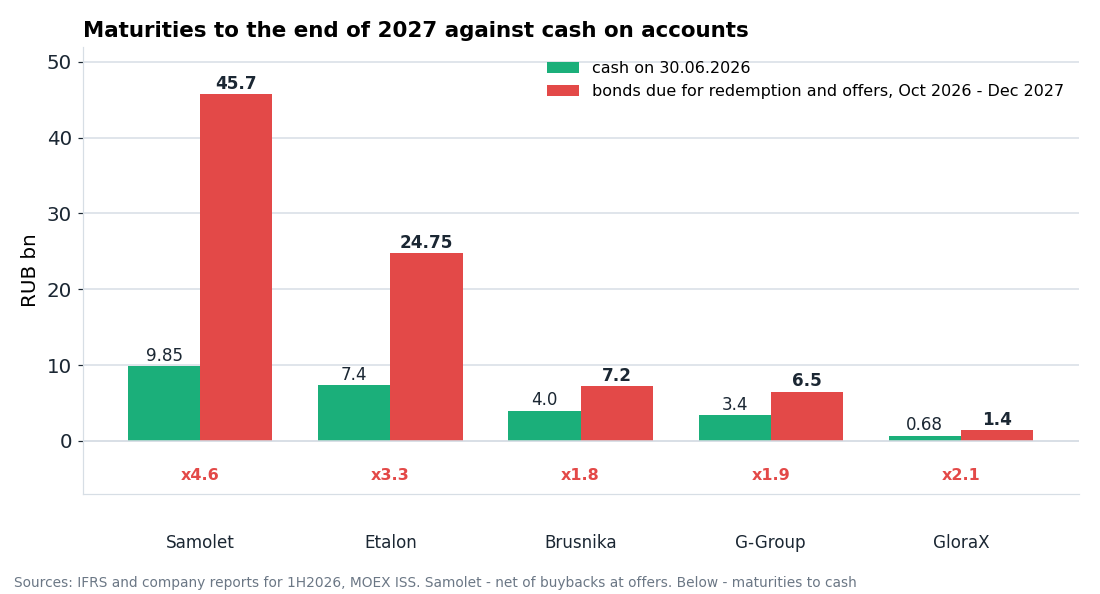
- Samolet and Etalon need the most attention, but both have strong support. By the end of 2027 they must repay or pass offers on roughly RUB 46 bn and 25 bn of bonds, with cash at 30.06 of about 10 bn and 7 bn, while escrow covers 61% and 42% of project debt. Behind Samolet stand the largest creditor banks, which benefit from an orderly solution; behind Etalon is AFK Sistema with a stake of about 72%.
- Third in the risk group is APRI, followed by Strana Development, G-Group and Legenda. Brusnika, Setl, GloraX and LSR are stronger, but each has a weak spot. A101, PIK and Pioneer withstand the reform, Pioneer because it repays nothing until the end of 2027.
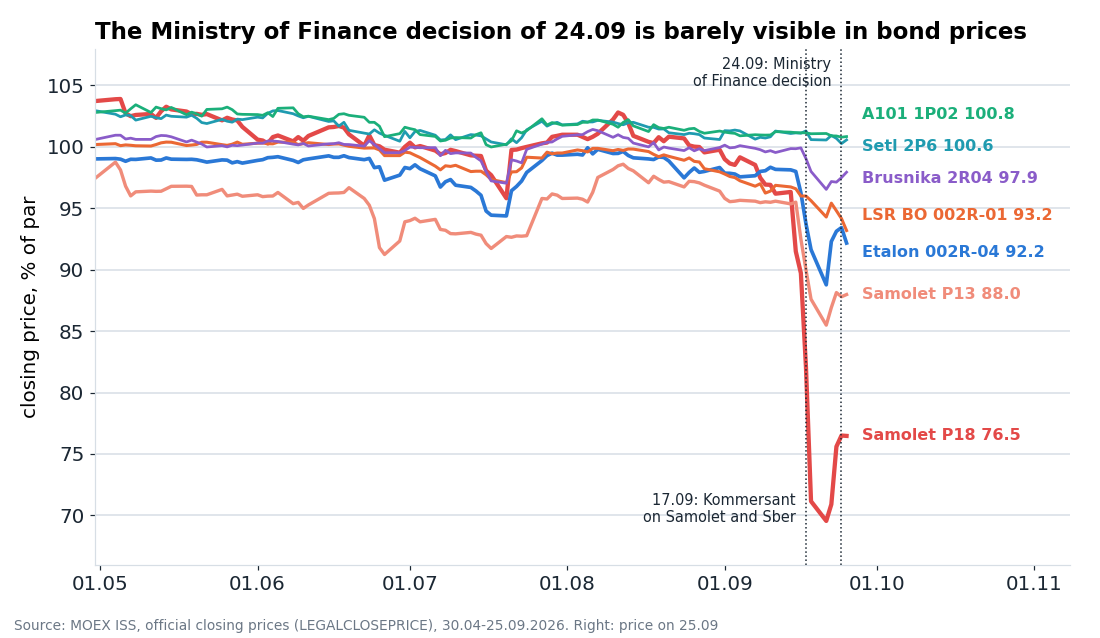
- The bond market barely noticed the reform on 24 September. The repricing of the sector happened earlier, on the Samolet story.
- The bill arrives in January-February 2027, together with reports for a weak fourth quarter and the peak of maturities.
Prices and yields are Moscow Exchange closing values as of 25.09.2026 unless stated otherwise. Disclosure: we may hold bonds of some of the companies mentioned on our balance sheet.
From 1 October a family with one child pays 10-12% instead of 6%
We analysed the reform itself in detail in [our previous article](https://telegra.ph/Family-Mortgage-October-2026-09-25). For contracts from 1 October the rate depends on the number of children and the region. In the regions it is 10/8/6/4/2% for families with 1/2/3/4/5+ children, in Moscow, St Petersburg and their regions 12/10/8/6/4%. Previously it was 6% for everyone.
According to ERZ, the family mortgage accounts for about 70% of new-build sales, and families with one child make about 70% of purchases under it. ERZ expects new-build sales to fall by 20% ([RIA Real Estate](https://realty.ria.ru/20260924/erz-2120075535.html)); our range is wider, minus 14-33%. The third quarter will be strong because of the rush, and the collapse will fall on October-December. After the two previous peaks in 2026 issuance fell 47-57% the following month.
Every unsold escrow rouble costs the developer 12-15 kopecks a year
Until a building is commissioned the developer does not use the escrow money and builds on a project loan. Its rate is recalculated monthly. The part of the debt covered by escrow carries a preferential rate, up to 4%, the uncovered part the base rate, key rate plus 2-5 pp, currently about 16-19% ([DOM.RF Bank](https://domrfbank.ru/for-developers/project-finance/)). Every rouble of sales that did not reach escrow moves a rouble of debt from the preferential rate to the market rate. The difference is 12-15 kopecks a year, more precisely depending on the bank's formula. At APRI, where there is almost no escrow, the effective project loan rate is about 15.5%.
The industry enters the reform with coverage already weakened. As of 1 July 2026 project debt was RUB 10.85 trn, escrow balances on projects with active loans were 7.07 trn, coverage 65.2%. This is the Bank of Russia's definition, which we use throughout the article. If the debt is divided into all RUB 7.55 trn of escrow, including projects without a loan, the result is 69.6%, the figure cited by ERZ and part of the media. 65.2% is the minimum of the series: a year earlier it was 71%, in mid-2024 88% ([Bank of Russia](https://www.cbr.ru/Collection/Collection/File/62336/pf_2Q2026.pdf)).
In May, at 68% coverage, the central bank called that level a "yellow zone" and 70% an expert benchmark ([RIA Real Estate](https://realty.ria.ru/20260522/zadolzhennost-2093994579.html)). Now the industry is below both marks. For 26% of project debt coverage is below 30%, and this debt is serviced at almost the market rate.
There is a precedent. After the end of mass-market subsidised mortgages in July 2024, quarterly escrow inflows fell 24%, coverage dropped from 88% to 81% over the quarter ([Bank of Russia](https://www.cbr.ru/Collection/Collection/File/54851/pf_2024_Q3.pdf)), and to 71% over the year. Now the key rate is falling, but there is nothing to replace the lost demand, and the market mortgage costs about 18.7%.
ICR below one in the first half is the sector norm
The last link is interest coverage (ICR). We calculate it under IFRS with one formula for everyone: operating profit to finance costs plus interest expensed through cost of sales. Without this adjustment, interest capitalisation makes coverage look better than it is.
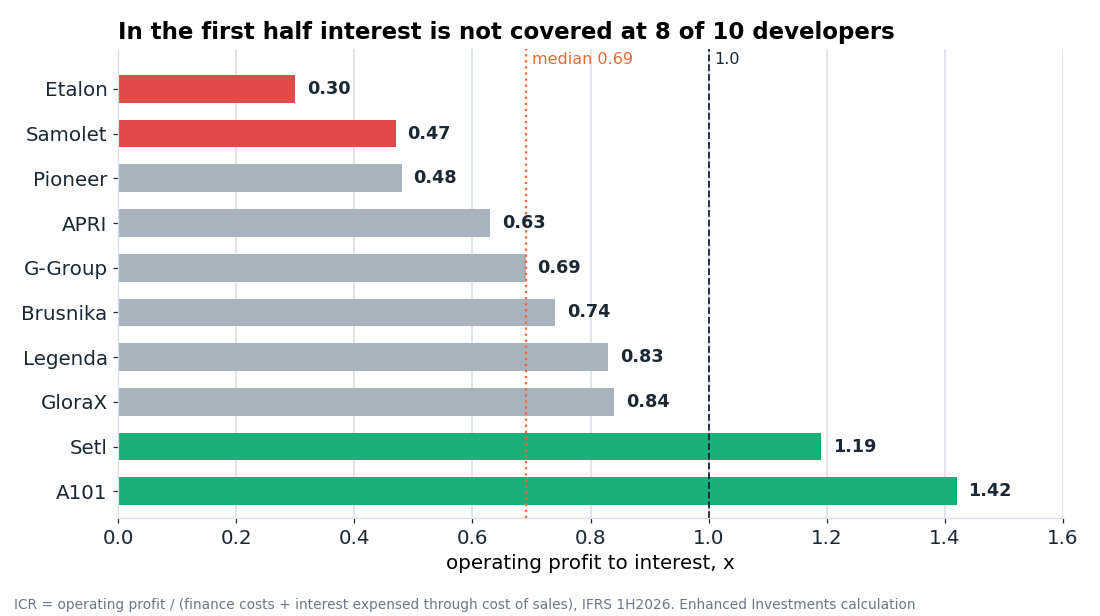
The median across ten issuers is 0.69. The first half is seasonally weak for developers, with most profit coming in the second, so an ICR below one is the norm here, not a distress signal. It is therefore more important to look at cash against 2027 maturities, escrow coverage of project debt and who stands behind the company, as discussed below.
Agencies calculate in their own ways, and we give their figures for reference. Expert RA (EBITDA to interest for 2025) notes that most developers have a ratio no higher than 1.5x, A101 15.7x ([Expert RA](https://raexpert.ru/researches/development/housing_construction_2026/)). For Setl, ACRA calculates FFO to net interest payments on average for 2023-2028, 3.6x, and excludes from debt the project loans fully covered by escrow ([ACRA](https://www.acra-ratings.ru/press-releases/6854/)).
The bondholder stands in line behind the bank
When a building is completed, escrow money first repays the bank's project loan, and only the project margin goes to the group. Bonds are issued by the parent company and serviced from this margin, land sales and refinancing. Legally the bonds are not subordinated, but the bondholder receives money after the bank.
That is why the company's relations with banks and its shareholder matter so much to holders of bonds of large groups.
Shareholders take the losses first, for bonds dates decide. If the developer's affairs go badly, shares lose first and more: in a debt restructuring the shareholder stands last. The bondholder receives at most par and coupon, and for him the main question is whether the company will pass its maturities. Lower sales will reduce escrow releases in 2027-2028, that is, the source of repayment. The failure will become visible in fourth-quarter reports in late January – February, exactly at the peak of maturities, and if the market closes to weak issuers in those months, there will be nothing to refinance them with.
For Samolet the additional interest under our stress test is RUB 6-9 bn a year at full run-rate, comparable with the 9.85 bn of cash at 30.06 (before third-quarter payments). It is mostly not paid from this cash: interest on project loans is capitalised and repaid in the project companies from escrow. The bondholder will feel it differently. When escrow is released in 2027-2028, less margin will return to the group, and debt metrics will come closer to bank covenants.
For strong issuers the picture is the opposite. With escrow coverage above 100%, the first part of the shortfall eats up the excess coverage and barely changes the rate, so for A101, PIK and Pioneer the reform barely threatens bonds and affects mainly profit and shares.
The market repriced Samolet before the reform and barely touched the rest
Across 54 developer issues with duration over 30 days, the median price change on 23-24.09 was plus 0.04 pp, on 23-25.09 minus 0.08 pp. LSR (its most liquid issue BO 002R-01 minus 1.6 pp over two days, to 93.19%) and Etalon (minus 1.0 pp median) reacted more than the others.
The main repricing happened a week earlier. On 17 September [Kommersant](https://www.kommersant.ru/doc/8956857) wrote that Sberbank might obtain control of part of Samolet's business. The company does not confirm this version. From 14 to 21 September P18 fell from 96.33% to 69.55%, and Etalon 002R-04 followed from 98.13% to 88.77%.
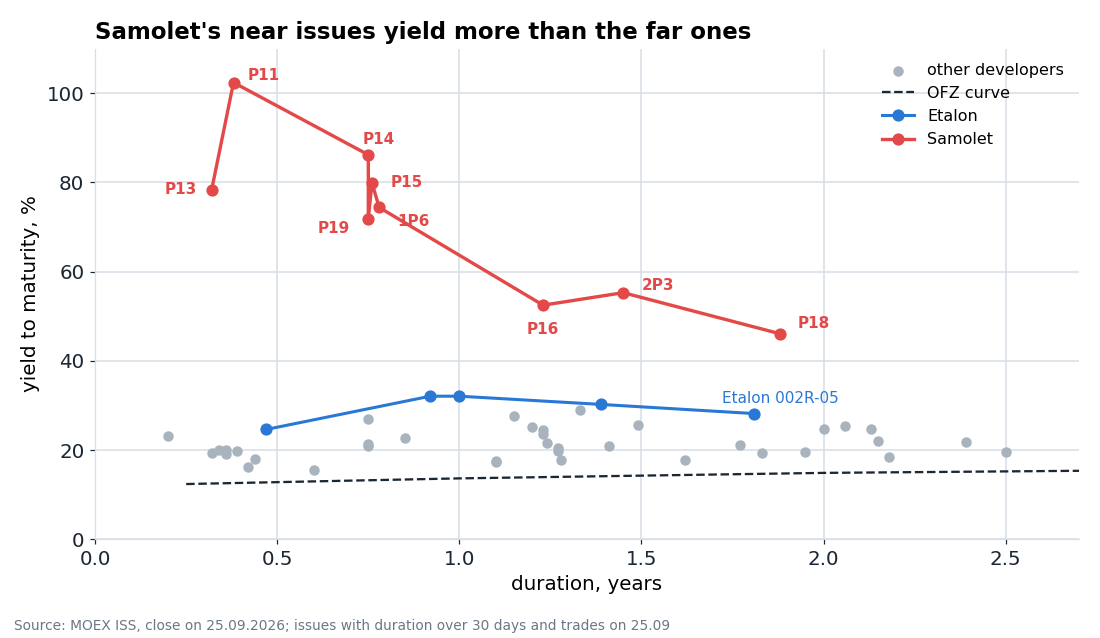
Samolet's curve has been inverted since mid-September, that is, before the reform. P11 to the offer on 12.02.2027 yields 102.4% per annum, P13 78.4%, P18 maturing in 2029 46.1%. This shape means the market is pricing a possible revision of terms. It is a market assessment of risk, not an event, and if banks support the company, such a yield becomes a premium for holders. Samolet has made its payments. In May 2026 coupons on three issues reached the NSD overnight on 5 May instead of the 4th ([Kommersant](https://www.kommersant.ru/doc/8636934)), and the Moscow Exchange put these cases on the list of technical defaults. Brusnika had a similar story in November 2025: the coupon of 002R-04 for RUB 133 mn reached the depository one day late and also landed on this list ([Moscow Exchange](https://www.moex.com/ru/listing/emidocs.aspx?type=4)). Neither company has any unfulfilled obligations.
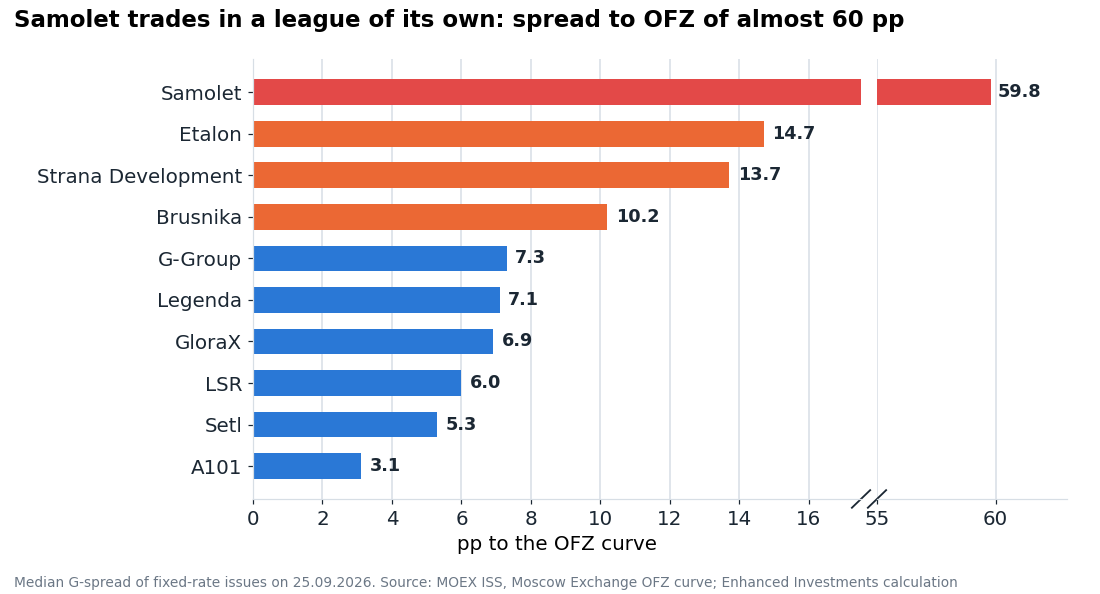
A spread to OFZ above 10 pp is seen, besides Samolet, only at Etalon, Strana Development and Brusnika; for the others it is 3-7 pp. APRI's bonds trade at 81-100% of par with a yield of 37-47%. The two-year OFZ curve has risen 1.6 pp since the end of April, and for most issuers the rise in yield is explained by the risk-free rate.
Rating agencies lag the market; we found no reactions to the Ministry of Finance decision as of 26.09.
The maturity wall weighs RUB 142-174 bn and peaks in the first quarter of 2027
From October 2026 to December 2027 residential developers must repay or pass offers on roughly RUB 174 bn according to Moscow Exchange data, of which 129 bn are redemptions and amortisation and 45 bn are offers. This is an upper bound, as for offers the whole issue is counted. Taking into account Samolet's buybacks at the 2026 offers, the wall shrinks to roughly RUB 142 bn, of which about 46 bn is Samolet.
By quarter: fourth quarter of 2026 – 18.0 bn, first quarter of 2027 – 71.2 bn (about 42 bn net of buybacks), second quarter – 8.5 bn, third quarter – 49.2 bn, fourth quarter – 27.2 bn. The quarter when sales fall the most is light on maturities. The bill arrives in the first quarter of 2027, when the market will be reading weak operating reports.
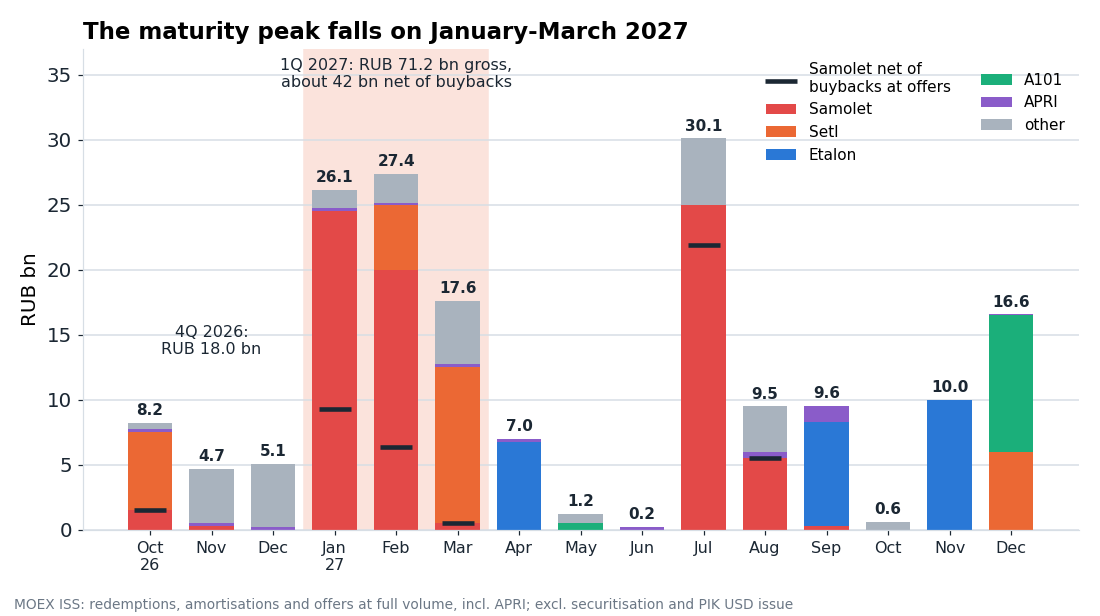
By issuer, RUB bn ([MOEX ISS](https://iss.moex.com/iss/engines/stock/markets/bonds/securities.json)): Samolet 77.6 per the Moscow Exchange and about 46 net of buybacks, Setl 12 of redemptions plus offers up to 17, Etalon 24.75 without offers, A101 11.0, Brusnika 7.2, G-Group 6.5, Legenda 5.75, LSR 4.5, APRI 3.6 across 14 issues (of which 1.6 are offers), GloraX 1.4, Talan 1.2, Strana Development 1.0, Pioneer nothing. PIK has no rouble bonds; its USD issue of $395 mn matures on 19.11.2026.
Stress test: for whom the reform breaks coverage
The industry. In the second quarter RUB 1.175 trn arrived in escrow. If sales fall 20% over a year, escrow receives about RUB 0.94 trn less, at minus 30% about 1.4 trn. Coverage falls from 65% to about 56% and 52%. Interest on project finance, now about RUB 1.08 trn a year, reaches a run-rate RUB 140-210 bn a year higher by the end of the year if counted at 15 kopecks per rouble, and 115-170 bn at 12 kopecks. This is the annual run-rate at the end of the period; over the first 12 months the effect is about half as large (our estimate based on central bank data).
The model most likely understates the blow. In 2024 coverage fell over the year from 88% to 71%, by 17 pp, more than in our minus 30% scenario (minus 13 pp). The comparison is approximate, as since 2025 the central bank has calculated coverage using a refined methodology. The model also does not account for the growth of instalment plans, where there is a sale but no escrow, and for discounts.
Issuers. We set the sales shock by segment; this is an authors' assumption. The Moscow mass-market segment (Samolet, PIK, Setl, Legenda, LSR) – minus 25-35%, regions – minus 15-25%, business class – minus 10-20%, to which we also assign Etalon. The base is annual sales or escrow inflows under IFRS and operating reports, not revenue. The money not received is deducted from escrow balances, and we add to interest 15% of the part not closed by the excess of escrow over debt.
A separate item is the subsidising of buyers' rates. By our rough estimate, cutting the rate by 4 pp for the first 1-3 years costs 4-8% of the apartment price, with project margins of 5-10%. If half of sales are subsidised, for Samolet this is RUB 3-7 bn a year, comparable with the additional interest. Operating profit falls after the shock, and ICR declines with it.
Below is escrow coverage of project debt now, in the soft and hard scenarios, with additional interest in RUB bn a year at full run-rate in brackets.
- Samolet (minus 25-35%, base – sales of about RUB 165 bn a year per the guidance of 700-800 thousand sq. m) – 61% / 53% / 50% (+6.2 / +8.7). Buyer subsidies add another 3-7 bn.
- Etalon (minus 10-20%, base – second-quarter sales receipts annualised, about 93 bn) – 42% / 34% / 26% (+1.4 / +2.8). There is no excess of escrow over debt, and the whole shortfall immediately goes to the market rate.
- Brusnika (minus 15-25%, base – first-half sales of 56.5 bn annualised) – 68% / 61% / 56% on loans under escrow (+2.5 / +4.2). This is 4-7% of the company's 12-month EBITDA, 60.2 bn. Coverage of total project debt is now 53% (our Brusnika review).
- Setl – coverage about 106%, excess of escrow over debt about RUB 7.6 bn. The company does not disclose rouble sales, so we do not calculate the shock. Beyond the excess, every 10 bn of shortfall adds about 1.5 bn of interest a year. Finance costs for the half-year have already risen 36.8%, to 19.4 bn ([Moskovskaya Perspektiva](https://mperspektiva.ru/topics/dolg-setl-group-vyros-na-26-i-dostig-205-mlrd-rubley/), checked against IFRS).
- GloraX – escrow covers 78% of project debt versus 87% at the start of the year ([GloraX IFRS](https://cms-investors.glorax.com/assets/965a5cce-3128-45bb-9168-f6127173fc67.pdf)).
- APRI – coverage is 14%, almost all project debt already goes at the market rate, so the reform adds little through escrow. The risk is in sales and in refinancing RUB 3.6 bn of bonds by the end of 2027.
- G-Group – escrow covers 35% of total debt, and the available statements do not split project and corporate debt. Strana Development, LSR, PIK – we have not checked the half-year IFRS against the primary source and do not include them in the stress test.
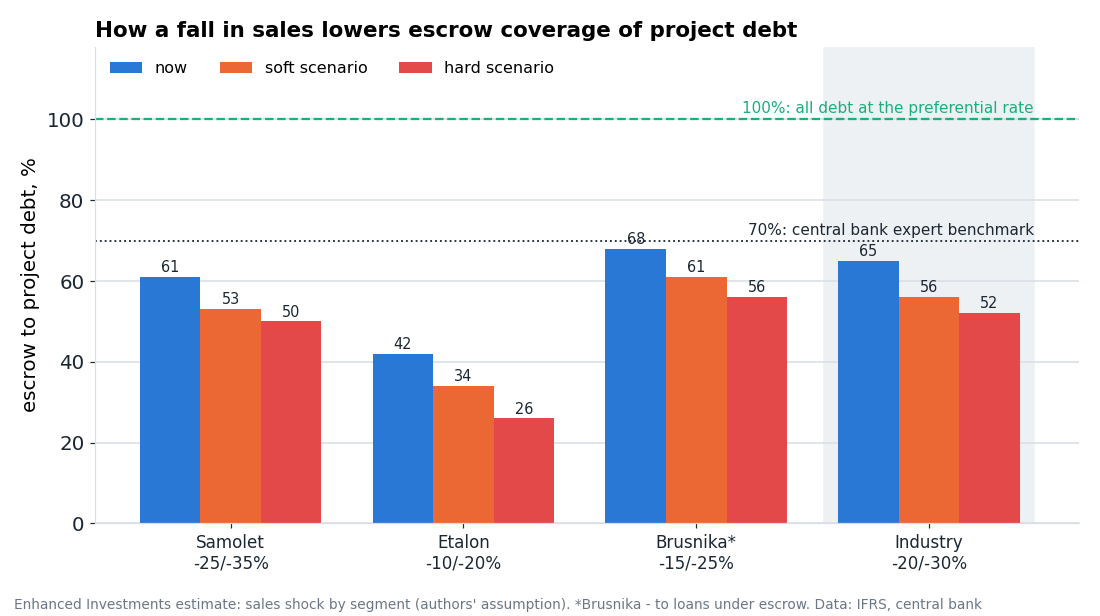
There are three conclusions. For Samolet and Etalon the stress hits the source of bond repayment, so support from banks and the shareholder becomes decisive. Additional interest and buyer subsidies reduce the margin that will return to the group when escrow is released in 2027-2028, and it is from this and from refinancing that bonds are repaid. Regional players with an ICR of 0.6-0.8 (APRI, G-Group, Brusnika) have no margin: a weak fourth quarter eats part of the profit of the second half, which accounts for the main result of developers. For Setl, coverage above 100% works as a cushion, but a thin one, enough for roughly RUB 7-8 bn of sales shortfall.
Two dimensions of risk: starting point and sensitivity to the reform
The first axis is starting credit risk: ICR, cash against maturities, spread, capital. The second is sensitivity to the reform: the share of the capitals, the share of mortgages in sales, the escrow coverage margin and maturities by the end of 2027. A place in the ranking takes both into account.
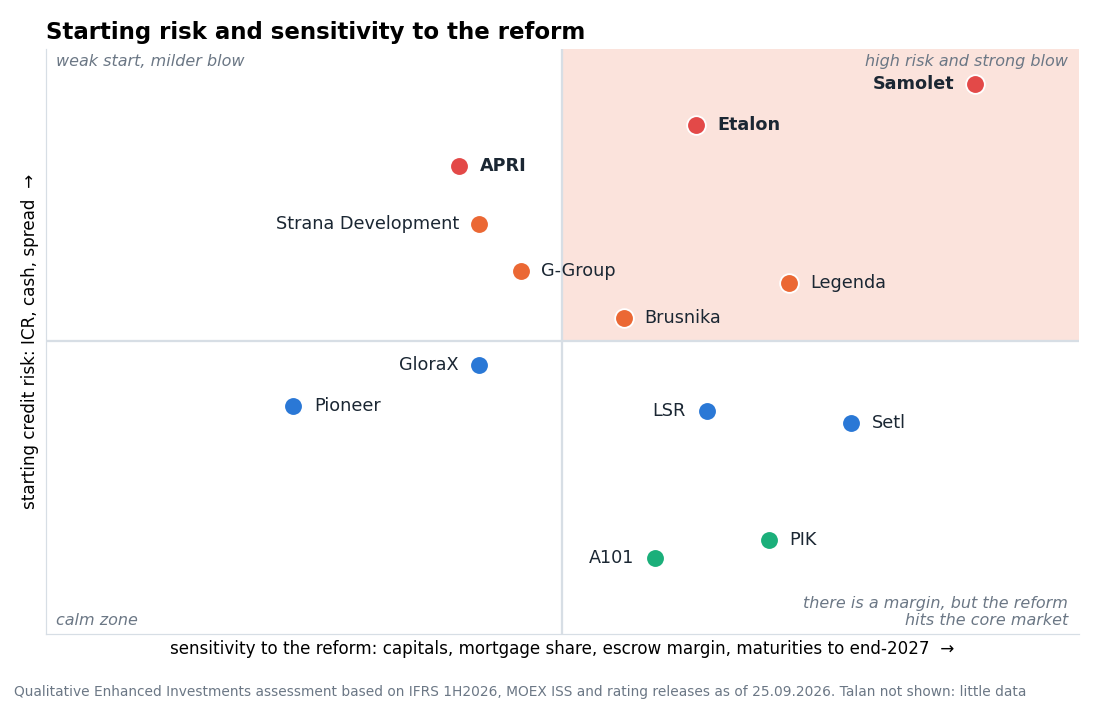
Below are the first-half ICR, escrow coverage, cash against bonds due for redemption by the end of 2027 (RUB bn), a representative issue (price / yield) and rating.
- 1. Samolet – high, with a mitigating factor. ICR 0.47, coverage 61%, cash 9.85 against about 46. P18 76.47% / 46.1%, P13 87.98% / 78.4%. ACRA A-(RU), NKR A.ru, outlooks stable. Support – creditor banks: Sber 274 bn, VTB 86 bn ([Kommersant](https://www.kommersant.ru/doc/8956474)).
- 2. Etalon – high, with a mitigating factor. ICR 0.30, coverage 42%, cash 7.4 against 24.75. 002R-04 92.17% / 32.1%. Expert RA ruBBB+, NKR A-.ru. Support – shareholder AFK Sistema, about 72%.
- 3. APRI – high. ICR 0.63, coverage 14%, net debt to EBITDA 6.4x per our [review](https://telegra.ph/APRI-Bonds-Deep-Review-Sep-2026-09-16) (4.2x per the company), 3.6 due for redemption and offers throughout 2027. Issues at 81-100% / 37-47%. NKR BBB-.ru.
- 4. Strana Development – high. Spread to OFZ 13.7 pp, third in the sector after Samolet and Etalon, 1.0 due for redemption. 2R2 101.11% / 27.0%. Expert RA ruBBB-, EBITDA to interest for 2025 of 0.8x per the agency. We have not checked the half-year statements against the primary source.
- 5. G-Group – high. ICR 0.69 for the first half and 1.24 for the second half of 2025, Expert RA EBITDA to interest for 2025 of 0.9x. Cash 3.4 against 6.5. 2R5 96.14% / 22.8%. Expert RA ruBBB+, ACRA BBB+(RU).
- 6. Legenda – medium. ICR 0.83, NKR OIBDA to interest for 2025 of 1.2x. Debt to OIBDA 8.5x, capital 4-5% of assets, 5.75 due for redemption. 2P7 99.50% / 20.8%. NKR BBB+.ru.
- 7. Brusnika – medium. ICR 0.74, escrow covers 68% of loans under escrow and 53% of total project debt, cash 4.0 against 7.2. 2R04 97.94% / 25.6%. ACRA A-(RU) with a negative outlook.
- 8. Setl – moderate, but sensitive to the reform. ICR 1.19, ACRA FFO to interest 3.6x. Coverage about 106%, cash 4.0 against 12 of redemptions and up to 17 of offers. 2P6 100.57% / 19.1%. ACRA A-(RU), NKR A.ru.
- 9. GloraX – moderate. ICR 0.84, coverage 78%, cash 0.7 against 1.4. 1R5 101.00% / 22.0%. NKR BBB+.ru with a positive outlook.
- 10. LSR – moderate. Spread 6.0 pp, higher than Setl's, and on 24-25 September LSR's issues fell the most. 4.5 due for redemption. ACRA A(RU).
- 11-13. PIK, A101, Pioneer – low. PIK has an ACRA rating of AA-(RU) and no rouble bonds. A101 has an ICR of 1.42, 11.0 due for redemption, almost all in December 2027. Pioneer has an ICR of 0.48, and its low risk rests only on the fact that it has no maturities until the end of 2027.
- Outside the ranking – Talan. 1.2 due for redemption, 1P4 93.24% / 27.6%, Expert RA ruBBB-. We did not find the group's IFRS statements in the public domain; there is too little data for a place in the ranking.
Samolet and Etalon. Samolet has the mass segment of Moscow and the region, where families with one child account for 40-45% of family mortgage deals. Etalon has more business class, where the limit of RUB 12-18 mn softens the blow. Escrow coverage fell over the half-year from 78% to 42%, and on a number of loans banks agreed not to enforce covenant claims ([Etalon IFRS](https://www.etalongroup.com/upload/iblock/22c/gxr6gebhoo642nck6v3s7pgav6n68l04/Etalon_IFRS_Int_Cond_Cons_FS_26_r_6m_Etalon_MSFO_Prom_Sokr_Kons_FS_26_r_6m_1102.pdf)).
APRI, Strana Development, G-Group. Regional players with a 10% rate for a family with one child, the blow to demand is milder, but there is almost no margin. At APRI less than a third of revenue goes through equity participation agreements. We assess Strana by the market: a spread of 13.7 pp with bonds of only RUB 2.3 bn, and for holders the company's access to banks is decisive.
Legenda, Brusnika, Setl. Legenda and Setl depend on St Petersburg, where a family with one child now pays 12%. We rank Legenda, with its debt load and thin capital ([NKR](https://ratings.ru/ratings/press-releases/Legenda-RA-150426/)), above Brusnika. Brusnika has the highest disclosed share of mortgages in sales, 78%, and the negative outlook from [ACRA](https://www.acra-ratings.ru/press-releases/6350/) since December 2024 is linked precisely to the risk of missing the sales plan. Setl is stronger by starting point, but the reform changes its picture the most: about 85% of revenue in St Petersburg, operating cash flow for the half-year of minus RUB 44.9 bn and up to 29 bn of redemptions and offers by the end of 2027.
GloraX, LSR, PIK. GloraX is undergoing a reorganisation, and shareholders who disagree with it may tender shares for buyback until 19 November, with payment by 19 December. This is a possible cash outflow against a balance of RUB 0.7 bn at 30.06. LSR has a net loss for the half-year of RUB 57.6 bn due to a one-off write-off related to the sale of a subsidiary ([Vedomosti](https://www.vedomosti.ru/investments/news/2026/08/28/1224548-chistii-ubitok-lsr)). We have not yet checked the buyer and terms of the deal against primary reporting; for creditors this is a corporate governance question. PIK is leaving the exchange, and according to [ACRA](https://www.acra-ratings.ru/press-releases/7005/) the company's interest income exceeds its expenses.
What supports Samolet's and Etalon's bonds
Samolet. Samolet is the largest developer in the Moscow region and too big a borrower for banks: Sber lends RUB 274 bn to the group, VTB 86 bn ([Kommersant](https://www.kommersant.ru/doc/8956474)). For banks and the state an orderly solution is better than problems at a company that builds for hundreds of thousands of families. The company makes bond payments; the P13 offer in February and the P15 offer in August were honoured. Negotiations with banks on new loan terms are disclosed in the half-year IFRS and, according to the company, are constructive. Undrawn credit line limits at 30.06 are RUB 519 bn, mostly project ones. The market has already priced in a lot of risk, and if bank support works, the current yield is the premium for holders.
What and when we check: 28.09 redemption of P20, 30.10 series 01, the outcome of bank negotiations, by 22.12 the rating review at ACRA, 24.01.2027 redemption of P13, 12.02.2027 offer on P11. P18 matures in 2029, and its fate depends on how the 2027 payments go.
Etalon. The main thing on the bonds' side is the controlling shareholder AFK Sistema. In February 2026 Etalon conducted an SPO for RUB 18.4 bn; Sistema bought 377 mn of the 400 mn new shares ([Etalon](https://www.etalongroup.com/news/gruppa-etalon-privlekla-18-4-mlrd-rubley-v-rezultate-spo/)), and its stake rose to roughly 72% (our calculation from the share count; [Kommersant](https://www.kommersant.ru/doc/8459608) gives 71%). Part of the funds went to buy from Sistema the company Business-Nedvizhimost for RUB 14.8 bn. Sistema is itself a large borrower in the bond market, and the group's reputation with investors matters to it. There are no direct Sistema guarantees on Etalon-Finance's bonds. The nearest offer on 002R-01 is 19.05.2028, after all the 2027 maturities.
What and when we check: 22.10 the Etalon-Finance meeting on two large transactions, 01.04.2027 redemption of 002R-03, 30.09.2027 – 002R-02, 11.11.2027 – 002R-04, and whether the banks' waivers of covenant claims will be preserved in the annual report.
Calendar of checks to February 2027
- 28.09 – redemption of Samolet BO-P20 for RUB 2.5 bn. 29.09 – buyback at the APRI 002R-03 offer. 30.09 – DARS 001R-03 for 1 bn.
- 02.10 – Setl 002P-04 offer up to 6 bn. After it the coupon falls to 16.5% against the issuer's issue yields of 18-19%, and in our estimate most will be tendered for buyback.
- 13.10 – PIK shareholder meeting on delisting. 22.10 – Etalon-Finance meeting on large transactions.
- 23.10 – central bank meeting, consensus expects the rate to stay at 14% or fall to 13.75% ([Izvestia](https://iz.ru/2160675/evgenii-grachev/na-rynke-prognoziruyut-pauzu-v-snizhenii-klyuchevoj-stavki)).
- 30.10 – Samolet 01 for 1.5 bn. 08.11 – Brusnika 002R-03. 19.11 – PIK's USD issue.
- November – central bank data on project finance for the third quarter and first data on mortgage issuance for October.
- 12.12 – G-Group floater for 3 bn, the company's first test after the reform. By 22.12 – review of Samolet's rating at ACRA.
- 24.01.2027 – redemption of Samolet P13. 12.02.2027 – offer on Samolet P11. January-February – operating reports for the fourth quarter.
The central bank rate will help demand faster than project loans
A 1 pp cut in the key rate makes cheaper only the part of project debt not covered by escrow, about RUB 3.8 trn, i.e. roughly 38 bn a year. This is about a quarter of the effect of minus 20% sales. The covered part already goes at the preferential rate, which is why over the second quarter the average project finance rate fell by only 0.03 pp. The key rate works more strongly through demand: according to Samolet, the market mortgage will work at a key rate of about 10%.
The second mitigating factor is the reduction of new launches, which reduces the need for project debt and is not accounted for in the model.
The decisive variable is the actual fall in sales. If it turns out to be within 20%, most second-tier issuers get through 2027 at current spreads. If it is closer to 30% and deeper, Strana, G-Group and Legenda are added to APRI in the risk zone, support from banks and the shareholder becomes even more important for Samolet and Etalon, and the question for Brusnika and Setl shifts from yield to access to refinancing.
Conclusion
For the sector the reform means by the end of the year a run-rate of RUB 140-210 bn of additional interest a year and a 9-13 pp fall in escrow coverage from an already record-low 65%. For individual bonds it is a question of dates: the bill for a weak fourth quarter arrives in January-February 2027, and for Etalon the whole of 2027 consists of redemptions without offers. For Samolet and partly Etalon the market has already priced in high risk, and the outcome there depends on support from banks and the shareholder. For the other issuers the market has added almost no risk premium. The next move in spreads will be determined by sales data for October-November.
See also: market overview · valuation map · stock screeners