GLORAX: revenue up 44.6%, but EBITDA and profit fall — cash goes into debt

On August 25, GLORAX reported H1 2026 results: revenue grew 44.6% YoY, but EBITDA fell 3.3% and net profit dropped 31.6%. This review examines why sales growth is not converting into profit and how it affects leverage.
Key takeaways
— H1 revenue grew 44.6%, but EBITDA fell 3.3% — margin compressed from 36.7% to 24.5%
— Net profit declined 31.6%, and net margin dropped from 12.5% to 5.9%
— Operating cash flow over the last 12 months is negative — minus 19.0 billion RUB
— Net debt rose by 17.1 billion RUB over the year, reaching 78.5 billion RUB
— Net debt to EBITDA for the last 12 months stands at 6.86 — a high level
— P/E for the last 12 months is 5.4, EV/EBITDA is 8.0, below the three-year average
— ROE is 40.5% — high return on capital, but amid rising debt
Key figures, RUB bn
| Metric | H1 2025 | H1 2026 | Change |
|---|---|---|---|
| Revenue | 18.7 | 27.0 | +44.6% |
| EBITDA | 6.85 | 6.63 | -3.3% |
| Operating profit | 6.74 | 6.48 | -3.8% |
| Net profit | 2.33 | 1.60 | -31.6% |
| Operating cash flow | -3.43 | -6.24 | — |
| EBITDA margin | 36.7% | 24.5% | -12.2 pp |
| Net margin | 12.5% | 5.9% | -6.6 pp |
H1 revenue grew 44.6%, but EBITDA fell 3.3% — margin compressed from 36.7% to 24.5%
In H1 2026, GLORAX's revenue reached 49.6 billion RUB, up 44.6% year-on-year. However, EBITDA for the same period declined by 3.3%, and the EBITDA margin fell from 36.7% to 24.5%. This indicates that sales growth was accompanied by a disproportionate increase in operating costs.
The margin compression of 12.2 percentage points is a key signal for shareholders. The company is growing revenue but cannot maintain profitability at previous levels, raising questions about the efficiency of its operating model.
Net profit declined 31.6%, and net margin dropped from 12.5% to 5.9%
Net profit for H1 2026 amounted to 2.4 billion RUB (calculated as 5.9% of revenue), down 31.6% from the same period last year. Net margin fell from 12.5% to 5.9%.
The decline in profit amid rising revenue points to pressure on operational efficiency and possibly higher financial expenses. Shareholders should pay attention to the cost structure and debt burden.
Operating cash flow over the last 12 months is negative — minus 19.0 billion RUB
For the trailing twelve months (as of June 30, 2026), GLORAX's operating cash flow was minus 19.0 billion RUB. This means the company spends more cash on operating activities than it generates from them.
Negative operating cash flow is a worrying signal, especially combined with rising debt. It may be related to working capital buildup or expenses not reflected in EBITDA, and warrants close attention.
Net debt rose by 17.1 billion RUB over the year, reaching 78.5 billion RUB
As of the latest reporting date, GLORAX's net debt stood at 78.5 billion RUB, up 17.1 billion RUB over the last 12 months. The change from the previous reporting date is zero.
Rising debt amid negative operating cash flow indicates that the company is financing its operations with borrowed funds. This increases interest expenses and adds pressure on profit.
Net debt to EBITDA for the last 12 months stands at 6.86 — a high level
Net debt to EBITDA for the trailing twelve months stands at 6.86. This is a high level, typically associated with elevated risk for creditors and shareholders.
At this level of leverage, the company becomes vulnerable to rising interest rates and deteriorating operational performance. Further debt accumulation could lead to a credit rating downgrade.
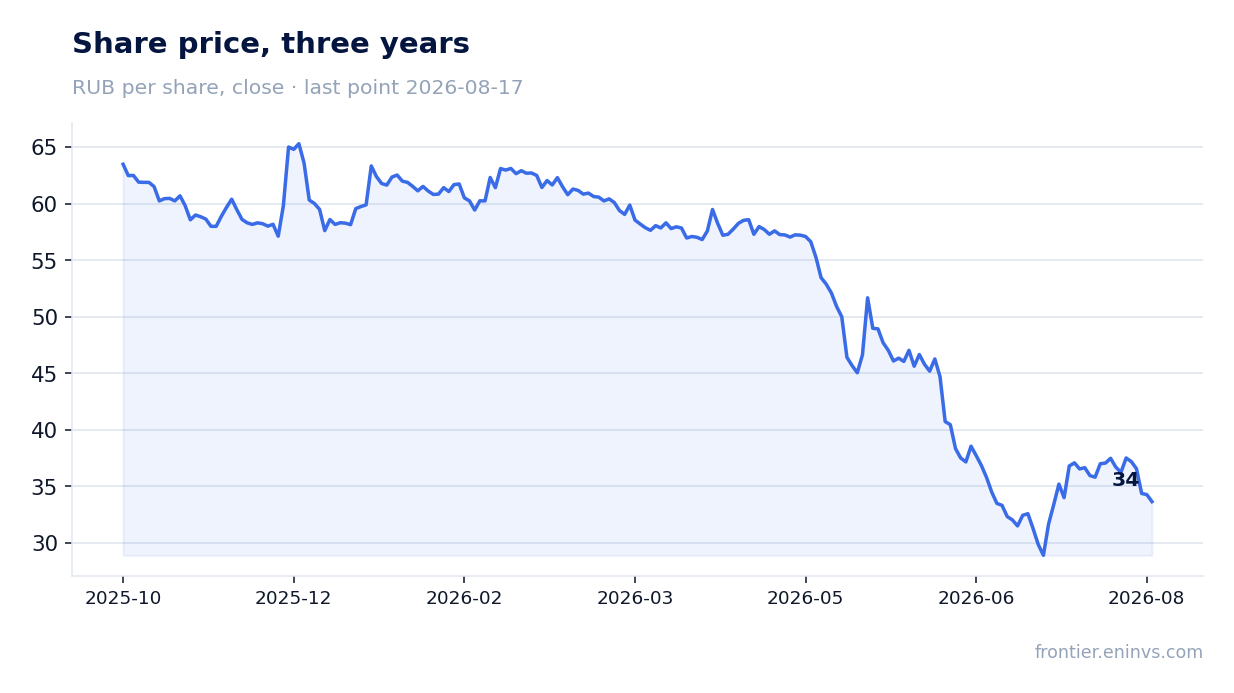
P/E for the last 12 months is 5.4, EV/EBITDA is 8.0, below the three-year average
GLORAX's market capitalization is 12.8 billion RUB, resulting in a trailing twelve-month P/E of 5.4 and EV/EBITDA of 8.0. Both multiples are below the three-year average, indicating a relatively cheap valuation.
Low multiples may reflect market skepticism about earnings quality and cash flow sustainability. Investors should consider that the cheap valuation may be justified by high debt and negative operating cash flow.
ROE is 40.5% — high return on capital, but amid rising debt
Return on equity (ROE) stands at 40.5%, which is a high figure. However, such profitability is achieved amid significant debt, which increases financial leverage.
High ROE may be partly due to the financial leverage effect, not just operational efficiency. If profit declines and debt rises, this metric could deteriorate quickly.
Valuation on the latest reported figures
| Metric | Value |
|---|---|
| Market cap | 12.8 bn ₽ |
| P/E (LTM) | 5.4 |
| EV/EBITDA (LTM) | 8.0 |
| P/B | 1.78 |
| Net debt / EBITDA (LTM) | 6.86 |
| Operating cash flow (LTM) | -19.0 bn |
| ROE | 40.5% |
Bottom line
Bottom line: GLORAX shows strong revenue growth (+44.6%), but it does not convert into profit: EBITDA and net profit are declining, margins are compressing. Negative operating cash flow and rising debt (78.5 billion RUB) create significant strain. The stock trades cheaply (P/E 5.4), but this may be justified by high risk. The key question for shareholders is whether the company can restore margins and cash flow, or the debt spiral will continue.
Open the company's financial profile GLRX →
See also: market overview · valuation map · stock screeners