MGTS is buying back its preferred shares at RUB 1,501. Is it worth participating?
*Update of 10 September: brokers stopped accepting orders on 8 September, and the price fell to 1,340. What this means for those who tendered and those who did not make it, and why a squeeze-out from this offer does not follow: [telegra.ph/MGTS-buyback-update-09-10-09-10](https://telegra.ph/MGTS-buyback-update-09-10-09-10).*
*Updated on 28 August: added the answer from the IR team of MTS on non-participation, and recalculated the probability and the purchase threshold (previous values were 70% and RUB 1,410). Corrected the point about leverage: the claim that shares held on margin cannot be tendered did not pass verification.*
The idea is simple. Buy a share on the exchange for RUB 1,432, tender it for the buyback and receive RUB 1,501 from the company a month later. Participation makes sense if you can buy below RUB 1,445. At a higher price the premium no longer pays for the main risk. The company may buy back only part of a tendered order rather than all of it.
Below are five theses that make up this conclusion.
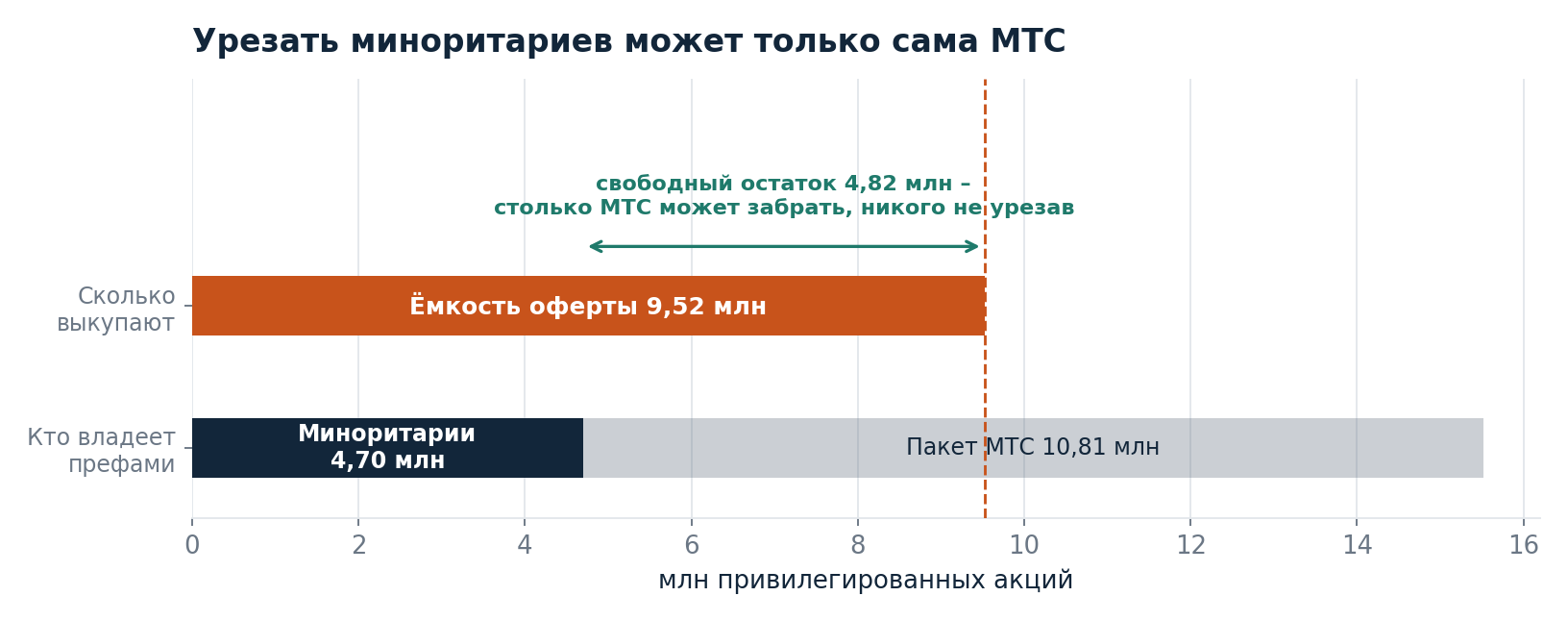
Only MTS itself can cut the orders, and it has enough room not to do so. Up to 9.52 mn shares are being bought back, while all minority shareholders together hold about 4.70 mn. MTS can take another 4.82 mn without affecting anyone.
MTS IR answered a direct question that it does not plan to participate. The company has not said this publicly: in May the CFO said that no decision had been made and that it might come later. The IR answer is not a commitment, but it raises the probability of a favourable outcome.
The best explanation of why the buyback appeared right now is the Constitutional Court decision in autumn 2025. Under the charter of MGTS, preferred holders are entitled to 10% of net profit, and since September 2025 unpaid amounts can be recovered through the courts. A buyback followed by cancellation removes the class of shares that has just received protection.
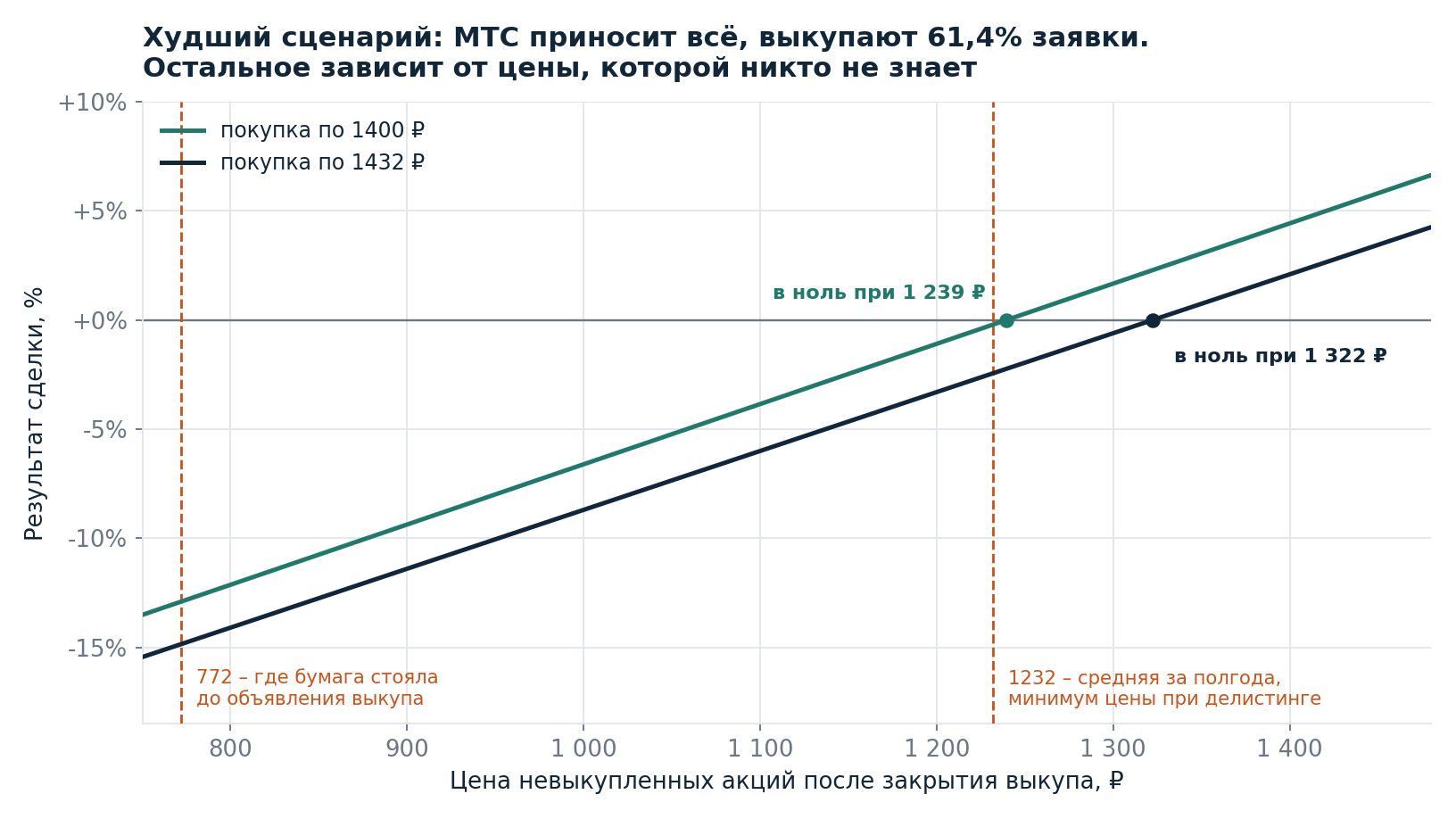
If MTS does bring its whole stake, 61.4% of an order will be bought back and the rest stays in the stock. What these shares will be worth afterwards is not known to anyone, so one should rely not on a price forecast but on the breakeven point. For a purchase at 1,432 it is RUB 1,322.
At 1,400 the trade beats the money market under any reasonable assumption about the price of the remainder, at 1,432 only under a favourable one. This is where the purchase threshold comes from.
What is happening
MGTS is a Moscow operator of fixed-line communications and home internet and a subsidiary of MTS. Two types of its shares trade on the Moscow Exchange, and the whole story concerns the preferred shares, ticker MGTSP.
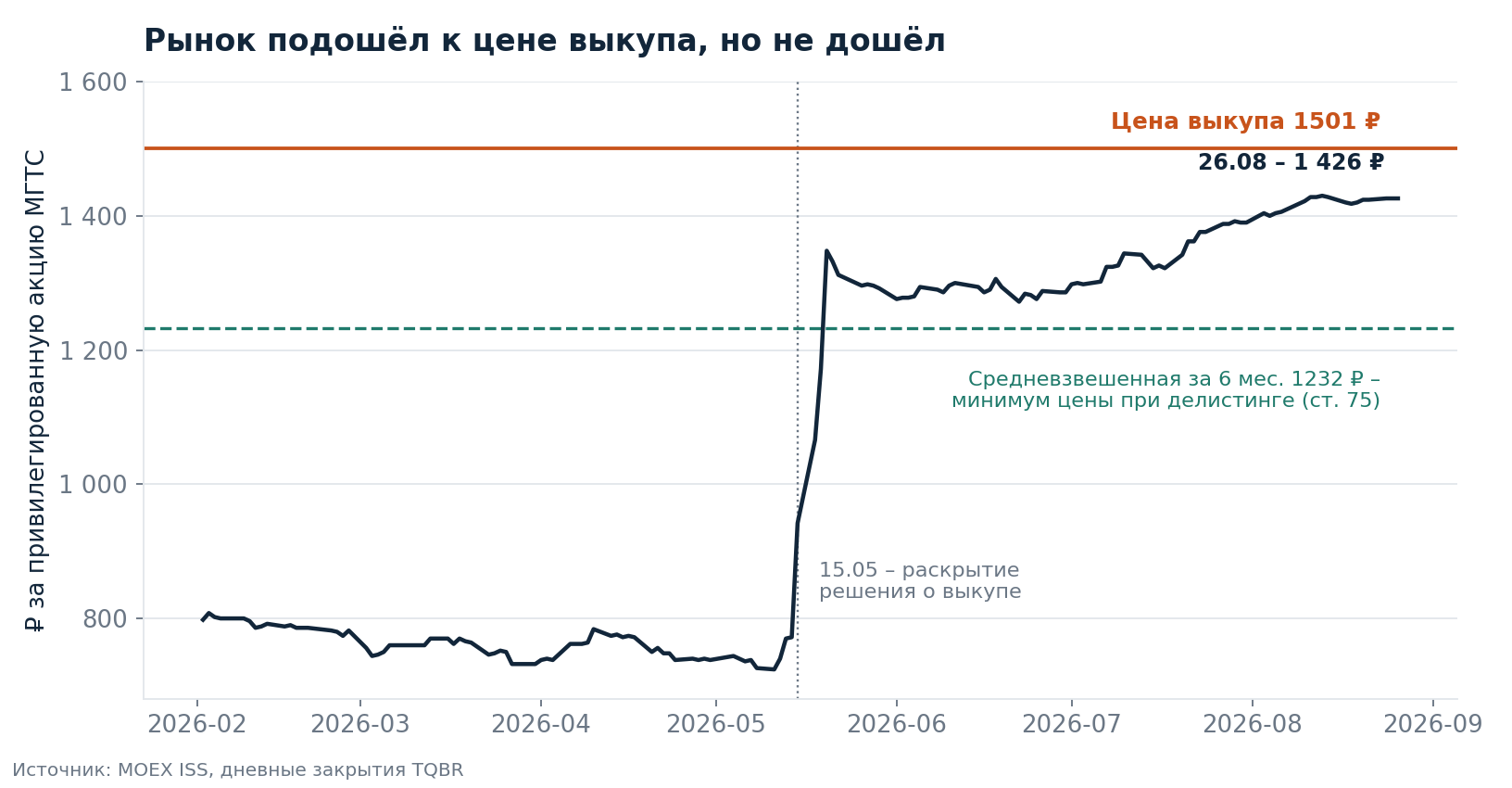
On 14 May the MGTS board of directors decided to buy back up to 9,522,279 preferred shares from shareholders at RUB 1,501 per share, and disclosed the decision on the 15th. On the day before disclosure the share cost RUB 772, so the price was set at twice the market. It was determined by an independent appraiser, and the decision itself was justified by the undervaluation of the shares on the exchange amid low trading volumes.
Sale applications are accepted from 10 June to 13 September, and the money is promised by 28 September. At the time of writing the share costs RUB 1,432.
What the idea is
Buy a share on the exchange for RUB 1,432, tender it for the buyback and receive RUB 1,501 from the company. The difference is 4.8%, or 4.2% after tax. There are 33 days left until settlement, which annualises to about 53%.
The first question to ask is why the market has not pulled the price all the way up to 1,501 if the money is promised in a month. For three months the share has been creeping up but stubbornly does not reach the buyback price. This means the market sees a risk. Working out exactly which one is the whole job on this idea.
There is exactly one risk: an order may be bought back only in part
The buyback is carried out under Article 72 of the Joint-Stock Companies Law. It allows a company to repurchase no more than 10% of its own shares, and if shareholders tender more than this volume, orders are filled pro rata.
In practice it looks like this. You tendered 1,000 shares, and the company was offered twice as many as it is ready to buy. This means money will arrive for 500 shares and the other 500 will stay in your portfolio. You will have to sell them on the exchange at whatever price is there.
It is important not to confuse three different mechanisms that are all called an "offer" in conversation.
- A mandatory offer (Art. 84.2) is made by someone who has crossed an ownership threshold in a company. There everything tendered is bought, and there is no cutting of orders.
- A buyout from dissenting shareholders (Art. 75) arises in a reorganisation or a major transaction. Only those who voted against or did not vote at all have the right, and the volume is limited to 10% of net assets. This is how the previously reviewed GLORAX case worked, where order cuts were predetermined by arithmetic.
- A company's buyback of its own shares (Art. 72), as at MGTS. The offer is addressed to all holders of preferred shares, the limit is calculated from share capital, and in case of oversubscription orders are cut pro rata.
Further on, only one question is examined: how likely oversubscription is at MGTS.
Only MTS itself can create oversubscription
MGTS has 15,514,042 preferred shares in total. MTS owns about 69.7% of them, roughly 10.81 mn shares. All other holders have about 4.70 mn.
A check from the other side gives the same picture. MTS directly and through a subsidiary owns 94.7% of all MGTS securities. This means minority shareholders together, across both classes of shares, hold no more than 5.05 mn shares out of 95.22 mn. And up to 9.52 mn are being bought back.
The company is ready to buy almost twice as many shares as exist at all outside the MTS group. If only minority shareholders tender, all their orders will be filled in full and there will be room left over.
Actual participation will most likely be even lower. Since 15 May, 834 thousand preferred shares have traded on the exchange, 18% of the minority stake. The MGTS register was filled through the privatisation of the 1990s, and a noticeable share of holders do not respond to such offers at all. A reasonable estimate of participation is 3–4 mn shares.
MTS said it had not made a decision on its stake
The only public statement on the main question came on 22 May, when MTS commented on its first-quarter results. CFO Alexey Katunin said that the offer is addressed mainly to minority shareholders, that any holder of MGTS shares can come with its stake, and that MTS itself had not come at that point and had not made a decision for itself, allowing that it might come later.
The weight of these words should be understood correctly. They were said on 22 May, more than two weeks before applications opened on 10 June, so "have not come" was true at that moment simply by the calendar. The substantive part is one thing: the decision has not been made, and the company itself allows that it may come.
On the evening of 27 August we put this question directly to the MTS investor relations department. The answer: it does not plan to participate. It should be assessed soberly. This is not a disclosure or a commitment, plans may change before 13 September, and no public statement has appeared since. But as a guide it is valuable, and the calculation below already takes it into account.
Formally nothing prevents it. Article 72 addresses the offer to every holder of preferred shares, with no exception for the parent company. Article 81 takes a company's buyback of its own shares outside the rules on interested-party transactions, so separate approval from other shareholders will not be required. MTS did not answer a repeat question from Kommersant at the end of May.
But it takes money out of MGTS in another way, and it is cheaper
This is the main argument for MTS not bringing its stake.
MGTS has not paid dividends since 2020, and retained earnings reached almost RUB 136 bn by the end of 2024. The company does not hold this money itself. It goes upstream as loans to its parent MTS: about RUB 110–115 bn at the key rate plus 0.15 percentage points, whereas in the market such a borrower pays the key rate plus 4–5 points. MTS does not repay the interest on these loans in cash, and it accumulates in MGTS's receivables, which grew from RUB 1.2 bn in 2023 to RUB 19.4 bn in 2025.
MTS already has a channel for moving money upstream, it is well established and almost free. Against this background there is no reason to buy back preferred shares at double the price for the sake of cash. The economic point of the buyback is then different: to collect the minority block of preferred shares, which became voting under Art. 32 because dividends are not paid and which remains the only notable block of votes outside MTS's control.
It also follows that MGTS itself has little free cash. A full buyback of RUB 14.3 bn would require returning part of the loans upstream, while a buyback from minority holders only would cost about RUB 7 bn. This is already the authors' observation, the company has said nothing about it.
There is a counter-argument too. MTS's own balance sheet is strained, it finances dividends with new loans, and a cash-constrained shareholder may well tender its preferred shares to take RUB 7–10 bn in one go. The motives pull in different directions, which is why the question remains open.
Preferred shares have a charter right to 10% of profit, and in autumn 2025 it was protected
This is the most underestimated part of the story, and it best explains why the buyback appeared right now.
Under the MGTS charter, holders of preferred shares are entitled to a dividend of 10% of RAS net profit, and no less than what is paid on common shares. For 2025, 10% of profit is RUB 2.8 bn, about RUB 180 per share, or 12–13% of the current exchange price. Nothing is paid: a separate clause of the charter allows the general meeting to decide on partial payment on preferred shares, and the meeting has used this right since 2020. The price of this is that the preferred shares became voting.
On 25 September 2025 the Constitutional Court found unconstitutional the provisions of the Joint-Stock Companies Law that left holders of preferred shares without working protection (ruling No. 31-P). The meaning of the decision is this: paying dividends on common shares while ignoring preferred shares is no longer allowed, and if such a decision is nevertheless carried out, preferred holders may recover what is due through the courts as unjust enrichment. Until the law is amended, the ruling applies directly.
This norm is not yet applied literally to MGTS, because nothing is paid to anyone there, neither common nor preferred shares. But it closes a convenient future scenario for MTS: resuming dividends at MGTS without paying the preferred holders will no longer work.
Hence a plausible answer to the question "why now". The preferred shares became voting long ago, and that could not have been the trigger. A working recovery mechanism, however, appeared in September 2025, eight months before the buyback was announced. A buyback followed by cancellation removes the class of shares that has just got teeth. This is the authors' reconstruction of the motive, the company has not given such explanations.
An important implication for the deal follows. The goal of "removing minority preferred shares" is achieved only if MTS does not tender its own. Tendering its own means cutting minority holders and leaving them in the capital with the same claim.
It can take 4.82 mn shares without cutting anyone
If minority shareholders bring their whole stake of 4.70 mn shares, there is still room in the buyback for another 4.82 mn. At the buyback price that is RUB 7.2 bn, which MTS receives without touching a single outside order.
Applications are collected by the MGTS registrar, a structure controlled by the group. The group can see how many applications have already been filed, and nothing prevents it from submitting its own in the last days of the period.
Hence the base scenario. MTS either does not come at all or takes the free remainder, and the orders of the others are filled in full. The probability of such an outcome is estimated at 85%, and this figure is the authors' own: before the IR answer the calculation used 70%. Even this does not give full certainty, because there is still no disclosure, and aloud the company only said "not decided, we may come later".
Nobody knows the price of the unbought remainder, so we calculate breakeven
The worst case is calculated exactly. Then 15.51 mn shares are tendered against a readiness to buy 9.52 mn, and the fill ratio is 61.4%. For an order of 1,000 shares, money arrives for 614 and 386 remain in the portfolio.
This is where it is easiest to pass a guess off as a calculation. At what price these 386 shares will trade after the buyback closes, nobody knows: not us, not the market and most likely not the company itself. So instead of a price forecast it is more appropriate to ask the reverse question: at what price of the remainder does the trade bring no loss. For a purchase at RUB 1,432 it is RUB 1,322, 8% below today's exchange price.
The reference points between which this price will land are facts, not a forecast.
- RUB 772 – what the share cost before the buyback announcement in May. The lower bound of imagination: a return exactly there would give minus 15%.
- RUB 1,232 – the average exchange price over the last six months. If the company ever goes for delisting, a right to demand a buyout under Art. 75 will arise, and the price there by law cannot be lower than this average. The calculation window moves forward, the cheap May days drop out of it, and by November the floor will rise to RUB 1,350–1,400.
- About RUB 180 per share a year – the charter right to 10% of net profit, if payment is ever unfrozen.
Arguments for a low price of the remainder: after the buyback closes, the demand that has pulled the share up for three months will disappear, and liquidity will become worse than before. An argument for a high one: since September 2025 this share has been legally worth more than it was before, and the reduction of the preferred class brings the resolution closer, whatever it may be. Let us honestly note the opposite as well: before the buyback was announced, the market did not price the charter right to RUB 180 a year at all, trading the share at 772.
What definitely should not go into the calculation is the hope of a squeeze-out of the remainder at RUB 1,501. According to lawyers, cancellation of the repurchased stake is not considered an acquisition under Art. 84, so the obligation to make an offer to everyone else may not arise.
Buying makes sense up to RUB 1,445
The expected result depends on two numbers that nobody knows: the probability of a full buyback and the price of the unbought remainder. The first is taken as 85% after the IR answer, and this is the authors' estimate. The second cannot be guessed, so three variants are given below at once. The table shows expected return annualised, before tax.
| Purchase price, RUB | Remainder fell to 900 | Remainder 1,125 | Remainder 1,250 |
|---|---|---|---|
| 1,400 | +52% | +63% | +68% |
| 1,432 | +26% | +36% | +42% |
| 1,445 | +16% | +26% | +32% |
| 1,460 | +5% | +15% | +20% |
| 1,480 | -10% | -1% | +5% |
Hence the threshold. With a key rate of 14%, a money market fund gives its 14% a year without risk, without locking up money and without illiquidity. Paying for a place in this trade makes sense as long as the margin over the rate does not depend on whether we guessed the price of the remainder. Such a margin holds up to about RUB 1,445: above it the pessimistic variant with the remainder at 900 no longer covers the rate.
Before the IR answer the same threshold was calculated as 1,410. The difference of RUB 35 is the price of one question asked in time.
Chasing the price in the order book is not worth it anyway. The closer the purchase is to 1,501, the less is left of both the premium and the margin for error in the probability estimate.
What happens to the share after the buyback
The company is required by law to sell the repurchased shares within a year at a price not below market, otherwise the shareholders' meeting must reduce the share capital and cancel them. Selling 9.5 mn preferred shares into an order book where RUB 3–25 mn trade in a day is impossible. Cancellation remains.
After it, MGTS will have about 6 mn preferred shares left, the free float will fall below 5%, and trading them will become even harder than now. For those who remain in the share not by choice, selling will be harder.
Five things that break the calculation in practice
Leverage is dangerous not because of a ban but because of settlements. The common claim that shares held on margin cannot be tendered is not confirmed by documents: there is no single rule, and the procedure is set by the particular broker. What is confirmed is that an application is executed according to the account balance on the settlement date, and if there are fewer shares there than declared, the order is cancelled. For a leveraged position this is the main risk: forced closing before 28 September will leave you with neither shares nor the buyback, and you will have to pay for rolling the position all this time. How it works at your broker, only the broker can tell.
The broker's deadline ends earlier than the legal one. 13 September falls on a Sunday, the last business day is the 11th, and brokers close acceptance of applications even earlier. The exact date should be clarified with support now, not in September.
From the moment of tendering, the shares are blocked until settlement. If news about MTS's participation appears, it will no longer be possible to sell them on the exchange. The application can be withdrawn before the end of the period, but the result will become known later.
Who will withhold the tax must be clarified in advance. If the money comes directly from the company through the registrar, the broker may not act as tax agent, and you will have to file a tax return yourself.
Position size is strictly limited. RUB 3–25 mn of MGTS preferred shares trade in a day. With a position of RUB 50 mn and a cut to 61.4%, an unbought remainder of RUB 19 mn is left in the stock, and that is several days of all trading in this share.
What to watch next
There are few observable signals before 11 September. A narrowing of the gap between the exchange price and RUB 1,501 means the market increasingly believes in a full buyback, a widening says the opposite. MGTS will disclose the results after the application period closes, and settlements will take place by 28 September.
Sources: MOEX ISS (quotes, volumes, average price calculation), Bank of Russia (key rate), MGTS announcements of 15 May 2026 as reported by CNews and ComNews, Kommersant of 18 May 2026 and its article on the sixth year without dividends, MTS comments on first-quarter results of 22 May 2026, PJSC MGTS RAS statements for 2025, Articles 32, 72, 75 and 81 of the Federal Law "On Joint-Stock Companies".
See also: market overview · valuation map · stock screeners