MGTS preferred fell to 1,340 before the close of the 1,501 buyback. Why, what to do for those who tendered and those who did not, and whether a squeeze-out will follow
*Prices as of 14:45 Moscow time on 10 September. The detailed buyback mechanics, MTS's motives and the rights of preferred holders are covered in the [article of 27 August](https://telegra.ph/MGTS-buyback-1501-08-27).*
MGTS, the Moscow fixed-line operator and a subsidiary of MTS, decided in May to buy back up to 9.52 mn of its preferred shares from shareholders at RUB 1,501 per share, twice the exchange price at the time. By law, applications are accepted until 13 September, and the money is promised by 28 September. On the exchange the share costs about 1,340, 11% below the buyback price, and at first glance this looks like a gift.
There is no gift. Brokers stopped accepting participation orders on 8 September, a week before the legal deadline. You can still buy the share today, but you can no longer carry it into the buyback. From this day the exchange price refers not to the buyback but to the shares that will remain in hand after it.
Two conclusions follow. Those who tendered need to do nothing: the result depends only on whether MTS brought its own stake, and will be known after 13 September. For those who did not tender, buying at 1,340 is a bet on the price of the unbought remainder. There is no forecast of this price here, only three factual reference points and one warning: a squeeze-out of the remainder at 1,501 does not follow from this offer under the law.
The broker tender window closed on 8 September, and the 11% discount to the buyback price is no longer available to anyone.
The fall from 1,444 to 1,340 on small turnover is explained by buyers leaving the buyback trade, not by news.
For those who tendered, one question remains: whether MTS brought its own stake.
For those who did not tender, the price of 1,340 is a bet on a remainder between 772 and 1,501.
A squeeze-out does not arise from this offer by law; it would require a separate transaction by the MTS group.
The tender window closed on 8 September, and this explains the fall
By law, applications are accepted through 13 September inclusive, which is a Sunday, so the last business day falls on the 11th. But the application is filed not by the shareholder but by their broker through the depository, and brokers closed acceptance of orders on 8 September in order to pass them down the chain to the registrar in time. Those who hold shares directly in the register can formally apply later, but shares bought on the exchange sit in the depository, and for them the path is closed.
On 2 September the share closed at 1,444, on 8 September at 1,426, and today by midday it stands at about 1,340 with a low of 1,328. Turnover is small. Yesterday RUB 7 mn traded, in the first half of today about RUB 4 mn, whereas at the end of August RUB 12–25 mn traded a day. There are few sellers; there are simply no buyers left.
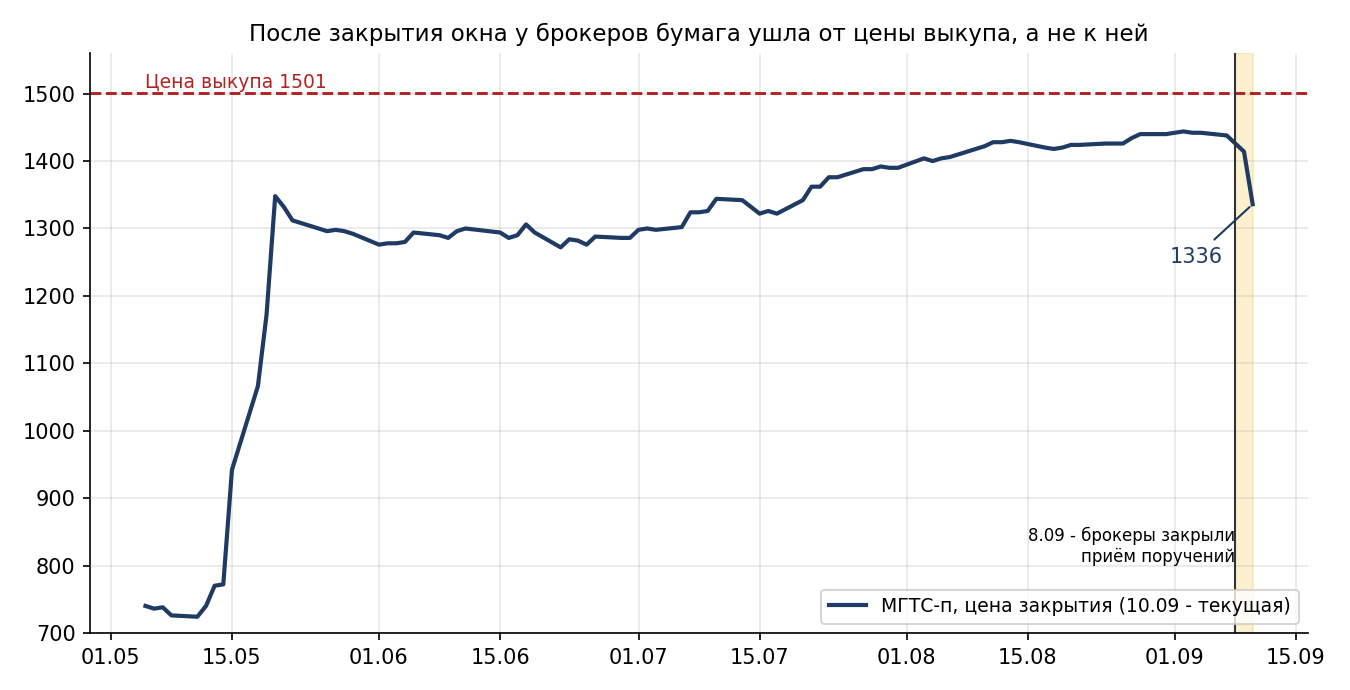
For three months the price was held up by one type of buyer: the one who bought the share in order to tender it for the buyback and receive 1,501. Since 8 September there is no such buyer. Those who were late with the application or decided not to wait for the results are selling, and the only demand against them now comes from those ready to hold the share further. No public reports of a change in the buyback terms or of MTS participating with its stake have appeared, at least in open news sources, and the trading volume speaks against a leak theory: with such knowledge people would sell a lot and fast, not RUB 4–7 mn a day.
Those who tendered have one answer to wait for
The company buys back no more than 9.52 mn out of 15.51 mn preferred shares. MTS holds about 10.81 mn preferred shares, and all other holders together 4.70 mn. If only minority shareholders tender, everything will be bought back and there will still be room. If MTS brings its whole stake, orders will be filled at 61.4% and 38.6% of the shares will stay in the portfolio. At the end of August the MTS investor relations department answered a direct question that it does not plan to participate. This is not a disclosure or a commitment, but taking the answer into account, the probability of a full buyback is estimated here at 85%, and this figure is the authors' own.
In the worst case the result per share equals 0.614 × 1,501 plus 0.386 × the price of the remainder, that is RUB 922 plus 0.386 × the price of the remainder. Breakeven depends on the purchase price:
- bought at 1,300 – the remainder must be worth at least 980
- bought at 1,400 – at least 1,239
- bought at 1,432 – at least 1,322
- bought at 1,445 – at least 1,356
From the moment of tendering, the shares are blocked until settlement and cannot be sold on the exchange, so today's fall does not affect a tendered application. The money for bought-back shares is promised no later than 28 September.
For those who did not tender, the price of 1,340 is a bet on the remainder
Without a filed application the share remains an ordinary long position in an illiquid stock, where after 13 September there will definitely be no buyer for the buyback, and after the cancellation of the repurchased shares about 6 mn preferred shares will remain and the free float will drop below 5%. There is no price forecast here, only reference points.
- RUB 772 – the price before the buyback announcement in May. At that time the market priced neither the charter right of preferred holders to 10% of net profit (about RUB 180 per share a year) nor the protection of this right by the Constitutional Court since September 2025.
- RUB 1,262 – the average exchange price over six months to 9 September, versus 1,232 at the end of August. Below it the law does not allow shares to be bought out in a delisting or reorganisation, and the calculation window moves forward, so the May days at 772 drop out of it.
- RUB 1,501 – the price that an independent appraiser named as the market price in May 2026. Any discussion of future group transactions in these shares returns to it, but it is not a commitment.
The return on such a bet is not calculated here, because there is nothing to calculate: where between 772 and 1,501 the price of the remainder will land, this review does not undertake to say.
A squeeze-out from this offer does not arise by law
The right to buy out shares from the remaining shareholders without their consent is given by Art. 84.8 of the Joint-Stock Companies Law, and the conditions there are strict. The right goes to someone who crossed 95% of voting shares as a result of a voluntary or mandatory offer to all shareholders and who also bought at least 10% of all shares through that offer. The buyout demand is sent within six months after the offer ends.
A company's buyback of its own shares under Art. 72 is not such an offer. After the cancellation of the repurchased shares, MTS's share in voting shares will mechanically exceed 95%: it now holds 94.7% of all shares, which is 99.1% of common and 69.7% of preferred shares, and preferred shares vote as long as no dividends are paid on them. But the right to a squeeze-out will not arise from this, because the threshold was crossed not as a result of an offer.
The second condition is even harder for MTS. It already has 94.7%, and buying 10% from outside shareholders through an offer is physically impossible. In Russian practice this is worked around: one group company makes the offer, while other companies of the same group tender their shares into it, collecting the necessary 10%. The bill that bans counting shares bought from related persons (No. 519694-8) was submitted to the State Duma in December 2023 and has not moved since February 2024. The path is open, but it is a separate transaction with separate disclosure and separate timing, not tied to the current buyback.
On the price of such a buyout, if it ever happens. Under Art. 84.8 it cannot be below the independent appraiser's valuation or below the price of the offer through which 95% was crossed. For a mandatory offer there is one more rule: not below the highest price at which the buyer or its affiliates acquired these shares in the previous six months, and MGTS is an affiliate of MTS, so its 1,501 falls under this rule to the letter of the law until the end of March 2027. For a voluntary offer there is no price floor at all, and it is more convenient for the group to go exactly this way.
There are no signals that MTS intends to collect the remainder. It has held 99.1% of common shares since 2011, and in fifteen years it has never tried to buy out the rest. An argument the other way: after the buyback, minority holders will be left with shares worth about RUB 2–3 bn, and closing the issue entirely will become cheap. What will outweigh, nobody knows, so the only practical conclusion is this: a squeeze-out at 1,501 cannot be built into the price of the remainder.
What next
The company will disclose the results of the application period after 13 September, and the money is promised by 28 September. Then the 85% probability estimate of a full buyback will be checked against the fact. Separately, it is worth watching where the price of the unbought shares goes after settlement: this is a rare chance to test the argument about the rising six-month average on live data.
Sources: MOEX ISS (quotes, volumes, calculation of the six-month average), MGTS announcements of 15 May 2026 on the acquisition of shares, MTS annual report (MGTS ownership structure), Articles 32, 72, 75, 84.1, 84.2 and 84.8 of the Federal Law "On Joint-Stock Companies", the card of bill No. 519694-8 on sozd.duma.gov.ru, order acceptance deadlines according to brokers.
See also: market overview · valuation map · stock screeners