State FX purchases and the ruble: what actually predicts the exchange rate (2018-2026 data)
State FX purchases barely predict the ruble. The direction of change in purchases does not work at all, the level of purchases works weakly, and the only reliable signals are pauses by the regulator and oil with a lag of one to two months. This is the result of a test on data from the Ministry of Finance, the Bank of Russia and the balance of payments for 2018-2026. Below: what was tested, what held up, and what it means for an FX position in September-October 2026.
The whole piece in one paragraph:
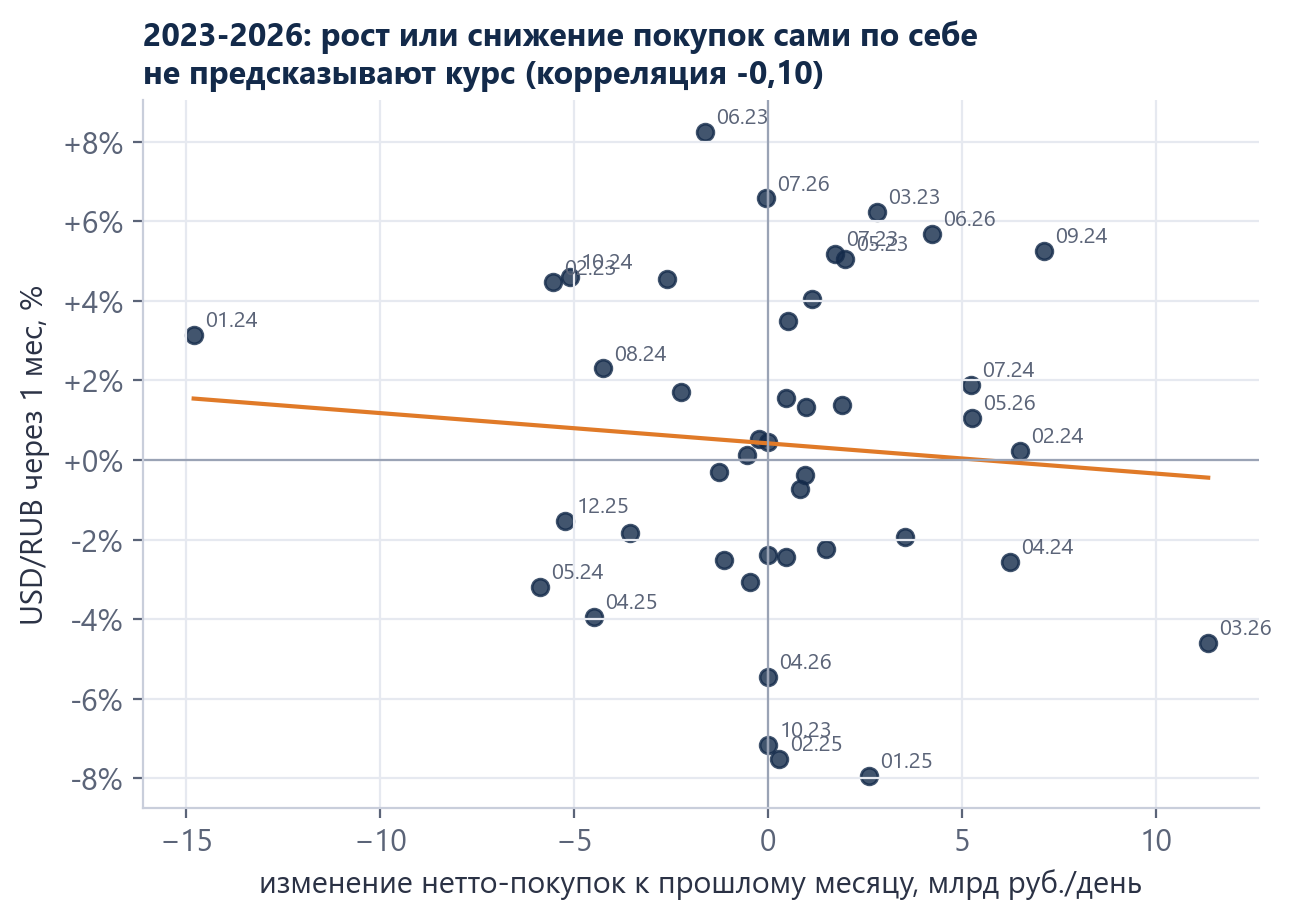
- A rise or fall in Minfin purchases versus the previous month tells us nothing about the future exchange rate. The correlation with the change in the rate one month later is minus 0.10.
- A high level of purchases on average precedes a weaker ruble, but the link is weak. The correlation is about +0.25, and all of the post-crisis statistics rest on a single episode in summer 2026.
- Purchases are last month's oil in different packaging. The exchange rate prices in the same oil earlier and more strongly, through exporters' revenue.
- Regulator pauses work. In 4 cases out of 5, the ruble strengthened by 3-19% within two to three months after purchases stopped.
- An improving current account predicts a stronger ruble in the next quarter, but the model missed in the latest quarter.
- In October, purchases will rise 2-4 times, and that is not a reason to buy more FX. August-September oil works against the dollar more strongly through the lag.
How state operations work and which series was tested
The budget rule is simple. Oil and gas budget revenue above the base oil price (in 2026, USD 59 per barrel of Urals) is directed by the Ministry of Finance to buying FX and gold, and when revenue falls short, it sells FX from the National Wealth Fund. The monthly volume is announced on the third business day, and operations run from the fifth business day to the fourth business day of the following month. The Bank of Russia carries them out on the exchange.
In addition, the Bank of Russia runs its own operations outside the rule. Since 2024 it has "mirrored" NWF spending and investment: it sells FX in equal daily amounts over a half-year. In 1H2024 this was RUB 11.8 bn per day, in 2H2024 8.4, in 2025 8.86 and 8.94, in 1H2026 4.62, and in 2H2026 just 0.58 bn per day. That is why in summer 2026 the state became a net buyer of FX for the first time in two and a half years: Minfin bought RUB 5.4-6.5 bn per day, while central bank sales fell almost to zero.
For the test we built a monthly series of "net state FX purchases" from 2018: the Minfin plan, taken from its own table of additional oil and gas revenue, adjusted for what the central bank actually executed in the market (pauses on 23.08.2018, 10.03.2020, 24.01.2022, 10.08.2023, 28.11.2024 and March-April 2026), plus central bank operations outside the rule. The exchange rate is the official USD/RUB rate of the Bank of Russia, and oil is Brent.
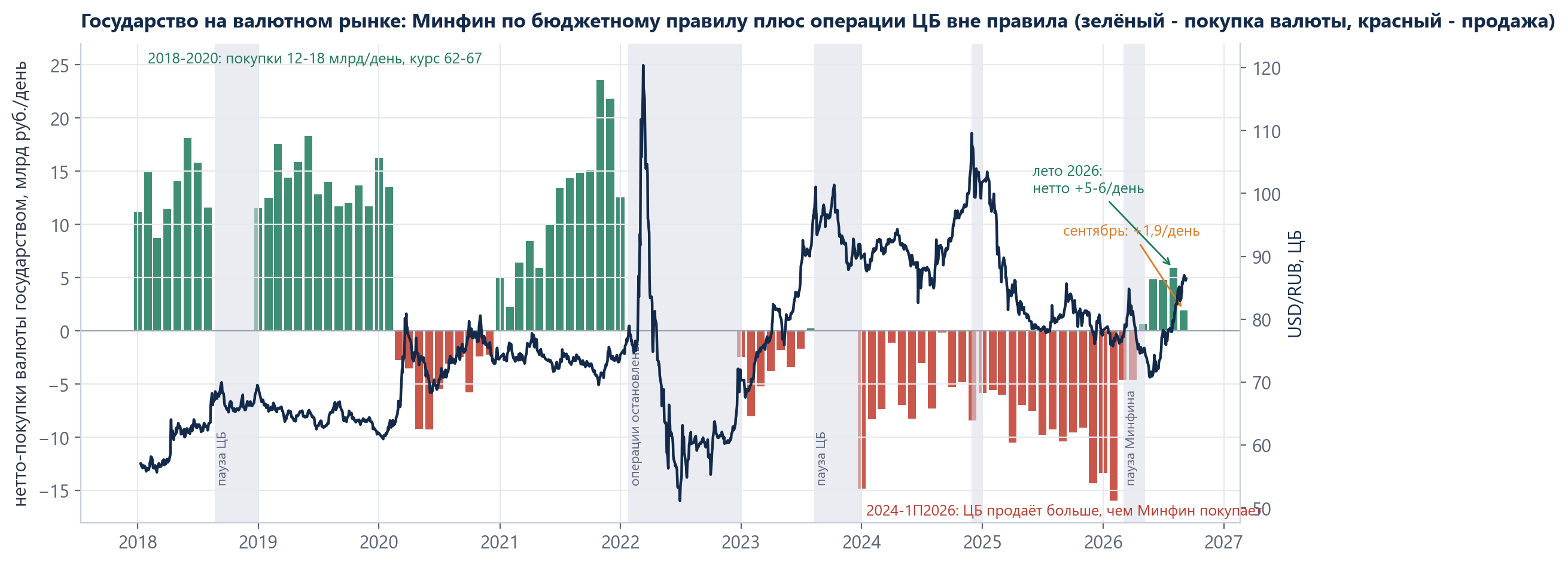
The chart shows three regimes. In 2018-2020 the state bought RUB 12-18 bn per day at a rate of 62-67. From 2024 to 1H2026 the central bank sold more than Minfin bought, and over that time the ruble went from 88 to 110 and back to 71. In summer 2026 net purchases turned positive at RUB 5-6 bn per day, and the ruble weakened from 71 to 87.
The level of purchases predicts the rate weakly, and the "high purchases" group after 2022 is a single episode
The correlation of monthly net purchases with the change in the exchange rate 1, 2 and 3 months later is +0.20, +0.26 and +0.28 over 45 months since 2022. In 2018-2020 it was +0.10, +0.25 and +0.27. The sign matches the hypothesis "they buy, the dollar rises", but the strength of the link means purchases explain 5-8% of the variation in the rate.
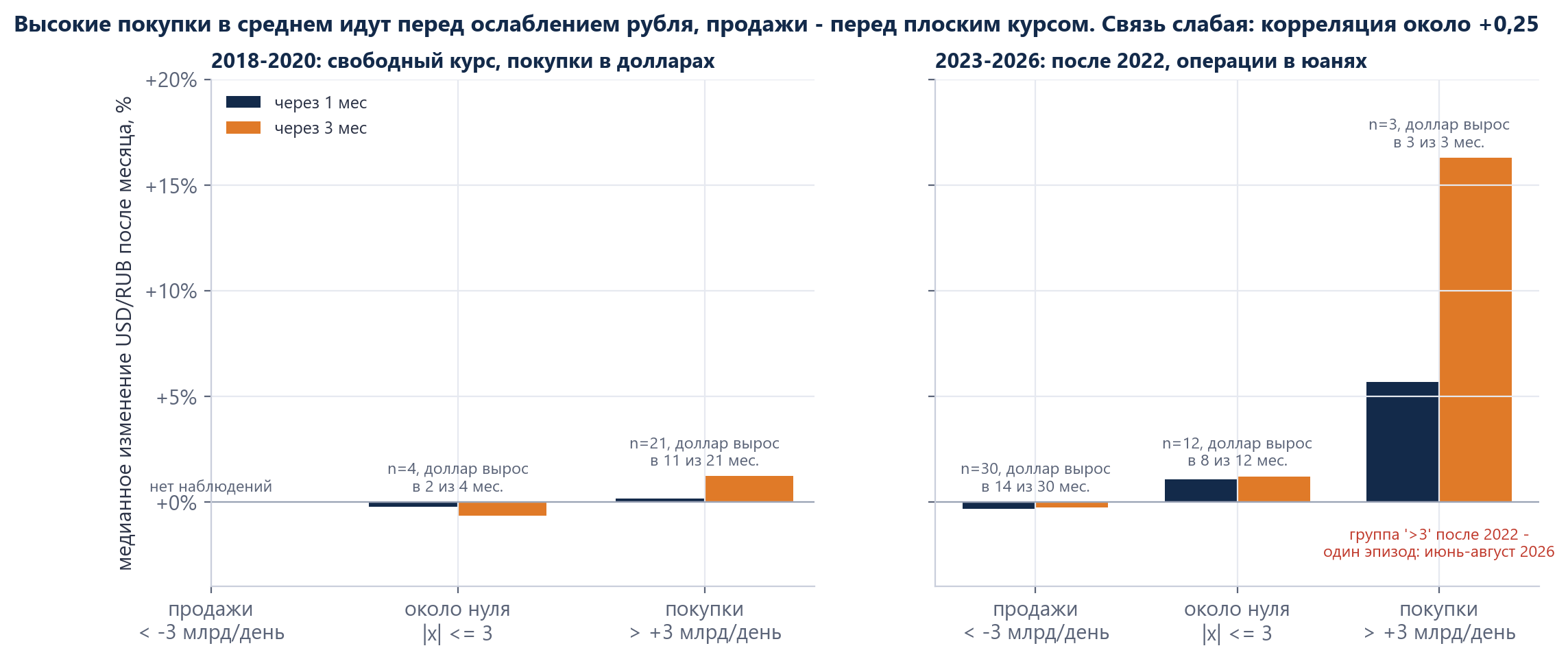
Splitting by group shows where the link comes from. Since 2022 there have been only three months with net purchases above RUB 3 bn per day: June, July and August 2026, and the dollar rose after each of them. That is one episode, not statistics. There were thirty months with sales below minus RUB 3 bn per day, and after them the rate on average stood still: the median was minus 0.3%, and the dollar rose in 14 cases out of 30. So the second half of the hypothesis, "they sell, the ruble strengthens", is not confirmed.
A rise or fall in purchases versus the previous month distinguishes nothing
This is what is discussed most often around Minfin announcements: purchases rose or fell. After months when net purchases rose by more than RUB 1 bn per day, the dollar gained a median of 1.4% a month later and rose in 10 cases out of 15. After months when purchases fell, the dollar gained 2.0% and rose in 8 cases out of 14. There is no difference.
Purchases are last month's oil, and the rate has already priced it in
The volume of Minfin purchases is calculated from the previous month's Urals price. The correlation of net purchases with the level of Brent a month earlier since 2022 is +0.68. The same oil reaches the market as exporters' FX revenue, and in volume that is an order of magnitude larger: RUB 5.9 bn per day is about USD 70 mn per day, or 1.5 bn per month, against goods exports of more than USD 40 bn per month.
A regression of the change in the exchange rate on purchases and three monthly lags of oil confirms this. The coefficient on purchases is +0.16% of the rate per RUB 1 bn per day, statistically insignificant (t-statistic 1.4). Oil at a two-month lag is significant: minus 15% of the rate per 100% change in oil (t-statistic minus 2.1). The model without purchases explains 15% of monthly moves, and with purchases 19%.
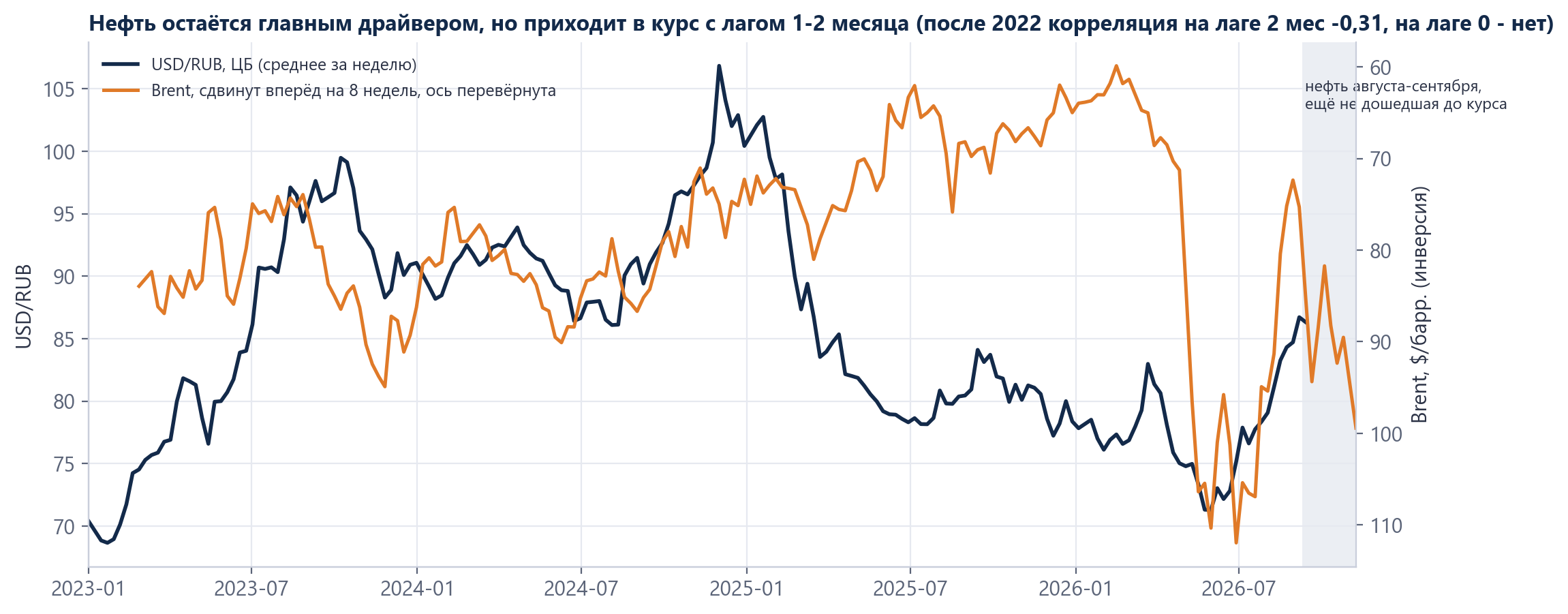
The oil lag is the main thing to remember. Before 2022, oil affected the rate instantly. After 2022 there is no same-month link, and the peak falls at 5-10 weeks. The current weakening of the ruble from 71 to 87 is the delayed effect of Brent's collapse from USD 104 to 85 in June. And August-September oil, which rose from 84 to 96 dollars, has not yet reached the rate.
Regulator pauses work: 4 out of 5
The only signal from state operations that passes the test is a decision to stop purchases. Since 2018 there have been five such decisions.
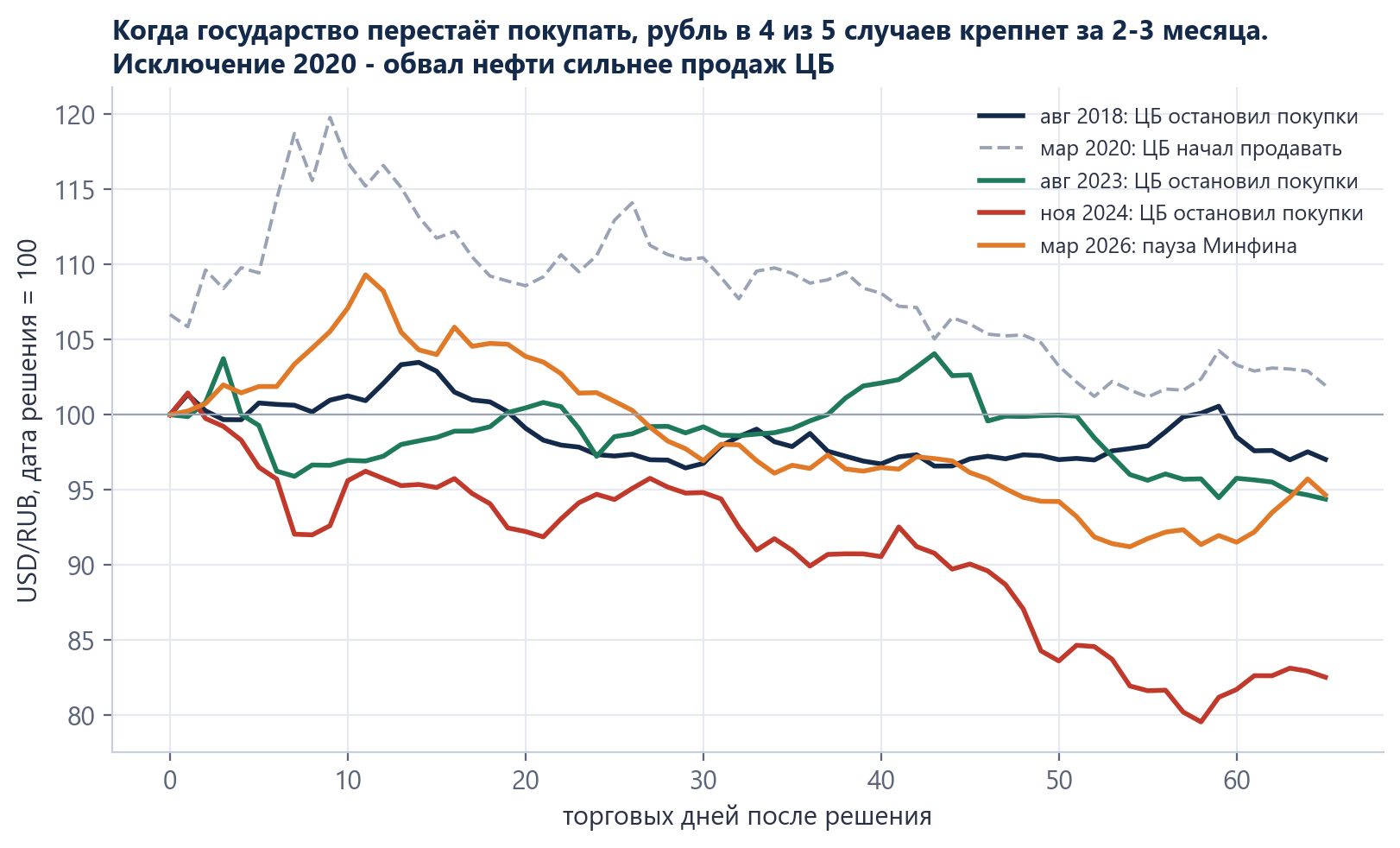
- 23.08.2018, the central bank suspended purchases until year-end: the rate two months later was minus 3.4%.
- 10.08.2023, the central bank stopped purchases at a rate of about 100: three months later minus 5.6%.
- 28.11.2024, the central bank stopped purchases at a rate of 108: three months later minus 18.8%.
- 04.03.2026, the Ministry of Finance suspended operations for March-April: three months later minus 5.5%.
- 10.03.2020, the central bank stopped purchases and began selling: two months later plus 9.4%. Oil at USD 25 outweighed it.
The reason is clear. The regulator stops purchases at the peak of panic, often together with a rate hike (August 2023: plus 350 basis points). The signal is rare but strong, and it works not because USD 1.5 bn of monthly demand disappeared, but because the pause coincides with a turn in sentiment.
Balance of payments: an improvement in the current account predicts a stronger ruble a quarter later
The current account is the balance of exports and imports of goods, services and income, that is, how much FX the country earned in a quarter over what it spent. The change in the current account versus the previous quarter predicts the next quarter's rate: the correlation is minus 0.85 over 14 quarters in 2022-2026, and the sign matched in 11 cases out of 14.
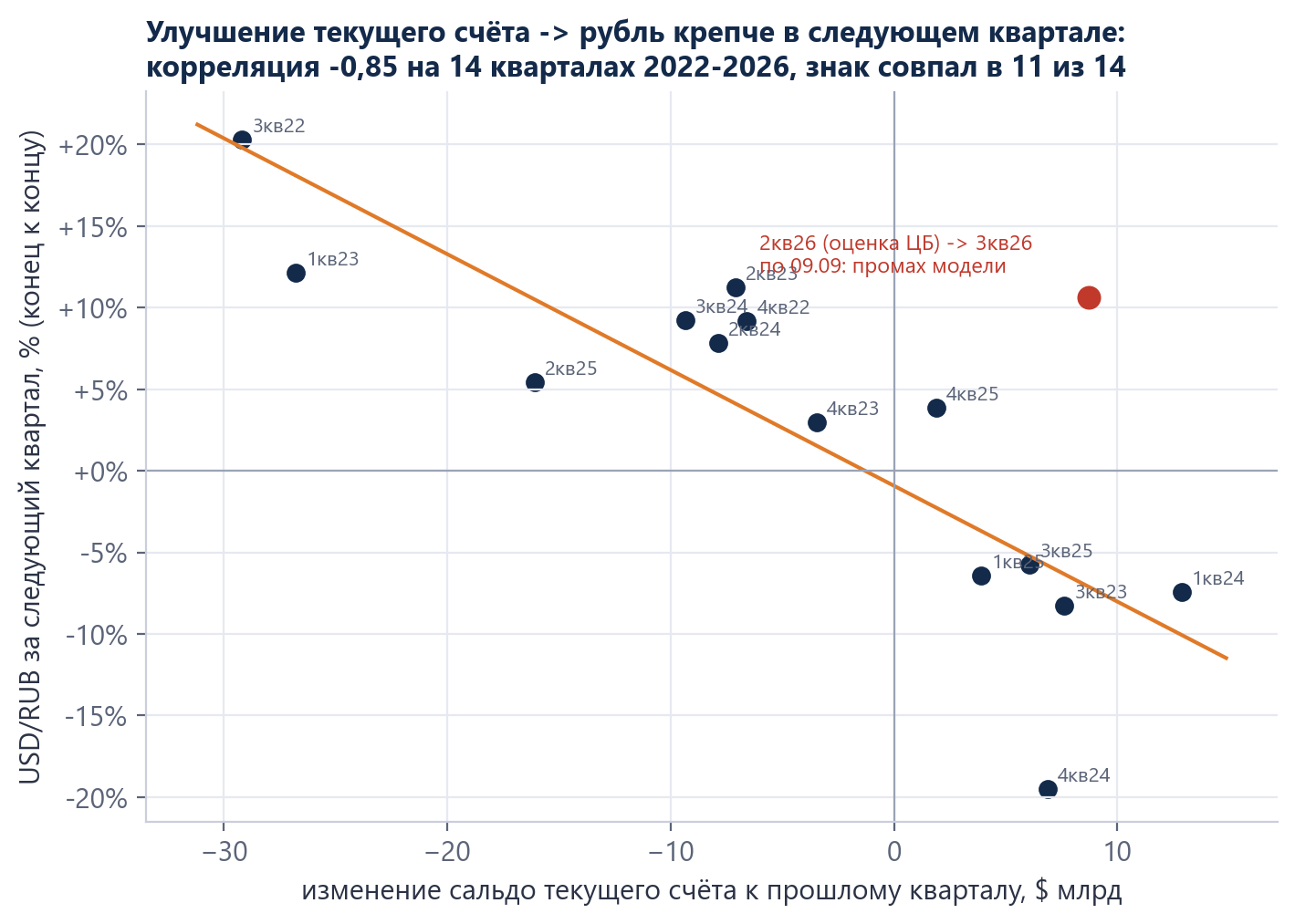
Private capital outflow gives no separate information. With no change in reserves it equals the current account by the accounting identity, and the correlation of outflow with the rate in the same and the next quarter is about zero. What is useful is the current account, and only its change, not its level.
The caveat about the latest quarter matters. The central bank's estimate for 2Q2026 (a surplus of USD 21.4 bn versus 12.7 in the first) predicted a stronger ruble in the third quarter. The fact from the end of June to 9 September is plus 10.6% for the dollar. The reason is the same oil. The second-quarter surplus reflected Brent at USD 100 in March-May, while the rate was already reacting to the June collapse. The current account and lagged oil are one and the same driver in different packaging, and monthly oil is faster.
Where we are now: October purchases will rise 2-4 times, but that is not a reason to buy more
In September Minfin buys RUB 55.6 bn from 7 September to 6 October, RUB 2.5 bn per day. After central bank sales, net state purchases are RUB 1.9 bn per day versus 5.9 in August. This is a consequence of the August adjustment. August taxes were calculated on July Urals at exactly the USD 59 base, and Minfin expected RUB 114 bn of additional revenue and got minus 4.
In October the picture reverses. Expected additional revenue is calculated from the September Urals price. In August the tax-basis Urals was USD 67.1 with Brent at 88, and in September Brent is so far 96. With September Urals at USD 68-76 and an adjustment from zero to plus RUB 50 bn (the second part of the miss on the additional income tax, which is spread over two months), the purchase volume will be RUB 107-213 bn, that is, net RUB 4.3-9.1 bn per day. The Minfin announcement is on 5 October, and the Urals price from the Ministry of Economic Development comes on 1-3 October.
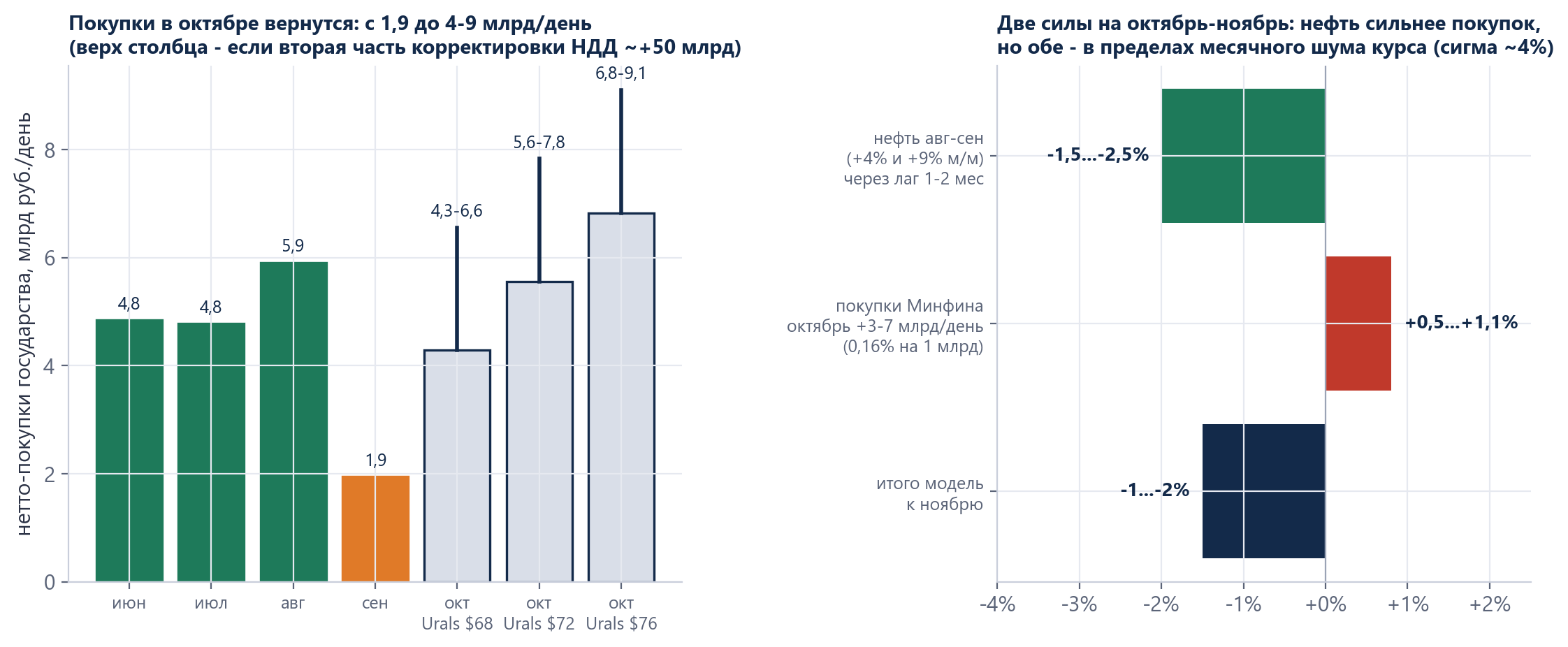
But exactly the same oil works against the dollar through a stronger channel. A 4% rise in Brent in August and 9% in September gives, in the lagged model, minus 1.5-2.5% for USD/RUB by November. October purchases give plus 0.5-1.1%. The model's net result is minus 1-2%, while the monthly standard deviation of the rate is 4%. Both forces are within the noise, and oil is slightly stronger.
Practical conclusions for an FX position:
- The thesis "purchases will rise in October" is correct, but on its own it does not justify an overweight in FX. Do not buy more FX ahead of the 5 October announcement.
- The core of the FX position remains a structural decision. The budget deficit, the budget rule base of USD 50 from 2027, and shrinking exports are arguments for quarters, not for the October announcement.
- A pullback to 82-85 on oil that has reached the rate is a zone for rebuilding the core, not a signal to close the position.
- Reassessment points: the rate decision on 11 September, the Urals price and the Minfin announcement on 1-5 October, and the central bank's balance of payments estimate for the third quarter around 10 October. A surplus below USD 21.4 bn would signal a weak ruble for the fourth quarter, and above it a strong one.
Caveats
The March 2020 operations series was estimated by hand (about minus RUB 60 bn), and trading days were counted without holidays. The post-crisis sample is short: 45 months and 14 quarters, and the summer 2026 episode dominates the statistics on high purchases. All coefficients are slopes, not point forecasts.
Sources: the Ministry of Finance table of additional oil and gas revenue (release of 03.09.2026), Bank of Russia press releases on operations with NWF funds, official Bank of Russia exchange rates, the Bank of Russia balance of payments and its estimate for 1H2026 of 14.08.2026, and Brent from ICE exchange data.
See also: market overview · valuation map · stock screeners