Moscow Exchange 2Q2026: fees at a record, profit barely growing
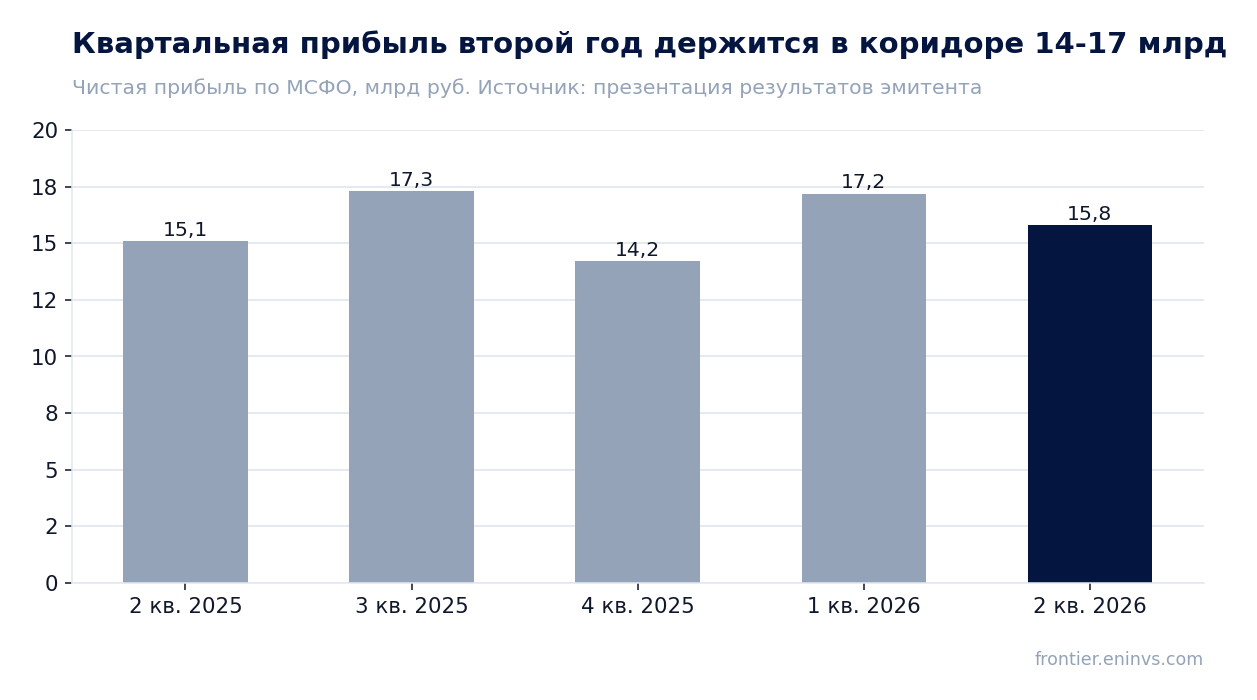
On 26 August Moscow Exchange published its condensed consolidated IFRS statements for the second quarter and first half of 2026. Fee and commission income for the quarter rose 24.8% year on year to RUB 22.3 bn, operating income grew 5.9% to RUB 32.4 bn, and net profit rose 4.7% to RUB 15.8 bn. The statements were signed on 24 August. The auditor, B1 – Audit, performed a review rather than a full audit, as is normal for interim reporting.
Main conclusion: the fee business has reached a record, but this barely moves profit, because the interest part of income is no longer growing and one-off items worked against the exchange this quarter.
- Fees grew by a quarter, operating income by only 5.9%: the gap was closed by FX revaluation and stagnant interest income.
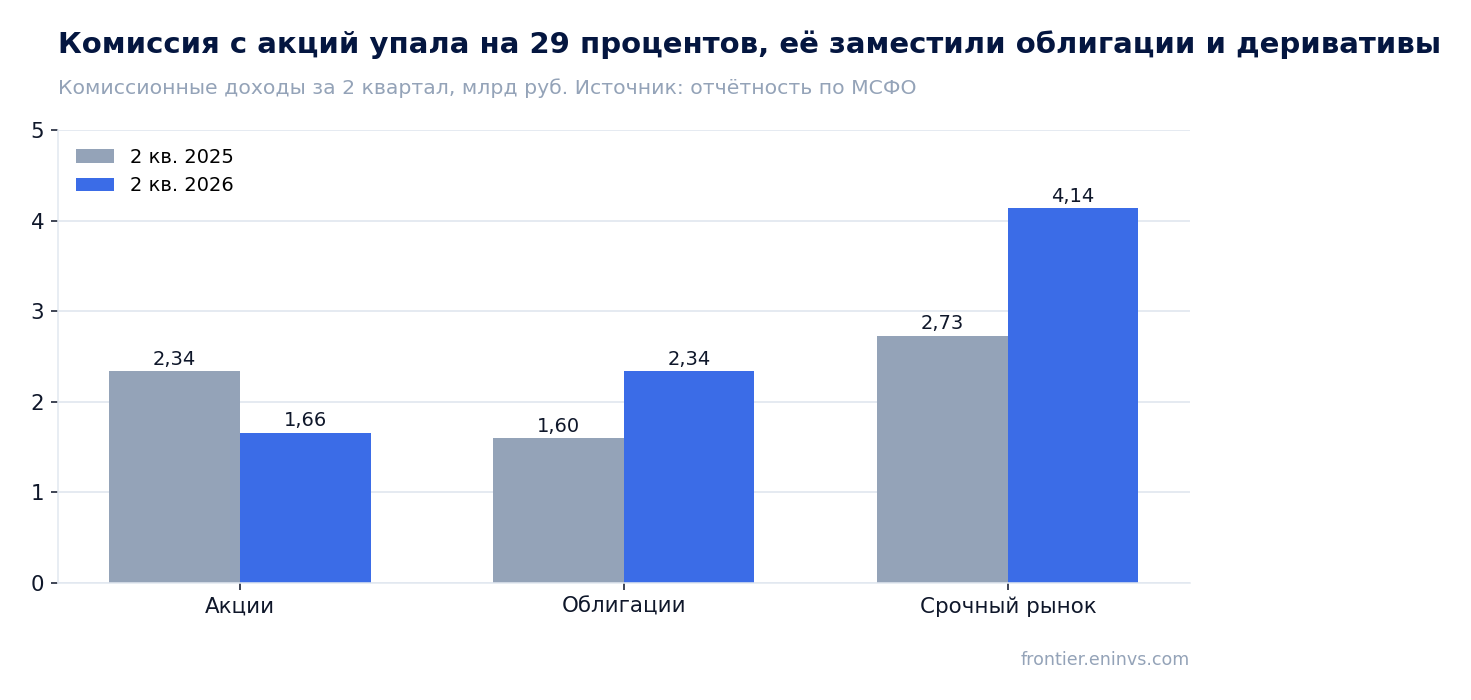
- The fee drivers have changed: equities lost 29%, derivatives gained 52%, bonds gained 46%.
- Interest income held up with the key rate 6 points below last year's, but client balances shrank by RUB 221 bn over the half-year.
- The half-year's saving on personnel is only on paper: RUB 1.3 bn came from the reversal of a programme linked to the share price.
- Quarterly profit is 8.1% below the first quarter – the half-year growth of 17.8% was created by the weak base of early 2025.
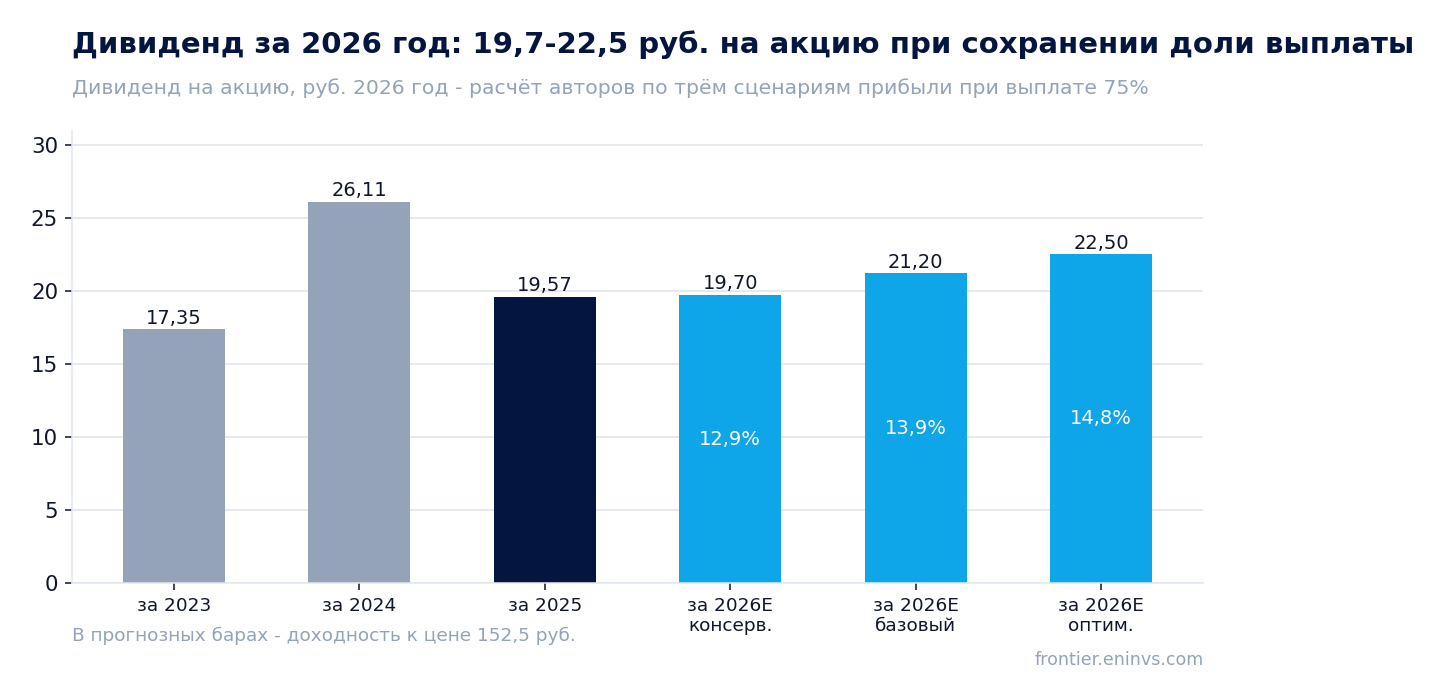
- Valuation is 5.4 years of earnings with a return on equity of 24%, but the dividend for 2025 has already fallen from RUB 26.11 to RUB 19.57 per share.
- 2026 profit is in a range of RUB 60-68 bn and the dividend RUB 19.7-22.5 per share, or 12.9-14.8% of the current price if the payout ratio holds.
- The dividend yield is at the top of its historical range, but allowing for dividend growth the premium over long OFZ is ordinary, 4-5 percentage points.
- Fair value on three approaches is RUB 128-160 against a quote of RUB 152.5: the stock is fairly valued, not cheap.
Fees grew by a quarter, while operating income for the quarter grew only 5.9%
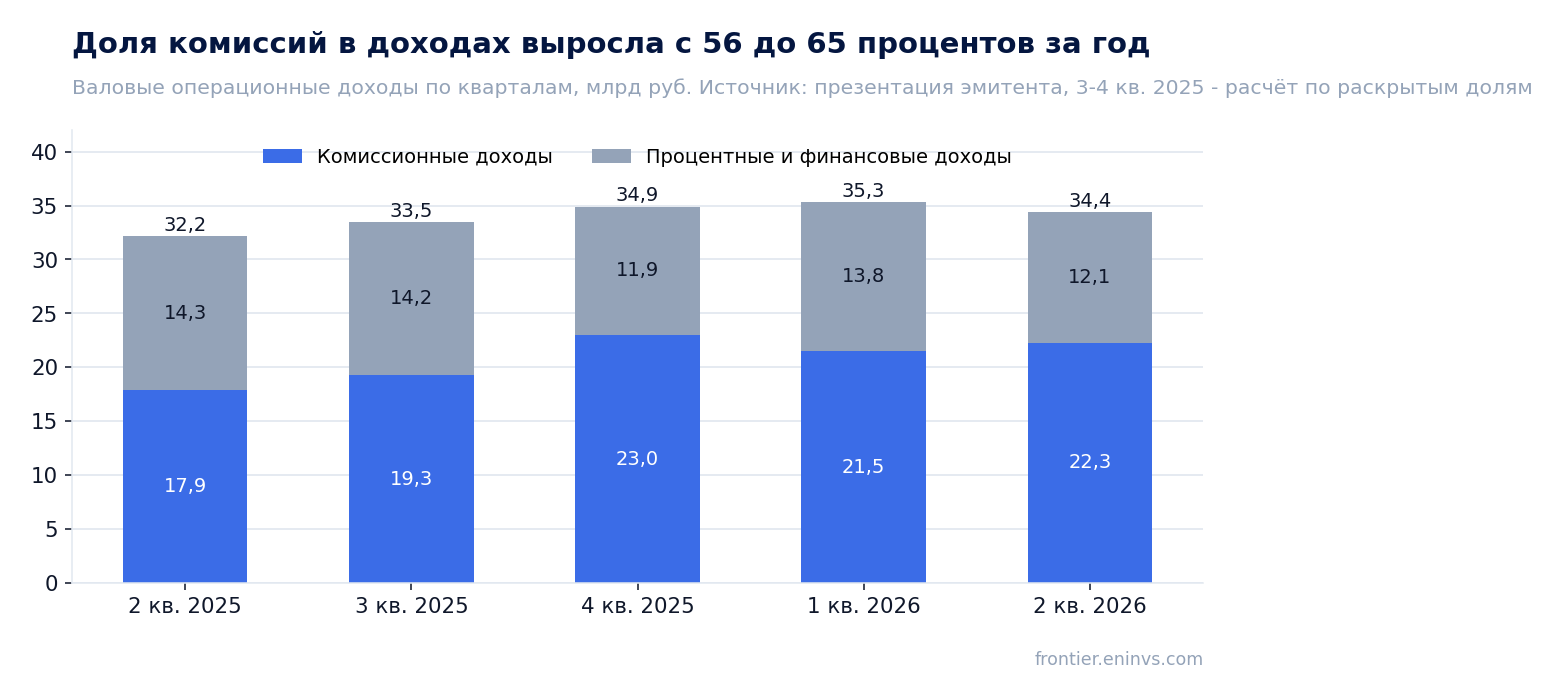
Fee and commission income in 2Q was RUB 22.3 bn against RUB 17.8 bn a year earlier. For the half-year fees brought in RUB 43.8 bn against RUB 36.3 bn (+20.5%). That is more than in any half-year of the previous two years: RUB 30.1 bn in the first half of 2024, RUB 32.9 bn in the second, and RUB 36.3 bn and RUB 42.3 bn in 2025.
Operating income meanwhile rose only to RUB 32.4 bn (+5.9%). The gap was created by two items unrelated to exchange fees. Net interest income added only 2.2% (RUB 13.3 bn against RUB 13.0 bn), and operations in foreign currency and precious metals produced a loss of RUB 1.2 bn against a gain of RUB 1.5 bn a year earlier.
The income structure continues to shift towards fees: for the half-year they provided 60.5% of operating income against 57.7% a year earlier (authors' estimate based on the statements). For an investor this is a plus – fee income is more stable than interest income, as it depends on trading activity rather than central bank policy.
The fee drivers have changed: equities minus 29%, derivatives plus 52%, bonds plus 46%
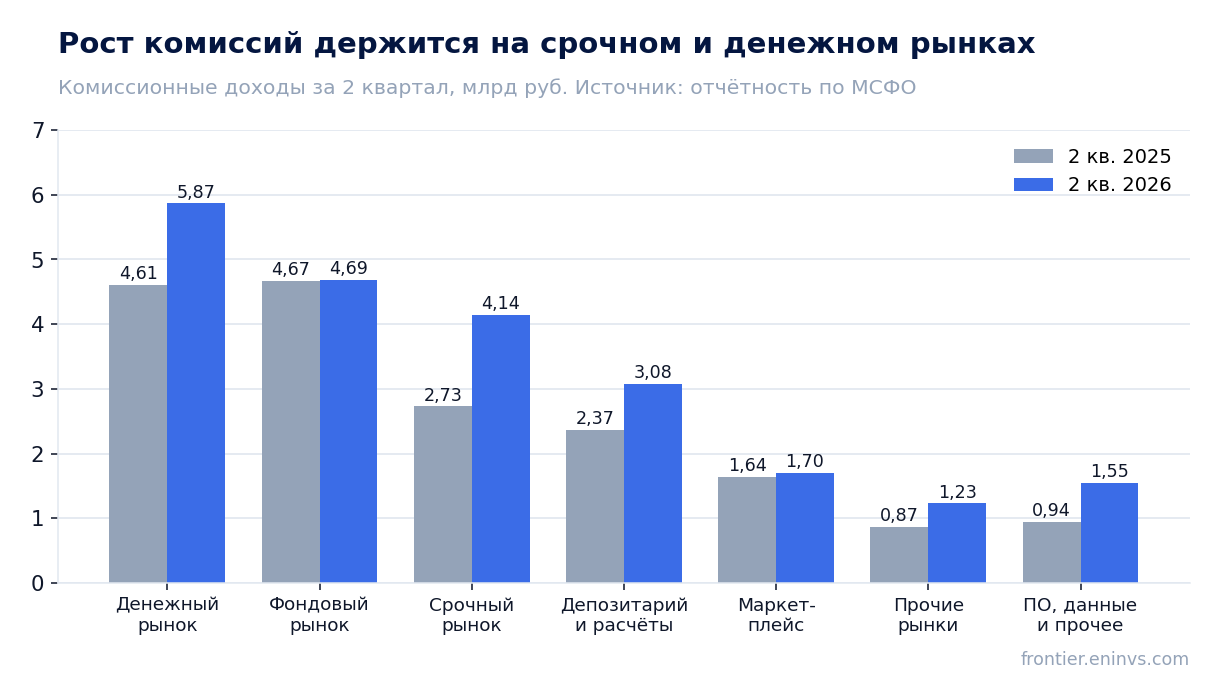
Fee breakdown by business line for 2Q, RUB bn (the first figure is for 2026, the second for 2025):
| Line | 2Q2026 | 2Q2025 | Change |
|---|---|---|---|
| Money market | 5.87 | 4.61 | +27.3% |
| Equity market as a whole | 4.69 | 4.67 | +0.4% |
| of which equities | 1.66 | 2.34 | −29.0% |
| of which bonds | 2.34 | 1.60 | +46.4% |
| Derivatives market | 4.14 | 2.73 | +51.7% |
| Depository and settlement operations | 3.08 | 2.37 | +29.7% |
| Financial marketplace | 1.70 | 1.64 | +3.5% |
| Other markets | 1.23 | 0.87 | +41.2% |
Fees repeat what is visible in turnover. In 2Q2026 equity trading volume was RUB 7.4 trn against RUB 9.3 trn a year earlier (−20%), while derivatives rose from RUB 29.8 trn to RUB 43.3 trn (+45%), bonds from RUB 3.1 trn to RUB 4.4 trn (+39%), and the money market from RUB 334 trn to RUB 476 trn (+42%). Authors' estimate based on Moscow Exchange ISS data, monthly aggregation.
The meaning of the reshuffle is simple. The retail investor, who used to bring the exchange its most visible fee from equity trades, has moved into money market instruments and derivatives. The exchange earns on these too, but the income structure becomes more dependent on professional participants and on refinancing volumes rather than on a retail inflow into equities.
Interest income held up with the rate 6 points lower, but funding is getting more expensive
Interest income for the quarter was RUB 16.1 bn against RUB 15.9 bn a year earlier. The result is not obvious. In 2Q2025 the key rate stood at 21% and 20%; in 2Q2026 at 15%, 14.5% and 14.25%. With the rate down almost 6 points, interest income did not fall.
The explanation is visible in the balance sheet. Funds in financial institutions rose from RUB 1.68 trn to RUB 1.81 trn since the start of the year, and interest income on the portfolio of securities measured through other comprehensive income grew 25% over the quarter (RUB 2.63 bn against RUB 2.10 bn). A larger volume of placement offset the lower rate.
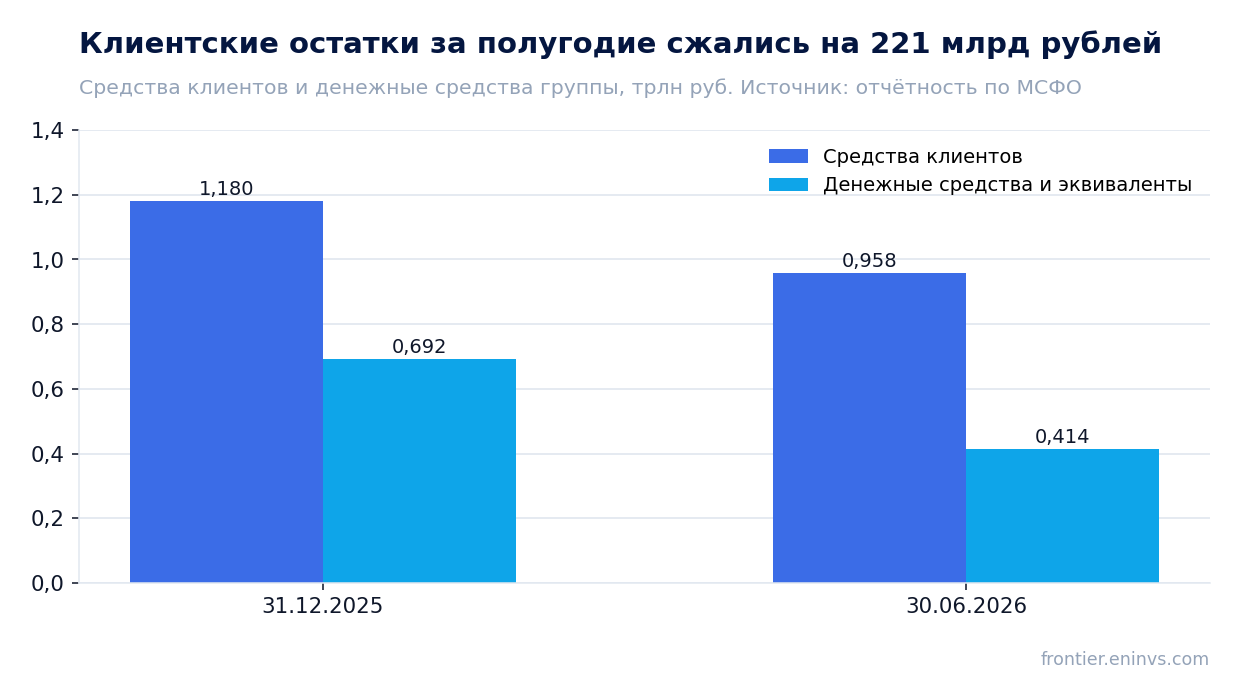
At the same time funding is getting more expensive. Client funds fell from RUB 1,180 bn to RUB 958 bn – minus RUB 221 bn, or 18.8% over the half-year. They were partly replaced by interbank money: funds of financial institutions rose from RUB 21.6 bn to RUB 41.8 bn, and interest expense on interbank loans and deposits from RUB 1.49 bn to RUB 2.19 bn for the quarter (+46%). This is exactly the kind of replacement that lowers future interest income. Client balances cost the exchange almost nothing, while interbank money costs market rates.
The FX line took RUB 2.7 bn from the quarter
The line "income less expenses on operations in foreign currency and precious metals" produced a loss of RUB 1.18 bn in 2Q against a gain of RUB 1.50 bn a year earlier. The difference was RUB 2.68 bn. That is more than half of the whole increase in fee income for the quarter.
The line reflects the revaluation of the group's own foreign currency assets and liabilities, not clients' trading result. It is unpredictable and has swung both ways in the past: for the half-year of 2024 it was negative at RUB 2.46 bn, for the half-year of 2025 positive at RUB 0.67 bn, and now it is negative again at RUB 1.08 bn. It cannot be used to judge the quality of the business, but it is exactly what explains why the two-year-high fees did not turn into profit growth.
The half-year's saving on personnel is only on paper: it came from the reversal of a share-based programme
Personnel expenses for the half-year were RUB 11.5 bn, 6.8% lower than last year. It looks like tight cost control, but inside the line sits the 2023 remuneration programme with cash settlement: the payout is tied to the future price of Moscow Exchange shares, and the liability is revalued every reporting period.
The share price fell over the year – the valuation model used a weighted average price of RUB 171.78 against RUB 191.60 a year earlier – and the liability was revalued downwards. In the first half of 2026 the programme produced a reversal of expenses of RUB 150 mn, in the first half of 2025 an accrual of RUB 1,144 mn. The difference in favour of the current year is about RUB 1.3 bn. Without it, personnel expenses would have grown by about 4% (authors' estimate).
General and administrative expenses received no such support. They were RUB 10.5 bn for the half-year (+11.1%) and RUB 5.8 bn for the quarter (+12.9%). Amortisation of intangible assets, technical maintenance and taxes other than income tax are growing. A methodological point should also be kept in mind: from 2026 the exchange moved direct costs related to providing services out of general and administrative expenses into a separate line, "fee and other direct expenses", and last year's data were restated – the previous RUB 12.6 bn of administrative expenses for the 1H2025 became RUB 9.5 bn. This line cannot be compared with older publications.
Expenses keep growing faster than income: 2026 guidance raised to 9-15%
Management's guidance, given together with the results: total expenses in 2026 will grow 9-15% against 2025. Of this, 3-9 percentage points relate to the controllable part, and a further 6 points the exchange classifies as uncontrollable – amortisation and the VAT rate increase. A possible provision for the long-term incentive programme is not included in the guidance.
In 2Q expenses already rose 10.4% year on year to RUB 13.5 bn. The fastest growth is in amortisation and IT maintenance – plus 31.4%, with IT maintenance itself up 50.4%. Headcount rose 8.6% over the year, with hiring for strategic projects and to strengthen the IT function. The cost-to-income ratio, as the exchange itself calculates it, rose to 39.2% from 37.9% a year earlier.
The meaning for an investor is simple. The cost base is growing at the lower end of double-digit rates and does not depend on what turnover will be. If fees slow while interest income keeps shrinking, profit will fall faster than income.
Segments: markets and depository added a third to profit, treasury lost 17%
Profit before other operating expenses by segment for the half-year, RUB bn (the first figure is for 2026, the second for 2025):
| Segment | 1H2026 | 1H2025 | Change |
|---|---|---|---|
| Markets | 24.5 | 18.4 | +32.8% |
| Depository | 8.7 | 6.5 | +33.9% |
| Treasury | 11.1 | 13.4 | −17.3% |
| Marketplace | loss of 2.5 | loss of 1.8 | – |
| Other | profit of 1.9 | loss of 0.9 | – |
The picture confirms the main storyline. The segments that live on fees – trading organisation and the depository – grew by about a third. Treasury, which earns on placing free funds, lost 17%, and this is the direct effect of the lower rate. Last year treasury's result was additionally supported by a release of provisions for expected credit losses of RUB 1.97 bn; this year the release was RUB 0.56 bn.
A separate loss zone is the Finuslugi marketplace. Its income for the half-year fell to RUB 0.9 bn from RUB 1.0 bn, and the loss before tax rose to RUB 2.9 bn from RUB 1.8 bn, including RUB 0.36 bn of impairment. The project is financed from the profit of the core business, while the marketplace's fee income for the quarter grew only 3.5% – the weakest growth of any business line.
The client base and product range are expanding, but this does not turn into equity fees
The operating part of the statements looks strong. The number of individuals registered on the equity market reached 42.2 mn by the end of July, and the number of open individual investment accounts reached 6.4 mn. In 2Q there were two IPOs on the exchange, B2B-RTS and Inkab, and the number of traded shares rose to 263. Added were 122 exchange-traded funds under Russian law, 222 futures and one premium option, 232 fixings on foreign securities, three indices on silver, platinum and palladium, and currency futures became available in weekend sessions.
Yet the fee from equities fell 29% over the quarter, and by 27.3% when units of investment funds are included. The client base and instrument range are expanding, but the money comes not from a retail inflow into equities but from the turnover of professional participants in derivatives and repo. These are sources of different stability: retail activity in equities returns with market growth, while money market volumes hold up on a high rate and may grow more slowly after it falls.
The dividend for 2025 fell by a quarter, and equity shrank 4% over the half-year
For 2025, RUB 44.5 bn of dividends were declared, or RUB 19.57 per share against RUB 26.11 a year earlier. This is 75% of IFRS net profit for 2025. The record date was 8 July and payment 22 July, so the balance sheet at 30 June shows a dividend payable of RUB 45.5 bn, while the cash flow statement does not yet reflect the payment.
Because of the accrued dividend, group equity over the half-year fell from RUB 269.6 bn to RUB 258.6 bn (−4.1%), despite a profit of RUB 32.9 bn. Cash and equivalents fell from RUB 692 bn to RUB 414 bn, but for the exchange this reflects the movement of client and clearing flows rather than solvency: operating cash flow before changes in client balances rose to RUB 46.3 bn from RUB 43.1 bn.
Investment is growing: over the half-year RUB 4.0 bn was spent on property, plant and equipment and intangible assets, plus RUB 3.9 bn of advances for acquiring non-current assets and RUB 1.0 bn on investment property – RUB 8.9 bn in total against RUB 4.1 bn a year earlier. The statements do not disclose what the advances were issued for.
Valuation: 5.4 years of earnings with a return on equity of 24%
At a price of RUB 152.5 the exchange's market capitalisation is RUB 347 bn. Profit for the last twelve months, that is, the second half of 2025 plus the first half of 2026, is RUB 64.2 bn attributable to the parent's shareholders, or RUB 28.3 per share. That gives a P/E of 5.4, and 5.9 on 2025 profit. Equity per share is RUB 113.8, P/B 1.34. Return on average equity for the same twelve months is 24.4%. All multiples are calculated by the authors from the statements and Moscow Exchange quotes.
The actual payout ratio for 2025 was 75% of IFRS net profit. If it is maintained, first-half 2026 profit corresponds to a dividend of about RUB 10.9 per share, or 7.1% of the current price for the half-year. This is the authors' assumption: the supervisory board will decide on the 2026 dividend in spring 2027.
The market's reaction to the report was restrained. On 26 August the stock closed 1.7% lower, while the Moscow Exchange index lost 2.2% that day. The report was taken as neutral – neither a disappointment nor a surprise.
2026 forecast: profit of RUB 60-68 bn, dividend of 12.9-14.8% of the current price
The authors' estimate, three scenarios. The common framework is one: in the second half of 2026 fees keep growing, interest and financial income decline following the rate, expenses stay within management's 9-15% guidance, and the effective tax rate remains about 25%.
- Conservative: second-half fees +10% year on year, interest and financial income −12%, expenses at the upper end of guidance (+15%). 2026 profit is RUB 59.7 bn, the 2025 level.
- Base: fees +18%, interest income −8%, expenses +12%. Profit is RUB 64.2 bn (+8% on 2025).
- Optimistic: fees +24%, interest income −3%, expenses at the lower end of guidance (+9%). Profit is RUB 68.3 bn (+15%).
For 2025 the exchange distributed 75% of IFRS net profit. If the payout ratio is maintained, the dividend for 2026 will be RUB 19.7-22.5 per share, that is 12.9-14.8% of the current price. If the board returns to distributing half of profit, the range falls to RUB 13.1-15.0, or 8.6-9.8%. The decision will be taken in spring 2027 and payment in summer, so a holder has to wait almost a year.
Whether this is a lot or a little is clear from history. For the last three record dates an investor received 7.0% (dividend for 2023 at a price of RUB 249), 13.5% (for 2024 at RUB 193) and 11.9% (for 2025 at RUB 164). The forecast range is in the upper part of this series.
This yield cannot be compared directly with long OFZ. Issue 26248 maturing in 2040 traded on 26 August at 16.1% a year, and that is its entire return: the coupon is fixed. For a stock the dividend is only part of the return, with dividend growth added to it. Sustainable growth at a 75% payout is about 5.8% a year, and actual dividend growth from 2023 to the 2026 base forecast is 6.9% a year. The full expected return comes to 19-21% against a risk-free 16.1%, so the risk premium is 4-5 percentage points. This is the ordinary price of equity risk, not an exceptional opportunity.
Two caveats to this calculation. The payout ratio is not fixed by any commitment: at a distribution of half of profit the yield falls to 8.6-9.8%. And dividend growth is not monotonic – RUB 26.11 was paid for 2024, RUB 19.57 for 2025, and the base forecast for 2026, RUB 21.2, is still below the level of two years ago.
Value creation: the spread between return on equity and its cost has narrowed to 2-3 points
The exchange earns more than its capital costs, but the margin is small. Return on equity for the last twelve months is 24.4%, and in the 2026 base scenario it falls to 23.0% (authors' estimate). The cost of equity, with long OFZ at 16.1% and an equity risk premium of 3-5 points, is 19-21%. The spread is 2-4 percentage points, or about RUB 8 bn of economic profit a year on equity of about RUB 280 bn.
This is the spread the market pays for: capitalisation of RUB 347 bn against equity of RUB 258 bn, a premium of RUB 89 bn. A modest spread explains why a stock with a return on equity of 23% trades at only 1.34x book value – at a cost of capital of about 20% the fair premium should indeed be small.
Sustainable growth under this payout policy is limited: if 75% of profit is distributed, equity grows by 25% of the return on equity, that is, about 5.8% a year. The exchange can grow faster only if profit on existing equity grows by itself – through turnover and fees, not through reinvestment.
Fair value: three approaches give RUB 128-160, the current quote is in the upper part of the range
Three independent valuation methods under the base profit scenario (authors' estimate; assumptions – return on equity of 23%, sustainable growth of 5.8%, required return of 19-21%, book value per share of RUB 113.4):
- Fair P/B = (return on equity − growth) / (required return − growth). At a required return of 19% this is 1.30x book, or RUB 148 per share; at 20%, RUB 137; at 21%, RUB 128.
- Dividend discount model: RUB 160 at a required return of 19%, RUB 148 at 20%, RUB 139 at 21%.
- Required dividend yield: if an investor requires 14% in dividends from the stock, the price is RUB 151; at 16%, level with long OFZ, RUB 132.
The range comes to RUB 128-160 against a quote of RUB 152.5. In other words, the stock is fairly valued, not cheap: low multiples (5.4 earnings) compensate for the high required return rather than creating a margin of safety.
Sensitivity works both ways. If return on equity falls towards 20% – which happens if interest income shrinks faster than fees grow – fair value at a required return of 20% falls to RUB 113. If OFZ yields decline to 12-13% and the required return moves to 17%, fair value rises towards RUB 174-188. So the main driver of the stock's re-rating is not the report but the path of rates, and it also works against the exchange's interest income.
What next: record July turnover against a rate that keeps falling
There is already leading data for the third quarter. In July total turnover on the group's markets was RUB 204.7 trn – more than in any month of the first half – and equity turnover (RUB 3.5 trn) was the best since March. The fee part of the third quarter will most likely be strong.
Working against this is the rate: it was cut to 14% from 27 July, and if the easing cycle continues, treasury's interest income will keep shrinking – all the more so the longer client balances stay at RUB 958 bn instead of last year's trillion-plus.
The main question for the next reports is whether fee growth can offset the shrinking of interest income not only in income but also in profit. So far in the quarter it does not: fees plus 24.8%, profit plus 4.7%.
Conclusion
The report is neutral. Operationally the exchange is strong: fees are at a record for the available history of half-years, the share of stable income has risen from 56% to 65%, and return on equity is 23-24%. But profit has stood still for a second year – RUB 38.9 bn for the half-year of 2024 and RUB 32.9 bn now – because the interest part, which fed the exchange at a rate of 20% and above, is going away together with the easing of central bank policy, while expenses are growing at double-digit rates according to the company's own guidance.
As an investment the stock looks moderately attractive, but without a margin of safety. The base-scenario 2026 profit of RUB 64 bn gives a dividend of about RUB 21 per share and a yield of 13.9% – in absolute terms the top of the exchange's historical payout range. Allowing for dividend growth, the full expected return is 19-21% against 16.1% on long OFZ, so the risk premium is of ordinary size. Fair value on three approaches is RUB 128-160. A bet on re-rating of the stock is a bet on falling yields in the economy; the same falling yields reduce the exchange's interest income, so the whole question is whether fees can grow enough to offset this shrinkage. So far in the quarter they cannot.
The issuer card with full indicators and reporting history is on the Frontier portal.
This review was prepared by the Enhanced Investments team from the condensed consolidated IFRS statements of PAO Moscow Exchange MICEX-RTS for the six months ended 30 June 2026 and Moscow Exchange trading data. Issuer analysis is in the Telegram channel @eninv.
See also: market overview · valuation map · stock screeners