MTS has changed its dividend policy: what it means for the shareholder
On 16 September MTS announced a new capital return policy for 2027-2028. Shareholders will receive up to 20% of OIBDA a year, but not less than RUB 70bn. Of this amount, 70% will go to dividends and 30% to share buybacks. There will be three payments a year, the first to be recommended by the board of directors at the end of November together with the third-quarter report. Repurchased shares will not be cancelled; they will remain with the company. On the day of the announcement the shares lost 7.5%, and 13% over three sessions; they now trade at RUB 174.9.
OIBDA is operating profit before depreciation and amortisation, the main indicator in MTS's results reporting.
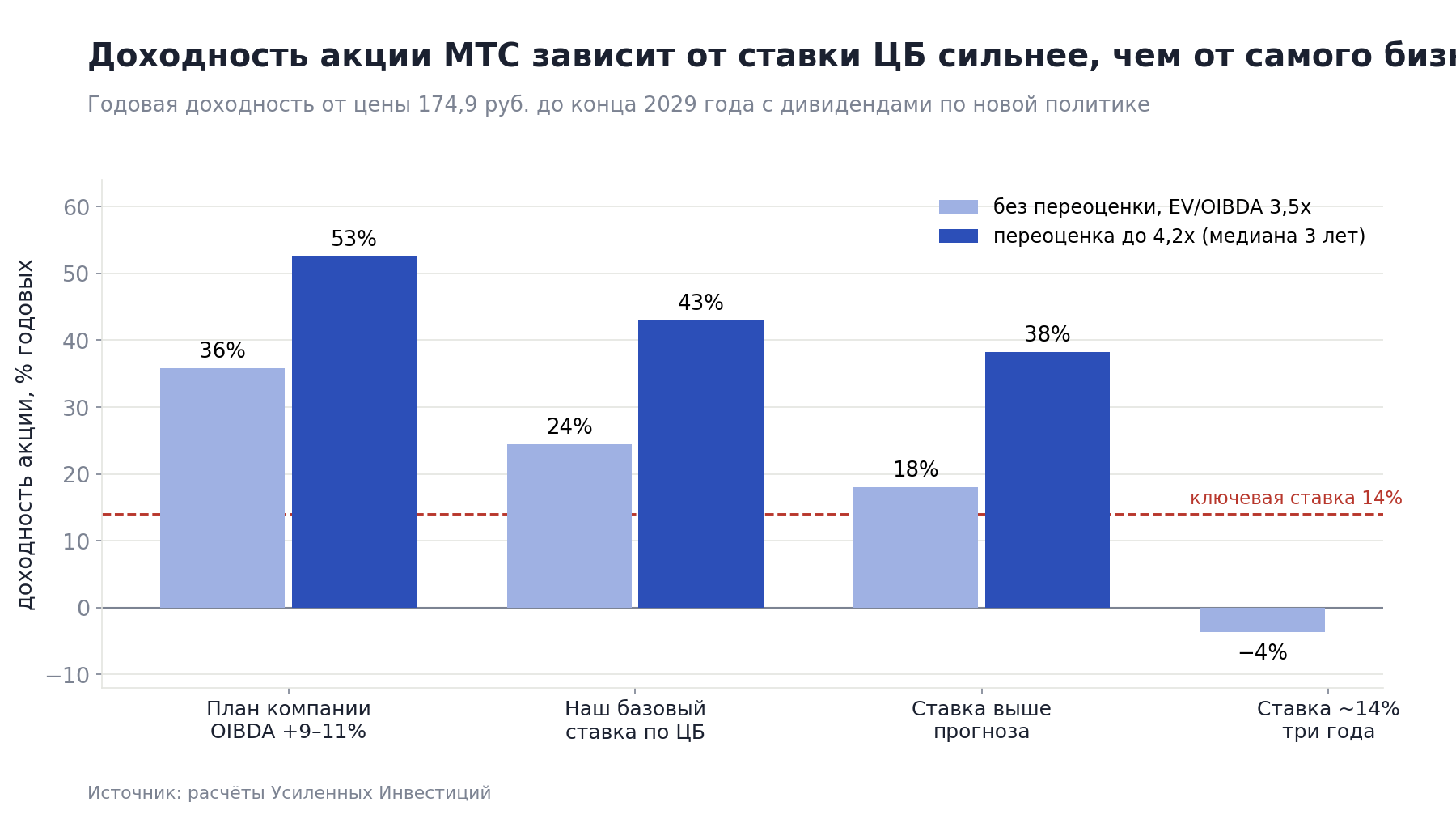
Key conclusion. The stock has become less attractive and uncertainty has increased, but the idea is not broken. The shareholder receives less cash, a third of the return goes into a buyback whose fate the company has not explained. At the same time the business is growing, leverage has been falling for a second year, and MTS remains in the top group of the market by yield. If the key rate falls as the Bank of Russia forecasts, the share yields about 24% a year, and about 40% if the company also sells the repurchased block into the market.
- The size of the return has not changed, its form has: a third of the dividend has been replaced with a share buyback.
- The dividend really is paid with borrowed money, but the burden is falling: EBITDA is growing faster than debt.
- The main constraint is accounting: the profit of PJSC MTS under Russian standards is not enough for the previous payout.
- Concerns that the buyback was designed to let AFK Sistema exit are not confirmed in conversation with the company, but the fate of the block has still not been announced.
- The next dividend will be announced at the end of November and will be paid entirely in cash, without a buyback.
1. A third of the dividend has been replaced with a buyback, and the total return stays the same
For 2025 MTS paid RUB 35 per share, RUB 70bn in total. The floor of the new policy is the same RUB 70bn. Of this, 70%, or RUB 49bn, will go to dividends, which is RUB 24.5 per share. On the current price that is a 14% yield instead of 20% at the previous RUB 35. Another RUB 21bn will go to the buyback, about 6% of the market value of the whole share issue.
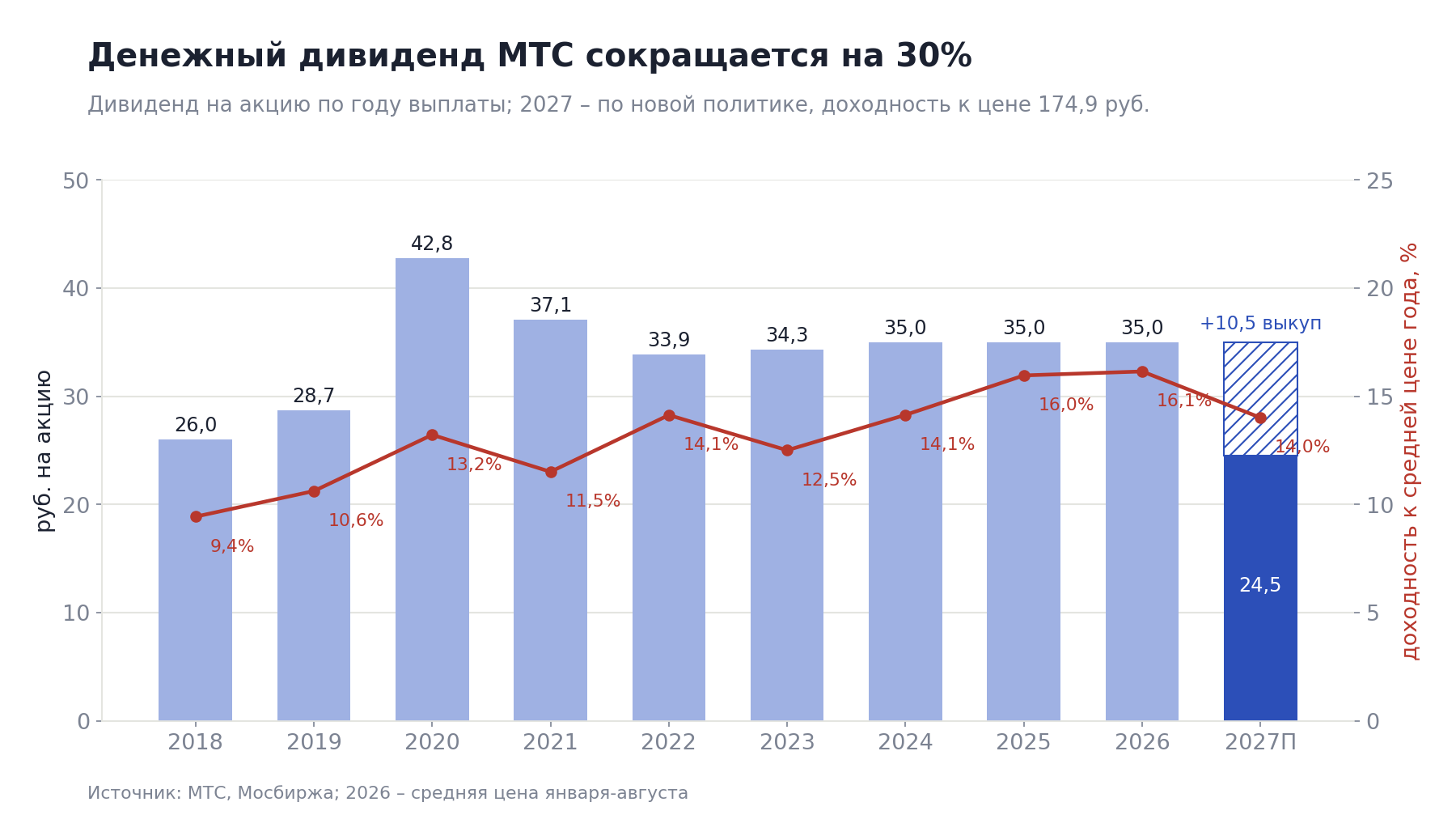
In exchange, the dividend ceases to be fixed. The previous policy worked like a bond with a constant coupon: from 2022 to 2026 the payment stayed in the range of RUB 33.9-35 and reacted neither to revenue growth nor to inflation. The company itself called this a shortcoming at its investor day. The resemblance to a bond largely remains, except that the coupon can now grow with profit.
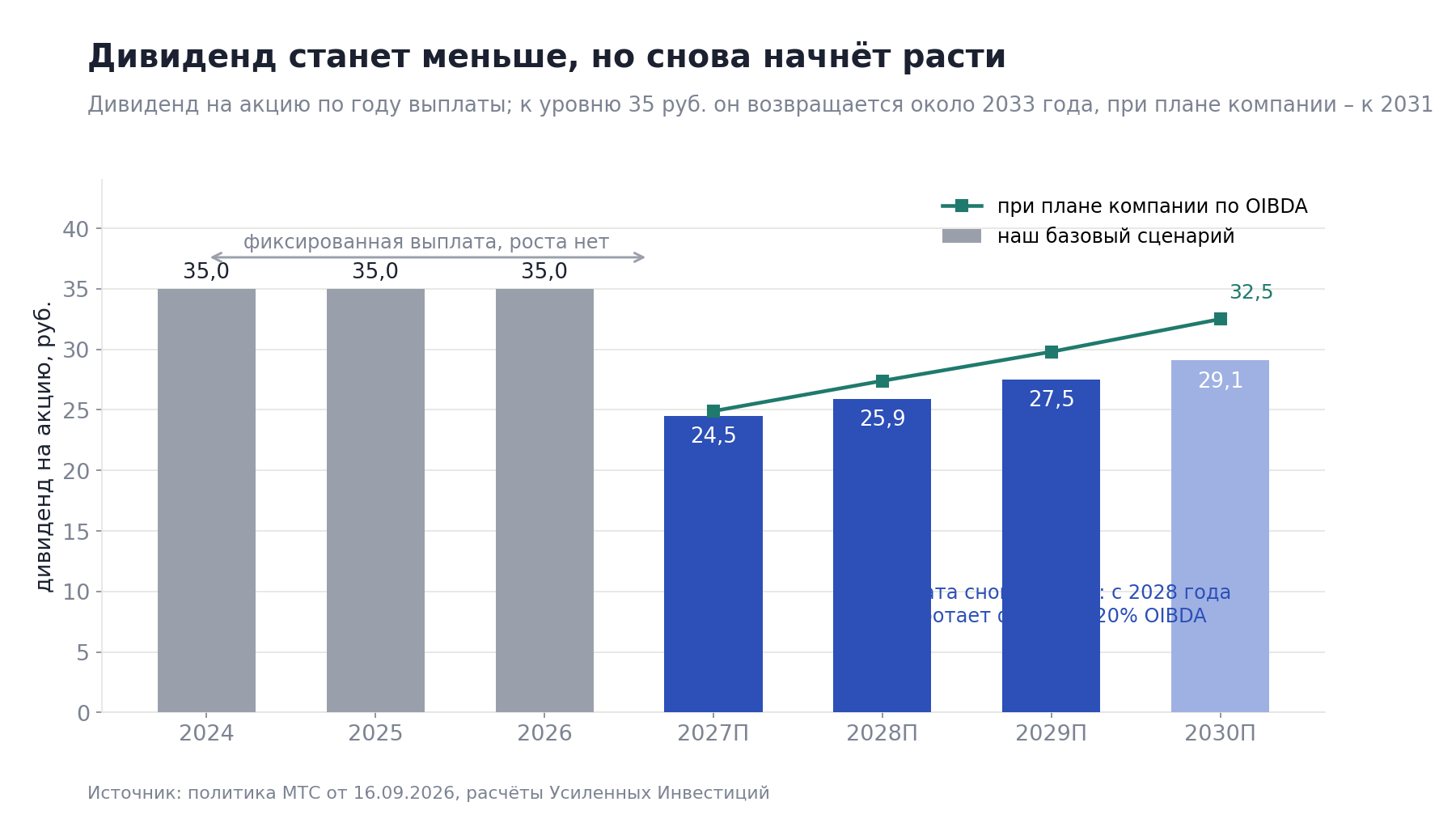
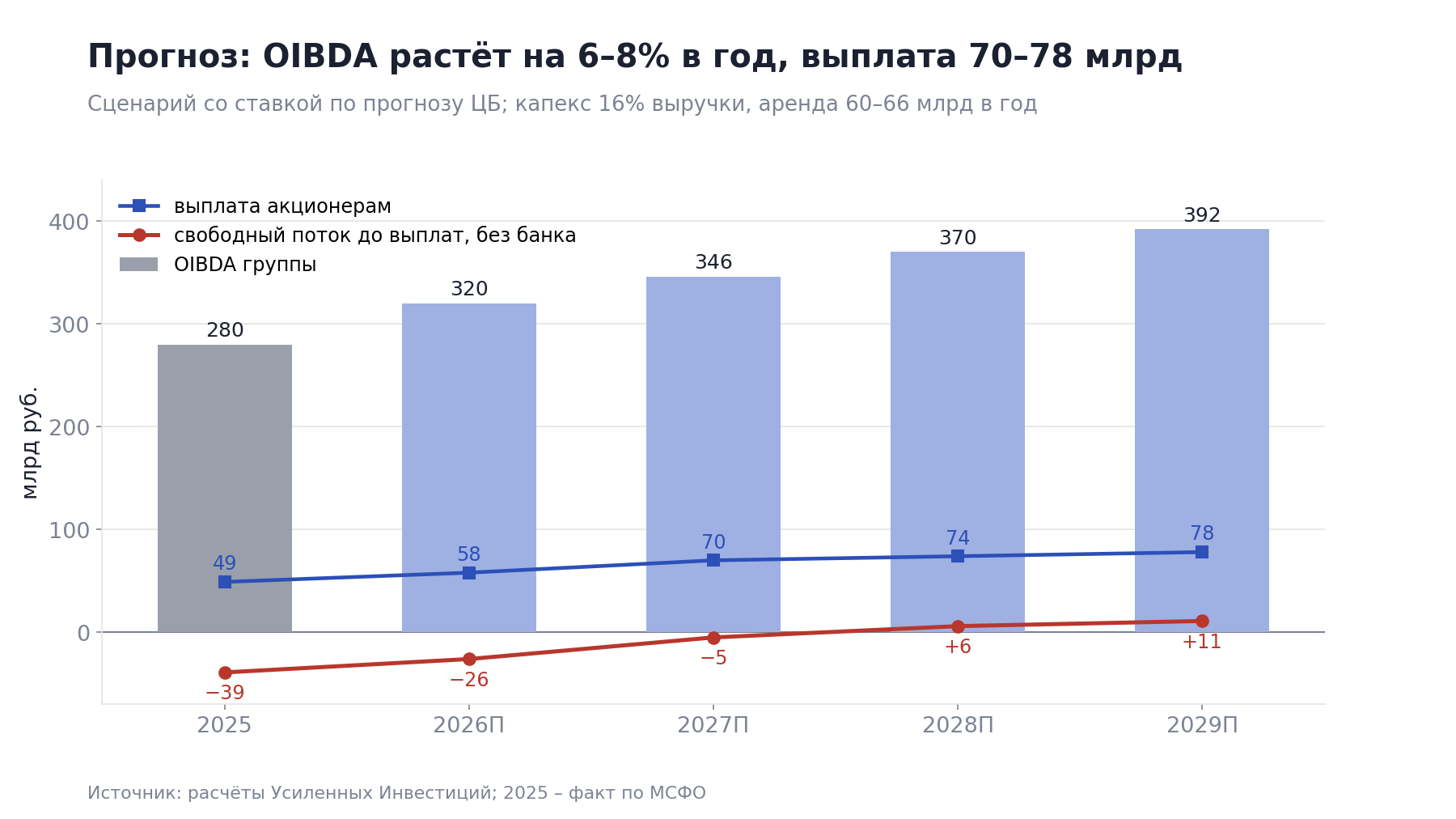
The new formula is tied to OIBDA, but it does not kick in immediately. While 20% of OIBDA is below RUB 70bn, the floor applies, and the threshold is OIBDA of RUB 350bn. In 2026 OIBDA is expected at about RUB 320bn, in 2027 RUB 346bn by our estimate, and in 2028 RUB 370bn. So the payment starts to grow from 2028, or from 2027 if the company delivers its own plan of double-digit OIBDA growth. An important caveat: the policy speaks of returning "up to 20%" of OIBDA, so 20% is a ceiling, not a commitment. The dividend is also limited by the PJSC's profit under RAS, while the buyback has no such limit. It is therefore convenient for the board to stay close to the floor and to add a buyback rather than dividends above it. Our growth estimate assumes payment at the ceiling; with payment at the floor the dividend stays at about RUB 24.5 in both 2027 and 2028.
2. The dividend is paid with debt, but the leverage is not rising, and this is a workable structure
First, the business. OIBDA grew from RUB 246bn in 2024 to RUB 280bn in 2025 and by another 17% in 1H2026. Telecom OIBDA added 12.8% over the half-year, mainly thanks to tariff indexation. Revenue from communication services for business grew 16.6% in the second quarter, advertising 16%, and the MWS cloud business from external clients 18%. The company targets RUB 1tn of revenue by 2028.
However, cash flow is not enough for the payout. Excluding MTS Bank, free cash flow in 2025 was minus RUB 39bn, and minus RUB 16bn over the last 12 months. The payment to shareholders sits on top and is financed with new debt.
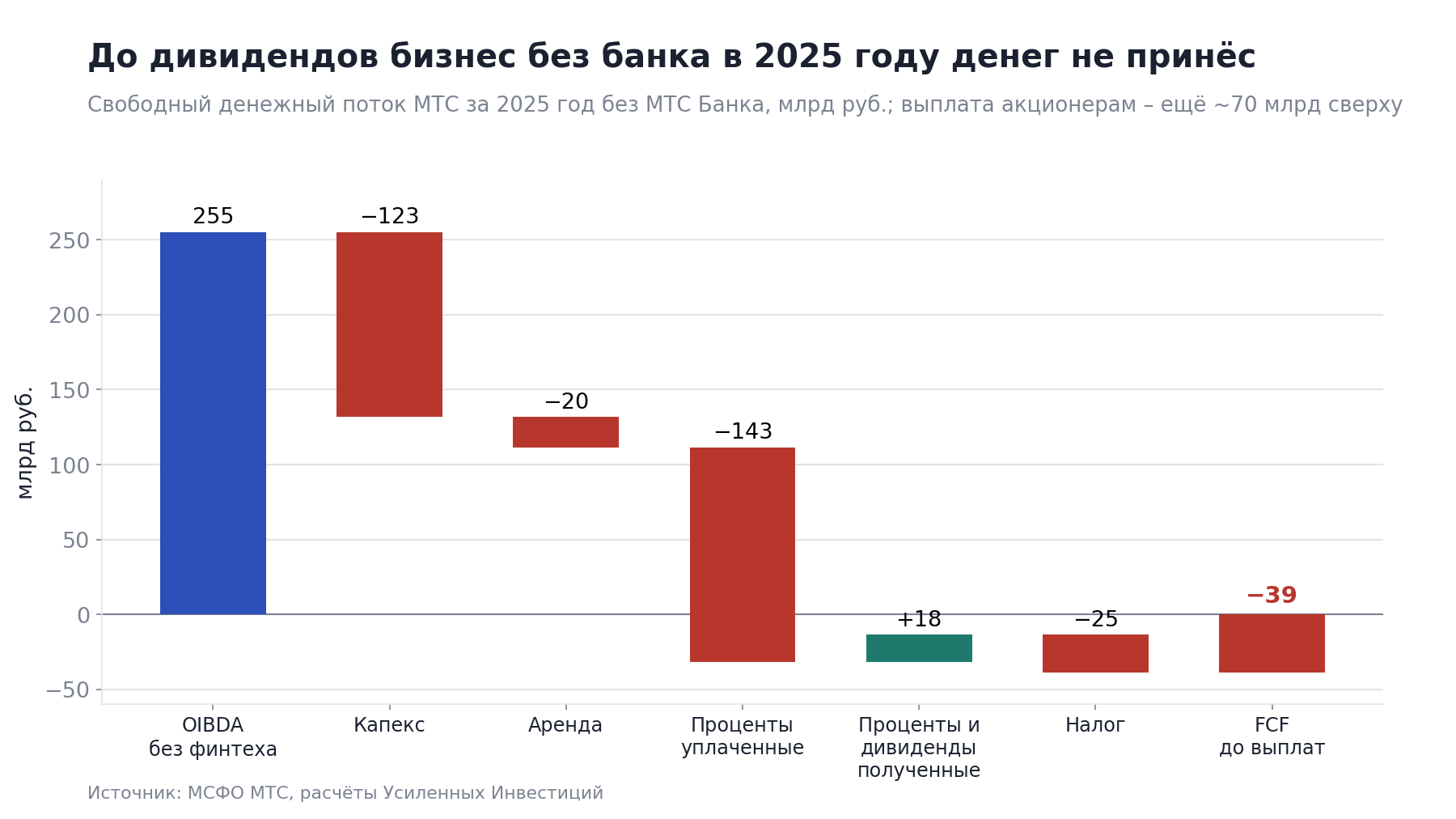
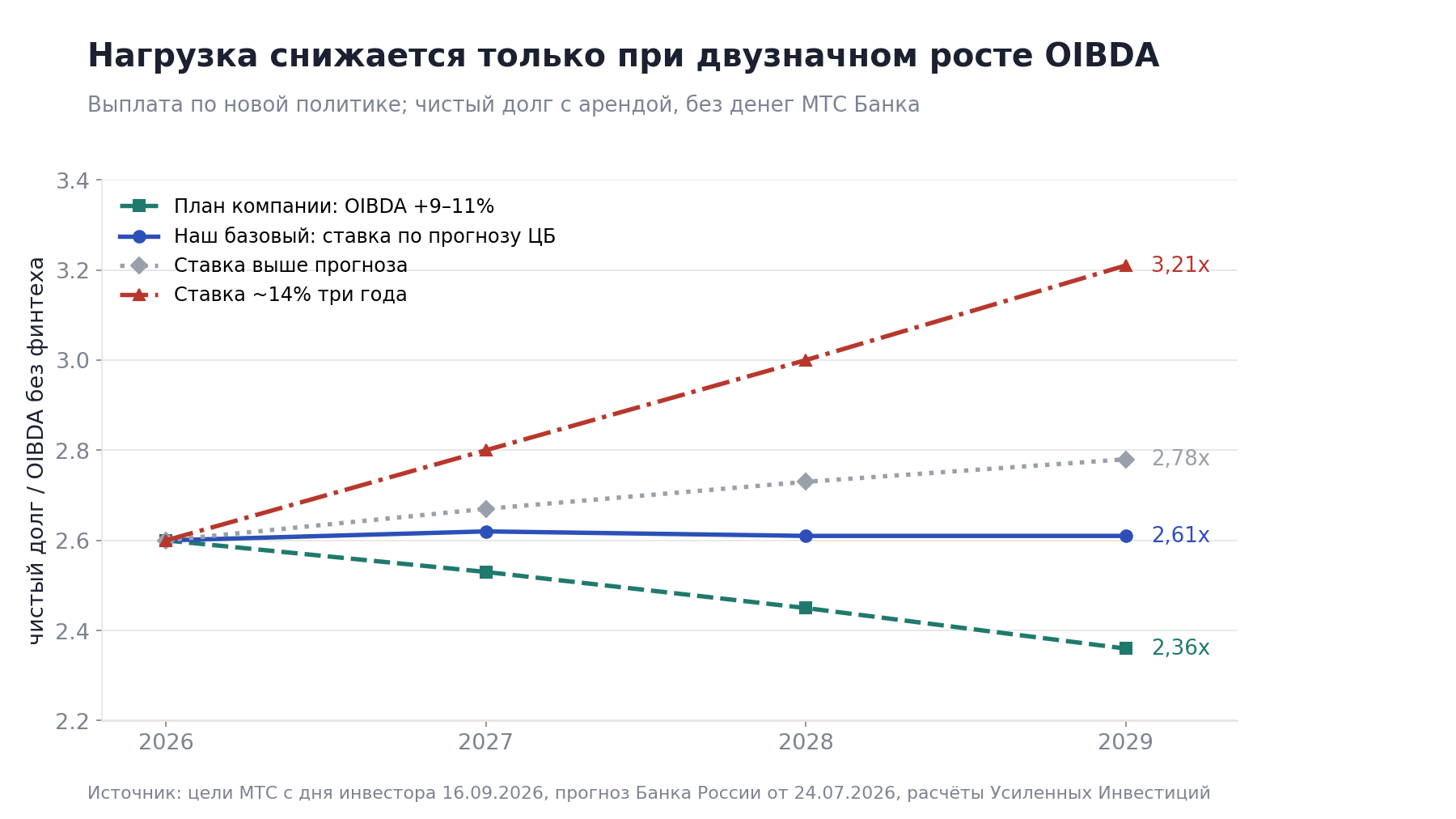
In itself this is not a verdict. If EBITDA grows and the company holds the ratio of debt to EBITDA at one level, debt can grow with the business and value is not destroyed. The question is whether the leverage holds.
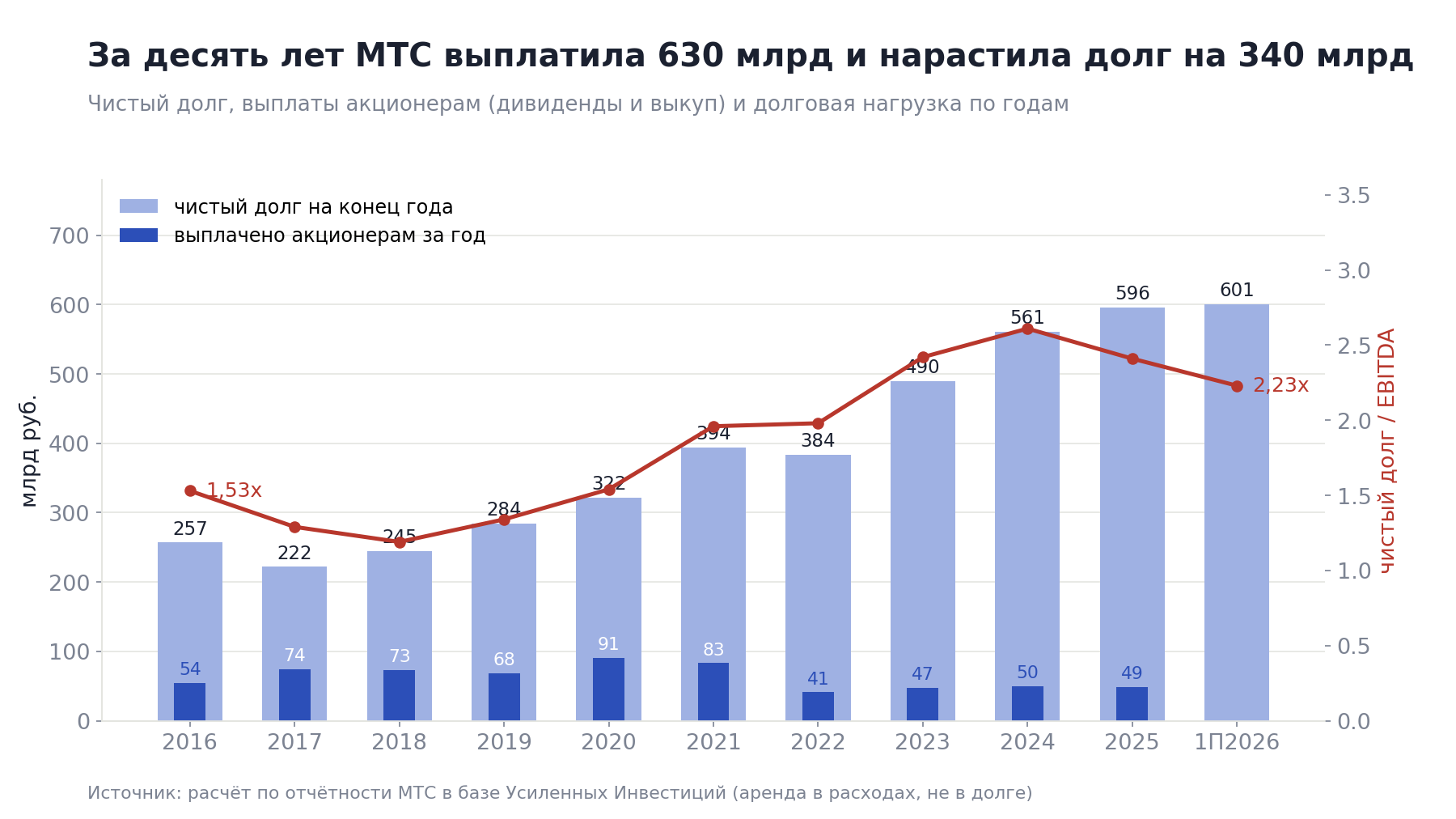
A breakdown of recent years shows how this is achieved.
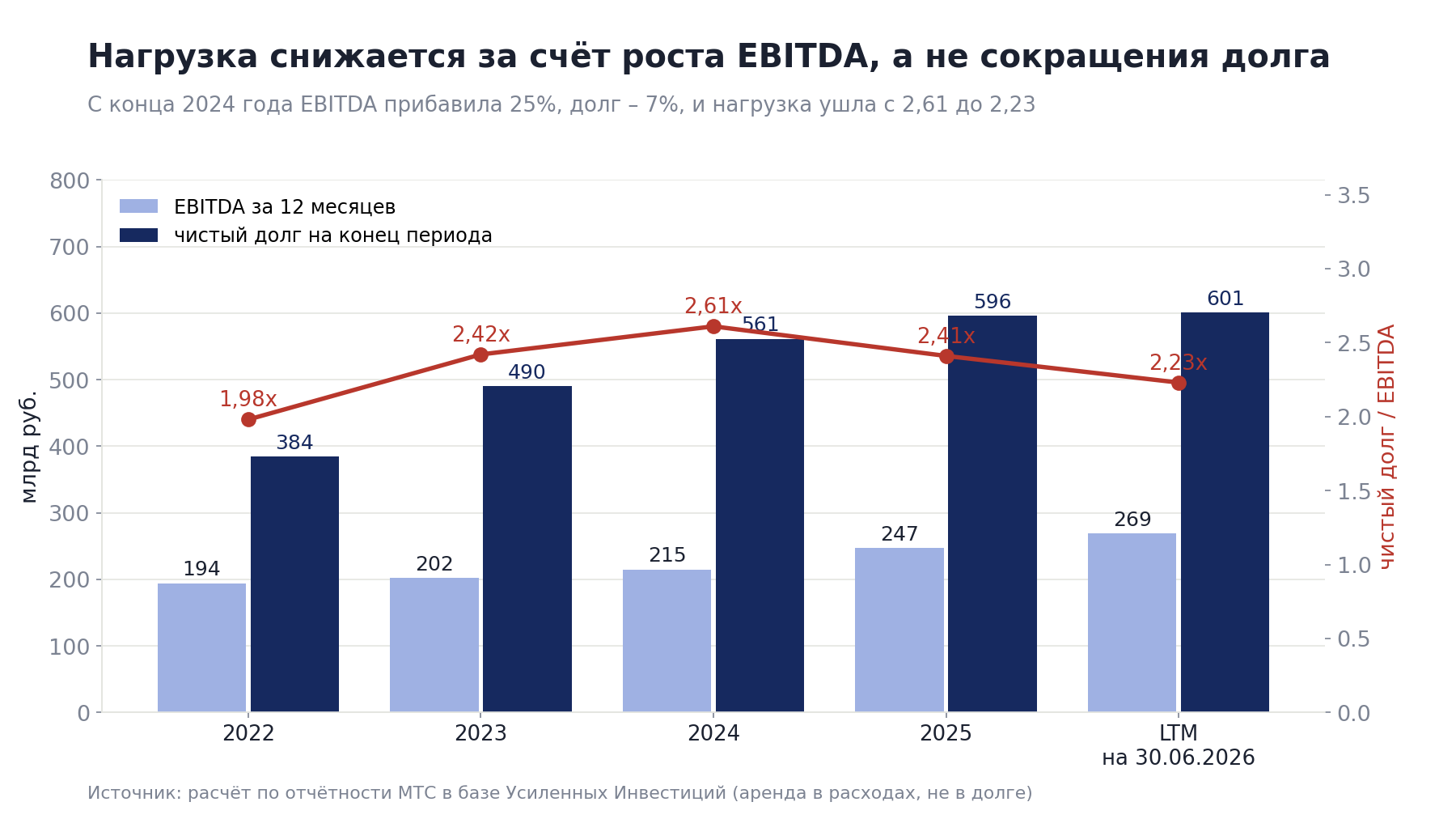
In other words, debt is not shrinking but is not accelerating either, while the denominator grows faster. This is the structure in which paying out of borrowed money works: the company borrows against a growing business. The equity of the parent company is nevertheless melting, which is covered in the next section. The structure breaks only if EBITDA stops growing or the rate stays high enough for interest to eat the whole increment.
The company shows its debt more softly than it is. At 30 June MTS reports net debt of RUB 474bn and leverage of 1.6x. The calculation excludes leases, although there are RUB 172bn of them on the balance sheet, and OIBDA is calculated before lease payments. In addition, the cash of the whole group is deducted from debt, but almost all of it sits in MTS Bank: RUB 60.6bn of RUB 64.5bn. For the telecom this is depositors' money, and it cannot be used to pay a dividend.
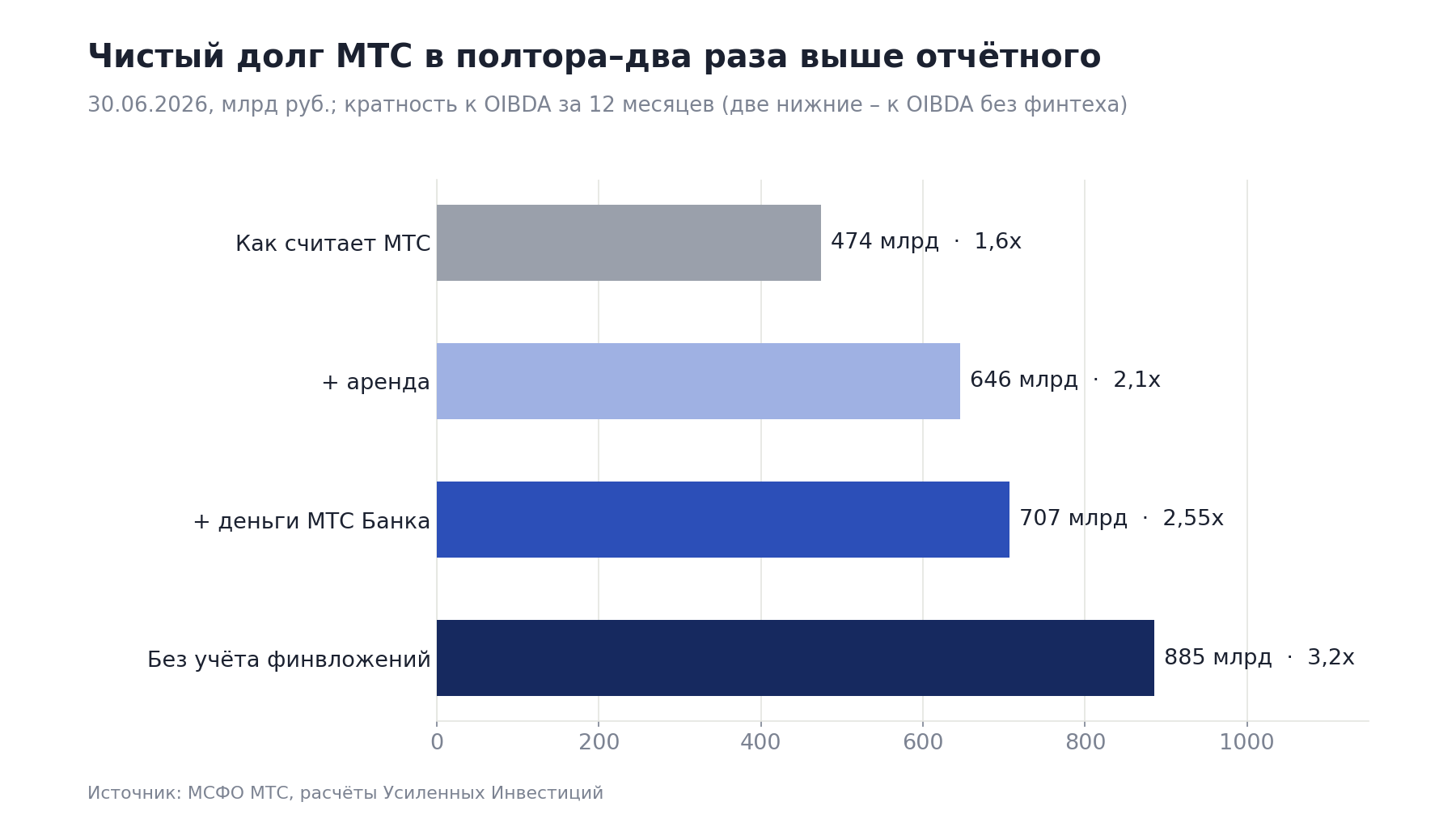
There are two more items that are not in the reported debt. In December 2025 MTS sold 165mn of its own shares with an obligation to buy them back after six months: this is a loan of RUB 35.9bn secured by its own shares, and it sits in the line "other financial liabilities". And in June 2026 the company sold 49.9% of the tower company BIK. This improved the balance sheet: RUB 81.6bn of debt left the balance sheet and another RUB 21.7bn will arrive in cash, about RUB 100bn together. In return there is a tower lease of RUB 65.6bn at 16.85% for seven years, but MTS still owns 50.1% of BIK, and roughly half of the lease payments return to it through its share of profit. Even by the strictest measure, with the full amount of the lease, the balance sheet improved by about RUB 38bn. The reporting now also shows a BIK loan of RUB 47.9bn. There is no separate loan disbursement in the cash flow, so this appears to be the previous intragroup loan rather than new money. In addition, upon certain events MTS may assume a BIK credit line with a limit of up to RUB 86bn.
3. The main constraint is accounting: the profit of PJSC MTS under Russian standards
In Russia dividends are paid not from the group's consolidated profit but from the parent company's profit under Russian accounting standards (RAS). For PJSC MTS this profit is tight: for 2025 it was RUB 26bn against a payment of RUB 70bn. The difference is covered by retained earnings of past years, and this cushion is melting.
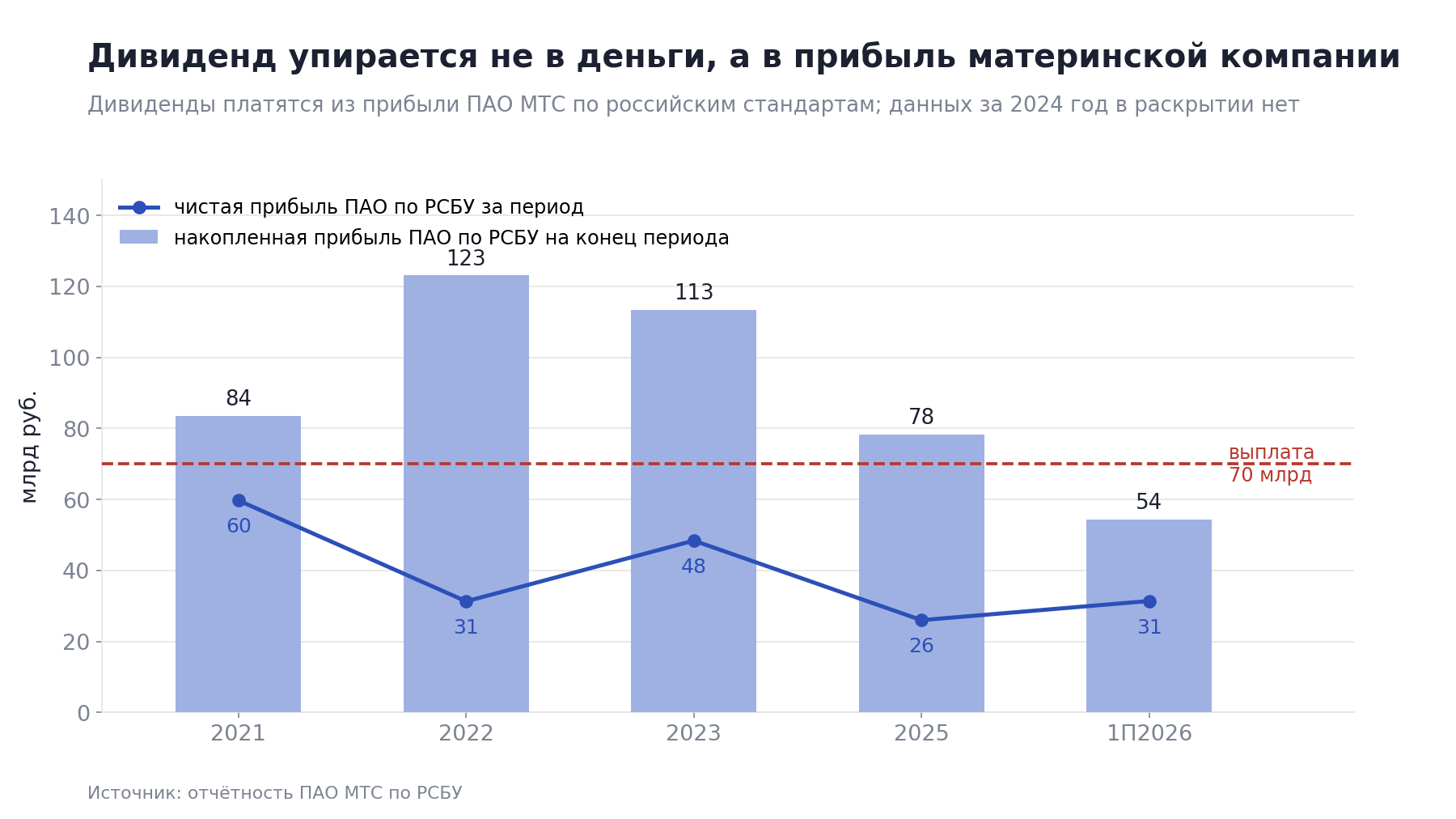
The sale of the stake in the tower company does not rescue the situation. In the consolidated statements the deal produced RUB 53.3bn of profit, but RUB 19bn of it is a revaluation of the stake still held by MTS, a paper amount. In cash, RUB 21.7bn is due, and it had not yet been received at 30 June.
This explains the structure of the new policy. A share buyback does not require distributing RAS profit, while a dividend does. Replacing a third of the payment with a buyback removes part of the load from the parent company. For the same reason the company does not cancel repurchased shares: cancellation reduces capital, which it is short of as it is.
This constraint is temporary. The PJSC's profit is pressed down by interest: the parent company itself issues bonds worth RUB 353bn, and each percentage point of the rate costs the group up to RUB 7bn a year as the floating part reprices. As the rate falls and the business grows, the PJSC's profit recovers and the accounting ceiling moves away.
4. Concerns that it was all done for AFK's exit are not confirmed, but the fate of the block has not been announced
The market's first reaction was that the buyback is needed to let AFK Sistema, which has its own debt burden, exit. Conversation with the company does not confirm this. The company said the buyback will be carried out proportionally, simultaneously among existing shareholders and on the open market, in order to preserve the current shareholder structure. On the sidelines of the investor day the mechanics were described in more detail: after each dividend record date MTS buys shares on the exchange in equal volumes, and on the Friday of the same week it buys a block from AFK at the same price. The parent's stake, 42.1%, does not change, and neither do the stakes of the other shareholders.
If so, with a buyback of RUB 21bn a year, about RUB 12bn goes to sellers on the exchange and about RUB 9bn to AFK Sistema for its proportional share. Together with the dividend, AFK's cash flow from MTS stays roughly as before, about RUB 29.5bn a year. An exit scheme does not emerge from this.
What quasi-treasury shares are. Repurchased shares end up either on the balance sheet of the company itself (treasury) or on the balance sheet of its subsidiaries (quasi-treasury). In Russia the second is more common: by law treasury shares must be sold or cancelled within a year, while a subsidiary can hold a block for as long as it likes. Three effects follow.
- The dividend on such shares stays inside the group. The company declares a payment on all issued shares, but the part falling on its own block moves from one pocket to another. Less cash leaves, and this improves the economics for those who hold the stock.
- External shareholders have fewer shares. The same profit and the same business are divided among fewer shares. Economically this is close to cancellation.
- The block remains an asset that can be sold when the share is more expensive.
MTS already has a large block of this kind. In the reporting it is visible in the earnings per share calculation: it is divided not by all 1,998mn issued shares but by 1,669mn. The difference, about 330mn shares or 16.5% of the issue, belongs to the group itself. The statement of changes in equity gives the same order of magnitude: dividends declared in 2025 were RUB 57.6bn, that is about 1,645mn shares at RUB 35. The often-cited 8% is the 165mn shares that MTS sold in December 2025 with an obligation to buy them back, that is only part of the block.
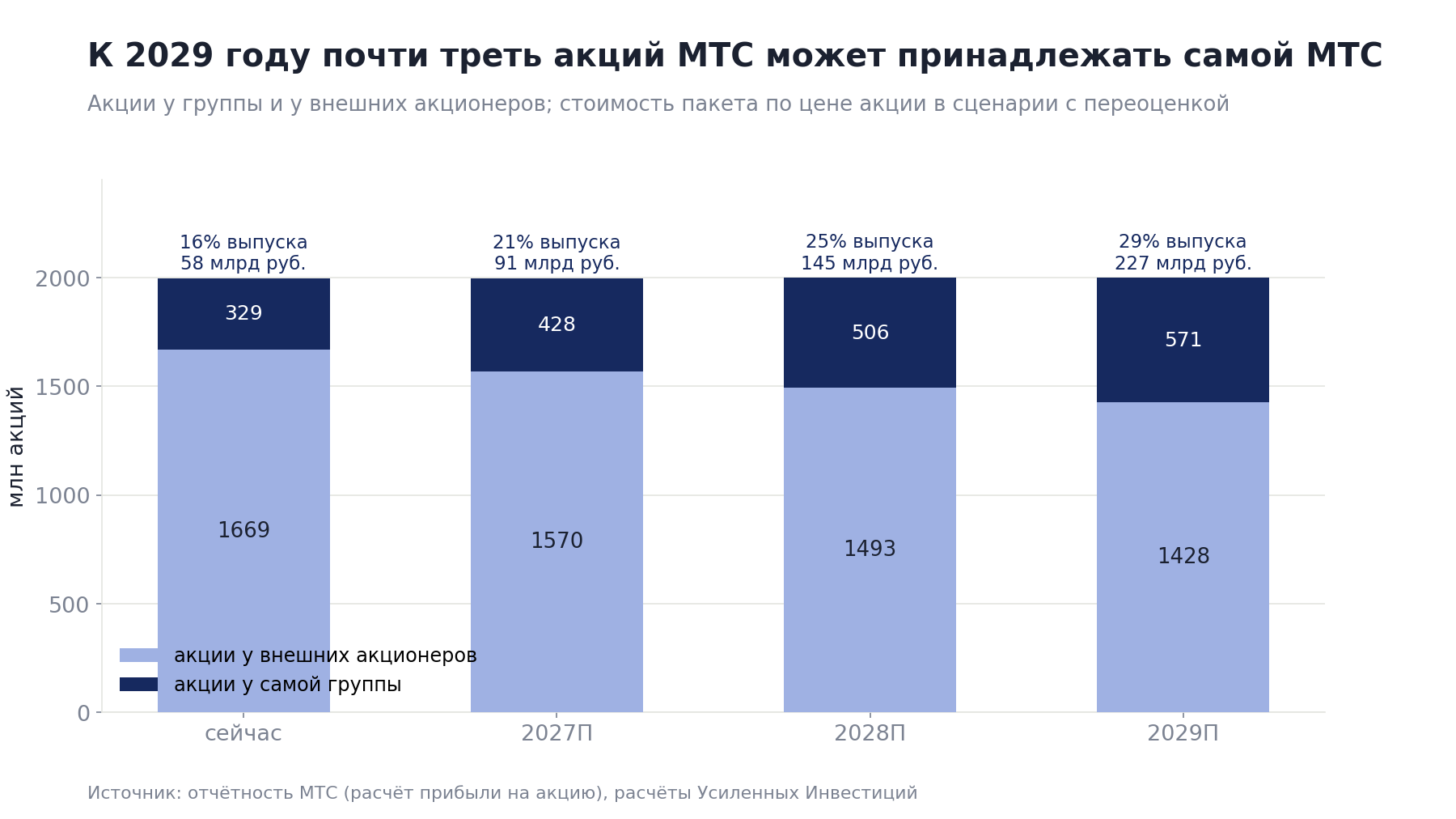
The weak point here is communication. The company has not said what it will do with the block: hold, cancel or sell. Asked about this, the company replied that it would think about clearer disclosure. While there is no timeline, the market prices in the worst case. Concerns that the block will go to management incentives look exaggerated: it is already incomparably larger than any compensation programme.
5. What it adds up to in money: a good return if the rate falls and an excellent one if the block is sold
First, the forecast assumptions. Revenue grows 8% in 2027 and slows to 6% by 2029, from RUB 886bn to RUB 1,085bn, so our estimate meets the company's target of RUB 1tn by 2028. OIBDA grows at the same pace, from RUB 320bn to RUB 392bn, with the margin held at 35%. Here we are more conservative than the company, which promises double-digit OIBDA growth in 2027-2028. Capex is 16% of revenue and leases are RUB 60-66bn a year. The rate on debt is calculated from the Bank of Russia forecast and comes to 13.8% in 2027, 11.6% in 2028 and 10.8% in 2029: half of the debt is fixed-coupon bonds at 13.5-16%, which get cheaper only on redemption.
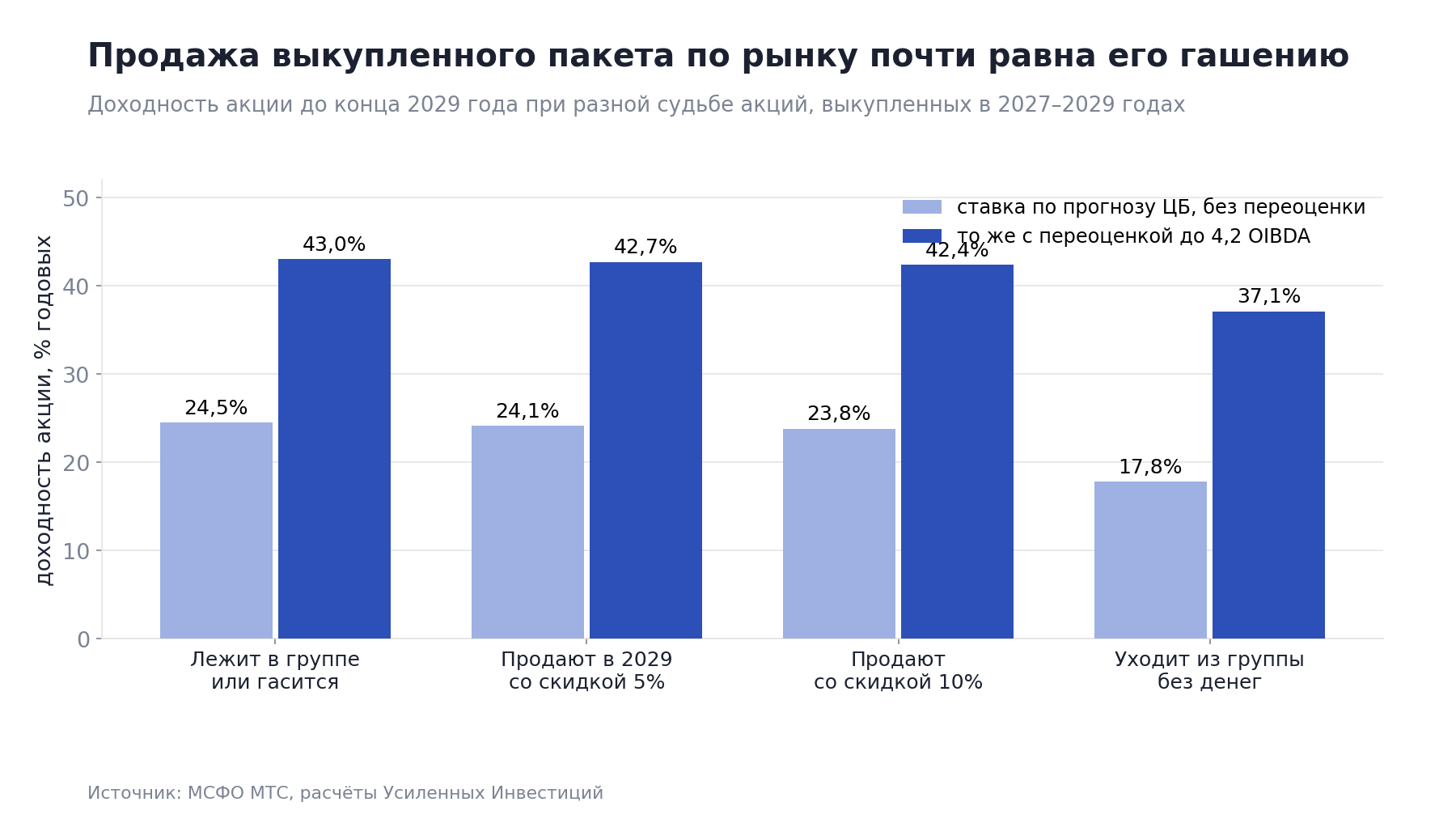
Now the repurchased block. A block bought in 2027-2029 for about RUB 67bn would, in the revaluation scenario, be worth about RUB 95bn by the end of 2029. The money will return to the company and reduce debt. A sale at a 5-10% discount to the market costs the shareholder only 0.3-0.7 percentage points of annual return, that is, it is almost equal to cancellation.
Otherwise the share's return is determined by the central bank rate more than by anything else. There are 1,669mn shares outside the group, RUB 292bn at the current price, while the value of the whole business with debt is about RUB 1tn. Shareholders own less than a third, so a shift in the EV/OIBDA multiple of 0.5x moves the share price by about 50%.
6. The news is negative, but MTS remains in the top group of the market by yield
Over the last 12 months MTS actually paid RUB 35, which is 20% of the current price. Under the new policy the annual payment will be RUB 24.5, that is 14% in cash plus about 6% in buyback. Only two payments out of three will fall into the next 12 months' cash, about RUB 20.5. Even without the buyback, this is at the level of the key rate and of Sber and the Moscow Exchange.
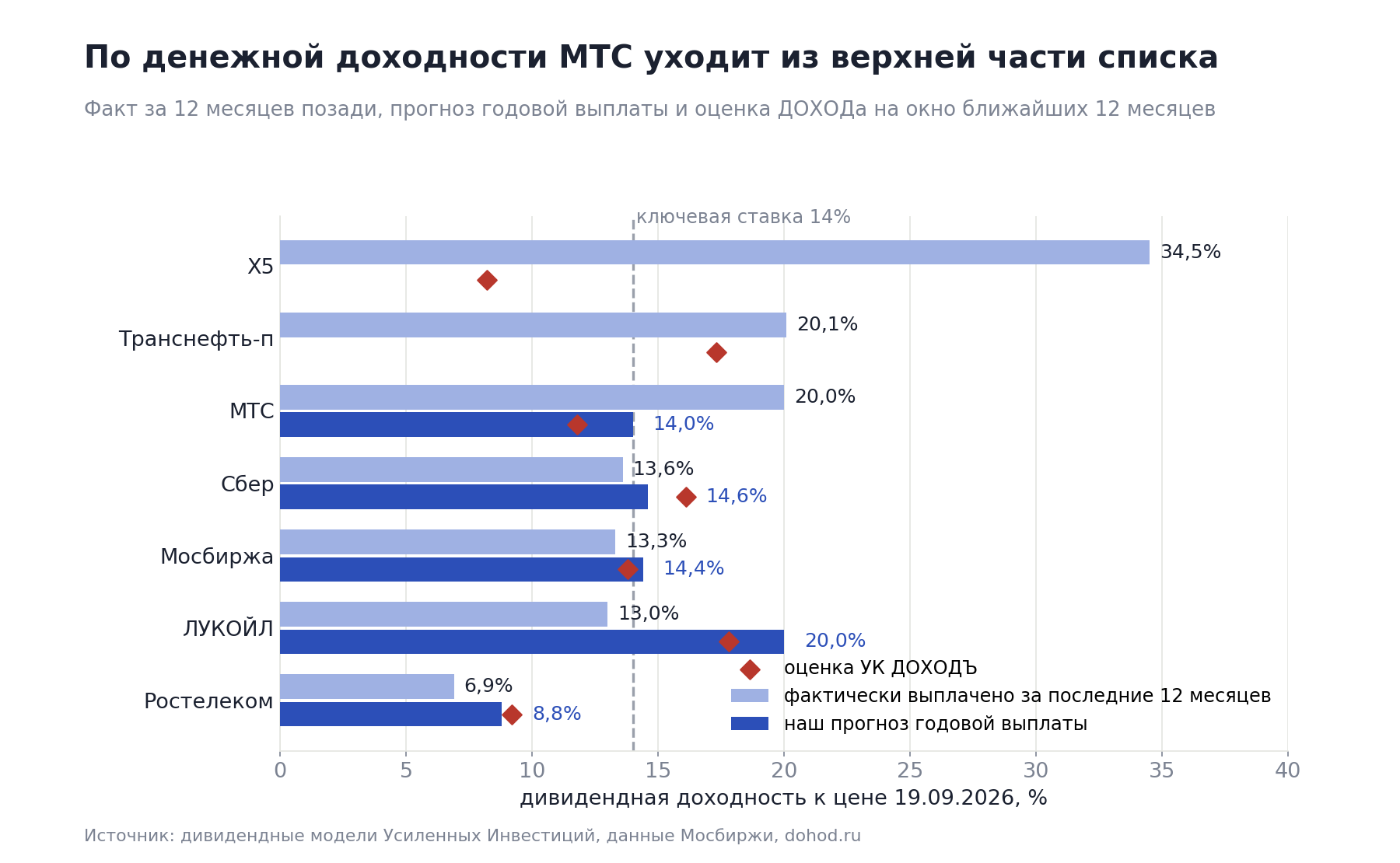
Cross-check against an independent source. Dividend forecasts easily diverge because of different assumptions, so we compared our figures with DOHOD estimates for the same date.
- For MTS the divergence is only apparent. DOHOD has RUB 20.52 and 11.8% for the next 12 months, we have RUB 24.5 and 14%. The difference is the window: with three payments a year, only two fall into the next 12 months, January and June, while the September one is already beyond the window. The sum of all three payments at DOHOD is RUB 24.59, exactly our RUB 24.5. There is no disagreement in substance.
- For the Moscow Exchange and Rostelecom the estimates agree within half a percentage point: 13.8% against our 14.4% and 9.2% against 8.8%.
- For Sber DOHOD is more optimistic: RUB 44.53 and 16.1% against our RUB 40.33 and 14.6%. The difference is in the forecast of the bank's profit; the payout formula is the same for both, half of profit.
- For Transneft DOHOD has RUB 175.28 and 17.3%, which falls exactly in the middle of our 16-20% range.
- For LUKOIL DOHOD has RUB 928 and 17.8% against our estimate of RUB 1,000-1,150 and 19-22%. Both figures are well above the actual for the last 12 months.
- For X5 DOHOD expects RUB 146 and 8.2% against 34.5% actual. This confirms that past payments were one-off.
Three caveats to this chart.
For LUKOIL the 12-month actual understates the future payout. The company pays twice a year and gives shareholders about 60% of free cash flow. The last 12 months include payments for the weak 2025, RUB 675 and 13%. The first half of 2026 was strong: profit of RUB 440bn against 90bn a year earlier, cash flow after investment of RUB 551bn against 325bn. If the second half is similar, the payout for 2026 will return to RUB 1,000-1,150, which is 19-22% of the current price, and the company has no net debt.
For X5 the actual includes a catch-up payment after the move to Russia, which is twice annual profit, so no repeat should be expected.
For Transneft the RUB 204.17 paid in July is 61% of reported profit against a formula of 50%. If the company returns to the formula, the next payment will give about 16%; if it repeats last year's approach, about 20%.
At Sber and the Moscow Exchange the dividend is covered by profit, at LUKOIL by cash flow with zero net debt. At MTS it relies on debt, but the share benefits from a falling rate more than the others. At Rostelecom, the closest business analogue, the yield is almost half as high at comparable leverage.
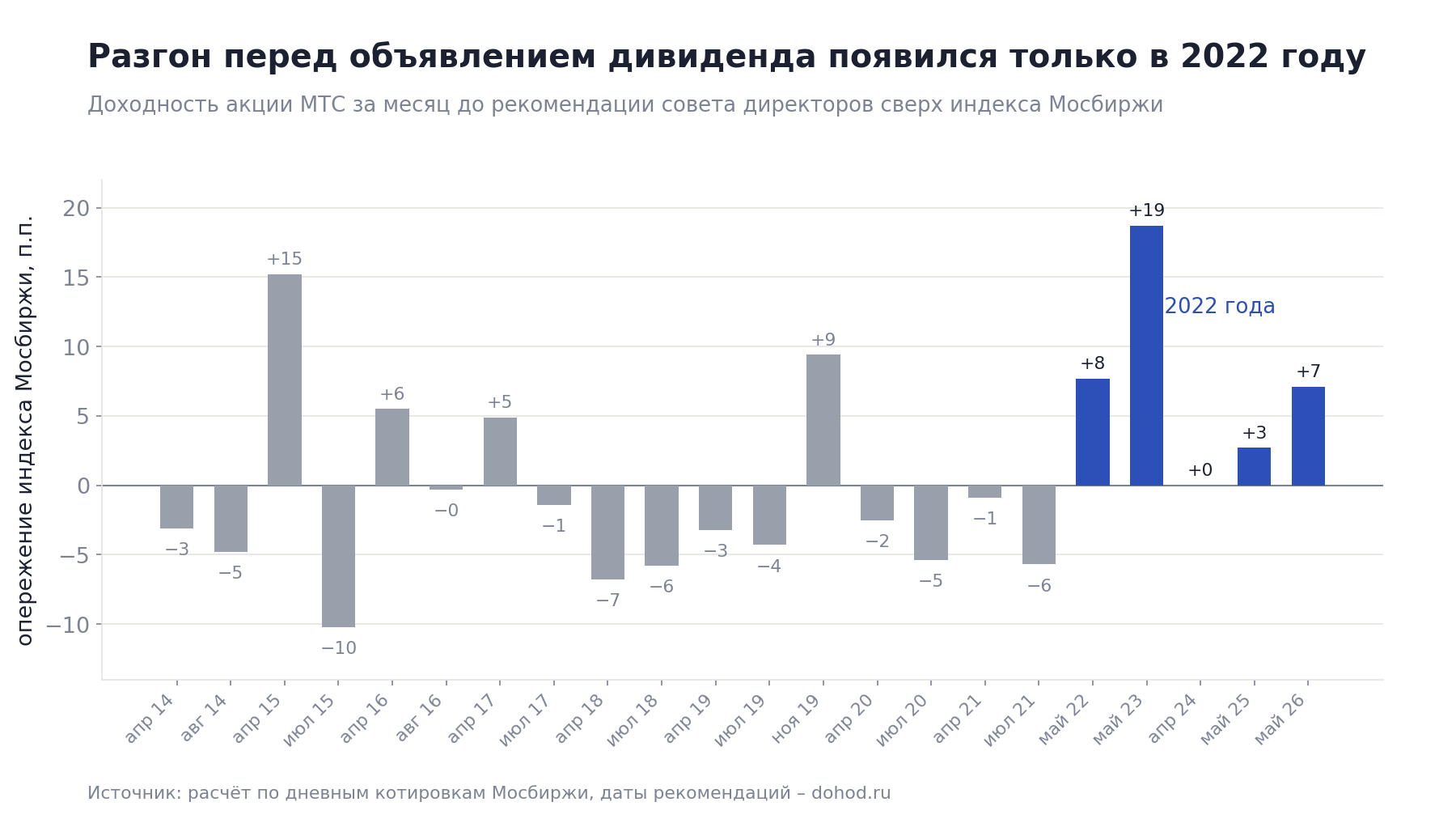
The next dividend will be announced as early as the end of November, together with the third-quarter report, and the money will arrive in January. MTS's chief financial officer confirmed that the January payment will be entirely a dividend, without a buyback, and the first buyback will accompany the payment in July 2027. The volume and procedure of each buyback will be approved by the board of directors separately. Right now some disappointed holders are leaving the stock and pressing on the price, and demand usually returns by the recommendation. We tested this on history: we took 22 dividend announcements since 2014 and calculated how the share behaved in the month before the recommendation relative to the Moscow Exchange index.
Summary
The attractiveness of MTS has declined slightly and uncertainty has increased. The shareholder receives 30% less cash, a third of the return has gone into a buyback, and the fate of the repurchased block is not described. If the company said it would sell the block within two to three years as conditions recover and return the money to the business, the buyback would read as a deferred dividend. We hope clearer disclosure on the block will appear.
At the same time nothing has broken. The business is growing at double-digit rates, leverage is falling for the second year in a row, from 2028 the dividend may start growing again if the board pays above the floor, and by yield the stock remains in the top group of the market. If the rate falls as the Bank of Russia forecasts, the share yields about 24% a year, and about 40% on a re-rating to the three-year average multiple. MTS remains a moderately attractive asset, but it is now a story not about a fixed coupon but about falling rates and company discipline.
What to watch:
- the recommendation of the first payment at the end of November together with the third-quarter report;
- any disclosure about the fate of the repurchased block: a named timeline for sale or cancellation removes the main uncertainty;
- the third-quarter report: whether the RUB 21.7bn for the tower company has arrived, whether the RUB 35.9bn repo is closed, and how much MTS lent to AFK Sistema;
- Bank of Russia rate decisions: each percentage point costs MTS up to RUB 7bn of interest a year as floating debt reprices.
All figures on MTS, the model and the reporting are on the company card.
See also: market overview · valuation map · stock screeners