M.Video: revenue down 36.8%, EBITDA up 145.6% – what drives the divergence and what it means for debt
25 августа М.Видео раскрыла результаты за первое полугодие 2026 года: выручка сократилась на 36,8% год к году, до 261,7 млрд руб., при этом EBITDA выросла на 145,6%, а маржа по EBITDA расширилась с 3,0% до 11,8%. В обзоре разберём, за счёт чего произошёл такой разрыв, как он соотносится с денежными потоками и долгом, и почему мультипликаторы выглядят экстремально.
Key takeaways
— Revenue for the half-year fell 36.8% – the steepest decline in recent years, not offset by price increases
— EBITDA rose 145.6% due to a sharp reduction in operating expenses, not higher sales
— EBITDA margin doubled from 3.0% to 11.8% – but this is the result of aggressive cost-cutting, not improved demand
— Operating cash flow over the last twelve months is negative – minus RUB 58.2 bn, questioning the quality of earnings
— Net debt increased by RUB 49 bn over the year to RUB 206.4 bn, and the Net Debt/EBITDA LTM ratio stands at 65.6 – a level at which debt servicing is problematic
— EV/EBITDA LTM is 68.2 – the market values the company extremely expensively relative to current cash flows
— No dividends have been paid or are expected, which, given a fair yield of 12%, means no return for shareholders
Key figures, RUB bn
| Metric | H1 2025 | H1 2026 | Change |
|---|---|---|---|
| Revenue | 171 | 108 | -36.8% |
| EBITDA | 5.19 | 12.8 | +145.6% |
| Operating profit | -7.56 | — | — |
| Net profit | -25.2 | — | — |
| Operating cash flow | -27.4 | 5.29 | to profit |
| Capex | 2.66 | 2.90 | +8.9% |
| EBITDA margin | 3.0% | 11.8% | +8.8 pp |
| Net margin | -14.7% | — | — |
Revenue for the half-year fell 36.8% – the steepest decline in recent years, not offset by price increases
In the first half of 2026, M.Video's revenue amounted to RUB 261.7 bn, down 36.8% year-on-year. This is a dramatic decline that cannot be explained solely by weaker consumer demand – rather, the company is losing market share amid competition and changing shopping habits.
A decline of this magnitude means that even with rising electronics prices (inflation in the segment was notable), physical sales volumes fell even more. For a retailer with a high share of fixed costs, this is a double blow: contribution margin shrinks while rent and personnel costs remain.
EBITDA rose 145.6% due to a sharp reduction in operating expenses, not higher sales
EBITDA for the first half of 2026 increased by 145.6% year-on-year. Given that revenue fell by a third, such growth is only possible through drastic cost reduction – likely the company cut marketing budgets, optimized staff, and renegotiated lease terms.
This is a classic 'squeeze' story: when revenue declines and costs are cut even faster, operating profit can grow. But such growth is unrelated to the health of the business – it is one-off and cannot continue indefinitely, as the base for cost reduction is limited.
EBITDA margin doubled from 3.0% to 11.8% – but this is the result of aggressive cost-cutting, not improved demand
EBITDA margin for the first half of 2026 was 11.8% versus 3.0% a year earlier. Formally, this is an impressive jump, but it was achieved against falling revenue, indicating the one-off nature of the improvement.
If demand were recovering, we would see revenue growth and possibly less pronounced margin expansion. Here, the margin rose because the company cut costs faster than sales fell. The question is how sustainable such a margin is: with further revenue declines, maintaining it would require new cuts that are already impossible without losing service quality.
Operating cash flow over the last twelve months is negative – minus RUB 58.2 bn, questioning the quality of earnings
Over the last twelve months, M.Video's operating cash flow was minus RUB 58.2 bn. This means the company spends more cash on its current operations than it receives from them. Given this dynamic, EBITDA, which for the same period was RUB 3.1 bn, looks more like an accounting construct than a real source of funds.
Negative operating cash flow is a worrying signal: it indicates that the company is financing its activities through debt or asset sales. For a retailer, this is especially dangerous as it requires constant replenishment of working capital.
Net debt increased by RUB 49 bn over the year to RUB 206.4 bn, and the Net Debt/EBITDA LTM ratio stands at 65.6 – a level at which debt servicing is problematic
Net debt at the latest reporting date was RUB 206.4 bn, up RUB 49 bn over the year and RUB 2 bn over the last six months. Rising debt amid falling revenue and negative operating cash flow means the company is increasingly dependent on borrowed financing.
The Net Debt/EBITDA LTM ratio of 65.6 is extreme. Even if EBITDA remains at current levels, it would take decades to repay the debt. Interest expenses on such debt likely consume a significant portion of operating profit, making the business vulnerable to rate increases.
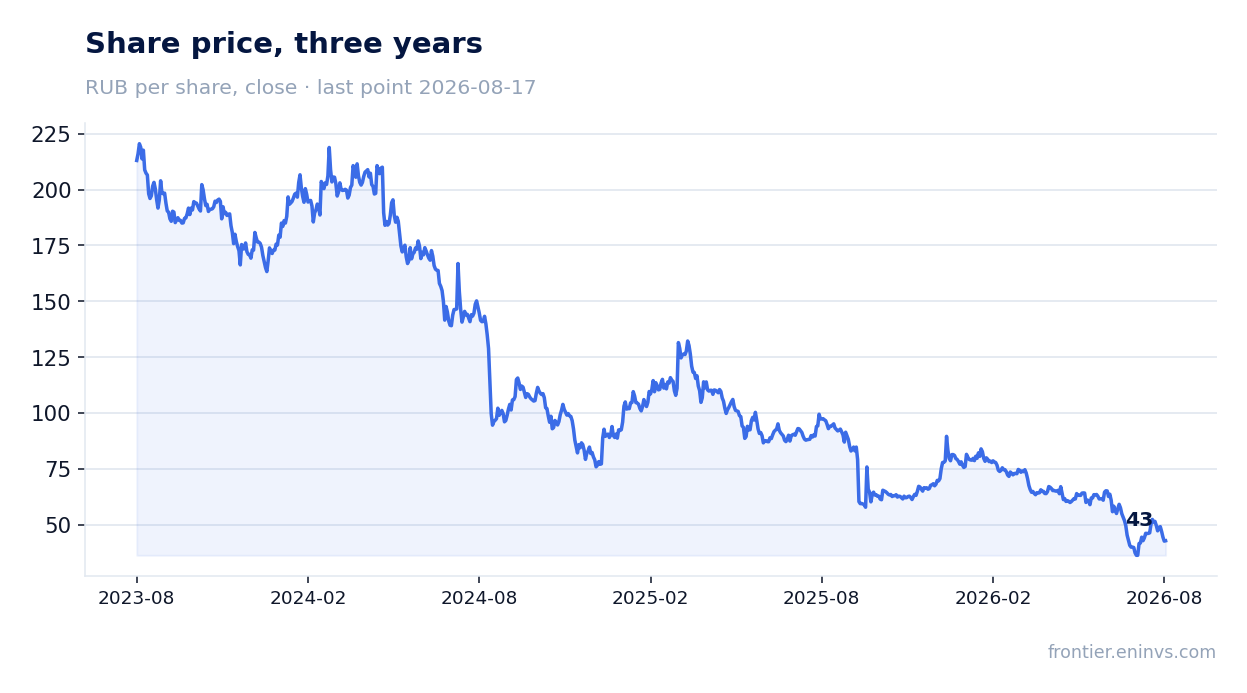
EV/EBITDA LTM is 68.2 – the market values the company extremely expensively relative to current cash flows
EV/EBITDA LTM is 68.2 – a very high valuation, especially for a retailer with falling revenue and huge debt. Such a figure may reflect investor expectations that EBITDA will recover to previous levels, but given current trends, this is unlikely.
For comparison, the historical EV/EBITDA range for M.Video was typically within 5–10. The current multiple of 68.2 is an anomaly that either indicates a bubble or that the market is pricing in a future recovery that is not yet confirmed by operating metrics.
No dividends have been paid or are expected, which, given a fair yield of 12%, means no return for shareholders
Over the last twelve months, the company has not paid dividends, and our model estimates the next payment at RUB 0.0 per share. Given a fair yield of 12%, this means shareholders receive no cash flow from holding the stock.
The absence of dividends given such debt and negative operating cash flow is understandable: all available funds go to debt servicing. But for investors, this means the return on the stock depends solely on price changes, which is extremely risky at current valuations.
Valuation on the latest reported figures
| Metric | Value |
|---|---|
| Market cap | 8.37 bn ₽ |
| EV/EBITDA (LTM) | 68.2 |
| Net debt / EBITDA (LTM) | 65.56 |
| Operating cash flow (LTM) | -58.2 bn |
| ROE | 168.8% |
Bottom line
Bottom line: M.Video showed formally strong EBITDA and margin growth, but this growth is driven by cost cuts, not business improvement. Revenue is falling 36.8%, operating cash flow is negative, debt has risen to RUB 206.4 bn, and the Net Debt/EBITDA ratio has reached 65.6 – an unsustainable level. The real question for shareholders is whether the company can stabilize revenue and generate positive cash flow, or whether current EBITDA is just a temporary phenomenon before a new round of problems. So far, there is no answer, and multiples (EV/EBITDA 68.2) leave no margin of safety.
Open the company's financial profile MVID →
See also: market overview · valuation map · stock screeners