Polyplast: a strong business, debt-funded construction and RUB 132bn of short-term debt – why the market pays 19-25% on an A rating
Polyplast is Russia's largest producer of concrete additives and specialty chemicals. It has 17 bond issues outstanding in rubles, yuan and US dollars totalling RUB 49bn, rated A(RU) by ACRA and A.ru by NCR. With the key rate at 14%, the ruble issues yield 19-25% simple, and the foreign-currency issues mostly 18-24% in dollars and yuan, twice what reliable foreign-currency bonds pay. The market already prices the company not as an A but as a borrower one or two notches lower, and we consider that premium justified. The business is real and profitable. Revenue grew 3.6 times in two years, and the EBITDA margin is 29%. But the growth was paid for with debt. Free cash flow has been negative for the third year in a row, interest including capitalized interest takes about RUB 50bn a year against EBITDA of RUB 69bn, and at 30.06.2026 the company had RUB 132bn of debt due within a year against RUB 2.5bn of cash. The construction is real, but its cost cannot be verified from the financial statements, and a general contractor registered at the group's site is, according to the registry, linked to one of its managers. In our spot model, at the current rate the company is left with between minus RUB 11bn and plus RUB 6bn a year after interest and capex. One interesting detail: the foreign-currency issues were sold hardest, and they now yield as much as the ruble ones, although for other issuers foreign-currency paper yields 6-12 pp less. We see no signs of default. Banks are opening new credit lines in 2026, and in September the market provided money in both rubles and yuan. The short issues maturing before spring 2027 are a bet that refinancing will continue; we are not buying the long 2028-2029 issues now.
The issuer card on the portal, with financials by period, our credit analysis and all issues: Polyplast. Below are the calculations of Enhanced Investments based on the issuer's IFRS and RAS statements, the MOEX payment schedule and disclosures; where a figure is the authors' estimate, it is marked as such.
What the company is: 70% of the concrete additives market and chromium production in Pervouralsk
Fact (ACRA, 31.07.2026). Polyplast has about 70% of the Russian market for plasticizer additives for concrete and about a quarter of global naphthalene sulfonate output. The group has 8 plants and 4 research centers; its largest site is Novomoskovsk (about 41% of shipments), and its own raw material (naphthalene) covers at least half of its needs.
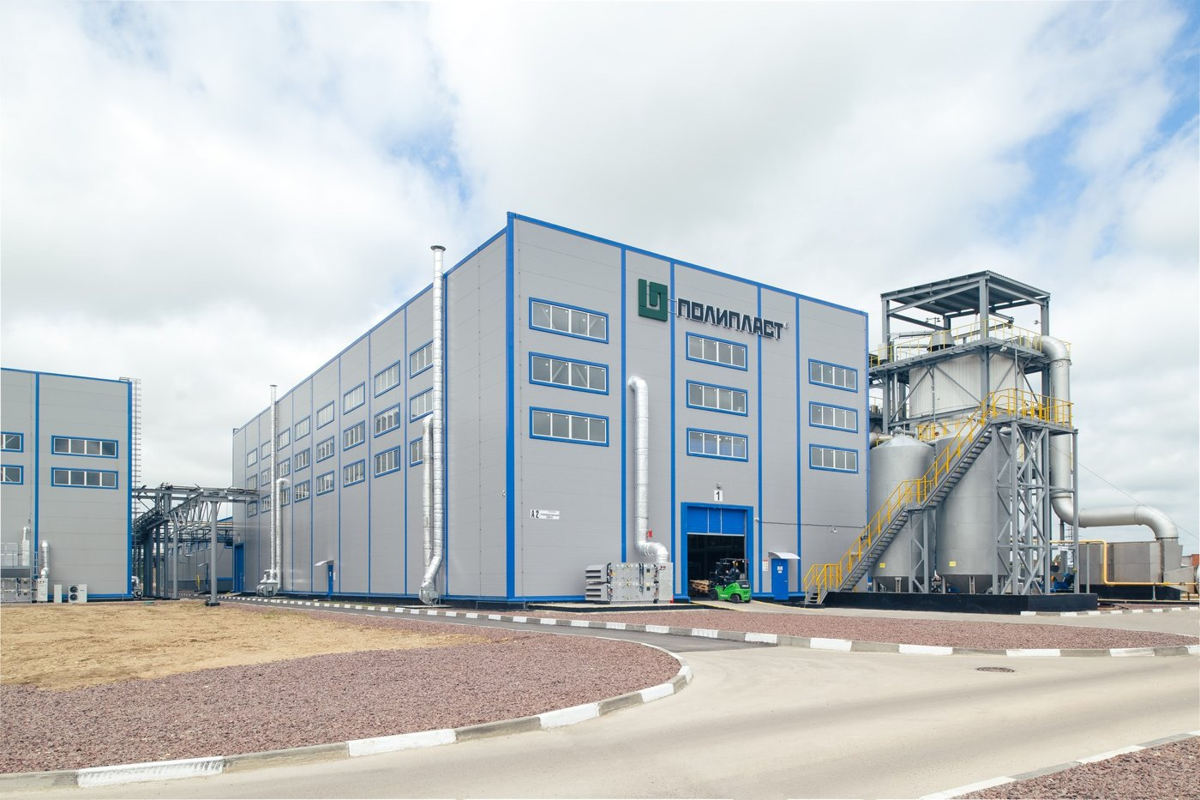
Fact (IFRS). In September 2023 the group bought Khrompik in Pervouralsk (formerly Russky Khrom 1915) for RUB 12.65bn. This is the only large acquisition; the other deals (a sanatorium in Crimea, Promtech, Matur) are small and non-core.
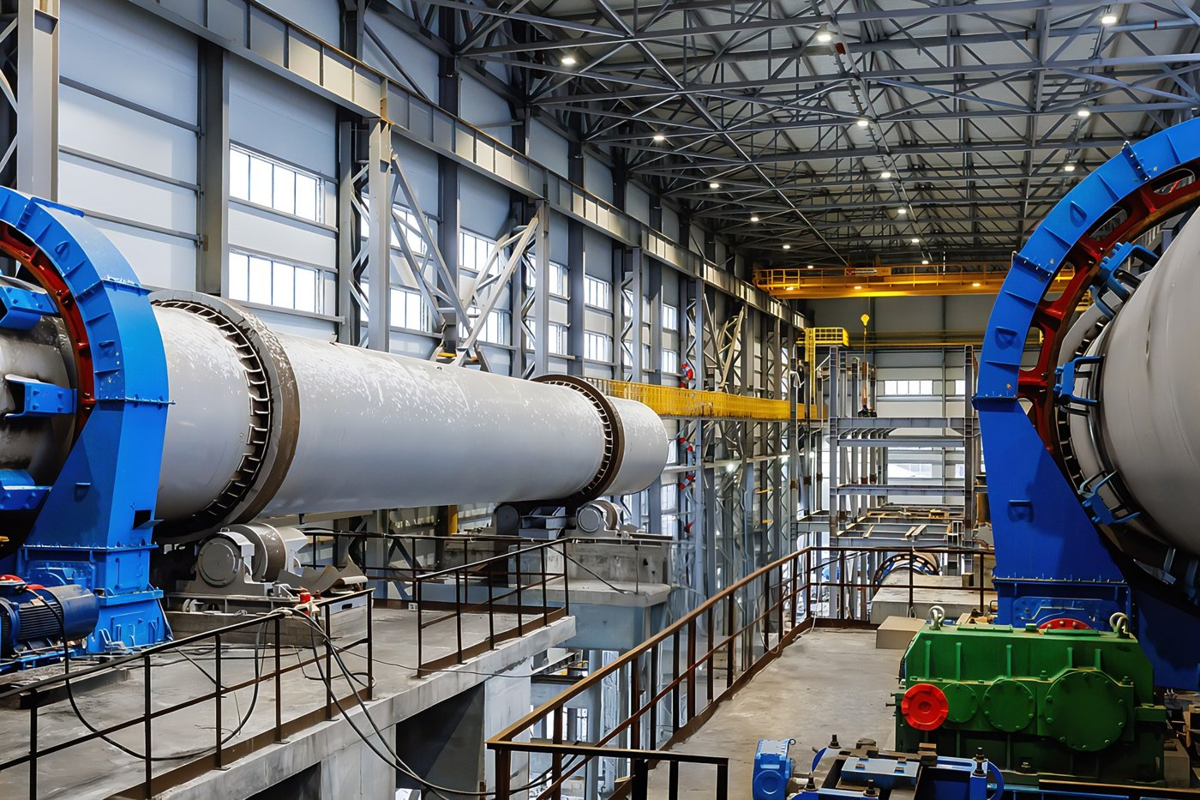
What this means for an investor. This is not a financial shell or a developer with a single project. The company has market share, raw materials and exports. The question is not whether the business exists, but how much debt it can service.
Growth is organic and profitable: revenue of RUB 65bn to 236bn in two years at a 26-29% margin
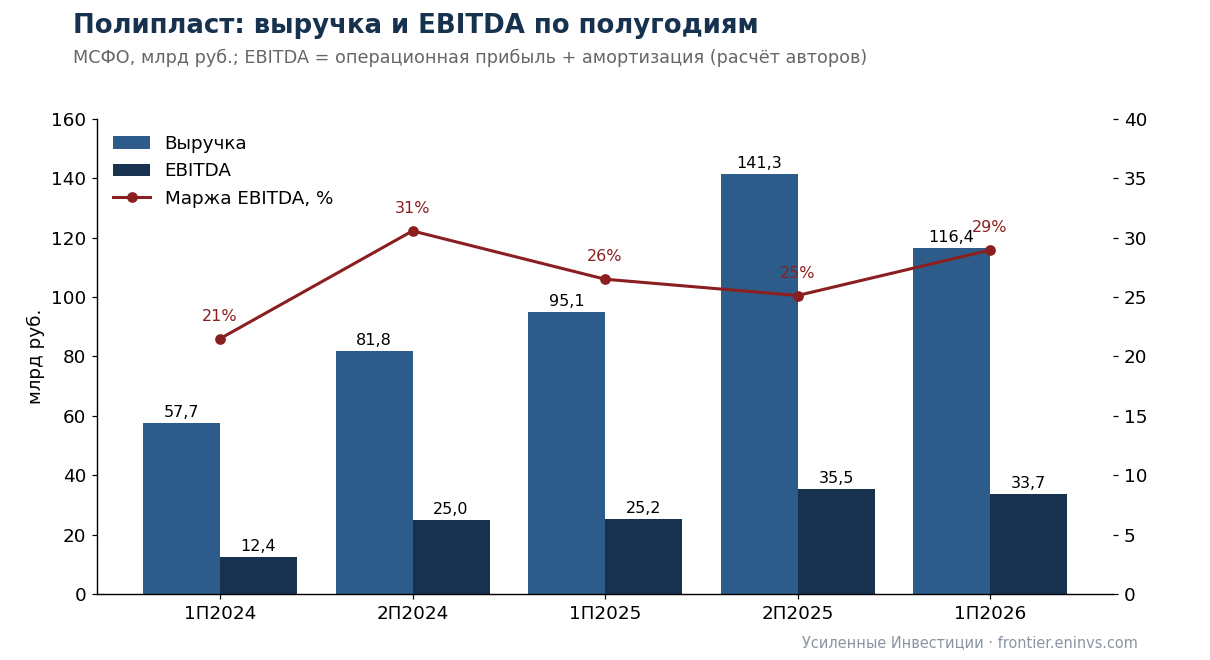
Fact (IFRS). Revenue grew from RUB 64.8bn in 2023 to RUB 139.5bn in 2024 and RUB 236.4bn in 2025; in 1H2026 it was RUB 116.4bn (+22% y/y), EBITDA RUB 33.7bn, margin 29%, net profit RUB 11.2bn. Volumes drove the growth. Plasticizers 30.7 -> 54.2 -> 116.1bn, specialty additives 14.5 -> 47.7 -> 76.4bn, chromium compounds 1.7 -> 7.0 -> 18.1bn. Sales grew most in the Urals-Siberia region, where revenue rose from RUB 27.2bn to RUB 82.8bn in 2025.
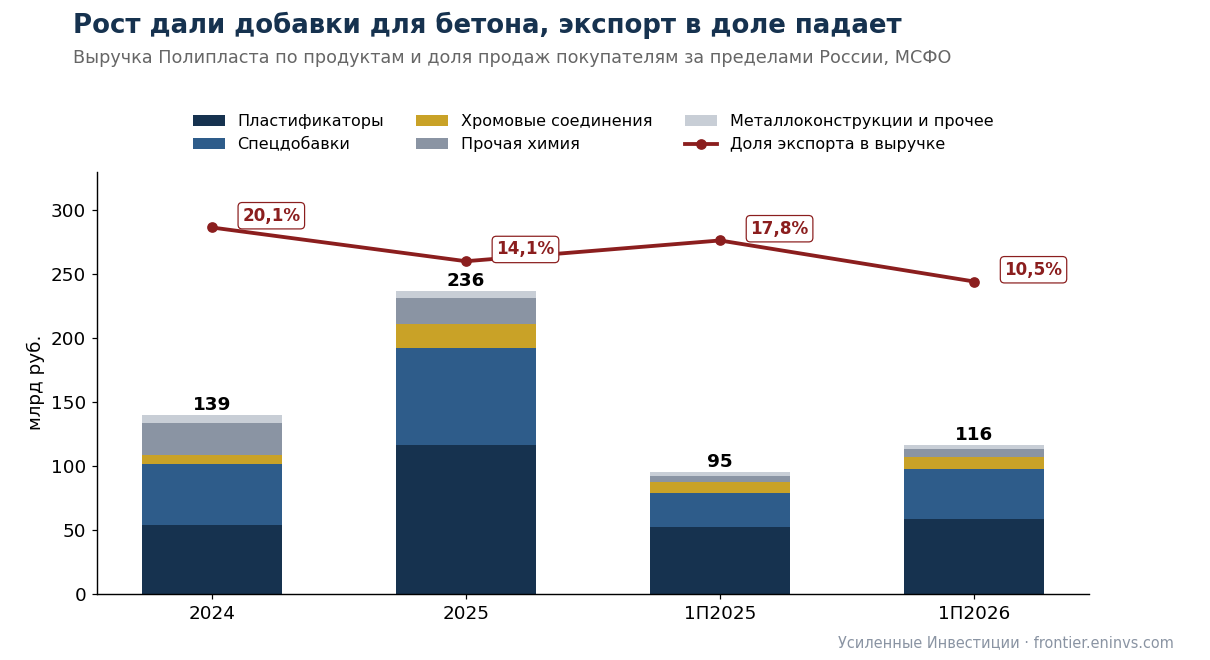
What raises questions. First. The growth runs against the industry: cement consumption in 1H2026 fell 12% y/y (Soyuzcement) and housing completions fell 15% (Rosstat). Second. The export share. ACRA cites more than 20% of revenue, NCR 36% in 2025, while under IFRS disclosure the share of customers outside Russia is falling: 20.1% in 2024, 14.1% in 2025, 10.5% in 1H2026. Authors' assumption: part of the exports goes through Russian intermediaries and is recorded as domestic sales. Third. Advances paid to related parties rose from RUB 0.3bn to RUB 10.0bn over the half-year, and of the RUB 27.9bn of customer advances at the end of 2025, RUB 14.4bn came from related parties.
Cash: construction and interest have taken more than the business generates for three years
Fact (IFRS). Operating cash flow after tax was RUB 22.6bn in 2024, RUB 46.8bn in 2025 and RUB 18.5bn in 1H2026. Capex over the same periods was RUB 48.4bn / 81.3bn / 17.1bn, and interest paid RUB 20.7bn / 43.7bn / 24.7bn. Construction in progress together with advances to contractors and construction materials at 30.06.2026 was RUB 219bn out of RUB 265bn of property, plant and equipment, that is, 83% of fixed assets have not yet been put into operation.
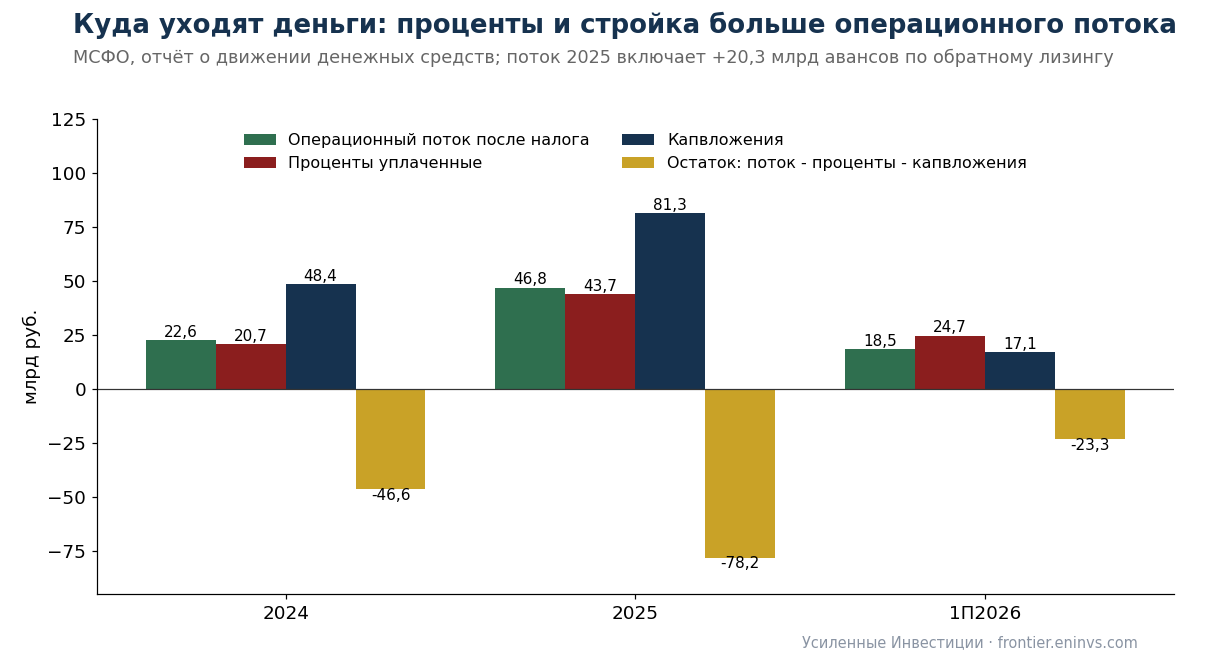
Authors' estimate. Cash flow minus interest minus capex: -RUB 46.6bn in 2024, -78.2bn in 2025, -23.3bn in 1H2026, about -RUB 148bn over two and a half years. The 2025 cash flow is also overstated. RUB 20.3bn arrived as advances on the sale of equipment with leaseback, essentially a loan that the statements show within operating cash flow.
What is changing. The company cut the remaining investment program from RUB 97.2bn (through 2030) to RUB 15.5bn for 2026-2027, and ACRA expects positive free cash flow from 2026. We tested whether that is enough with the spot model below: at the current rate, between minus RUB 11bn and plus RUB 6bn a year is left after interest and capex.
The construction is real, but its cost cannot be verified from the financial statements
Fact (company and regional news). What is being built: in Novomoskovsk, a plant for high-molecular polymers with a capacity of 130 thousand t a year for RUB 20bn (stages launched in August 2024 and November 2025) and a polymer binder for thermal insulation of 60 thousand t (launched in April 2026). In Pervouralsk, the modernization of Khrompik for more than RUB 60bn (under an agreement with the region, RUB 70bn through 2030; as of 1 June 2026 the energy center was more than 70% complete, with completion in 2027) and the Polyplast-UralSib epoxy resin plant of 55 thousand t for RUB 12.5bn (so far only a pilot unit is running). At SPIEF-2025 the group signed another polymer agreement with the Tula region for about RUB 70bn, with no capacity disclosed. The launches were held publicly, with governors present, and headcount at Khrompik rose by two thirds.
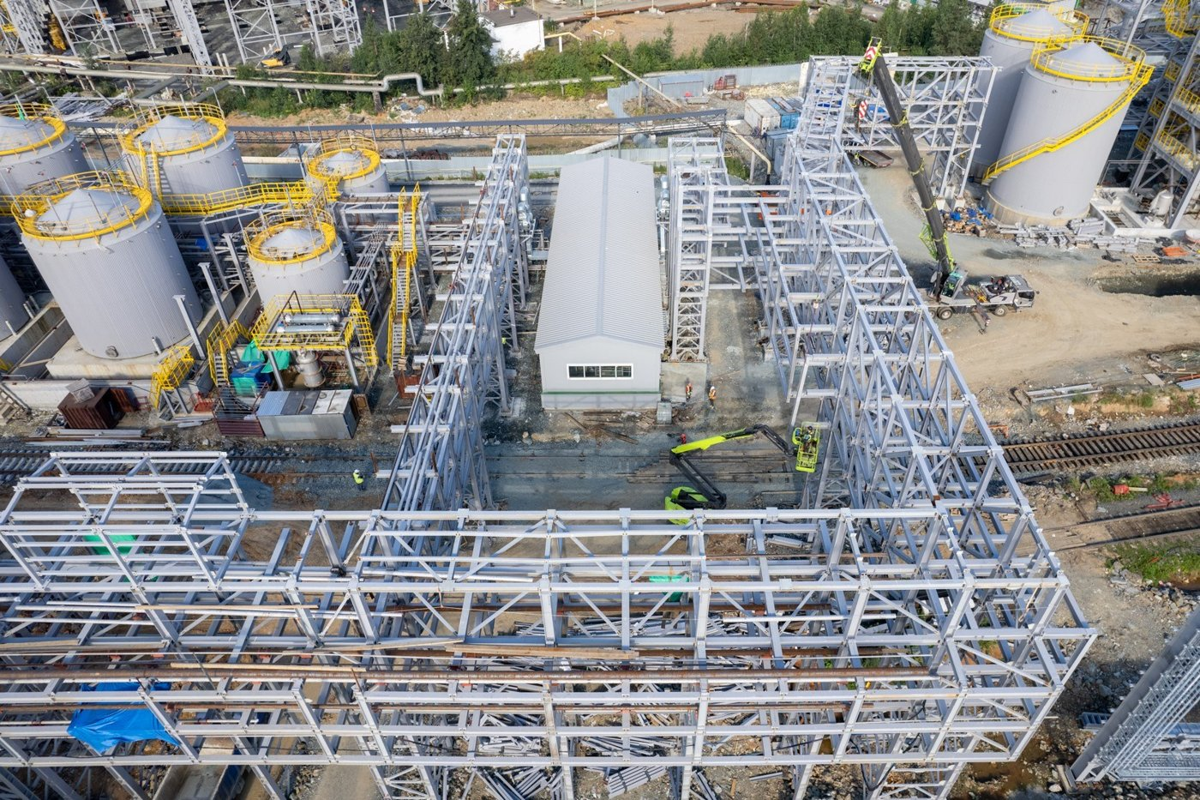
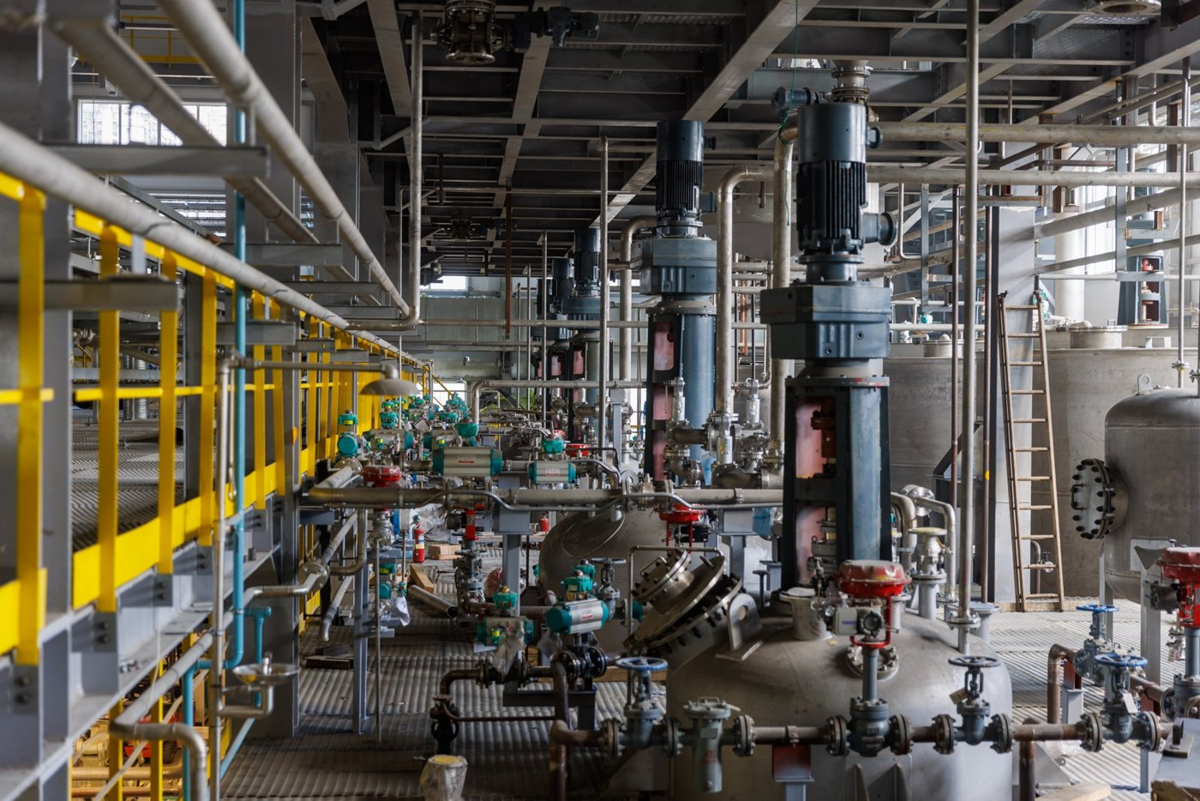
Fact (IFRS). Construction in progress together with advances to contractors and construction materials rose from RUB 21bn in 2023 to RUB 219bn at 30.06.2026 (of which construction proper was RUB 148.5bn at the end of 2025). About RUB 11bn has been transferred to working fixed assets over this time: RUB 1.8bn in 2023, 1.1bn in 2024, 7.6bn in 2025 and no more than RUB 1bn in 1H2026. The statements contain no list of projects with amounts. Fixed assets are carried at historical cost, with no revaluation.
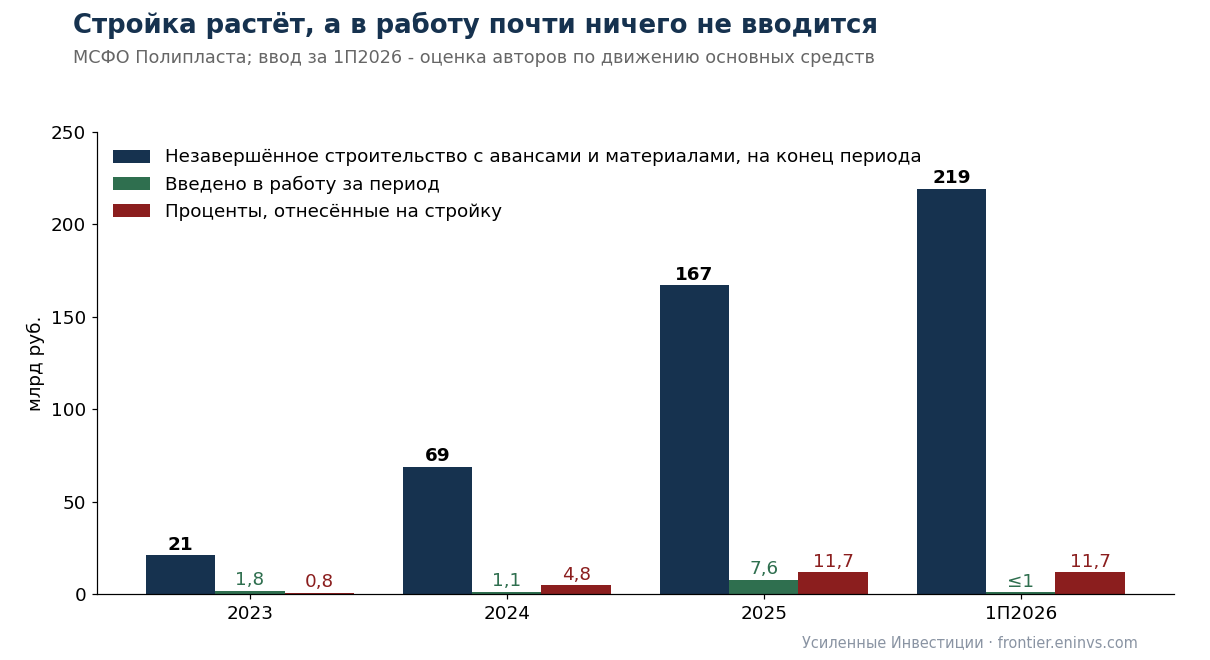
Why this matters to a creditor (authors' estimate). While a facility is recorded as under construction, no depreciation is charged on it, and interest on construction loans goes into the cost of the asset rather than into expenses. In 1H2026, RUB 11.7bn was treated this way, half of all interest. Had it gone through the income statement, pre-tax profit for the half-year would have fallen from RUB 15.3bn to RUB 3.5bn. Four facilities have been launched publicly, yet almost nothing has been transferred into operation in the statements. Either the facilities are not yet ready, or profit is overstated by the deferral of interest and depreciation. This cannot be told apart from public data.
Scale (authors' estimate). RUB 60-70bn is being spent on Khrompik against RUB 18.1bn of revenue in the chromium segment in 2025, which is 3.5-4 years of revenue for the entire division. The polymers in Novomoskovsk cost about RUB 154 thousand per tonne of capacity, while the group's own polycarboxylates in Kingisepp in 2022 cost about RUB 20 thousand per tonne. These are different products and the comparison shows only an order of magnitude, but the difference is noticeable. The announced projects add up to roughly RUB 165-175bn, of which about RUB 70bn is an agreement with no disclosed capacity.
Fact (Unified State Register of Legal Entities via checko.ru; minutes of the public hearings of the Pervouralsk administration of 08.10.2025). OOO Spetskhimstroy (INN 7116160060) was registered in 2020 at the address of the group's site in Novomoskovsk; its main activity is customer-developer and general contractor. It acted as the contractor for the environmental assessment of the Polyplast-UralSib epoxy plant. Spetskhimstroy's revenue was RUB 1.7bn in 2023, RUB 4.4bn in 2024 and RUB 16.4bn in 2025, with net profit of RUB 3mn and equity of RUB 35mn. The owners are the director V. Yu. Tabakov (51%) and M. Yu. Ilyin (49%). Ilyin is the general director of OOO Promtekhnopark, which is 99.99995% owned by AO Polyplast, and of OOO Orgsintez, owned by I. Z. Shamsutdinov (50.5%), A. F. Kovalev (7.4%) and Polyplast Novomoskovsk (42.1%). In the IFRS statements only shareholders are named as related parties; Spetskhimstroy is not mentioned.
What follows from this. We found no evidence of money being siphoned out through the construction. Direct purchases of fixed assets from related parties are small (RUB 4.3bn in 2025, about 4% of additions), capitalized interest reconciles with interest paid, and a contractor with a 0.02% margin does not accumulate profit itself. But what the completed assets actually cost cannot be checked from public data. The statements do not disclose the projects, almost nothing is being put into operation, and a general contractor registered at the group's site is, according to the registry, linked to its manager and is not disclosed as a related party. For a bondholder this is not grounds for accusations but grounds to demand a premium for opacity. It is reasonable to put the question about Spetskhimstroy to the company directly.
Other dealings with related parties (fact, IFRS). An advance to shareholders personally for fixed assets of RUB 3.27bn, unchanged since the end of 2025. Charitable donations to related parties of RUB 7.35bn over 2023-1H2026. An office building sold to a related party for RUB 3.2bn on deferred payment. Advances received from related parties of RUB 14.4bn at the end of 2025. The company explains the growth in advances by leaseback deals but does not name the lessors.
Debt doubled in a year and a half; interest coverage including capitalized interest is 1.4x
Fact (IFRS). Loans and bonds rose from RUB 138bn at the end of 2024 to RUB 235bn at the end of 2025 and RUB 278bn at 30.06.2026, plus RUB 14.1bn of leases and RUB 15.9bn of reverse factoring. In rubles RUB 228.6bn, yuan 36.3bn, dollars 12.8bn. Bonds and digital financial assets are about RUB 53bn, the rest is bank debt. At the end of 2025, 71% of debt carried a floating rate.
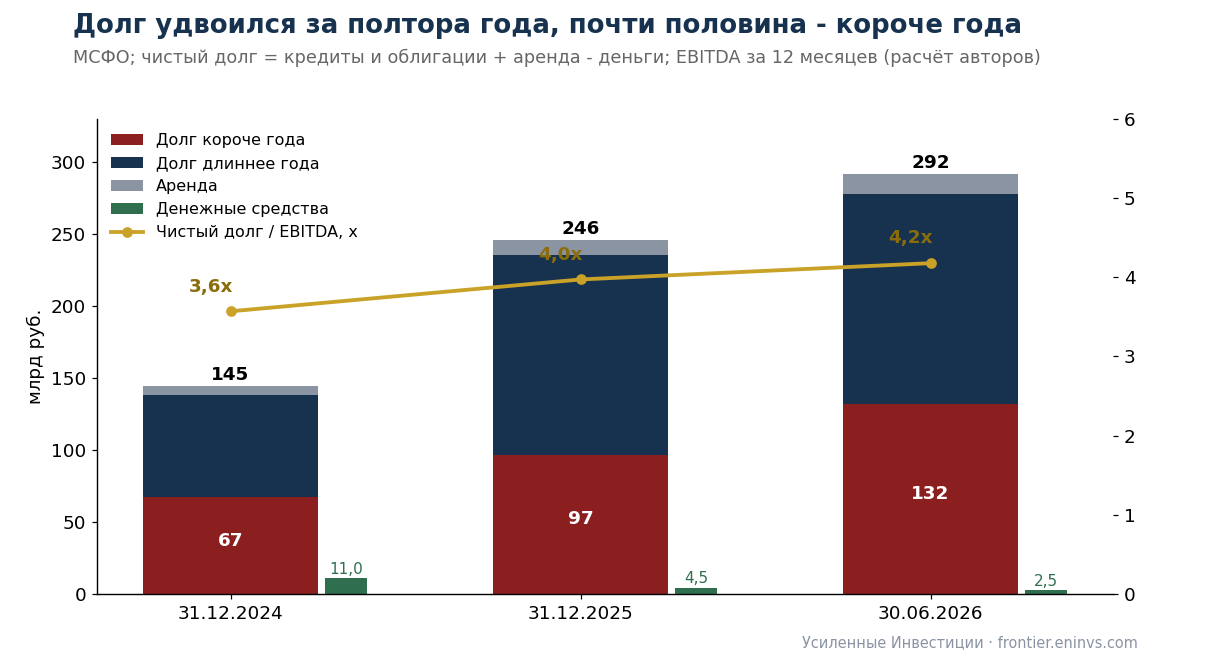
Authors' estimate. Net debt (loans, bonds and leases minus cash) is RUB 289bn, which is 4.2x 12-month EBITDA of RUB 69.3bn (4.4x with reverse factoring; 3.6x a year earlier). In the income statement interest coverage looks decent, at about 2.1x, but it excludes the interest the company assigns to the cost of construction: RUB 11.8bn for 2025 and another RUB 11.8bn for the first half of 2026 alone. Total interest for 12 months is RUB 49.8bn, EBITDA coverage 1.4x; on interest paid (RUB 48.0bn) it is also 1.4x.
Sensitivity to the rate (authors' estimate). With 71% of debt floating, each percentage point of the key rate is about RUB 2bn of interest a year. A cut in the rate from 14% to 10% would add about RUB 8bn a year to cash flow, the main external factor in favor of holders.
Spot model: at the current rate almost no cash is left after interest
How we calculated (authors' estimate). We take IFRS for the 12 months to 30.06.2026: revenue RUB 257.7bn, of which exports RUB 28.6bn, cash costs RUB 180.9bn (raw materials 156.2, staff 13.4, transport 4.7, energy 2.3, other 4.3), and other net operating expenses of RUB 7.5bn. We convert exports at today's rate of RUB 84.2/$ instead of the 78.5 period average. All costs are indexed by 6.3%, August y/y inflation. Interest is calculated on current debt: RUB 278bn of loans and bonds, RUB 14.1bn of leases, RUB 15.9bn of reverse factoring and RUB 4.6bn of revaluation of foreign-currency debt at today's rate. The rate is the actual 1H2026 rate (18.3% a year including capitalized interest), reduced on the floating part by the difference between the current 14% key rate and the 15.1% half-year average. Capex is RUB 10bn a year, the remainder of the RUB 15.5bn program for 2026-2027.
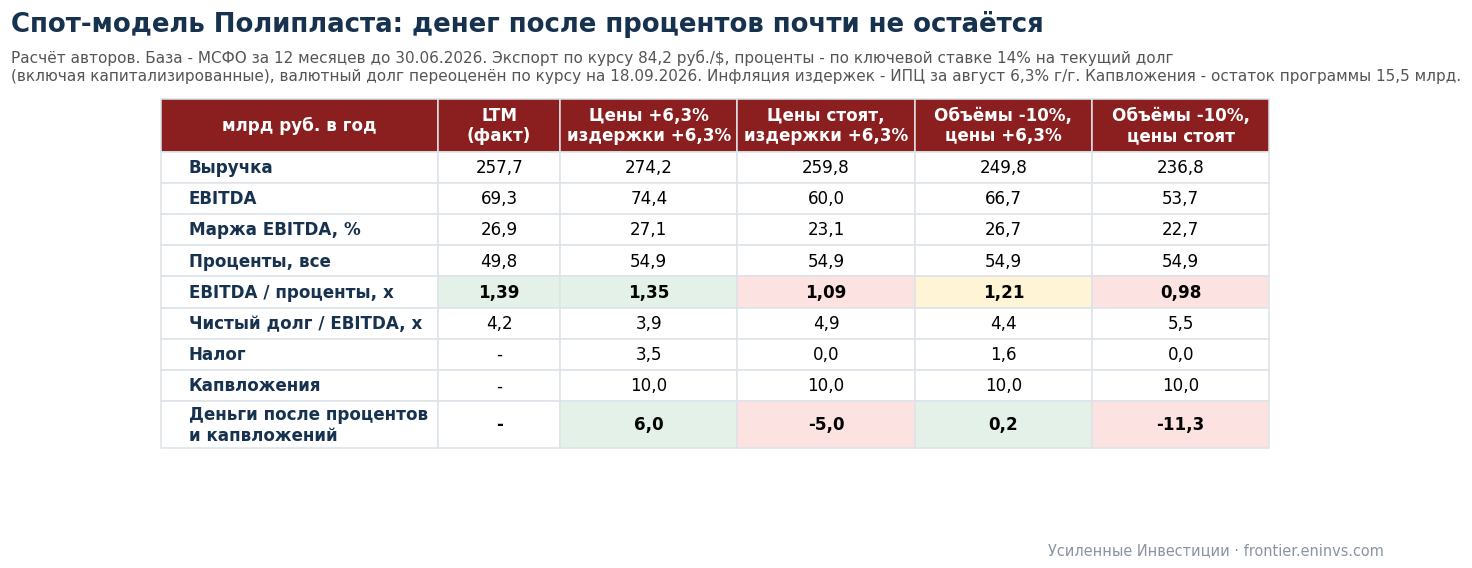
Result. Interest on current debt is about RUB 55bn a year, more than the RUB 49.8bn of the last 12 months: the decline in the rate is not keeping pace with the growth in debt. If the company passes cost inflation into prices, EBITDA rises to RUB 74bn, interest coverage stays at about 1.35x, and about RUB 6bn a year is left after interest and capex. If prices do not rise, EBITDA falls to RUB 60bn, coverage to 1.1x, and the company is short by about RUB 5bn a year. With a 10% fall in volumes and unchanged prices, coverage drops to 0.98x, below 1.0x. ACRA names FFO interest coverage below 1.0x as a condition for a downgrade; our measure is calculated from EBITDA and is slightly higher, but close in meaning.
The rate. With 71% of debt floating, a cut in the key rate to 12% reduces interest to RUB 51bn, and to 10% to RUB 47bn. In the best combination (prices indexed, rate at 10%), about RUB 12bn a year is left after interest and capex. That is enough for debt to stop growing, but not to repay RUB 132bn of short-term debt: it will still have to be rolled over.
Limitations of the model. The company does not disclose physical volumes and prices by product, so the scenarios are built on total revenue. Changes in working capital are not included: at present suppliers are also financing the construction (accounts payable rose from RUB 17bn to RUB 68bn in a year and a half), and if they demand payment, there will be less cash. New facilities are not included either: if the launched capacity adds revenue beyond indexation, the result will be better.
Liquidity: RUB 132bn of debt due within a year against RUB 2.5bn of cash, and the company itself writes of a shortfall
Fact (IFRS 1H2026). Short-term debt is RUB 131.7bn, cash RUB 2.45bn, and undrawn credit lines RUB 5.3bn. Current assets are RUB 170bn against RUB 262bn of current liabilities. In the notes the company directly writes of negative working capital and a "planned liquidity shortfall" through 2027, which is closed by refinancing. Covenants on loans were met at the reporting date. Fixed assets of RUB 55.3bn and stakes in 8 subsidiaries are pledged to banks.
Fact (e-disclosure). Banks continue to lend: in March 2026 Roseximbank opened revolving lines for Khrompik and Polyplast Novomoskovsk, and on 24.07.2026 Gazprombank opened a line for Khrompik, backed by guarantees from AO Polyplast and its subsidiaries; on 14 and 16 September the board of directors approved changes to the terms of these lines. The bond market is also open: in May, P02-BO-16 was placed for RUB 5bn at 17.45%, on 9 September P02-BO-17 for RUB 1.4bn at 17.75%, and on 17 September an additional placement of the yuan P02-BO-10 at 99.5% of par was announced.
What this means for an investor. The liquidity shortfall is planned and is closed not by operating cash but by extending loans. As long as banks keep extending, the bonds are repaid. The company has no cushion of its own, so any pause in lending immediately becomes a problem for bondholders, and the collateral stays with the banks.
Bonds: about RUB 39bn of payments in 12 months, with a peak of RUB 30bn from January to May 2027
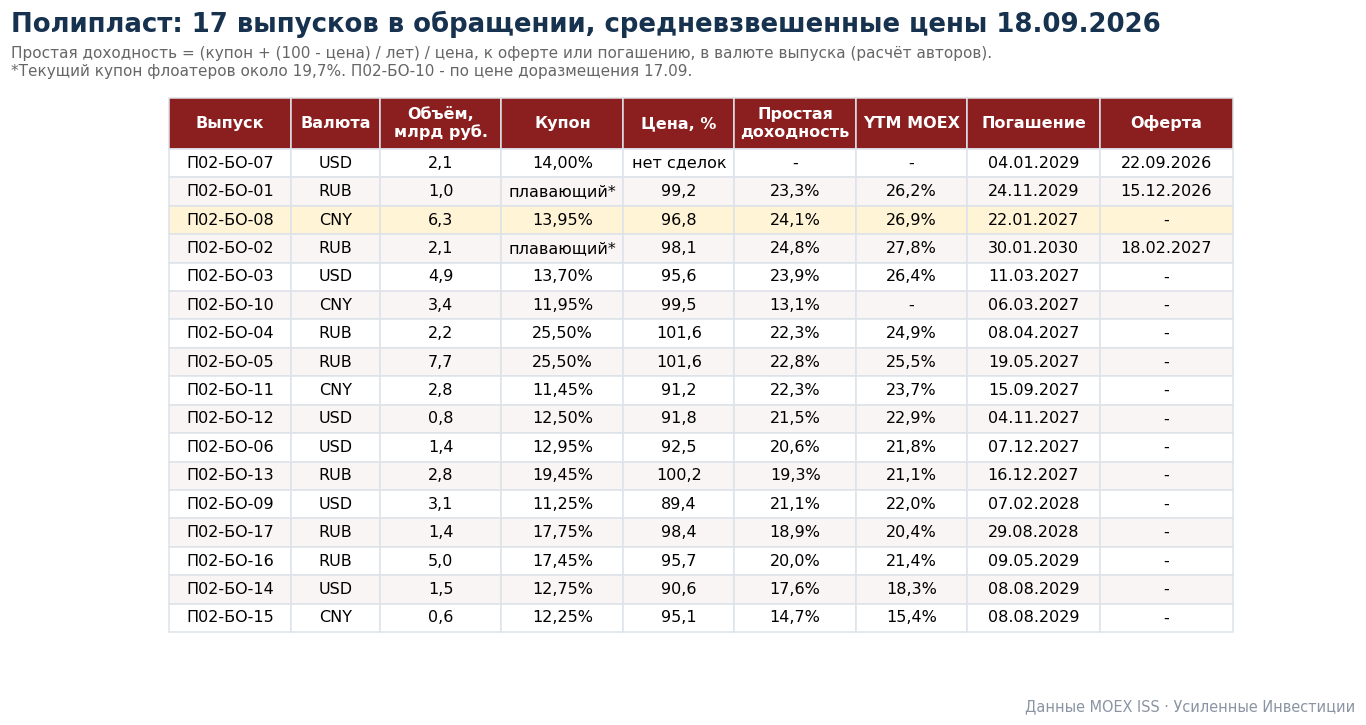
Authors' estimate based on the MOEX schedule. Counting coupons, redemptions and put offers, the upper estimate for 12 months comes to about RUB 39bn. Most of it falls in January-May 2027. On 22.01, P02-BO-08 for CNY 500mn (RUB 6.3bn); in March P02-BO-03 for $58mn (RUB 4.9bn) and P02-BO-10 for CNY 270mn (RUB 3.4bn, plus the volume of the additional placement); in April P02-BO-04 for RUB 2.25bn; on 19 May P02-BO-05 for RUB 7.7bn. Put offers: P02-BO-07 on 22 September (up to $25mn), P02-BO-01 on 15 December (RUB 1bn), P02-BO-02 on 18 February (RUB 2.1bn).
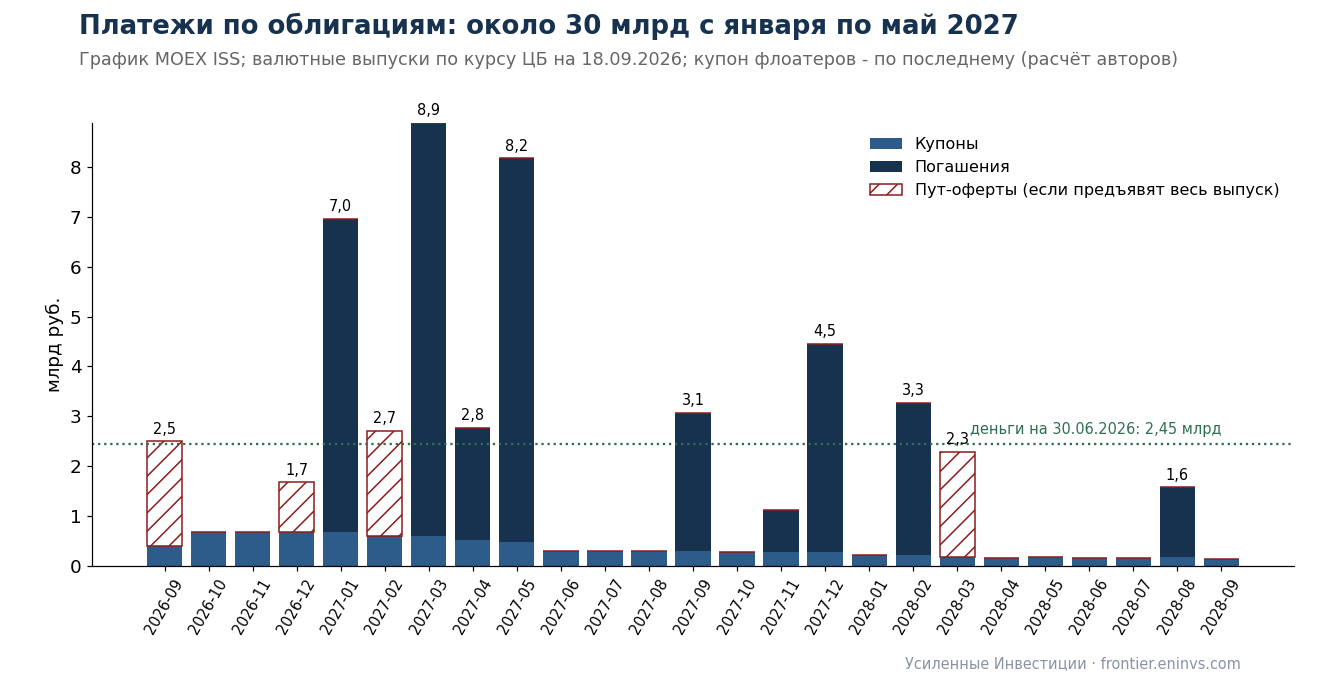
What this means. Bonds are about 16% of debt; the main refinancing is the RUB 132bn of short-term bank debt, and the spring 2027 bond peak is small against it. Foreign-currency issues carry an additional risk. Repayment in yuan and dollars costs less when the ruble is strong, but if the ruble weakens the burden grows, and export revenue, judging by IFRS, covers a shrinking share.
Market: on 17-18 September the bonds fell together with the whole A segment, with no news from the issuer
Fact (MOEX). Over two days P02-BO-16 fell from 99.9 to 95.7% of par, and P02-BO-05 from 105.3 to 101.6% (close of 16.09 against the weighted average price of 18.09). The index of corporate bonds rated A fell 1.5% on 17 September and another 2.2% on 18 September, the BBB and high-yield indices by about 1% and 2%, while AA-rated paper and OFZ were unchanged. The Bank of Russia kept the key rate at 14% on 11 September. There were no negative Polyplast disclosures on those days: on 17 September the application period for the P02-BO-07 offer ended and an additional placement of P02-BO-10 was announced. Versions from forums about a blogger's post and a fund selling are not supported by anything. A caveat: Polyplast is a prominent issuer in the A segment, so the index may partly reflect its own bonds.
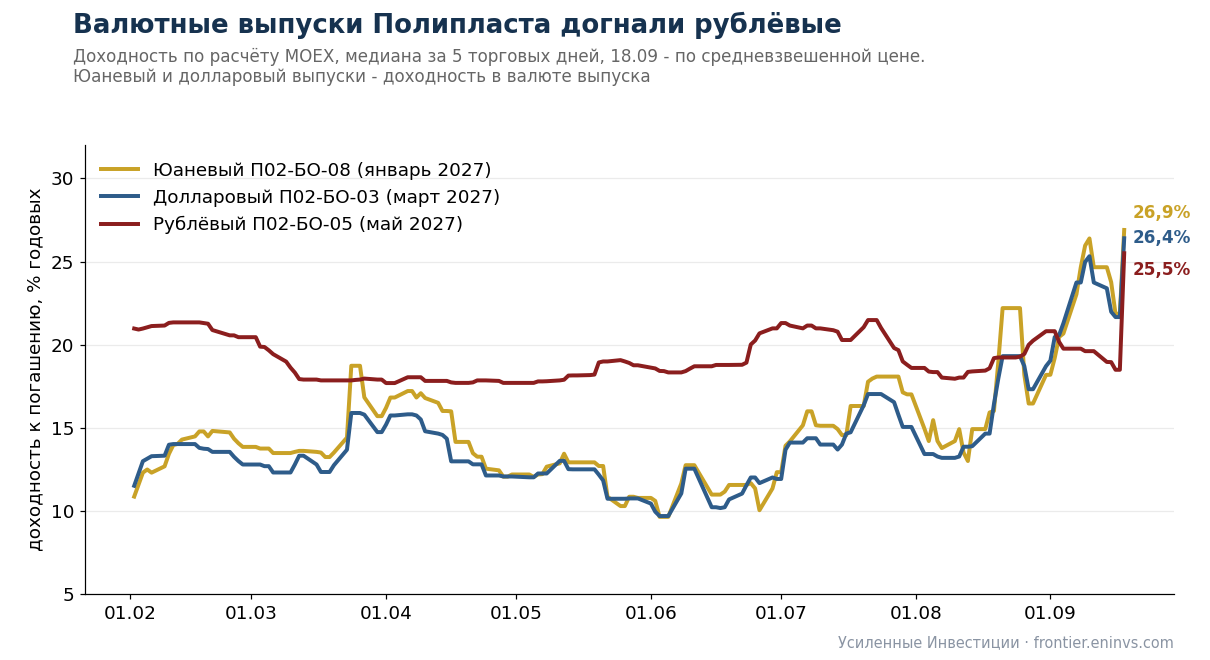
Finding: foreign-currency issues were the first to suffer in the sell-off
Authors' estimate. The ruble issues yield 19-25% simple, which is 5-11 pp above the key rate. The foreign-currency ones yield 18-24% in dollars and yuan, the same as the ruble ones, although an issuer's foreign-currency debt usually yields 6-12 pp less than its ruble debt. This is an anomaly, and we double-checked it.
Fact (MOEX, 18.09.2026). Liquid foreign-currency bonds of reliable issuers (Sibur, PhosAgro, Gazprom Capital, Polyus, Norilsk Nickel) yield 8-10% in dollars and yuan. Segezha's yuan issues yield 18-24%, but its ruble issues yield 30-37%, that is, rubles are 6-12 pp more expensive than yuan, as they should be. Polyplast has no such gap: the yuan P02-BO-08 yields 25.4%, the dollar P02-BO-03 25.7%, and the ruble P02-BO-05 with a similar maturity 25.1% (the figures match on MOEX, Smart-Lab and our portal eninvs.com). Back in March Polyplast's foreign-currency issues yielded about 12% against 18-20% on the ruble ones; on 16 September about 20% against 18%. The gap closed and reversed over the summer.
Authors' assumption. The default risk of an issuer's ruble and foreign-currency issues is the same, so such a gap is a question not of credit quality but of who holds the bonds. In our assumption, the foreign-currency issues are held mainly by retail investors for the sake of currency yield, and in a sell-off they fall further. For someone who accepts Polyplast's credit risk, the foreign-currency issues now pay more for it than the ruble ones.
Ratings, audit, taxes and courts
- ACRA, 31.07.2026: A(RU), outlook stable. Debt to FFO 4.0x (weighted average for 2023-2028), FFO to interest above 1.7x, and the agency assesses free cash flow as very weak. A downgrade is possible if debt/FFO exceeds 5.0x or FFO interest coverage falls below 1.0x.
- NCR, 10.11.2025: upgrade from A-.ru to A.ru, outlook stable.
- Audit: OOO Rusaudit gave a qualified opinion on the 2025 IFRS statements and a qualified conclusion on the 1H2026 review. The qualification is technical (issues with an offer within a year, RUB 2.96bn and then RUB 5.04bn, are shown as long-term debt), but it is atypical for an A-rated issuer.
- Taxes: according to open Federal Tax Service data as of 25.08.2026, AO Polyplast's arrears are RUB 0.1mn (insurance contributions and VAT); on 01.07.2026 they were RUB 16.2mn. Against RUB 50bn of interest a year the amount is negligible, and we do not treat it as a flag.
- Courts: the former Italian co-owners of Khrompik are suing in the Sverdlovsk Region Arbitration Court for recognition of a foreign judgment (Interfax, 10.07.2025); we have not checked the outcome. We were unable to check the group's full arbitration case file.
Risks
- Refinancing. With RUB 2.5bn of cash and RUB 5.3bn of free lines, everything rests on the willingness of banks to extend loans.
- Rate. 71% of debt is floating; if the cuts in the key rate stop, the interest burden will stay at about RUB 50bn a year.
- Demand. Construction is contracting: cement consumption -12% in 1H2026, housing completions -15% over seven months. For now Polyplast's revenue is growing despite the market, but with interest coverage at 1.4x there is little room for error.
- Quality of cash flow. Part of operating cash flow is leaseback advances and settlements with related parties; without them free cash flow is worse than reported.
- Opacity of the construction. RUB 219bn of construction in progress with no list of projects, almost zero transfers into operation, and a contractor linked to a group manager and not disclosed as a related party.
- Priority. Banks hold the collateral. Authors' assumption: under stress, bondholders will queue behind secured creditors.
Conclusion: the short issues are a bet on loan extensions; we are not taking the long ones yet
Polyplast is a real and profitable business with a market share that no one else in the industry has. The problem is not operations but the financial structure. Construction of RUB 219bn has been financed with short-term debt, and for three years the company has lived on refinancing. The construction itself is real, but its cost cannot be verified from the statements, and the spot model shows that even after it ends, cash after interest remains only if prices are indexed. The A ratings rest on the forecast that construction has ended and cash flow will turn positive. The market does not yet believe that forecast and demands 19-25% in rubles and 18-24% in foreign currency.
What we are doing. The yuan P02-BO-08 maturing on 22.01.2027 is in the bond strategy on our portal. We hold it because it is four months to maturity, the simple yield is about 24% in yuan, and the risk over such a horizon is not the sustainability of the debt over years but the extension of money for the coming months. In addition, for the same credit risk the foreign-currency issue now pays as much as the ruble one while protecting against a weaker ruble. The signals here are so far good. In September the company raised both rubles and yuan, and banks signed new lines. The long 2028-2029 issues are a bet that the construction has really ended, and we will test that against the 2026 report.
What to watch next: how many bonds are tendered to the P02-BO-07 offer on 22 September; the Bank of Russia rate decision on 23 October; extension of the bank lines for Khrompik and Novomoskovsk; in the 2026 report, capex no higher than the declared RUB 15.5bn for two years and positive cash flow after interest.
Sources and caveats
- Consolidated IFRS of AO Polyplast for 2024 and 2025 (auditor OOO Rusaudit) and interim IFRS for 1H2026, from the Enhanced Investments reporting archive. Revenue, EBITDA, cash flow, debt, interest, debt structure by currency, advances, related parties.
- Issuer disclosures on e-disclosure from July to 18.09.2026: guarantees on the Roseximbank and Gazprombank lines, placements of P02-BO-16 and P02-BO-17, additional placement of P02-BO-10, the P02-BO-07 offer.
- ACRA press release of 31.07.2026; NCR press release of 10.11.2025.
- Issue terms, schedule of coupons, redemptions and offers, quotes as of 18.09.2026, corporate bond indices: MOEX ISS. Exchange rates: Bank of Russia as of 18.09.2026.
- Industry data: Soyuzcement via RIA Novosti (cement consumption, 1H2026), Rosstat (housing completions, January-July 2026). Taxes: open Federal Tax Service data as of 25.08.2026. Khrompik court case: Interfax, 10.07.2025.
- Projects: polyplast-un.ru, Interfax (21.04.2026), Kommersant (07.06.2024), URA.ru (01.06.2026), mashnews (24.11.2025), rupec (17.07.2024), Vedomosti St. Petersburg (27.05.2022). Contractor: Unified State Register of Legal Entities via checko.ru, minutes of the Pervouralsk administration's EIA public hearing of 08.10.2025.
- Photos: press service of the Polyplast group (polyplast-un.ru); Tatyana Yankova, CC BY-SA 3.0, Wikimedia Commons.
- The company does not disclose its own definition of EBITDA; here it is operating profit plus depreciation. Net debt, interest coverage, cash flow after interest and the ruble calendar are the authors' estimates.
Reviews of other issuers and weekly analytics are in the Telegram channel Enhanced Investments @eninv, and extended cards of all issuers are on the portal.
See also: market overview · valuation map · stock screeners