Rusagro: revenue up 9.1% but profit all but vanished on biological asset revaluation
On 28 August Rusagro reported results for the first half of 2026. Revenue rose 9.1% year on year to RUB 183.0 bn, but adjusted EBITDA fell 28.6% to RUB 13.8 bn, and net profit collapsed 98.8% to RUB 55.9 mn. The culprit is a sharp drop in the gain from revaluation of biological assets and agricultural produce, which contributed RUB 8.9 bn a year earlier but only RUB 3.0 bn now. At the current price the shares look attractive for holders of the dividend story: the trailing yield of 24.2% is well above the 22.5% we consider fair for this name, while the LTM EV/EBITDA multiple of 4.7x is only slightly above its own three-year average of 4.4x.
Key takeaways
— Revenue rose 9.1% but profit all but vanished on biological asset revaluation
— EBITDA fell 28.6% even as revenue grew: margin compressed from 11.5% to 7.5%
— Net profit of RUB 55.9 mn is 0.0% of revenue, with interest expense absorbing the result
— A 24.2% dividend yield against a 14.0% key rate is the main argument for the stock
— Net debt at 3.15x LTM EBITDA is a level that limits room for manoeuvre
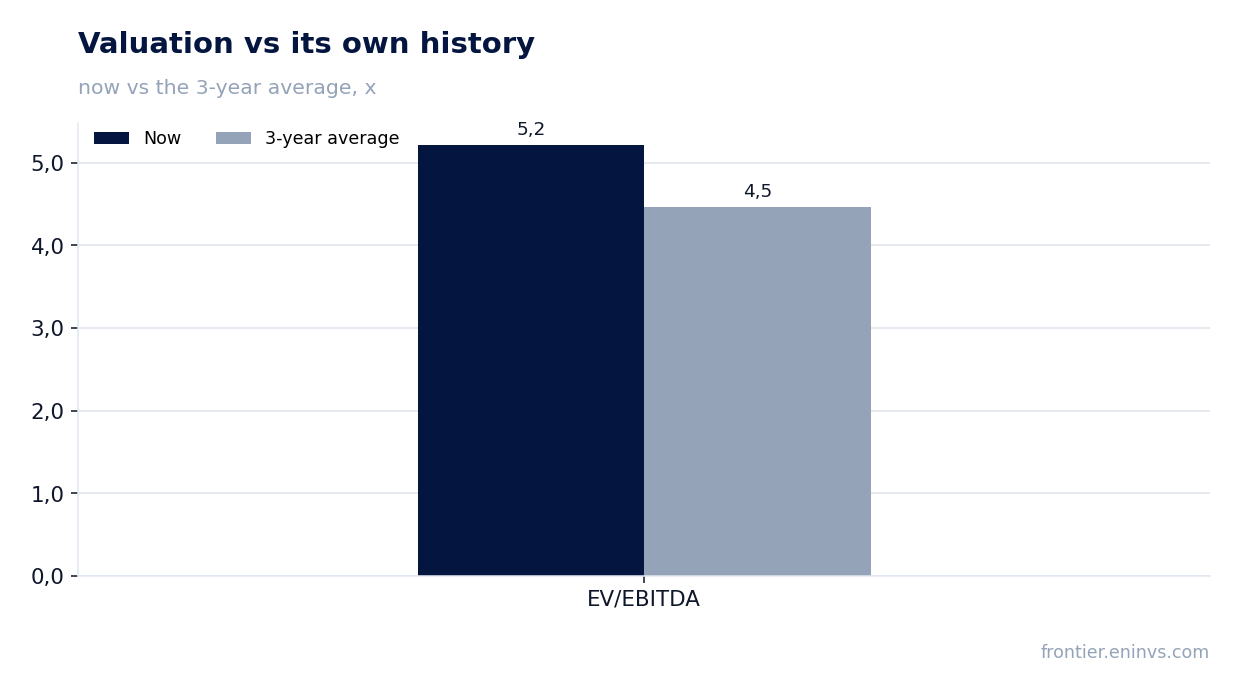
— EV/EBITDA LTM of 4.7x versus its own three-year average of 4.4x – valuation slightly above history
Attractiveness
Key figures, RUB bn
| Metric | H1 2025 | H1 2026 | Change |
|---|---|---|---|
| Revenue | 168 | 183 | +9.1% |
| EBITDA | 19.3 | 13.8 | -28.6% |
| Operating profit | 11.1 | 6.89 | -38.2% |
| Net profit | 4.83 | 0.06 | -98.8% |
| Operating cash flow | 4.24 | 32.9 | +675.1% |
| Capex | 14.1 | 8.24 | -41.4% |
| EBITDA margin | 11.5% | 7.5% | -4.0 pp |
| Net margin | 2.9% | 0.0% | -2.9 pp |
Revenue rose 9.1% but profit all but vanished on biological asset revaluation
Revenue for the first half of 2026 came in at RUB 183.0 bn, up 9.1% year on year. Growth was driven by all key segments, but the oil and fats division and agriculture contributed the most. Net profit, however, collapsed 98.8% to RUB 55.9 mn, which against revenue of RUB 183 bn implies a near-zero margin.
The main reason for the profit collapse is a sharp reduction in the gain from revaluation of biological assets and agricultural produce. In the first half of 2025 this gain was RUB 8.9 bn; in the reporting period it was only RUB 3.0 bn. This item is non-cash but directly affects accounting profit. Excluding it, the pre-tax loss would have been around RUB 3.2 bn versus a profit of RUB 4.2 bn a year earlier.
Operating profit nearly halved to RUB 6.9 bn from RUB 11.1 bn a year earlier. Revenue grew, yet cost of sales rose faster, to RUB 161.5 bn from RUB 139.7 bn. Gross profit shrank to RUB 24.5 bn from RUB 37.0 bn a year earlier. Even excluding the biological asset revaluation, the business is under serious margin pressure.
EBITDA fell 28.6% even as revenue grew: margin compressed from 11.5% to 7.5%
EBITDA for the first half of 2026 was RUB 13.8 bn, down 28.6% year on year. The EBITDA margin fell to 7.5% from 11.5% in the first half of 2025. A 4 percentage point compression is the most alarming signal in the report, as it points to fundamental cost pressure rather than one-off write-downs.
The main hit to the margin came from cost of sales, which rose 15.6%, faster than revenue. Commercial expenses, by contrast, fell to RUB 12.5 bn from RUB 13.8 bn, while general and administrative expenses were almost flat at RUB 8.6 bn versus RUB 8.3 bn. Savings on commercial expenses only partially offset the rise in production costs.
Other operating income was RUB 3.5 bn versus expenses of RUB 3.7 bn a year earlier. This RUB 7.2 bn swing partially supported operating profit but could not reverse the negative trend. Government subsidies of RUB 6.0 bn, up 2.1% year on year, played a significant role in other income. Without subsidies, EBITDA would have been even lower.
Net profit of RUB 55.9 mn is 0.0% of revenue, with interest expense absorbing the result
Net profit for the first half of 2026 was RUB 55.9 mn, down 98.8% year on year. The net margin fell to 0.0% from 2.9% a year earlier. With revenue of RUB 183.0 bn, this means the company essentially broke even.
The key factor wiping out profit was interest expense of RUB 8.6 bn. Interest income was RUB 2.3 bn, down 56% from RUB 5.3 bn a year earlier. The decline in interest income reflects lower deposit balances and a changed structure of short-term investments. Net interest expense was therefore around RUB 6.2 bn, comparable to operating profit.
The pre-tax loss was RUB 197.9 mn versus a profit of RUB 4.2 bn a year earlier. However, a corporate income tax credit of RUB 253.8 mn pushed the bottom line into a token profit. Profit attributable to owners of Rusagro Group was negative – a loss of RUB 1.4 bn versus a profit of RUB 5.6 bn a year earlier. The positive result came from the non-controlling interest, which contributed RUB 1.5 bn of profit.
A 24.2% dividend yield against a 14.0% key rate is the main argument for the stock
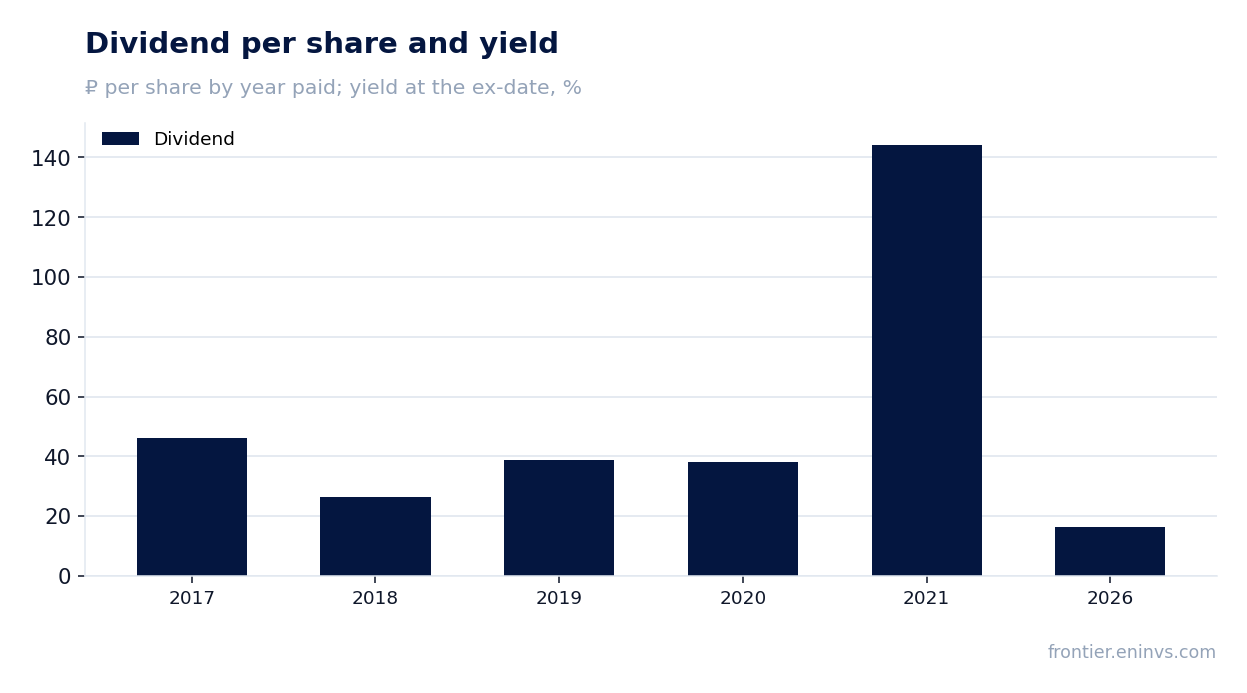
Over the last 12 months Rusagro paid RUB 16.48 per share, giving a dividend yield of 24.2% at the current price. That is well above the central bank key rate of 14.0% and above the 22.5% yield we consider fair for this name. Our model estimates the next payout at RUB 0.0 per share – we do not expect a dividend for the current year given the sharp drop in profit.
Rusagro's dividend history is uneven: RUB 144.28 per share in 2021, RUB 38.20 in 2020, RUB 38.82 in 2019, RUB 26.44 in 2018. The RUB 16.48 paid in 2026 is the lowest since 2018. The implied payout ratio of 0.86 of profit is close to the upper limit of what is reasonable. If profit remains at the current level, the company cannot sustain even this payout without increasing debt.
The key risk to dividends is leverage. Net debt to LTM EBITDA stands at 3.15x, and with EBITDA falling this level could become a constraint on payouts. Net debt at 30 June 2026 was RUB 173.7 bn, down RUB 19.1 bn from RUB 192.9 bn at 31 December 2025, but up RUB 65.9 bn from RUB 107.9 bn at 30 June 2025. The year-on-year increase in debt is substantial and requires servicing, diverting funds from dividends.
Net debt at 3.15x LTM EBITDA is a level that limits room for manoeuvre
Net debt at 30 June 2026 was RUB 173.7 bn, down RUB 19.1 bn from RUB 192.9 bn at 31 December 2025. Over 12 months, however, debt rose RUB 65.9 bn from RUB 107.9 bn at 30 June 2025. Net debt to LTM EBITDA stands at 3.15x, close to the level generally considered comfortable for agricultural companies.
Interest expense for the first half of 2026 was RUB 8.6 bn, down 10% from RUB 9.5 bn a year earlier. The decline reflects refinancing of part of the debt at lower rates. But with the key rate at 14.0%, the cost of servicing debt remains high. Interest income fell to RUB 2.3 bn from RUB 5.3 bn, increasing the net interest burden.
Operating cash flow for the first half of 2026 was RUB 32.9 bn versus RUB 4.2 bn a year earlier. The 7.8-fold increase is explained by working capital changes: receivables fell RUB 20.7 bn and inventories RUB 20.3 bn. This release of funds was one-off and is unlikely to repeat in the second half. Capital expenditure was RUB 8.2 bn, down 41% from RUB 13.9 bn a year earlier.
EV/EBITDA LTM of 4.7x versus its own three-year average of 4.4x – valuation slightly above history
The LTM EV/EBITDA multiple is 4.7x, slightly above its own three-year average of 4.4x. This means the market values the company a little more expensively than its three-year average, despite the profit decline. The LTM P/E is 4.39x, also reflecting the low profit base over the last 12 months. Market capitalisation is RUB 66.6 bn.
Such low multiples are explained not so much by undervaluation as by the fall in the denominator – EBITDA and profit. If EBITDA recovers, the multiples will automatically decline. But if margin pressure persists, the current valuation may not look so cheap. For comparison: EV/EBITDA of 4.7x with an EBITDA margin of 7.5% implies the market is pricing in a margin recovery.
Return on equity (ROE) is 0.04%, reflecting near-zero profit. This is an extremely low figure for a company with a market capitalisation of RUB 66.6 bn and assets of RUB 211.5 bn (property, plant and equipment at 30 June 2026). If profit does not recover, ROE will remain under pressure, limiting the interest of fundamentally oriented investors.
Valuation on the latest reported figures
| Metric | Value |
|---|---|
| Market cap | 66.6 bn ₽ |
| P/E (LTM) | 4.4 |
| EV/EBITDA (LTM) | 4.7 |
| P/B | 0.26 |
| Net debt / EBITDA (LTM) | 3.15 |
| Operating cash flow (LTM) | 19.2 bn |
| ROE | 0.0% |
| Dividend yield (12m) | 24.1% |
| EV/EBITDA, 3-year average | 4.4 |
Dividend per share, ₽, and yield at the ex-date
| Year paid | Dividend | Yield |
|---|---|---|
| 2017 | 46.27 | — |
| 2018 | 26.43 | — |
| 2019 | 38.82 | — |
| 2020 | 38.20 | — |
| 2021 | 144.28 | — |
| 2026 | 16.48 | 15.5% |
Bottom line
The first half of 2026 was a test for Rusagro: revenue rose 9.1%, but EBITDA fell 28.6% and net profit collapsed 98.8% to RUB 55.9 mn. The main blow came from biological asset revaluation, which contributed RUB 8.9 bn a year earlier but only RUB 3.0 bn now. Operating cash flow of RUB 32.9 bn looks strong, but it was driven by a one-off working capital release rather than business improvement. The 24.2% dividend yield remains the main argument for the stock, but payout sustainability is in question given leverage of 3.15x LTM EBITDA and falling profit. At the current price the shares look attractive for those who believe in a margin recovery, but the risk of further deterioration in financials is high.
Open the company's financial profile RAGR →
See also: market overview · valuation map · stock screeners