Renessans: insurance result down 123.7%, and 6.0% dividend yield does not offset the loss

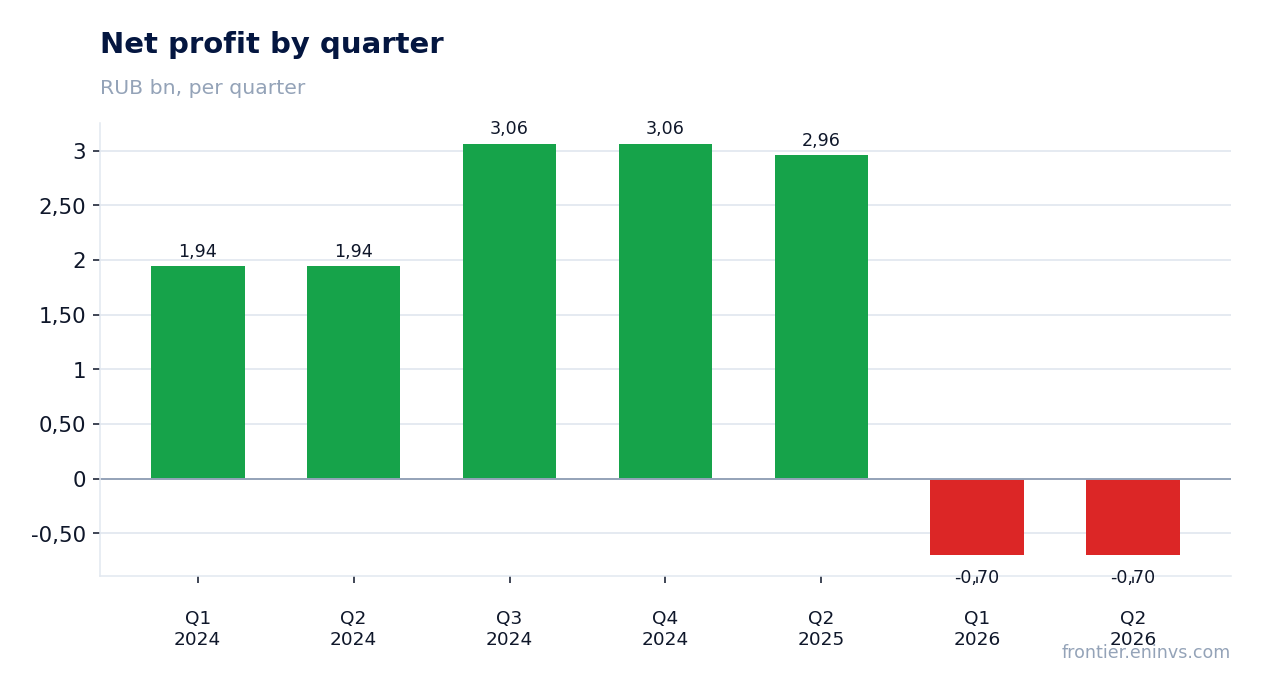
On August 21, 2026, Renessans reported Q2 2026 results: revenue grew 9.2% YoY to RUB 28,247.3 million, but net profit fell 123.7% to a loss of RUB 701.0 million. This review examines what happened to profitability, the dividend policy, and why the stock trades at a P/E of 3.5.
Key takeaways
— Revenue grew 9.2% in Q2, but net profit fell to a loss of RUB 701.0 million.
— Net margin collapsed from 11.4% to -2.5% in the quarter.
— Dividend yield of 6.0% versus a fair 10.5% leaves little room for growth.
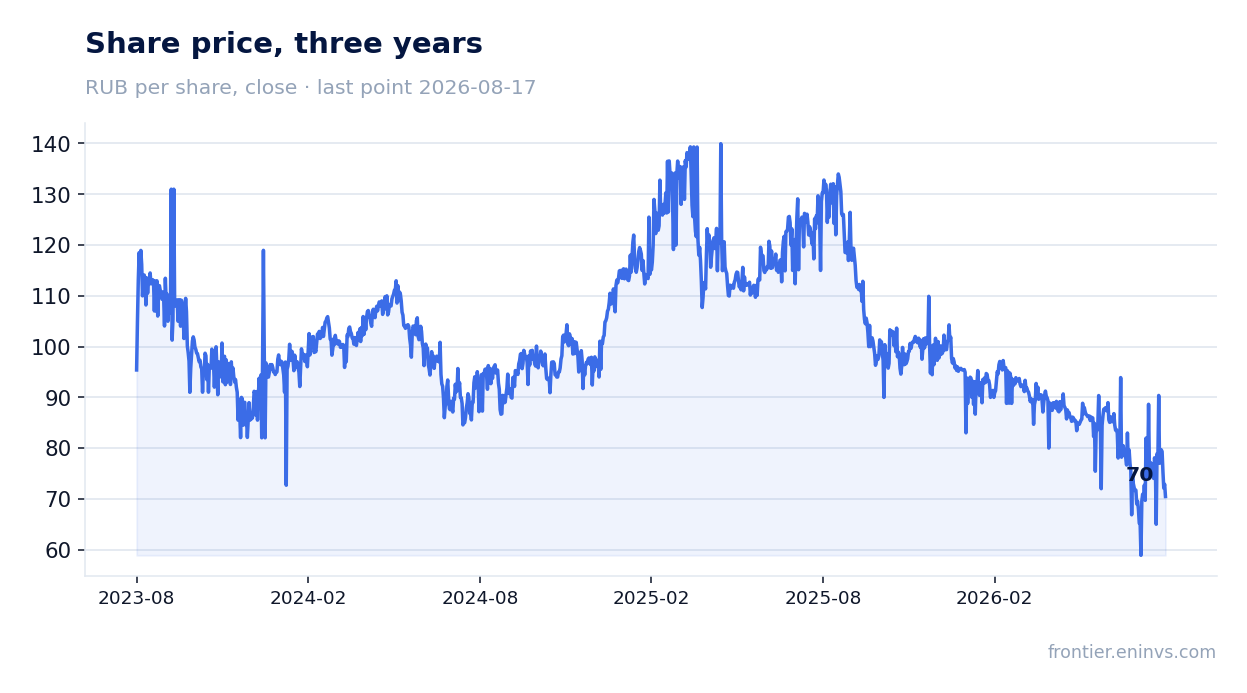
— P/E of 3.5 reflects unprofitability, not cheapness.
— Operating cash flow of RUB 29,000 million over 12 months is not a result metric for an insurer.
Key figures, RUB bn
| Metric | Q2 2025 | Q2 2026 | Change |
|---|---|---|---|
| Revenue | 25.9 | 28.2 | +9.2% |
| Net profit | 2.96 | -0.70 | -123.7% |
| Net margin | 11.4% | -2.5% | -13.9 pp |
Revenue grew 9.2% in Q2, but net profit fell to a loss of RUB 701.0 million.
In Q2 2026, Renessans's revenue reached RUB 28,247.3 million, up 9.2% YoY. However, net profit for the quarter was negative – minus RUB 701.0 million versus a profit of RUB 2,958.1 million a year earlier.
The main reason for the loss was finance expenses from insurance and reinsurance contracts, which for H1 2026 totaled RUB 14,267.3 million, and a negative result from investment and finance activities of RUB 3,470.4 million for the half-year. This outweighed the positive insurance service result of RUB 4,811.1 million.
Net margin collapsed from 11.4% to -2.5% in the quarter.
In Q2 2026, net margin was minus 2.5%, versus 11.4% a year earlier. This means the company earns less on every ruble of revenue, and in the reporting quarter it operates at a loss.
The decline in margin is due to faster growth in insurance service expenses: for H1 they rose from RUB 43,501.3 million to RUB 51,907.7 million, or 19.3%, while insurance revenue grew only 9.2%.
Dividend yield of 6.0% versus a fair 10.5% leaves little room for growth.
Over the last 12 months, Renessans paid dividends of RUB 4.1 per share, providing a yield of 6.0%. Our model estimates the next payout also at RUB 4.1 per share, implying a forward yield of 6.0%.
However, the fair yield for this name, in our view, is 10.5%. This means that at the current share price, the investor receives insufficient compensation for risk, and to achieve a fair yield, the price would need to be significantly lower.
P/E of 3.5 reflects unprofitability, not cheapness.
Renessans trades at a P/E of 3.5 based on trailing twelve months profit of RUB 11,041.6 million. This seems like a very low multiple, but it is calculated on profit that includes one-off effects and does not reflect current unprofitability.
In Q2 2026, the company posted a net loss, and if this trend continues, profit over the next twelve months will be significantly lower, and the P/E will rise. Therefore, the current low P/E is not a sign of cheapness but a consequence of falling profit.
Operating cash flow of RUB 29,000 million over 12 months is not a result metric for an insurer.
Over the last 12 months, Renessans's operating cash flow was RUB 29,000 million, but for an insurance company this metric does not reflect business efficiency. It depends on client balances and central counterparty positions, not on operating profit.
Therefore, we deliberately do not use operating cash flow in assessing results and do not build an investment thesis on it. For an insurer, the key metrics remain insurance service result, investment income, and net profit.
Valuation on the latest reported figures
| Metric | Value |
|---|---|
| Market cap | 38.6 bn ₽ |
| P/E (LTM) | 3.5 |
| P/B | 0.69 |
| ROE | -5.2% |
| Dividend yield (12m) | 6.0% |
Bottom line
In Q2 2026, Renessans showed revenue growth of 9.2%, but this growth did not convert into profit: net loss was RUB 701.0 million versus a profit a year earlier. The main reason is a sharp increase in insurance service expenses and a negative investment result. A dividend yield of 6.0% looks attractive, but it is below fair and does not offset the loss. For shareholders, the key question is whether the company can return to profitability in the coming quarters; otherwise, the low P/E of 3.5 will become a trap.
Open the company's financial profile RENI →
See also: market overview · valuation map · stock screeners