Rusolovo: revenue doubled, but interest on debt consumed almost all of it
On 28 August Rusolovo released its interim financial statements for the first half of 2026. Revenue rose 91.8% year on year to RUB 8,569.6 mn, EBITDA reached RUB 2,493.9 mn at a 29.1% margin versus a negative margin a year earlier, and net profit was RUB 178.3 mn against a loss. However, out of operating cash flow of RUB 1,493.4 mn, RUB 622.5 mn went to interest payments, while capital expenditure reached RUB 1,670.4 mn, meaning the cash flow does not even cover capex. With EV/EBITDA LTM at 17.0 and net debt of RUB 25.6 bn, the share looks overvalued relative to its own history and leaves no room for error, so our verdict is rather unattractive.
Key takeaways
— Revenue rose 91.8% on tin concentrate, but gross profit remains thin
— EBITDA of RUB 2,493.9 mn at a 29.1% margin marks a turnaround from a loss a year earlier
— Net profit of RUB 178.3 mn was almost entirely consumed by RUB 1,190.1 mn in interest expenses
— Operating cash flow of RUB 1,493.4 mn does not cover capital expenditure of RUB 1,670.4 mn
— Net debt rose to RUB 25.6 bn, with net debt/EBITDA LTM at 12.42
— No dividends were declared or paid for the first half of 2026
— EV/EBITDA LTM of 17.0 and the portal model imply 44% downside to fair value
Attractiveness
Key figures, RUB bn
| Metric | H1 2025 | H1 2026 | Change |
|---|---|---|---|
| Revenue | 4.47 | 8.57 | +91.8% |
| EBITDA | -0.97 | 2.49 | to profit |
| Operating profit | -2.19 | 0.98 | to profit |
| Net profit | -2.89 | 0.18 | to profit |
| Operating cash flow | -3.40 | 1.49 | to profit |
| Capex | 1.45 | 1.67 | +15.2% |
| EBITDA margin | -21.8% | 29.1% | +50.9 pp |
| Net margin | -64.7% | 2.1% | +66.8 pp |
Revenue rose 91.8% on tin concentrate, but gross profit remains thin
Revenue for the first half of 2026 reached RUB 8,569.6 mn, up 91.8% from the same period last year. The main contribution came from tin concentrate sales — RUB 6,938.6 mn versus RUB 3,734.1 mn a year earlier. Revenue from copper concentrate also increased, to RUB 1,609.1 mn, while tungsten concentrate contributed only RUB 21.9 mn versus RUB 55.9 mn a year earlier.
Gross profit turned positive for the first time, reaching RUB 2,718.4 mn against a loss of RUB 100.9 mn a year earlier. However, cost of sales rose to RUB 5,851.2 mn, still 68% of revenue. The main cost items are personnel expenses (RUB 1,535.5 mn) and third-party production services (RUB 1,512.3 mn). Revenue growth outpaces cost growth, but the margin of safety is thin.
Selling and administrative expenses increased to RUB 1,034.0 mn from RUB 709.0 mn a year earlier, partly due to higher personnel costs and third-party services. This limits the operating margin, which remains modest.
EBITDA of RUB 2,493.9 mn at a 29.1% margin marks a turnaround from a loss a year earlier
EBITDA for the first half of 2026 was RUB 2,493.9 mn, with an EBITDA margin of 29.1%. A year earlier the figure was negative at minus 21.8%. This turnaround was driven by revenue growth and positive gross profit, as well as operating leverage: depreciation in cost of sales rose to RUB 1,463.4 mn, but revenue grew faster.
Operating profit reached RUB 984.4 mn against a loss a year earlier. However, net profit was only RUB 178.3 mn, as interest expense reached RUB 1,190.1 mn. Thus, almost all operating profit went to debt servicing.
The net margin was 2.1% versus a negative value a year earlier. This is a positive shift, but the absolute profit is small relative to the scale of the business and the debt burden.
Net profit of RUB 178.3 mn was almost entirely consumed by RUB 1,190.1 mn in interest expenses
Interest expense for the first half of 2026 amounted to RUB 1,190.1 mn, up from RUB 865.0 mn a year earlier. This is the key factor that reduces almost all operating profit to a symbolic net profit of RUB 178.3 mn. The bulk of the debt consists of loans from related parties: the parent company and companies under common control.
Short-term loans and borrowings as of 30 June 2026 stood at RUB 23,954.1 mn, of which RUB 20,028.0 mn were loans at 12% per annum. There are also promissory notes payable of RUB 1,862.2 mn at 8% per annum. Total debt is growing: in the first half of 2026, proceeds from loans and borrowings amounted to RUB 6,945.6 mn, while repayments were RUB 5,347.9 mn.
Net debt as of 30 June 2026 was RUB 25,576.6 mn, up from RUB 24.4 bn as of 31 December 2025. The net debt/EBITDA LTM ratio stands at 12.42 — a high level that limits financial flexibility and increases vulnerability to interest rate changes.
Operating cash flow of RUB 1,493.4 mn does not cover capital expenditure of RUB 1,670.4 mn
Operating cash flow before taxes and interest for the first half of 2026 was RUB 1,493.4 mn versus a negative value a year earlier. This is an improvement, but after interest payments (RUB 622.5 mn) and income tax (RUB 1.6 mn), net operating cash flow falls to RUB 900.9 mn.
Capital expenditure for the same period reached RUB 1,670.4 mn, up 15.2% from a year earlier. Thus, even before interest payments, operating cash flow does not cover investments, and including interest the gap becomes significant. The company funds the shortfall through new borrowings.
The cash flow statement also shows capitalised interest of RUB 50.5 mn and acquisition of financial assets of RUB 46.2 mn. Total cash outflow from investing activities was RUB 1,674.0 mn. This means free cash flow remains negative, and the company continues to increase debt to sustain its investment programme.
Net debt rose to RUB 25.6 bn, with net debt/EBITDA LTM at 12.42
Net debt as of 30 June 2026 was RUB 25,576.6 mn, up from RUB 24.4 bn as of 31 December 2025. Over 12 months, from 30 June 2025, net debt increased from RUB 21.4 bn to RUB 25.6 bn. The increase is driven by financing of capital expenditure and negative free cash flow.
The net debt/EBITDA LTM ratio is 12.42. This is a high level, reflecting a significant debt burden relative to annual EBITDA. EBITDA LTM stands at RUB 2,059.7 mn, while revenue LTM is RUB 13,300.0 mn. Operating cash flow LTM is RUB 3,626.7 mn.
The high level of debt and interest expenses makes the company sensitive to changes in the key rate. Most of the debt consists of loans from related parties, which may soften terms but does not eliminate the need to service it. The report also shows lease liabilities of RUB 555.1 mn and promissory notes payable of RUB 1,862.2 mn.
No dividends were declared or paid for the first half of 2026
According to the financial statements, no dividends were declared or paid for the first half of 2026 or for the 12 months of 2025 at the time of approval of the statements. This means the company does not distribute profit to shareholders, directing funds to investments and debt servicing.
Net profit for the first half of 2026 under Russian accounting standards was RUB 12.2 mn against a loss of RUB 352.2 mn a year earlier. However, even with profit, no dividend payments are made. With net debt/EBITDA at 12.42 and negative free cash flow, the likelihood of dividends in the near term remains low.
For an investor, this means no current income from holding the share. All returns can only come from share price appreciation, which in turn depends on tin prices and the company's ability to generate positive free cash flow.
EV/EBITDA LTM of 17.0 and the portal model imply 44% downside to fair value
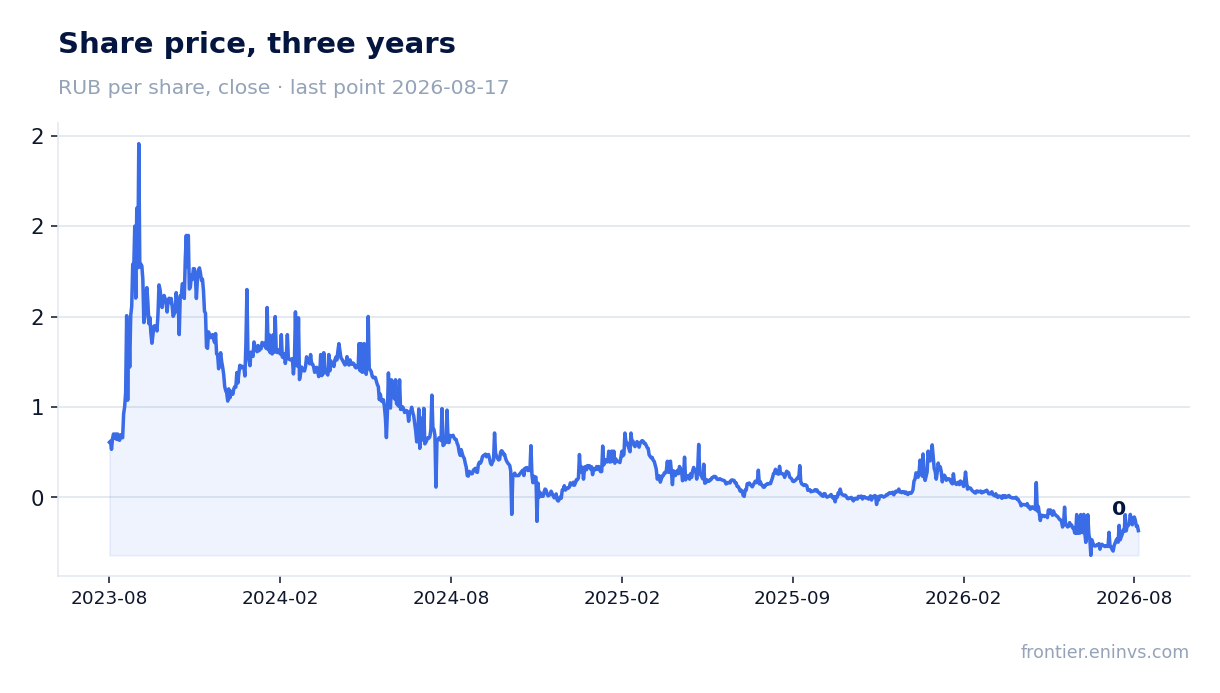
The current valuation at EV/EBITDA LTM is 17.0. This is a high level, especially given the debt burden and negative free cash flow. Market capitalisation is RUB 10,620.4 mn, while net debt is RUB 25,576.6 mn, meaning a significant portion of the business value is debt-financed.
According to the portal model, which re-prices EBITDA at current commodity prices at the target EV/EBITDA, the fair value of the share implies 44% downside to the current price. This is our own estimate, not a market consensus. It reflects the risk that current tin prices may not hold at high levels and the debt burden remains significant.
Return on equity (ROE) is 39.3%, which looks high but is achieved with a small absolute net profit and significant debt. For comparison, EV/EBITDA of 17.0 exceeds typical levels for mining companies, making the share vulnerable to re-rating if tin prices decline or operating results deteriorate.
Valuation on the latest reported figures
| Metric | Value |
|---|---|
| Market cap | 10.6 bn ₽ |
| EV/EBITDA (LTM) | 17.0 |
| P/B | 13.00 |
| Net debt / EBITDA (LTM) | 12.42 |
| Operating cash flow (LTM) | 3.63 bn |
| ROE | 39.3% |
Bottom line
The strong side of the report is the turnaround from loss to profit: revenue rose 91.8%, EBITDA reached RUB 2,493.9 mn, and net profit was RUB 178.3 mn. However, this result was almost entirely consumed by interest expenses of RUB 1,190.1 mn, and operating cash flow does not cover capital expenditure. Debt continues to grow, no dividends are paid, and the EV/EBITDA valuation of 17.0 and the portal model point to 44% downside. The question for a holder now is whether the company can sustain revenue growth and improve the conversion of EBITDA into free cash flow to justify the current valuation.
Open the company's financial profile ROLO →
See also: market overview · valuation map · stock screeners