Sberbank: quarterly profit tops RUB 500bn for the first time, but grows slower than net interest income
On 28 September Sberbank reported results for the second quarter of 2026. Net interest income came in at RUB 1,066.8bn, up 26.7% year on year, and net profit at RUB 511.2bn (+20.9%). Profit growth lags net interest income growth, and profit as a share of net interest income fell to 47.9% from 50.2% a year earlier. The share looks attractive for an income holder: a forward yield of 15.4% against the 10.5% we consider fair, on a P/E of 3.3 and an ROE of 24.4%.
Key takeaways
— Net interest income accelerated to +26.7% year on year, but profit grew only 20.9%
— Quarterly profit exceeded RUB 500bn for the first time, yet its share of net interest income fell to 47.9%
— Fee and commission income of RUB 215.3bn grows slower than net interest income and does not catch up
— A 24.4% return on equity on a P/E of 3.3 leaves room for a re-rating
— We estimate the 2026 dividend at RUB 42.33 per share – a 15.4% forward yield
— The portal's model implies 33% upside to fair value, but that is our estimate, not a consensus
Attractiveness
Key figures, RUB bn
| Metric | Q2 2025 | Q2 2026 | Change |
|---|---|---|---|
| Net interest income | 842 | 1 067 | +26.7% |
| Net profit | 423 | 511 | +20.9% |
| Net margin | 50.2% | 47.9% | -2.3 pp |
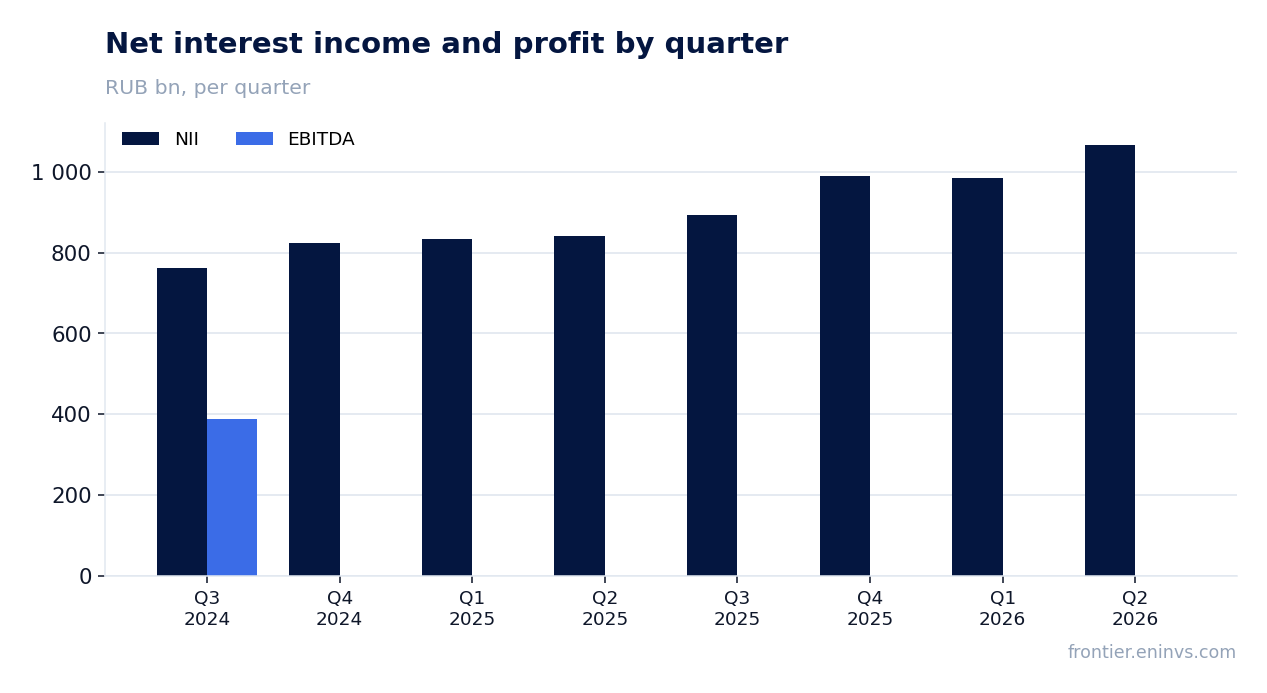
Net interest income accelerated to +26.7% year on year, but profit grew only 20.9%
Net interest income in Q2 2026 was RUB 1,066.8bn, up 26.7% year on year. Growth accelerated from 18.2% in Q1. This jump is the main reason the report looks strong.
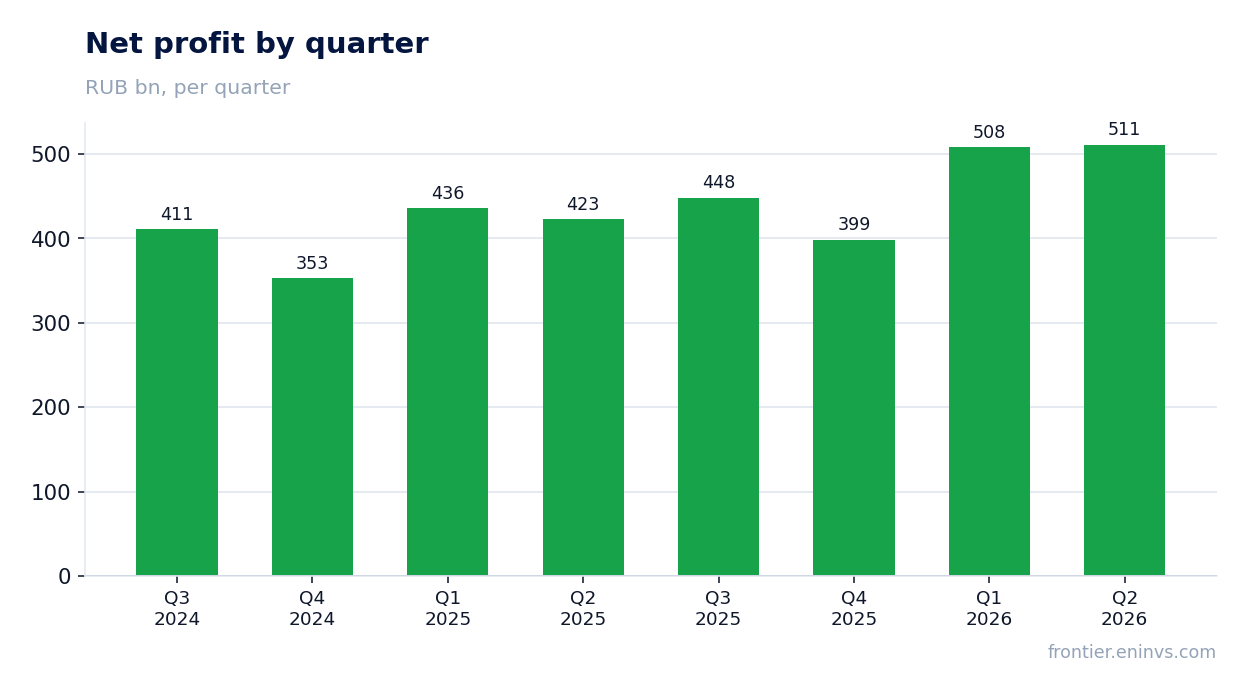
Net profit rose 20.9% year on year to RUB 511.2bn – the first quarter above RUB 500bn. However, profit growth lags net interest income growth noticeably. Profit as a share of net interest income fell to 47.9% from 50.2% a year earlier. This is not a margin or a profitability measure, just a ratio of two report lines, but it shows that costs or provisions absorbed part of the gain.
The gap between 26.7% and 20.9% is the key detail of the quarter. Net interest income accelerated, profit did not. What exactly caused this – higher provisions, operating costs or one-offs – is not disclosed in the provided data. We note the fact itself: profit growth trails the growth of the core income line.
Quarterly profit exceeded RUB 500bn for the first time, yet its share of net interest income fell to 47.9%
Net profit of RUB 511.2bn in Q2 2026 is a record for Sberbank. A year earlier it was RUB 422.9bn, a gain of RUB 88.3bn. This is an absolute high, but the relative measure is worse: profit as a share of net interest income fell to 47.9% from 50.2%.
A falling share means costs or provisions are growing faster than income. For a bank this could be either higher provisions for the loan book or higher operating expenses. Without a detailed breakdown we cannot name the exact cause, but the fact itself – profit growing slower than net interest income – matters for assessing the sustainability of the result.
For a holder this is a signal: a record profit does not necessarily mean improved efficiency. If the gap persists, the next quarter could show slower profit growth even with strong net interest income.
Fee and commission income of RUB 215.3bn grows slower than net interest income and does not catch up
Fee and commission income in Q2 2026 was RUB 215.3bn. A year earlier it was RUB 195.0bn, up about 10.4%. That is significantly slower than the 26.7% growth in net interest income.
The gap between the growth rates of the two income sources is widening. Net interest income is accelerating, fee income is not. This makes the result increasingly dependent on the interest rate and lending volumes rather than on fees, which are usually more stable.
This matters for assessing profit sustainability: if interest rates start to fall, support from fee income will be weaker than it could be. For now, fee income remains the smaller part of the picture and does not drive the result.
A 24.4% return on equity on a P/E of 3.3 leaves room for a re-rating
Sberbank's return on equity over the last twelve months is 24.4%, and its price-to-earnings ratio is 3.3. That is a very low multiple for a bank with such a return on equity. The market values the share below what current earnings would justify.
According to the portal's model, which compares return on equity with the price-to-book valuation, the upside to fair value is +33%. This is our own estimate, not a market consensus or a target price. It reflects the gap between actual profitability and how the market values it.
Such a gap can persist for a long time if investors price in rate cuts or rising risks. But for a dividend-oriented holder, a low multiple means that even if earnings stay flat, the dividend yield remains high.
We estimate the 2026 dividend at RUB 42.33 per share – a 15.4% forward yield
Over the last twelve months Sberbank paid RUB 37.64 per share, giving a current dividend yield of 13.7%. We estimate the 2026 payout at RUB 42.33 per share, a forward yield of 15.4%. That is well above the 10.5% we consider fair for this name.
Our estimate assumes a payout of about 49% of profit. If annual profit comes in below expectations or the bank decides to build capital, the dividend could be smaller. The key risk is higher provisions or tighter capital requirements forcing a payout cut.
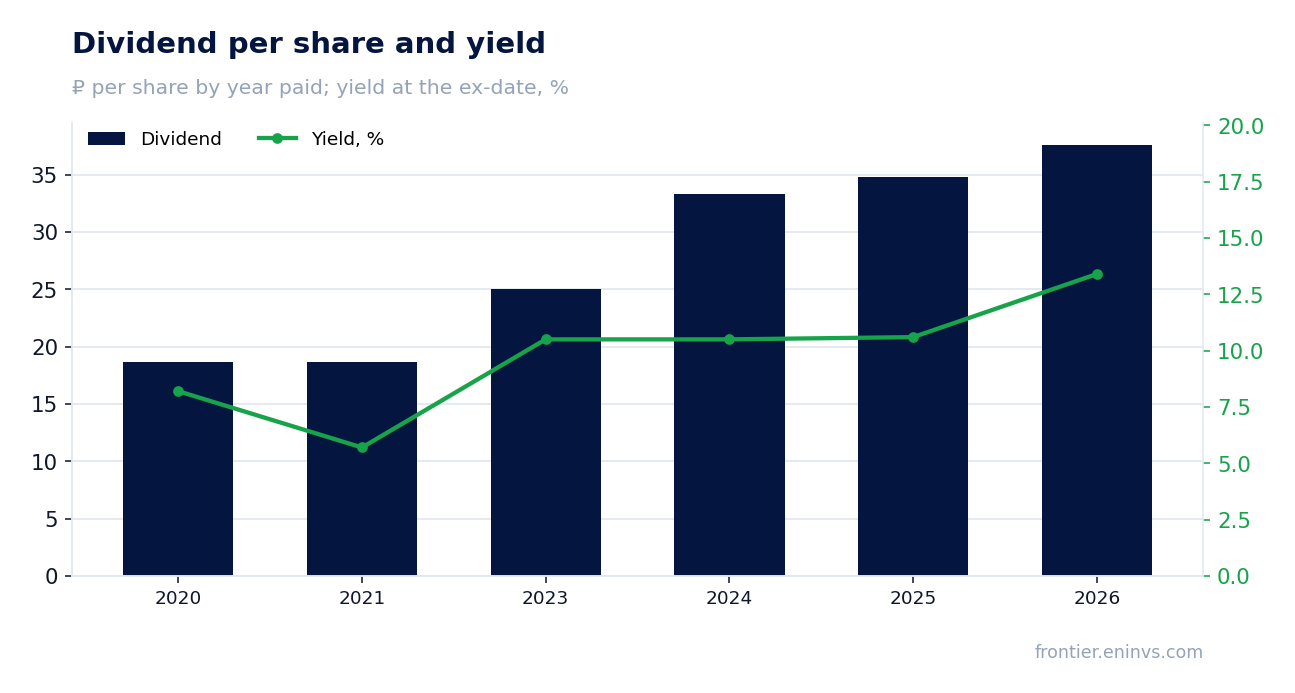
For comparison, the central bank key rate is now 14.0%. The 15.4% forward yield exceeds it, making the share attractive for income investors. The payout history also supports this: in recent years the yield at the ex-date ranged from 5.7% to 13.4%, and the current level is among the highest.
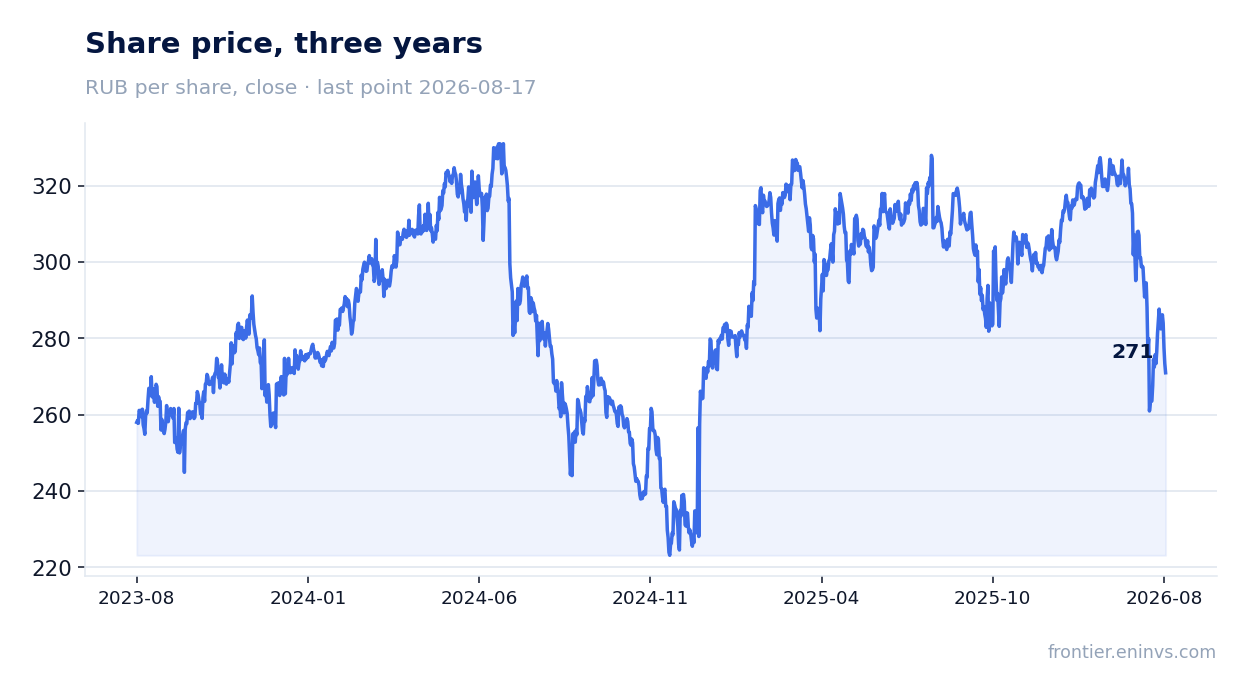
The portal's model implies 33% upside to fair value, but that is our estimate, not a consensus
Our model estimates the upside to fair value at +33%. This comes from comparing the 24.4% return on equity with the current P/E of 3.3. The model assumes the market will eventually value the bank closer to its return on equity.
This is not a target price or a recommendation. The market can ignore high profitability for a long time if it sees risks in the economy or regulation. But for an investor holding the share for the dividend, this gap provides an additional argument: even without a re-rating, the yield remains high.
Keep in mind that the model is our tool, not a market consensus. It does not account for possible one-off write-offs or changes in dividend policy. We present it as a guide, not a guarantee.
Valuation on the latest reported figures
| Metric | Value |
|---|---|
| Market cap | 6 191 bn ₽ |
| P/E (LTM) | 3.3 |
| P/B | 0.75 |
| ROE | 24.4% |
| Dividend yield (12m) | 13.7% |
Dividend per share, ₽, and yield at the ex-date
| Year paid | Dividend | Yield |
|---|---|---|
| 2020 | 18.70 | 8.2% |
| 2021 | 18.70 | 5.7% |
| 2023 | 25.00 | 10.5% |
| 2024 | 33.30 | 10.5% |
| 2025 | 34.84 | 10.6% |
| 2026 | 37.64 | 13.4% |
Bottom line
The quarter delivered a record profit of RUB 511.2bn and strong net interest income growth of 26.7%. However, profit grows slower than income, and its share of net interest income fell to 47.9%. For a holder the main thing is the dividend: a forward yield of 15.4% against the fair 10.5% and the key rate of 14.0%. A P/E of 3.3 with a 24.4% ROE leaves room, but realising it depends on profit sustainability. The verdict is attractive: the dividend and low multiple outweigh the risk of a falling profit share.
Open the company's financial profile SBER →
See also: market overview · valuation map · stock screeners