Sberbank: net interest income up a quarter, but profit lags – held back by more than the business
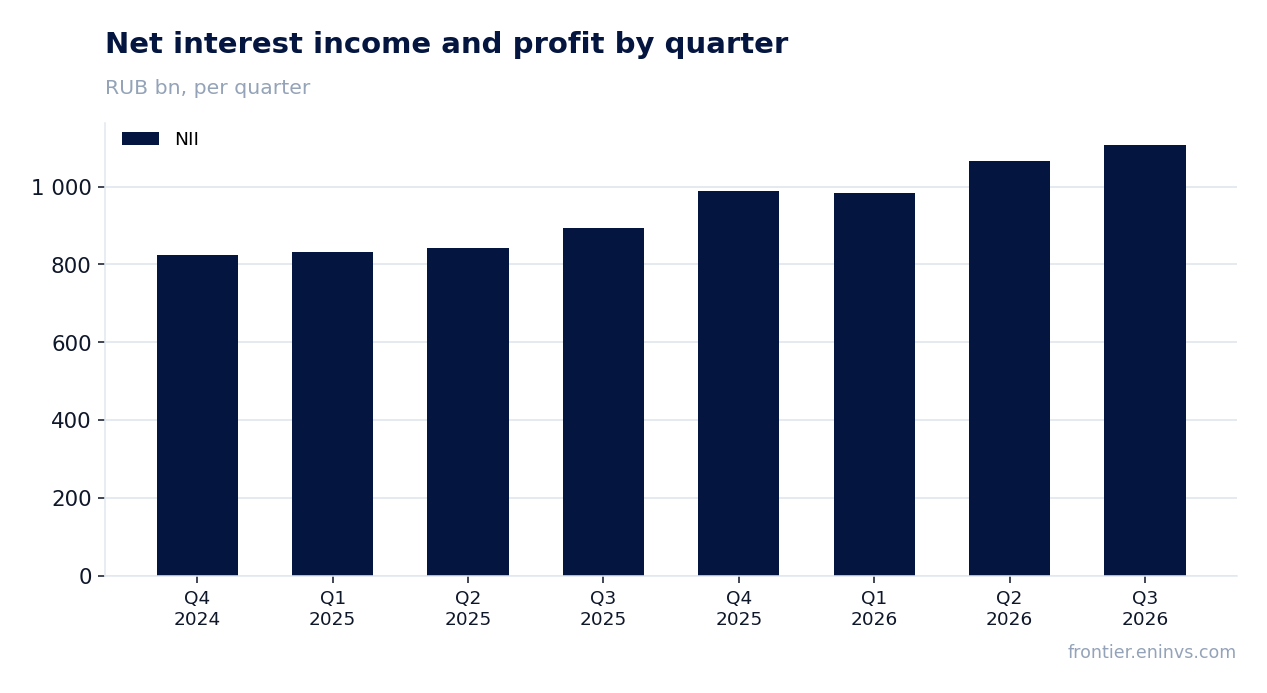
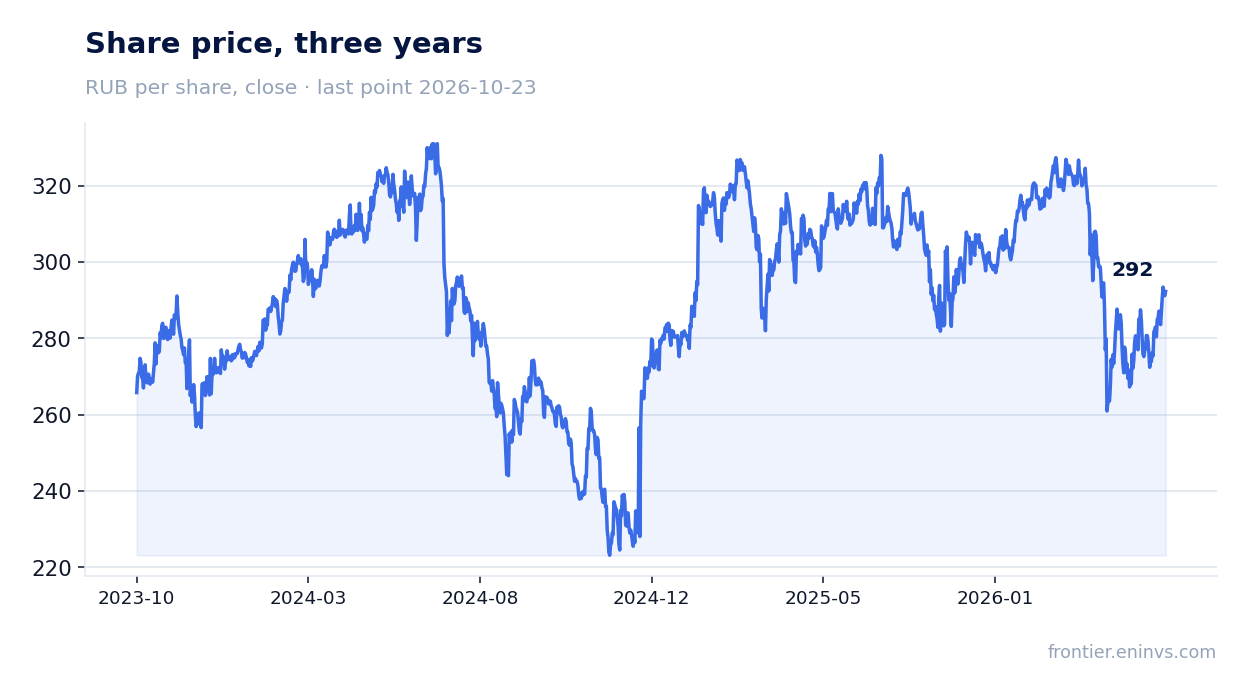
In its Q3 2026 report Sberbank posted net interest income of RUB 1,107.7 bn, up 24.0% year on year, and net profit of RUB 510.8 bn (+13.9%). Profit growth is markedly slower than interest income growth, and its ratio to net interest income fell to 46.1% from 50.2% a year earlier. The stock trades at a P/E LTM of 3.5 and offers a trailing dividend yield of 12.6% – our estimate for the next payout is 42.33 per share, or 14.2% at the current price. Given the discount to its own multiple, a strong dividend record and the portal model's +30% upside, the share looks attractive, although the deceleration in interest income growth from 26.7% in Q2 to 24.0% in Q3 warrants monitoring.
Key takeaways
— Net interest income grew 24.0% year on year, but the pace decelerated from 26.7% in Q2
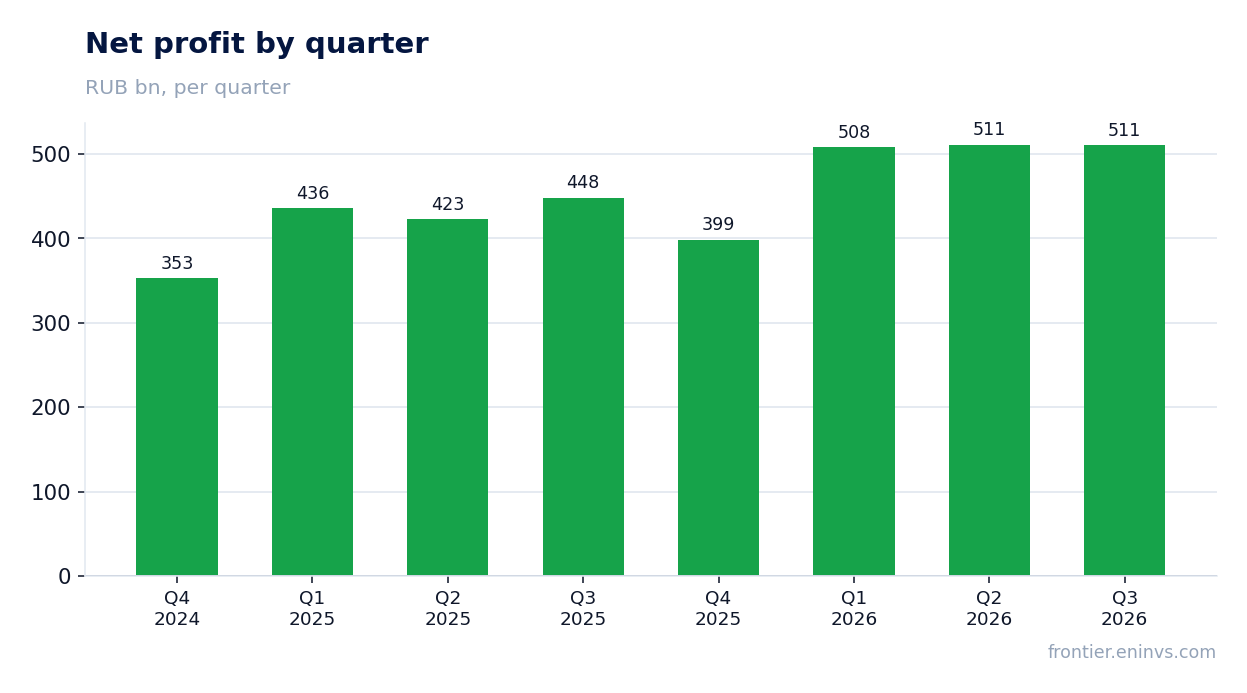
— Profit added only 13.9%, and its share of net interest income fell to 46.1%
— Fee and commission income is nearly flat and does not offset pressure on profit
— Dividend yield of 12.6% and an estimated next payout of 42.33 per share
— P/E LTM of 3.5 and +30% upside on the portal's model
— ROE of 7.7% against a 14.0% key rate – capital earns less than money costs
Attractiveness
Key figures, RUB bn
| Metric | Q3 2025 | Q3 2026 | Change |
|---|---|---|---|
| Net interest income | 894 | 1 108 | +24.0% |
| Net profit | 448 | 511 | +13.9% |
| Net margin | 50.2% | 46.1% | -4.1 pp |
Net interest income grew 24.0% year on year, but the pace decelerated from 26.7% in Q2
In Q3 2026 Sberbank's net interest income reached RUB 1,107.7 bn, up 24.0% from the same quarter a year earlier. That is a strong result, but it is slower than the 26.7% growth seen in Q2. The deceleration of 2.7 percentage points is the first signal that the growth rate in interest income is starting to level off.
The figure is supported by the high key rate of 14.0%, which allows the bank to earn on placing funds. Further dynamics will depend on how quickly the regulator begins to cut rates. For now, quarterly growth of 24.0% remains solid, and against the previous three quarters (18.2%, 26.7% and 24.0%) it is clear the bank is holding a high base.
For shareholders, it matters that interest income is the main source of profit, and its deceleration feeds into profit with a lag. If the slowdown continues, it will limit the ability to grow dividend payments at the same pace as in recent years.
Profit added only 13.9%, and its share of net interest income fell to 46.1%
Net profit in Q3 2026 was RUB 510.8 bn, up 13.9% year on year. That is almost half the growth rate of net interest income. As a result, the ratio of profit to net interest income fell to 46.1% from 50.2% a year earlier. This is not a margin or a profitability measure, but a ratio of two absolute figures, and it shows that revenue growth is accompanied by faster growth in costs or charges.
Profit is growing, but its conversion from interest income is deteriorating. The cause may be higher funding costs, rising operating expenses or provisioning – the report does not provide a breakdown within our review. Nevertheless, the 4.1 percentage point decline in profit's share of interest income is a significant signal for assessing the sustainability of the dividend base.
It is worth remembering that Q3 2026 profit is a standalone figure, not a cumulative total. For an annual assessment, the LTM profit of RUB 1,928.5 bn is more important, and it is this figure that feeds into the dividend calculation.
Fee and commission income is nearly flat and does not offset pressure on profit
Fee and commission income in Q3 2026 was RUB 212.3 bn, essentially in line with the previous quarter (RUB 215.3 bn) and slightly below the year-earlier figure (RUB 216.5 bn). In effect, the fee business is stagnating: it is not growing and does not help offset the slowdown in net interest income.
Fees account for a smaller share of the bank's income than interest, but their contribution is important for diversification. The lack of growth here means that the entire burden of supporting profit falls on net interest income, which is itself starting to decelerate. This increases the vulnerability of the financial result to a decline in the key rate.
For shareholders, this is another argument that the current profit level may come under pressure if interest income stops growing as fast as it did in recent quarters.
Dividend yield of 12.6% and an estimated next payout of 42.33 per share
Over the last 12 months Sberbank paid RUB 37.64 per share, which at the current price gives a dividend yield of 12.6%. That is above the yield we consider fair for this name (10.5%) and well above the key rate of 14.0% after tax advantages for long-term holders. Our model estimates the next payout at RUB 42.33 per share, corresponding to a forward yield of 14.2%.
The payout estimate is based on a payout ratio of about 0.49 of profit and LTM profit of RUB 1,928.5 bn. If profit holds at the current level, a dividend of RUB 42.33 looks achievable. However, the decline in profit's share of interest income to 46.1% and stagnating fee income are factors that could limit profit growth and, consequently, the dividend.
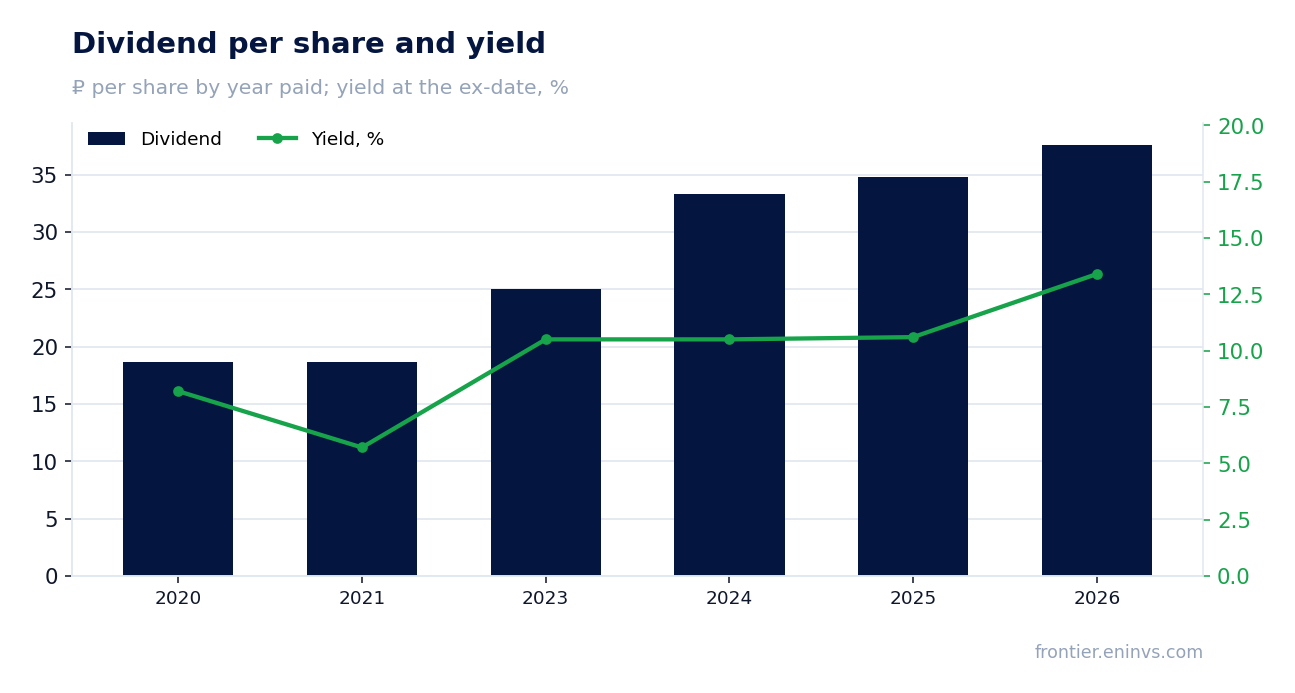
The payment history shows stability: RUB 18.7 in 2020 and 2021, RUB 25.0 in 2023, RUB 33.3 in 2024, RUB 34.84 in 2025 and RUB 37.64 in 2026. The yield at the ex-date ranged from 5.7% to 13.4%, and the current level of 12.6% is in the upper part of the historical range. This supports the appeal of the stock for income investors.
What could reduce the payout: a further slowdown in net interest income, higher provisions or operating expenses, or a change in dividend policy. For now, the combination of high yield and a moderate payout ratio leaves room for manoeuvre.
P/E LTM of 3.5 and +30% upside on the portal's model
Sberbank's stock trades at a P/E LTM of 3.5 – a very low multiple that reflects both high profit and persistent country risks. The three-year history of the multiple is not provided in the facts, so we cannot compare the current level with its historical average. However, an absolute value of 3.5 looks modest for a bank with an ROE of 7.7% and a stable dividend record.
According to the portal's model, which compares ROE with P/B, the upside to fair value is estimated at +30%. This is our own estimate, not a market consensus. It rests on the assumption that current profit is sustainable and the P/B multiple will gradually move towards a level consistent with the return on capital.
It is worth noting that the stock is held in several of the portal's model strategies: RU AI conviction, RU AI long-short, RU Banks & financials and RU Dividend growers. This is a fact, not an argument for the verdict, but it shows that the stock passes the screens of different approaches – from dividend to quantitative.
ROE of 7.7% against a 14.0% key rate – capital earns less than money costs
Sberbank's LTM return on equity is 7.7%, below the key rate of 14.0%. This means the bank earns less on capital than a risk-free placement would yield. Such a gap weighs on valuation: investors demand a higher dividend yield as compensation for low capital efficiency.
Low ROE alongside a high P/E may be explained by the structure of profit: a significant portion of income comes from interest operations, which are sensitive to the rate. If the rate starts to decline, ROE could recover through lending growth, but that will take time. For now, the ratio of ROE to the cost of capital remains the weak link in the investment case.
For the dividend record this is not critical: a payout ratio of about 0.49 allows payments to be maintained even at moderate profitability. However, the long-term sustainability of the dividend depends on the bank's ability to raise ROE or at least keep it at the current level.
Valuation on the latest reported figures
| Metric | Value |
|---|---|
| Market cap | 6 751 bn ₽ |
| P/E (LTM) | 3.5 |
| P/B | 0.82 |
| ROE | 7.7% |
| Dividend yield (12m) | 12.6% |
Dividend per share, ₽, and yield at the ex-date
| Year paid | Dividend | Yield |
|---|---|---|
| 2020 | 18.70 | 8.2% |
| 2021 | 18.70 | 5.7% |
| 2023 | 25.00 | 10.5% |
| 2024 | 33.30 | 10.5% |
| 2025 | 34.84 | 10.6% |
| 2026 | 37.64 | 13.4% |
Bottom line
The report's strengths remain net interest income growth of 24.0% and a stable dividend record with a current yield of 12.6%. However, profit is growing more slowly at 13.9%, and its share of interest income is declining, pointing to pressure on the conversion of revenue into profit. The dividend yield is above what we consider fair for the stock, and the portal model implies +30% upside. The key question for a holder now is whether the bank can sustain interest income growth and return on equity against a possible rate cut. The verdict is attractive, but with a caveat on deceleration.
Open the company's financial profile SBER →
See also: market overview · valuation map · stock screeners