Samolet bonds: the case for and against
Samolet is paying on all its bonds, but it has no cash cushion, and the fate of the bonds depends on agreements with the banks. Samolet Group is one of Russia's largest homebuilders, with about RUB 68 bn of bonds outstanding. In 2026 the company passed two put offers and redeemed the BO-P20 issue, but twice transferred the money to the depository late. The holding company that issues the bonds had RUB 0.17 bn in its accounts at 30 June against RUB 250 bn of debt. It pays with money that moves up to it from the project subsidiaries and with new borrowing. There are enough arguments that the banks benefit from keeping the public debt serviced. There is no guarantee of this in any document.
This is how the market prices it. The October issue 01 trades at par. The January BO-P13 is at 82.3% of par, the February BO-P11 put at 69.7%, and the long issues at 56-68%.
- Pros. Scale and the banks' interest: Sber and VTB alone had lent the group RUB 360 bn at the end of 2025. Bonds are about 9% of the debt, and keeping them serviced is cheap for the lenders. All 2026 put offers and redemptions have been passed, escrow accounts hold RUB 339 bn, the group is completing the confiscated Kvartal Marino project as a contractor, and ACRA rates it A-(RU) with a stable outlook.
- Cons. Accrued interest for the year (RUB 102 bn) exceeds EBITDA (RUB 82 bn), and two thirds of EBITDA is the non-cash escrow effect. Debt without escrow cover is RUB 217 bn, not RUB 113 bn as the company counts it. Excluding intangibles, the group's equity is negative. The issuer has almost no cash and has guaranteed subsidiaries' loans for RUB 1.44 trn.
- Upcoming payments: 30 October – RUB 1.5 bn, 24 January – RUB 9.3 bn, 12 February – a put of up to RUB 6.4 bn. To the end of 2027, including coupons, about RUB 59 bn.
- Authors' estimate. Prices on 6 October imply a 56-69% chance of being paid on time on BO-P13 and 33-51% on the BO-P11 put.
What is happening: sales have fallen, the company is negotiating with the banks
Samolet Group builds housing in Moscow, the Moscow Region, St Petersburg and other regions. According to ERZ data cited by ACRA, at the start of 2026 it had the largest volume of construction in progress among Russian developers. The shares have traded on the Moscow Exchange since 2020; market capitalisation on 6 October was about RUB 14 bn against RUB 773 bn of debt.
Fact. The group ended 1H2026 with revenue of RUB 117.4 bn (-31% year on year) and a net loss of RUB 22.3 bn. On the 28 August analyst call, CFO Nina Golubnichaya said sales had fallen about 15 pp more than the market and linked this to the February letter requesting state support. At the time the company asked for a RUB 50 bn subsidised loan. No direct support was granted; indirect measures were discussed. On 24 February the Ministry of Finance said that its review had found no preconditions for financial instability risks at the group.
In its 1H IFRS statements the company writes that it "is negotiating with its key lending banks to restructure the existing loan portfolio and reduce the current debt burden". On 17 September Kommersant wrote about possible forms of a deal with Sberbank. The company does not officially confirm that report and says the talks with the banks are constructive. The terms of any agreements have not been disclosed.
Key bond events over the past year:
- 24 December 2025 – ACRA downgraded the rating from A(RU) to A-(RU), outlook stable;
- 3 February 2026 – RUB 15.2 bn of the RUB 24.5 bn BO-P13 issue was redeemed at the put;
- 6 February – ACRA placed the rating under review after the request for state support; on 2 March it removed the review status;
- 5 May – technical default on coupons of three issues: the money reached the depository a few hours late, and the payments were made within the grace period;
- 7 August – RUB 3.1 bn of the RUB 5 bn BO-P15 issue was redeemed at the put;
- 10 August – the fund of the heirs of co-founder Mikhail Kenin sold 18% of the shares to a fund managed by Kazakhstan's Fonte Capital for RUB 4.2 bn;
- 28 August – 1H results: talks on restructuring the loans and a covenant breach on one RUB 3.0 bn loan;
- 14-16 September – the same fund sold almost its entire stake: first to 15%, then to 10% and to about 5% (disclosed on 29 September, buyers not named);
- 28 September – redemption of BO-P20 for RUB 2.5 bn: the coupon arrived in full, but only RUB 269 of the RUB 1,000 face value was paid on time, the rest on 29 September. The NSD recorded a technical default; the company attributed the delay to technical reasons.
After 28 September the issues maturing after January fell by another 7-16 pp. As of 6 October we found no rating actions following the BO-P20 redemption.
The new shareholder did not stay long. Fact. On 10 August the Horizont fund, representing the heirs of co-founder Mikhail Kenin, sold 18% of the shares for RUB 4.2 bn to a fund managed by Kazakhstan's Fonte Capital. As early as 14-16 September that fund sold almost its entire stake, down to about 5%: precisely in the days when the bonds started to fall. Who bought the shares has not been disclosed, and below 5% the fund may not report changes in its stake. Support from this shareholder cannot be counted on, and for the bonds this is rather a negative.
What supports Samolet bonds
The banks are better off if the group finishes the buildings. At the end of 2025 the largest lenders were Sberbank (RUB 274.2 bn, 30.6% of debt) and VTB (RUB 85.9 bn). Most of the debt is project loans for specific developments. Halting construction would hurt the banks themselves and tens of thousands of homebuyers, so the lenders have an interest in the company having enough money to complete its projects.
Bonds are a small part of the debt. About RUB 68 bn of bonds are outstanding at face value (RUB 74 bn on the balance sheet including accrued coupons) out of RUB 773 bn of group debt, around 9%. Keeping them serviced is cheaper for the lenders than dealing with the consequences of a default on public debt.
So far the company is making every payment. In 2026 it redeemed RUB 18.3 bn at put offers (BO-P13 and BO-P15) and the RUB 2.5 bn BO-P20 issue, and coupons were paid in full. There were delays, but they were short, and formally the technical default did not turn into a default.
Construction is mostly covered by homebuyers' money. Fact. Escrow accounts held RUB 338.8 bn at 30 June, 61% of project loans (RUB 556.7 bn). For the industry, according to the Bank of Russia for 2Q, coverage is 65%. On the covered part the bank charges a subsidised rate close to zero, and when the buildings are handed over the escrow money goes to repay the loans.
A large land bank. Land on the balance sheet is worth RUB 372.6 bn, of which RUB 243.0 bn is plots without building permits. This value includes capitalised interest, the land sells slowly (RUB 4.9 bn in six months), and most of it is pledged to banks. But it is a real asset against which maturities can be negotiated.
The state has let Samolet keep building a project confiscated from it. Kvartal Marino in New Moscow (855 thousand sq m) passed to the state following a Prosecutor General's Office lawsuit against Latvia's Rietumu Banka, a co-owner of the project, and the group wrote it off in its accounts. In spring 2026 Samolet resumed construction, now as a contractor, CFO Nina Golubnichaya said. For bondholders this is rather a positive. The group remains a guarantor of the project's RUB 13.2 bn loan and has obligations to about 1,600 buyers, and completing the project reduces these risks. Moreover, the decision to entrust the construction to the company suggests the authorities see no reason to remove it from large projects.
The rating and the state's position. ACRA rates the company A-(RU) with a stable outlook. In February the Ministry of Finance found no preconditions for financial instability at the company.
Related parties are buying the bonds. Fact. The face value of group bonds held by related parties rose from RUB 0.88 bn to RUB 3.3 bn over the half-year. Samolet's IFRS defines related parties as companies connected through key management personnel.
A lower key rate helps directly. Part of the project loans not covered by escrow carries a base rate linked to the market rate. The average portfolio rate is 11.8%, and a lower key rate will reduce interest payments.
The business does not earn its interest: EBITDA of RUB 82 bn against RUB 102 bn of accrued interest
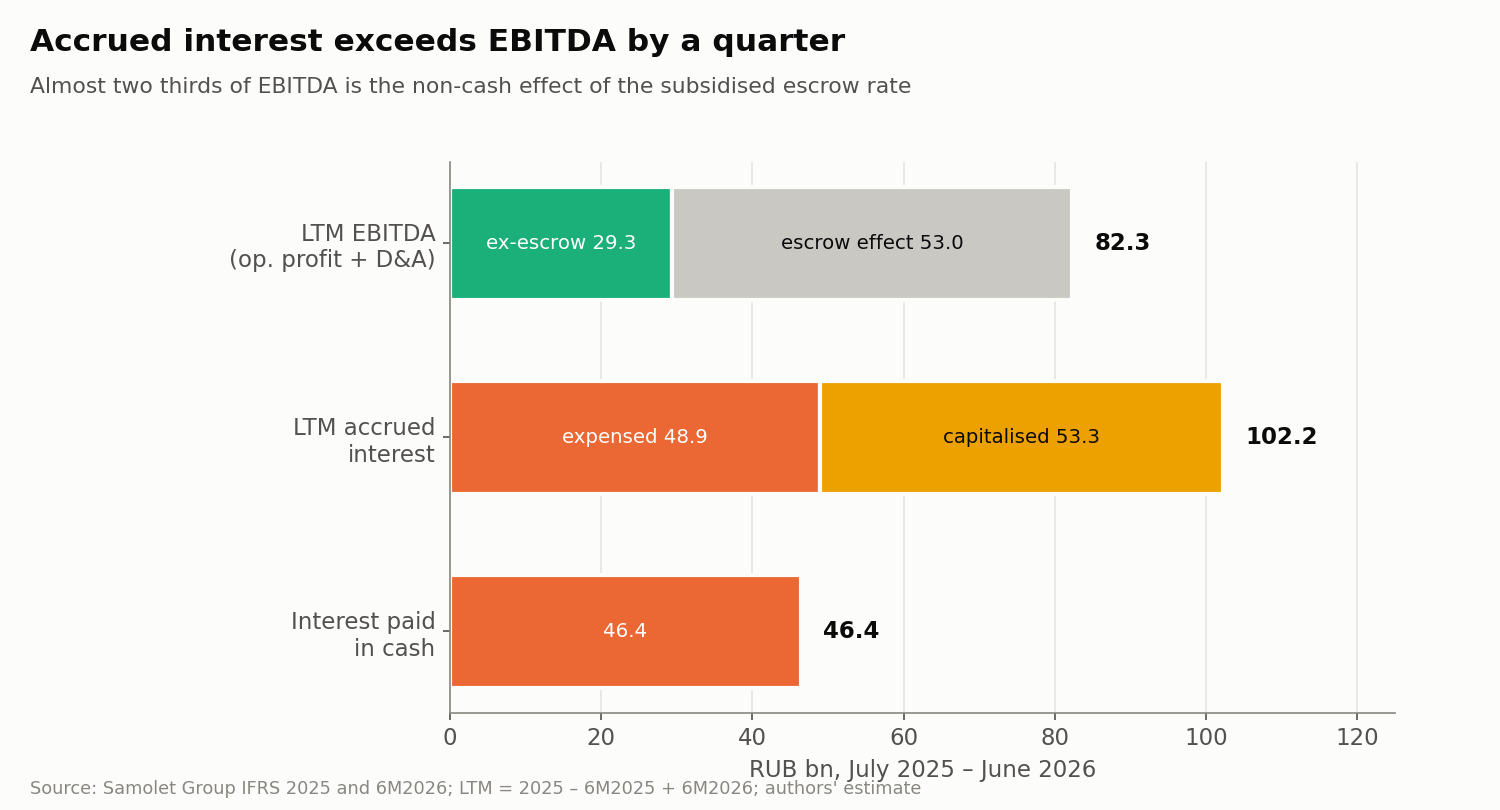
Authors' estimate. EBITDA for the 12 months to 30 June (operating profit plus D&A) was RUB 82.3 bn. The company's adjusted EBITDA is higher, at RUB 109.4 bn: the company adds back interest previously capitalised into cost of sales, impairments and compensation to buyers.
Under IFRS a developer recognises the escrow saving in revenue, that is, the difference between the market and subsidised rates on the project loan. This revenue brings in no actual cash. Over 12 months the effect was RUB 53.0 bn; without it EBITDA is RUB 29.3 bn.
Accrued interest for the same period was RUB 102.2 bn: RUB 48.9 bn went through expenses and RUB 53.3 bn was capitalised into the cost of buildings under construction and land. RUB 46.4 bn was paid in cash; the rest accumulates in the project loans and is repaid when escrow is released.
Authors' estimate. EBITDA covers accrued interest 0.81x, and 0.29x excluding the escrow effect. The company explains why the loss does not worry it: the gap between profit and cash in development is three years on average, and what matters is that future revenue from the apartments on the balance sheet covers the accumulated costs. For a group that survives these three years, the logic holds. For a lender it means that the debt is currently being serviced with new borrowing and asset sales.
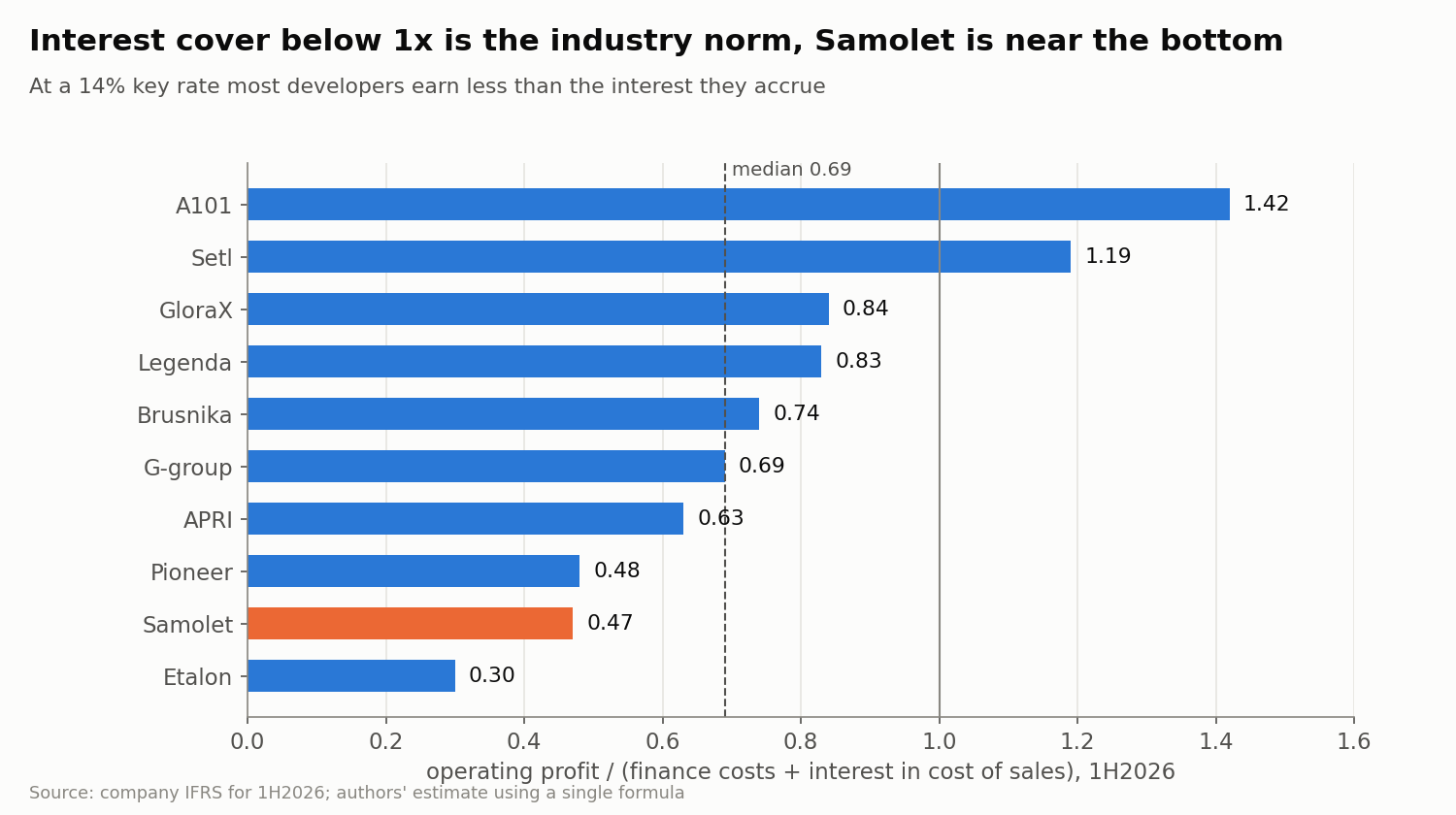
Interest cover below 1x in 1H was the case for most listed developers, with a median of 0.69 across ten companies. Samolet, at 0.47, is near the bottom of the list. Only Setl and A101 are above 1x.
Debt without escrow cover is RUB 217 bn, not 113
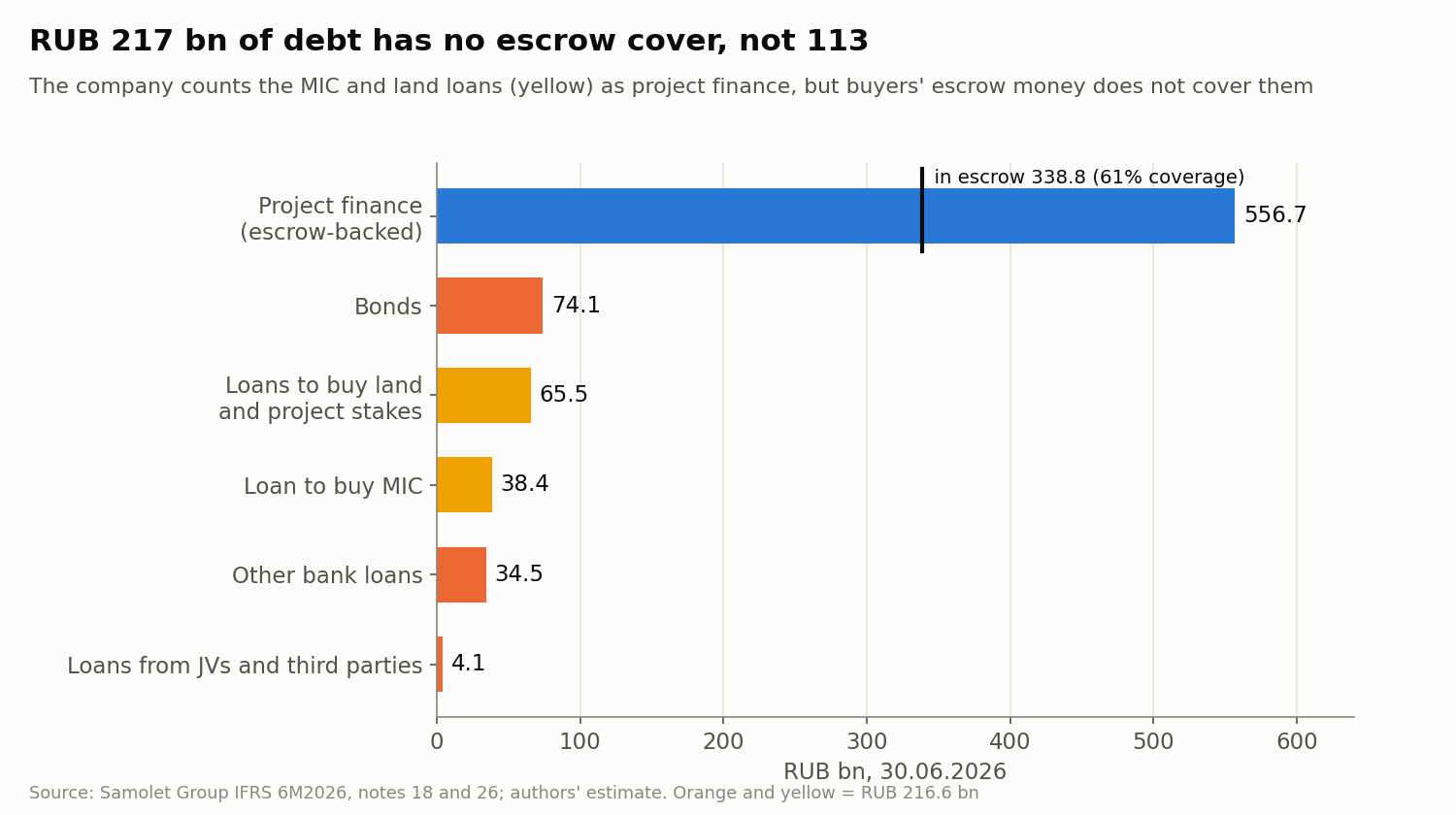
The company splits its debt into two parts. It considers project finance (RUB 660.6 bn) to be backed by homebuyers' money and calls the rest corporate debt (RUB 112.7 bn), showing a ratio of 0.94x to EBITDA.
Within project finance there are two lines unrelated to escrow. The 2023 loan to buy the MIC group is RUB 38.4 bn, and loans to buy stakes in project companies and land are RUB 65.5 bn, of which RUB 45.6 bn is due within a year. The company classifies them as project finance in line with established market practice: MIC is essentially a land bank with project documentation. The logic is understandable, but escrow does not cover these loans, and they will have to be repaid from project margins or land sales.
Authors' estimate. Including these loans, debt without escrow cover is RUB 216.6 bn; net of RUB 9.9 bn of cash, RUB 206.8 bn, or 2.5x LTM EBITDA. Total net debt less escrow money is RUB 425 bn, or 5.2x EBITDA. Using its own methodology with adjusted EBITDA, the company gets 3.9x.
There are a lot of short-term obligations. Of RUB 325.3 bn of short-term loans, about RUB 113 bn is not covered by escrow: bonds (22.9), land loans (45.6), the MIC loan (12.3), bank loans (29.0) and other borrowings (3.3). Undrawn limits of RUB 519 bn are mostly project credit lines for specific developments and cannot be used to repay bonds. Long-term loans of RUB 396 bn are subject to covenants, and there is already one breach.
Excluding intangibles, the group's equity is negative
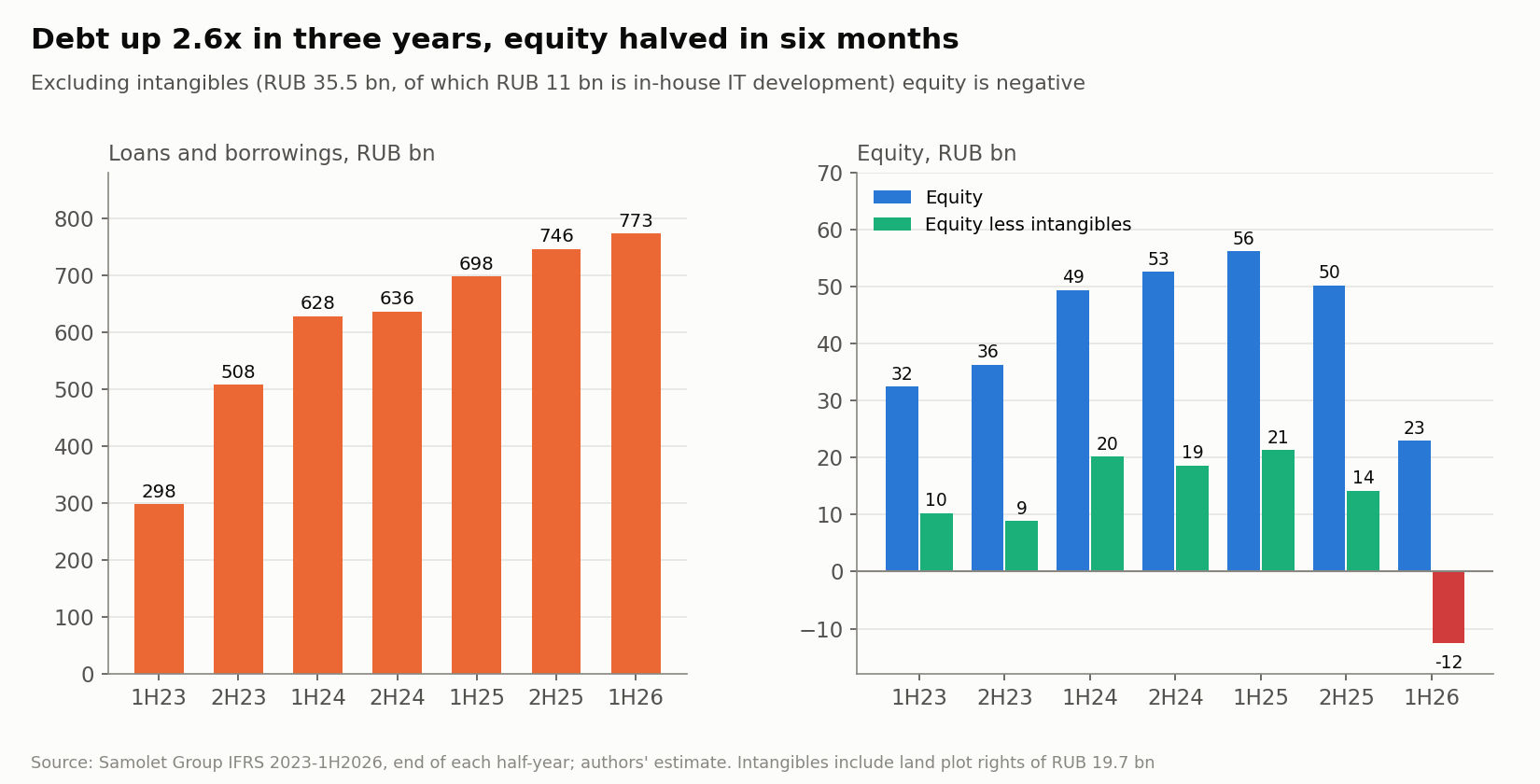
Fact. Over three years the group's loans and borrowings grew from RUB 298 bn to RUB 773 bn. Equity held at around RUB 50 bn in 2024-2025, and in 1H2026 fell to RUB 23.0 bn, or 2.2% of assets. Of this, RUB 8.3 bn belongs to the shareholders of the PJSC.
Authors' estimate. Assets include RUB 35.5 bn of intangibles: rights to land plots under the St Petersburg built-up area redevelopment programme (RUB 19.7 bn), in-house IT development (RUB 11.0 bn), licences and software (RUB 4.4 bn) and goodwill (RUB 0.4 bn). Without them equity is minus RUB 12.5 bn. If the land rights are kept as an asset close to a land bank, equity is RUB 7.2 bn. Another RUB 35.5 bn of assets are deferred tax assets, which will turn into cash only if the company returns to profit.
The bond issuer is a holding with RUB 1.44 trn of guarantees and almost no cash
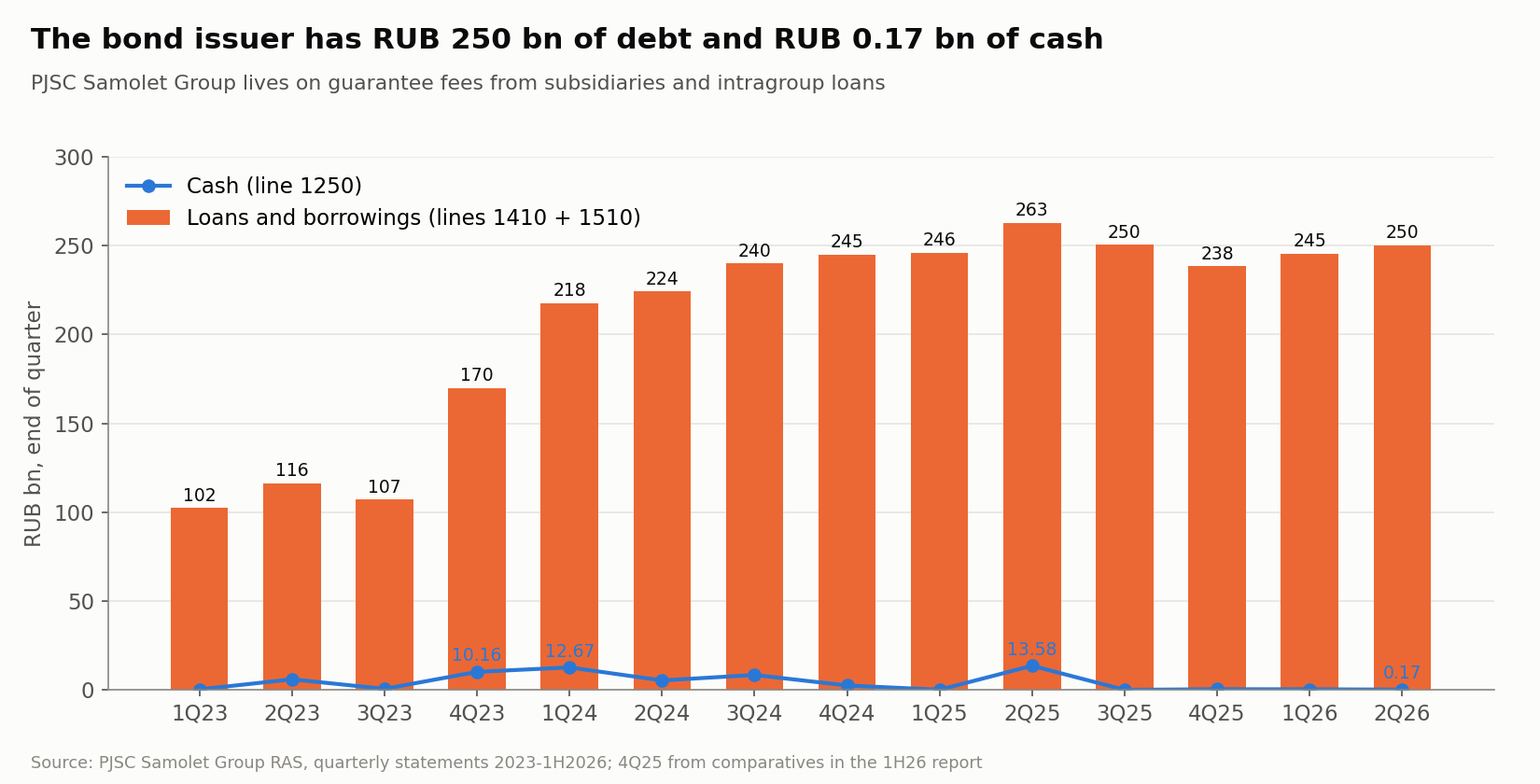
The bonds are issued by PJSC Samolet Group, so it is useful for a bondholder to look at its standalone RAS statements. Fact. At 30 June:
- cash in accounts of RUB 0.17 bn;
- loans and borrowings of RUB 250.1 bn: bonds, bank loans of RUB 79.1 bn, loans from its own subsidiaries and interest accrued on them;
- equity of RUB 11.1 bn;
- all revenue for the half-year (RUB 8.6 bn) is fees from subsidiaries for guarantees;
- collateral issued for loans and guarantees totals RUB 1,443 bn.
Over three years the PJSC's debt grew from RUB 102 bn to RUB 250 bn. In half of the quarters, cash at period end was below the monthly coupon amount (about RUB 1 bn).
The PJSC has guaranteed its subsidiaries' loans, so if problems arise the banks will claim against both the project company and the holding. Unlike bondholders, the banks hold collateral: rights to land and buildings under construction worth RUB 268.5 bn, stakes in subsidiaries with net assets of RUB 49.9 bn and claims under loans of RUB 12.2 bn.
The PJSC does not pay interest on loans from its own subsidiaries but accumulates it: long-term payables on them grew from RUB 7.9 bn to RUB 15.0 bn in six months. The holding is saving cash on intragroup settlements in order to pay external creditors.
In its 2025 statements the PJSC corrected prior-year errors, and equity at the end of 2024 fell almost by half. Fact. In its 2023 statements the company did not fully reflect the impairment of investments in subsidiaries (RUB 6.25 bn), a loan to a subsidiary (RUB 0.35 bn) and receivables from subsidiaries (RUB 1.70 bn); in 2024 it wrongly recognised RUB 0.9 bn of income from participation and a deferred tax asset of RUB 0.31 bn. In the original statements the PJSC's equity at the end of 2024 was RUB 18.2 bn; in the restated ones, RUB 9.4 bn. The conclusion for a holder is simple: the issuer's RAS statements for past years showed an equity cushion that did not exist.
Loans to related parties are growing, and provisions on them have risen ninefold
Fact. At 30 June the group had lent RUB 13.5 bn to companies connected through key management personnel. The loans are unsecured, at 21.6% a year, for 1-5 years. In 1H, already in the middle of the cash problems, another RUB 0.54 bn was lent to them. The expected credit loss provision on these loans rose from RUB 151 mn to RUB 1.31 bn. Another RUB 3.5 bn has been lent to joint ventures (provision RUB 1.7 bn) and RUB 6.1 bn to project partners.
An outside investor cannot check on what terms this money was lent or whether it will come back. Interest income on such loans flatters the accounts until the borrowers stop paying. There are no direct signs of cash being siphoned off in the statements, but with RUB 0.17 bn in the issuer's accounts, RUB 23 bn of loans to related parties, JVs and partners is a large sum, and the rise in provisions shows that the company itself already considers part of it problematic.
The heaviest months are January-February and July-August 2027
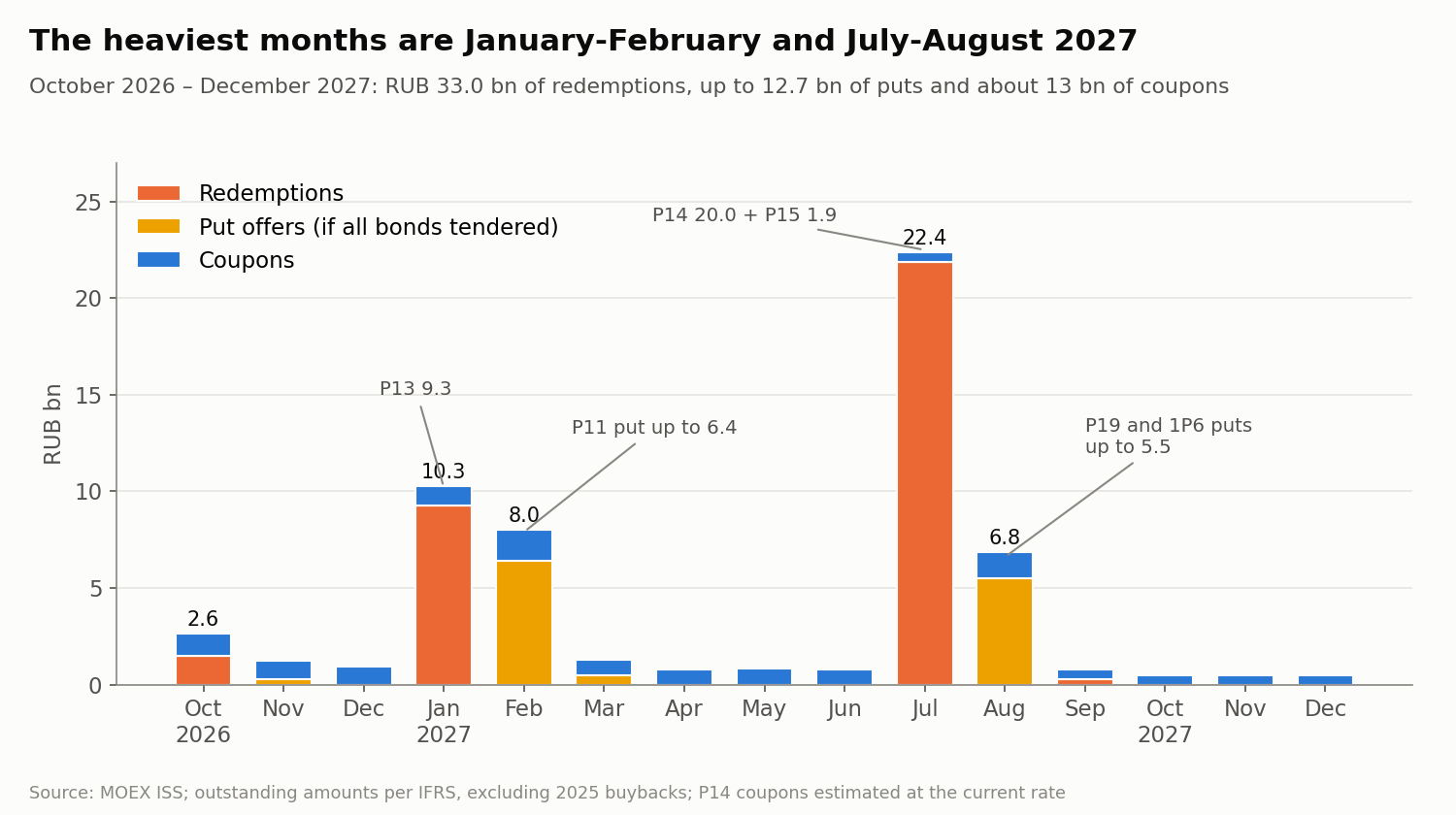
Upcoming payments:
- 30 October 2026 – redemption of issue 01, RUB 1.5 bn;
- 9 November – put offer on issue 1P5, up to RUB 0.3 bn;
- 24 January 2027 – redemption of BO-P13, RUB 9.3 bn (the remainder after the February 2026 put);
- 12 February – put offer on BO-P11, up to RUB 6.4 bn;
- 22 and 30 July – redemption of BO-P14 (RUB 20.0 bn) and the remainder of BO-P15 (RUB 1.9 bn);
- 2 and 9 August – put offers on BO-P19 and 1P6, up to RUB 5.5 bn.
Authors' estimate. From October 2026 to December 2027 holders are due RUB 33 bn of redemptions, up to RUB 12.7 bn at put offers and about RUB 13 bn of coupons, up to RUB 59 bn in total. That is more than the group's cash EBITDA for a year. Since June the company has placed only RUB 1.6 bn of new bonds (the discount issue 002P-05).
On the 28 August call, asked about the January-February redemptions, the CFO replied that there "is a plan, and there was one a year ago", that the 2026 put offers had gone smoothly and the redemptions would go the same way.
The industry: new-build sales under pressure from the key rate and the new family mortgage
The industry backdrop is unfavourable. The key rate is 14%, market mortgages are about 18.7% a year, and the next Bank of Russia meeting is on 23 October. On the call Samolet's CFO said market-rate mortgages would start working at a key rate of about 10%.
From 1 October the terms of the family mortgage changed: the rate depends on the number of children and the region. In Moscow, St Petersburg and their regions, a family with one child now borrows at 12% instead of 6%, and with two children at 10%. According to ERZ, about 70% of family mortgage buyers are families with one child, and the new-build market may shrink by 20%. For Samolet, whose sales are mainly in Moscow and the Moscow Region, this is a direct risk to guidance. As early as August the CFO said the 2026 sales forecast of 700-800 thousand sq m would be hard to meet.
From 1 January 2026 the moratorium on penalties for late delivery of buildings was lifted, another potential expense if construction slows.
Taxes and courts: the tax service has filed to bankrupt four project companies
According to open sources, the Federal Tax Service has filed bankruptcy petitions against four of the group's special-purpose developers:
- LLC SZ Samolet-Ostrov – 20 July, Moscow Arbitration Court, case A40-209723/2026;
- LLC SZ Samolet-Poima – 6 August, Moscow Region Arbitration Court, case A41-81525/2026;
- LLC SZ Paveletskaya – 11 September, claim of RUB 14.3 mn, case A40-298131/2026; according to the tax service as of 14 September, the company's accounts are blocked;
- LLC SZ Samolet-Pyatnitskie Kvartaly – 11 September, case A40-297013/2026, hearing scheduled for 15 October.
No bankruptcy proceedings have been opened in any of the cases. We have not checked the outcome of the hearings in the first two cases. The amounts are small for the group, but tax claims against project companies usually mean that money for current payments is already short at the level of individual developments.
What bond prices imply
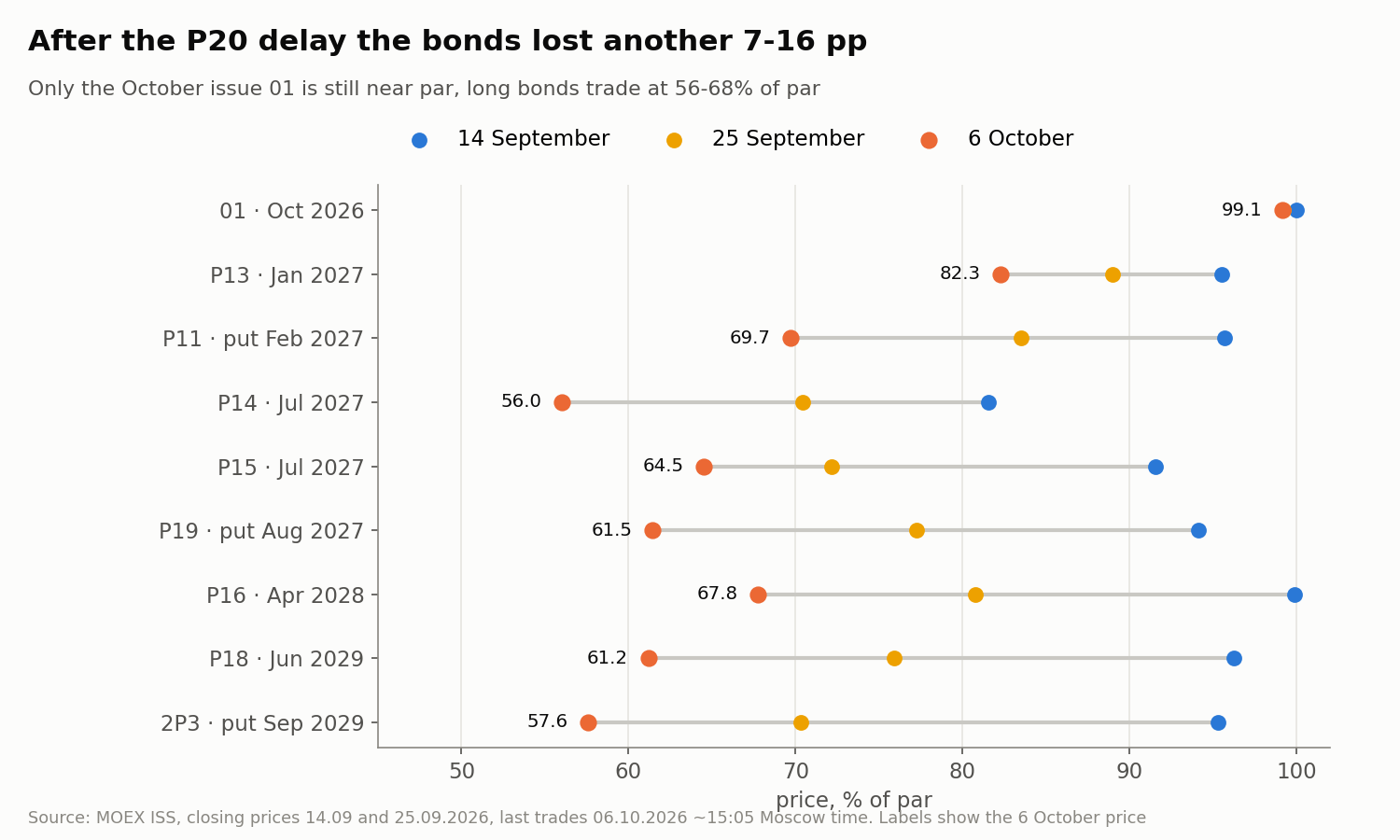
Moscow Exchange prices on 6 October (last trades around 15:05 Moscow time, cross-checked with Smart-Lab), with the 14 September close in brackets:
- issue 01, maturing 30 October – 99.1% (100.0%);
- BO-P13, maturing 24 January – 82.3% (95.5%), yield to maturity per the exchange 140% a year;
- BO-P11, put on 12 February – 69.7% (95.7%), yield to put 240%;
- BO-P14, maturing 22 July 2027 – 56.0% (81.6%);
- BO-P16, maturing April 2028 – 67.8% (99.9%);
- BO-P18, maturing June 2029 – 61.2% (96.2%), yield to maturity 65%.
Authors' estimate. The probability of timely payment implied by 6 October prices, taking into account accrued coupon and discounting at 14% a year:
- BO-P13: with a recovery of 40% of face value in case of problems – 69%, at 50% – 64%, at 60% – 56%;
- BO-P11 (put in February): 51%, 43% and 33%;
- issue 01 (30 October): 97-98%.
The recovery levels are assumptions. What they turn out to be in practice depends on the terms of agreements with the banks, which do not yet exist. For comparison, at 25 September prices the same estimates were 67-77% for BO-P13 and 58-69% for BO-P11.
The market values the long issues at 56-68% of par as bonds likely to see changed terms or partial losses. If the company reaches an agreement with the banks and keeps paying, their yield will turn out to be very high. If not, losses for holders of the long issues will be larger than for the short ones.
What will show which scenario plays out
- redemption of issue 01 on 30 October and the 1P5 put on 9 November: the money must reach the depository on time, without a repeat of the BO-P20 story;
- official terms of the agreements with the banks: which loans, projects and PJSC guarantees are affected, and whether bond servicing is preserved;
- sources of money for January-February: new non-project loans, sales of land or projects;
- the Bank of Russia rate decision on 23 October and sales in October-November after the family mortgage change;
- ACRA's reaction to the BO-P20 delay.
Bottom line: Samolet bonds are a bet on an agreement with the banks
Both sides have weighty arguments. For the bonds: the company's size, the banks' interest in completing construction, the small share of bonds in the debt, and the put offers passed in 2026. Against: a business that does not earn its interest at the current rate, thin equity, an issuer with no cash and RUB 1.44 trn of guarantees, two payment delays in six months, growing loans to related parties and a heavy redemption schedule in 2027.
The market considers the short issue 01 almost risk-free. For BO-P13 and the BO-P11 put, prices imply a significant probability of problems, and only the terms of the agreements with the banks can settle the argument between optimists and pessimists. Until they are published, Samolet bonds are suitable only for those prepared for high risk who understand that in a bad scenario an unsecured bondholder stands in line behind the banks with their collateral.
What to take from this story into your own practice
- Look at the bond issuer, not just the group. The consolidated statements show RUB 773 bn of debt and RUB 9.9 bn of cash; the PJSC's statements show RUB 0.17 bn in its accounts and RUB 1.44 trn of guarantees.
- Check what the company calls corporate debt. Moving land loans into project finance cut the figure in half.
- Separate non-cash revenue from actual cash. For developers the escrow effect can be more than half of EBITDA.
- Compare accrued interest, not just interest in the income statement. Samolet's capitalised interest for the year exceeds the interest that went through expenses.
- Calculate equity without intangibles and deferred taxes. For a group with RUB 23 bn of equity, tangible equity turned out to be negative.
- Read the notes on error corrections. The restatement of the PJSC's RAS statements cut equity at the end of 2024 almost by half.
- Money arriving late at the depository is a signal even if the payment went through. Two delays in six months show the issuer has no liquidity cushion.
- Loans to related parties when cash is short are a negative until proven otherwise. The rise in provisions on them shows that the company itself already considers part of the money problematic.
An extended Samolet card with financials and multiples is available on our portal Frontier.
Sources
- IFRS statements of PJSC Samolet Group for 2023-2025 and 6 months of 2026; RAS accounts of the PJSC for 2023-1H2026 (e-disclosure).
- Recording of the company's analyst call on 1H2026 results, 28.08.2026.
- MOEX ISS and Smart-Lab: issue parameters, coupon and put schedules, prices.
- [RIA Real Estate on the BO-P20 redemption, 29.09.2026](https://realty.ria.ru/20260929/samolet-2121042753.html); [Prime, 29.09.2026](https://1prime.ru/20260929/samolet-873778005.html); [Kommersant, 17.09.2026](https://www.kommersant.ru/doc/8956474); [Interfax on 1H2026 results](https://www.interfax.ru/business/1111802); [RIA Novosti on the Ministry of Finance position, 24.02.2026](https://realty.ria.ru/20260224/minfin-2076478593.html); [Kommersant on the Fonte Capital deal](https://www.kommersant.ru/doc/8876403); [RIA Real Estate on the sale of the Fonte stake, 29.09.2026](https://realty.ria.ru/20260929/samolet-2121047194.html); [ACRA, 24.12.2025](https://www.acra-ratings.ru/press-releases/6448/); [Vedomosti on the rating review, 06.02.2026](https://www.vedomosti.ru/investments/news/2026/02/06/1174492-akra-prisvoilo-status); [Rusbonds on the removal of the review, 02.03.2026](https://rusbonds.ru/news/20260302133400187919); [Kommersant on the 5 May technical default](https://www.kommersant.ru/doc/8636934); [Vitvet on the tax service petitions, 17.09.2026](https://vitvet.com/about/news/iski-o-bankrotstve-dochek-gk-samolet/); [RIA Real Estate on resumed construction at Kvartal Marino, 02.04.2026](https://realty.ria.ru/20260402/samolet-2084871143.html); [Dvizhenie.ru on Kvartal Marino](https://dvizhenie.ru/media/6135/samolet-vozobnovil-stroitelstvo-nacionalizirovannogo-zhk-kvartal-marino); [Ministry of Finance on the new family mortgage terms, 24.09.2026](https://minfin.gov.ru/ru/press-center/?id_4=40636).
See also: market overview · valuation map · stock screeners