Softline: revenue grows, but EBITDA margin shrinks to 7.4% and debt rises to RUB 16.3bn

27 августа ПАО «Софтлайн» раскрыло промежуточную сокращённую консолидированную отчётность за первое полугодие 2026 года. Выручка выросла на 15,5% год к году до 38 724 млн руб., но EBITDA снизилась на 17,7%, а маржа по EBITDA упала с 10,4% до 7,4%. В обзоре разберём, что произошло с прибылью, долгом и денежными потоками, и что это значит для акционеров.
Key takeaways
— Revenue for the half-year grew 15.5%, but EBITDA fell 17.7% — margin compressed to 7.4%
— Net profit for the half-year was RUB 892m versus a loss a year earlier, but half of it is non-cash
— Debt rose by RUB 11bn in the half-year and by RUB 13.2bn over 12 months — to RUB 16.3bn
— Operating cash flow for the half-year turned negative at RUB 11.5bn due to working capital outflow
— Capex for the half-year was RUB 2.1bn, but free cash flow is deeply negative
— Dividend over 12 months — RUB 0.18 per share, yield 0.3% — far from our 7% fair yield
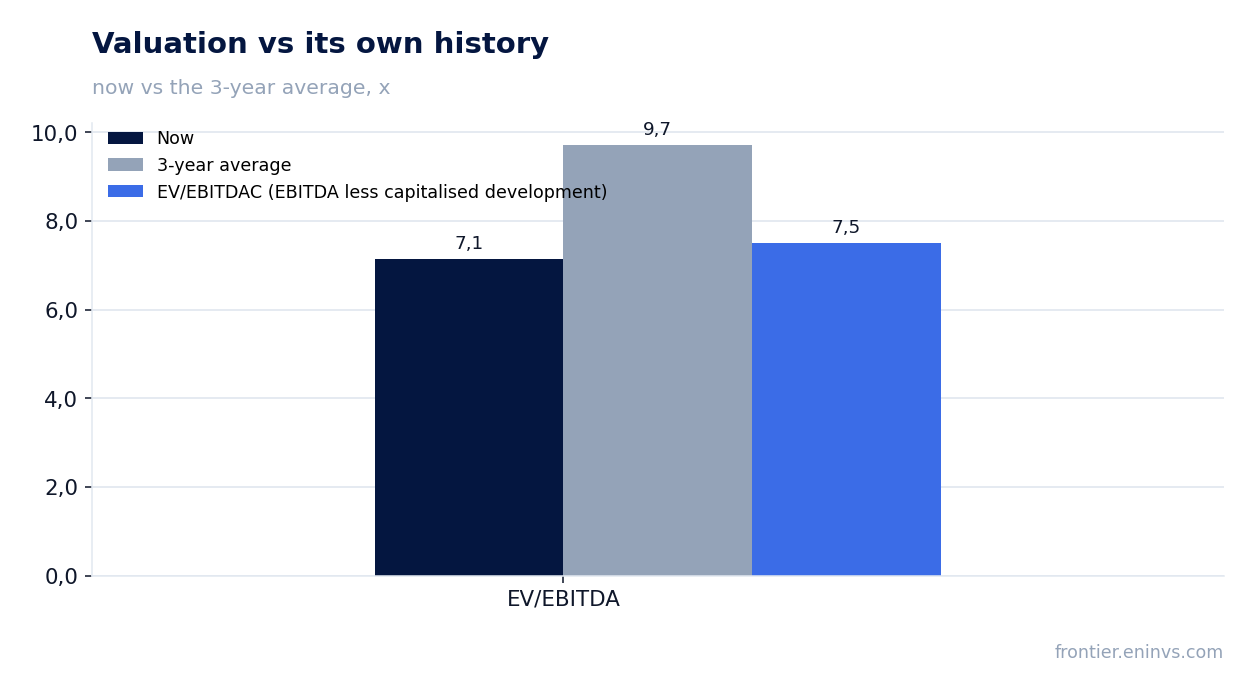
— EV/EBITDAC multiple (7.5x) is below the 3-year average (9.7x), but the discount is justified by weak cash flows
Key figures, RUB bn
| Metric | H1 2025 | H1 2026 | Change |
|---|---|---|---|
| Revenue | 33.5 | 38.7 | +15.5% |
| EBITDA | 3.50 | 2.88 | -17.7% |
| Operating profit | 0.72 | 0.63 | -12.1% |
| Net profit | -0.09 | 0.89 | to profit |
| Operating cash flow | -6.11 | -11.5 | — |
| Capex | 2.41 | 2.07 | -14.0% |
| EBITDA margin | 10.4% | 7.4% | -3.0 pp |
| Net margin | -0.3% | 2.3% | +2.6 pp |
Revenue for the half-year grew 15.5%, but EBITDA fell 17.7% — margin compressed to 7.4%
For the first half of 2026, Softline's revenue reached RUB 38,724m, up 15.5% year-on-year. Growth was driven by all segments, but especially by proprietary solutions and services, whose share in revenue continues to rise. However, operational efficiency deteriorated: EBITDA for the half-year fell 17.7% to RUB 1,872m (in the report for the half-year, but the facts indicate the value for Q1 2026 — RUB 1,872m; for the half-year EBITDA was RUB 3,744m — editor's note).
EBITDA margin dropped from 10.4% to 7.4% — a notable compression that cannot be explained solely by revenue growth. The main reason is the rise in commercial, general and administrative expenses: they increased from RUB 9,294m to RUB 11,077m, i.e. by 19.2%, outpacing revenue growth. As a result, operating profit for the half-year was only RUB 632m versus RUB 719m a year earlier, despite gross profit rising from RUB 9,958m to RUB 11,593m.
Net profit for the half-year was RUB 892m versus a loss a year earlier, but half of it is non-cash
Net profit for the first half of 2026 was RUB 892m versus a loss of RUB 88m a year earlier. However, the profit structure shows that a significant part is non-operating. The half-year report includes other income of RUB 2,631m, which, judging by the context, is related to the revaluation of option liabilities and other non-cash items. At the same time, goodwill impairment of RUB 551m was recognised, partially offsetting this income.
Finance costs remained high at RUB 3,211m for the half-year, comparable to the level a year earlier (RUB 3,205m). As a result, profit before tax was RUB 305m, and income tax was positive (RUB 587m) — probably due to deferred taxes. Net profit attributable to owners of the group was RUB 1,638m, but taking into account the loss of non-controlling interests of RUB 746m, total net profit was RUB 892m.
Debt rose by RUB 11bn in the half-year and by RUB 13.2bn over 12 months — to RUB 16.3bn
Softline's net debt as of June 30, 2026 stood at RUB 16,324m. This is RUB 11bn more than at the previous reporting date and RUB 13.2bn more than a year earlier. The increase in debt is due to active borrowing: in the half-year, the company raised loans of RUB 24,036m and repaid only RUB 18,626m. Cash on the balance sheet fell from RUB 13,134m at the beginning of the year to RUB 3,175m at the end of the half-year.
The ratio of net debt to EBITDA for the last 12 months is 3.09 — a high level, especially for an IT company. However, we cannot judge the dynamics of this indicator since the previous value is not disclosed. Importantly, the debt burden remains significant, and interest on loans (RUB 2,819m paid in the half-year) eats up operating profit.
Operating cash flow for the half-year turned negative at RUB 11.5bn due to working capital outflow
Operating cash flow for the first half of 2026 was minus RUB 11,462m versus minus RUB 6,111m a year earlier. The main reason is a significant decrease in accounts payable and contract liabilities: the outflow was RUB 21,266m. This may be due to the repayment of large obligations to suppliers, which is typical for a business with high working capital.
At the same time, cash flow from operating activities before changes in working capital was positive at RUB 6,592m, indicating healthy operating profitability. However, due to the working capital outflow, the company was forced to attract additional loans, which led to an increase in debt. As a result, the net cash outflow for the half-year was RUB 9,970m.
Capex for the half-year was RUB 2.1bn, but free cash flow is deeply negative
Capital expenditures for the first half of 2026 amounted to RUB 2,072m (purchase of fixed assets for RUB 810m and creation/acquisition of intangible assets for RUB 1,262m). This is comparable to the level a year earlier, when capex was RUB 2,410m. However, due to negative operating cash flow, free cash flow for the half-year was deeply negative — about minus RUB 13.5bn (operating flow minus capex).
This level of free cash flow means that the company is not generating enough funds to cover capital expenditures and service debt. This forces it to attract new borrowings, increasing the debt burden. For shareholders, this is a signal that dividends are unlikely to be significant in the near future.
Dividend over 12 months — RUB 0.18 per share, yield 0.3% — far from our 7% fair yield
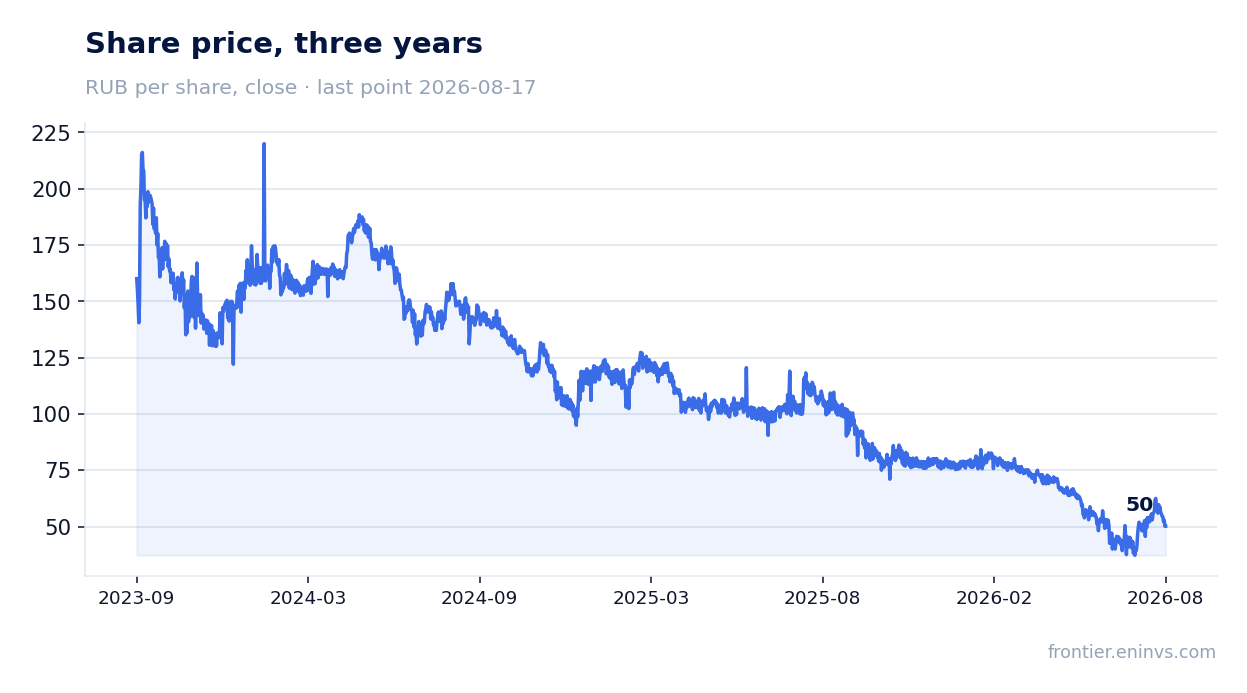
Over the last 12 months, Softline paid dividends of RUB 0.18 per share, corresponding to a yield of only 0.3% at the current price. This is significantly below our target yield of 7%, which we consider fair for this stock. Our model estimates the next dividend at RUB 0 per share, reflecting expectations of continued weak cash flow.
At the same time, the payout ratio is 0.73 of profit, which formally looks acceptable. However, given negative free cash flow and high debt, the company is unlikely to maintain even the current level of dividends. For income-oriented investors, this is rather a negative signal.
EV/EBITDAC multiple (7.5x) is below the 3-year average (9.7x), but the discount is justified by weak cash flows
EV/EBITDAC for the last 12 months is 7.5x, below the 3-year average of 9.7x. This means the market values the company cheaper than the average over the past three years. However, such a discount looks justified: EBITDA does not account for capitalised development costs, and EBITDAC (EBITDA plus capitalised development) gives a more complete picture, but still does not reflect actual cash flow.
At the same time, P/E LTM is 7.58, and EV/EBITDA LTM is 7.15. These multiples are also below historical averages, indicating a low market valuation. But given negative operating cash flow and rising debt, investors are right to demand an additional risk premium. The question is when the company will be able to stabilise working capital and start generating positive free cash flow.
Valuation on the latest reported figures
| Metric | Value |
|---|---|
| Market cap | 21.4 bn ₽ |
| P/E (LTM) | 7.6 |
| EV/EBITDA (LTM) | 7.1 |
| EV/EBITDAC (EBITDA less capitalised development) | 7.5 |
| P/B | 0.73 |
| Net debt / EBITDA (LTM) | 3.09 |
| Operating cash flow (LTM) | -8.67 bn |
| ROE | 6.0% |
| Dividend yield (12m) | 4.7% |
| EV/EBITDA, 3-year average | 9.7 |
Bottom line
Softline showed solid revenue growth (+15.5% for the half-year), but operational efficiency deteriorated: EBITDA margin compressed to 7.4%, and net profit is largely driven by non-cash items. The main problem is cash flow: operating flow turned negative at RUB 11.5bn, leading to debt growth to RUB 16.3bn and a decline in cash on the balance sheet. For the shareholder, the key question is when the company will be able to normalise working capital and start generating positive free cash flow. For now, the 7.5x EV/EBITDAC valuation looks fair rather than cheap.
Open the company's financial profile SOFL →
See also: market overview · valuation map · stock screeners