T buys Tochka at the April price, although by our estimate about RUB 20 bn was paid out of it
T-Technologies is buying Tochka from entities related to its largest shareholder, Interros, at the same price at which Interros bought a stake from VK in April: RUB 84.8 bn. Dividends have been paid out of Tochka since then: in June Tochka's bank transferred about RUB 22 bn to the holding company, and about RUB 9 bn is already visible in T's statements as paid to shareholders after April. The exact amount has not been disclosed, but by our estimate about RUB 20 bn most likely went to shareholders. The price did not change.
On a like-for-like basis the deal looks expensive. Since April, banks have fallen 11% including the dividends they paid. With that adjustment and net of the money paid out after April, Tochka's April price is about RUB 55 bn. T pays about RUB 76 bn at the market price of its shares, by our estimate roughly 38% more. Counting only the confirmed RUB 9 bn, the overpayment is about 15%. Without the payouts the price would be close to fair. On current earnings Tochka is being bought at twice the multiple T itself trades at.
The board valued 100% of JSC Tochka at RUB 84.8 bn. 64% will be paid with new T shares at RUB 320, the rest, RUB 30.5 bn, in cash funded with debt. The placement price is 27% above the previous day's close (RUB 251.24). The market had expected worse, and by 13:10 Moscow time on 1 October T shares were up 4.1%, while the banking index was up 0.5%.
85 mn new shares will reach the market, 3.3% of shares outstanding. That is less than expected, but it does not by itself make the deal cheap: T pays a third of the price in cash funded with debt. The deal is almost neutral for earnings per share. On 2025 figures the effect is +1.7%; on our 2026 estimate it is -1.4%. Only lending synergies can make it profitable, and the company has not quantified them.
Tochka's sellers are related to T's largest shareholder, Interros. T does not mention this in its deal announcements. Under US, UK or Hong Kong standards such a deal would require an independent committee, a published fairness opinion and a vote without Interros. T has disclosed none of this.
T pays RUB 84.8 bn: 64% in shares at RUB 320, 36% in cash funded with debt
Tochka's ownership has several layers. 64% of JSC Tochka belongs to Catalytic People, which T-Technologies and Interros hold almost equally (50.01% and 49.99%). Interros bought another 25% from VK in April 2026, and 11% belongs to 1C. T's own economic interest in Tochka is 32%.
The issue of 170 mn shares at RUB 320 will go to Catalytic People for its 64%. Half of these shares correspond to T's own stake and will return to the group as a quasi-treasury block. The other half, 85 mn shares, will go to Interros. At the placement price that is RUB 27.2 bn; at market, about RUB 21.4 bn.
T-Technologies will pay for the remaining 36% in cash, RUB 30.5 bn, and will borrow it. The company refers to settlements "with the other shareholders". Based on the ownership structure, that means Interros' 25% (RUB 21.2 bn) and 1C's 11% (RUB 9.3 bn).
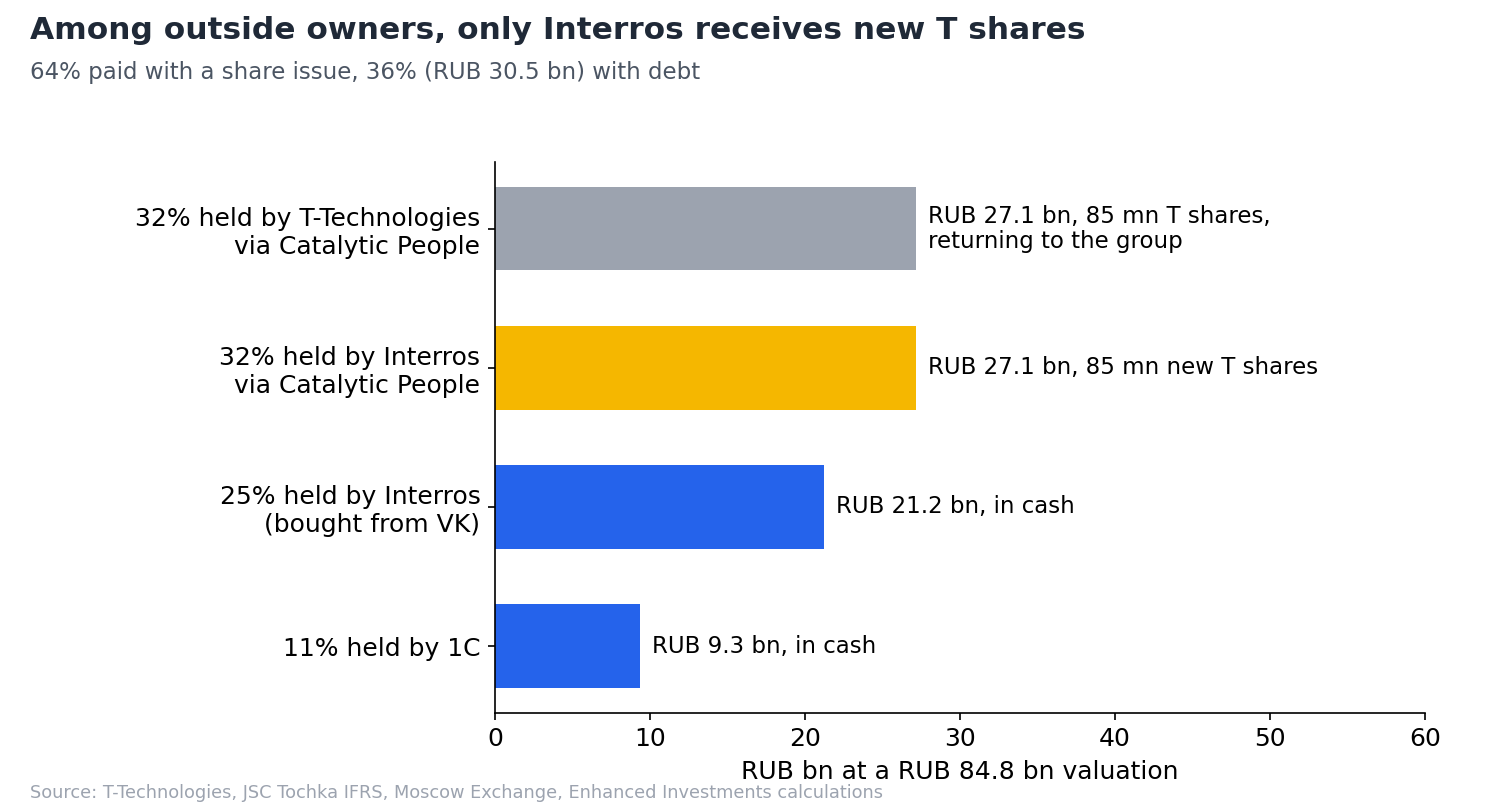
The headline RUB 84.8 bn is calculated at a T share price of RUB 320. The sellers receive stock that trades at RUB 251 on the exchange. At market prices the whole purchase costs about RUB 76 bn. Below, multiples are calculated from RUB 76 bn; from RUB 84.8 bn they come out 11% higher.
Dividends were paid out of Tochka while the price stayed at the April level: by our estimate, an overpayment of up to 38%
On 16 April 2026 Interros closed the purchase of 25% of Tochka from VK for at least RUB 21.2 bn, valuing the whole company at RUB 84.8 bn. This was a deal between unrelated parties, so in our August review we used it as the benchmark. The announced valuation matched it to the first decimal.
The market has fallen noticeably since April. From 16 April to 30 September the MOEX Index fell 17% and the financial sector index 19%. Sberbank fell 15%, Bank Saint Petersburg 22%, Sovcombank 25%, MTS Bank 30%, and T itself 23%. But part of this decline reflects dividend cut-offs: banks paid dividends over the summer. The financial sector total return index, which includes dividends, fell only 11%. For a comparison with Tochka, which also paid dividends, this is the right index to use.
Part of the decline is reflected in the deal. The RUB 320 placement price almost matches T's share price in April (RUB 326 after the split), so the share component fell in value along with T. At market prices the whole purchase is worth about RUB 76 bn. The cash component is not adjusted for the market decline. 1C receives the full April price in cash for its 11%.
The April price adjusted for banks' total return is RUB 75.4 bn. If nothing had been taken out of Tochka, a RUB 76 bn deal would be almost fair. But in April Interros bought Tochka together with money that was later paid out to shareholders. T is buying it without that money. So the paid-out money has to be deducted from the comparable price.
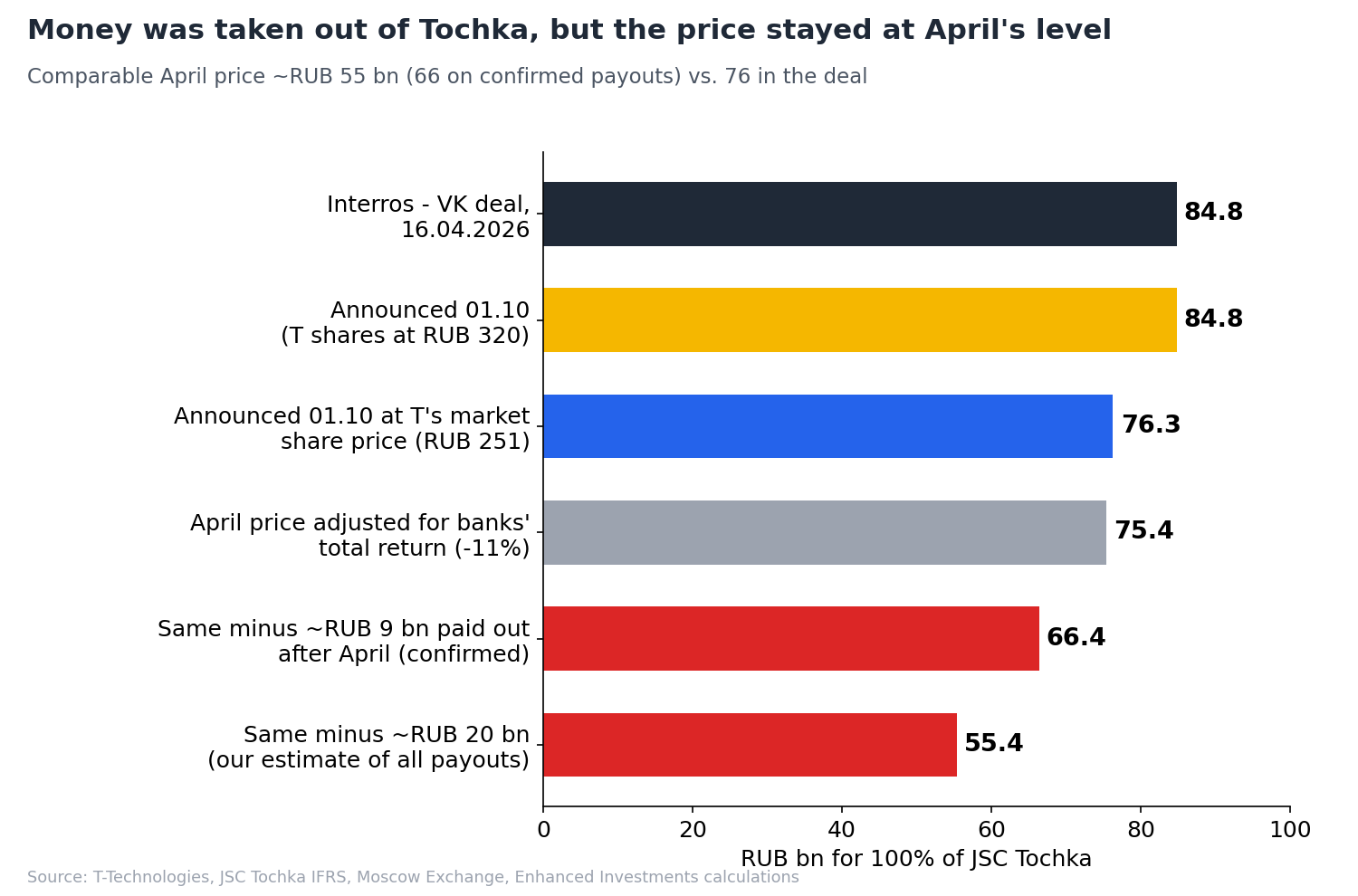
If about RUB 20 bn went to the holding company's shareholders after April, as we estimate, the comparable April price is RUB 55 bn and T pays 38% more. If only the RUB 9 bn confirmed by T's statements, it is RUB 66 bn and an overpayment of about 15%. In money terms this is RUB 7-14 bn for the 68% being acquired, 1-2% of T's market capitalisation. Interros and 1C receive it.
In that case, on its 25% bought from VK, Interros received RUB 2-5 bn of dividends over a few months of ownership and is selling the stake to T at cost. Over the same period the banking sector fell.
On current earnings Tochka is being bought at twice T's own multiple
T-Technologies trades at 3.4x trailing 12-month earnings and 0.9x book. We count shares outstanding, excluding 132.8 mn treasury shares. Sberbank trades at 3.3x earnings and 0.7x book, Bank Saint Petersburg at 4.0x and 0.5x, Sovcombank at 2.6x and 0.5x, MTS Bank at 1.9x and 0.3x. VTB is excluded from the comparison, as its equity is inflated by preferred shares and perpetual bonds.
At the deal price Tochka costs 4.0x 2025 earnings if earnings are cleaned of the income on dividends already paid out (more on this below). That is in line with T itself and the banks. On our estimate of 2026 earnings the deal P/E is 7-8x, twice that of any bank on the list. From the headline RUB 84.8 bn it is 8-9x.
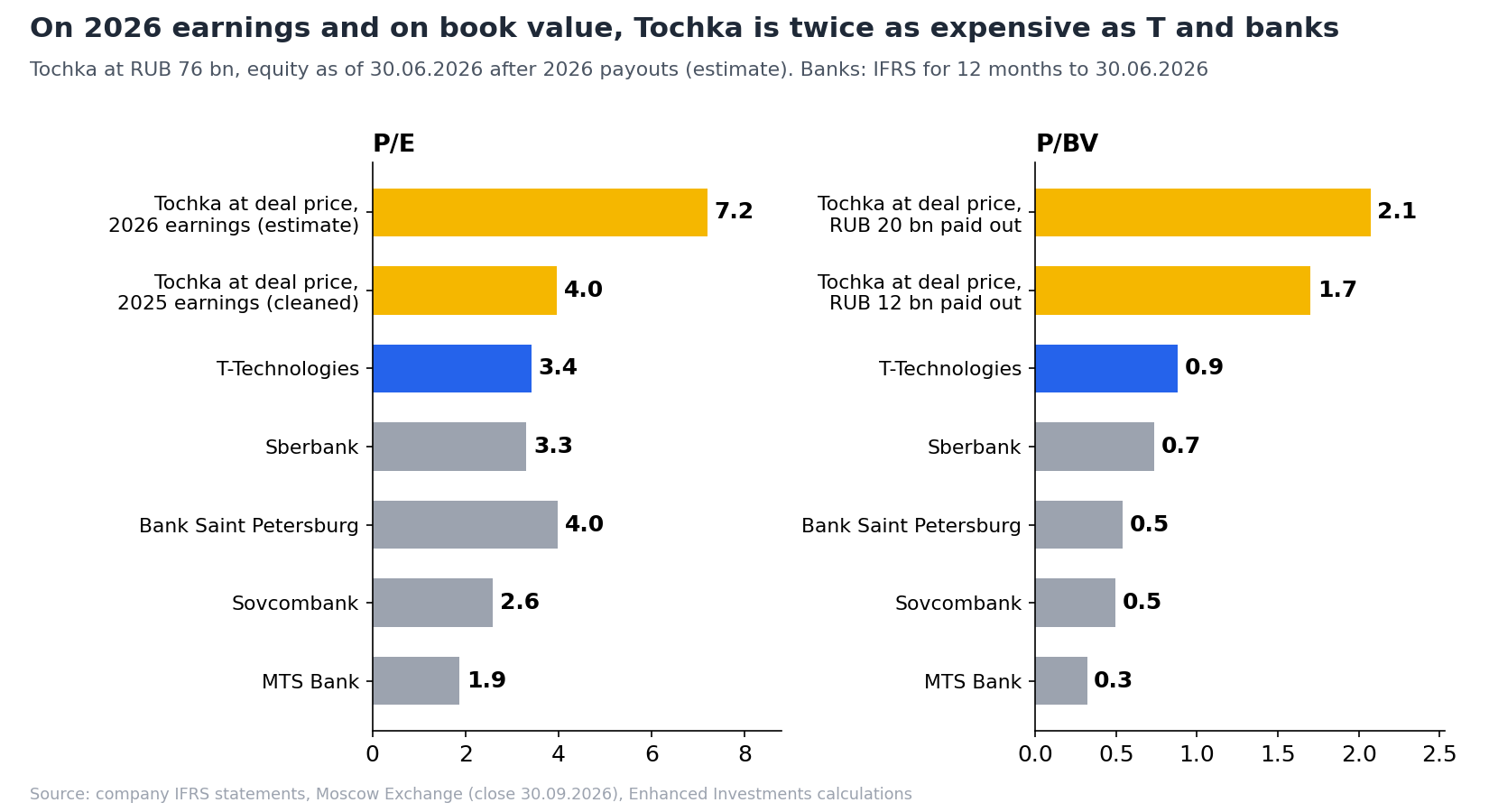
On book value the premium is obvious. Tochka's equity was RUB 51.5 bn at the end of 2025 and RUB 50.4 bn on 31 March 2026 according to T's IFRS. After the 2026 payouts it is, by our estimate, about RUB 35-44 bn. The deal P/BV is 1.7-2.2x against 0.9x for T. Part of the premium is justified by profitability. In 2025 Tochka earned about 42% on average equity against 26% for T, but its profit is falling in 2026.
At T's own multiples Tochka would be worth about RUB 66 bn on cleaned 2025 earnings, about RUB 32-36 bn on 2026 earnings and RUB 31-39 bn on book value after payouts. A RUB 76 bn deal is more expensive than any of these. T gives away its own shares, valued at 3.4x earnings, and receives a business at 7-8x this year's earnings, with falling profit.
Before the terms were announced, analysts discussed RUB 150-200 bn, and in our July research we feared 3-4x book. The actual price is better than those fears but more expensive than the banking market and T itself.
Tochka's profit will almost halve in 2026: both the bank's reporting and T's IFRS show it
The company gives no profit forecast for Tochka, and the holding JSC Tochka publishes no interim statements. But there are two indirect sources, and both point to a roughly twofold decline.
The first is Bank Tochka LLC's Form 102 reporting to the CBR for 1H2026.
- Net interest income of RUB 19.1 bn against RUB 22.6 bn a year earlier, down 15%. Almost all of it is the key rate earned on entrepreneurs' balances, and the average rate fell from 20.9% to 15.1%.
- Fee income of RUB 5.7 bn against RUB 5.4 bn, up 5%.
- Provisions of minus RUB 2.1 bn against almost zero, apparently due to loans to marketplace sellers, which Tochka has frozen.
- Income after provisions and before operating expenses of RUB 24.3 bn against RUB 28.9 bn, down 16%.
The bank's RAS profit meanwhile rose 64% to RUB 13.3 bn before tax. This is an artefact. "Other operating expenses", which include the bank's fees to the holding company, fell from RUB 18.7 bn to RUB 4.5 bn. Money stopped flowing within the group, but the group's profit does not change because of this. Excluding this reshuffle, the bank's business shows a 16% drop in income.
For the holding company this means a much sharper fall in profit. Tochka's expenses in 2025 ate up more than half of revenue and grew 38%. If they grow another 10-20% in 2026 while income falls 16%, the holding company's profit will drop 40-50%.
The second source is T's own IFRS, and it is more precise. In its 1Q report T provides a table for JSC Tochka: profit for the quarter was only RUB 1.8 bn. In May-December 2025 Tochka earned about RUB 1.4 bn a month, i.e. more than RUB 4 bn a quarter. For the half-year, T's share of associates' profit, excluding Selectel, corresponds to Tochka profit of about RUB 4.5-5 bn.
A line-by-line model based on the holding company's 2025 statements gives the same figure. Assumptions: interest income -15%, fees +5%, IT revenue +15%, expenses +10-20%, provisions doubled, minus the income on the RUB 14 bn of dividends paid in 2025.
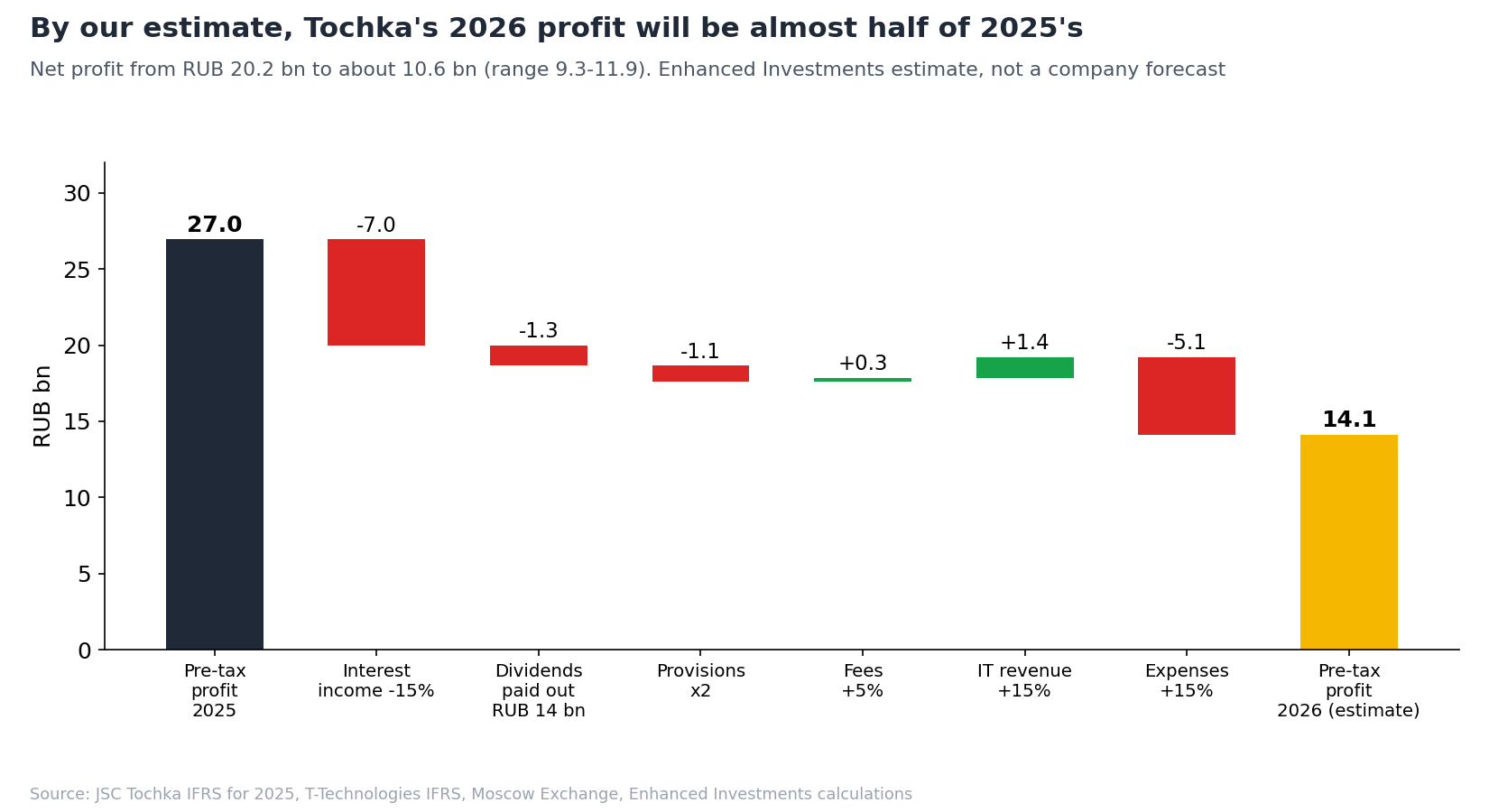
Net profit for 2026, according to the model, is about RUB 10.6 bn, and taking into account 1Q and provisions more likely RUB 9-10 bn. If interest income falls 25%, profit will be about RUB 7 bn. VAT on card and IT services from 2026 (Law 425-FZ) is not accounted for separately and may reduce fee growth.
The 2025 dividend is ordinary; the problem is the 2026 payout, made after the price was set and before closing
Dividends are a normal thing for a profitable bank, and the 2025 payout raises no questions. Tochka declared RUB 14 bn, 69% of 2025 profit. For a business that needs almost no capital for lending, this is a lot, but not abnormal. Equity at the end of 2025, RUB 51.5 bn, is already net of the payout, and by year-end at least RUB 9 bn of the 14 had been paid, most likely the full amount. The dividend on VK's stake went to VK itself. Interros' April price was calculated without this money, so it does not distort the comparison with the deal price.
The only adjustment from this payout concerns the multiple. 2025 profit was partly earned on RUB 14 bn that is no longer in the company, about RUB 1 bn net. So we calculate the 2025 P/E from cleaned profit, RUB 19.2 bn instead of RUB 20.2 bn.
The 2026 payout is different. It took place after Interros bought the stake from VK. According to monthly Form 123, Bank Tochka LLC's own funds fell in June 2026 from RUB 40.6 bn to RUB 19.5 bn, and core capital from RUB 35.7 bn to RUB 13.5 bn. Nothing like this happened in 2025; the bank's capital grew throughout the year. A RUB 22 bn drop in a single month corresponds to a dividend paid by the bank to its owner, the holding JSC Tochka. In response to our question the company confirmed that dividends were paid this year and that part of them reached T as a shareholder. It did not disclose how much the holding company passed on to shareholders.
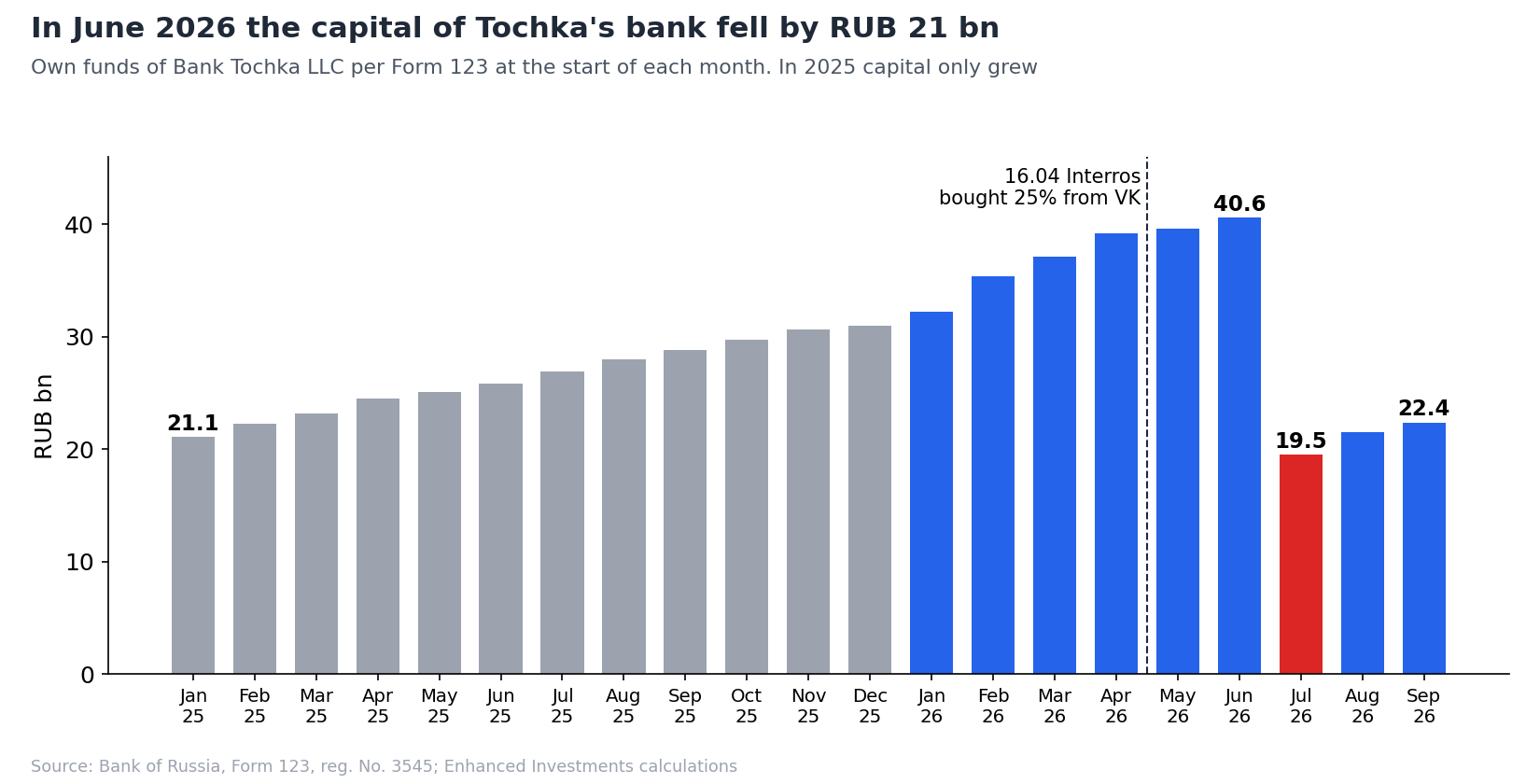
How much of this reached shareholders can be seen in T's own statements. T accounts for 64% of Tochka through Catalytic People as a joint venture. In 1Q T received RUB 1.9 bn in dividends from Tochka, meaning Tochka paid out about RUB 3 bn in total, before Interros' purchase. For the half-year T received about RUB 7.7 bn from associates, so in 2Q Tochka paid out about RUB 9 bn. The rest of the RUB 22 bn transferred by the bank in June did not appear in the half-year statements. In response to our question the company suggested relying on the bank's monthly reporting to see the payouts. By our estimate, the remainder most likely also went to shareholders in 3Q. T's 9-month report will show this precisely. The company does not disclose the amount.
The issue is not the dividend itself but three circumstances. The payout took place after the price benchmark was set in April and before the deal closed, yet the price did not change. In normal practice such payouts before closing are prohibited or deducted from the price. Over a year and a half, from early 2025 to mid-2026, Tochka earned about RUB 25 bn and paid out at least RUB 26 bn, and by our estimate about RUB 38 bn, 105-150% of profit. T itself pays out about 30% of profit, Sberbank 50%. And the money went to the sellers, while Tochka bank's capital halved. Lending to its clients, which is the purpose of the deal, will have to be funded with T's capital.
T-Technologies says the payout is reflected in the valuation, but the price in roubles does not differ from April. Hence the overpayment of up to 38% calculated above, and a P/BV of about 2x instead of 1.5x. The company promises to disclose Tochka's figures with its 3Q report; until then the payout amount cannot be verified.
The question remains why T did not buy VK's stake itself in the spring. According to reports on the deal, Interros bought it in order to later pass it to T through a share issue. Had T bought the stake directly, it would have paid the same RUB 21.2 bn, and the summer dividends, by our estimate RUB 3-5 bn, would have gone to its shareholders. Now they are with Interros, and the price for T is unchanged. Whether T was offered the stake has not been publicly disclosed.
Dilution of 3.3% instead of 7%: the payment structure softens the high price
In August the board set the issue ceiling at 550 mn shares and estimated actual needs at half of that. Net of the quasi-treasury third, about 187 mn shares would have reached the market, 7.3% of shares outstanding. Now the company names 85 mn, or 3.3% (3.2% of all issued shares, as T itself calculates).
The difference comes from two decisions. A third of the price is paid in cash rather than shares. Shares are given at RUB 320 instead of the market RUB 251. At the market price, 108 mn shares would have been needed for the same amount instead of 85 mn.
Interest on the debt at a 14% rate and 25% tax will cost about RUB 3.2 bn of net profit a year.
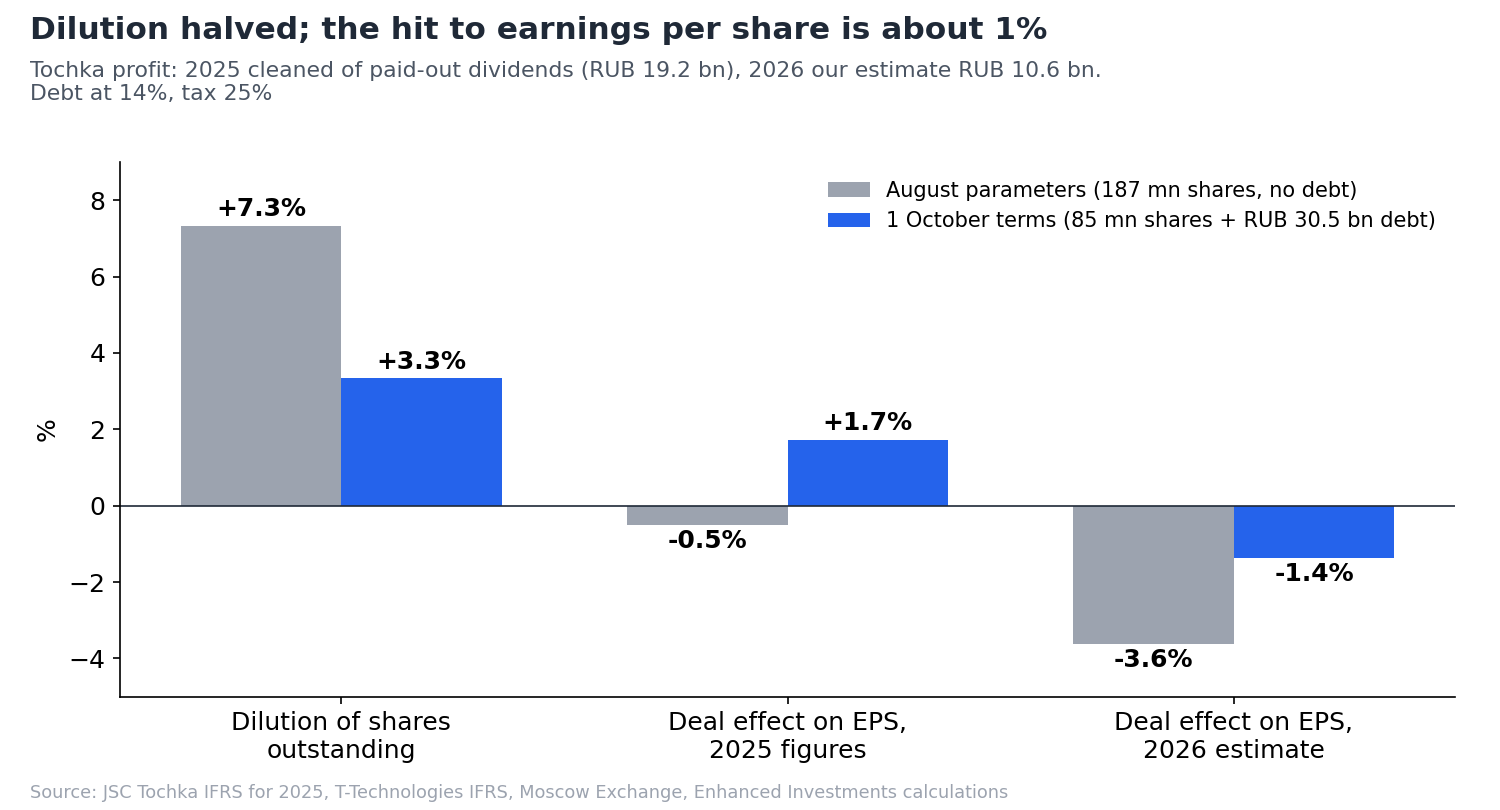
Applied to 2025 figures, the deal adds 1.7% to T's earnings per share. T's own EPS for 2025 grew 21%, which is a separate metric. T receives 68% of Tochka's cleaned profit, RUB 13.1 bn, minus RUB 3.2 bn of interest, and divides the result by a share count 3.3% higher. On the 2026 estimate the result is -1.4%, in a range from -1.8% to -1.0%. Under the August parameters on the same data, the figures were -0.5% and -3.6%.
Debt at 14% is three times cheaper than a share issue at market
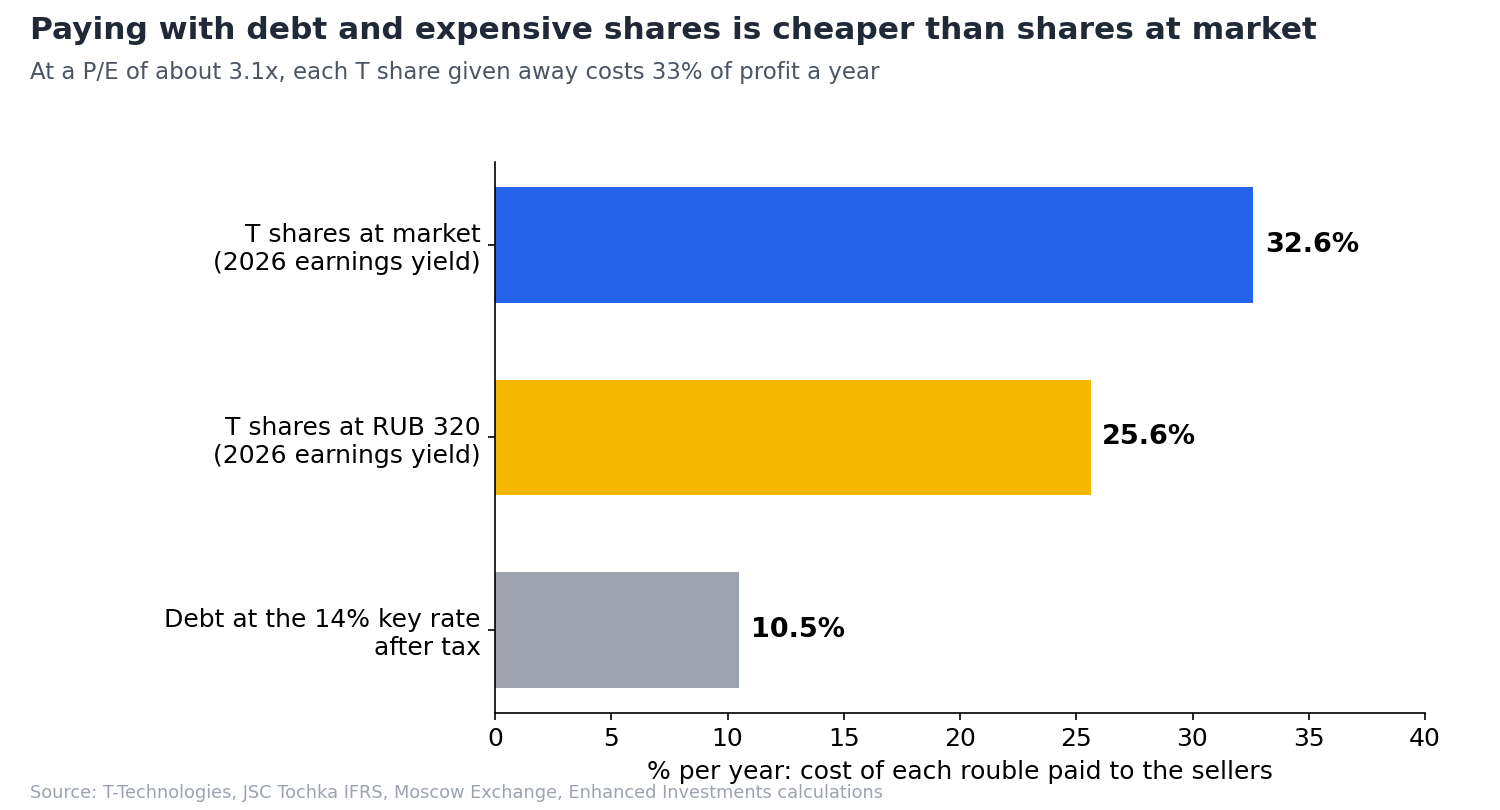
T-Technologies is worth about RUB 641 bn on the exchange, counting only shares outstanding. With 2026 profit guidance of RUB 209 bn, that is a P/E of about 3.1x. Each new share given away at market costs existing shareholders 33% of annual profit per rouble invested.
A loan at the 14% key rate costs about 10.5% a year after tax. Shares at RUB 320 cost 26%. The company explained the choice of cash payment by a wish "not to divert capital from the core business". At T's current multiples it is also the cheapest way for shareholders to pay.
The company named the rate guidance, around the key rate or key rate plus 1 pp, but did not disclose the term or the borrower within the group.
The deal will consume part of the capital, and with it part of the room for dividends. T pays about RUB 76 bn for a company with equity of RUB 37-45 bn after payouts. The difference of RUB 31-39 bn will go into goodwill and intangible assets, which are deducted from the banking group's capital. On top of that, Tochka's risk-weighted assets will come onto the group's balance sheet. By our rough estimate, T's Basel CET1 ratio, 11.8% on 30 June, will fall by 0.5-1 pp. Tochka bank's own capital halved after the June payout, to RUB 19.5 bn, so lending to Tochka's clients will have to come from T's balance sheet. The smaller the capital buffer, the less room for dividend growth and buybacks. The company says capital in the core business is sufficient and promises dividend per share growth of more than 20% in 2026. It has not disclosed the deal's effect on capital ratios.
T holds 132.8 mn treasury shares but chose not to pay with them
According to T's 1H2026 statements, the group holds 132.8 mn treasury shares, 4.95% of the issue, carried at RUB 40.8 bn. At the end of 2024 there were 126.6 mn, at the end of 2025 108.8 mn, and 24 mn more were bought in 1H2026. The company directs repurchased shares to its long-term management incentive programme.
Technically this block would be enough: Interros needs 85 mn shares. For current shareholders there is almost no difference. Treasury shares do not count in the EPS calculation, and giving them to the seller dilutes shareholders just as issuing new ones does. In both cases 85 mn shares enter circulation.
The difference is the overhang. With the new issue, the group will hold about 218 mn treasury and quasi-treasury shares after the deal: 132.8 mn already repurchased plus 85 mn returning via Catalytic People. That is about 7.6% of the issue. They do not create dilution now. If they are eventually handed out to management or sold into the market, real dilution will be noticeably higher than the stated 3.2%. T has promised not to sell the quasi-treasury block from the deal into the market, but has not committed to cancelling it.
T does not call the sellers related parties
In none of T's announcements on the Tochka consolidation, from 26 August to 1 October, is Interros mentioned. They refer to "shareholders of JSC Tochka", Catalytic People and an independent appraiser. They do not say that the sellers are related to T's largest shareholder. According to the material fact on the board's decisions, all 9 board members voted in favour, including 4 independent directors. There was no separate approval by independent directors only.
T's financial statements describe the situation formally. The group states that it has no ultimate controlling party, although Interros owns more than 41% of the shares. The related-party note has a "Shareholders" column without names. It shows a non-controlling interest of RUB 111.4 bn, which is essentially Interros' half of Catalytic People. It also shows loans issued to shareholders of RUB 29.4 bn at 5.0-14.4% per year and borrowings from shareholders of RUB 90.9 bn. Some of the loans to shareholders were issued below the key rate.
At the 18 September meeting 94.1% of participants voted for the share issue, with a 63.6% turnout. Interros owns about 43% of voting shares. If it voted, it accounted for about two thirds of the votes cast, and among the other participants about 82% voted in favour. Minority shareholders as a whole supported the deal. Without Interros' votes the approval would have looked more modest than 94%. Whether Interros voted is not clear from the company's public announcements.
This is not T's first deal with Interros. In 2024 TCS merged with Rosbank through a share issue, also from Interros. Dilution then was about 35%, and Interros became T's largest shareholder. After that deal profit grew faster than before, but earnings per share lagged because of dilution, and return on equity fell from about 33% to 29%.
In developed markets the deal would be approved without Interros' votes and with a published valuation
In our July research on M&A in the Russian market ([https://telegra.ph/Empire-vs-Dividend-RU-MA-07-09](https://telegra.ph/Empire-vs-Dividend-RU-MA-07-09)) we compared how different jurisdictions protect minority shareholders when a company buys an asset from a related party. The common standard in developed markets is the same. The deal is run by a committee of independent directors. An independent bank confirms the fairness of the price in a written opinion, which is published. Shareholders receive a circular with the valuation and the financial statements of the business being acquired. Only disinterested shareholders vote.
Going through this list for Tochka gives the following picture.
- Conflict of interest. In developed markets the seller is named directly and its interest described. T does not name Interros in its deal announcements.
- Independent committee. Usually only independent directors run and approve the deal. At T the full board voted, 9 out of 9, including 4 independent directors.
- Fairness opinion. It is usually published along with the bank's name and valuation methods. T mentions an independent appraiser but does not name it or disclose either the report or the multiples.
- Vote. Usually a majority of disinterested shareholders decides. At T's meeting everyone voted, and by our estimate about two thirds of the votes belonged to Interros.
- Target financials. Usually these are full financial statements and pro forma accounts of the combined company. Tochka disclosed abridged 2025 statements without a cash flow statement; there are no interim statements and no pro forma.
- Impact on earnings per share. It is usually quantified. T writes about a "positive trajectory in the medium term" without figures.
- Synergies. They are usually stated in roubles and by year. T lists areas but not amounts.
- Payouts before closing. Usually the price is fixed at a date, taking money out of the company before closing is prohibited, and any leakage is deducted from the price. In Tochka's case the bank paid about RUB 22 bn upstream in June, after the April deal, and the price remained at the April level.
To be fair, T has disclosed more than many Russian companies in similar deals. It named the price, the number of shares, the placement price, the premium to market, the cash share of payment and the effective dilution. Many Russian related-party deals do not even disclose the price. But disclosure is still far from a standard at which a minority shareholder can check the fairness of the price on their own. Russian regulation does not require it either: since the 2017 reform, approval of an interested-party transaction is obtained only on request, and there is no mandatory fairness opinion.
We asked the company questions: some got specific answers, we are waiting on the rest
After the terms were announced, we asked T-Technologies about the same things this article covers. Why the related-party deal is not called one and who approved it. Why the price does not reflect the 20% fall in the banking sector since April. Why Tochka is being bought at 2x book and 6-7x 2026 earnings. Why payment is by share issue rather than at least partly with the treasury block.
On approval, the company pointed to the material fact: the board voted 9 out of 9, including 4 independent directors. It did not explain why the deal is not called a related-party transaction. We received specific answers on some points and are waiting on the rest: the company has not yet disclosed the dividend amount or Tochka's figures. The answers, in our paraphrase, are as follows.
- On the market decline. If one looked only at public market dynamics, no M&A deals would ever be done. Private and public multiples always differ, and Tochka is a strategic acquisition, not speculation.
- On multiples. Calculating them from Tochka's standalone statements is incorrect. Tochka's clients will be lent to from T's balance sheet, and including that income the effective multiple, by the company's estimate, is close to the banking market. B2C and operating synergies were not included in the valuation.
- On the treasury block. It is difficult to use: it is needed for T's management incentive programme and a future programme for the Tochka team. The high placement price, according to the company, should address concerns about overpayment.
- On the placement price. RUB 320 was chosen because the market price is below T's book value per share, and the company did not want to place below book. In addition, a high price makes it unattractive for minority shareholders to exercise pre-emptive rights, which reduces the actual issue. According to the company, the independent appraiser valued Tochka above RUB 84.8 bn.
- On debt. The cash component is planned to be financed at roughly the key rate or key rate plus 1 pp.
- On the quasi-treasury block from the deal. It will remain in Catalytic People for at least 12 months, and there are no plans for it. Dividends on it return to the group, and it is not counted in shares outstanding.
- On Tochka in 2026. Its income will decline following the key rate, and its equity will also decrease by year-end. The company promises to disclose selected Tochka figures with its 3Q report and describe synergies in more detail closer to closing.
- On loans to marketplace sellers. Tochka has frozen such lending, and the company attributes the losses to testing Tochka's own scoring models. Going forward, lending will be based on T's mechanisms.
Some of the answers sound convincing. The company openly says it values Tochka for its client base and for lending against its balances, not for current profit. The argument about the placement price being above book value per share is also fair; it protects existing shareholders. Other answers are weaker. The argument "if you look at the market, no deals should be done" does not explain why a seller related to the largest shareholder gets the April price after the market fell and after dividends were paid. And there is an inconsistency in the lending argument. If Tochka's clients are to be lent to from T's balance sheet, T could earn that income without the buyout: it already held a third of Tochka and half of Catalytic People, and a cooperation agreement would have sufficed for lending. Buying the remaining 68% primarily adds Tochka's own profit to T, and that is being bought at a high price. The company promises to quantify synergies by its 3Q report.
A separate note on the treasury block. According to the 30 June statements it holds 132.8 mn shares, 4.95% of the issue, not about 3% as stated in the company's answer. Management incentives take on average up to 2% of shares a year. The block is enough for about two and a half years of incentives, or to pay for Tochka with some left over.
T lagged the market before the deal and met the terms with a rally, because the market expected worse
By 13:10 Moscow time on 1 October T shares were up 4.1%, to RUB 261.6. The financial sector index rose 0.5% over the same time, and the MOEX Index 0.3%. The stock outperformed the market by about 3.6%, roughly RUB 23 bn of market capitalisation. Turnover by then was RUB 7.4 bn against an average of RUB 4.1 bn for a full trading day in September.
Before the announcement the stock was noticeably lagging the market. From 10 August, the eve of the half-year report, to 30 September T fell 9.9%. Over the same period Sberbank lost 3.7%, banks on average 5.9%, and the MOEX Index 1.2%. The underperformance started before the issue parameters were announced on 26 August and continued after. After 26 August the index rose 9.4%, and T only 1%. It looks as if the market was pricing in the dilution it feared and the overhang of the share issue. There is no direct proof of this, but the 1 October rally recovered about half of the underperformance.
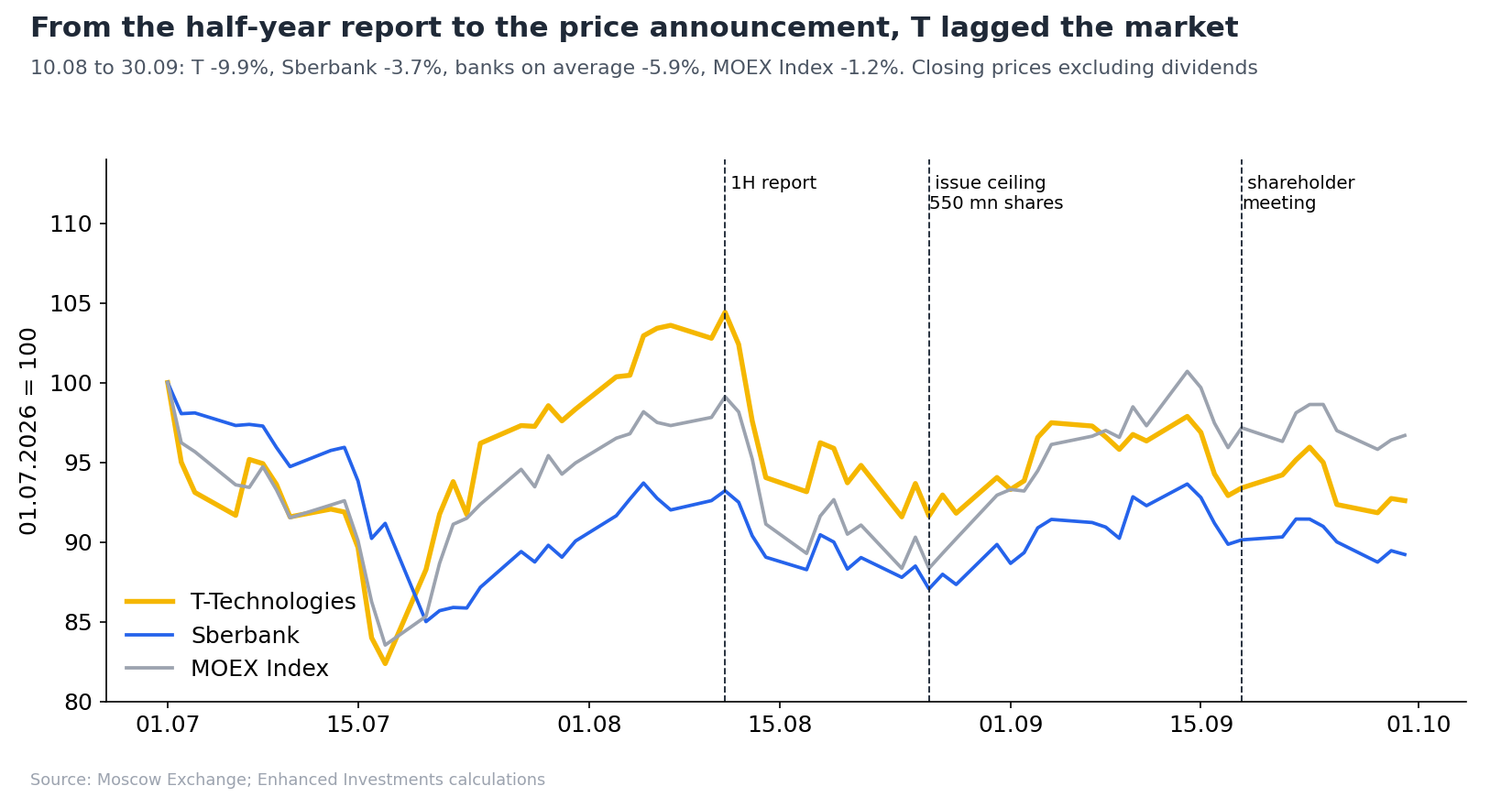
The weak price did not affect the number of shares for the sellers, since the placement price is fixed at RUB 320. But the lower the market, the larger the premium in the placement price looks and the less attractive it is for minority shareholders to exercise pre-emptive rights to buy new shares. The company itself says it chose a high price partly for this reason.
The rally is explained by expectations and the placement price, not by Tochka being cheap. The 27% premium to market in the placement price shows how management values its own shares, and the market partly moved towards that valuation. Analysts had assumed a more expensive scenario before the announcement. On 11 August KIT Finance valued Tochka at RUB 150-200 bn and expected T shareholders to be diluted by 12-15%. The company's own August parameters implied 7%. The actual 3.3% turned out better than all of these estimates.
Brokers are broadly positive on T. In August, after the half-year report, Euler, Aton, BCS, Tsifra broker and Sovcombank rated the shares as attractive at a 2026 P/E of 3.1-3.4x. Sovcombank separately noted a significant synergy effect from acquisitions. By midday on 1 October major investment houses had not published detailed comments on the deal terms; the news quotes only the company itself.
The deal also has strengths
T is also giving away its own shares at a high price. At the RUB 320 placement price T itself is valued at 4.4x 12-month earnings, a 27% premium to the market. Tochka at the headline price costs 4.4x cleaned 2025 earnings. Both sides are valued at a premium, and on last year's earnings the share component is close to an exchange at equal multiples. Taking into account the money taken out of Tochka in 2026, this parity is broken to T's disadvantage, but the gap is smaller than in the cash component.
Shares are not placed below book value. T's market price, RUB 251, is below book value per share (about RUB 285). Placing at market would dilute book value per share for everyone. At RUB 320 this does not happen.
Dilution is small. 3.3% of shares outstanding against 7% under the August parameters and 12-15% in analysts' expectations. This is a plus, with a caveat: T pays a third of the price in cash borrowed at the key rate or slightly above, and that money also costs shareholders profit.
The client bases barely overlap. After the merger T will have about 1.5 mn active SME clients, second only to Sberbank. According to the company, T's and Tochka's clients overlap only to a limited extent. Tochka's loan book is close to zero, while T has ready-made business lending technology. This is the clearest synergy in the deal, and it does not need to be built from scratch.
A conflict of interest goes away. T owned a large but non-controlling stake in Tochka, while Interros held half of Catalytic People and a direct stake. Two competing SME-banking companies under one large shareholder is a poor setup for T's minority shareholders. After the deal all of Tochka's cash flow, including synergies, goes to T's shareholders.
The market reacted positively to the deal. The gain of RUB 23 bn in market capitalisation above the market on announcement day is more than our estimate of the overpayment, RUB 7-14 bn for the 68% being acquired.
The deal is expensive and dilution is small; only synergies can make it profitable
The deal price is weak. Dividends were paid out of Tochka after the April deal, yet the price stayed at the April level. Adjusted for the market and the payouts, T by our estimate pays about 38% above the comparable price, and about 15% on the confirmed part of the payouts. On 2026 earnings Tochka is being bought at 7-8x against 3.4x for T itself, and at about 2x book against 0.9x. The premium goes to sellers related to T's largest shareholder.
The payment structure is strong. Dilution is 3.3%, shares are given at 27% above market, and a third of the price is paid with debt that is three times cheaper than T's own shares. So the weak price barely hurts earnings per share.
The synergies are real, but they have been paid for in advance. Tochka holds about RUB 350 bn of entrepreneurs' account balances, and T's business lending is growing 55% a year. By our rough estimate, directing RUB 100 bn of these balances into small business loans at a margin of about 5% over the key rate would yield about RUB 4 bn of net profit a year. That is enough to offset the deal's negative effect on earnings per share. But T itself will create this effect, and it has already handed the premium for it to the sellers.
The deal also removes a long-standing conflict of interest. Before it, Interros controlled two competitors in small business banking at once, T and Tochka. After it, Tochka becomes part of T.
Where we could be wrong
- Tochka's 2026 profit is our estimate. The holding company has no interim statements, and the bank's Form 102 dynamics may not match the holding company's. An error of 10 pp in interest income changes profit by about RUB 3.5 bn, and the 2026 P/E from 7-8x to 5.5-11x.
- We reconstruct the payment date of the 2025 dividends from the balance sheet. If the money left in early 2025, there is almost no adjustment to the 2025 P/E.
- We do not know the amount the holding JSC Tochka paid to shareholders in 2026. We see only the RUB 22 bn drop in the bank's capital and the company's confirmation that dividends were paid. If the holding company passed less to shareholders, the overpayment and P/BV will be lower than our estimates.
- We identify the recipients of the cash component from the ownership structure. The company does not name them.
- Bank multiples are calculated on reported 12-month earnings, and for T on shares outstanding. Brokers often calculate T's P/E on operating profit, in which case it is lower, about 3.1x.
- The estimate of goodwill and the impact on capital is rough; the company has not disclosed it.
- We estimate synergies roughly. If T manages to convert more of Tochka's balances into loans, the deal will turn out better than the price suggests.
What to ask the company and what to check before closing
- Related party. Who the appraiser was, whether its report will be published and whether Interros voted at the 18 September meeting.
- Tochka's 2026 dividends. How much the holding company paid to shareholders, when and to whom, and how exactly this is reflected in a price that remained equal to April's.
- Tochka's 9M2026 figures, which the company promises to disclose with its 3Q report: profit and equity after payouts.
- Synergies in roubles and by year. How much of Tochka's balances is planned to be directed into loans.
- Terms of the RUB 30.5 bn debt and the deal's effect on capital adequacy.
- The fate of the quasi-treasury block after 12 months. Cancellation would be the best signal.
- T's dividends. The company promises dividend per share growth of more than 20% in 2026 and quarterly growth after the share issue. This is a direct test of its claims about the deal's positive effect.
The deal is planned to close at the end of 2026. Tochka Bank will keep its brand and team.
Sources: T-Technologies announcements on the deal (t_tech channel, 26.08, 22.09 and 01.10.2026), T-Technologies consolidated interim IFRS statements for 1H2026, the disclosed consolidated statements of JSC Tochka for 2025, Form 102 of Bank Tochka LLC, banks' IFRS statements for 3Q2025-2Q2026, Moscow Exchange data (prices and the IMOEX and MOEXFN indices) as of 16.04, 30.09 and 01.10.2026, KIT Finance (11.08.2026), a compilation of broker views in the t_tech channel (19.08.2026). Enhanced Investments calculations. Previous review of the deal dated 31 August: [https://telegra.ph/T-Tochka-Deal-3108-08-31](https://telegra.ph/T-Tochka-Deal-3108-08-31)
See also: market overview · valuation map · stock screeners