TGC-14: 21-23% for the Heat of Chita and Ulan-Ude. The Business Is Growing, the Risk Is the Owner and the CHP-2 Construction
TGC-14 is the only large producer of heat and electricity in Zabaykalsky Krai and Buryatia: seven CHP plants in Chita, Ulan-Ude and the region, 650 MW of electric and almost 4,000 Gcal/h of heat capacity. The company has six bond issues totalling RUB 13.6 bn, and the fixed coupons give 21.5-23.2% to maturity against 15.1% on OFZ of the same maturity. The review was prepared following requests in the comments under the video about Brusnika, where TGC-14 was requested most often.
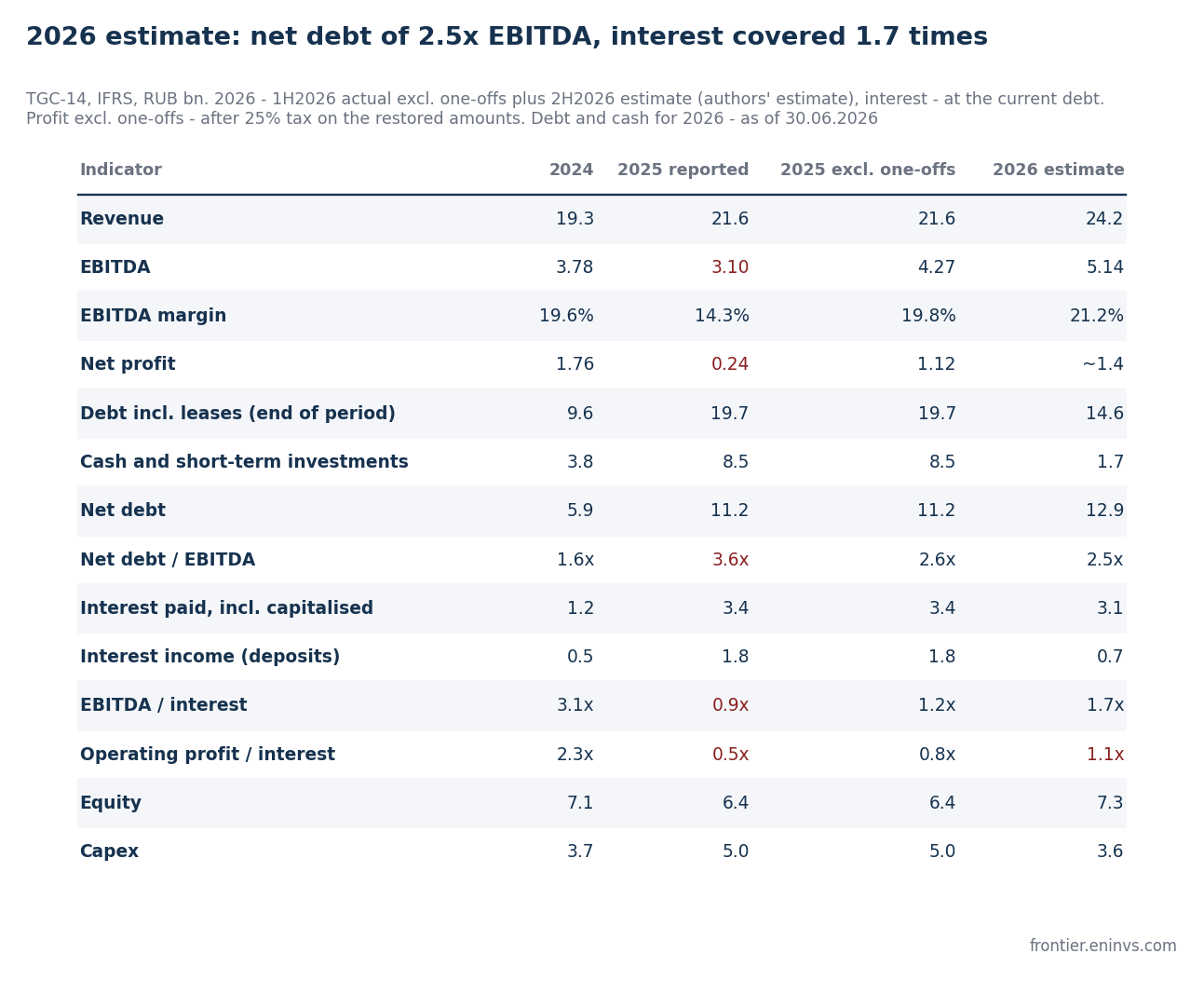
Conclusion. The business has clearly strengthened in the first half of 2026: revenue +19%, EBITDA excluding one-off items +44%. By our estimate for 2026 net debt equals 2.5x EBITDA, interest is covered 1.7 times by EBITDA and 1.1 times by operating profit. The 2025 slump was caused by one-off write-offs of RUB 1.1 bn, not by the business. A premium of about 8 pp over OFZ is paid for three risks: the criminal case and the claim to seize shares from the owner, the prosecutor's tariff disputes, and the construction of two units of Ulan-Ude CHP-2 for RUB 86 bn, which the company cannot lift on its own. We consider the seizure of shares in favour of the state rather a plus for bondholders: this is what happened at Borets and TGC-2. The main uncertainty is CHP-2. The clearest issue is the short 001R-02 maturing in July 2027: it is repaid before penalties for the construction begin. Issues 001R-02 and 001R-07 are included in our bond strategy BONDS1.
The issuer's card on the portal with financials by period and all issues: TGC-14. Below are the calculations of Enhanced Investments based on the company's IFRS, MOEX charts and disclosures. Where a figure is our estimate, this is marked.
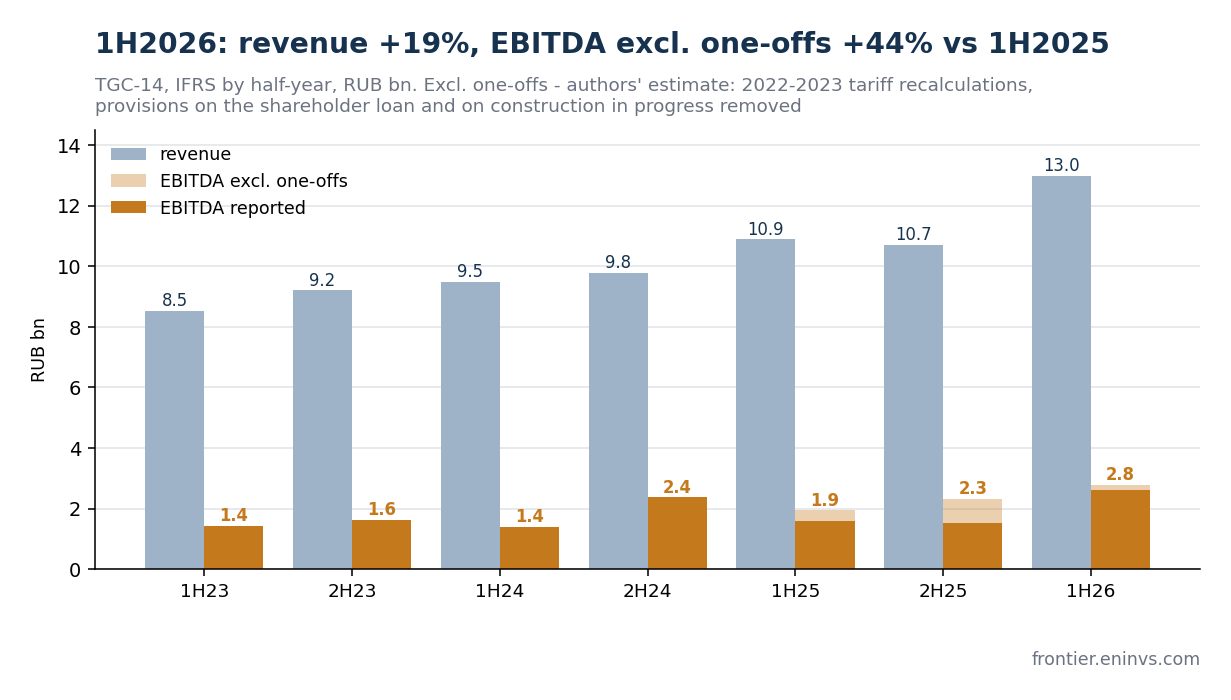
Half-year revenue rose 19%, EBITDA excluding one-offs 44%
Fact (IFRS 1H2026, review by Kapt). Revenue was RUB 12.99 bn versus 10.89 a year earlier. Heat brought 7.16 bn (+20%), electricity 4.33 bn (+22%), capacity 1.27 bn (+13%). Fuel costs rose 15%, personnel costs only 3%. Operating profit doubled to 1.81 bn, net profit was 0.84 bn versus 0.40. For the whole of 2026 we expect about 1.4 bn: part of the half-year profit came from interest on deposits (0.72 bn), and deposits shrank after the bond redemption in April.
Authors' estimate. EBITDA (operating profit plus depreciation) is 2.62 bn. If the provisions on the shareholder loan and on unfinished construction are added back, it comes to 2.79 bn, which is 21.5% of revenue. The second half at TGC-14 is usually no weaker than the first: EBITDA excluding one-offs of 1.44 and 1.63 bn in 2023, 1.40 and 2.38 in 2024, 1.94 and 2.33 in 2025. More heat is sold in winter, but more coal is burned too, and every year the second half includes revenue from connecting new consumers to heat networks (0.33 bn in 2024, 0.47 bn in 2025). But simple doubling overstates the result here. The first half of 2026 grew against the previous year thanks to the tariff indexation from 1 July 2025, while the second half of 2025 already contained that indexation. In 2026 the next indexation was moved to 1 October and will give only the fourth quarter (+0.42 bn of revenue). So we calculate the second half of 2026 from the second half of 2025: the same tariffs plus the October indexation, connections at the level of previous years and cost growth. This gives about 2.35 bn, for the year RUB 24.2 bn of revenue and 5.1 bn of EBITDA against 5.6 when doubled.
Fact. The growth came from indexation. For households, heat tariffs from 1 July 2025 rose by 13.6% in Zabaykalye and 13.0% in Buryatia. The free price of electricity in the second price zone (Siberia) in January-May 2026 was 17% above last year's, according to the Market Council.
2025 was spoiled by one-off write-offs of RUB 1.1 bn, not by the business
Fact. For 2025 net profit fell to RUB 0.24 bn from 1.76 a year earlier, and the second half showed a loss of 0.16 bn. The main reason is other expenses. The Zabaykalsky Krai court ruled back in 2023 that heat tariffs for legal entities in Chita for 2022-2023 were overstated, and the ruling stood in all instances. In 2025 the company recorded the recalculation: RUB 515 mn of prior-year loss and another 541 mn of provision for future refunds. On top of that, a provision of 55 mn on the shareholder loan and 53 mn of provisions for court cases.
Authors' estimate. Without these items 2025 EBITDA is RUB 4.27 bn instead of 3.10, margin 19.8% instead of 14.3%, and net profit about 1.1 bn instead of 0.24 (the one-off items were added back net of 25% tax). The first half of 2026 also contains one-off expenses of 0.17 bn (a provision of 105 mn on the shareholder loan and 62 mn on unfinished construction), but they are three times smaller.
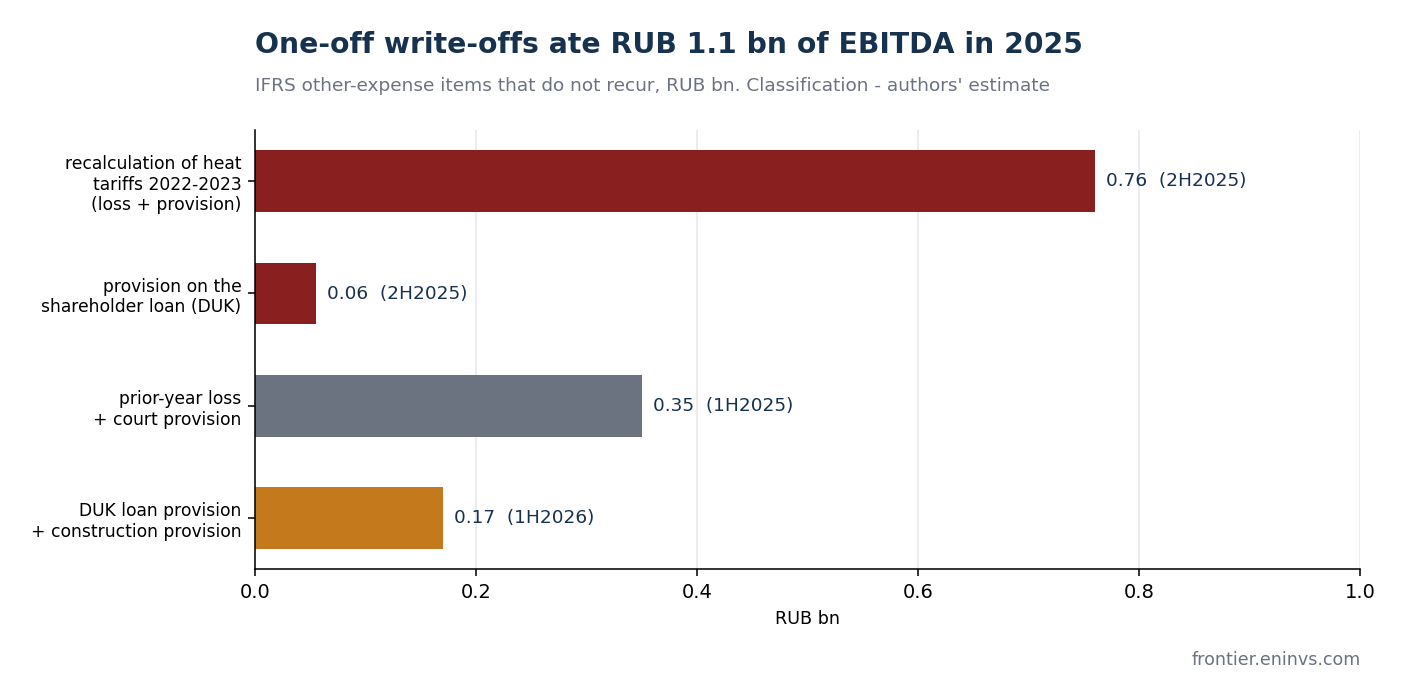
Authors' assumption. Tariff stories cannot be considered fully one-off. The prosecutor challenges TGC-14's tariffs in both regions, more on this below. But the recalculation for 2022-2023 is already fully reflected in the statements, and for Zabaykalye the tariffs for 2024-2026 were left unchanged in August 2026.
By the 2026 estimate net debt is 2.5x EBITDA, operating profit covers interest almost without a margin
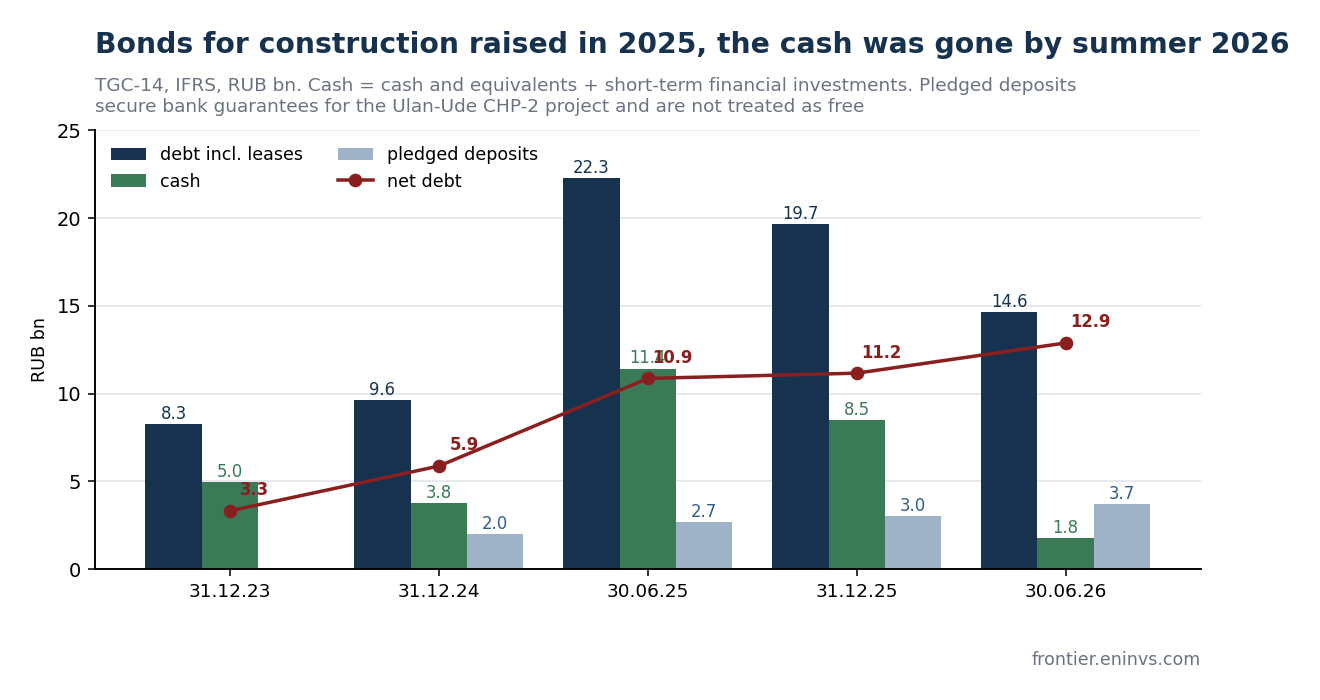
Fact. As of 30 June 2026 debt including leases is RUB 14.63 bn: bonds 13.6 bn, banks 0.76 bn, leases 0.27 bn. Cash is 1.75 bn. Another 3.72 bn sits on deposits at Sovcombank until 2031. This is collateral for bank guarantees on the CHP-2 construction, and we do not treat this money as free.
Authors' estimate. Net debt is 12.9 bn, which is 2.5x 2026 EBITDA. If the pledged deposits are counted, it is 1.8. Annual interest on the current debt is about 3.1 bn, of which 2.5 bn comes from two large issues: 001R-05 at 24.75% and 001R-07 at 21.5%. EBITDA covers interest 1.7 times, and taking into account interest on deposits (about 0.7 bn a year) net interest expense is covered 2.2 times. Operating profit after depreciation (about 3.5 bn) covers interest 1.1 times. Depreciation of the plants is repairs that will have to be done, so there is no margin here. A lower key rate will barely help: 93% of the debt is at fixed rates until 2027-2030.
Fact. In 2025 the company borrowed RUB 11.35 bn through bonds for construction, kept the money on deposits and earned 1.85 bn of interest on them. In the first half of 2026 it repaid the issue 001R-01 for 3.5 bn and 1.5 bn of bank loans, mostly VBRR. As a result cash fell from 8.2 to 1.75 bn, and debt from 19.7 to 14.6 bn.
Fact. Operating cash flow in 2023-2024 is overstated in the statements by reverse factoring. Part of the payments to suppliers on the company's behalf was made by Sberbank Factoring and VTB Factoring at 23.4-23.8%, and the company repaid this debt in financing activities: new factoring liabilities of RUB 1.97 bn in 2023, 2.42 bn in 2024, 0.97 bn in 2025. Without it, 2024 operating cash flow is 1.8 bn instead of 4.2 in the report. By the end of 2025 factoring was repaid, so the current figures are clean. This adjustment was found by Pavel Granatkin.
Authors' estimate. There is no free cash flow. Of the 5.1 bn of EBITDA, after interest, interest on deposits and tax about 2.2 bn is left. Excluding CHP-2, capital expenditure is by our estimate about 3 bn a year: repairs and concessions on heat networks in Chita and Ulan-Ude, where the company has contractual obligations of 17.4 bn until 2040. About 0.8 bn a year is missing, and so far the gap was closed by new debt. The 2027 maturities will mostly have to be refinanced: 0.15 bn on 001R-04 in June, 1.95 bn on 001R-02 in July and about 0.6 bn of bank loans. The next big payment will come only in January 2029, 4.85 bn on 001R-05 and 001R-06.
Fact. The debt-to-EBITDA covenant under RAS is breached in the VBRR loan, but the balance there is only RUB 24 mn. There are no overdue payments, according to the company.
The main risk is the RUB 86 bn construction that the company cannot lift on its own
Fact. In 2024 TGC-14 won the competitive selection for building two new 200 MW units at Ulan-Ude CHP-2 (KOM NGO). Capacity supply must begin from the end of 2028 and from July 2029. In parallel the modernisation of Chita CHP-1 is under way. According to IFRS 1H2026 the CHP-2 budget including VAT is RUB 85.9 bn, six months ago it was 76.4 bn. According to Kommersant, in 2024 the estimate was 31.8 bn.
Fact. On 30 June 2026 the board of directors suspended the construction because there is no funding. The statements say the company is considering raising additional money, postponing deadlines or other options and does not intend to abandon the project. According to the Market Council's explanation, penalties for non-delivery of capacity are applied only after the supply start dates or in the event of an official refusal of the obligations.
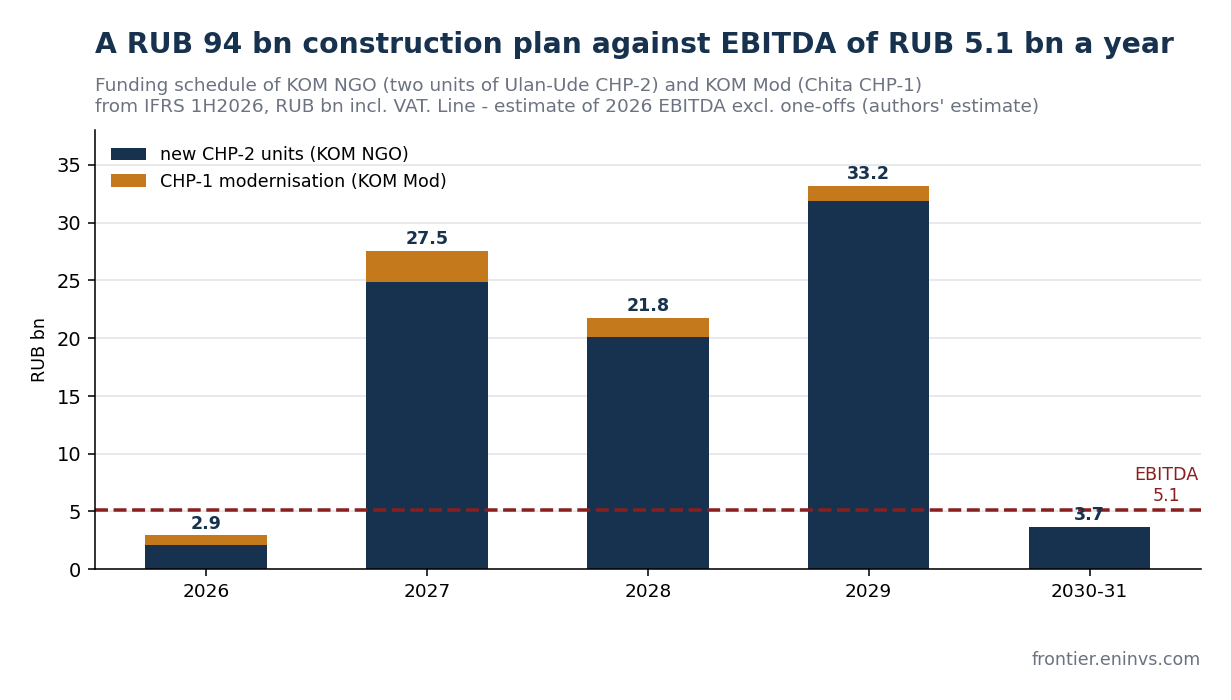
Authors' estimate. For 2027-2029 about RUB 80 bn is needed under the plan. This is 16 annual EBITDAs. The company will not raise such a sum with bonds or bank loans on market terms. There are three realistic outcomes: the state or a state holding provides money or takes the project, deadlines are postponed, or the company exits the project and loses the guarantee deposits. The third option is the worst of the understandable ones: about 3.7 bn of collateral, which is not included in our net debt calculation anyway. Beyond the guarantees we did not find the size of the penalty in open sources, and this is the main unknown parameter of the whole credit profile.
Authors' assumption. While the project is frozen, this is rather good for the bonds. Money does not go into construction, debt does not grow, and two years remain until the dates after which sanctions begin.
The company serviced the debt on which the owner bought TGC-14
Fact. Since December 2021 79.32% of TGC-14 has been owned by JSC Far Eastern Management Company (DUK), whose beneficiary is Konstantin Lyulchev. The stake was bought from the Russian Railways structure Energopromsbyt using a bank loan. TGC-14 itself gave DUK loans for 5-6 years "for the purpose of repaying the principal debt and paying interest" on this loan: RUB 528 mn as of 30.06.2026, secured by only 4.11% of its own shares. In addition, TGC-14 pledged its own promissory note for 300 mn as security for DUK's loan at Sovcombank. When DUK breached the schedule, the bank collected on the note, and TGC-14 booked it as another loan to the shareholder for 299 mn for three years. Together with DUK receivables the claims on the shareholder are RUB 1.06 bn, with a provision of 160 mn.
Fact. It was like this before as well. In 2023 TGC-14 placed its first bonds for RUB 5.57 bn and in the same year issued loans of 3.23 bn, so claims on DUK at the end of the year were 3.34 bn. In 2024 DUK returned 2.5 bn, but in the same year the company paid 2.33 bn of dividends, 79% of which goes to DUK. For 2023-2025 dividends (4.50 bn) exceeded profit (3.65 bn) by 0.86 bn. For 2025 the meeting in May 2026 decided not to pay dividends.
Authors' estimate. The bond money of 2023 in effect went to the owner's purchase of the company itself. Now about 1 bn hangs on the shareholder, of which 0.16 bn is recognised as doubtful. The refusal of dividends for 2025 probably hit DUK. This is a negative sign of governance quality, and it also explains why a change of owner matters more to bondholders than it seems.
The criminal case and the claim to seize shares: no decision yet
Fact. On 29 May 2025 Konstantin Lyulchev (chairman of the board) and his deputy Viktor Myasnik were detained. According to the investigation, about RUB 4.45 bn was taken out of TGC-14 through loans, guarantees and unnecessary services. The charges are fraud, embezzlement and money laundering. On 25 August 2026 the court extended Lyulchev's arrest until 28 November. Sources differ on whether the case has been sent to court.
Fact. On 15 May 2026 the Zabaykalsky Krai prosecutor's office filed a claim with the Arbitration Court of Zabaykalsky Krai (case A78-4476/2026). It asks to declare invalid the 2021 transaction on the purchase of the stake and to turn the shares of DUK and Lyulchev personally, about 76.6% of the capital in total, into state revenue. The media cite a figure of 84%, but it does not match the number of shares. As security for the claim 39.8% of TGC-14 shares owned by DUK were arrested. The court refused to arrest the property of TGC-14 itself. We found no ruling on the merits as of 25 September.
Fact. Ratings suffered more than the business. In December 2025 ACRA cut the rating to BB(RU) and two weeks later withdrew it at the company's request. Expert RA withdrew ruBBB- in April 2026 because of a lack of information. Only BBB.ru from NKR with a stable outlook (November 2025) remains in force.
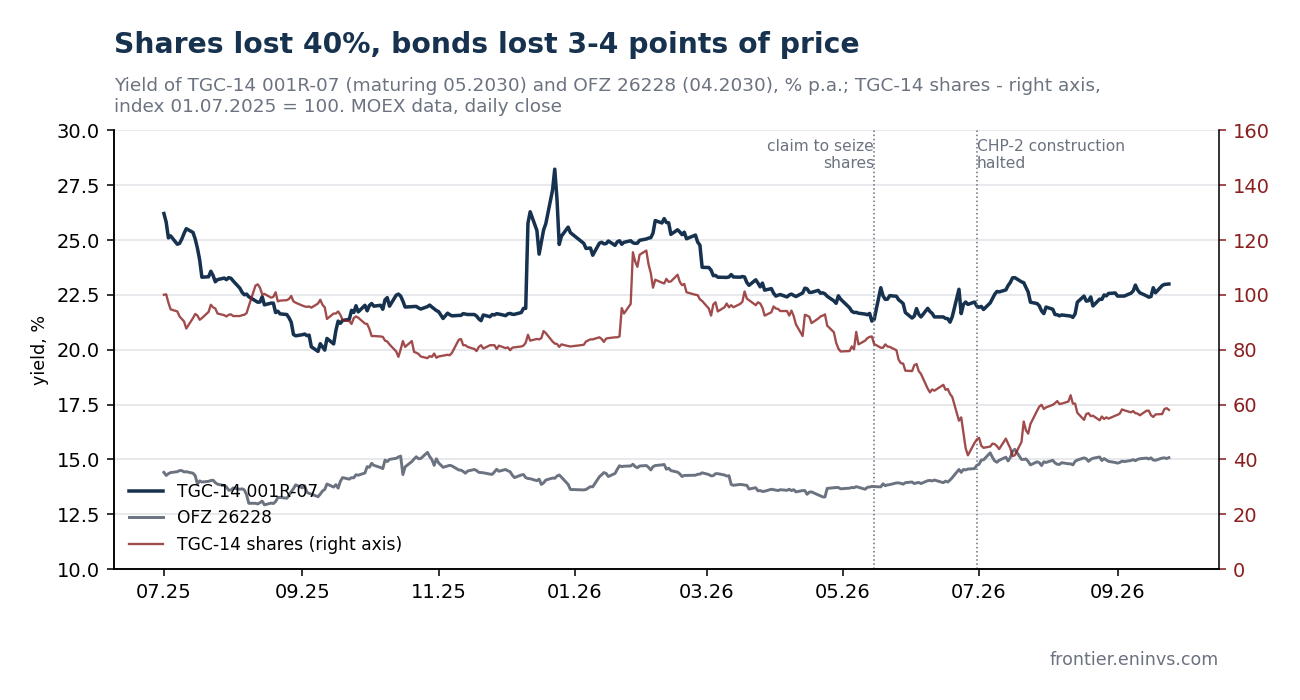
Fact. The bonds reacted calmly to the claim itself. 001R-07 fell from 104.5% to 101.1% of par in a day, and the yield rose from 21.4 to 22.8%. The shares have lost 40% since April 2026, and the market capitalisation is now about RUB 5 bn. The heaviest period for the bonds was June 2025 after the owners' detention, when 001R-07 traded at a yield of 31%, and December 2025 after the ACRA downgrade.
Fact (comparison). At Borets the Prosecutor General's Office filed a claim in February 2025, the court granted it seven weeks later, and since April 2025 the group has been managed by Rosimushchestvo. Because of interim measures private investors did not receive coupons for several months, from August 2025 payments were restored, and in November 2025 and March 2026 the company placed new issues. At YuGK, after the seizure of the stake, Expert RA kept ruAA, and in October 2025 the company also borrowed in the market. TGC-2 passed under the management of Gazprom Energoholding after the seizure of shares in 2023.
Authors' assumption. For TGC-14's bonds, a transfer to the state is most likely a plus: loans to the owner will stop, and there will be an understandable shareholder to negotiate with about CHP-2. The risk of the transition period is elsewhere. If the court imposes measures on the accounts of the company itself, as happened at Borets, payments may be temporarily delayed. There are no such measures so far.
Tariffs are indexed faster than inflation, but the prosecutor challenges them
Fact. The government approved an increase in household utility charges from 1 October 2026 of 12.0% in Zabaykalye and 8.9% in Buryatia. In Ulan-Ude TGC-14's heating tariff from 1 October is RUB 3,172.65 per Gcal, which is +8.7%. The Ministry of Economic Development in its forecast of 24 September 2026 assumed indexation of utility payments of 11% from 1 July 2027 and 8.6% in 2028. The capacity price at the competitive selection in the second price zone for 2027 rose by 29%.
Fact (IFRS 1H2026). In February 2026 the Zabaykalsky Krai court, on the prosecutor's claim, declared heat tariffs for 2024-2026 unlawful. On 21 August 2026 the regional tariff service adopted new acts with tariffs at the previous level. In Buryatia in August 2025 the court cancelled the tariffs for 2024-2025, and the recalculation reduced the tariff for the second half of 2025. In June 2026 the Buryatia prosecutor's office challenged the tariff order for 2024-2026, and the proceedings are suspended. The company does not estimate the amount of a possible recalculation.
Fact. About RUB 2 bn a year TGC-14 receives from regional budgets as compensation for the difference between the economically justified and the preferential tariff. In 2024 it was 0.38 bn. Separately, the company claims 733 mn of lost income for 2022-2023 from Zabaykalye.
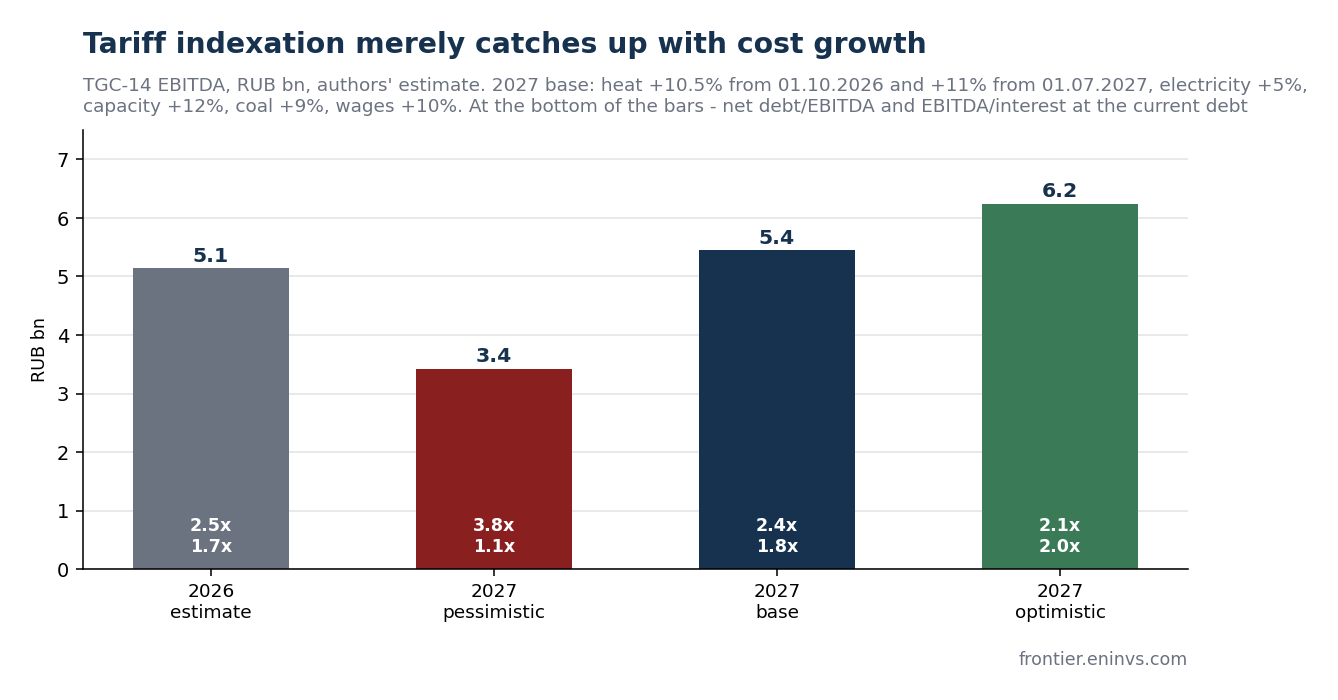
Authors' estimate (forecast for 2027). Base scenario: heat rises 10.5% from October 2026 and 11% from July 2027, electricity 5%, capacity 12%, coal with transport 9%, wages 10%, other expenses 7%. 2027 EBITDA is then about 5.4 bn against 5.1 in 2026, net debt to EBITDA 2.4, interest coverage 1.8. Indexation almost entirely goes to cost growth: heat gives 55% of revenue, but all costs rise. The optimistic scenario with capacity prices up 29% and electricity up 10% gives 6.2 bn. Pessimistic: courts and regulators cut heat indexation to 5%, electricity and capacity prices stand still, budget compensation falls by a quarter. EBITDA falls to 3.4 bn, the debt load to 3.8, interest is covered 1.1 times. This does not mean default, but refinancing would be hard in that case.
Authors' assumption. The free price of electricity in Siberia in late summer 2026 was 20% below last year's. The second half of 2026 may turn out weaker than the first for electricity, so we assumed moderate growth in the base scenario.
Russian TGCs have not gone bankrupt, but there have been bond defaults
A popular argument among holders: heat generation cannot be put into bankruptcy, because then the population would be left without heat. We checked how this worked in practice.
Fact. None of TGC-1...TGC-14 and OGKs has been declared bankrupt since 2005. But there were bond defaults. In September 2013 TGC-2 did not repay an issue of RUB 5 bn, and it was exchanged for a new one with a five-year term and amortisation. In April 2017 TGC-2 did not pay the amortisation on the new issue itself, and it was restructured a second time. Holders eventually received par, but years later. In 2023 TGC-2's shares were turned into state revenue and handed to Gazprom Energoholding for management.
Fact. Individual CHP plants go bankrupt regularly. Novokuznetsk Central CHP was declared bankrupt in 2015 with debt of about RUB 2 bn. In 2019 it was sold at auction for 335 mn, and creditors received less than 17%. Heat in the central districts of the city was not switched off. In 2025 Severnaya CHP in Astrakhan was declared bankrupt, in June 2026 Sverdlovsk's OTSK.
Fact. The law does not provide for the irreplaceability of a heat supply organisation. The status of a unified heat supply organisation (ETO) ends on declaration of bankruptcy, and the municipality appoints a new operator. The property is sold at a tender together with the obligation to maintain the facilities and regulated tariffs, and if there is no buyer, it passes to the municipality. For creditors this means low recoveries.
Authors' assumption. So the protection of TGC-14's bondholders is not that bankruptcy is legally impossible. It is that large regional generation does not usually reach bankruptcy: it is taken earlier by the state or a state holding, as with TGC-2, RAO Energy Systems of the East (RusHydro) and Kvadra (Rosatom). At TGC-14 the state is already at the door through the prosecutor's claim. The worst realistic scenario for a holder is a restructuring with extended maturities, as at TGC-2, not a loss of par.
Six issues: the short 001R-02 is the clearest, 001R-03 is overvalued
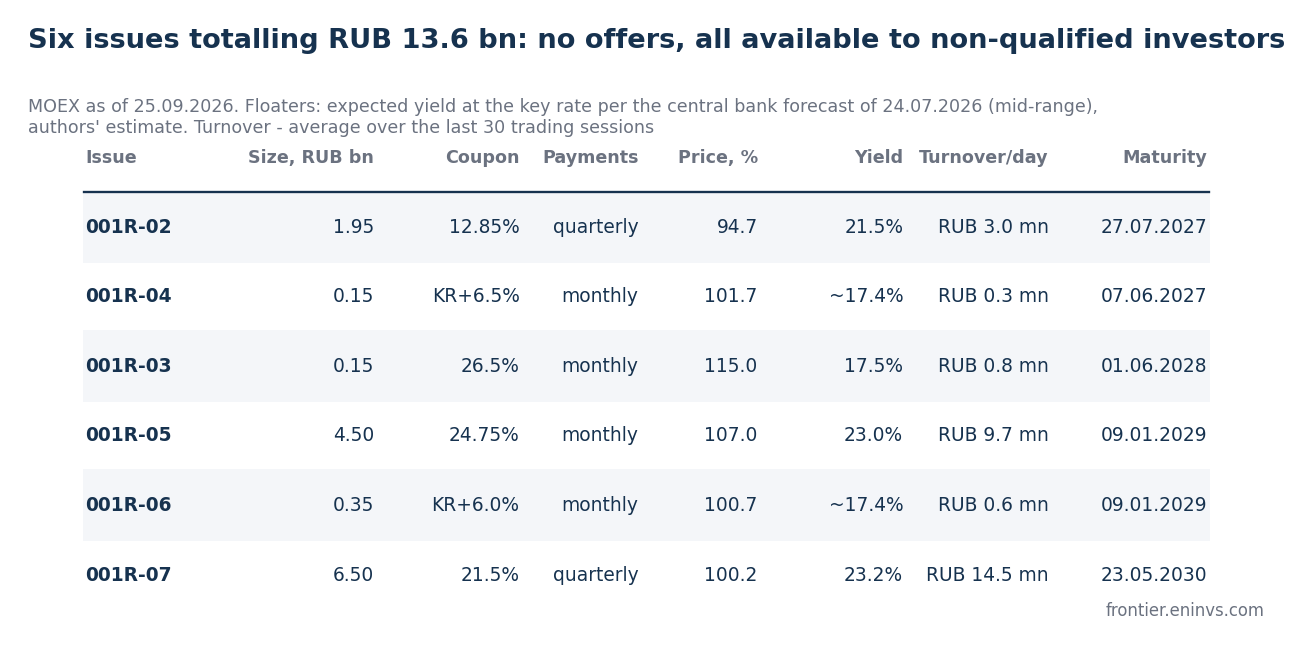
Authors' estimate. A spread to OFZ of about 7.9 pp for a company with debt of 2.5x EBITDA is the payment for the owner and CHP-2. At the same time, among issuers rated BBB, TGC-14 trades expensive: by Pavel Granatkin's calculation, the BBB median in our high-yield screen gives 24.7-28.3%, and the Moscow Exchange BBB index has a spread to OFZ of 14.2 pp. The market values the company a notch above the rating because it sees a regulated cash flow. There is no premium for the rating group in the yield. There is no early redemption right on a change of owner in the terms of 001R-07. 001R-02 (maturity 27.07.2027, yield 21.5% due to a price of 94.7 at a low coupon of 12.85%) is repaid before the dates after which sanctions on CHP-2 begin, and before the main wave of refinancing. For a private investor this issue has a tax advantage: most of the income comes from the price rising to par, not from the coupon. 001R-05 and 001R-07 give 23% for 2.3 and 3.7 years, but their repayment depends on how the construction story ends. 001R-03 at 115% with a yield of 17.5% is more expensive than the risk, the size of the issue is only 150 mn. The floaters 001R-04 (key rate + 6.5 pp) and 001R-06 (rate + 6.0 pp) now pay 20-20.5% a year, but the coupon falls together with the rate. If the rate follows the central bank forecast of 24 July 2026 (13.7-14.0% on average until the end of 2026, 10.5-12.5% in 2027, 8-9% in 2028), the expected yield of both is about 17.4%, within the forecast bounds of 16.6-18.3%. This is 5-6 pp less than on fixed-rate issues of the same risk.
Fact. Liquidity exists only for three issues. Average daily turnover over the last 30 sessions: 001R-07 about RUB 14.5 mn, 001R-05 about 9.7 mn, 001R-02 about 3 mn. The other three issues trade at 0.3-0.8 mn a day, and a large order there will have to be placed in parts.
Main risks
- CHP-2. A budget of RUB 86 bn against EBITDA of 5.1 bn. There is no funding decision, the size of the penalty on exiting the project is not disclosed, and the guarantees are secured by deposits of 3.7 bn.
- Tariffs. The prosecutor challenges tariffs in both regions, and in 2025 the recalculation for previous years cost the company 1.06 bn. In Buryatia the case for 2024-2026 is still under way.
- Owner. Loans to the shareholder of 0.8 bn, the criminal case, the claim to seize shares. Interim measures are possible that would temporarily affect payments, as at Borets.
- Interest burden. Operating profit covers interest 1.1 times, debt is almost entirely at fixed 12.85-26.5%, and a lower rate will not make it cheaper.
- Refinancing. After interest and capex about 0.8 bn a year is missing, about 2.7 bn must be repaid in 2027, and of the ratings only BBB.ru is left.
- Budget compensation. About RUB 2 bn a year depends on the regional budgets of Zabaykalye and Buryatia.
- Plant reliability. The accident at Chita CHP-1 in February 2026 and the reduced heating parameters because of wet coal in September 2026. Unplanned repairs weigh on capex.
Conclusion
TGC-14 is a working monopoly business with growing tariffs and debt of 2.5x EBITDA, but almost without a margin on interest: operating profit covers it 1.1 times. The high yield rests on three events outside the business itself: the criminal case against the owners, tariff disputes and the frozen construction of CHP-2. The first for creditors will most likely end with a change of owner to the state, and this is a plus. The second is already mostly reflected in the statements. The third remains the main question until 2028. The short 001R-02 passes before this fork, while the long issues outlive it.
Traffic light: green. By the formal rules of our screen the issuer would come out yellow: operating profit covers interest 1.1 times against a threshold of 1.5, and cash and flow over the year are less than the bond payments including the 001R-02 redemption. We set green deliberately. The weak points of the balance sheet were largely created by the owner's withdrawal of money: loans to DUK and dividends above profit. When the shares pass to the state this channel will close, while the business itself with regulated tariffs works steadily.
For 001R-02 without reservations: the issue is repaid in July 2027, before the CHP-2 fork. For 001R-05 and 001R-07 also green, but with one open question – how the CHP-2 construction ends and whether there will be a penalty on exiting the project. We do not take 001R-03 at 115%, it is overvalued.
What we will watch: the ruling of the Arbitration Court of Zabaykalye in case A78-4476/2026, the board's decision on the fate of CHP-2, the tariff courts in Buryatia, the 2026 statements and how the company refinances the June-July 2027 maturities.
Sources
- TGC-14 IFRS for 2025 (audit by Kapt, unqualified) and for 1H2026 (review by Kapt, 28.08.2026): income statements, cash flow statements, notes 5, 8, 11, 13, 15-17, 19, 20. The balance sheets in PDF are images, recognised by the authors.
- MOEX ISS: issue parameters, redemption schedules, prices and yields as of 25.09.2026, price history since 2025; OFZ 26228.
- Interfax, TASS, Kommersant, chita.ru: the criminal case and the claim of the Zabaykalsky Krai prosecutor's office (case A78-4476/2026), the suspension of CHP-2 construction.
- Releases of NKR (27.11.2025), ACRA (11.12.2025, 29.12.2025), Expert RA (22.07.2025, 27.04.2026).
- Government Order 3413-r of 25.11.2025 on indexation of utility payments, Buryatia's RST (Ulan-Ude tariffs), Ministry of Economic Development forecast of 24.09.2026 (Vedomosti), Market Council and System Operator (DAM and KOM prices).
- Cases of Borets, YuGK, TGC-2, Novokuznetsk Central CHP: RBC, Forbes, Kommersant, Expert RA, energy industry media; the Heat Supply Organisation Rules (Government Decree 808), articles 132 and 197-201 of the bankruptcy law.
Reviews of other issuers and weekly analytics are in the Telegram channel Enhanced Investments, issuer cards are on the portal.
See also: market overview · valuation map · stock screeners