Ultimate Education at 71%: a 52% annual yield on a bond whose coupons are already being paid from new loans
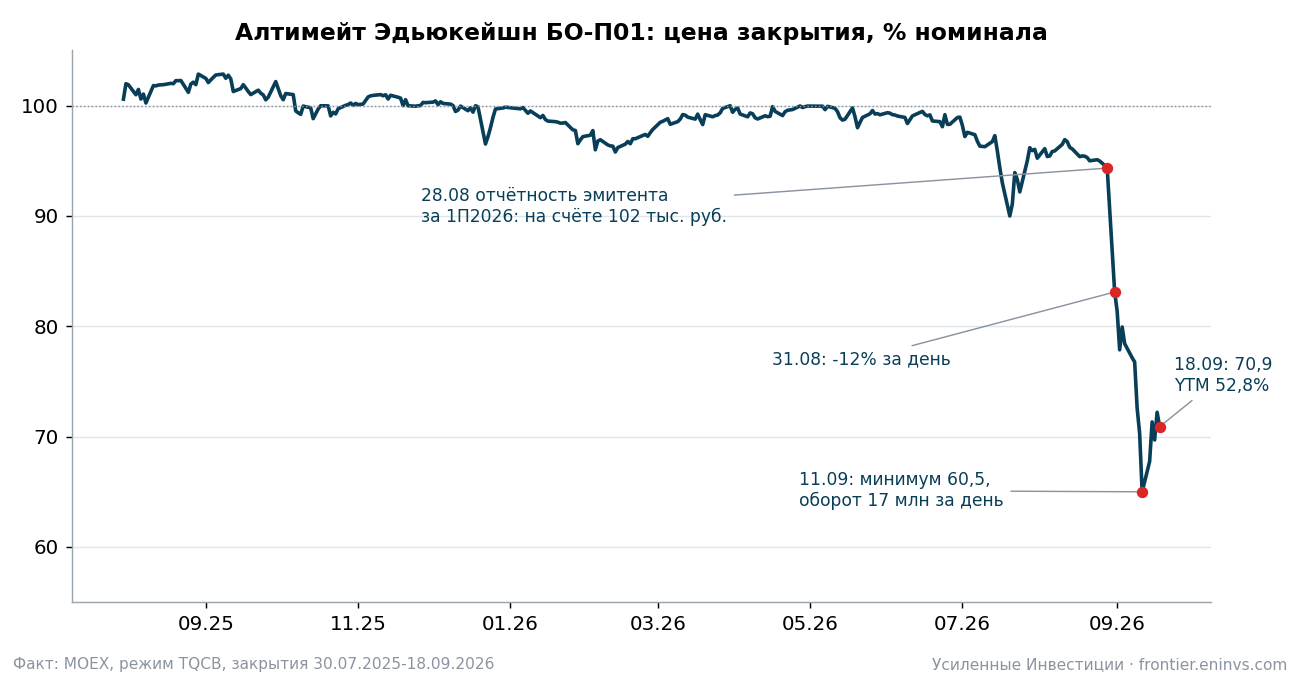
Ultimate Education is a holding of online schools offering continuing education for adults: Bang Bang Education, Fashion Factory, XYZ School, Psychodemia, MAED, Moscow Digital School and MIIN. The company has one bond issue, BO-P01, for RUB 600mn with a 19.75% coupon paid monthly and maturity on 14 July 2028. Over three weeks the bond fell from 94% to 71% of par, and the yield to maturity rose to 52.8%, against 14.8% on OFZ of the same maturity.
Conclusion: we are not putting new money into the issue. The group's 2025 revenue fell by 32%. If we subtract the fees paid to banks for instalment plans (RUB 258mn), only RUB 69mn is left of the RUB 327mn of EBITDA, while annual coupons cost RUB 118.5mn. The group spends more on developing courses than its operations bring in. As of 30 June 2026 the issuer itself held RUB 102 thousand in its accounts and paid coupons out of new loans of RUB 115mn. The nearest coupons will most likely arrive as long as the owners or lenders keep providing money. Repayment of the RUB 600mn in July 2028 is not visible in the current business.
Our first review of this bond came out on 4 September at a reader's request in the comments, when the bond cost 79% of par. Recently the author of the channel [Manka Abligatsiya](https://t.me/marythebond/5324) praised it – he bought at 64% and set out his logic in detail. The arguments are examined in a separate section near the end. We agree with some of the facts, but draw different conclusions from them.
The issuer's card on the portal, with financials by period, our credit analysis and all issues: Ultimate Education. Below are the calculations of Enhanced Investments based on the issuer's IFRS and RAS statements, the MOEX payment schedule and disclosures; where a figure is the authors' estimate, it is marked as such.
What we wrote on 4 September and what has changed since
Fact. The 4 September review concluded as follows. The company services its coupons, but the RUB 600mn redemption in July 2028 cannot be refinanced given these results, credit quality is weak, annual payment coverage in our screening is 0.2, and operating-profit interest coverage is 0.35. The bond then stood at 79% of par with a yield of 42%.
Fact. In the two weeks after that review the price fell from 79% to 71% of par and the yield rose from 42% to 52.8%. Accrued coupon over the same two weeks added roughly as much as the price lost, so a holder since 4 September came out about flat. From the late-August peak, before the issuer published its half-year statements, the bond lost about a quarter.
Authors' estimate. We do not change our assessment, but two new facts strengthen it. First, the issuer's half-year statements showed that coupons in 2026 are being paid from new loans. Second, a school-by-school review showed that all seven schools shrank in 2025, and reach continues to fall in 2026.
The price fell by a quarter after the issuer's half-year statements
Fact. Until the end of August the issue traded at 94-96% of par. On 28 August the issuer published its accounting statements for the first half of 2026, and on the first trading day after that, 31 August, the bond lost 12% (from 94.3 to 83.1) on turnover of RUB 9.3mn. The second wave of selling came on 9-11 September: on 11 September the price touched 60.5% and closed at 65%, with daily turnover of RUB 17mn, the highest in the bond's history. By 18 September the quote had rebounded to 70.9%.
Seven schools: in 2025 revenue fell at every one, and every one ended the year with a loss
Fact (RAS of each company from the Federal Tax Service's GIR BO, RUB mn). Bang Bang Education (design, Sila Znaniya LLC) 451 in 2024 versus 309 in 2025, loss of 18. Psychodemia (psychology) 413 versus 329, loss of 27. Fashion Factory (fashion) 405 versus 268, loss of 66. MIIN (nutrition science, two legal entities) 684 versus 373; revenue was shifted between the LLC and the non-profit, so the comparison is rough. XYZ School (game development) 245 versus 139, against a peak of 302 in 2023, loss of 40. Moscow Digital School (law) 183 versus 121, loss of 16. MAED (marketing) 71 versus 50, loss of 12.
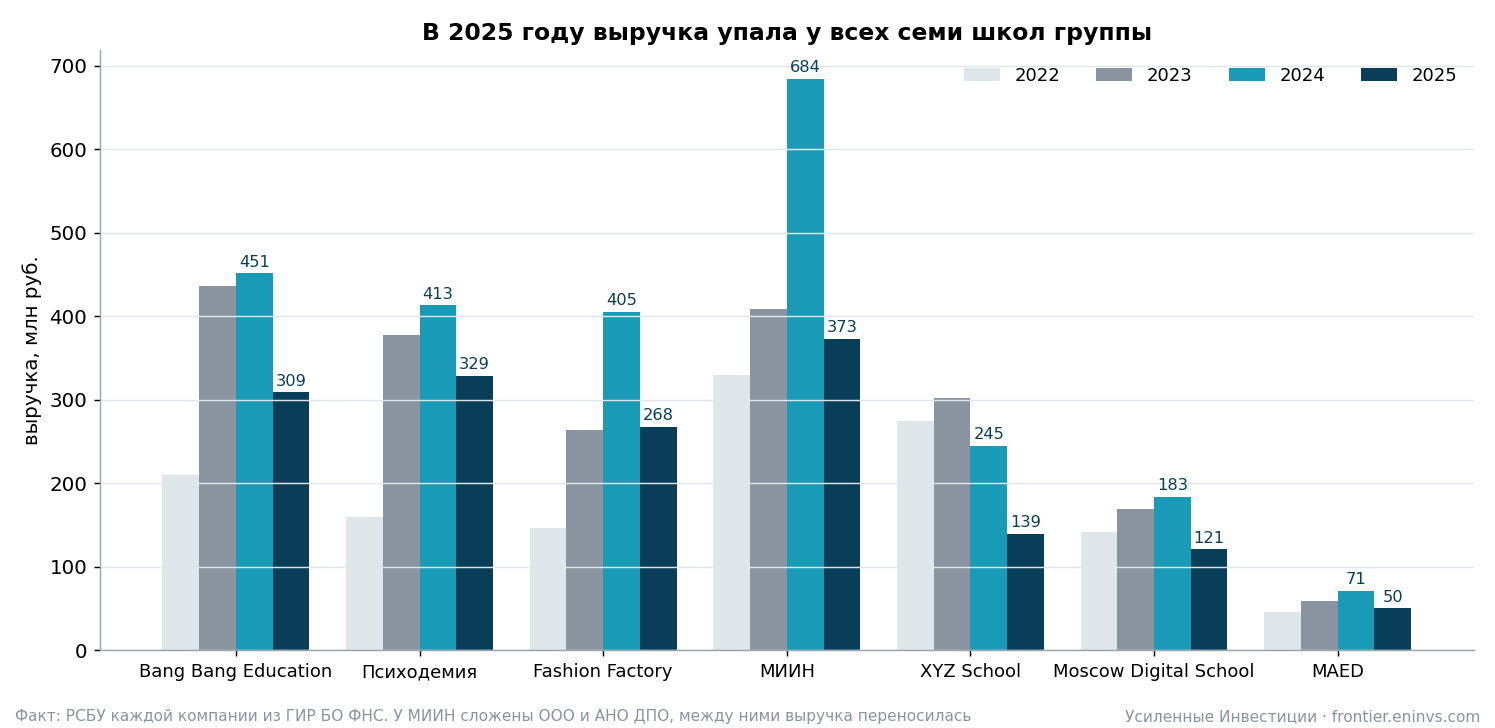
Authors' estimate. The sum across schools for 2025 is about RUB 1.6bn against RUB 2.5bn a year earlier. This does not reconcile exactly with consolidated revenue of RUB 1.87bn: part of the turnover goes through the management company and intragroup settlements. But the direction is the same at all seven schools, and none has grown. The largest loss is at the game-development school XYZ: it is falling for the third year in a row and has halved from its 2023 level. Under RAS there were no profitable schools in 2025, although a year earlier the group earned RUB 366mn.
Fact. The schools operate as separate LLCs, and some have minority owners. The holding's founder Pavel Moseykin directly owns 11.87% of XYZ School, three individuals hold 34% of Moscow Digital School, and 18% of Fashion Factory belongs to another group company. In December 2025 Moseykin left the post of the holding's CEO, remaining a co-owner and a board member.
What is visible in 2026: no reporting, and the schools' reach has fallen threefold
Fact. The group has not published consolidated statements for the first half of 2026, so there is no direct data on sales. The available indirect sign of demand is the reach of the schools' Telegram channels, through which they sell courses. At Moscow Digital School the median views per post fell from 1,160 in January to 259 in September, at Psychodemia from 1,420 to 547. The channels of Bang Bang Education and XYZ School are closed to reading without a subscription, so they cannot be measured.
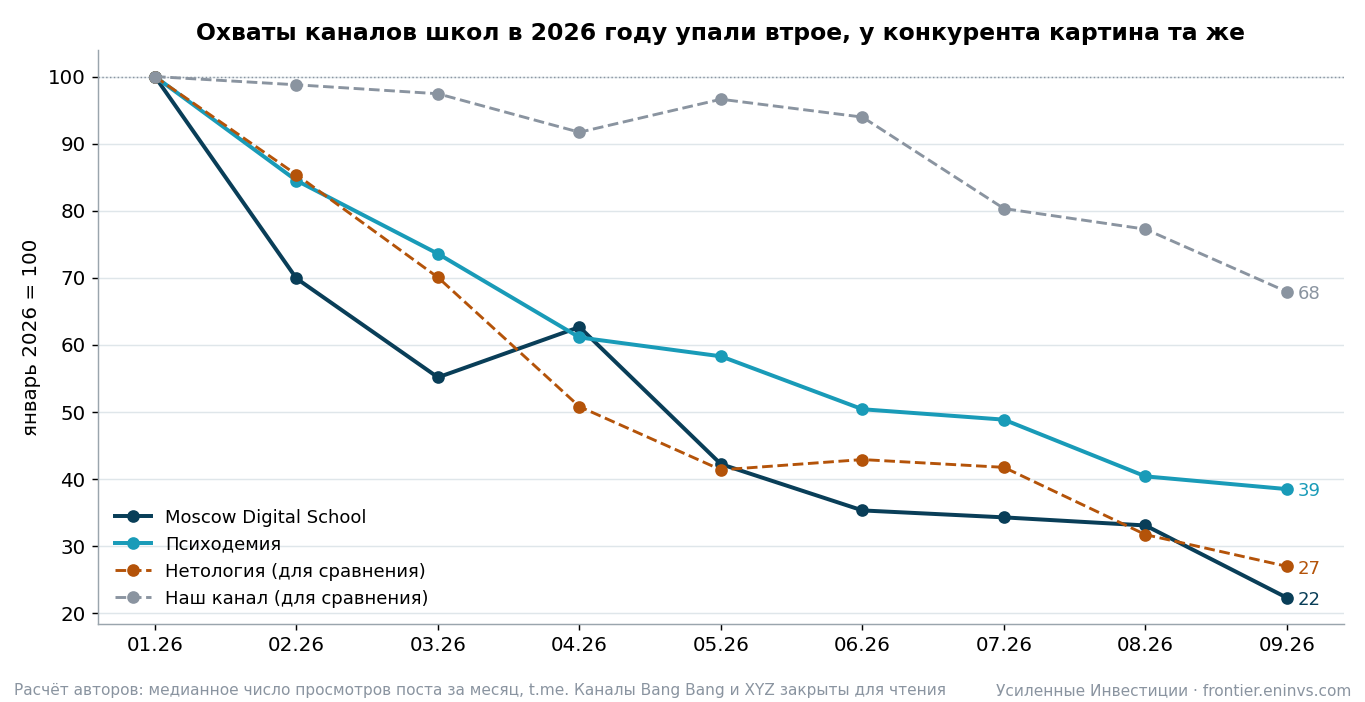
Authors' estimate. Part of the decline is common to the platform: over the same nine months the reach of the Enhanced Investments channel fell by 32%. But the schools lost 60-78%, that is, three times faster. Netology, which is not part of the group and is taken for comparison, fell by 73%. This looks like a problem of the whole adult online education segment, not of one company. For the bondholder the difference is small: the group's revenue depends on the same flow, which is shrinking.
Authors' assumption. Post views are not sales, and the schools have other acquisition channels. But over nine months in a row, at both schools that could be measured, the trend is the same. We are waiting for the 2026 reporting to check it against revenue.
After bank instalment fees, the 2025 operating result is a loss of RUB 140mn
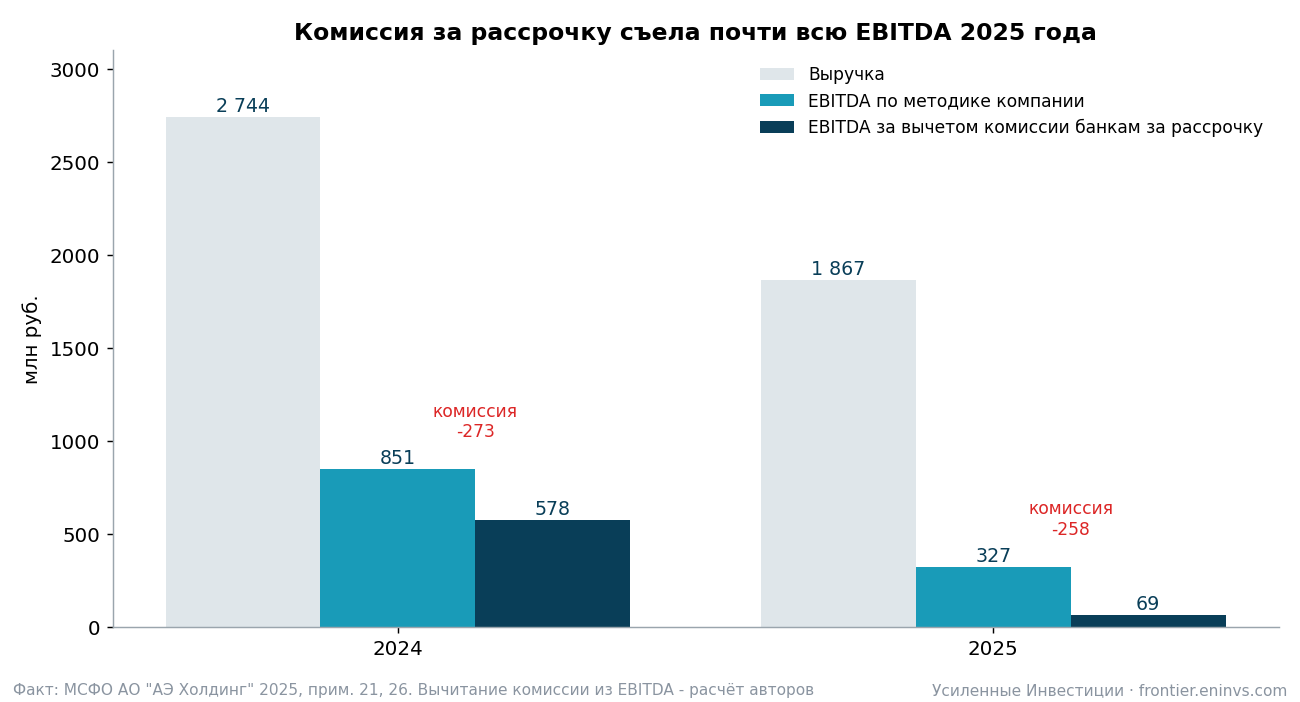
Fact (consolidated IFRS of AE Holding JSC, the issuer's owner, for 2025). Revenue of RUB 1,867mn versus RUB 2,744mn a year earlier. Recorded courses brought RUB 1,448mn (-23%), webinars and online classes RUB 409mn (-52%). Operating profit was RUB 118mn versus RUB 671mn, and the net loss RUB 180mn versus a profit of RUB 366mn. EBITDA by the company's definition was RUB 327mn.
Fact. Finance costs of the group, below operating profit, include an "instalment payment fee": RUB 258mn in 2025 (14% of revenue) and RUB 273mn in 2024. Interest on debt within the same finance costs is only RUB 77mn. The company's definition adds all finance costs back to EBITDA, including this fee. Online schools usually sell courses on instalment through partner banks: the bank immediately transfers the course price to the school net of its fee.
Authors' estimate. The instalment fee rises and falls with sales and in substance is a selling expense. If it is deducted, 2025 operating profit turns into a loss of RUB 140mn, and EBITDA into RUB 69mn. For comparison, the bond coupons cost RUB 118.5mn a year. In 2024 the same adjustment left RUB 578mn, and then there was a cushion.
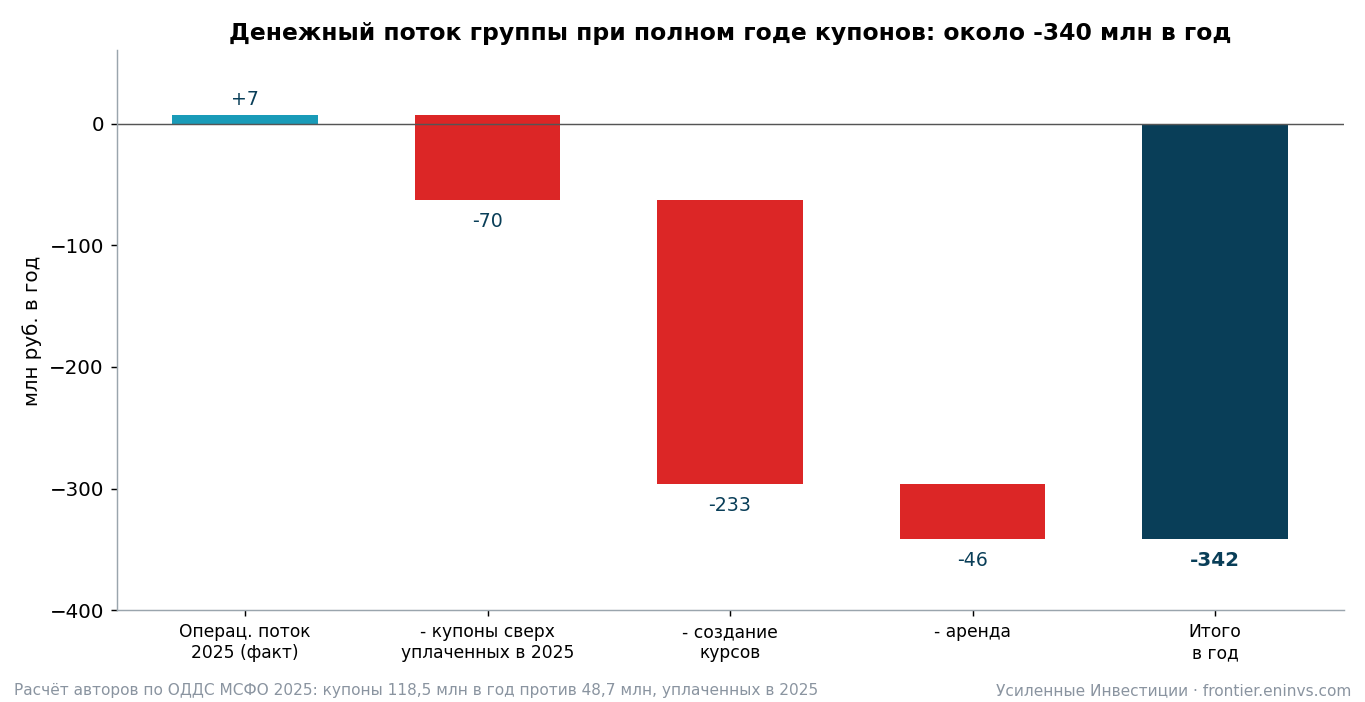
Operating cash flow of +RUB 6.9mn exists, but without course spending and without seven coupons out of twelve
Fact. Net cash from operating activities in 2025 was plus RUB 6.9mn (plus RUB 223mn in 2024). The instalment fee is already included. Of the coupons, only RUB 48.7mn made it in: the issue was placed on 30 July, and five payments took place in 2025. Separately, in the investing section, the group spent RUB 233mn on intangible assets, of which RUB 197mn on content, that is, on the courses themselves. Another RUB 45.5mn went on office rent.
Authors' estimate. With a full year of coupons (RUB 118.5mn) and the same spending on courses and rent, the group is short by about RUB 340mn a year. Amortisation of courses in 2025 was RUB 135mn; without new investment the product becomes obsolete. If development is cut in half, the deficit is still about RUB 225mn a year. Customer prepayments are also falling. Contract liabilities declined from RUB 198mn to RUB 146mn, which means customers are buying less in advance.
The bond proceeds went to buying out stakes in the schools from their co-owners
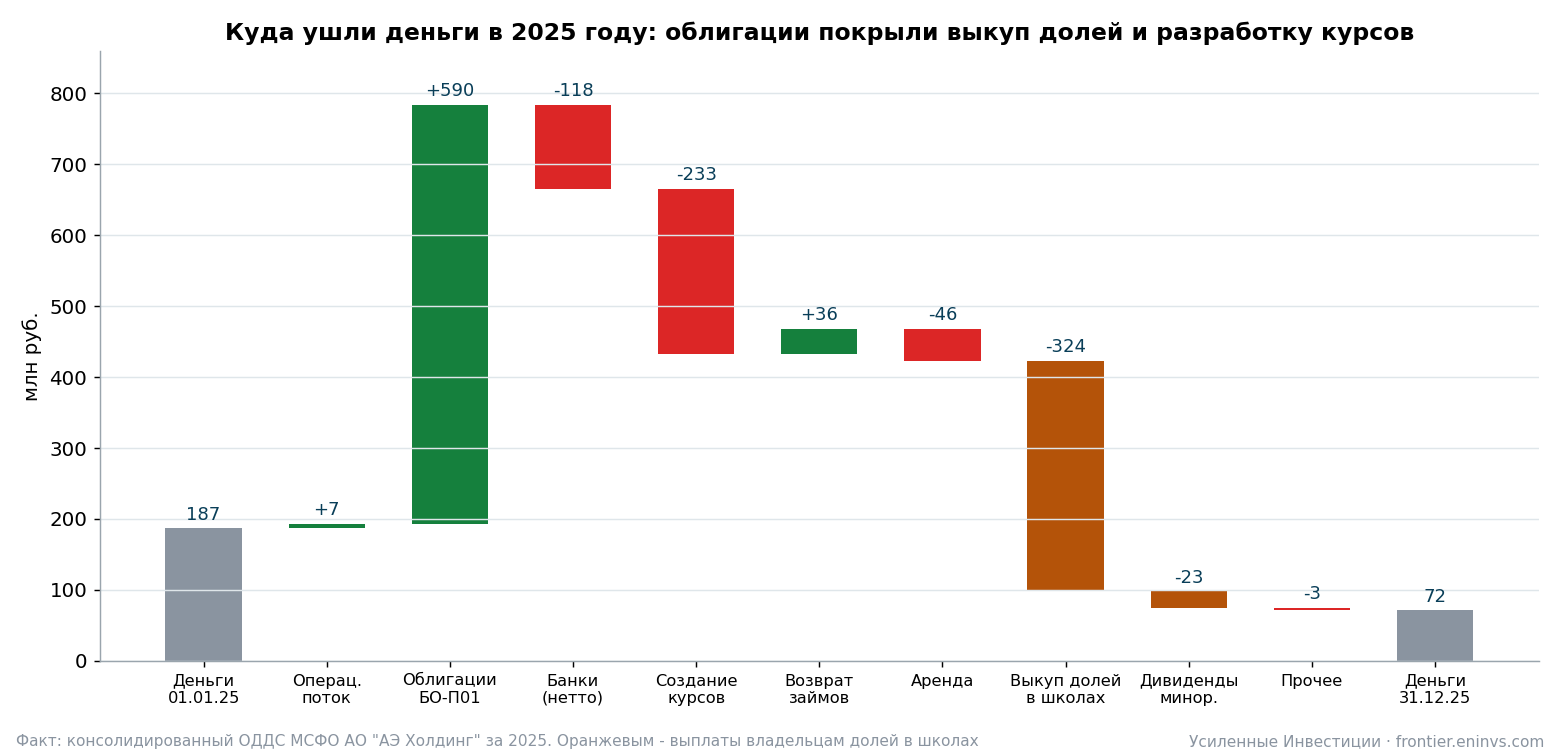
Fact. The bonds brought RUB 590mn net. In the same July 2025 the group paid RUB 304mn of deferred debt for stakes in subsidiary schools bought in 2024 (the cash flow statement shows RUB 324.5mn for the year on this line). Co-owners of Fashion Factory were paid RUB 23.4mn in dividends, even though the group ended the year with a loss. Bank loans were repaid by RUB 118mn net. Over the year cash fell from RUB 187mn to RUB 72mn. The buyout continues: in March 2026 the group bought 18% of Fashion Factory for RUB 11mn and signed options on the remaining 18% for another RUB 11mn, exercisable from 4 May.
Authors' estimate. Of the RUB 600mn of borrowed money, more than half went to the owners of stakes in the schools. These payments create no new cash flows from which the bonds could be repaid.
The issuer as of 30 June 2026: RUB 102 thousand in accounts, coupons paid with new loans
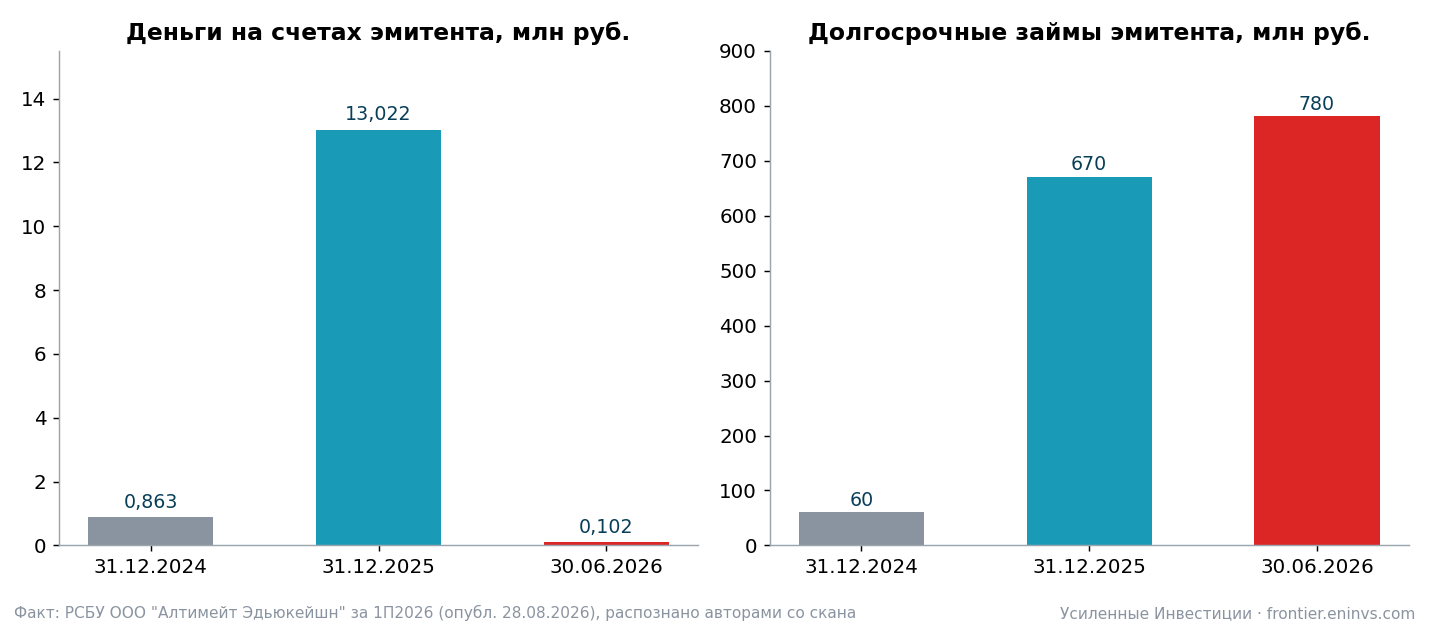
Fact. The bonds were issued by Ultimate Education LLC, a management company 100% owned by AE Holding JSC. The schools operate through subsidiaries. The bonds are unsecured: there are no guarantees from the schools or the holding. According to the issuer's RAS for the first half of 2026, cash in accounts was RUB 102 thousand versus RUB 13.0mn at the start of the year. Long-term loans rose from RUB 670mn to RUB 780mn: RUB 115mn of new loans were received, with the lender not named in the statements. Over the half-year the issuer paid RUB 59mn of interest (six coupons) and extended RUB 57mn of loans to other companies. The issuer's own revenue is RUB 6.5mn, with a loss of RUB 45.6mn.
Authors' estimate. There are no consolidated group statements for the half-year in the disclosures, and the issuer's RAS says little about the schools' business. But it does show what pays the coupons: in the first half of 2026 they were paid with borrowed money.
Behind the bond stand the schools' brands: 88% of the group's assets are goodwill and intangibles
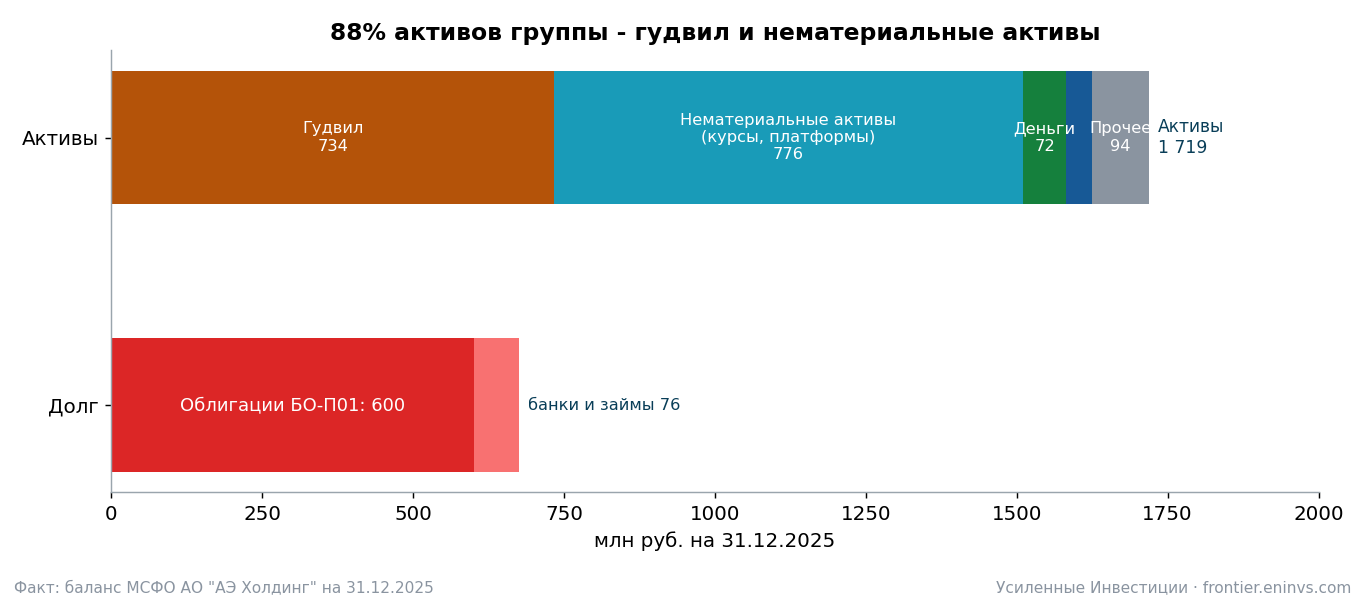
Fact. The group's assets at 31 December 2025 were RUB 1,719mn. Of these, goodwill is RUB 734mn and intangible assets RUB 776mn (courses, platforms, digital assets), cash RUB 72mn, receivables RUB 43mn. Equity is RUB 796mn, but net of goodwill and intangible assets it is negative, minus RUB 714mn. The company identified no impairment indicators. Debt consists of RUB 600mn of bonds and RUB 76mn of loans and borrowings.
Authors' assumption. The value of an online school rests on its team, course authors and advertising. In a restructuring it is unlikely to be sold at book value, and money would reach the bondholders of the management company only after the creditors of the schools themselves. In practice, in high-yield bond defaults prices fell to 11-15% of par (Anterra) and to 40-46% (L-Start, where the technical default was cured within a week).
Debt metrics: from 2.1x to 9.8x depending on what counts as EBITDA
Authors' estimate. The group's debt including leases rose from RUB 216mn to RUB 676mn in a year. On EBITDA as the company calculates it, this is 2.1x (net debt 1.85x), which is quite moderate. On EBITDA after deducting bank instalment fees it is 9.8x (net debt 8.8x). The difference between these two figures is the main dispute about this bond.
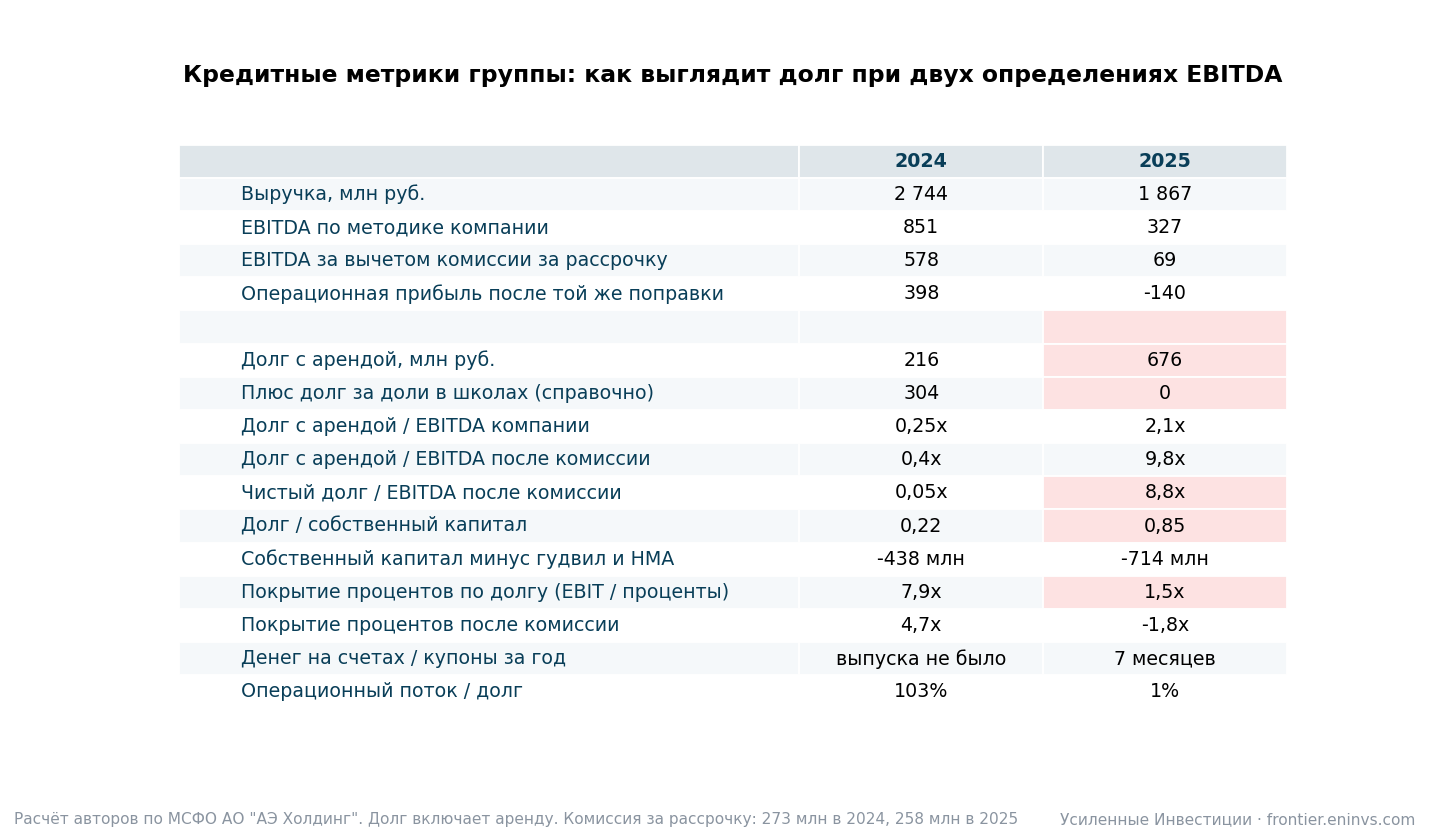
Authors' estimate. Other metrics: debt to equity is 0.85 versus 0.22 a year earlier. Equity net of goodwill and intangibles is negative, minus RUB 714mn. Operating-profit interest coverage is 1.5x, and if the instalment fee is treated as a selling expense, minus 1.8x. Operating cash flow covers 1% of debt. Cash in accounts at the end of 2025 was enough for 7 months of coupons, but it sits in the schools, while the bonds are paid by the management company.
Fact. The statements themselves contain two inconsistencies. In the capital management table for 2024 the line "loans, borrowings and leases" is shown as RUB 520.6mn, although per the balance sheet it is RUB 216.4mn: the difference is exactly RUB 304.2mn, meaning the debt for stakes in schools is counted both within the line and as a separate line below. In the note on non-controlling interests, the net assets of six of the seven schools at 31 December 2025 matched last year's to the ruble, although each school had a profit or loss over the year. This does not affect credit conclusions, but it shows how careful the disclosure is.
The adult online education market is flat, while the company is losing share
Fact (Smart Ranking, 1Q2026). Revenue of the hundred largest EdTech companies grew by 10.2%, but almost all of the growth (73%) came from children's education, which added 20.8%. Continuing professional education, where the Ultimate Education schools operate, grew by 1.4%. Market participants attribute this to cautious buyers and the difficulty of instalment plans, and Telegram restrictions forced advertising to move to other channels. For 2025 as a whole the market grew by 12%, while Ultimate Education's revenue fell by 32%.
Fact. In December 2025 the founder Pavel Moseykin left the post of CEO, remaining a co-owner and a board member. The company announced IPO plans for 2026-2027 in 2024, and in 2025 shareholders had already registered pre-IPO shares for RUB 500mn.
Taxes and courts: no arrears, an unqualified auditor opinion, a rating under negative outlook
- Federal Tax Service. According to open data as of 25 August 2026, the issuer has no arrears, penalties or fines, and the company is active.
- Audit. The consolidated IFRS for 2025 was audited by FBK, with an unqualified opinion.
- Rating. ACRA: BBB(RU), outlook "negative" since 7 October 2025. The annual review is expected before 7 October 2026.
- Courts. We could not check the arbitration case file, and this item remains open.
Red flags: three of eight on our scale, and both heavy ones are present
We count the signs that distinguished defaulted issues from the rest in our study of the segment. Here is how the issuer looks against this list.
- Debt grows faster than revenue – yes. Debt including leases tripled, from RUB 216mn to RUB 676mn, while revenue fell by a third.
- Interest coverage below 1.5 – yes. Exactly 1.5 on operating profit, and minus 1.8 if the instalment fee is treated as a selling expense.
- Cash below quarterly interest – yes, at the issuer level. At the end of 2025 the group had RUB 72mn against RUB 19mn of quarterly interest, while the issuer, which actually pays on the bonds, had RUB 102 thousand left on 30 June 2026.
- Negative operating cash flow – no for the group, yes for the issuer. The group earned plus RUB 6.9mn, the issuer spent RUB 65mn.
- Equity below 10% of assets – no. Equity is RUB 796mn against assets of RUB 1,719mn, which is 46%. But net of goodwill and intangibles it is negative.
- Paper profit with negative cash flow – no. The group has a loss, not a paper profit.
- Three years in a row of profit with no cash – no. In 2024 cash flow was plus RUB 223mn.
- Heavy receivables – no. Receivables are RUB 43mn; customers pay immediately or through a bank.
Authors' estimate. Three signs out of eight, and the two most telling in our sample of defaults are present. Four things that are not on the formal list are added to them. Goodwill and intangibles make up 88% of the balance sheet. The company has not recognised goodwill impairment anywhere, although the MIIN school, which accounts for RUB 313mn of the RUB 734mn of goodwill, saw revenue fall by 45% over the year. The issuer has two unremedied disclosure violations according to the Moscow Exchange. And the 2026 coupons were paid with borrowed money, not the schools' money.
Authors' assessment. On our scale this is a yellow zone leaning red: a payment delay is far off and payments are being made, but the source of payments is not the business. We call it the red zone when there is already nothing to pay with; here there is nothing to pay with from operations, but for now there is someone to lend.
The arguments of Manka Abligatsiya and what the statements show about them
The channel's author bought the bond at an average price of 64% and listed his reasons. We give them in order, the paraphrase is ours.
- "Operating cash flow was positive in 2025". True, plus RUB 6.9mn. But it includes 5 coupons out of 12 and excludes RUB 233mn spent on creating courses. With a full year of coupons and the same spending, the group burns about RUB 340mn a year beyond what it earns.
- "It pays the coupons and most likely will keep paying". For the coming months we agree: the 23 September coupon costs RUB 9.7mn. But in the first half the coupons were paid from new loans, and the issuer had RUB 102 thousand in cash on 30 June. There are 23 coupons left until maturity, worth RUB 224mn.
- "There are no large payments until July 2028". True by the schedule. But in July 2028 RUB 600mn is needed, and borrowing it at a yield above 50% is economically impossible. Repayment depends on whether the owners provide the money.
- "Margin of safety: in a technical default the price would fall to 30%, I will exit there". The 30% level remains an assumption. The group has about RUB 115mn of tangible assets (cash and receivables) against RUB 676mn of debt. In real high-yield defaults quotes went to 11-15% as well, and buyers on the way out can be few.
- "The issuer's RAS is not relevant". For assessing the schools' business that is so. But the bond is the debt of precisely this legal entity, with no guarantees, and its statements show where the money for coupons comes from.
In one thing the author is definitely right: what is happening in the group in 2026 is not publicly known, as there are no consolidated figures for the half-year. The bet is built on that uncertainty.
At a price of 71% the market prices roughly equal odds of repayment and default
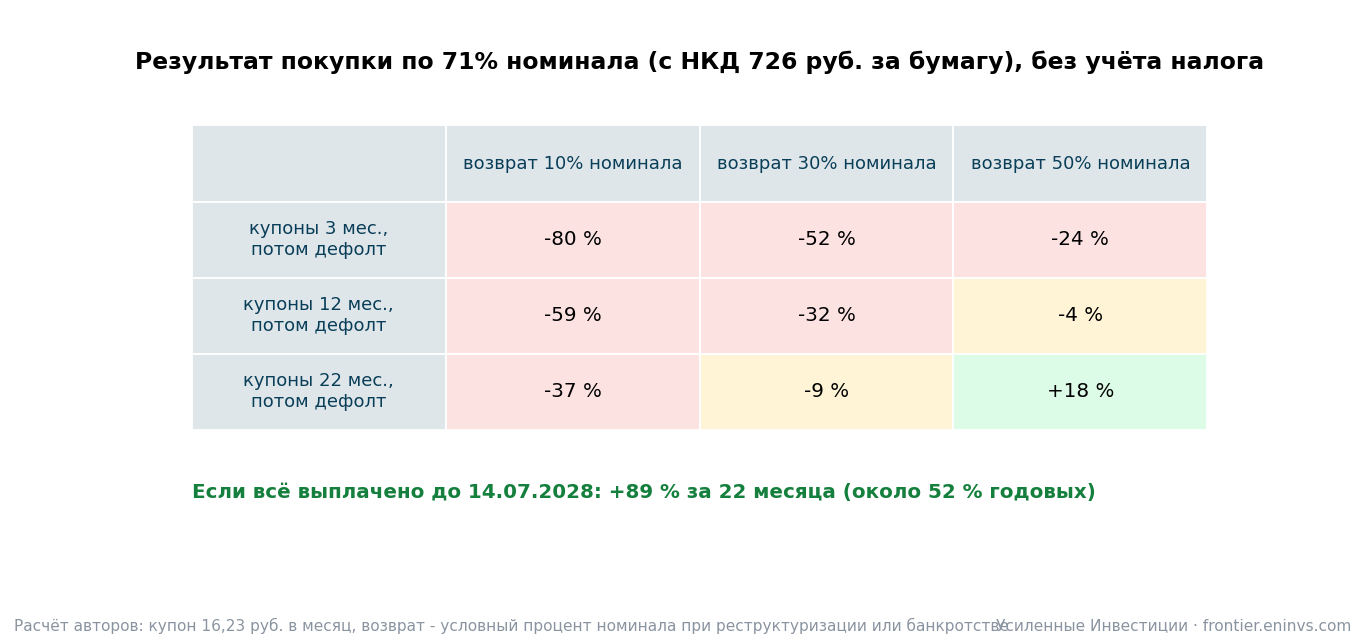
Authors' estimate. Buying at 71% with accrued coupon costs RUB 726 per bond. If the company pays everything by 14 July 2028, the holder receives RUB 1,373, that is, +89% over 22 months, about 52% a year. If a default occurs in a year and recovery is 30% of par, the result is minus 32%. To break even, even with all coupons paid except the last, a recovery of at least 37% of par is needed.
Authors' estimate. A spread to OFZ of about 38 pp with an assumed 30% recovery corresponds to a default probability of about 40% a year and about 50% by the maturity date. The estimate is rough; it shows the order of magnitude, not an exact number.
What could change the picture
- Owners' money. In 2024 the shareholders invested RUB 540mn in the group through the pre-IPO. If they inject capital or buy back part of the issue, repayment risk drops sharply.
- Consolidated figures for 2026. Stabilising revenue and cutting course spending without losing sales would show whether the business has a floor.
- ACRA's decision before 7 October. A downgrade would narrow the circle of buyers of the bond; affirmation would support the quote.
- The nearest coupons. 23 September and 23 October, RUB 9.7mn each. A delay even of a few days would be a signal that the loans have run out.
Conclusion and our view: we are not buying, and the bond becomes interesting closer to 50% of par
Conclusion. The business does not earn enough for its own coupons. After bank instalment fees and course spending, the group spends about RUB 340mn a year more than it receives. The bond money went not into development but into buying out stakes in the schools. The issuer approached summer 2026 with RUB 102 thousand in accounts and paid the half-year coupons with new loans of RUB 115mn. All seven schools shrank in 2025, and the reach of their channels in 2026 has fallen threefold. Repayment of the RUB 600mn in July 2028 depends on whether the owners provide money.
What we do. We are not entering the issue with new money and we are not taking the bond for ourselves at 71% of par. This is not a default forecast: the nearest coupons will most likely arrive. It is a refusal to pay 71% for the right to find out whether shareholders will agree with creditors in 2028.
Authors' estimate – at what price the picture changes. If we take as the base case a restructuring with a recovery of 30% of par, then a purchase breaks even at a price of about 64% of par if coupons are paid for two years, and about 48% if coupons are paid for one year. At a price of 50% of par, full repayment would give about +166%, while the scenario of one year of coupons with a 30% recovery would give minus 4%. We consider such a ratio acceptable for a speculative position; today's is not.
What to watch. The coupons of 23 September and 23 October, RUB 9.7mn each. ACRA's decision on the BBB(RU) rating with a negative outlook, expected before 7 October. The group's 2026 reporting and signs that course spending has been cut without losing sales. Any shareholder money: a capital contribution or a buyback of part of the issue from the market changes the picture sharply, because in 2024 they already invested RUB 540mn through the pre-IPO.
Correction to the 4 September review: intangible assets and equity of the group were given there with an error in order of magnitude (5.6 and 8.7bn rubles). The correct figures are 0.78 and 0.80bn; the old article has been corrected.
Sources and caveats
- Consolidated IFRS of AE Holding JSC for 2025 with FBK's audit opinion (published 30.04.2026): statements of profit and loss and of cash flows, notes 1, 8, 13-17, 21, 23, 25-26, 28.
- RAS of Ultimate Education LLC for 1H2026 (published 28.08.2026, scan, figures recognised by the authors).
- MOEX quotes and turnover (TQCB mode) through 18.09.2026, MOEX OFZ zero-coupon yield curve at 18.09.2026.
- ACRA, issuer card and press release of 07.10.2025. Smart Ranking, EdTech ranking for 1Q2026 and the agency's channel news.
- Open data of the Federal Tax Service (tax arrears at 25.08.2026). Post of the channel "Manka Abligatsiya" of 17.09.2026.
Other issuer reviews and weekly analysis are on the Telegram channel Enhanced Investments @eninv; extended cards for all issuers are on the portal.
See also: market overview · valuation map · stock screeners