X5 2Q2026 results: how much of the December dividend is actually left
On 13 August X5 (PJSC Corporate Center IKS 5) published IFRS results for 1H2026. Revenue grew 9.9% year on year, net profit fell 28.9% in 2Q, and net debt rose by RUB 82 bn over the half-year. On the day of the release the shares lost 3.4%.
The main question for a shareholder is the interim dividend, which the supervisory board traditionally recommends in November and the shareholders' meeting approves in December. Below is a review of the report and a calculation of how much is left for this dividend under the company's own formula. The material was prepared by Enhanced Investments from primary data: the issuer's press releases, the dividend history on the X5 website and Moscow Exchange quotes.
Revenue growth is half what it was two quarters ago, and EBITDA stopped growing in 2Q for the first time
2Q revenue was RUB 1,289.9 bn (+9.9% YoY), and RUB 2,480.5 bn for the half-year (+10.5%). This reflects like-for-like sales growth of 4.2% and selling space growth of 6.9%. LFL traffic turned positive in all three chains (+1.1% Pyaterochka, +1.6% Perekrestok, +2.0% Chizhik), but the average ticket (+3.0%) is still the main contributor.
The problem is not the top line but what happens below it. Gross margin even improved, to 23.8% from 23.6% a year earlier, thanks to lower product losses. But selling and administrative costs (excluding depreciation and LTI) rose to 18.4% of revenue from 17.4%, an increase of 102 basis points over the year. As a result:
- adjusted EBITDA before IFRS 16 was RUB 77.0 bn, −2.4% YoY, with a margin of 6.0% against 6.7%;
- EBITDA was RUB 74.3 bn (+2.0%), with a margin of 5.8% against 6.2%;
- operating profit was RUB 44.9 bn, −3.7%, while revenue grew almost 10%.
Cost growth by item: staff excluding LTI +37 bp (8.6% of revenue, described as "a higher pay level for front-line staff relative to the market"), utilities +16 bp, delivery +19 bp (online is growing faster than offline and pulls logistics along), third-party services +9 bp, other +29 bp. Separately, management's long-term incentive costs were RUB 2.8 bn for the quarter, +35.3% YoY.
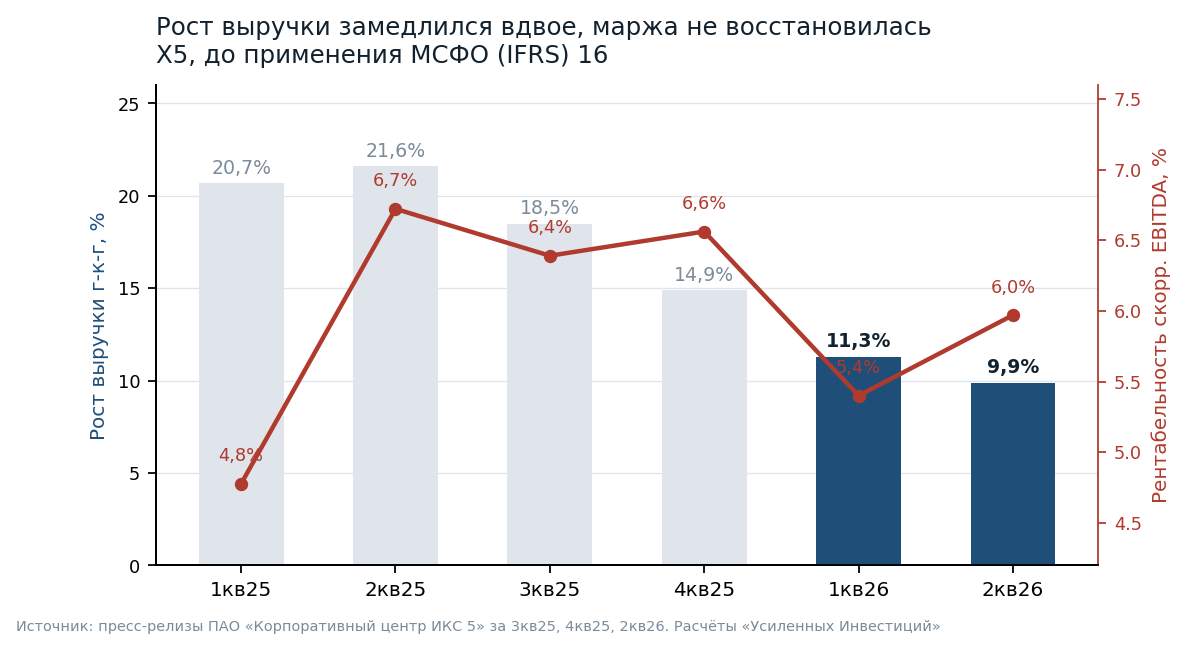
For comparison: at the Investor Day in March 2025 X5 presented a strategy to 2028 with average annual revenue growth of 17–18% and a target margin of about 7%. The actual 9.9% and 6.0% are half the stated growth rate and a percentage point short on margin. The company still plans to open more than 2,000 stores in 2026.
Profit fell 29% not because of operations but because interest income disappeared
Net profit in 2Q before IFRS 16 was RUB 21.2 bn against RUB 29.8 bn a year earlier. On full reporting including leases the fall is even deeper: RUB 16.4 bn against RUB 26.0 bn, down 37.0%.
Operating profit fell by only 3.7%. Two lines account for the rest of the decline. The first is net finance costs: RUB 14.5 bn against RUB 6.1 bn, a 2.3-fold rise. A key detail from the press release: interest expense itself fell 5.0% as rates came down, and finance costs rose "mainly due to lower finance income accrued on short-term financial investments and deposits". Put simply, the company has run out of the cash cushion it used to earn interest on.
The second is tax: the effective rate for the half-year rose to 28.3% from 25.7%.
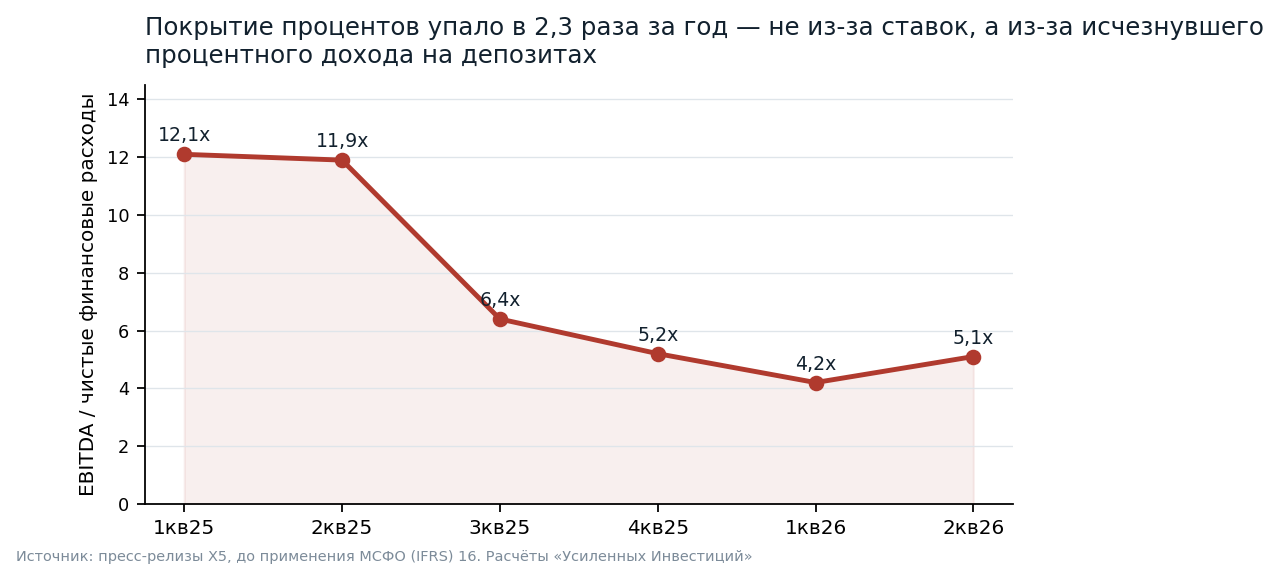
Interest coverage was 5.1x in 2Q against 11.9x a year earlier. For a retailer rated AAA(RU) (affirmed by ACRA in June 2026) this is not critical, but the trend is one-directional: over the last twelve months the ratio is 5.1x, against about 12x a year ago.
Net debt rose by RUB 82 bn in six months and hit the dividend formula
This is the central figure of the report for a dividend investor. As of 30 June 2026:
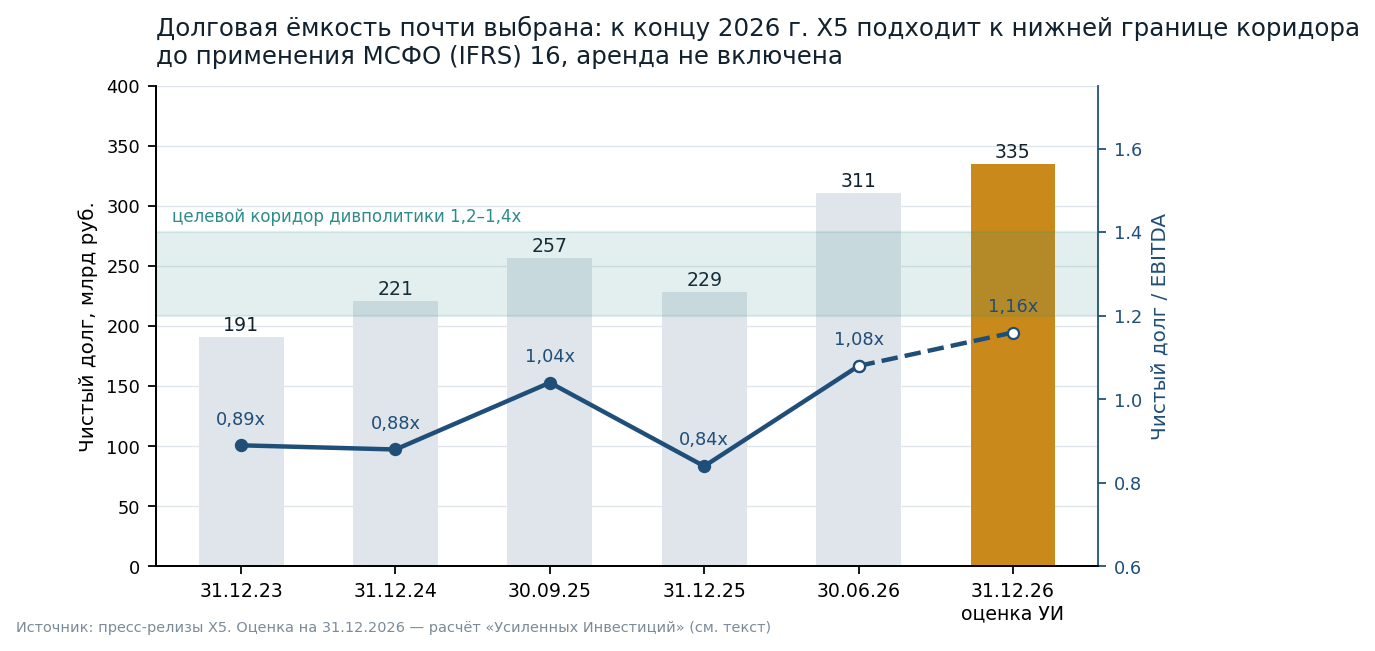
- net debt was RUB 310.6 bn against RUB 228.5 bn at 31 December 2025;
- net debt / EBITDA was 1.08x against 0.84x at the end of 2025;
- gross debt was RUB 435.9 bn, of which short-term RUB 127.3 bn (29.2%), all of it in roubles;
- lease liabilities were RUB 743.0 bn, and including them net debt / EBITDA is 2.27x;
- undrawn credit lines were RUB 804.6 bn.
The company has liquidity. The constraint is not the banks but its own dividend policy. It works like this: payments are made twice a year (for the past year and for 9 months), and the supervisory board sets the amount based on the volume of free cash flow, with a target consolidated net debt / EBITDA ratio at the end of the year in which the payment is planned of not less than 1.2x and not more than 1.4x.
The simple consequence: the higher the debt at the time of the decision, the less is left for the dividend. In six months X5 has used up about a quarter of its annual dividend capacity.
In 2025 the company paid RUB 150 bn in dividends with free cash flow of about zero
This is the key to understanding where the debt growth came from. We use the company's own adjusted figures before IFRS 16:
- 2024: operating cash flow RUB 190.2 bn, investment RUB 161.2 bn, free cash flow +RUB 29.0 bn, no dividends paid (restrictions applied until the redomiciliation was completed);
- 2025: operating cash flow RUB 218.8 bn, investment RUB 224.7 bn, free cash flow −RUB 5.9 bn. In August 2025 RUB 158.8 bn of dividends for 2024 was paid;
- 1H2026: operating cash flow RUB 109.0 bn, investment RUB 96.6 bn, free cash flow +RUB 12.4 bn. In January RUB 90.2 bn was paid, and in July another RUB 60.3 bn.
The gap was closed through the balance sheet: in 2025 gross debt rose from RUB 288.8 bn to RUB 407.0 bn, and the cushion of short-term financial investments accumulated before the "move" was spent. It is precisely the disappearance of that cushion that zeroed out the interest income and caused the profit decline in 2Q2026.
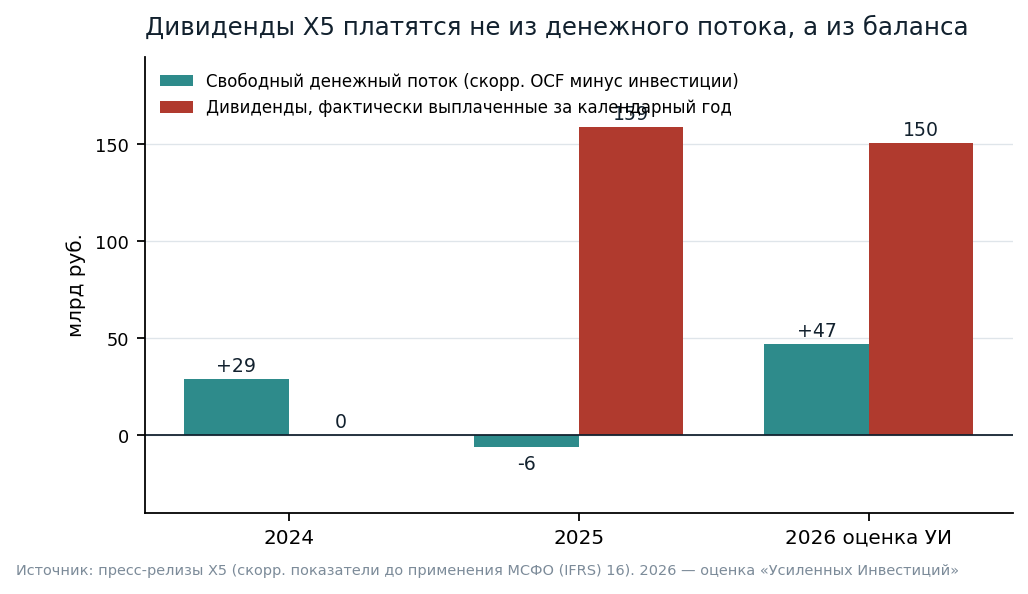
In other words, the 2025–2026 dividends are not a distribution of what was earned in the period but a normalisation of the capital structure: a company with almost no debt is bringing leverage up to the target 1.2–1.4x. Such a source is finite by definition, and it is almost exhausted.
How the supervisory board calculates the dividend: reconstructing the RUB 613 decision for 2025
Two payments were declared for 2025: RUB 368 for 9 months (supervisory board recommendation on 13 November 2025, extraordinary shareholders' meeting on 18 December, record date 6 January 2026, RUB 90.2 bn in total) and RUB 245 final (annual meeting on 26 June 2026, record date 7 July, RUB 60.3 bn in total). That makes RUB 613 per share, RUB 150.5 bn.
We check them against the balance sheet at the end of 2025. Net debt was RUB 228.5 bn and 2025 EBITDA was RUB 273.1 bn. We add the debt and all dividends declared for the year and divide by EBITDA:
(228.5 + 150.5) / 273.1 = 1.388x, which is exactly the upper bound of the 1.2–1.4x corridor.
Working backwards: 1.4 × 273.1 − 228.5 = RUB 153.8 bn, or RUB 627.6 per share against the actual RUB 613. The error is 2.3%. The match is too precise to be accidental: the board distributes exactly the amount that brings the leverage of the past reporting year to 1.4x.
An important technical detail for converting roubles to billions. The dividend is not accrued on all 271,572,872 shares. According to the company's own disclosure, the RUB 245 payment totalled RUB 60,269,252,750, which means it applied to 245,996,950 shares: about 25.6 mn shares (9.4% of share capital) do not receive the payment. So one rouble of dividend costs the company not RUB 272 mn but RUB 246 mn.
Bridge to 31 December 2026: net debt of about RUB 335 bn
To apply the same formula to the December decision, two figures are needed: net debt at the end of 2026 and 2026 EBITDA.
Net debt
- RUB 310.6 bn: actual at 30 June 2026;
- +RUB 60.3 bn: the final dividend for 2025, paid after the 7 July record date, that is, already in 3Q;
- −RUB 35 bn: estimated free cash flow in 2H. Benchmark: 2H2025 was +RUB 31.3 bn, 4Q is traditionally strong for food retail working capital, and the company is cutting investment in distribution centres and opening fewer stores, but paying noticeably more in interest and taxes;
- total of about RUB 335 bn. A reasonable range is RUB 320–350 bn.
A cross-check from the other side: RUB 228.5 bn at the end of 2025 plus RUB 150.5 bn of dividends paid in 2026, minus about RUB 47 bn of free cash flow for the whole of 2026, gives RUB 332 bn. The two independent estimates agree.
EBITDA
For 1H2026 it was RUB 136.7 bn (+11.3%), but all of the growth came from 1Q: in 2Q adjusted EBITDA already fell 2.4%. In 2H2025 it was RUB 150.4 bn, and 4Q2025 itself was abnormally strong (+48.6% YoY on a weak 2024 base), so the base for 4Q2026 is tough. Scenarios for 2H2026: 145 / 152 / 160 bn, which gives 2026 EBITDA of RUB 282 / 289 / 297 bn.
With base-case EBITDA of RUB 289 bn and net debt of RUB 335 bn, leverage at the end of 2026 would be about 1.16x, still below the lower bound of the target corridor. Formally there is room for a payment, but not much.
How much is left for December: RUB 100–170 in the base case
Annual dividend capacity = target ratio × 2026 EBITDA − net debt at 31 December 2026. We take the December tranche as 60% of the annual amount, which is exactly the proportion in which the board split the payments for 2025 (368 out of 613).
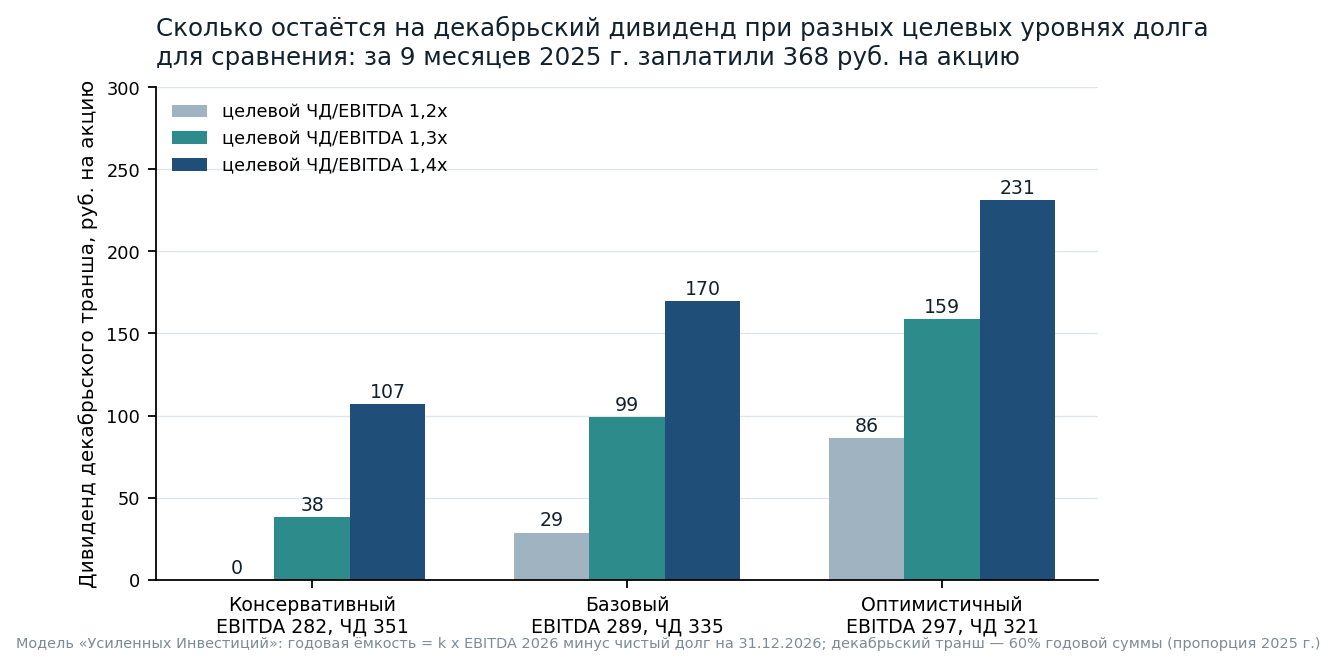
The result:
- Base case (EBITDA RUB 289 bn, debt RUB 335 bn): at a 1.2x target RUB 29, at 1.3x RUB 99, at 1.4x RUB 170 per share;
- Optimistic (EBITDA RUB 297 bn, debt RUB 321 bn): RUB 86 / 159 / 231;
- Conservative (EBITDA RUB 282 bn, debt RUB 351 bn): RUB 0 / 38 / 107.
Our central estimate is RUB 100–170 per share, with a midpoint of about RUB 140. At a price of RUB 2,043 (Moscow Exchange, 14 August) this is a yield of 5–8%, against 12.2% on last year's December dividend (RUB 368 on the closing price of RUB 3,027.5 on 5 January, the last day to buy before the record date).
External reference points: after the report Market Power gives RUB 100–150, and the asset manager DOHOD assumes RUB 74.3 in its model with a record date of 6 January 2027. Our range lies between these estimates, closer to the upper one.
Where the calculation can be wrong, in both directions
The scenario above rests on empirics: the supervisory board behaves as if it targets 1.4x on the balance sheet of the year just ended. There is a literal reading of the policy that gives a different answer.
The policy refers to the ratio at the end of the year in which the payment is planned. The December 2026 decision concerns money that will go out in January 2027, so the target becomes leverage at 31 December 2027. This adds one more year of EBITDA and one more year of free cash flow: with 2027 EBITDA of about RUB 306 bn and free cash flow of about RUB 55 bn, the capacity for the entire 2026 reporting year rises to RUB 350–600 per share, and the December tranche to RUB 210–360.
Why we do not take this as the base case: the same logic applied to November 2025 allowed RUB 780–1,020 to be declared for 2025, and the board declared RUB 613. In practice the board pays substantially less than the literal ceiling of the policy. But the upper scenario cannot be fully ruled out.
There is also a serious counterargument in the other direction. In November 2025 the analyst consensus was about RUB 265, and the board recommended RUB 368, 39% higher. The board has a history of decisions in favour of shareholders, and the 60/40 assumption in favour of December may not hold: at the results presentation it was said that the two payments of a calendar year are planned to be roughly equal in size.
What pushes the estimate up
- a strong 4Q on working capital: in 4Q2025 the release gave RUB 31.8 bn;
- further capex cuts: 1H2026 investment is already 7.3% below last year's;
- lower rates make debt cheaper to service: interest expense in 2Q already fell 5.0%;
- the fate of the 9.4% stake that does not receive dividends: any transaction with it changes the payout arithmetic.
What pushes the estimate down
- adjusted EBITDA fell in absolute terms in 2Q: the first such quarter in reporting since the "move";
- staff and utility costs are growing faster than revenue, so operating leverage is negative;
- the tough 4Q2025 base (EBITDA margin of 6.4%);
- the company itself notes in its reporting higher risks in logistics operations in 1H2026;
- the effective tax rate is 28.3% against 25.7% a year earlier.
The company's position after the report: Maria Yazeva, head of investor relations, said that no cut in payments is expected, that the dividend policy is based on net cash flow and that the company's internal expectations for its volume have not changed. Management did not give specific figures.
Calendar: decision in November, meeting in December, cash in January
Last year's cycle, which is a sensible basis for expectations:
- 27 October 2025: 3Q results;
- 13 November 2025: the supervisory board recommended RUB 368 for 9 months;
- 18 December 2025: the extraordinary shareholders' meeting approved the payment;
- 5 January 2026: the last day to buy the share for the dividend (T+1 mode);
- 6 January 2026: register closes; cash arrives within 25 business days.
Hence the expectations for 2026: 3Q results at the end of October, supervisory board recommendation in mid-November, meeting in mid-December, record date in early January 2027. The "December" dividend physically reaches the account in late January or February and falls into next year's tax base, which matters for those planning their tax result for the year.
How the market priced in past record dates: on 6 January 2026 the share opened with a gap down of RUB 302 on a dividend of RUB 368 (it priced in 82% of the payment), and on 7 July 2026 the gap was RUB 248 on a dividend of RUB 245, so the payment was fully priced in.
What this means for a shareholder
The share costs RUB 2,043 (Moscow Exchange, 14 August; an independent check from the broker terminal gives RUB 2,050), with a 52-week range of RUB 1,766–3,050 and −32.6% year to date. Trailing twelve-month multiples: P/E about 6.8x, EV/EBITDA before IFRS 16 about 3.0x, and about 3.5x including lease liabilities. This is cheap by the historical standards of the sector.
But the company no longer has the means to pay a 12–13% dividend yield as in the last two payments, at least until free cash flow sustainably exceeds RUB 100 bn a year. The logic of the latest payments was one-off: bringing almost zero debt up to the target level. That work is three-quarters done.
The practical conclusion: expect about RUB 100–170 per share in December (yield 5–8%) as the base outcome, keep in mind the risk of a more modest payment if 4Q is weak, and the possibility of a positive surprise if the supervisory board again decides to go to the upper bound of the corridor. Key data for refining the estimate will come at the end of October with the 3Q results: look first of all at net debt at 30 September and the trend in adjusted EBITDA.
Tickers
X5, Magnit. Extended issuer cards are on our portal frontier.eninvs.com.
Summary
The X5 report for 2Q2026 is operationally neutral and financially unpleasant: revenue is growing at half the pace of the strategy, adjusted EBITDA fell in absolute terms for the first time, and profit dropped 29% because interest income disappeared. For the dividend something else matters more: net debt rose by RUB 82 bn in six months and brought leverage to 1.08x against a target corridor of 1.2–1.4x.
By the formula that precisely explains the supervisory board's decision last year, about RUB 100–170 per share is left for the December payment, three to four times less than last year's RUB 368. That is still a 5–8% yield, but the era of double-digit X5 dividends is ending together with the stock of debt capacity.
For weekly analytics, see the Telegram channel Enhanced Investments.
See also: market overview · valuation map · stock screeners