Yandex 3Q26: guidance withdrawn, strike damage will land in 4Q, and net debt excluding Fintech money rose to RUB 209 bn
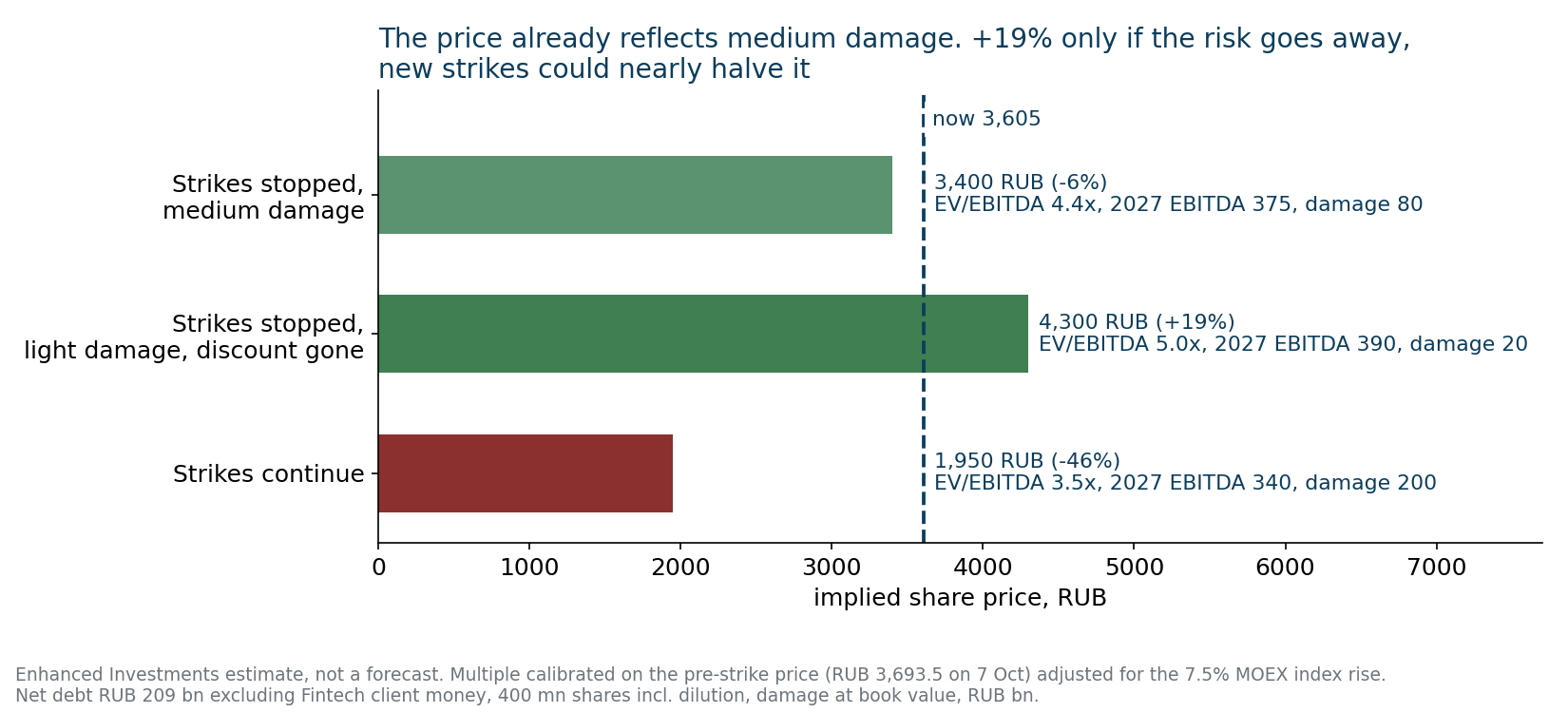
Verdict: neutral. Yandex went through the third quarter before the strikes on its data centres, and the quarter was steady: revenue of RUB 410.6 bn (+12% year-on-year), adjusted EBITDA of RUB 87.8 bn (+12%), a 21.4% margin. The real news is elsewhere: the company withdrew its 2026 guidance and did not disclose the damage. We estimate the strikes will take about RUB 10 bn off fourth-quarter EBITDA, and the server write-off may push the quarter's IFRS net income into a loss. At RUB 3,605 the share trades close to our base case (RUB 3,400): a 19% upside requires the risk of new strikes to go away, while a continued series could cost the stock almost half its value.
Yandex published its third-quarter results on 29 October. The drone strikes on the data centres in Sasovo, Kaluga and Vladimir on 8-11 October happened after the reporting date, so they are not in the quarter's numbers. The company mentioned them in the subsequent-events section: part of the infrastructure was damaged, the consequences are still being assessed, and all services have been restored in their key functions. Our earlier review of these events is [here](https://telegra.ph/Yandex-Data-Centers-Oct-2026-10-11).
Since 7 October, the last day before the strikes, the shares have fallen 2.4%, from RUB 3,693.5 to RUB 3,605 (morning of 29 October). The MOEX index rose 7.5% over the same period. The underperformance amounts to 9 pp, or RUB 144 bn of market capitalisation. In absolute terms the stock lost RUB 35 bn.
A quarter before the strikes: growth slowed for the third quarter in a row
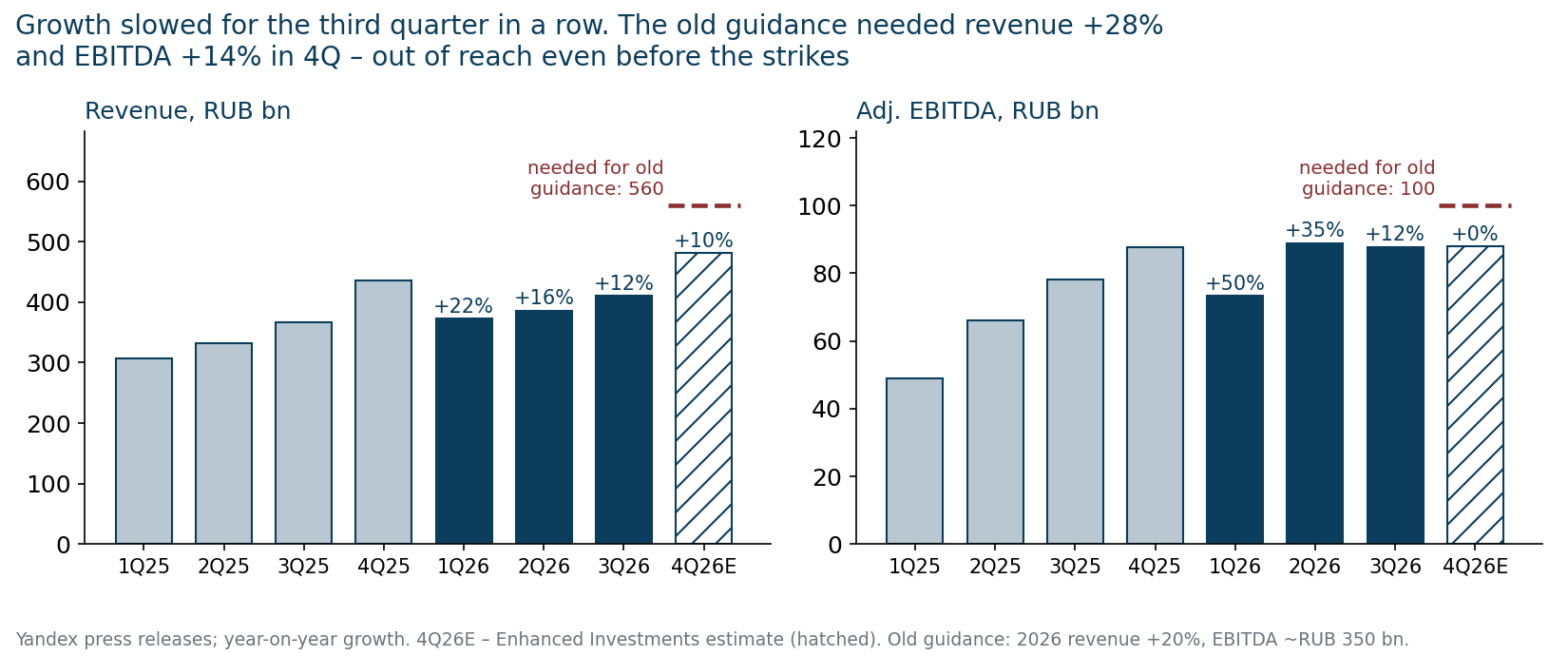
Yandex's revenue growth has been slowing since the start of the year. It was 22% in the first quarter, 16% in the second and 12% in the third. Adjusted EBITDA (operating profit before depreciation; Yandex also excludes share-based compensation) grew 50%, 35% and 12%. Much of this is a base effect: margins rose sharply in 2025, and the comparison is now against a high level.
| Metric, RUB bn | 3Q26 | 3Q25 | Change | 9M26 | Change |
|---|---|---|---|---|---|
| Revenue | 410.6 | 366.1 | +12% | 1,169.6 | +16% |
| Adj. EBITDA | 87.8 | 78.1 | +12% | 250.0 | +30% |
| Adj. EBITDA margin | 21.4% | 21.3% | +0.1 pp | 21.4% | +2.2 pp |
| IFRS net income | 42.5 | 34.6 | +23% | 135.9 | +239% |
| Adj. net income | 45.9 | 44.7 | +2% | 128.1 | +46% |
| Capex | 54.6 | 39.7 | +38% | 114.6 | +32% |
Nine-month net income rose 3.4 times, but RUB 25.7 bn of it came from the one-off gain on the sale of Auto.ru in June. Third-quarter adjusted net income grew only 2%: income tax rose from RUB 6.3 bn to RUB 14.6 bn, and the company excludes a RUB 5.6 bn FX gain from adjusted profit.
Advertising, ride-hailing and Market slowed; Fintech, Plus and the cloud grew faster
Advertising and promotion turnover, Yandex's main source of profit, grew 9% to RUB 136 bn. In the second quarter it was +12%. The company blames a difficult macro backdrop and cautious budgets of small and medium businesses. Revenue of the whole Search and AI block rose only 4%: smart-device sales fell (the company links this to logistics being rebuilt after the attacks on marketplace warehouses), classifieds weakened, and Auto.ru left the perimeter. Even so, the block's EBITDA grew 7% to RUB 67.3 bn, with a 46.5% margin.
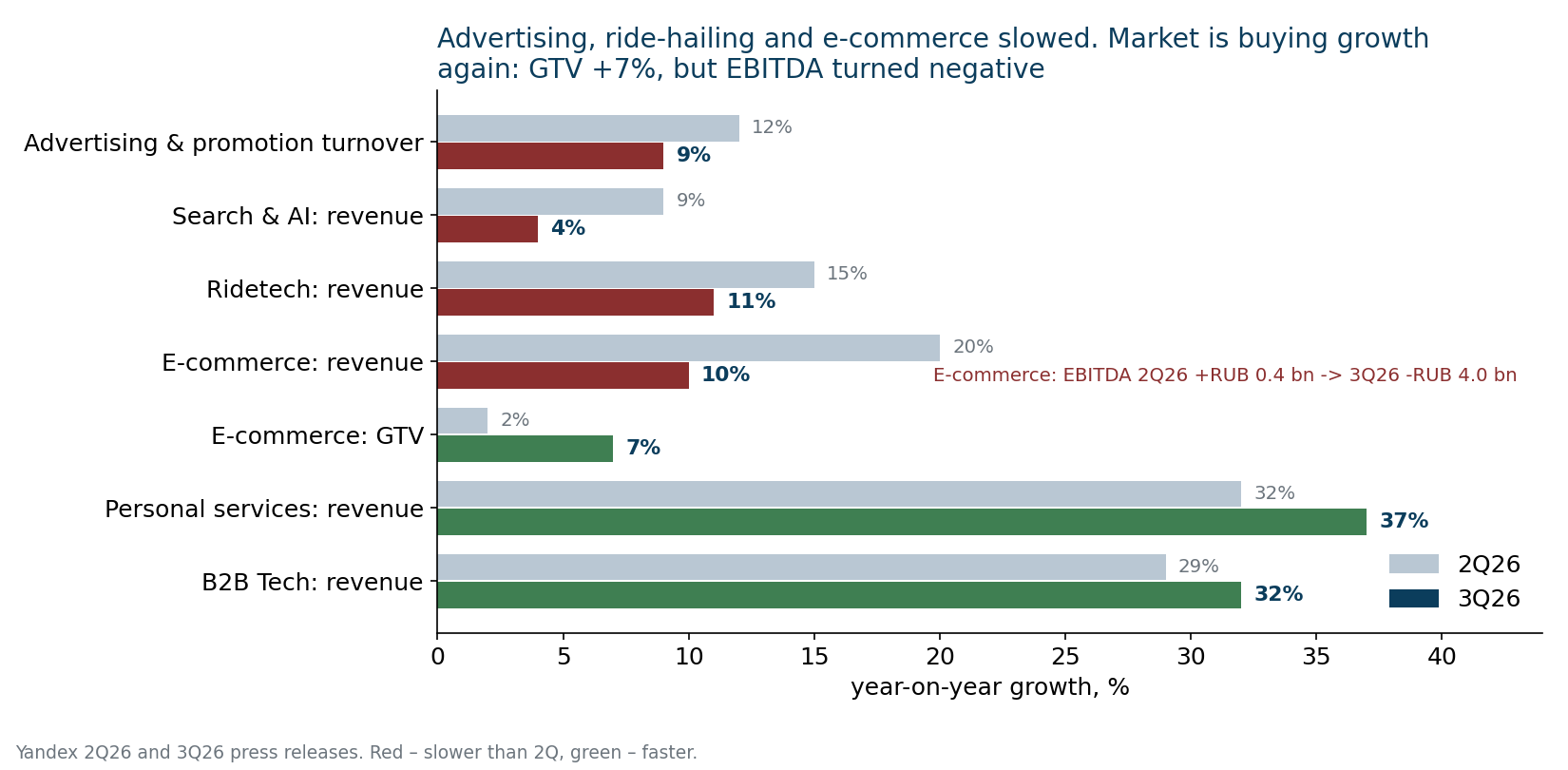
The most visible change came in e-commerce. In the second quarter Market, Lavka and Eats reached a small positive EBITDA for the first time (+RUB 0.4 bn) while turnover (GTV, the value of all goods sold) grew only 2%. In the third quarter GTV growth accelerated to +7%, and EBITDA went negative again, at -RUB 4.0 bn. The growth is being bought with discounts and promotions. The company keeps its target of sustainable breakeven for the business next year.
Ridetech (taxi, car-sharing, scooters) remains the main profit source of City Services. Its EBITDA grew 23% to RUB 35.2 bn, with a margin of 7.4% of GTV. But revenue growth slowed here too, from 15% to 11%.
The fastest growth comes from businesses that still earn almost no profit. Financial services revenue grew 49% (RUB 35.2 bn), Plus and entertainment services +36%, the cloud-based B2B Tech +32%. B2B Tech's margin rose to 31.7%, and consumption of AI-model tokens through the cloud increased 2.4 times quarter-on-quarter. These figures predate the strikes, and the cloud was hit hardest.
Guidance withdrawn, but the revenue target was out of reach even without the strikes
Until October Yandex guided for about 20% revenue growth in 2026 and adjusted EBITDA of about RUB 350 bn. The company has now withdrawn both targets. In its words, after the attacks "additional external factors emerged that make it difficult to assess" the results. It may resume guidance from next quarter.
The revenue target was unattainable even before the attacks. Nine-month revenue grew 16% to RUB 1,169.6 bn. To reach +20% for the year, the fourth quarter needed RUB 560 bn, or +28% year-on-year, against +12% in the third. The EBITDA target was more realistic: it needed RUB 100 bn in the fourth quarter, +14% year-on-year.
The strikes took that chance away. We estimate that without them fourth-quarter EBITDA would have been about RUB 98 bn (growth at the third-quarter pace, +12%). About RUB 10 bn of that will be lost:
- About RUB 4 bn is lost in the cloud: Yandex Cloud and Yandex 360 were free for existing customers from 8 to 31 October. B2B Tech revenue was RUB 5.5 bn a month in the third quarter, 24 days were free, and the costs stayed.
- RUB 2-3 bn was the cost of advertising, taxi, delivery and payment services outages on 8-13 October.
- About RUB 3 bn goes on renting capacity from other providers, the emergency migration and engineers' overtime.
- About RUB 0.5 bn goes on compensation to Fintech customers. This is the higher 20% rate on savings accounts from 11 to 17 October and waived late fees on Split.
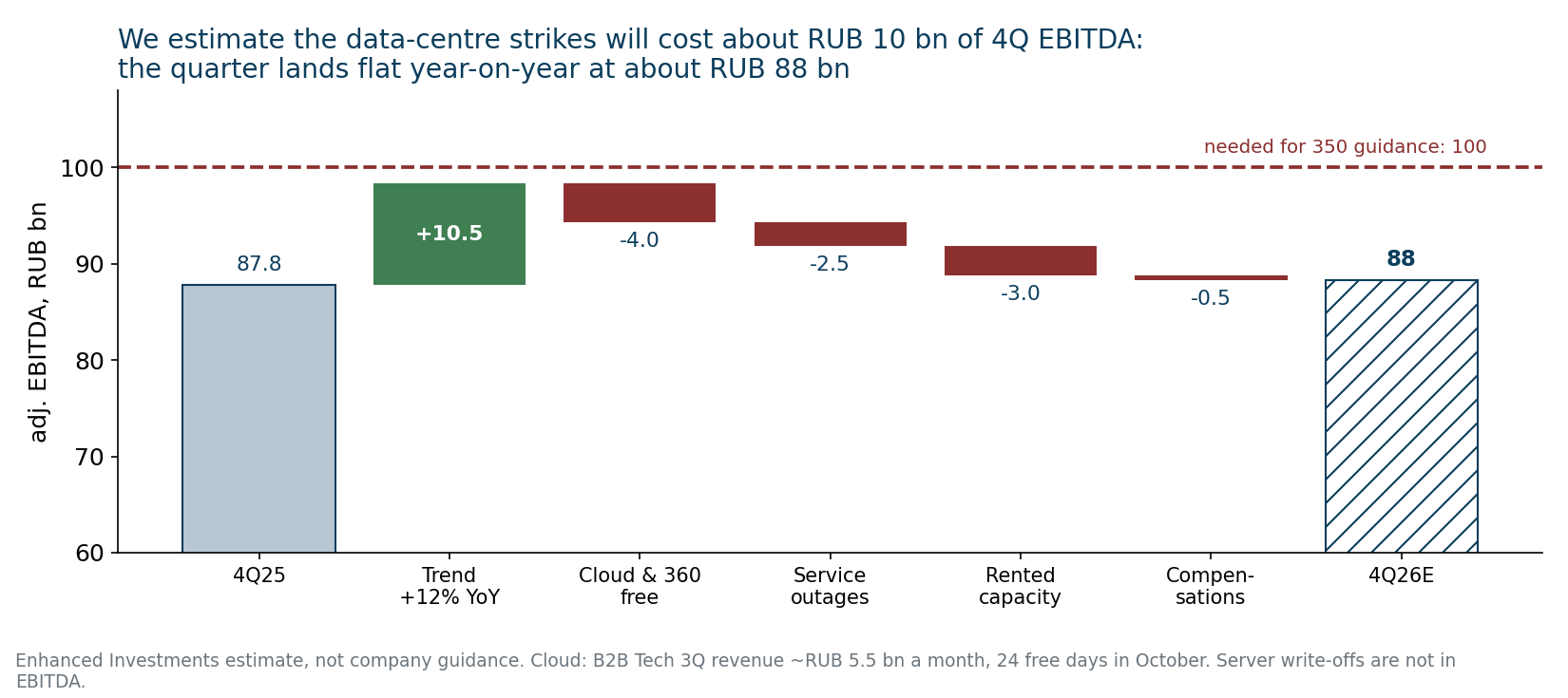
As a result, we expect the fourth quarter to deliver RUB 481 bn of revenue (+10%) and RUB 88 bn of EBITDA, flat year-on-year. For the full year that means RUB 1,650 bn of revenue (+15%) and RUB 338 bn of EBITDA versus the earlier 350. This is our estimate, not company guidance. For the share price 2027 matters more, and the uncertainty there is greater: according to the investor relations team (call on 13 October), next year's budget faces "deep adjustments".
The company did not name the damage. On the balance sheet it is RUB 20-110 bn, and it will hit the 4Q accounts
Yandex has still not disclosed the size of the damage or recovery timelines for the sites. Before the report, the company said two important things. On 26 October its press service stated that all three supercomputers were undamaged: they were moved out and are being redeployed at new sites. Earlier, Yandex called untrue a Vedomosti report that some data centres had been left without terrorism-risk insurance at the time of the attacks. The company did not specify which sites are covered or for how much. The supercomputers surviving makes the heavy damage case less likely. The report itself adds three new facts.
First, the company will not increase capex this year because it "invested in advance in reserve capacity and the purchase of necessary equipment". Third-quarter capex rose to RUB 54.6 bn, 13.3% of revenue versus 10.8% a year earlier. During the quarter inventories grew by RUB 12 bn, VAT receivable by RUB 12 bn and prepayments by RUB 7 bn. This is consistent with stockpiling equipment, although the report gives no breakdown. On 23 October Yandex Cloud opened a new availability zone in a different location to replace the damaged Vladimir one, with limited capacity at the first stage. The company has not reported the return of the Sasovo zone.
Second, property and equipment on the balance sheet grew to RUB 404 bn as of 30 September, RUB 73 bn more than at the start of the year. Most of it is servers and data-centre equipment. In our October review we estimated servers at about RUB 190 bn as of 30 June and allocated the damage in proportion to the capacity of the three sites (115 MW): RUB 20 bn in the light case, RUB 80 bn in the medium case, RUB 110 bn in the heavy case. The report gives no new data to narrow this range.
Third, the strikes happened in October, so the equipment write-off will appear in the fourth-quarter accounts. It is a non-cash expense and does not affect EBITDA, but it will reduce IFRS net income. Without the write-off we expect about RUB 45 bn of net income in the fourth quarter. After 25% tax, it would be about RUB 30 bn in the light case, a loss of about RUB 15 bn in the medium case and a loss of about RUB 38 bn in the heavy case. Yandex usually excludes one-off items from adjusted net income, as it did with the Auto.ru gain.
Replacement will need more cash than the book damage. Servers are carried at about half their original cost, and new ones are 25% or more expensive. If the company does not raise 2026 capex, replacement comes at the expense of new capacity, and the capex increase shifts to 2027. The distributed network of smaller protected sites the company talks about will, by its own account, be more expensive than the old model.
Net debt of RUB 1.6 bn includes Fintech client money. Without it net debt is RUB 209 bn and rose by RUB 49 bn in the quarter
Yandex reports adjusted net debt of RUB 1.6 bn, or 0.005x annual EBITDA. But the RUB 318 bn of cash on the balance sheet includes Fintech client funds. As of 30 September clients held RUB 434 bn in Yandex Pay and savings accounts, with RUB 166 bn of inflows over nine months. Part of this money has been lent out (RUB 158 bn) and invested in bonds (RUB 68 bn); the rest, about RUB 207 bn, sits in the group's cash. This money does not belong to shareholders.
We calculate symmetrically, as we do for Ozon: we subtract client funds net of loans and securities from cash. On that basis Yandex's net debt as of 30 September is RUB 209 bn, or 0.6x annual EBITDA. That is still low, and the balance sheet is not at risk. But this debt rose by RUB 49 bn in the third quarter.
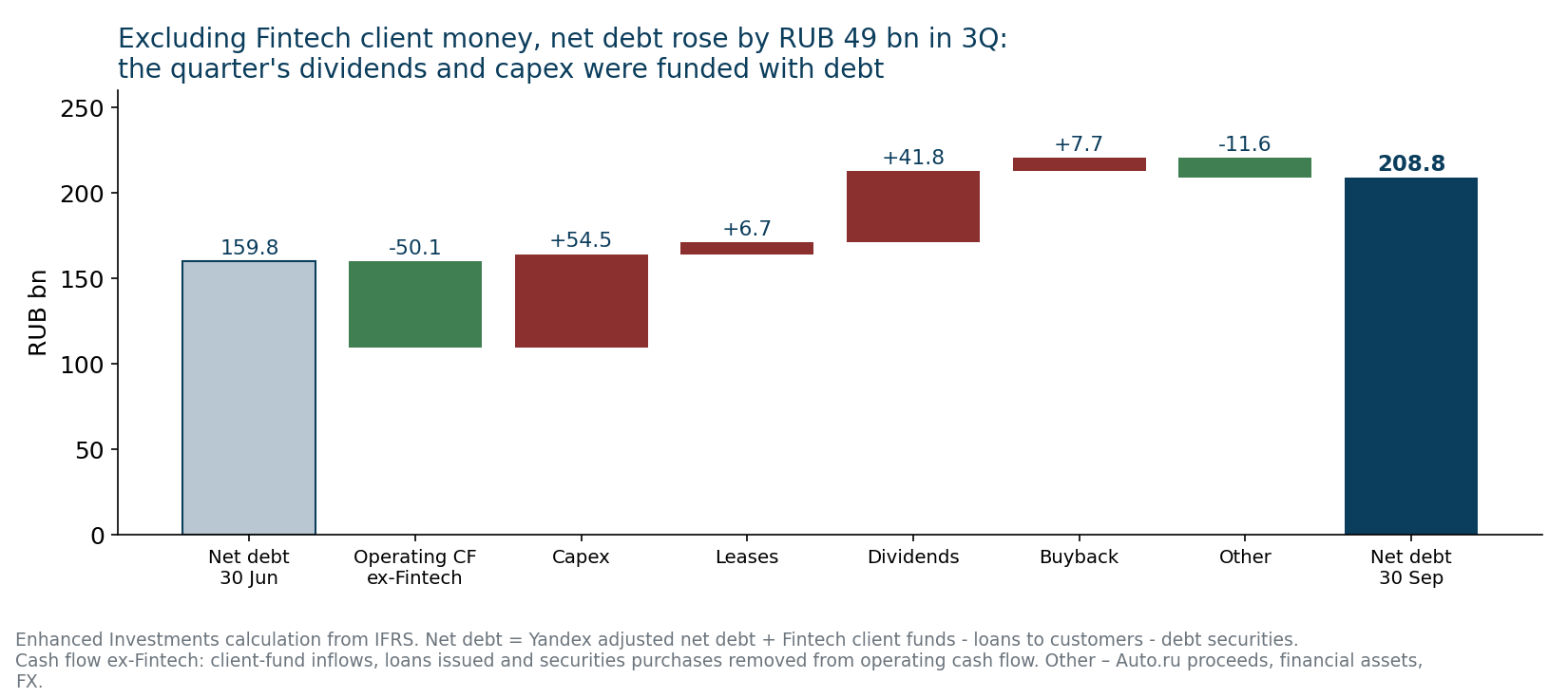
The cash flow shows why. Excluding client-fund inflows and loans issued, third-quarter operating cash flow was about RUB 50 bn. Capex took RUB 54.5 bn and leases RUB 6.7 bn, so free cash flow excluding Fintech was negative, at about -RUB 11 bn. Meanwhile shareholders received RUB 49.5 bn: RUB 41.8 bn of dividends for the first half (RUB 110 per share) and RUB 7.7 bn of buybacks. Over nine months free cash flow excluding Fintech was RUB 24 bn, while shareholder payouts were RUB 99 bn.
A separate point on dilution. The board approved the placement of 11 mn new shares in November, 2.8% of the share capital, for the employee incentive programme. This should cover needs at least until the end of 2027. Buybacks since July amounted to 2.1 mn shares (0.53%), which partly offsets the dilution. The diluted share count used for EPS is 398 mn, 5% above the basic count.
For dividends this means the following. The decision on the payout for the second half of 2026 will be made in spring. On the 13 October call the company said plainly that there is no dividend commitment, and the split of cash between capex, dividends and buybacks will be decided anew. Paying RUB 110 twice a year (a 6.1% annual yield at the current price) with negative free cash flow and rising capex is possible only with debt. We factor in the risk of a lower payout.
Valuation: the price already reflects medium damage
At RUB 3,605 Yandex's market capitalisation is RUB 1,421 bn. With net debt excluding Fintech client money, enterprise value (EV) is RUB 1,630 bn, or 4.8x last-12-month adjusted EBITDA (RUB 338 bn). Adjusted EBITDA excludes share-based compensation, although the company buys shares for the programme with cash. Treating these RUB 37 bn a year as an expense raises the multiple to 5.4x. Subtracting capex (RUB 174 bn over 12 months) from EBITDA gives 9.9x.
| Multiple | Value |
|---|---|
| EV / LTM adj. EBITDA | 4.8x |
| EV / (adj. EBITDA - share-based compensation) | 5.4x |
| EV / (adj. EBITDA - capex) | 9.9x |
| EV / our 2027 adj. EBITDA estimate | 4.3x |
| Net debt ex-Fintech client money / EBITDA | 0.6x |
This is how we built the scenarios. Before the strikes, on 7 October, the market valued Yandex at about 4.1x the EBITDA one could expect for 2027 based on company guidance (about RUB 395 bn, our assumption). The MOEX index has risen 7.5% since then, so the base case uses 4.4x. We then subtract RUB 209 bn of net debt and the book damage and divide by 400 mn shares including dilution.
| Scenario | EV/EBITDA | 2027 EBITDA, RUB bn | Damage, RUB bn | Price, RUB | vs current |
|---|---|---|---|---|---|
| Strikes stopped, medium damage (50%) | 4.4x | 375 | 80 | 3,400 | -6% |
| Strikes stopped, light damage, risk discount gone (30%) | 5.0x | 390 | 20 | 4,300 | +19% |
| Strikes continue (20%) | 3.5x | 340 | 200 | 1,950 | -46% |
In the base case we take 2027 EBITDA at RUB 375 bn. That is RUB 338 bn in 2026, plus 12% organic growth, plus about RUB 10 bn from e-commerce reaching breakeven, minus about RUB 13 bn for more expensive distributed infrastructure and protection. The probability-weighted price is about RUB 3,380, 6% below the current level. Using the company's net debt definition, the values would be about RUB 130 higher. The conclusion does not change: the current price is close to the base case.
Relative to the index, the market has taken about RUB 144 bn off Yandex. In our base case the losses are larger: RUB 80 bn of book damage, about RUB 90 bn from lower 2027 EBITDA and RUB 49 bn of debt growth in the third quarter. So the price leaves almost no safety margin against new strikes.
We will decide based on five signals
On 9 October we cut Yandex's weight in our model portfolios by 2-4 times at about RUB 3,400. At the time we wrote that we would restore the weight if there were no new attacks within a month and the guidance held. The first condition is being met so far: there have been no new strikes on Yandex sites since 11 October. The second is not: the guidance was withdrawn. From here we watch five things:
- New strikes or protection measures. On 14 October a Sber data centre in the Saratov region was attacked, so the threat applies to the whole industry. Government decisions on protecting data centres, mentioned by the Minister of Digital Development, would allow an earlier move to the upside scenario.
- Disclosure of the damage. We expect the company to state the write-off amount, the insurance recovery and recovery timelines for the sites. This may come on the 29 October call or in the fourth-quarter report.
- Cloud recovery. The Sasovo zone and the capacity of the new zone replacing Vladimir will show how many cloud customers have left for good. This also matters for the planned merger of Yandex B2B Tech with VK Tech.
- New guidance and the 2027 budget. How much the company adds to capex for equipment replacement and protection.
- The second-half dividend and dilution. The spring decision will show how the company splits cash between capex and shareholders.
If there are no new strikes before the fourth-quarter report and the company names damage within our medium case, the stock could move towards the upside scenario. If the strikes resume, the pessimistic scenario becomes closer to reality.
Sources: Yandex press releases for 4Q25, 1Q26, 2Q26 and 3Q26 (ir.yandex.ru), 3Q26 presentation and supplementary slides, call with Yandex IR on 13.10.2026, Yandex Cloud blog (23.10.2026), Kommersant (26.10.2026), Vedomosti, T-Zh, RBC, Habr, Moscow Exchange (prices as of 29.10.2026, 09:05 Moscow time).
Open the company's financial profile YDEX →
See also: market overview · valuation map · stock screeners